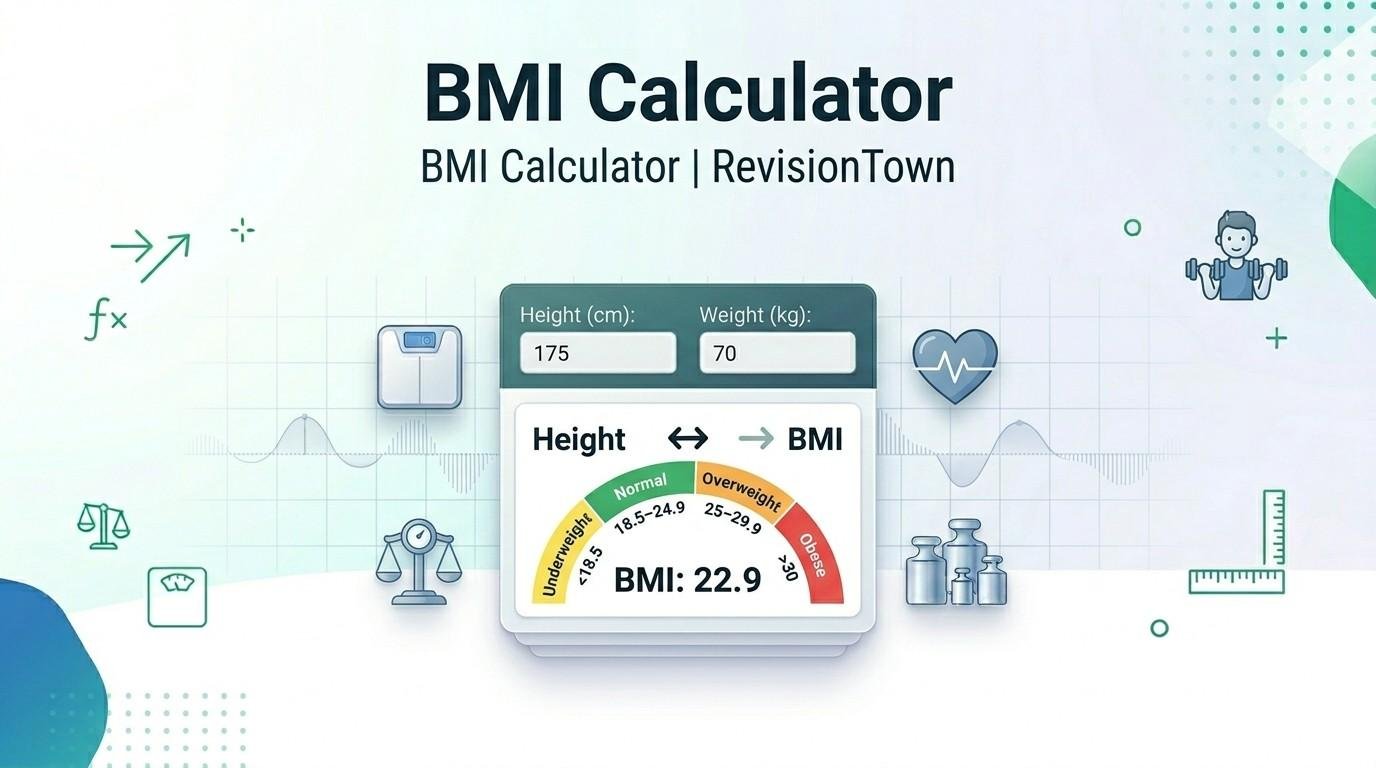
Adult BMI calculator
BMI Calculator
Calculate adult body mass index from height and weight, see the standard BMI category, estimate a healthy-weight range for your height, and learn how to interpret the result responsibly. BMI is a screening measure for adults, not a diagnosis; it is most useful when read alongside waist measurement, body composition, medical history, fitness level, and professional clinical judgment.
Calculate Your BMI
Choose metric or imperial inputs. The calculator uses adult BMI categories for people aged 20 and older. If the age entered is below 20, it still shows the BMI value, but it flags that children and teens need BMI-for-age percentile interpretation.
Results
BMI is a screening measure. Use it with other health information, not as a stand-alone diagnosis.
What This BMI Calculator Does
This BMI Calculator estimates body mass index from height and weight. It supports metric inputs in kilograms and centimeters, imperial inputs in pounds, feet, and inches, and a healthy-weight range calculator based on the adult BMI range commonly used for screening. The result helps adults understand where their weight-to-height ratio falls within standard categories: underweight, healthy weight, overweight, and obesity classes.
BMI is useful because it is simple, quick, and consistent. A person does not need specialized equipment to calculate it; height and weight are enough. That simplicity is also why BMI has limits. It cannot measure body fat percentage, muscle mass, bone density, pregnancy status, fluid changes, waist size, or metabolic health. For that reason, this page explains both the calculation and the interpretation so the number is used carefully.
If you want a broader set of health tools, the health and fitness calculators hub can help you find related calculators. To compare BMI with body composition, use the body fat percentage calculator or lean body mass calculator. For weight targets, compare this page with the ideal weight calculator. For unit conversions, use the height converter or weight converter.
BMI Formula
Body mass index is weight divided by height squared. In the metric system, the formula is:
If height is measured in centimeters, convert centimeters to meters first:
Therefore, a metric BMI calculation can also be written as:
In the imperial system, weight is measured in pounds and height is measured in inches. The formula uses the conversion factor 703:
For adults, the formula is the same for men and women. The calculator does not change the mathematical BMI based on sex. However, sex, age, ethnicity, muscle mass, fat distribution, and medical history can affect how a BMI result should be interpreted.
Metric BMI Example
Suppose an adult weighs 75 kilograms and is 180 centimeters tall. First convert height to meters:
Then square the height:
Now divide weight by height squared:
A BMI of 23.15 falls in the adult healthy weight category because it is at least 18.5 and below 25.
Imperial BMI Example
Suppose an adult weighs 165 pounds and is 5 feet 6 inches tall. First convert height to total inches:
Apply the imperial BMI formula:
A BMI of 26.63 falls in the adult overweight category because it is at least 25 and below 30. The result is a screening category, not a diagnosis of health status.
Adult BMI Categories
For adults aged 20 and older, standard BMI categories use fixed cutoffs. These categories are intended for screening and population-level comparison. They help identify whether a person may benefit from a more complete health assessment, but they do not determine health by themselves.
| BMI range | Adult category | How to read it |
|---|---|---|
| Below 18.5 | Underweight | May suggest low body weight for height and should be interpreted with nutrition status, symptoms, and medical history. |
| 18.5 to less than 25 | Healthy weight | Often associated with lower weight-related health risk, but fitness, nutrition, waist size, and health markers still matter. |
| 25 to less than 30 | Overweight | A screening flag for possible increased risk, especially when combined with high waist circumference or metabolic risk factors. |
| 30 to less than 35 | Obesity class 1 | Signals higher likelihood of weight-related risk and may warrant clinical discussion. |
| 35 to less than 40 | Obesity class 2 | Signals higher risk level and usually calls for individualized medical evaluation. |
| 40 and above | Obesity class 3 | Also called severe obesity in many clinical contexts; interpretation should be handled by a healthcare professional. |
These categories are helpful for adults, but they are not designed for children, teens, pregnancy, elite athletes, or every ethnic group equally. A BMI result should be read as a starting point for understanding weight relative to height, not the final word on health.
Healthy Weight Range from BMI
The healthy-weight range calculator reverses the BMI formula. Instead of using weight and height to find BMI, it uses height and the adult healthy BMI range to estimate a corresponding weight range. For adults, the common healthy BMI range is 18.5 to less than 25. This page uses 18.5 and 24.9 as practical endpoints for the displayed range.
For a height of 170 centimeters, height in meters is 1.70. The square is \(1.70^2=2.89\). The lower endpoint is \(18.5\times2.89=53.47\) kilograms. The upper endpoint is \(24.9\times2.89=71.96\) kilograms. The calculator rounds these values for readability.
A healthy-weight range is not a personal prescription. A person with more muscle may be healthy above the range. A person inside the range may still have high abdominal fat, poor fitness, or metabolic risk markers. Use the range as context, then compare it with body composition, waist measurement, energy needs, and professional advice when needed.
How to Interpret a BMI Result Responsibly
BMI is a screening measure. Screening means it can identify a category that may deserve attention; it does not diagnose disease, fitness, nutrition quality, or body composition. A BMI of 31 does not, by itself, explain blood pressure, blood sugar, cholesterol, strength, cardiorespiratory fitness, or eating pattern. A BMI of 22 does not guarantee those markers are healthy. The number is useful, but it is one piece of a larger picture.
For adults, BMI can be most useful when tracked over time with consistent measurements. If height is stable and weight changes, BMI changes in the same direction. A rising BMI may prompt a review of nutrition, activity, sleep, medication changes, stress, or medical conditions. A falling BMI may be intentional weight loss, but rapid or unexplained weight loss should be discussed with a healthcare professional.
Context matters. A strength athlete, a person recovering from illness, an older adult with muscle loss, a pregnant person, and a growing teenager can have the same BMI number but very different health meanings. If BMI is being used for a medical decision, employment requirement, sports requirement, or treatment plan, it should be combined with a qualified assessment rather than used alone.
BMI Limitations
Muscle and lean mass
BMI cannot distinguish fat mass from lean mass. A muscular person may have a BMI in the overweight range while carrying relatively low body fat. Conversely, a person with low muscle mass may have a BMI in the healthy range while still having higher body fat or lower metabolic fitness. This is why BMI and body composition are not the same thing.
Waist size and fat distribution
BMI does not show where body fat is stored. Abdominal fat is often more closely tied to cardiometabolic risk than fat stored elsewhere. Waist circumference, waist-to-height ratio, and waist-to-hip ratio can add useful context. If two adults have the same BMI but very different waist measurements, their risk profiles may differ.
Age and life stage
Older adults may face health concerns from low muscle mass even when BMI looks normal. Pregnancy changes weight and body composition in ways that make standard BMI interpretation inappropriate during pregnancy. Children and teens require age- and sex-specific percentile interpretation rather than adult BMI categories.
Ethnicity and individual risk
Some populations may experience metabolic risk at lower BMI values than the standard adult cutoffs suggest. Clinical guidelines may use additional measures or lower action points for certain groups. A single calculator cannot capture every individual risk factor, so BMI should be interpreted with medical history, family history, and clinical measurements.
Children and Teen BMI
The BMI formula is the same for children and teens, but interpretation is different. Adults use fixed BMI category cutoffs. Children and teens are still growing, and body composition changes with age and sex. For ages 2 through 19, BMI is usually interpreted as a BMI-for-age percentile compared with children of the same age and sex.
| BMI-for-age percentile | Category used for children and teens |
|---|---|
| Less than the 5th percentile | Underweight |
| 5th percentile to less than the 85th percentile | Healthy weight |
| 85th percentile to less than the 95th percentile | Overweight |
| 95th percentile or greater | Obesity |
Parents and caregivers should avoid using adult BMI categories to judge a child or teenager. Growth charts, puberty timing, height velocity, medical history, nutrition, activity, and emotional health all matter. If there are concerns about a child's weight, growth, eating pattern, or body image, a pediatric clinician is the right starting point.
Measurements That Improve BMI Context
BMI becomes more useful when it is paired with additional measurements. None of these measurements is perfect, but together they create a better picture than BMI alone.
Waist circumference
Waist circumference estimates abdominal size. It can be especially useful when BMI is in the overweight range or when body fat distribution is a concern. Measure around the abdomen with a flexible tape at a consistent point, standing relaxed, without pulling the tape tight.
Waist-to-height ratio
Waist-to-height ratio compares waist circumference with height:
This measure is popular because it adjusts waist size for body size. It does not replace medical assessment, but it can add context when BMI seems incomplete.
Body fat percentage
Body fat percentage estimates how much of body weight is fat mass. It can be measured by several methods, including bioelectrical impedance scales, skinfolds, air displacement, hydrostatic weighing, and DEXA. Consumer devices vary in accuracy, but repeated measurements under similar conditions can still show trends. The body fat calculator can help compare BMI with a body-composition estimate.
Lean body mass
Lean body mass includes muscle, organs, bone, and body water. It is relevant for athletes, older adults, and anyone using resistance training. A stable weight with increasing lean mass and decreasing fat mass can be a positive change even if BMI barely moves.
Using BMI with Calories, TDEE, Macros, and Training
BMI can identify a weight category, but it does not explain how much energy a person needs or what nutrition plan fits their goals. If the next step is weight maintenance, loss, or gain, energy balance matters. The calorie calculator, TDEE calculator, and maintenance calorie calculator can help estimate daily energy needs.
Macronutrients matter as well. Protein supports muscle repair and satiety, carbohydrate supports training and daily energy, and fat supports essential physiological functions. The macro calculator, protein calculator, and fat intake calculator can help organize those estimates after BMI has provided basic weight-status context.
Activity planning should also fit the person. A beginner may focus on walking, basic strength training, and consistency. A runner may use the pace calculator to plan sessions. Someone monitoring cardiovascular training can use the target heart rate calculator. Hydration planning can be supported with the water intake calculator.
For weight change, avoid extreme interpretations of BMI. A small shift from BMI 27 to 25 may be meaningful for one adult. Another adult may need to focus first on blood pressure, sleep, strength, medication effects, or eating disorder recovery. BMI helps organize the conversation; it should not force the same plan on everyone.
How to Measure Height and Weight Accurately
Measurement quality affects BMI. A height error of even one or two inches can shift the BMI result enough to change categories near a cutoff. Measure height without shoes, standing tall, looking forward, with heels, hips, shoulders, and head positioned as consistently as possible. If using a wall mark, use a flat object at a right angle to the wall rather than estimating from eye level.
Weight should be measured with a consistent scale, ideally at a consistent time of day. Body weight changes through the day due to food, fluid, sodium, exercise, bowel contents, menstrual cycle, and hydration. A single weight is less informative than a trend measured under similar conditions. For tracking, many people prefer morning weight after using the bathroom and before eating, but consistency matters more than the exact time.
If you are converting units, use reliable conversion values. One kilogram is about 2.20462 pounds. One inch is 2.54 centimeters. One foot is 12 inches. The calculator handles these conversions automatically, but checking units is important when entering values copied from a form, medical record, gym machine, or overseas measurement.
For a deeper guide to measurement accuracy, the most accurate BMI measurement page can help users avoid common errors. Accurate input is the easiest way to make a simple BMI calculator more useful.
When to Speak With a Healthcare Professional
Consider professional guidance if BMI is below 18.5, at or above 30, changing rapidly without a clear reason, or accompanied by symptoms such as fatigue, shortness of breath, swelling, dizziness, appetite changes, digestive problems, menstrual changes, sleep problems, or joint pain. A clinician can consider medical history, medications, lab results, body composition, blood pressure, glucose, lipids, and other factors that BMI cannot measure.
Professional support is also important for anyone with a history of eating disorders, disordered eating, pregnancy, recent childbirth, chronic illness, cancer treatment, kidney disease, heart disease, endocrine disorders, or unexplained weight changes. BMI can be part of the record, but individualized assessment is essential in these situations.
If the goal is weight loss, weight gain, sports performance, or body recomposition, a registered dietitian, physician, physiotherapist, or qualified exercise professional may help build a plan that is safe and realistic. The best plan is one that fits medical needs, food access, culture, schedule, preferences, and long-term sustainability.
Common BMI Calculation Mistakes
- Using centimeters directly in the metric formula without converting height to meters.
- Forgetting to square height before dividing weight.
- Using pounds with the metric formula or kilograms with the imperial formula.
- Entering feet as inches without converting total height correctly.
- Reading adult BMI categories for a child or teenager.
- Treating BMI as a diagnosis rather than a screening value.
- Ignoring muscle mass, pregnancy, older age, body composition, or waist circumference.
- Using one daily weight measurement as if it represents a stable long-term trend.
- Assuming a healthy BMI always means healthy blood pressure, glucose, cholesterol, sleep, or fitness.
- Assuming a BMI outside the healthy range explains every health concern.
Practice BMI Problems
Problem 1: Metric calculation
An adult weighs 82 kilograms and is 175 centimeters tall. Height is \(1.75\) meters, and height squared is \(1.75^2=3.0625\). BMI is \(82/3.0625=26.78\). This falls in the adult overweight category.
Problem 2: Imperial calculation
An adult weighs 140 pounds and is 5 feet 4 inches tall. Height is \((5\times12)+4=64\) inches. BMI is \((140\times703)/64^2=98420/4096=24.03\). This falls in the adult healthy weight category.
Problem 3: Healthy weight range
An adult is 160 centimeters tall. Height in meters is 1.60, and height squared is \(1.60^2=2.56\). Lower healthy-range estimate is \(18.5\times2.56=47.36\) kilograms. Upper healthy-range estimate is \(24.9\times2.56=63.74\) kilograms.
Problem 4: Category boundary
An adult has a BMI of 29.9. That is still below 30, so it falls in the overweight category. A BMI of 30.0 falls in obesity class 1. Results near cutoffs should be interpreted carefully because small measurement changes can move the category.
Reading Each Adult BMI Category in Practical Terms
The adult BMI categories are simple, but the practical meaning of each category depends on context. Two people in the same category may have different diets, activity levels, medical histories, body composition, waist measurements, sleep patterns, stress levels, and lab results. The category is a starting point for better questions, not an automatic conclusion.
Underweight
A BMI below 18.5 may reflect a naturally small frame, but it can also be associated with low energy intake, nutrient deficiency, illness, gastrointestinal conditions, high training volume, medication effects, stress, or disordered eating. If BMI is low and weight loss was not intentional, the result deserves attention. Useful next questions include: has weight changed recently, is appetite normal, is energy level stable, are there digestive symptoms, and is strength or menstrual health affected?
For someone trying to gain weight, the goal is usually not simply to increase scale weight as fast as possible. A careful plan may focus on regular meals, enough protein, resistance training, sleep, and medical review when symptoms are present. A BMI calculator can show that body weight is low for height, but it cannot explain the cause or choose the safest plan.
Healthy weight
A BMI from 18.5 to less than 25 is commonly called the healthy weight range for adults. This range is associated with lower weight-related risk at the population level, but it does not guarantee health for an individual. A person can have a healthy BMI and still have high blood pressure, high blood sugar, low fitness, high abdominal fat, nutrient deficiencies, or poor sleep. BMI should never be used as proof that all health markers are normal.
For many adults, a stable BMI in this range can be a useful maintenance signal. If energy, strength, blood pressure, blood tests, mental health, and daily function are also good, the focus may be maintaining habits rather than chasing a lower weight. If the BMI is healthy but waist circumference is high or body fat percentage is elevated, additional lifestyle or clinical assessment may still be helpful.
Overweight
A BMI from 25 to less than 30 is categorized as overweight for adults. This category can mean different things. For some adults it reflects excess body fat and higher cardiometabolic risk. For others, especially muscular people, it may reflect higher lean mass. Waist measurement, blood pressure, glucose, lipids, family history, and fitness level can clarify whether the BMI category is meaningful for health planning.
If weight reduction is appropriate, even modest changes can matter. Many clinical discussions focus on realistic improvements rather than a perfect target. A small sustained reduction in body weight, improved activity, better sleep, and improved nutrition quality can produce benefits even before BMI reaches the healthy range. BMI helps track direction, but it should not be the only success measure.
Obesity classes
A BMI of 30 or greater is categorized as obesity in adult screening. The classes are 30 to less than 35, 35 to less than 40, and 40 or greater. Higher BMI classes are associated with higher likelihood of weight-related complications at the population level, but individual evaluation still matters. Some people may already have diabetes, sleep apnea, joint pain, fatty liver disease, or hypertension. Others may have fewer current complications but still benefit from preventive guidance.
For BMI values in the obesity range, a healthcare professional can help review risk markers, medications, weight history, mental health, nutrition, activity, sleep, and treatment options. Treatment can include lifestyle support, behavioral strategies, medication when appropriate, and surgical evaluation for some patients. The calculator does not recommend a treatment; it identifies the screening category so the next step can be informed.
BMI, Waist Measurement, and Metabolic Risk
BMI and waist measurement answer different questions. BMI compares weight with height. Waist measurement estimates abdominal size. Abdominal fat is often more closely linked to metabolic risk than BMI alone, so waist measurement can be especially helpful when BMI falls near a category cutoff or when body composition is uncertain.
For example, two adults may both have a BMI of 27. One has a high level of muscle mass, a low waist measurement, normal blood pressure, and strong fitness. The other has a high waist measurement, high blood pressure, and elevated fasting glucose. Their BMI category is the same, but their risk context is different. That is why clinicians often combine BMI with waist circumference and lab markers.
Waist-to-height ratio is another simple measure:
The ratio is easy to calculate when waist and height use the same unit. If waist is 85 centimeters and height is 170 centimeters, the ratio is \(85/170=0.50\). This number does not diagnose disease, but it can help explain why a person with a moderate BMI may still want a more complete health assessment.
Waist measurement also helps when BMI is in the healthy range but body composition may not be ideal. A person can lose muscle and gain abdominal fat while scale weight changes very little. BMI may remain stable, but waist measurement may rise. In that situation, resistance training, protein intake, sleep, and metabolic screening may be more informative than BMI alone.
Tracking BMI Over Time
BMI is often most useful as a trend. A single result gives a snapshot. Repeated results, measured consistently, show direction. If height is fixed, BMI changes because weight changes. That makes it a convenient way to summarize long-term weight movement without requiring a separate chart for every unit system.
For tracking, consistency is more important than perfection. Use the same scale when possible. Measure at a similar time of day. Avoid overreacting to daily changes caused by water, food volume, sodium, training, travel, or menstrual cycle changes. A weekly or monthly average is often more meaningful than one measurement.
When BMI is used in weight management, pair it with behavior and health markers. Track activity, strength, sleep, energy, hunger, waist measurement, blood pressure, glucose, cholesterol, or any clinician-recommended marker. A person may improve fitness and waist size while BMI changes slowly. Another person may lose weight quickly but feel weak, fatigued, or overly restricted. BMI alone cannot judge the quality of the change.
For people with a history of eating disorders or body image distress, frequent BMI tracking can be harmful. In that situation, follow the plan set by a qualified healthcare professional. The existence of a calculator does not mean everyone should use it frequently. Health tools should support wellbeing, not create anxiety or unsafe behavior.
BMI and Goal Setting
BMI can help frame goals, but it should not be the only goal. A person with BMI 31 may choose an initial goal of improving energy, walking capacity, blood pressure, waist measurement, or meal consistency rather than immediately aiming for BMI below 25. A person with BMI 18 may need to focus on nourishment, strength, and medical evaluation rather than trying to fit a general chart.
When weight loss is appropriate, gradual and sustainable changes are usually more realistic than severe restriction. A realistic plan often includes a moderate energy deficit, protein at meals, fiber-rich foods, regular movement, resistance training, sleep support, and a way to handle weekends, travel, stress, and social eating. The calorie and TDEE tools linked earlier can estimate energy needs, but the best plan is the one a person can sustain safely.
When weight gain is appropriate, the target is often lean mass and functional improvement, not just higher scale weight. That may involve a modest energy surplus, adequate protein, progressive strength training, and regular meals. Medical review is important if low weight is unexplained, appetite is low, or symptoms are present.
For body recomposition, BMI may stay the same while body composition improves. Someone can lose fat and gain muscle with little change in scale weight. In that case, body fat percentage, waist measurement, progress photos, performance, and clothing fit may show progress better than BMI. This is one reason BMI should not be used as the only measure in fitness programs.
Why BMI Calculators Can Give Slightly Different Results
Most BMI calculators use the same formulas, but small differences can appear because of rounding, unit conversion, or input handling. One calculator may round height before calculating. Another may keep more decimal places. One may use 703 for imperial BMI, while another may use a more exact conversion based on kilograms and meters. The difference is usually small, but it can matter near category cutoffs.
For example, a person near BMI 25 may see 24.9 on one calculator and 25.0 on another. That does not mean one tool is necessarily wrong. It may reflect rounding. If a result is close to a cutoff, read it as near the boundary rather than treating the category as sharply different. Measurement error in height and weight can be larger than the formula difference.
Height entry is a common source of differences. In imperial systems, 5 feet 10 inches must be entered as 70 inches in the formula. If someone enters 5.10 feet as a decimal, the result will be wrong because 5.10 feet is not the same as 5 feet 10 inches. The calculator on this page separates feet and inches to avoid that mistake.
Weight entry can also cause confusion when converting stones, pounds, and kilograms. Use the same unit consistently. If a scale shows kilograms, use the metric tab. If it shows pounds, use the imperial tab. If you need to convert first, use a weight converter and then enter the converted value carefully.
BMI for Public Health, Clinical Screening, and Personal Use
BMI is used in public health because it is easy to collect for large groups. Researchers can study trends in weight status across populations, age groups, regions, and time periods. In that context, BMI is useful because the same formula can be applied consistently. Population-level usefulness does not mean every individual is perfectly classified.
In clinical screening, BMI can help identify when additional assessment may be appropriate. A clinician may use BMI to decide whether to check waist circumference, blood pressure, glucose, lipids, liver markers, sleep apnea risk, nutrition status, or other measures. It is one item in a broader assessment, not a full assessment by itself.
For personal use, BMI is best used as a quick orientation tool. It can answer "What is my weight category based on height and weight?" It cannot answer "Am I healthy?" or "What exact diet should I follow?" Those questions require more information. The value of a BMI calculator is that it makes the first number easy to calculate correctly, so the next questions can be more informed.
Schools, employers, insurers, gyms, and apps may use BMI in different ways. If BMI is being used for a policy decision, ask how it will be interpreted and whether other measures are considered. A single BMI number can be too limited for decisions that affect access, eligibility, or care.
Building a Safer Health Dashboard Around BMI
A practical health dashboard does not need to be complicated. BMI can be one row. Waist measurement can be another. Add resting heart rate, blood pressure, training minutes, strength milestones, sleep consistency, and any clinician-recommended lab markers. This creates a broader picture of health behavior and health risk.
For weight loss goals, include behavior measures that are under daily control. Examples include protein at breakfast, servings of fruit and vegetables, steps, planned workouts, sleep schedule, and meal planning. BMI changes slowly; behaviors can be tracked immediately. This helps prevent discouragement when scale weight fluctuates.
For weight gain goals, include meal frequency, protein intake, strength training progression, energy level, and symptoms. BMI can show whether weight is increasing, but it cannot show whether the gain is mostly muscle, fat, water, or restored nutritional status. Strength and body composition context matter.
For general wellness, BMI may be checked occasionally while the main focus remains habits and clinical markers. People are more than a number. A useful calculator should make the math easier while encouraging careful interpretation.
Step-by-Step BMI Workflow
- Measure height accurately without shoes.
- Measure weight consistently, preferably using the same scale and similar conditions.
- Choose the metric or imperial calculator tab that matches your units.
- Enter age, because adult categories apply to people aged 20 and older.
- Read the BMI value and category.
- Check whether the result is near a category cutoff.
- Compare the result with waist measurement, body composition, and fitness context.
- Use related tools for calories, protein, macros, body fat, or ideal weight only if they match your goal.
- Speak with a healthcare professional if BMI is very low, in an obesity category, changing rapidly, or connected with symptoms.
- Track trends over time only if tracking supports a healthy plan.
This workflow prevents the most common BMI mistake: calculating correctly but interpreting too narrowly. The formula is simple; the human context is not. A responsible workflow keeps both in view.
BMI for Older Adults
BMI can be harder to interpret in older adults because muscle mass, bone density, hydration, posture, and height can change with age. An older adult may have a BMI in the healthy range while losing muscle and strength. Another older adult may have a BMI slightly above the standard healthy range but maintain good function, stable labs, and strong mobility. The number still has value, but it should be paired with function and clinical context.
Height measurement can also change. Spinal compression, posture changes, and osteoporosis can reduce measured height over time. Because BMI squares height in the denominator, a shorter measured height can raise BMI even if weight has not changed. If an older adult's BMI appears to increase without weight gain, rechecking height measurement may help explain the change.
For older adults, unintended weight loss is especially important. A falling BMI may reflect illness, appetite loss, medication side effects, dental problems, depression, social isolation, difficulty shopping or cooking, or loss of muscle mass. A BMI calculator can show the trend, but the cause needs a proper health review. Strength, walking speed, fall risk, appetite, and daily function may be more important than a category label alone.
Medication, Medical Conditions, and BMI
Body weight can change because of medications or medical conditions. Some medicines can increase appetite, change fluid balance, affect metabolism, or make activity harder. Other medicines or illnesses can reduce appetite, cause nausea, or lead to unintentional weight loss. BMI reflects the result on the scale, but it does not explain why the change happened.
Conditions affecting the thyroid, adrenal system, digestive tract, kidneys, heart, liver, mental health, sleep, or chronic inflammation can influence weight. Fluid retention can raise weight quickly without representing fat gain. Dehydration can lower weight temporarily. Changes in bowel habits, edema, appetite, or energy level can all make BMI interpretation more complex.
If BMI changes quickly, if weight change is unexplained, or if symptoms appear with weight change, it is better to discuss the pattern with a healthcare professional than to respond only by changing diet or exercise. The calculator can help document the value, but the medical story behind the number matters.
Ethnicity, Body Composition, and Category Cutoffs
Standard adult BMI cutoffs are widely used, but body composition and metabolic risk can vary between populations. Some groups may have higher body fat percentage or metabolic risk at lower BMI values compared with others. Some clinical guidelines therefore use additional measures or different action points for certain populations. This calculator shows standard adult categories, but users should understand that standard categories do not capture every risk pattern.
This is one reason waist circumference, waist-to-height ratio, blood pressure, glucose, cholesterol, family history, and medical history matter. If a person has a BMI in the healthy or overweight range but also has high waist measurement, strong family history of diabetes, high blood pressure, or abnormal lab markers, a clinician may interpret risk differently than BMI alone suggests.
The same caution applies in the other direction. A person with BMI in the overweight range may have high lean mass and favorable clinical markers. BMI does not know whether weight comes from muscle, fat, bone, water, or a combination. It is useful because it is easy, not because it is complete.
What BMI Cannot Tell You
BMI cannot tell you how much muscle you have, how strong you are, how well you sleep, whether your blood pressure is normal, whether your blood sugar is healthy, how nutritious your diet is, or whether your weight is changing for a medical reason. It cannot identify eating disorders, body image distress, fluid retention, pregnancy-related changes, or the difference between fat loss and muscle gain.
BMI also cannot tell you what you should weigh for a sport, job, pregnancy, recovery plan, or medical treatment. It cannot choose a calorie target, exercise plan, supplement, medication, or procedure. Those decisions require additional information and, in many cases, professional guidance.
What BMI can do is provide a standardized starting number. That number can help adults understand weight relative to height, compare with broad screening categories, calculate a reference weight range, and decide whether to look more closely at other health measures. Used this way, BMI is helpful. Used as a stand-alone judgment, it is too limited.
Important Use Notes
This calculator is for educational screening only. It does not provide medical advice, diagnose health status, or replace a qualified healthcare professional. BMI is one measure of weight relative to height. It should be interpreted with body composition, waist measurement, medical history, symptoms, lab markers, medications, pregnancy status, age, sex, ethnicity, and individual goals.
Do not use this adult BMI calculator to judge children or teens by adult categories. Do not use it to make restrictive nutrition decisions for a child. Do not use it as the only measure for athletes, pregnant people, people with eating disorders, older adults with muscle loss, or anyone with complex medical needs.
Frequently Asked Questions
BMI, or body mass index, is a calculated measure of weight relative to height. It is found by dividing weight in kilograms by height in meters squared, or by using the imperial formula with pounds and inches.
For adults aged 20 and older, a BMI from 18.5 to less than 25 is commonly categorized as healthy weight. This is a screening category and should be interpreted with other health information.
BMI can misclassify muscular athletes because it does not distinguish muscle from fat. Athletes often need body composition, waist measurement, performance context, and clinical assessment for a better interpretation.
No. Children and teens need BMI-for-age percentile interpretation based on age and sex. Adult BMI categories are intended for people aged 20 and older.
BMI is a screening tool, not a diagnosis. A healthcare professional may use BMI along with waist circumference, body composition, blood pressure, lab values, symptoms, medical history, and other measures.
Occasional BMI checks can help track long-term weight trends, but daily BMI calculation is usually unnecessary. If you are monitoring weight for health reasons, discuss a reasonable tracking plan with a healthcare professional.