AP Precalculus Overview: Curriculum, Prerequisites, Exam Format, and Study Strategy
AP Precalculus is not just a faster version of a regular precalculus class. It is a function-centered course that asks students to model change, compare representations, justify conclusions, and prepare for later work in calculus, statistics, data science, physics, economics, engineering, health science, and other quantitative subjects.
Current-status note: This guide was checked against College Board public information on July 9, 2026. For the 2026 AP Precalculus Exam, College Board lists a 3-hour hybrid digital exam with 40 multiple-choice questions and 4 free-response questions. College Board also notes that clarifications for the 2026-27 school year are planned and that exam updates begin with the May 2027 exam. Students and teachers should always confirm final details in My AP, AP Classroom, Bluebook, and the official College Board AP Precalculus pages close to the test date.
What AP Precalculus Is Really About
AP Precalculus is a college-level high school mathematics course built around functions and modeling. The course expects students to work with function rules, graphs, tables, transformations, rates of change, end behavior, inverses, logarithms, trigonometric models, polar relationships, and symbolic manipulation. The central question is not simply "Can you solve this equation?" The deeper question is "Can you recognize the structure of a situation, choose a useful representation, use mathematics accurately, and explain what the result means?"
That difference matters. A student who memorizes isolated steps may get through a few homework assignments, but AP Precalculus rewards flexible thinking. You may be asked to interpret \(f(x)\) from a graph, compare average rates of change, identify a horizontal asymptote from a rational expression, explain why a logarithmic model fits a situation, or use a sinusoidal function to describe a repeating real-world pattern. The course connects algebra to function behavior, and it connects function behavior to modeling.
For many students, this is the bridge between Algebra II and calculus. The bridge is built from fluency, representation, and reasoning. Fluency means you can manipulate expressions without losing meaning. Representation means you can move among graphs, tables, equations, and verbal descriptions. Reasoning means you can justify why a conclusion follows from the information given. If one of those pillars is weak, AP Precalculus will show it quickly; if you strengthen all three, the class becomes one of the most useful math courses you can take before college.
RevisionTown has a dedicated AP Precalculus section for students who want topic-by-topic support beyond this overview. Use this page first to understand the course architecture, then use the linked topic pages when you need targeted practice on a specific skill.
Quick Course Snapshot
Course Focus
Functions and Modeling
Students study polynomial, rational, exponential, logarithmic, trigonometric, and polar functions. The goal is to understand behavior, not merely plug numbers into formulas.
Exam Content
Units 1-3
The AP Exam assesses the first three units. Unit 4 is part of the course framework but is not assessed on the AP Precalculus Exam.
Main Skills
Manipulate, Translate, Explain
Expect algebraic work, graph and table interpretation, model construction, technology use, and written reasoning that communicates why an answer makes sense.
Is AP Precalculus Hard?
AP Precalculus is challenging, but it is not designed to be inaccessible. Most students who struggle do not struggle because the course is mysterious; they struggle because the course exposes gaps in algebra, graph interpretation, or study habits. If you already have a strong Algebra II foundation and you practice consistently, the course is very manageable. If you enter with weak factoring, shaky exponent rules, or limited function sense, you can still succeed, but you need to repair those gaps early.
The class feels different from earlier math courses because the problems often require more than one move. A question may begin with a real-world description, ask you to select a model, require a transformation, and then ask for an interpretation in context. That kind of question tests whether you understand the relationship between the equation and the situation. For example, if a function \(P(t)=P_0(1.08)^t\) represents population growth, the base \(1.08\) is not a random number; it means the model grows by \(8\%\) per time period. AP Precalculus expects you to connect the symbol to the story.
Another reason the course feels demanding is pace. AP classes usually move more quickly than standard high school courses. You may not have two weeks to practice one isolated method. A new unit may combine old algebra, new function behavior, graphing technology, and explanation in one sequence. That is why the best preparation is not cramming; it is steady repetition. A student who spends 20-30 minutes reviewing mistakes after each class often outperforms a student who studies for several hours only before a test.
The course is also rewarding because it makes later math less surprising. Students who learn to analyze rates of change, inverse functions, trigonometric models, and function transformations are better prepared for calculus, statistics, physics, and economics. If you plan to continue in STEM, business analytics, health science, data science, social science research, or any field where models and graphs matter, AP Precalculus can strengthen the way you think about quantitative information.
Prerequisites: What You Should Know Before AP Precalculus
Before entering AP Precalculus, you should be comfortable with the main ideas of Algebra I, Geometry, and Algebra II. You do not need to be perfect, but you should recognize the following skills and be willing to practice them until they become reliable. The course assumes that you can manipulate expressions, solve equations, interpret graphs, and use mathematical vocabulary accurately. When those skills are automatic, the new content becomes easier to learn.
Algebraic Manipulation
You should be able to simplify expressions, solve equations and inequalities, factor quadratics, use the quadratic formula, work with fractions, handle radicals, and apply exponent rules. AP Precalculus often asks you to transform an expression so that its behavior becomes visible. For example, rewriting a rational expression may reveal a hole, vertical asymptote, or end behavior.
Function Sense
A function connects inputs to outputs. You should know how to evaluate \(f(x)\), interpret \(f(a)\), identify domain and range, read a graph, describe intervals of increase and decrease, and understand transformations such as shifts, reflections, stretches, and compressions. If this area feels weak, start with RevisionTown's functions cheat sheet and then practice with specific function families.
Graphing and Interpretation
You should be comfortable connecting algebraic features to graph features. Slope, intercepts, zeros, asymptotes, extrema, end behavior, and concavity cues all matter. The AP Precalculus Exam includes graphical, numerical, analytical, and verbal representations, so graph reading is not optional.
Trigonometry Basics
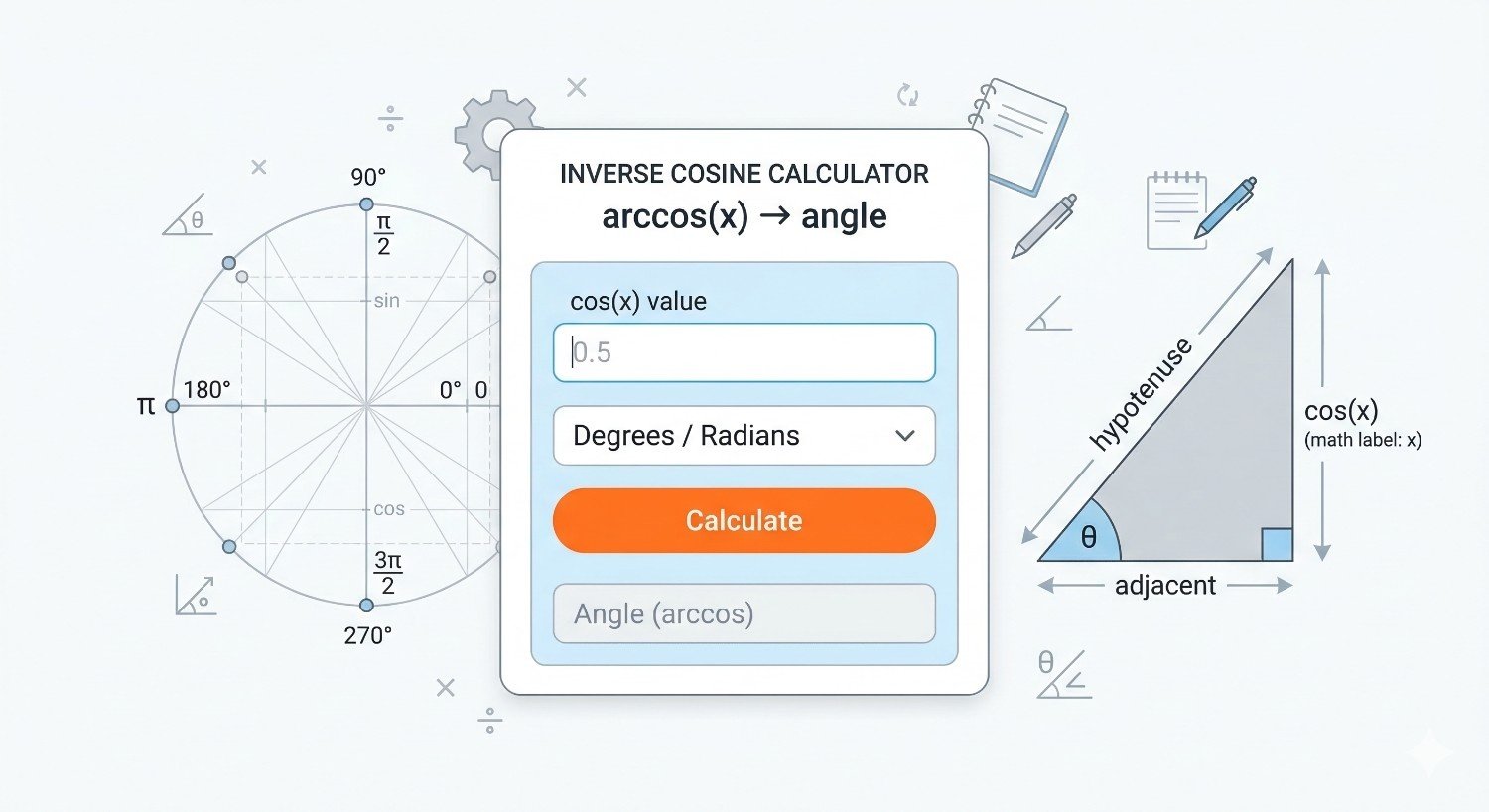
You do not need to enter the course as a trigonometry expert, but you should know right-triangle ratios, the unit-circle idea, radians, degrees, and basic sine, cosine, and tangent behavior. A helpful foundation is RevisionTown's guide to basic trigonometry, especially if radian measure or periodicity feels unfamiliar.
Systems, Exponents, and Radicals
You should know how to solve systems algebraically and graphically, simplify powers and roots, and interpret exponential growth and decay. Exponential and logarithmic functions form a major AP Precalculus unit, so exponent laws need to be quick and accurate.
Mathematical Communication
The AP course rewards precise language. Students should be able to explain what a zero, intercept, asymptote, parameter, or rate of change means in a problem. A correct number without a meaningful explanation may not be enough on free-response questions.
AP Precalculus Curriculum Overview
The AP Precalculus course framework is organized into four units. Units 1, 2, and 3 are assessed on the AP Exam. Unit 4 is part of the framework and may be included by schools, but College Board identifies it as not assessed on the AP Precalculus Exam. This distinction is important because students should prepare for the full classroom course while prioritizing exam practice around the tested units.
The units are not isolated. Unit 1 builds the function language that supports the rest of the year. Unit 2 extends that language to exponential and logarithmic relationships, which often model growth, decay, finance, population, pH, sound, and other real-world patterns. Unit 3 moves into periodic and polar behavior, where functions describe cycles, waves, circular motion, and angle-based relationships. Unit 4, when taught, extends the function idea into parameters, vectors, matrices, and motion models.
| Unit | Main Focus | Exam Weighting | What Students Should Be Able to Do |
|---|---|---|---|
| Unit 1: Polynomial and Rational Functions | Function relationships, rates of change, polynomial behavior, rational behavior, transformations, and modeling. | 30%-40% of multiple-choice section | Analyze zeros, end behavior, asymptotes, rates of change, transformations, and function models. |
| Unit 2: Exponential and Logarithmic Functions | Sequences, exponential models, logarithmic models, inverse relationships, composition, and solving equations. | 27%-40% of multiple-choice section | Model growth and decay, use logs as inverses of exponentials, solve equations, and interpret parameters. |
| Unit 3: Trigonometric and Polar Functions | Periodic models, sinusoidal functions, transformations, trigonometric equations, inverse trig ideas, and polar graphs. | 30%-35% of multiple-choice section | Model periodic phenomena, interpret amplitude and period, work in radians, solve trig equations, and analyze polar behavior. |
| Unit 4: Functions Involving Parameters, Vectors, and Matrices | Parametric functions, planar motion, implicitly defined functions, conic sections, vectors, and matrices. | Not assessed on the AP Exam | Extend function thinking into motion, multi-variable relationships, geometric representation, and linear transformations. |
Mathematical Practices in AP Precalculus
The AP Precalculus framework emphasizes three mathematical practices. These practices describe how students use content, not just what content they memorize. A student who can apply all three practices is more likely to succeed on both multiple-choice and free-response questions because the exam often asks for interpretation and justification, not only computation.
| Mathematical Practice | What It Means | Common Question Language | Overall Exam Weighting |
|---|---|---|---|
| Practice 1: Procedural and Symbolic Fluency | Algebraically manipulate functions, equations, and expressions. | Solve, simplify, evaluate, manipulate, identify, rewrite. | 39%-48% |
| Practice 2: Multiple Representations | Translate mathematical information between graphs, tables, equations, and verbal descriptions. | Graph, represent, interpret, transform, compare, estimate. | 20%-27% |
| Practice 3: Communication and Reasoning | Use precise language, support conclusions, and explain why a mathematical statement is valid. | Explain, justify, describe, support, determine whether. | 32%-39% |
The percentages are a reminder that AP Precalculus is not only a symbolic manipulation course. Fluency matters, but nearly as much of the exam is about reasoning and explanation. If your study routine consists only of solving answer-only drills, add written work. After each practice problem, write one sentence explaining what your answer represents and one sentence explaining why your method was appropriate. That habit prepares you for free-response scoring and improves your multiple-choice accuracy because it forces you to read the situation carefully.
Unit 1: Polynomial and Rational Functions
Unit 1 is the foundation of the course. It develops function analysis through polynomial and rational functions, but the bigger purpose is to teach students how to read function behavior. You work with rates of change, transformations, zeros, multiplicity, end behavior, rational expressions, holes, vertical asymptotes, horizontal asymptotes, slant behavior, and real-world models. If you master Unit 1, later units become more logical because the same habits repeat with new function families.
Polynomial functions are especially important because they connect algebraic structure to graph behavior. A polynomial such as \(p(x)=2x^3-5x^2-4x+3\) is more than an expression. Its degree, leading coefficient, zeros, and turning behavior all tell a story. End behavior comes from the leading term. Zeros may appear through factoring, graphing, or numerical approximation. Multiplicity affects whether the graph crosses or touches the x-axis. The same idea appears later in calculus when students analyze local and global behavior, but AP Precalculus builds the language first.
Rational functions require careful attention to restrictions. A rational function is a quotient of polynomial functions, usually written as \(r(x)=\frac{p(x)}{q(x)}\), where \(q(x)\ne 0\). That condition is not a footnote. It controls domain, vertical asymptotes, and removable discontinuities. Many errors in Unit 1 happen because students cancel factors without recording the original restriction. If \(f(x)=\frac{(x-2)(x+3)}{x-2}\), the simplified rule looks like \(x+3\), but the original function still has \(x\ne 2\). The graph has a hole at \(x=2\), not a continuous line with no restriction.
For focused Unit 1 support, start with Unit 1A: Polynomial and Rational Functions and then use Unit 1B: Polynomial and Rational Functions when you are ready for deeper function behavior. Students who need more practice with rates of change can review polynomial functions and rates of change, while students who need extra factoring and zeros practice can use polynomial functions and complex zeros.
Core Unit 1 Skills
- Identify key features of a graph, including intercepts, extrema, intervals, asymptotes, and end behavior.
- Use average rate of change to compare function behavior over intervals.
- Analyze polynomial degree, leading coefficient, zeros, multiplicity, and long-term behavior.
- Determine domain restrictions for rational functions and distinguish holes from vertical asymptotes.
- Construct function models from tables, graphs, verbal descriptions, and application contexts.
- Interpret transformations such as \(f(x)+k\), \(f(x-h)\), \(af(x)\), and \(f(bx)\).
A good Unit 1 study routine is to keep a graph-feature journal. For each new function, record its domain, range, intercepts, zeros, behavior, restrictions, and a sentence describing what the graph is doing. This may feel slow at first, but it trains the exact observation skills that appear across the course.
Unit 2: Exponential and Logarithmic Functions
Unit 2 shifts attention from polynomial and rational behavior to exponential and logarithmic relationships. Exponential functions model repeated multiplication, which makes them useful for population growth, compound interest, radioactive decay, medicine concentration, technology adoption, depreciation, and many other situations. Logarithms reverse exponential relationships, allowing students to solve for an exponent or interpret multiplicative change on a transformed scale.
The key conceptual link is inverse behavior. If \(b^y=x\), then \(\log_b(x)=y\). That statement is simple, but it explains why logarithms are so powerful. They answer questions such as "How long until this investment doubles?" or "What exponent is needed to reach this value?" Students who treat logarithms as random button-presses miss the structure. Students who understand the inverse relationship can move between exponential and logarithmic forms with confidence.
Sequences often appear in this unit because arithmetic sequences connect to linear functions and geometric sequences connect to exponential functions. An arithmetic sequence has a constant difference, while a geometric sequence has a constant ratio. Recognizing this distinction helps students select a model from data. If each output increases by the same amount, a linear model may be appropriate. If each output is multiplied by the same factor, an exponential model may be appropriate.
Students can deepen this unit by reviewing RevisionTown's exponents and logarithms guide. That page supports the algebraic rules needed for exponential and logarithmic equations, including product, quotient, power, and change-of-base relationships. If the rules feel mechanical, connect each one back to exponent laws. Logs are not a separate universe; they are the inverse language of exponents.
Core Unit 2 Skills
- Identify whether a pattern is linear, exponential, or neither from a table or description.
- Interpret parameters in exponential growth and decay models.
- Use logarithms to solve exponential equations and interpret the solution in context.
- Connect arithmetic sequences to linear functions and geometric sequences to exponential functions.
- Work with inverse functions and composition.
- Use technology appropriately while still understanding domain, range, and restrictions.
A common Unit 2 mistake is confusing percent increase with multiplier. A \(7\%\) increase corresponds to multiplying by \(1.07\), not by \(0.07\). A \(7\%\) decrease corresponds to multiplying by \(0.93\), not subtracting 7 from every output. AP Precalculus questions often test whether students understand these parameter meanings rather than simply asking for a formula.
Unit 3: Trigonometric and Polar Functions
Unit 3 introduces periodic and angle-based function behavior. This unit can feel very different from the first two because the graphs repeat, the inputs are often measured in radians, and the models describe cycles rather than one-directional growth. However, the underlying questions are familiar: What is the domain? What is the range? What does the graph do? How do transformations change behavior? What does each parameter mean in context?
The most important idea in trigonometric modeling is that sine and cosine describe periodic motion. A sinusoidal model such as \(y=A\sin(B(x-C))+D\) has amplitude \(|A|\), period \(\frac{2\pi}{|B|}\), phase shift \(C\), and vertical shift \(D\). Those parameters are not arbitrary. In a tide model, amplitude may represent half the difference between high and low tide. In a temperature model, vertical shift may represent average temperature. In a Ferris wheel model, period may represent time for one full rotation.
Radian measure is essential. A degree-based mindset can work in early trigonometry, but AP Precalculus expects students to understand radians because radians connect angles to arc length and circular motion. If \(\theta\) is in radians, then arc length can be written as \(s=r\theta\). That relationship is one reason radians become the natural language of calculus and advanced mathematics.
Polar functions extend the idea of representing points and curves. Instead of using \(x\) and \(y\) coordinates directly, polar coordinates describe a point using distance \(r\) from the origin and angle \(\theta\). A polar equation such as \(r=2+2\cos(\theta)\) can generate a curve with symmetry and shape that are easier to understand in polar form than in rectangular form. Unit 3 expects students to interpret these relationships, not simply plot points blindly.
Students who need a stronger trig foundation should work through RevisionTown's trigonometric functions page and return to the AP course after the basic graphs and transformations feel comfortable. For broader formula support, RevisionTown's geometry and trigonometry formulae page can also help students organize identities, triangle relationships, and measurement formulas.
Core Unit 3 Skills
- Use radians and understand the relationship between angle, radius, and arc length.
- Graph sine, cosine, tangent, and transformed trigonometric functions.
- Interpret amplitude, period, phase shift, midline, and frequency in real-world models.
- Solve trigonometric equations and interpret solutions over a given interval.
- Understand inverse trigonometric function restrictions and meanings.
- Analyze polar coordinates and polar function graphs.
Unit 4: Parameters, Vectors, and Matrices
Unit 4 is part of the AP Precalculus course framework, but it is not assessed on the AP Precalculus Exam. That does not mean it is useless. Schools may include Unit 4 because it supports state standards, local curriculum goals, physics preparation, computer graphics, robotics, engineering, and later work with multivariable thinking. Students who study Unit 4 gain a broader view of how functions can describe motion and transformations.
Parametric functions allow \(x\) and \(y\) to depend on a third variable, often time. Instead of writing \(y\) directly as a function of \(x\), a parametric relationship might use \(x(t)\) and \(y(t)\). This is helpful when an object moves in a plane and both coordinates change over time. For example, a projectile or a moving particle may be easier to describe parametrically than as a single rectangular equation.
Vectors describe magnitude and direction. They are useful for displacement, velocity, force, and navigation. Matrices organize numbers and can represent transformations, systems, and data. While these ideas are not on the AP Precalculus Exam, they are valuable for students moving into calculus, physics, linear algebra, economics, or data science.
If your school includes Unit 4, treat it as a long-term investment. Do not ignore the tested units, but do use Unit 4 to strengthen your ability to move between representations. A student who can interpret parametric motion is often better prepared to understand position, velocity, and acceleration later. A student who understands vectors is better prepared for physics and multivariable topics.
AP Precalculus Exam Format
The AP Precalculus Exam measures student understanding of Units 1-3 and the mathematical practices associated with the course. For the 2026 exam format published by College Board, the exam is 3 hours long and contains two main sections: multiple choice and free response. Some parts require a graphing calculator, while other parts do not permit a calculator. This split is intentional. College Board wants to assess both technology-supported modeling and independent algebraic reasoning.
| Section | Question Type | Number of Questions | Timing | Exam Weight | Calculator Policy |
|---|---|---|---|---|---|
| Section I, Part A | Multiple Choice | 28 questions | 80 minutes | 43.75% | Calculator not permitted |
| Section I, Part B | Multiple Choice | 12 questions | 40 minutes | 18.75% | Graphing calculator required |
| Section II, Part A | Free Response | 2 questions | 30 minutes | 18.75% | Graphing calculator required |
| Section II, Part B | Free Response | 2 questions | 30 minutes | 18.75% | Calculator not permitted |
Section I has 40 multiple-choice questions and counts for 62.5% of the exam score. Part A has no calculator, so students must be fluent with algebra, function features, symbolic manipulation, and mental graph reasoning. Part B requires a graphing calculator for some questions, so students must know how to use technology efficiently without letting it replace mathematical judgment.
Section II has 4 free-response questions and counts for 37.5% of the exam score. According to College Board's published structure for the 2026 exam, the first two free-response questions use a graphing calculator and include Function Concepts and Modeling a Non-Periodic Context. The last two are no-calculator questions and include Modeling a Periodic Context and Symbolic Manipulations. Each free-response question is worth 6 points, and scoring rewards organized reasoning, correct setup, interpretation, and mathematical communication.
Because AP Precalculus is a hybrid digital exam, students complete multiple-choice questions and view free-response questions in Bluebook, while handwritten free-response work is completed in paper booklets. That format means students should practice both digital navigation and handwritten mathematical explanation. Do not wait until exam week to practice writing clear free-response work by hand.
How the Calculator Changes the Exam
A graphing calculator is required for parts of the AP Precalculus Exam, but the exam does not reward button pressing without understanding. A calculator can graph, solve numerically, create tables, estimate intersections, evaluate functions, and support modeling decisions. It cannot decide for you which model is appropriate, what a parameter means, or how to write a defensible explanation.
Students should know how to use their calculator for graphing functions, adjusting windows, finding zeros, finding intersections, generating tables, evaluating expressions, and working with regression if taught. Just as importantly, students should know when not to use the calculator. If a question is testing symbolic reasoning, a calculator may waste time or hide the structure. If the no-calculator section asks for behavior of \(f(x)=\frac{x^2-9}{x-3}\), the important move is algebraic simplification plus domain awareness, not numerical approximation.
Use technology practice strategically. Build a small checklist for your calculator: enter a function correctly, set a meaningful viewing window, confirm radian mode for trigonometric work, use tables to test behavior, and record enough work to justify your answer. If your calculator gives a decimal, ask what the decimal represents. If your calculator shows an intersection, ask whether the intersection is within the stated domain and whether the problem asks for an exact or approximate answer.
RevisionTown's scientific calculator and math calculator pages can support routine checking, but AP exam preparation should still include official calculator policies and hands-on practice with the device you will actually use in class and on exam day.
How to Study AP Precalculus Without Wasting Time
The best AP Precalculus study plan is built around retrieval, correction, and transfer. Retrieval means you practice without looking at notes first. Correction means you study why your mistakes happened. Transfer means you apply the same idea in a new representation or context. Many students spend too much time rereading notes and too little time solving, explaining, and revising.
Start each study session with a short warm-up. Choose one algebra manipulation, one graph interpretation, and one modeling question. This keeps old skills alive while you learn new content. Then move to current unit work. After solving, mark each problem as "accurate," "minor error," "concept gap," or "representation problem." That classification is useful because it tells you what to fix. A sign error needs care. A concept gap needs reteaching. A representation problem means you may know the formula but cannot connect it to a graph or table.
When reviewing mistakes, write a corrected version of the solution in full. Do not simply look at the answer and say, "I get it now." The ability to reproduce the reasoning is what matters. For free-response practice, write complete sentences where needed. For example: "The average rate of change from \(x=2\) to \(x=6\) is positive, so the function's output increased on that interval, but this does not prove the function was increasing at every point in the interval." That kind of precision is exactly what AP-style reasoning expects.
A Practical Weekly Routine
| Day | Focus | What to Do |
|---|---|---|
| Monday | New content | Review class notes, complete assigned problems, and identify the one idea that felt least clear. |
| Tuesday | Fluency | Practice algebraic manipulation, function evaluation, graph features, and no-calculator skills. |
| Wednesday | Representation | Convert between graphs, tables, equations, and verbal descriptions for the same function idea. |
| Thursday | Reasoning | Write explanations for 3-5 problems. Include context, units, and justification where appropriate. |
| Friday | Mixed review | Complete a short mixed set from current and previous units. Track errors by type. |
| Weekend | AP-style practice | Do timed multiple-choice and at least one free-response problem. Revise your solution after checking. |
Students who want extra algebra conditioning can use RevisionTown's rearranging functions page to practice isolating variables and transforming equations. This is especially useful before units involving inverse functions, logarithmic equations, and symbolic free-response work.
Free-Response Strategy: How to Earn Points
Free-response questions are where many students lose points they could have earned. The reason is not always lack of knowledge. Often it is poor communication, incomplete setup, missing units, or unsupported conclusions. AP Precalculus free-response work should be readable, organized, and mathematically justified. You do not need perfect prose, but you do need enough explanation for a scorer to follow your reasoning.
Begin by reading the entire question before calculating. Identify the function, variables, domain, units, and context. If a table is given, note what the rows and columns represent. If a graph is given, label important features. If a calculator is permitted, decide what technology will help and what work must still be shown. Then answer the specific question asked. A common mistake is solving a related problem instead of the actual prompt.
For modeling questions, define your variables and interpret your answer. If you write \(t=5.7\), say what \(t\) measures. If the answer is a maximum, say maximum of what and within what interval. If a parameter represents growth, period, amplitude, or shift, explain its meaning in context. Short, precise explanations are better than long vague statements.
For symbolic manipulation questions, show steps. If you factor, write the factorization. If you cancel, state the restriction. If you solve an equation, be clear about possible extraneous solutions. If you use a graphing calculator to solve numerically, describe the equation or intersection used. Free-response scoring generally rewards correct setup and reasoning, so visible work matters.
Simple Free-Response Checklist
- Define variables and units when the problem has context.
- Use exact notation when possible and round only when the prompt allows or requires it.
- Show algebraic steps for symbolic questions.
- State restrictions, especially for rational and logarithmic expressions.
- Use calculator evidence clearly: graph, table, intersection, zero, or numerical solve.
- Answer in a complete sentence when interpretation is required.
Multiple-Choice Strategy: How to Avoid Traps
Multiple-choice questions in AP Precalculus often test subtle differences. Two choices may look plausible if you only compute, but one choice may match the domain, context, graph behavior, or transformation correctly. Read the stem carefully. Words like "increasing," "average," "instantaneous," "intercept," "zero," "solution," "model," and "rate" have specific meanings.
For no-calculator multiple choice, look for structure before expanding. Factoring, rewriting, symmetry, and transformation rules often solve the problem faster than brute force. For example, a question about end behavior of a polynomial usually depends on the leading term, not every coefficient. A question about a rational function may depend on denominator zeros and degree comparison, not a long table of values.
For calculator multiple choice, avoid over-trusting the first screen. A poor graphing window can hide intercepts, asymptotes, or local behavior. If a trig function looks wrong, check radian mode. If a model seems off, check whether the input unit matches the problem. If answer choices are exact values, a decimal approximation may only help you identify the correct expression after you understand the structure.
When stuck, eliminate choices based on behavior. If a function must be positive, remove negative outputs. If the graph has a vertical asymptote at \(x=3\), remove choices without the restriction. If a sinusoidal model has a midline of \(y=10\), remove choices with the wrong vertical shift. This behavior-first method is especially effective in AP Precalculus because the exam is built around function features.
Common Mistakes in AP Precalculus
Confusing Zeros and Intercepts
A zero is an input where \(f(x)=0\). An x-intercept is the graph point where the function crosses or touches the x-axis. They are connected, but one is an input value and one is a coordinate point.
Ignoring Domain Restrictions
Rational and logarithmic functions have restrictions. For logarithms, the argument must be positive. For rational functions, the denominator cannot be zero. Always check the original expression.
Using Degrees When Radians Are Expected
AP Precalculus trigonometry often expects radian mode, especially in calculator-active parts. A correct process with the wrong angle mode can produce a wrong answer.
Forgetting Context
Modeling questions require interpretation. A numerical answer must be connected to the problem situation, including units and meaning.
Canceling Incorrectly
You can cancel common factors, not common terms. Also, canceling a factor in a rational function does not erase the original domain restriction.
Memorizing Without Transfer
Knowing a formula is useful, but AP questions often present the idea through a graph, table, or written scenario. Practice moving among representations.
How AP Precalculus Prepares You for Calculus
AP Precalculus is not calculus, but it builds many habits that calculus depends on. Calculus studies change and accumulation, and those ideas make more sense when students already understand functions deeply. Average rate of change in AP Precalculus becomes a bridge to instantaneous rate of change in calculus. Graph behavior, transformations, asymptotes, and end behavior become essential when analyzing limits, derivatives, and integrals.
For example, calculus students need to interpret expressions like \(\frac{f(x+h)-f(x)}{h}\). That expression is easier to understand if you already know average rate of change and function notation. Similarly, exponential and logarithmic functions appear constantly in calculus, physics, finance, and differential equations. Trigonometric functions appear in waves, circular motion, derivatives, integrals, and periodic modeling. Polar and parametric ideas appear again in later calculus courses.
The biggest preparation, however, is not a specific formula. It is mathematical maturity. AP Precalculus asks students to choose representations, explain reasoning, and connect symbolic work to meaning. Those habits reduce the shock of calculus because students are no longer treating math as disconnected procedures. They are learning to analyze relationships.
Teacher and Student Planning Notes
Students and teachers should approach AP Precalculus as a full-year development of function thinking. The course should not become a race through formulas. A strong class includes conceptual development, skill practice, calculator fluency, written explanation, and mixed review. Because Units 1-3 are assessed on the AP Exam, students should revisit earlier units throughout the year rather than treating each unit as finished after a chapter test.
Teachers can help students by building routines around multiple representations. A daily warm-up might ask students to match an equation to a graph, interpret a table, or describe a parameter in context. Short free-response explanations should appear early in the year so students do not treat writing as an exam-week surprise. Calculator use should be integrated carefully: students should learn when technology clarifies behavior and when algebra is faster.
Students can help themselves by keeping a cumulative formula and concept notebook. This notebook should not be a copied list of formulas. It should include examples, restrictions, common mistakes, and one-sentence interpretations. For rational functions, include holes and asymptotes. For logarithms, include domain restrictions and inverse relationships. For trig functions, include amplitude, period, phase shift, and midline. A useful notebook helps you make decisions, not just memorize facts.
Eight-Week AP Precalculus Review Plan
If the exam is approaching, use a structured review plan instead of randomly choosing topics. The plan below assumes you already completed most of the course and need to consolidate. If you are earlier in the year, stretch the same sequence over a longer period and add more practice after each topic.
| Week | Primary Focus | Practice Tasks |
|---|---|---|
| 1 | Function foundations and transformations | Review notation, domain, range, composition, inverse ideas, shifts, reflections, stretches, and graph features. |
| 2 | Polynomial behavior | Practice zeros, multiplicity, end behavior, rates of change, and polynomial models. Use polynomials for extra topic review. |
| 3 | Rational functions | Practice domain restrictions, holes, asymptotes, graph behavior, and rational models. Use rational functions if you need more examples. |
| 4 | Exponential and logarithmic functions | Practice growth and decay, logs as inverses, solving equations, interpreting parameters, and using technology appropriately. |
| 5 | Sequences and inverse relationships | Connect arithmetic sequences to linear functions, geometric sequences to exponential functions, and inverse functions to composition. |
| 6 | Trigonometric functions | Practice radians, unit-circle values, graph transformations, sinusoidal modeling, period, amplitude, and trig equations. |
| 7 | Polar functions and mixed representation | Interpret polar graphs, compare representations, and complete mixed multiple-choice sets from Units 1-3. |
| 8 | Full exam practice and corrections | Complete timed practice, review every missed problem, rewrite free-response solutions, and focus on recurring errors. |
How Parents Can Understand the Course
Parents often ask whether AP Precalculus is worth taking. The answer depends on the student's goals, prior preparation, and schedule. For a student who plans to take calculus or pursue a quantitative field, AP Precalculus can be an excellent step. For a student who struggles significantly with Algebra II and is already overloaded, the course may require a support plan before the year begins.
The most useful parent support is not doing the math for the student. It is helping the student build a routine. Encourage consistent homework completion, timely help-seeking, test correction, and spaced review. Ask the student to explain a concept in plain language. If they can explain what a function parameter means, they probably understand more than if they can only reproduce a memorized procedure.
Parents should also understand that the AP score is not the only measure of value. Even when a student does not earn college credit, the course can improve readiness for college math and science. The skills of modeling, graph interpretation, and quantitative reasoning are broadly useful.
What to Do If You Are Struggling
If AP Precalculus feels overwhelming, diagnose the problem before assuming you are "bad at math." Most struggles fall into one of four categories: algebra fluency, graph interpretation, conceptual vocabulary, or time management. Each category has a different fix. Algebra fluency improves through short daily practice. Graph interpretation improves by describing features in words. Vocabulary improves by making concept cards with examples. Time management improves by starting assignments early enough to ask questions.
One useful method is the three-column error log. In the first column, copy the problem or summarize it. In the second column, write the exact error you made. In the third column, write the correction rule. For example: "I canceled terms instead of factors" becomes "Only cancel common factors after factoring." Over time, patterns will appear. Those patterns tell you what to practice.
Ask for help early. Bring a specific question to your teacher, tutor, or study group. Instead of saying "I don't get this unit," say "I can find the vertical asymptote, but I don't understand when a canceled factor becomes a hole." Specific questions lead to useful explanations. Vague frustration often leads to repeated confusion.
Connections to SAT Math and Other Courses
AP Precalculus is more advanced than SAT Math, but the overlap is real. Both require algebraic fluency, function interpretation, graph reading, and modeling. Students who become stronger in AP Precalculus often improve at advanced SAT Math topics because they learn to recognize structure quickly. RevisionTown's SAT Math section overview can help students see which algebra and function skills transfer to standardized testing.
The course also supports AP Calculus, AP Statistics, AP Physics, economics, computer science, and many college placement tests. Exponential models connect to finance and population. Logarithms connect to scientific scales. Trig functions connect to waves and circular motion. Rational functions connect to rates and restrictions. Polar and parametric ideas connect to motion and geometry. A strong AP Precalculus year gives students a larger mathematical toolkit.
AP Precalculus Formula and Concept Mini-Sheet
This mini-sheet is not a substitute for understanding, but it summarizes formulas and relationships students should recognize. Use it as a review prompt: for each formula, ask when it applies, what the variables mean, and what restrictions matter.
| Topic | Formula or Relationship | Meaning |
|---|---|---|
| Average rate of change | \(\frac{f(b)-f(a)}{b-a}\) | Change in output per unit change in input over an interval. |
| Quadratic formula | \(x=\frac{-b\pm\sqrt{b^2-4ac}}{2a}\) | Solves \(ax^2+bx+c=0\) when \(a\ne 0\). |
| Exponential model | \(y=ab^x\) | \(a\) is initial value and \(b\) is the growth or decay factor. |
| Logarithmic inverse | \(\log_b(x)=y \Longleftrightarrow b^y=x\) | Logarithms answer exponent questions. |
| Geometric sequence | \(a_n=a_1r^{n-1}\) | Each term is multiplied by a constant ratio \(r\). |
| Sinusoidal period | For \(y=A\sin(B(x-C))+D\), period \(=\frac{2\pi}{|B|}\) | The horizontal length of one complete cycle. |
| Arc length | \(s=r\theta\) | Works when \(\theta\) is measured in radians. |
| Rational function restriction | \(f(x)=\frac{p(x)}{q(x)},\ q(x)\ne 0\) | The denominator cannot equal zero. |
Frequently Asked Questions
What is AP Precalculus?
AP Precalculus is a College Board AP mathematics course focused on functions, modeling, multiple representations, and preparation for college-level quantitative work. It develops algebraic, graphical, numerical, and verbal reasoning through polynomial, rational, exponential, logarithmic, trigonometric, and polar functions.
What grade should you take AP Precalculus?
Many students take AP Precalculus after Algebra II or an equivalent advanced algebra course, often in 10th, 11th, or 12th grade depending on their math pathway. The right timing depends on readiness, not just grade level. Students should be comfortable with algebra, functions, graphing, and foundational trigonometry before enrolling.
Does AP Precalculus include calculus?
AP Precalculus prepares students for calculus but is not a calculus course. It develops the function analysis, modeling, and symbolic reasoning that calculus depends on. Students may see ideas such as rates of change and end behavior, but the course does not focus on derivatives and integrals as a calculus course would.
Which AP Precalculus units are tested?
The AP Precalculus Exam assesses Units 1, 2, and 3: polynomial and rational functions, exponential and logarithmic functions, and trigonometric and polar functions. Unit 4 is part of the course framework but is not assessed on the AP Exam.
Do you need a graphing calculator for AP Precalculus?
Yes. A graphing calculator is required for parts of the AP Precalculus Exam. Students should still practice no-calculator reasoning because other parts of the exam do not permit a calculator. The strongest students can decide when technology helps and when algebra is more efficient.
How should I prepare over the summer?
Review Algebra II, especially factoring, exponent rules, radical expressions, rational expressions, functions, graph transformations, systems, and basic trigonometry. Do not try to learn the whole AP course before school starts. Instead, enter with strong foundations so new ideas are easier to absorb.
Is AP Precalculus useful if I am not going into engineering?
Yes. The course strengthens modeling, graph interpretation, and quantitative reasoning. Those skills are useful in economics, business, psychology, health science, environmental science, data analysis, social science, and many college programs that require math placement or statistics readiness.
Official Sources and Further Reading
The details in this guide are aligned with the College Board pages available at the time of review. Because AP policies, exam dates, digital testing tools, and future exam structures can be updated, students should use this article as a practical study guide and verify final administrative information through official College Board channels.