SAT Practice Tests 2026: Free Official Tests, Timing, Review Strategy and Study Plan
SAT practice tests are useful only when they match the exam you are preparing for and when you review them properly. The SAT is now digital for most students, so the best practice starts with official full-length tests in Bluebook. Printable SAT PDFs still have a place, especially for students with paper-based accommodations and for offline review, but older paper tests should be used carefully because they do not fully match the current digital SAT.
Bookmark this page: This updated RevisionTown SAT practice hub is available at https://revisiontown.com/sat-practice-tests/. Use it as your starting point for choosing official practice tests, planning full-length mocks, reviewing mistakes and moving into targeted Reading, Writing and Math practice.
Quick Answer: What SAT Practice Tests Should You Use?
Most students preparing for the SAT in 2026 should use official full-length digital SAT practice tests in College Board's Bluebook app first. Bluebook gives the closest match to the actual SAT because it uses the current digital interface, section timing, test tools and adaptive module structure. A printable PDF may contain useful questions, but it does not reproduce the digital testing experience in the same way.
The best SAT practice-test plan is not simply "take as many tests as possible." A better plan is: take one official digital baseline test, review it deeply, study the highest-value weak areas, take another full practice test, and repeat the cycle. Each full test should produce a clear action list. If a practice test does not change how you study, it is mostly a long score check.
For most students, three to five official full-length practice tests are enough if the review is serious. A student who takes four tests with careful review will usually improve more than a student who takes eight tests without understanding mistakes. Full tests train stamina, pacing and decision-making. Targeted practice fixes the skills that the test reveals.
If you specifically need printable tests, use College Board's current paper practice resources or RevisionTown's guide to printable SAT practice test PDFs. If you are building a full prep plan rather than just downloading tests, pair this page with RevisionTown's SAT exam preparation guide and SAT score calculator.
Best first choice
Official Bluebook full-length digital SAT practice because it matches the current test environment most closely.
Best paper option
College Board's current full-length paper practice tests, especially for students with paper-based accommodations.
Best score-growth habit
Review every missed, guessed and slow question before taking the next full test.
What Changed With the Digital SAT?
The SAT is now digital for most students. That change matters because the current SAT is not just the old paper SAT displayed on a screen. It is shorter, modular and adaptive. It has two scored sections: Reading and Writing, then Math. Each section is split into two modules. Performance on the first module affects the difficulty range of the second module.
Reading and Writing is also different from the older paper SAT. Instead of long passages followed by several questions, the current test usually uses shorter passages or prompts, with one question connected to each. That changes pacing. Students must move quickly from task to task and identify exactly what each question is asking: central idea, evidence, vocabulary, grammar, transitions, rhetorical synthesis or standard English conventions.
Math is digital too. The current Math section allows calculator use throughout, and Bluebook includes a built-in Desmos graphing calculator. That changes strategy. Students should know when algebra is faster, when graphing helps, when substitution is efficient and when answer-choice testing can save time. Paper practice can help with math skills, but students still need experience using digital tools under timed conditions.
Because of this structure, current SAT practice should include at least one official Bluebook test early. Waiting until the final week to try Bluebook is risky. You need time to learn navigation, the Mark for Review tool, the calculator, module timing and the feel of reading on screen.
Official SAT Practice Tests and Where to Find Them
The official starting point is College Board's full-length practice-test hub. It directs students to Bluebook digital practice and to paper practice materials. College Board's Bluebook page explains that full-length practice tests are timed like the real SAT and allow students to review completed practice through My Practice. For current SAT prep, these official tools should come before third-party archives or old PDF collections.
| Official resource | Best for | How to use it |
|---|---|---|
| College Board full-length practice tests hub | Finding the current official practice options. | Start here before downloading or assigning practice tests. |
| Full-length digital practice tests on Bluebook | Most students taking the digital SAT. | Use for baseline testing, realistic timing, interface practice and final score simulations. |
| Full-length SAT paper practice tests | Paper-accommodation students, tutors, classrooms and offline review. | Use as nonadaptive printable practice with the matching scoring guide and explanations. |
| SAT Weekend Practice Quick Start Guide | Understanding how to set up official practice. | Use when you need a practical official guide to practice-test setup and review. |
Do not confuse official practice with random online PDFs. Some older SAT PDFs were official for previous versions of the test, but they do not match the current digital SAT as full simulations. Some third-party mirrors also rehost old PDFs in ways that may be incomplete, outdated or confusing. Use official College Board pages for current practice and use RevisionTown pages for guided strategy and internal revision support.
Printable SAT Practice PDFs: Current Official Paper Bundles
Printable SAT PDFs are still useful, but their role is different now. They are strongest for students with approved paper-based accommodations, for classrooms, for tutoring, for offline practice and for reviewing questions on paper. College Board describes its downloadable paper practice tests as nonadaptive, so digital SAT students should not treat them as a perfect substitute for Bluebook.
Each official paper bundle should be used as a complete package: questions, scoring guide and answer explanations. If you use only the questions, you will lose the most important part of the practice cycle: scoring and review.
| Official paper practice bundle | Questions | Scoring | Explanations |
|---|---|---|---|
| Practice Test 4 | Questions PDF | Scoring PDF | Explanations PDF |
| Practice Test 5 | Questions PDF | Scoring PDF | Explanations PDF |
| Practice Test 6 | Questions PDF | Scoring PDF | Explanations PDF |
| Practice Test 7 | Questions PDF | Scoring PDF | Explanations PDF |
| Practice Test 8 | Questions PDF | Scoring PDF | Explanations PDF |
| Practice Test 9 | Questions PDF | Scoring PDF | Explanations PDF |
| Practice Test 10 | Questions PDF | Scoring PDF | Explanations PDF |
| Practice Test 11 | Questions PDF | Scoring PDF | Explanations PDF |
For a deeper printable-PDF guide, including how to think about older official tests and why some legacy archives are less relevant now, use RevisionTown's Printable SAT Practice Test PDFs page.
Which SAT Practice Test Should You Take?
The right practice test depends on your goal. A baseline test, a pacing test, a section drill and a final mock are not the same thing. If you use the wrong test for the wrong purpose, your study plan becomes noisy.
| Student situation | Best practice choice | Reason |
|---|---|---|
| First week of SAT prep | One official Bluebook full-length test. | Gives a realistic baseline and shows the current digital interface. |
| Paper-based accommodation student | College Board paper practice bundle. | Matches the physical format more closely than Bluebook. |
| Weak in grammar | Targeted Standard English Conventions practice before another full test. | Full tests reveal the weakness; focused drills repair it. |
| Weak in Math | Math module drills plus calculator strategy, then a full Bluebook test. | Math improvement usually requires concept repair and timed decision-making. |
| Two weeks before test day | One full Bluebook test and a focused review plan. | Late-stage practice should confirm readiness and fix repeated errors. |
| Already used current tests | Printable official PDFs and older skill drills with caution. | Useful for extra practice but less exact as digital-score simulations. |
If you are unsure whether the SAT is the right test for you, compare it with the ACT rather than collecting more SAT PDFs. RevisionTown's ACT guide and SAT vs ACT comparison, ACT to SAT converter and SAT to ACT conversion calculator can help you make that decision with score context.
SAT Timing and Pacing Formulas
The current SAT has 64 minutes for Reading and Writing and 70 minutes for Math, for 134 minutes of testing time, plus a 10-minute break between the sections. Reading and Writing has 54 questions. Math has 44 questions. These numbers matter because pacing is one of the most common reasons students underperform their knowledge level.
Do not apply these averages mechanically. Some questions should take 20 seconds. Others may take two minutes. The average is a warning system. If a Reading and Writing question has taken two minutes and you still do not understand the task, mark it and move. If a Math question has become algebraically messy, consider graphing, substitution or eliminating answer choices.
Track your practice-test accuracy with a simple formula:
For review planning, use this rule:
A full SAT takes a little over two hours of testing time. That means serious review can easily take three to four hours. This is not wasted time. This is where score improvement usually happens.
How to Take a Practice Test Properly
A practice test should feel close to the real SAT. If you pause constantly, check answers during the test, use your phone, skip breaks randomly or take modules across several days, the score becomes less useful. A realistic score requires realistic conditions.
Before you start, choose the practice type. If it is a baseline or final mock, use Bluebook and take the entire test in one sitting. If it is a section drill, define the exact section and timing. If it is a printable paper test, download the questions, scoring guide and explanations before you begin, but do not open the answers until the test is complete.
Use the same tools you expect on test day. For digital practice, use the Bluebook calculator and tools. For paper practice, use the calculator rules and timing appropriate to the paper resource. Keep scratch paper ready. Sit at a desk. Use a timer only if the test environment does not already time the section. Remove distractions.
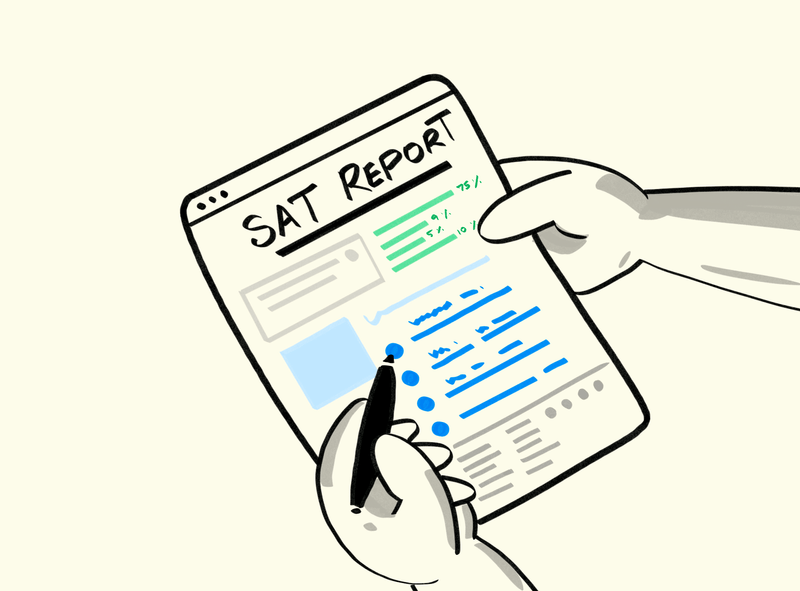
After the test, do not stop at the total score. Write down section scores, module performance, question types missed, timing problems and confidence levels. A strong practice-test record should tell you what to do next. The goal is not simply to know the score. The goal is to identify the next improvement step.
How to Review an SAT Practice Test
The review system is the difference between testing and improving. Every missed question should be sorted by cause. Every guessed question should be reviewed, even if it was correct. Every slow question should be studied because speed problems become score problems on test day.
Use four categories for mistakes:
- Content gap: You did not know the grammar rule, math concept or reading strategy.
- Misread: You missed a word, condition, graph detail or question task.
- Strategy error: You used an inefficient method or stayed too long on one question.
- Careless error: You knew what to do but made an arithmetic, copying or selection mistake.
For each serious mistake, write a correction note. A useful correction note is specific. "Need to study grammar" is too vague. "I chose a comma splice because I did not check whether both sides were independent clauses" is useful. "I got the linear equation wrong" is too vague. "I distributed the negative sign incorrectly in the second step" is useful.
Then assign a repair task. If the error was Standard English Conventions, use RevisionTown's Standard English Conventions SAT practice. If the error was hard Math, use hard SAT math questions. If the error was reading, use SAT reading practice. If the error was writing, use SAT writing practice.
Do not take another full test until you have repaired at least some of the patterns from the previous one. Otherwise, you are repeating the same test behavior and hoping for a different result.
Section Strategy: Reading and Writing, Then Math
Reading and Writing
The Reading and Writing section rewards precision. Each question is short enough that you can usually identify the task quickly, but the answer choices are designed to punish vague reading. Start by naming the task. Is the question asking for a transition, a grammar correction, a main idea, a text structure, evidence, inference, vocabulary or synthesis?
For grammar questions, identify the rule before looking for the answer that sounds best. For transition questions, determine the relationship between ideas: contrast, cause, example, continuation or conclusion. For vocabulary questions, use the local context rather than memorizing the first definition that comes to mind. For evidence questions, return to the exact claim being supported.
RevisionTown's SAT Reading section overview and SAT English pages are useful after a practice test reveals repeated Reading and Writing errors.
Math
The Math section rewards flexible method choice. Many students lose time because they insist on one method even when another method is faster. For each question, ask whether algebra, graphing, substitution, answer-choice testing or estimation is most efficient. Bluebook's built-in Desmos calculator can be powerful, but it should support reasoning, not replace it.
Common Math weaknesses include linear equations, systems, quadratics, functions, percentages, ratios, unit conversion, geometry, trigonometry, data analysis and word-problem translation. After every practice test, identify which math category created the most lost points. Then drill that category before taking another full test.
Use RevisionTown's SAT Math section overview and SAT Mathematics pages to organize math review after full-length practice.
SAT Practice-Test Study Plan
A good SAT practice-test plan spaces full tests far enough apart that you can learn between them. The exact timeline depends on your target score, school workload and test date, but the structure below works for many students.
| Timeline | Practice-test action | Review and study action |
|---|---|---|
| Week 1 | Take one official Bluebook baseline test. | Identify top three weak areas and create an error log. |
| Weeks 2-3 | Do targeted Reading and Writing or Math modules. | Study the highest-value content gaps from the baseline. |
| Week 4 | Take full practice test 2. | Compare score and mistake patterns with the baseline. |
| Weeks 5-6 | Use printable PDFs or section drills for weak areas. | Review explanations and redo missed questions after a delay. |
| Week 7 | Take full practice test 3. | Focus on pacing, confidence and repeated errors. |
| Final week | Do light timed modules or one final test only if needed. | Review formulas, grammar rules, error log and test-day strategy. |
If your target is 1500+, your plan should be more diagnostic. Use RevisionTown's how to get a 1500 on the SAT guide after you have at least one official practice score. High scorers usually need fewer broad lessons and more precision: missed question types, careless error patterns, time sinks and hard-question strategy.
Use real dates too. Match your practice-test schedule to your actual test date using RevisionTown's SAT test dates 2026 prep guide or College Board international SAT dates and deadlines page.
How to Build an SAT Practice-Test Error Log
An error log is the bridge between a practice score and a better score. Without it, students often remember only the final number and a vague feeling that Math or Reading and Writing was hard. A good log turns the test into a set of decisions: which skills need review, which question types waste time, which careless errors repeat, and which strategies should change before the next full practice test.
Do not make the log complicated. The best version is simple enough that you will actually use it after a two-hour test. Create columns for section, module, question number, result, confidence, time spent, question type, mistake cause, fix and redo date. If you do not know the exact time spent on each question, estimate it immediately after the test while the experience is still fresh. Mark questions that felt slow even if you answered them correctly. Slow correct answers are early warnings; they may become wrong answers under test-day pressure.
| Log column | What to record | Why it matters |
|---|---|---|
| Question type | Grammar, transition, inference, algebra, functions, geometry, data analysis or another clear label. | Repeated labels show the exact lesson or drill you need next. |
| Mistake cause | Content gap, careless reading, wrong strategy, time pressure, calculator issue or guessed answer. | The same wrong answer can require different fixes depending on the cause. |
| Fix | One concrete action, such as reviewing linear equations, drilling transitions or practising calculator setup. | A test review should end with a study task, not just an explanation. |
| Redo date | A date 3 to 7 days later when you solve the missed question again without notes. | Delayed redo proves whether you learned the idea or only understood the explanation temporarily. |
The most useful error-log calculation is not simply your percent correct. Track repeated-error rate:
If the repeated-error rate stays high, the problem is not that you need more tests. The problem is that the repair step is not strong enough. Review the underlying lesson, solve easier examples, then return to SAT-level questions. A student who keeps missing the same transition question or nonlinear equation after three practice tests is not short on exposure; they need a different correction method.
For Reading and Writing, your log should separate comprehension errors from grammar and craft errors. A wrong answer on a words-in-context question is different from a wrong answer on standard English conventions. If grammar is the issue, build targeted practice around rules, punctuation and sentence boundaries. RevisionTown's standard English conventions SAT practice page is useful when your log shows repeated grammar or mechanics problems. If evidence and inference are the issue, spend more time writing down why the correct answer is supported by the text and why the tempting wrong answer goes too far.
For Math, your log should separate setup errors from execution errors. If you knew the formula but wrote the wrong equation, the fix is not the same as forgetting the content. If you chose a slow method, record the faster method you should try next time. Harder SAT Math often rewards clean setup, graphing awareness and flexible strategy, so a missed advanced question should lead to a specific skill review rather than a general statement such as "study math more." When your log shows advanced algebra, functions or difficult word problems as the main barrier, use RevisionTown's hard SAT math questions practice after you finish the official test review.
Digital SAT Simulation Checklist
A digital SAT practice test should feel like a controlled rehearsal, not casual screen time. The test is shorter than the old paper SAT, but it still demands focus, reading stamina, timing discipline and comfort with the app. Treat at least two official practice tests as full simulations before the real exam.
Start by preparing the same device setup you expect to use on test day. Charge your device fully, connect to stable internet before starting, close unrelated tabs and apps, and place your phone away from the desk. Use the built-in tools available in the testing platform rather than switching to outside calculators, notes or browser tabs. If you plan to use graphing tools, practise with the built-in calculator during Math modules so that graphing, table checks and equation solving feel natural under time pressure.
Keep the room realistic. Use a quiet desk, not a couch or bed. Follow the official timing. Take the scheduled break but do not extend it. Eat and drink the way you expect to on test day. These details sound small, but they affect the reliability of your score. A practice test taken with music, snacks, pauses and phone checks is not measuring the same skill as the real SAT.
Before the test
- Confirm the test you are taking and whether it is diagnostic, progress-check or final simulation.
- Set a target for process, such as finishing Module 1 with time to review marked questions.
- Prepare scratch paper, pencils, calculator access and water before starting.
- Open only the test platform and required tools.
During the test
- Use Mark for Review for uncertain questions rather than stopping too long.
- Watch module timing, not just section timing.
- Write down only useful scratch work, especially equations and answer checks.
- Do not pause for explanations, videos or notes during the simulation.
After the test
- Record your section scores, module feelings and pacing issues immediately.
- Review missed, guessed and slow questions before doing new practice.
- Choose two or three priority fixes for the next study block.
- Schedule the next practice test only after the priority fixes are complete.
What not to do
- Do not split a full practice test across multiple days if you want a reliable score.
- Do not use unofficial scoring tables to over-interpret tiny score changes.
- Do not retake the same full test quickly and treat the second score as a fresh result.
- Do not ignore fatigue, anxiety or timing notes just because the content review feels easier.
Digital practice also changes how students should think about scratch work. On paper tests, some students underlined, annotated and circled directly on passages and diagrams. On the digital SAT, you need a lighter system. For Reading and Writing, write only short reminders such as "contrast," "cause," "claim" or "comma splice" when they help you choose. For Math, write equations, variables and answer checks clearly enough that you can return to a marked question without starting over.
If your digital practice score drops compared with an old paper practice score, do not panic. First check whether the drop came from unfamiliar tools, module timing, screen reading or content. A format problem can improve quickly after one or two realistic simulations. A content problem requires deeper study. The error log will tell you which one you are dealing with.
Practice-Test Strategy by Score Band
Not every student should use practice tests in the same way. A student trying to move from 1050 to 1200 needs a different plan from a student trying to move from 1450 to 1530. The lower your starting score, the more full tests reveal broad content gaps. The higher your score, the more full tests reveal small precision issues, timing losses and question-type weaknesses.
| Current official practice score | Main goal between tests | Best use of full practice tests |
|---|---|---|
| Below 1100 | Build core grammar, algebra, linear equations, data reading and basic reading accuracy. | Use one baseline, then wait several weeks before the next full test while you repair foundations. |
| 1100-1290 | Reduce repeated content gaps and improve pacing across both sections. | Take a full test every 3 to 4 weeks with section drills in between. |
| 1300-1440 | Target medium and hard question types, careless errors and module-end timing. | Use official tests to diagnose score-limiting patterns, then drill narrow weaknesses. |
| 1450+ | Increase precision, consistency and speed on the hardest questions. | Preserve official tests for high-quality simulations and review every uncertain answer, including correct guesses. |
For students below 1100, the biggest mistake is burning through too many full tests before learning the tested material. A diagnostic is useful, but repeated diagnostics do not teach algebra, grammar or data interpretation. After the first test, use the results to choose a few high-impact topics. For Math, that often means linear equations, systems, percentages, ratios, functions and basic geometry. For Reading and Writing, that often means sentence boundaries, transitions, main idea, evidence and vocabulary in context.
For students in the 1100-1290 range, timing and consistency usually matter more. The student may understand many topics but lose points because of rushed decisions, weak review habits or predictable question-type errors. Practice tests should be spaced far enough apart that the score has a reason to change. A good rhythm is one official full test, one deep review session, one to two weeks of targeted practice, then another timed section or full test.
For students in the 1300-1440 range, improvement comes from precision. You should know exactly which question types cost points. "Math" is not specific enough. Is it nonlinear equations, equivalent expressions, function notation, advanced word problems, geometry, probability, data displays or calculator strategy? "Reading and Writing" is also too broad. Is it boundaries, transitions, rhetorical synthesis, command of evidence or vocabulary? The more specific your diagnosis, the more useful your next study session becomes.
For students above 1450, official practice tests are limited assets. Do not waste them casually. A high scorer may miss only a few questions, so each missed question deserves close review. Ask whether the miss came from a knowledge gap, a trap answer, overconfidence, mental fatigue, a rushed calculation or an inefficient method. Also review questions you got right but marked uncertain. At this level, score growth often comes from preventing two or three avoidable mistakes, not learning an entirely new curriculum.
How Parents, Tutors and Classrooms Should Use SAT Practice Tests
Practice tests are not only for independent students. Parents, tutors and classroom teachers can use them well, but only if the test is treated as evidence rather than pressure. The purpose of a practice test is not to label a student as good or bad at the SAT. It is to identify what the next study decision should be.
Parents should avoid reacting only to the composite score. Ask better questions: Which section improved? Which questions took too long? Did the student review the test before taking another one? Was the test taken under realistic timing? A student who improves from 1150 to 1190 while reducing repeated errors may be doing stronger work than a student who jumps once because they retook familiar material.
Tutors should use full practice tests to plan instruction, not to fill tutoring time with silent test-taking. The best use is often outside the lesson: the student takes the official practice test independently, then the tutor spends the session analysing the error log, rebuilding weak concepts and choosing focused homework. Full-length testing during every tutoring session can feel productive, but it often leaves too little time for actual teaching.
Classroom settings need a slightly different approach. Not every student has the same target score, baseline or test date. A teacher can still use practice tests effectively by assigning common modules, then grouping review by skill. For example, students who missed similar standard English conventions questions can work together on sentence boundaries and punctuation, while students who struggled with advanced Math can work on functions or nonlinear equations. The full score matters less than the pattern of errors.
For any adult supporting a student, the key is to protect the quality of official practice. Do not have the student take official tests casually, with interruptions or without review. Use unofficial drills for daily practice and save official tests for clear milestones. When official practice tests are used carefully, they provide a reliable picture of readiness and a practical path for improvement.
Old SAT PDFs, Legacy Tests and What to Avoid
The older version of this page contained many links to old SAT PDFs and answer keys. Those older resources may have historical value and can still provide extra practice, but they should not be treated as current digital SAT simulations. The older paper SAT had different section structures, different pacing, older essay components and nonadaptive delivery.
Use old SAT PDFs only after you understand what they are. A 2016-2023 redesigned SAT PDF can still support reading, writing and math skills, but it does not reproduce the current digital module structure. A pre-2016 SAT is even less aligned. SAT Subject Tests are no longer current SAT practice and should not be used to predict a current SAT score.
For legacy files and broader archives, use caution and avoid making old scores your main benchmark. RevisionTown's 55 real SAT PDFs and ACT list page may be useful for archive-style practice, but the current practice hierarchy should remain clear: official Bluebook first, current College Board paper practice second, old PDFs only as targeted extra practice.
Also avoid taking full tests too frequently. A full practice test is expensive in time and energy. If you take one every day, you will not have enough time to repair weaknesses. Use full tests for measurement and endurance. Use targeted practice for improvement.
Common SAT Practice-Test Mistakes
Using old PDFs as the main test
Older official tests can help with skills, but Bluebook is the best simulation for the current digital SAT.
Skipping review
A test without review is mostly a score check. Improvement comes from analysing and repairing mistakes.
Taking too many full tests
Full tests should be spaced out. Use the time between tests for targeted drills and error correction.
Ignoring digital tools
Digital SAT students need practice with Bluebook navigation, marking questions and calculator strategy.
Reviewing only wrong answers
Guessed correct answers and slow correct answers also deserve review because they reveal unstable skills.
No timing notes
Record where time was lost. A score problem may be a pacing problem rather than a content problem.
SAT Practice Tests FAQs
What is the best SAT practice test?
The best SAT practice test for most current students is an official full-length digital SAT practice test in Bluebook because it most closely matches the real digital SAT experience.
Are SAT practice tests free?
Yes. College Board provides free official full-length digital practice tests through Bluebook and free downloadable paper practice materials.
How many SAT practice tests should I take?
Most students should take three to five full official practice tests across a study plan, with serious review between tests. More tests are useful only if you have time to analyse and fix mistakes.
Should I use printable SAT practice tests?
Printable SAT practice tests are useful for paper-accommodation practice, classroom work, tutoring and offline review. Digital test-takers should still use Bluebook for main score simulations.
Can old SAT PDFs help with the digital SAT?
They can help with extra skills practice, especially math and grammar, but they should not be used as exact digital SAT score predictions.
How long is the SAT?
The current SAT has 64 minutes for Reading and Writing and 70 minutes for Math, for 134 minutes of testing time plus a 10-minute break.
How should I review a missed Reading and Writing question?
Identify the question type first. Then decide whether the mistake was caused by vocabulary, grammar, transition logic, evidence, inference, main idea, time pressure or misreading.
How should I review a missed Math question?
Rewrite the problem, identify the tested concept, solve it correctly without looking at the explanation, then compare your method with the explanation and note the fastest reliable approach.
Should I take a practice test the day before the SAT?
Usually no. The day before the test is better for light review, sleep, logistics and confidence. A full test too late may create fatigue without enough time to fix weaknesses.
How do I know if my SAT practice score is improving?
Compare scores across official tests, but also compare mistake patterns. Real improvement means fewer repeated errors, better pacing, higher confidence and stronger performance in weak question types.
Final Takeaway
SAT practice tests work best when they are current, official and reviewed deeply. Start with Bluebook because it matches the digital SAT. Use official paper PDFs when you need printable practice or have paper-based accommodations. Use old PDFs only as extra skill drills after you understand their limits. Most importantly, turn every practice test into a study plan.
A strong SAT practice cycle is simple: test, review, diagnose, drill, retest. If you repeat that cycle with official materials and honest error analysis, your practice tests become more than score reports. They become the map for your next score improvement.
Sources and Further Reading
This page was updated against current College Board SAT practice resources on July 9, 2026. Use the official links below to confirm practice-test access and current test structure before final preparation.