
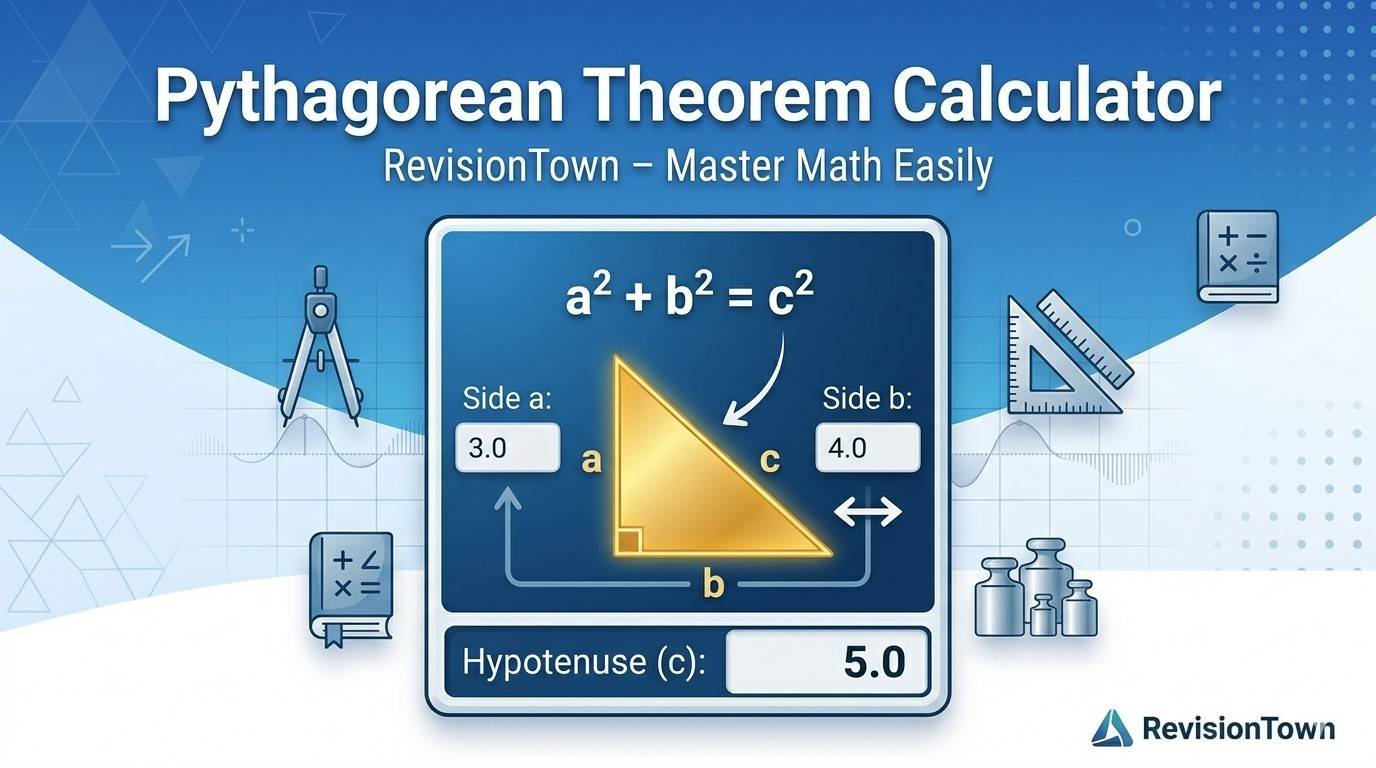
Pythagorean Theorem Calculator
Use this Pythagorean theorem calculator to find the missing side of a right triangle, calculate the hypotenuse, solve for a missing leg, verify whether three side lengths form a right triangle, and review the working behind each answer. The calculator uses \(a^2 + b^2 = c^2\), where \(a\) and \(b\) are the perpendicular legs and \(c\) is the hypotenuse, the side opposite the \(90^\circ\) angle.
This page is focused on calculation. It gives the formula, step-by-step substitution, area, perimeter, acute angles, common triples, real-world uses and mistakes to avoid. For a lesson-style explanation of the theorem itself, use the related Pythagorean theorem guide; for quick geometry tools, use the geometry calculators hub.
Remember: \(c\) must be the hypotenuse. It is always the longest side of a right triangle and always sits opposite the right angle.
Calculate a Right Triangle Side
Choose what you want to solve, enter the known sides, and press calculate. The labels are standard: \(a\) and \(b\) are the legs, \(c\) is the hypotenuse. Use one unit consistently for all entered sides. The result will be in the same unit.
What the Pythagorean Theorem Calculator Does
A Pythagorean theorem calculator solves side-length problems in right triangles. A right triangle is a triangle with one \(90^\circ\) angle. The two sides that meet at the right angle are called the legs, usually labeled \(a\) and \(b\). The side opposite the right angle is called the hypotenuse, usually labeled \(c\). The theorem states that the square of the hypotenuse equals the sum of the squares of the two legs.
The calculator above uses that equation in four practical ways. First, it can find the hypotenuse when the two legs are known. Second, it can find one missing leg when the hypotenuse and the other leg are known. Third, it can verify whether three entered side lengths satisfy the Pythagorean relationship. Fourth, it can calculate related values that often matter in geometry problems: triangle area, perimeter, acute angles, and the scale-adjusted sides of a similar right triangle.
The tool is useful for homework, construction layout, diagonal measurement, coordinate geometry, screen-size problems, navigation-style distance questions, and checking whether a set of side lengths is a Pythagorean triple. It is especially useful when the answer involves a square root that is not a whole number. Instead of stopping at a decimal only, the result panel also shows the formula structure so you can follow the algebra and decide whether an exact radical form is needed for classwork.
Use this calculator when you already know the triangle is right-angled or when you are checking whether it is right-angled. If the triangle is not right-angled, the Pythagorean theorem is not the correct method. In that case, a trigonometric method or coordinate distance formula may be better. For angle-based problems, use the trigonometry calculator or review right triangle trigonometry. For coordinate-distance work, the 2D distance calculator and 3D distance calculator handle point-to-point distance directly.
Pythagorean Theorem Formulas
The main equation \(a^2 + b^2 = c^2\) can be rearranged depending on which side is missing. The calculator uses the same rearrangements a student would write by hand. The only important condition is that \(c\) must be the hypotenuse. If \(c\) is not the longest side, or if it is not opposite the right angle, the calculation is not describing the intended right triangle.
Find the hypotenuse
When both legs are known, square each leg, add the squares, then take the square root. This is the most common Pythagorean theorem calculation.
For example, if \(a = 3\) and \(b = 4\), then \(c = \sqrt{3^2 + 4^2} = \sqrt{25} = 5\). The side \(c\) is longer than either leg because it stretches across the right angle.
Find a missing leg
When the hypotenuse and one leg are known, subtract the square of the known leg from the square of the hypotenuse, then take the square root. This works because \(a^2 + b^2 = c^2\) can be rearranged by moving one leg square to the other side.
If you enter a hypotenuse that is not longer than the known leg, the calculator will show an error. A right triangle cannot have a leg that is equal to or longer than its hypotenuse.
Area, perimeter and angles
After the three side lengths are known, the calculator also computes useful right-triangle properties. The area is half the product of the legs because the legs form the base and height. The perimeter is the sum of all three side lengths. The acute angles can be found from the ratios of side lengths.
The two acute angles always add to \(90^\circ\), because the third angle is already the right angle. If the calculator returns approximate angles such as \(36.87^\circ\) and \(53.13^\circ\), the slight rounding is normal.
Connection to distance formulas
The 2D distance formula is the Pythagorean theorem applied to a coordinate grid. If two points are \((x_1,y_1)\) and \((x_2,y_2)\), the horizontal change is \(x_2-x_1\), the vertical change is \(y_2-y_1\), and the straight-line distance is the hypotenuse.
In three dimensions, the same idea extends by adding the square of the change in \(z\):
For a formula-focused review, see the distance formulas page. For broader geometry reference, the geometry formulas page collects related area, perimeter, volume and coordinate formulas.
How to Use the Pythagorean Theorem Correctly
The most important step is identifying the hypotenuse. The hypotenuse is not just the side that happens to be labeled \(c\); it is the side opposite the right angle. In a diagram, it is the slanted side if the legs are drawn horizontally and vertically. In a word problem, it may be described as a diagonal, ladder, ramp, shortest straight-line path, cable, brace or line of sight. Once the hypotenuse is known, the formula is straightforward.
Start by drawing or imagining the right triangle. Label the legs \(a\) and \(b\), and label the hypotenuse \(c\). If you are calculating the diagonal of a rectangle, the width and height are the legs and the diagonal is the hypotenuse. If you are calculating how far a ladder reaches, the wall height and ground distance are the legs, while the ladder is the hypotenuse. If you are checking the corner of a rectangular foundation, two measured edges are legs and the diagonal tells whether the corner is square.
Then substitute the known values. Keep units consistent. Do not enter one side in feet and another in inches unless you convert first. If the calculator's unit label is set to feet, every side you enter should be in feet. If you need to convert measurements, the length conversion calculator can help before you solve the triangle.
After substitution, square the known side lengths. This is a common place for errors. The square of \(12\) is \(144\), not \(24\). The square of \(0.5\) is \(0.25\), not \(1\). If you are solving for a missing leg, subtract before taking the square root. If you are solving for the hypotenuse, add before taking the square root. The order matters because square roots do not distribute over addition or subtraction.
Finally, check reasonableness. The hypotenuse must be longer than either leg, but shorter than the sum of the two legs. For example, if the legs are 6 and 8, the hypotenuse is 10. That is longer than 8 and shorter than 14. If your calculator result violates those relationships, the labels or inputs are probably wrong. In geometry problems, a quick reasonableness check often catches mistakes before the final answer is submitted.
Common rule: Do not use \(a+b=c\). The Pythagorean theorem uses squares: \(a^2+b^2=c^2\). The final side length is found by taking a square root, not by adding the side lengths directly.
Worked Examples
Examples make the theorem easier to apply because they show how the same equation changes depending on the missing side. The calculator above gives the answer instantly, but the worked examples below are written the way you might show work in class.
Example 1: Find the hypotenuse
A right triangle has legs \(a=9\) and \(b=12\). Find the hypotenuse.
The hypotenuse is 15 units. This is a multiple of the \(3,4,5\) triangle because \(9,12,15\) is \(3\) times \(3,4,5\).
Example 2: Find a missing leg
A right triangle has hypotenuse \(c=13\) and one leg \(b=5\). Find the other leg.
The missing leg is 12 units. The three sides are \(5,12,13\), another common Pythagorean triple.
Example 3: Verify a triangle
Check whether side lengths 8, 15 and 17 form a right triangle. The longest side is 17, so it must be the hypotenuse.
Because the two sides match, \(8,15,17\) is a right triangle.
Example 4: Diagonal of a rectangle
A rectangular room is 10 ft wide and 24 ft long. The diagonal across the floor is the hypotenuse of a right triangle with legs 10 and 24.
The diagonal is 26 ft. This type of problem appears in construction, flooring layout, screen-size checks and movement across a rectangular area.
Example 5: Distance on a coordinate grid
Find the distance between \((2,3)\) and \((8,11)\). The horizontal change is \(8-2=6\). The vertical change is \(11-3=8\). These changes become the legs of a right triangle.
The distance is 10 units. This is why coordinate-distance problems are often Pythagorean theorem problems in disguise.
Pythagorean Triples
A Pythagorean triple is a set of three positive integers that satisfies \(a^2+b^2=c^2\). Triples are useful because they let you recognize exact right triangles quickly. The most famous triple is \(3,4,5\). If all three numbers are multiplied by the same positive number, the new set is also a right triangle. For example, \(6,8,10\), \(9,12,15\) and \(30,40,50\) are all scaled versions of \(3,4,5\).
Triples are common in exams because they reduce calculation time. If you see legs 5 and 12, you can often recognize the hypotenuse 13 without fully calculating. If you see a hypotenuse 25 and one leg 7, you may remember \(7,24,25\). Recognition should not replace understanding, but it is a useful check. If you forget a triple, the theorem still works.
Common Triples
| Leg a | Leg b | Hypotenuse c | Why it is useful |
|---|---|---|---|
| 3 | 4 | 5 | Most common right triangle; used for construction square checks. |
| 5 | 12 | 13 | Often appears in missing-leg problems. |
| 8 | 15 | 17 | Useful for larger integer side problems. |
| 7 | 24 | 25 | Common when the hypotenuse is a rounder square-related value. |
| 20 | 21 | 29 | Less obvious, helpful for verification practice. |
| 9 | 40 | 41 | Shows that one leg can be much longer than the other. |
Not every right triangle has integer side lengths. A triangle with legs 1 and 1 has hypotenuse \(\sqrt{2}\), which is irrational. A triangle with legs 2 and 5 has hypotenuse \(\sqrt{29}\). Exact radical answers are often preferred in algebra and geometry classes because they avoid premature rounding. Decimal answers are useful for measurement and construction, but exact form is cleaner for proof and symbolic work.
Real-World Uses of the Pythagorean Theorem
The Pythagorean theorem is one of the most practical formulas in geometry because right angles appear everywhere. Rectangles, coordinate grids, screen diagonals, walls, floors, ramps, braces, maps and digital graphics all create right triangles. Whenever a straight diagonal connects two perpendicular distances, the theorem is probably involved.
Construction and layout
Builders use the \(3,4,5\) rule to check whether a corner is square. If one side measures 3 units, the perpendicular side measures 4 units, and the diagonal between the endpoints measures 5 units, the corner is a right angle. The same idea works with scaled values such as \(6,8,10\) or \(30,40,50\). Roof, stair, ramp and brace problems also create right triangles. For roof and layout work, the theorem often appears behind practical calculators such as roofing, square footage and distance tools.
Coordinate geometry
On a coordinate plane, horizontal and vertical changes form the legs of a right triangle. The straight-line distance between two points is the hypotenuse. This is why the distance formula looks like the Pythagorean theorem. If you are solving coordinate problems directly, the distance calculator is a faster dedicated tool.
Technology and graphics
Computer graphics, games and user-interface design often need distances between points. A program may calculate how far a character is from an object, whether a mouse pointer is inside a radius, or how long a diagonal line should be. The formula is the same: square the horizontal difference, square the vertical difference, add, and take the square root.
Navigation and measurement
If a person travels north and east, the straight-line distance back to the starting point can be found with a right triangle. The path traveled may be two legs, while the direct route is the hypotenuse. Map grids, surveying, marine navigation and basic physics problems use this idea when perpendicular components are involved.
The theorem also supports other geometry topics. Triangle area, diagonals of squares and rectangles, distance in polygons, circle chords, vectors and right-triangle trigonometry all connect to it. If you are reviewing shapes more broadly, the shapes in geometry guide and the triangle area calculator can help place the theorem in a wider geometry toolkit.
Right Triangle Vocabulary
Understanding the vocabulary makes the formula much easier to use. The legs are the two sides that form the right angle. They may be vertical and horizontal in a drawing, but they do not have to be. A triangle can be rotated, and the legs are still the sides touching the right angle. The hypotenuse is the side opposite the right angle. It never touches the right angle directly and it is always the longest side.
The square on a side means the area of a square built outward from that side. The theorem can be interpreted visually: the area of the square on the hypotenuse equals the combined areas of the squares on the two legs. This area interpretation is why the formula uses squares. It is not just a numerical trick; it describes a geometric relationship between areas.
The converse of the theorem is also important. If three side lengths satisfy \(a^2+b^2=c^2\), with \(c\) as the longest side, then the triangle is right-angled. This is the logic behind the calculator's verify mode. It compares the sum of the two smaller squares with the square of the largest side. Because decimals can introduce rounding, the calculator uses a tolerance when checking approximate measurements.
Study tip: when a problem says diagonal, shortest distance, straight-line distance, ladder, ramp, brace, rectangle corner, coordinate distance or right triangle, pause and check whether the Pythagorean theorem is the intended method.
Common Mistakes and How to Avoid Them
The first mistake is using the theorem on a triangle that is not right-angled. The formula \(a^2+b^2=c^2\) is not true for every triangle. If an angle is not \(90^\circ\), a different method is needed. Some problems include a diagram that looks almost right-angled, but unless the right angle is marked or stated, you should be careful. In advanced geometry, the law of cosines generalizes the idea to non-right triangles.
The second mistake is labeling the hypotenuse incorrectly. The hypotenuse must be the longest side and must be opposite the right angle. If a student accidentally makes a leg the hypotenuse, the missing-side calculation may involve subtracting the wrong squares or taking the square root of a negative number. In the calculator, this usually appears as an input error when a known leg is greater than or equal to \(c\).
The third mistake is adding side lengths instead of adding squares. A triangle with legs 6 and 8 does not have hypotenuse 14. It has \(c=\sqrt{6^2+8^2}=\sqrt{100}=10\). The number 14 is the sum of the legs, not the diagonal. The theorem compares square areas first and side length only after the square root is taken.
The fourth mistake is rounding too early. If \(c=\sqrt{29}\), rounding to 5.39 at the beginning can create small errors in later area, perimeter or angle calculations. If the problem asks for exact form, keep \(\sqrt{29}\). If it asks for a decimal, round at the end. The calculator provides decimal output for measurement use, but the displayed formula helps you preserve exact reasoning when needed.
The fifth mistake is mixing units. If one side is in feet and another in inches, the theorem will still produce a number, but the number will not describe the real triangle. Convert every side to the same unit first. If a problem says a room is 12 ft by 180 in, convert 180 in to 15 ft or convert 12 ft to 144 in before calculating the diagonal.
How the Theorem Connects to Square Roots
The Pythagorean theorem is one of the first places many students see square roots used naturally. Squaring a side converts a length into the area of a square. Adding the two smaller square areas gives the larger square area. To return from square area to side length, you take the square root. That is why square roots are not an optional detail; they are built into the geometry.
For example, if \(a=6\) and \(b=7\), then \(c^2=36+49=85\). The hypotenuse is \(c=\sqrt{85}\). Since 85 is not a perfect square, the exact answer remains \(\sqrt{85}\). A decimal approximation is about 9.22. Both answers can be correct depending on the context. In class, exact radical form may be preferred. In measurement, a rounded decimal is usually more practical.
If square roots are the part of the process that feels difficult, review perfect squares and radical simplification. The page on square roots and cube roots is a natural companion to this calculator because missing-side calculations often end with a square root.
Exact Answers, Decimal Answers and Rounding
A Pythagorean theorem calculation often creates two valid forms of the same answer: an exact radical and a decimal approximation. The exact radical is the square root expression before rounding. The decimal approximation is the measured value you would use on a ruler, tape measure, screen, map or construction drawing. Understanding the difference helps you decide what to submit in a math class and what to use in a practical measurement situation.
Consider a right triangle with legs 4 and 7. The hypotenuse satisfies \(c^2=4^2+7^2=16+49=65\). Since 65 is not a perfect square, the exact answer is \(c=\sqrt{65}\). A decimal approximation is about 8.062. If the directions say "leave your answer in simplest radical form," \(\sqrt{65}\) is the cleaner answer. If the directions say "round to the nearest tenth," then 8.1 is the expected answer. If a carpenter is measuring a board, the decimal or a fractional measurement is more useful than the radical notation.
Do not round in the middle of the problem unless the context forces it. If you round the hypotenuse early, then use that rounded hypotenuse to calculate an angle or perimeter, small errors can accumulate. This matters most in multi-step problems, coordinate geometry and engineering-style word problems. A safe habit is to keep the full calculator value or exact radical form until the final line, then round according to the requested precision.
Radicals can sometimes be simplified. If \(c=\sqrt{72}\), then \(72=36\times2\), so \(c=6\sqrt{2}\). The decimal approximation is about 8.485. Both expressions describe the same length, but \(6\sqrt{2}\) shows exact structure. If your course is focused on algebraic exactness, simplified radicals matter. If your course is focused on applied measurement, a rounded decimal may be acceptable. The calculator provides decimal output because web tools are commonly used for measurement, but the surrounding formulas show how to keep the exact reasoning clear.
When checking a rounded answer, use a tolerance. Suppose a triangle has legs 1 and 1, and the hypotenuse is entered as 1.414. Squaring the rounded hypotenuse gives approximately 1.999396, not exactly 2. That does not mean the triangle is not right-angled; it means the decimal was rounded. This is why verify mode includes a tolerance field. A tolerance of 0.001 or 0.01 can make sense for approximate measurements, while exact integer triples can use a much smaller tolerance.
Proof Intuition: Why the Theorem Works
The calculator is designed to solve problems quickly, but the theorem is easier to remember when you understand why it is true. One visual proof starts with a right triangle and builds a square on each side. The square on leg \(a\) has area \(a^2\). The square on leg \(b\) has area \(b^2\). The square on hypotenuse \(c\) has area \(c^2\). The theorem says the two smaller square areas combine to equal the larger square area.
A classic rearrangement proof uses four identical right triangles inside a larger square. Arrange the four triangles so their hypotenuses form a tilted square in the center. Then arrange the same four triangles another way so the uncovered regions are two squares with side lengths \(a\) and \(b\). Because the large outside square and the four triangles are the same in both arrangements, the leftover area must also be the same. The central square area is \(c^2\), and the two smaller square areas are \(a^2+b^2\). Therefore \(a^2+b^2=c^2\).
This proof is powerful because it explains why the theorem is about area rather than ordinary length addition. The length \(a+b\) is not equal to the hypotenuse. Instead, the areas of squares built on the legs add to the area of the square built on the hypotenuse. After comparing areas, you take the square root to recover the side length. That is why the theorem feels different from perimeter formulas and why forgetting the square step changes the meaning completely.
The converse has a proof idea too. If three side lengths satisfy \(a^2+b^2=c^2\), where \(c\) is the longest side, then a triangle with those sides must have a right angle opposite \(c\). This is why builders can use the \(3,4,5\) rule to check a corner. If a measured triangle has sides in that relationship, the angle opposite the longest side is right. In practice, measurement error is possible, so large layouts use careful tape placement and repeated checks.
You do not need to reproduce a full proof every time you calculate a missing side, but proof intuition prevents formula misuse. It reminds you that the theorem belongs to right triangles, that \(c\) is tied to the right angle, and that the equation compares square areas before it gives a length. That understanding is what separates a reliable solution from a memorized button press.
Using the Theorem in 3D Problems
Many real objects are three-dimensional, but the Pythagorean theorem still appears inside them. A rectangular box, room or prism has a width, depth and height. To find a space diagonal from one corner to the opposite corner, you can apply the theorem twice. First, find the diagonal across the rectangular base. Then use that base diagonal and the height as the legs of a second right triangle.
Suppose a box is 6 units long, 8 units wide and 10 units tall. The base diagonal is \(\sqrt{6^2+8^2}=\sqrt{100}=10\). The space diagonal is then \(\sqrt{10^2+10^2}=\sqrt{200}=10\sqrt{2}\), about 14.14 units. You can also combine the two steps into one formula: \(d=\sqrt{l^2+w^2+h^2}\). This formula is just the Pythagorean theorem extended through two perpendicular right triangles.
This idea appears in packaging, architecture, 3D modeling, storage, shipping, game design and physics. If you need to know whether a long object can fit inside a box or through a room, the diagonal may matter more than any single side. If you need a dedicated coordinate tool, use the 3D distance calculator. If the problem is a simple right triangle on a flat plane, the calculator on this page is the more direct option.
Be careful not to use a 2D diagonal when the problem asks for a 3D diagonal. The diagonal across the floor of a room is not the same as the diagonal from a lower floor corner to an upper ceiling corner. The first uses two dimensions; the second uses three. Drawing a quick sketch usually reveals whether there is one right triangle or a pair of connected right triangles.
Problem-Solving Checklist
When a Pythagorean theorem problem feels confusing, use a checklist instead of guessing. First, confirm there is a right angle. If a right angle is not stated or marked, ask whether the theorem is actually allowed. Second, identify the hypotenuse. It is opposite the right angle and is the longest side. Third, decide whether you are adding squares or subtracting squares. Add when finding the hypotenuse. Subtract when finding a missing leg.
Fourth, keep units consistent. Convert everything before calculation. Fifth, write the formula before substituting values. This helps you avoid placing the hypotenuse in the wrong position. Sixth, perform the square operations carefully. Seventh, take the square root only after the addition or subtraction is finished. Eighth, check whether the answer makes sense compared with the known side lengths. The missing leg should be shorter than the hypotenuse; the hypotenuse should be longer than either leg.
Ninth, decide whether the final answer should be exact or rounded. A classroom answer may need radical form. A measurement answer may need a decimal to a practical number of places. Tenth, include units. A side length in a geometry problem is not just a number; it is a measured length. Area uses square units, perimeter uses ordinary units, and angles use degrees unless another unit is stated.
This checklist is intentionally simple because most mistakes come from skipping one of these basics. The calculator can catch some errors, such as a hypotenuse that is too short, but it cannot know whether your diagram was labeled correctly. The habit of drawing, labeling and checking reasonableness remains the best protection against wrong answers.
For measurement problems, add one more practical check: ask whether the real object is actually straight and perpendicular. A wall that is not vertical, a floor that is not level, or a tape line that bends around an obstacle will not match the ideal right triangle in the diagram. The theorem gives the straight-line mathematical distance. The accuracy of a real-world answer still depends on how accurately the right angle and side lengths were measured.
How to Interpret the Calculator Results
The result panel gives more than the missing side because right-triangle problems often ask for follow-up values. Side \(a\), side \(b\) and side \(c\) are shown together so you can confirm the full triangle. The area is calculated as \(\frac{ab}{2}\), which is valid because the legs are perpendicular. The perimeter is \(a+b+c\), useful for boundary, trim, framing and path-length problems. The acute angles help connect the theorem to trigonometry.
The check value compares \(a^2+b^2\) with \(c^2\). In solve modes, these should match apart from rounding. In verify mode, this comparison is the main result. If the values differ by more than the tolerance, the entered side lengths do not form a right triangle with \(c\) as the hypotenuse. If the calculator says the triangle is right only after using the longest side as the hypotenuse, your side labels may need to be rearranged.
The scale factor field is included for similar triangles. If a \(3,4,5\) triangle is scaled by 2, it becomes \(6,8,10\). If it is scaled by 0.5, it becomes \(1.5,2,2.5\). The angles stay the same because similar triangles preserve shape, while side lengths, perimeter and area change. Side lengths scale by the factor. Area scales by the square of the factor. This is a useful idea in drawings, models, maps and blueprints.
If the calculator returns many decimal places, round based on the purpose. For a school problem, follow the instruction. For a measurement, do not claim more precision than your tool can support. If a tape measure is accurate only to the nearest millimeter, giving a diagonal to six decimal places is not meaningful. Precision should reflect both the calculation and the quality of the original measurements.
Using the Calculator for Homework
For homework, use the calculator as a checking tool rather than a replacement for written work. Start by writing the formula. Substitute the known values. Show the square step. Add or subtract as required. Then take the square root. After you have your answer, use the calculator to verify the result and compare the area, perimeter and angle information if your problem asks for more than one value.
If your class requires exact answers, do not submit only a rounded decimal unless the directions allow it. The calculator gives decimal output because it is useful for measurement, but a teacher may expect \(\sqrt{13}\), \(2\sqrt{5}\) or \(5\sqrt{2}\). A good habit is to write both when appropriate: exact form first, decimal approximation second. For example, \(c=\sqrt{52}=2\sqrt{13}\approx 7.21\).
Grade-level pages can help place the calculator in the right learning sequence. If you are first learning the theorem, use the eighth grade Pythagorean theorem guide. If you are reviewing proofs, triples, converse statements or trigonometry connections, the tenth grade Pythagorean theorem page provides a more advanced classroom context.
Quick Reference Table
| Goal | Known values | Formula | Check |
|---|---|---|---|
| Find hypotenuse | Both legs \(a\) and \(b\) | \(c=\sqrt{a^2+b^2}\) | \(c\) should be longer than both legs. |
| Find leg \(a\) | Leg \(b\) and hypotenuse \(c\) | \(a=\sqrt{c^2-b^2}\) | \(c\) must be greater than \(b\). |
| Find leg \(b\) | Leg \(a\) and hypotenuse \(c\) | \(b=\sqrt{c^2-a^2}\) | \(c\) must be greater than \(a\). |
| Verify right triangle | All three sides | \(a^2+b^2=c^2\) | Use the longest side as \(c\). |
| Find area | Both legs | \(\text{Area}=\frac{ab}{2}\) | Only use perpendicular legs as base and height. |
Why This Calculator Stays Focused on Right Triangles
Geometry has many calculators, and each should answer a clear question. This page is designed for Pythagorean theorem problems: missing side, hypotenuse, right-triangle verification and related right-triangle values. It does not try to replace every triangle tool. If the goal is area from base and height, the triangle area calculator is more direct. If the goal is formula review, triangle area formulas are more useful. If the goal is broad calculator browsing, the calculators page is the natural starting point.
This separation keeps the page practical. A student who searches for a Pythagorean theorem calculator usually needs a side length or a check, not a full catalog of geometry formulas. A reader who wants the proof, historical context or class notes can move to the theorem lesson. A reader who needs coordinate distance can move to distance tools. The result is a calculator page that can rank for calculator intent while supporting, rather than competing with, related learning pages.
Pythagorean Theorem Calculator FAQ
What does a Pythagorean theorem calculator do?
It solves right-triangle side problems using \(a^2+b^2=c^2\). Depending on the selected mode, it can find the hypotenuse, find a missing leg, verify whether three side lengths form a right triangle, and calculate area, perimeter and acute angles.
When can I use \(a^2+b^2=c^2\)?
Use it only for right triangles. The sides \(a\) and \(b\) must be the legs that meet at the right angle, and \(c\) must be the hypotenuse opposite the right angle.
How do I find the hypotenuse?
Square both legs, add the squares, and take the square root: \(c=\sqrt{a^2+b^2}\). The hypotenuse will be longer than either leg.
How do I find a missing leg?
Square the hypotenuse, subtract the square of the known leg, and take the square root. For example, \(a=\sqrt{c^2-b^2}\). The hypotenuse must be greater than the known leg.
What is the hypotenuse?
The hypotenuse is the side opposite the right angle. It is always the longest side of a right triangle. In the standard formula, it is labeled \(c\).
Can I use the theorem if the triangle is not right-angled?
No. If the triangle does not have a \(90^\circ\) angle, use a different method such as the law of cosines, trigonometry, or another triangle formula that matches the given information.
What is a Pythagorean triple?
A Pythagorean triple is a set of three positive integers that satisfies \(a^2+b^2=c^2\). Examples include \(3,4,5\), \(5,12,13\), \(8,15,17\) and \(7,24,25\).
Why does the calculator ask for a tolerance in verify mode?
Measured sides and rounded decimals may not satisfy the equation exactly. Tolerance lets the calculator decide whether the difference is small enough to treat as a right-triangle match for practical purposes.
Can the answer be a square root instead of a decimal?
Yes. Many right triangles have irrational side lengths. For example, legs 1 and 1 give \(c=\sqrt{2}\). Exact radical form is often best for classwork, while decimals are useful for measurement.
How is the distance formula related to the Pythagorean theorem?
The distance formula treats horizontal and vertical coordinate changes as the legs of a right triangle. The straight-line distance between the points is the hypotenuse.
Can I use different units for different sides?
No. Convert all sides to the same unit first. Mixing feet, inches, meters or centimeters in one calculation will produce an incorrect result.
Does the order of \(a\) and \(b\) matter?
No. The two legs can be swapped because \(a^2+b^2\) equals \(b^2+a^2\). The hypotenuse \(c\) is the side that must be identified correctly.


