
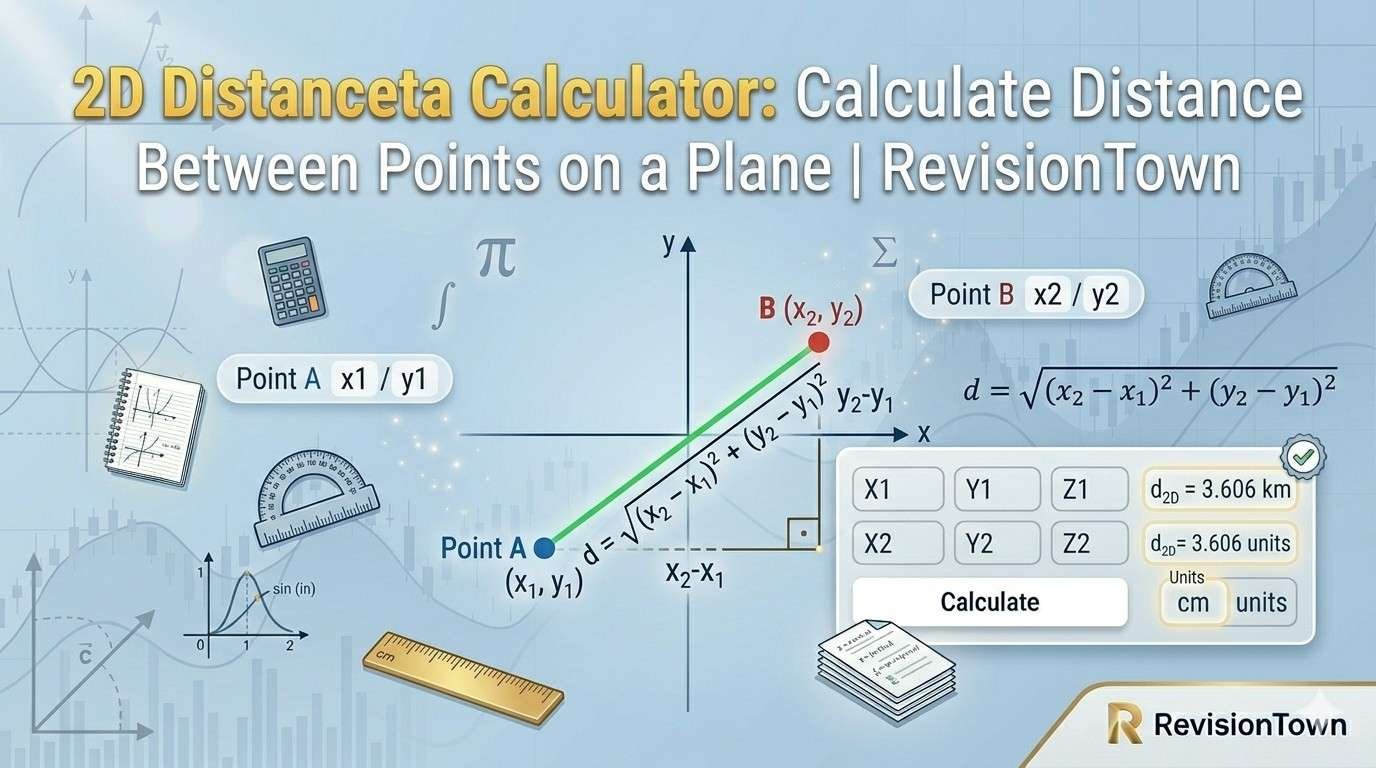
Coordinate geometry, distance formula, midpoint, slope and grid metrics
2D Distance Calculator: Calculate Distance Between Points on a Plane
Use this 2D distance calculator to find the straight-line distance between two points on a coordinate plane, compare Euclidean, Manhattan and Chebyshev distance, calculate midpoint, slope and angle, and understand the formulas behind coordinate geometry. The guide below explains when each distance metric is appropriate and how to avoid common mistakes with signs, squares, square roots and units.
What the 2D Distance Calculator Does
A 2D distance calculator measures how far apart two points are on a flat coordinate plane. A point in two dimensions is written as \((x,y)\), where \(x\) gives horizontal position and \(y\) gives vertical position. When two points are known, the calculator can measure the horizontal change, vertical change and straight-line distance between them.
The main calculation is Euclidean distance, also called straight-line distance. If the points are \(P_1(x_1,y_1)\) and \(P_2(x_2,y_2)\), the distance is found by applying the Pythagorean theorem to the right triangle formed by the horizontal and vertical differences. The calculator also gives related values that are often needed in coordinate geometry: midpoint, slope, angle, distance from the origin, Manhattan distance and Chebyshev distance.
This page is focused on coordinate-plane distance. If you need distance in three-dimensional space, use the 3D Distance Calculator. If you need distance between latitude and longitude coordinates on Earth, the Latitude Longitude Distance Calculator is a better fit because geographic distance needs spherical or ellipsoidal thinking rather than a flat \(x\)-\(y\) plane. For a broader collection of related tools, see the Distance Calculator and Geometry Calculators pages.
The Distance Formula
The standard 2D distance formula is:
In this formula, \(d\) is the distance between the two points. The expression \(x_2-x_1\) is the horizontal change, often written as \(\Delta x\). The expression \(y_2-y_1\) is the vertical change, often written as \(\Delta y\). The squares make both changes non-negative inside the sum, and the square root converts the squared length back into an ordinary distance.
The formula is symmetrical. The distance from \(P_1\) to \(P_2\) is the same as the distance from \(P_2\) to \(P_1\). If the subtraction order changes, \(\Delta x\) and \(\Delta y\) may change signs, but their squares do not. That is why distance is always non-negative.
Why the Formula Comes from the Pythagorean Theorem
The distance formula is the Pythagorean theorem written in coordinate form. When two points are plotted on a plane, you can draw a horizontal segment from the first point and a vertical segment to the second point. These two segments form the legs of a right triangle. The direct distance between the points is the hypotenuse.
If the horizontal leg has length \(|x_2-x_1|\) and the vertical leg has length \(|y_2-y_1|\), then the Pythagorean theorem gives:
Taking the square root of both sides gives the distance formula. This is also why the formula works in every quadrant. The horizontal and vertical changes can be positive or negative, but the leg lengths of the triangle are non-negative. Squaring the changes handles the signs automatically.
The formula is especially easy to recognize in \(3\)-\(4\)-\(5\) right triangles. If the points differ by \(3\) units horizontally and \(4\) units vertically, the distance is \(5\) units. The same pattern works whether the movement is right and up, left and down, right and down, or left and up. The signs change, but the distance does not.
Step-by-Step Example
Find the distance between \(A(1,2)\) and \(B(4,6)\).
Step 1: Find the horizontal change.
Step 2: Find the vertical change.
Step 3: Square both changes and add.
Step 4: Take the square root.
The two points are \(5\) units apart. This is an exact whole-number distance because the horizontal and vertical changes form a familiar Pythagorean triple. Many coordinate-distance problems do not simplify to whole numbers. In those cases, it is often best to keep the exact radical form and also give a decimal approximation if the problem asks for one.
Euclidean, Manhattan and Chebyshev Distance
The word "distance" can mean different things depending on how movement is allowed. In coordinate geometry, the default distance is Euclidean distance: the straight-line path. In a grid-based system, movement may be restricted. Manhattan distance counts horizontal and vertical movement only. Chebyshev distance counts the number of diagonal-or-straight steps needed when one diagonal step can change both coordinates at once.
| Metric | Formula | Best use | Example from \((0,0)\) to \((3,4)\) |
|---|---|---|---|
| Euclidean | \(\sqrt{(\Delta x)^2+(\Delta y)^2}\) | Straight-line geometry, physics, graphics, maps on a local plane | \(5\) |
| Manhattan | \(|\Delta x|+|\Delta y|\) | Grid movement, city blocks, taxicab movement, four-direction games | \(7\) |
| Chebyshev | \(\max(|\Delta x|,|\Delta y|)\) | Chess king moves, eight-direction grids, diagonal step systems | \(4\) |
For ordinary coordinate geometry, use Euclidean distance unless the problem says otherwise. For city-block movement, pathfinding on a square grid, or problems where diagonal movement is not allowed, Manhattan distance may be more appropriate. The calculator includes all three so you can compare how movement rules change the result.
Midpoint, Slope and Angle
Distance tells you how long the segment is, but it does not tell you where the segment is centered or what direction it points. That is why midpoint and slope are often used with distance. The midpoint is the point halfway between the two endpoints:
Slope describes steepness:
If \(x_2=x_1\), the line is vertical and the slope is undefined. A vertical segment can still have a valid distance; slope and distance answer different questions. The angle from the positive \(x\)-axis can be found using:
The midpoint formula has its own detailed treatment on RevisionTown's Midpoint Formula resource. For line equations built from a point and a slope, see the Point-Slope Equation Formula. Those topics connect naturally to distance because a segment on a plane has position, length and direction.
Distance from the Origin
The origin is the point \((0,0)\). Distance from the origin is a special case of the distance formula where one point is \((0,0)\). If the point is \(P(x,y)\), then:
This value is also the magnitude of the position vector \(\langle x,y\rangle\). In polar coordinates, it is the radius \(r\). A point such as \((3,4)\) has distance \(5\) from the origin because \(\sqrt{3^2+4^2}=5\). A point such as \((-3,-4)\) also has distance \(5\) from the origin because the signs disappear when squared.
Origin distance is common in physics, vectors, coordinate geometry, complex numbers, computer graphics and game development. If an object is located at \((x,y)\), its distance from the starting point or center can be found with this simplified formula. The calculator's origin mode uses the second point fields as the point \(P(x,y)\) and measures from \((0,0)\).
Exact Radical Form vs Decimal Approximation
Some distances simplify neatly. For example, \(\sqrt{25}=5\) and \(\sqrt{100}=10\). Other distances do not simplify to whole numbers. If \(\Delta x=2\) and \(\Delta y=3\), then:
The exact distance is \(\sqrt{13}\). A decimal approximation is about \(3.606\). In many math classes, exact radical form is preferred because it has no rounding error. In applied settings, a rounded decimal may be more useful. The calculator gives decimals for convenience, but the formula section shows how to keep exact form when needed.
To simplify a radical, look for perfect-square factors. For example:
A distance of \(\sqrt{50}\) units can therefore be written exactly as \(5\sqrt{2}\) units. If the problem asks for an exact answer, do not round unless instructed. If it asks for the nearest tenth, hundredth or thousandth, use a decimal approximation after the exact calculation is set up.
Common Distance Patterns
Certain coordinate differences appear frequently because they form Pythagorean triples. Recognizing these patterns can help you check answers quickly.
| \(|\Delta x|\) | \(|\Delta y|\) | Distance | Pattern |
|---|---|---|---|
| \(3\) | \(4\) | \(5\) | \(3\)-\(4\)-\(5\) |
| \(5\) | \(12\) | \(13\) | \(5\)-\(12\)-\(13\) |
| \(8\) | \(15\) | \(17\) | \(8\)-\(15\)-\(17\) |
| \(7\) | \(24\) | \(25\) | \(7\)-\(24\)-\(25\) |
| \(1\) | \(1\) | \(\sqrt{2}\) | Diagonal of a unit square |
Patterns are useful, but they are not a substitute for the formula. If either coordinate difference is negative, use its absolute value for pattern recognition or square the signed difference directly. For example, a change of \(-3\) and \(4\) still gives distance \(5\).
How to Use the Calculator Correctly
- Identify the first point \(P_1(x_1,y_1)\) and second point \(P_2(x_2,y_2)\).
- Enter \(x_1\), \(y_1\), \(x_2\) and \(y_2\) into the calculator.
- Use Distance mode for Euclidean straight-line distance.
- Use Metrics mode when comparing Euclidean, Manhattan and Chebyshev distance.
- Use Midpoint mode when you also need the center of the segment, slope or angle.
- Use Origin mode when measuring a point's distance from \((0,0)\).
- Check whether the result should be exact, rounded or expressed with units.
If the problem comes from a textbook or worksheet, keep a written setup beside the calculator result. A correct final answer usually needs the formula, substitutions and a simplified result. The calculator is best used as a checking and exploration tool, not as a replacement for showing the method.
2D Distance in Coordinate Geometry
Coordinate geometry connects algebra and geometry by placing shapes on a coordinate plane. Distance is one of the central tools because it measures side lengths, diagonals, radii and separations between points. You can use it to prove whether a triangle is isosceles, whether a quadrilateral has equal diagonals, whether a point lies on a circle, or whether two points are a fixed distance apart.
For example, a circle centered at \((h,k)\) with radius \(r\) contains all points \((x,y)\) whose distance from the center is \(r\). Applying the distance formula gives:
Squaring both sides gives the standard circle equation:
This is one reason distance formula is usually taught before circle equations. It explains what the radius means on a coordinate plane. For more coordinate-plane practice, RevisionTown has resources for Coordinate Plane 5th Grade Math, Coordinate Plane Sixth Grade, Coordinate Plane Seventh Grade and Coordinate Plane Eighth Grade. For higher-level line and circle work, see Lines in the Coordinate Plane and Circles in the Coordinate Plane.
Applications in Graphs, Design and Programming
Distance between points is used anywhere positions are stored as coordinates. In graphing, distance measures segment lengths and checks relationships between points. In computer graphics, distance can decide whether the mouse pointer is close enough to select an object, whether two shapes overlap, or how far a sprite is from a target. In game development, it can control collision detection, enemy range, movement limits and camera behavior.
In design and CAD work, two-dimensional distance can measure plan distances, drawing dimensions and layout spacing. In robotics or simulation, planar distance can estimate how far an object must travel on a flat surface. In data analysis, distance between two points in a scatter plot can help identify clusters or outliers, although advanced statistics may use other distance metrics depending on the data.
The correct distance metric depends on the movement rules. A drone or cursor moving freely across a plane uses Euclidean distance. A character moving only up, down, left and right across a grid may use Manhattan distance. A chess king or eight-direction tile movement may use Chebyshev distance. Choosing the metric before calculating prevents a technically correct number from answering the wrong practical question.
Units and Scale
Coordinate distance is measured in the same units as the coordinate axes. If the \(x\)- and \(y\)-coordinates are measured in meters, the distance is in meters. If the coordinates are in pixels, the distance is in pixels. If a map uses grid units, the distance is in grid units unless a scale converts those units to real-world measurements.
Be careful when the axes use different scales. The standard formula assumes one unit on the \(x\)-axis has the same physical size as one unit on the \(y\)-axis. If a graph is visually stretched or if a map has different horizontal and vertical scale factors, convert each coordinate difference to a common real unit before applying the formula.
For example, suppose one grid unit on the \(x\)-axis represents \(10\) meters and one grid unit on the \(y\)-axis represents \(5\) meters. If two points differ by \(3\) grid units horizontally and \(4\) grid units vertically, the real horizontal distance is \(30\) meters and the real vertical distance is \(20\) meters. The real straight-line distance is:
Do not simply calculate \(\sqrt{3^2+4^2}=5\) unless the grid units mean the same thing in both directions.
Common Mistakes to Avoid
- Forgetting to square both differences: Use \((x_2-x_1)^2\) and \((y_2-y_1)^2\), not just one of them.
- Adding coordinates instead of subtracting: Distance depends on change between coordinates, not the coordinate sums.
- Dropping a negative sign too early: It is fine to use absolute differences, but be consistent. Squaring signed differences also works.
- Confusing slope with distance: Slope is a ratio of vertical change to horizontal change. Distance is a length.
- Forgetting the square root: \((\Delta x)^2+(\Delta y)^2\) is distance squared, not distance.
- Rounding too soon: Keep exact values until the final step when possible.
- Using Euclidean distance for a grid-only problem: If diagonal movement is not allowed, Manhattan distance may be the intended metric.
- Using plane distance for Earth coordinates: Latitude and longitude distance requires a geographic method, not ordinary 2D coordinate distance over large regions.
Reading Coordinate Notation Carefully
A coordinate point is written in the order \((x,y)\). The first number is the horizontal position, and the second number is the vertical position. A point \((3,5)\) is not the same as \((5,3)\). Swapping the numbers changes the location, and it can change the distance to another point. Before calculating, label the coordinates clearly:
This labeling habit is especially useful when the coordinates include negative numbers or decimals. For example, if \(P_1=(-4,7)\) and \(P_2=(2,-1)\), then \(x_1=-4\), \(y_1=7\), \(x_2=2\), and \(y_2=-1\). The horizontal change is \(2-(-4)=6\), and the vertical change is \(-1-7=-8\). The distance is \(\sqrt{6^2+(-8)^2}=10\).
The signs matter in the subtraction step, but the final distance does not become negative. A common mistake is to subtract \(-4\) from \(2\) incorrectly. Remember that subtracting a negative is addition:
If you make a quick sketch, the result becomes easier to check. The two points above move \(6\) units horizontally and \(8\) units vertically. A distance of \(10\) makes sense because the changes form a scaled \(3\)-\(4\)-\(5\) triangle.
Horizontal and Vertical Special Cases
Some distance problems are simpler than the full formula suggests. If two points have the same \(y\)-coordinate, the segment is horizontal. The vertical change is \(0\), so the distance is just the absolute horizontal difference:
For example, the distance between \((-3,4)\) and \((8,4)\) is \(|8-(-3)|=11\). The formula still works:
If two points have the same \(x\)-coordinate, the segment is vertical. The horizontal change is \(0\), so the distance is the absolute vertical difference:
For example, the distance between \((5,-2)\) and \((5,9)\) is \(|9-(-2)|=11\). In this case the slope is undefined because the denominator \(x_2-x_1\) is zero, but the distance is perfectly valid. This difference between slope and distance is important: a vertical line has undefined slope, not undefined length.
Distance Squared: When the Square Root Is Not Needed
In some applications, especially programming and comparison problems, distance squared is enough. Distance squared is:
If you only need to compare which of two points is closer, you can compare \(d^2\) values without taking square roots. Since the square root function is increasing for non-negative numbers, the smaller \(d^2\) gives the smaller distance. For example, if point \(A\) has \(d^2=25\) from a target and point \(B\) has \(d^2=40\), point \(A\) is closer. You do not need to compute \(\sqrt{25}\) and \(\sqrt{40}\) to know that.
This shortcut appears in game development and computer graphics. A program checking whether an object is within a circular radius \(r\) can test:
Avoiding repeated square roots can make large simulations faster. However, if the problem asks for the actual distance, you must take the square root. A value of \(d^2=25\) means the distance is \(5\), not \(25\).
Choosing the Right Distance Metric in Grid Problems
A coordinate plane in a textbook usually allows straight-line measurement. A grid in a game or city map may not. The correct distance metric depends on the movement rules. If movement can occur in any direction, Euclidean distance is the natural choice. If movement is allowed only north, south, east and west, Manhattan distance is usually correct. If diagonal movement is allowed and one diagonal step costs the same as one straight step, Chebyshev distance may be correct.
Consider moving from \((0,0)\) to \((6,2)\). Euclidean distance is:
Manhattan distance is:
Chebyshev distance is:
All three values are correct for different movement systems. A robot that can drive straight toward the target might use Euclidean distance. A taxi driving on a rectangular street grid might use Manhattan distance. A game piece that can move diagonally one square at a time might use Chebyshev distance. The calculator lets you compare the three so the mathematical result matches the real or simulated movement rule.
Using Distance in Coordinate Proofs
Coordinate proofs often use the distance formula to prove geometric relationships. Instead of relying on a diagram, you calculate lengths from coordinates. If two side lengths are equal, the shape may have equal sides. If two diagonals are equal, that can support a rectangle proof. If the distance from a center to several points is the same, those points lie on a circle centered at that point.
To prove a triangle is isosceles, calculate the three side lengths. If two distances match, the triangle has two equal sides. To prove a triangle is right, calculate side lengths and check whether they satisfy:
This method connects distance formula with the Pythagorean Theorem Calculator. For example, if the side lengths are \(5\), \(12\) and \(13\), the triangle is right because \(5^2+12^2=13^2\).
Coordinate proofs are strongest when distance is paired with slope or midpoint. Equal slopes can show parallel lines, negative reciprocal slopes can show perpendicular lines, midpoints can show bisected diagonals, and distance can show equal sides. The calculator gives several of these values together because coordinate proof problems rarely need distance alone.
Rounding, Units and Answer Format
The final form of a distance answer depends on the context. In a pure geometry problem, an exact radical such as \(\sqrt{29}\) units may be preferred. In a measurement problem, a decimal such as \(5.39\) meters may be more useful. In a programming or graphics problem, a decimal with several places may be enough because coordinates are already approximate.
If a problem asks for the nearest tenth, round only at the end. For example:
Rounded to the nearest tenth, this is \(5.4\). Rounded to the nearest hundredth, it is \(5.39\). If you round intermediate values too early, the final answer can drift away from the correct value. This is especially important when a distance result is used in another formula.
Units should be included when the coordinates have units. If the coordinates are measured in meters, the distance is in meters. If coordinates are pixels, the distance is in pixels. If coordinates are abstract grid units, write "units" unless the problem defines a specific scale. A bare number can be acceptable in a coordinate-geometry exercise, but applied work should include a unit label.
When a Flat 2D Distance Is Not Enough
The ordinary 2D distance formula assumes a flat plane with consistent scale. That is exactly right for coordinate geometry, many diagrams, local screen coordinates, graphing problems and idealized maps. It is not always right for every real-world distance question.
If a problem involves height or depth as a third coordinate, use three-dimensional distance:
If a problem involves latitude and longitude on Earth, a flat formula may be acceptable only over very small local regions with appropriate projection assumptions. For long distances, the Earth's curvature matters. Use a geographic distance method instead. If a problem involves a route along roads, the shortest straight-line distance may not describe the actual travel distance. A route can be much longer than direct separation.
Knowing when not to use a formula is part of mathematical maturity. The 2D distance calculator answers a precise question: how far apart are two points on a flat coordinate plane?
Classroom Workflow for Learning the Distance Formula
A good learning sequence begins with graph paper. Plot two points and draw the horizontal and vertical changes. Count the grid squares to find \(|\Delta x|\) and \(|\Delta y|\). Then draw the diagonal segment and recognize it as the hypotenuse of a right triangle. This visual step makes the formula feel less abstract.
Next, write the Pythagorean theorem:
Replace \(a\) with \(\Delta x\), \(b\) with \(\Delta y\), and \(c\) with \(d\). Then solve for \(d\). After a few examples, students can move directly from coordinates to the formula. The calculator is helpful after the setup is understood because it confirms arithmetic, shows related metrics and allows quick comparison of different point pairs.
A useful classroom exercise is to ask students to create point pairs with a chosen distance. For example, find two points exactly \(10\) units apart. Students might choose \((0,0)\) and \((6,8)\), or \((2,3)\) and \((8,11)\). This reinforces that the same distance can appear in many locations on the coordinate plane.
Problem-Solving Checklist
- Write both points clearly in \((x,y)\) order.
- Label \(x_1\), \(y_1\), \(x_2\) and \(y_2\).
- Calculate \(\Delta x=x_2-x_1\) and \(\Delta y=y_2-y_1\).
- Square both differences.
- Add the squares to get distance squared.
- Take the square root for Euclidean distance.
- Simplify the radical if an exact answer is requested.
- Round only at the final step if a decimal answer is requested.
- Attach units when the coordinate scale has units.
- Check whether the problem actually wants Euclidean, Manhattan or another distance metric.
This checklist is intentionally methodical. Most errors in distance formula problems are not conceptual; they are sign errors, coordinate-order errors, missing square roots or premature rounding. A checklist catches those mistakes before they become final answers.
Worked Example with Negative Coordinates
Negative coordinates are not harder, but they require more care with subtraction. Find the distance between \(A(-6,5)\) and \(B(2,-7)\). First calculate the coordinate changes:
Now square both differences and add:
The radical can be simplified:
So the exact distance is \(4\sqrt{13}\), which is approximately \(14.42\) units. A common mistake would be to compute \(-7-5\) as \(-2\) or \(2-(-6)\) as \(-4\). Writing the subtraction step explicitly avoids that error. A quick sketch also confirms the answer should be fairly large because the points are \(8\) units apart horizontally and \(12\) units apart vertically.
Worked Example with Decimal Coordinates
Decimal coordinates appear in measurement, graphics and data problems. The formula does not change. Find the distance between \(P(1.5,-2.25)\) and \(Q(6.75,0.75)\). The coordinate changes are:
Then:
The distance is approximately \(6.05\) units. In decimal problems, rounding too early can cause noticeable error. Keep as many digits as practical until the final answer. If the context is pixels or screen coordinates, a distance such as \(6.05\) pixels may be useful. If the context is meters, write \(6.05\text{ m}\) if the coordinates were measured in meters.
Nearest Point Problems
A common task is to decide which point is closest to a target. Suppose the target is \(T(2,1)\), and the candidate points are \(A(6,4)\), \(B(-1,5)\) and \(C(4,-3)\). You can calculate the distance from \(T\) to each point, but you can also compare distance squared values to avoid unnecessary square roots.
Since \(20\) is smaller than \(25\), point \(C\) is closest. The actual distance from \(T\) to \(C\) is \(\sqrt{20}=2\sqrt{5}\). Points \(A\) and \(B\) are tied because they both have distance squared \(25\), so both are \(5\) units from the target.
Nearest-point thinking is used in scatter plots, map searches, game targeting, collision checks and clustering. When many points are involved, comparing distance squared is efficient. When the final distance must be reported, take the square root for the selected point.
Classifying Triangles with Distance
The distance formula can classify triangles from coordinates. Given three points, calculate all three side lengths. If all three side lengths are equal, the triangle is equilateral. If exactly two are equal, it is isosceles. If the side lengths satisfy \(a^2+b^2=c^2\), it is right. If none match and the Pythagorean relationship does not hold, it is scalene and non-right.
Consider \(A(0,0)\), \(B(4,0)\) and \(C(2,3)\). The squared side lengths are:
Since \(AC^2=BC^2\), the triangle is isosceles. You do not need to take square roots to compare equality because equal squared distances imply equal distances. This is another useful role for distance squared in coordinate proofs.
Finding a Missing Coordinate from a Distance
Sometimes the distance is known and one coordinate is missing. Suppose point \(A(1,2)\) is \(5\) units from point \(B(x,6)\). Substitute the known values into the distance formula:
Square both sides:
Therefore:
There are two possible points: \((4,6)\) and \((-2,6)\). This happens because a fixed distance from a point forms a circle. A horizontal line through \(y=6\) can intersect that circle in two places.
Coordinate Transformations and Distance
Some transformations preserve distance. Translations, rotations and reflections are called rigid motions because they move a figure without changing its size or shape. If a point pair is translated by the same vector, the distance between the points stays the same. For example, moving both points \(5\) units right and \(2\) units down changes their coordinates, but it does not change \(\Delta x\) or \(\Delta y\).
Suppose \(A(1,2)\) and \(B(4,6)\) have distance \(5\). Translate both points by \((10,-3)\). The new points are \(A'(11,-1)\) and \(B'(14,3)\). The coordinate changes are still:
So the distance remains \(5\). Dilations are different. If a figure is dilated by scale factor \(k\), all distances are multiplied by \(|k|\). If the same segment is dilated by factor \(2\) from the origin, its length becomes \(10\). This connection between distance and transformations is important in geometry proofs and coordinate graphing.
Implementation Notes for Spreadsheets and Code
The 2D distance formula is easy to implement in a spreadsheet, calculator or programming language. The core calculation is the same:
In spreadsheet notation, if \(x_1\), \(y_1\), \(x_2\) and \(y_2\) are stored in cells, the formula usually uses a square root function and exponentiation. In many programming languages, the calculation can be written using a square root function such as sqrt and multiplication for the squared terms. Multiplying a value by itself is often clearer than using a power operator:
When performance matters and you only need to compare distances, compare \(dx\cdot dx+dy\cdot dy\) values instead of computing \(d\) repeatedly. When readability matters, name variables clearly. A variable named distanceSquared prevents the common mistake of treating \(d^2\) as \(d\).
Study Path: From Coordinate Plane to Distance Formula
Students who struggle with distance formula often need to strengthen earlier coordinate-plane skills. First, make sure plotting points is automatic. A point such as \((-3,5)\) should immediately mean \(3\) units left and \(5\) units up from the origin. Next, practice finding horizontal and vertical differences by counting grid squares.
After that, connect the grid differences to right triangles. Draw a right triangle between the two points and label its legs \(|\Delta x|\) and \(|\Delta y|\). Then apply the Pythagorean theorem. Only after that visual step is comfortable should the symbolic formula be memorized. This sequence builds understanding rather than pattern matching.
Once the distance formula is secure, move to midpoint, slope, equations of lines and circles. These topics work together in coordinate geometry. A point pair can define a length, a midpoint, a slope, a direction angle and sometimes a line equation. The more connections you see, the easier it becomes to choose the right tool for a problem.
Distance Formula in Circle Problems
Circle problems often hide the distance formula inside the word radius. A circle is the set of all points at a fixed distance from its center. If the center is \((h,k)\) and a point \((x,y)\) is on the circle, then the distance from \((h,k)\) to \((x,y)\) is the radius \(r\).
Squaring both sides gives the circle equation:
For example, a circle centered at \((-2,3)\) passing through \((4,11)\) has radius squared:
The radius is \(10\), and the circle equation is \((x+2)^2+(y-3)^2=100\). This is one of the most important uses of 2D distance in algebra and geometry because it turns a geometric definition into an equation.
Presenting a Complete Distance Solution
A complete solution should show more than a decimal from a calculator. Start by writing the two points. Then show the coordinate differences or substitute directly into the formula. Next, simplify the expression under the square root. Finally, write the exact distance and any required decimal approximation.
A good written solution for \(A(-1,4)\) and \(B(5,2)\) could look like this:
If a decimal is requested, add \(2\sqrt{10}\approx6.32\). This presentation makes the work checkable. It also shows that the negative vertical change was handled correctly. In a classroom, this matters because the method is often worth as much as the final number.
Checking Results with a Sketch
A rough sketch is one of the fastest ways to catch unreasonable distance answers. Plot the two points approximately, draw the horizontal and vertical changes, and estimate the diagonal. If the horizontal change is \(12\) and the vertical change is \(5\), the distance should be a little more than \(12\) and less than \(17\), not \(5\) or \(30\). The exact value is \(13\).
The diagonal distance is always at least as large as the larger of \(|\Delta x|\) and \(|\Delta y|\), and at most as large as the Manhattan distance:
This inequality is a practical reasonableness check. If \(|\Delta x|=6\) and \(|\Delta y|=8\), Euclidean distance must be between \(8\) and \(14\). The correct value \(10\) fits. If your calculator or hand work gives \(5\), you likely forgot one coordinate change. If it gives \(50\), you likely forgot the square root.
Interpreting Coordinates from Diagrams and Tables
Distance problems do not always hand you two neat coordinate pairs in sentence form. Sometimes the points are shown on a graph, listed in a table, described as vertices of a shape, or embedded in a word problem. The first step is still the same: identify the two points and write them as ordered pairs before calculating.
From a graph, read the \(x\)-coordinate first by moving horizontally from the origin, then read the \(y\)-coordinate by moving vertically. If a point is left of the \(y\)-axis, its \(x\)-coordinate is negative. If it is below the \(x\)-axis, its \(y\)-coordinate is negative. A common graph-reading mistake is to reverse the order and write \((y,x)\). Always write \((x,y)\).
From a table, check the column headings. A table may list \(x\) values in one column and \(y\) values in another, or it may list named locations with coordinates. If the table gives a point \(A\) as \(x=-2\), \(y=5\), then write \(A(-2,5)\). If another point \(B\) has \(x=7\), \(y=-1\), write \(B(7,-1)\). Then use the formula normally:
From a word problem, identify what the axes represent. If \(x\) is time and \(y\) is height, the distance between plotted points is a graph distance, not necessarily a real physical path. If \(x\) and \(y\) are map coordinates in kilometers, the distance is in kilometers. If \(x\) and \(y\) are screen pixels, the distance is in pixels. The coordinate meaning determines the unit and whether the straight-line formula answers the intended question.
This final interpretation step is important because the same pair of numbers can mean different things in different contexts. The distance between \((2,5)\) and \((8,13)\) is always calculated the same way on a plane, but the answer may represent meters, miles, pixels, grid spaces, or abstract units depending on the axes. A complete answer should match the coordinate meaning given by the problem.
When the context is unclear, write "units" and state any assumption about the coordinate scale clearly and consistently.
Distance Formula vs Displacement
Distance and displacement are related but not identical. In coordinate geometry, the distance formula gives a scalar length: how far apart the points are. A displacement vector gives both direction and change:
The magnitude of the displacement vector is the Euclidean distance:
In physics, distance traveled can be larger than displacement magnitude if an object moves along a path rather than directly from start to finish. For motion-specific calculations, the Displacement and Distance Traveled Calculator is more targeted. The 2D distance calculator on this page measures direct separation between two points, not the total length of a curved or multi-step path.
Practice Problems
- Find the distance between \((0,0)\) and \((6,8)\).
- Find the distance between \((-2,3)\) and \((4,-5)\).
- Find the midpoint of \((1,7)\) and \((9,3)\).
- Find the slope of the segment from \((-1,-2)\) to \((5,10)\).
- Compare Euclidean and Manhattan distance from \((0,0)\) to \((5,12)\).
- A point is \(13\) units from the origin and has \(x=5\). What are possible \(y\)-values?
- Show that the points \((0,0)\), \((3,4)\) and \((6,0)\) form an isosceles triangle.
- Find the equation of the circle centered at \((2,-1)\) passing through \((5,3)\).
Show answers
- \(\sqrt{6^2+8^2}=10\).
- \(\Delta x=6\), \(\Delta y=-8\), so \(d=\sqrt{36+64}=10\).
- \(M=(5,5)\).
- \(m=\frac{10-(-2)}{5-(-1)}=\frac{12}{6}=2\).
- Euclidean distance is \(13\); Manhattan distance is \(17\).
- \(13^2=5^2+y^2\), so \(y^2=144\), giving \(y=12\) or \(y=-12\).
- The distances from \((3,4)\) to the other two points are both \(5\), so the triangle is isosceles.
- The radius squared is \((5-2)^2+(3-(-1))^2=9+16=25\), so \((x-2)^2+(y+1)^2=25\).
Quick Reference
For a formula-only review, use RevisionTown's Distance Formulas page. If a calculation involves several geometry formulas at once, the Geometry Formulas, Math Calculator and Scientific Calculator resources can help support the surrounding arithmetic.
2D Distance Calculator FAQ
How do you calculate distance between two points in 2D?
Use \(d=\sqrt{(x_2-x_1)^2+(y_2-y_1)^2}\). Subtract the \(x\)-coordinates, subtract the \(y\)-coordinates, square both differences, add them, and take the square root.
Can 2D distance be negative?
No. Distance is a scalar length, so it is always non-negative. The coordinate differences may be negative, but the squares in the formula make the final distance zero or positive.
What is the difference between distance and distance squared?
Distance squared is \((\Delta x)^2+(\Delta y)^2\). Distance is the square root of that value. Distance squared is useful for comparisons in programming, but ordinary geometric distance requires the square root.
When should I use Manhattan distance?
Use Manhattan distance when movement is restricted to horizontal and vertical steps, such as city-block routes or four-direction grid games. It is calculated as \(|x_2-x_1|+|y_2-y_1|\).
Is the 2D distance formula the same as the Pythagorean theorem?
Yes. The distance formula is the Pythagorean theorem applied to the right triangle formed by the horizontal and vertical changes between two coordinate points.
What is the distance from the origin?
The distance from \((0,0)\) to \((x,y)\) is \(\sqrt{x^2+y^2}\). It is also the magnitude of the position vector \(\langle x,y\rangle\).