
Trigonometry Calculator
Use this trigonometry calculator to evaluate sine, cosine, tangent, reciprocal trig functions, and inverse trig functions in degrees or radians. The guide below explains what the results mean, when each function is defined, how to switch between degrees and radians, and how to use trig values in right triangles, the unit circle, equations, identities, graphs, and calculus.
Trigonometry Calculator
Select a trigonometric function, enter a value, choose degrees or radians, and calculate. For ordinary trig functions such as \(\sin(x)\), \(\cos(x)\), and \(\tan(x)\), the input is an angle. For inverse trig functions such as \(\arcsin(x)\), \(\arccos(x)\), and \(\arctan(x)\), the input is a ratio, and the output is an angle in the unit you choose.
What Does a Trigonometry Calculator Do?
A trigonometry calculator evaluates relationships between angles and ratios. The basic trig functions connect an angle to a number. For a right triangle, the number is a ratio of side lengths. For the unit circle, the number is a coordinate or a slope-related quantity. This makes trigonometry useful in geometry, physics, engineering, navigation, wave motion, architecture, signal processing, calculus, and many other fields.
The three most common functions are sine, cosine, and tangent:
These functions take an angle \(\theta\) as input and return a ratio as output. If \(\theta=30^\circ\), then \(\sin(30^\circ)=0.5\). That means the side opposite a \(30^\circ\) angle in a right triangle is half the hypotenuse. If \(\theta=\frac{\pi}{6}\), the angle is the same angle measured in radians, so \(\sin(\frac{\pi}{6})=0.5\) as well.
The reciprocal functions are cosecant, secant, and cotangent:
The inverse trig functions reverse the process. Instead of asking for the ratio at a given angle, they ask for an angle that produces a given ratio. For example, \(\arctan(1)=45^\circ\), because \(\tan(45^\circ)=1\). Inverse trig outputs are principal values, meaning the calculator returns one standard angle from a restricted range rather than every possible angle that has the same trig value.
This page is designed as an all-in-one trigonometry calculator and guide. It does not try to replace a full graphing environment or every shape-specific geometry tool. If your problem is mainly right-triangle geometry, the Pythagorean Theorem Calculator can help with missing sides. If your problem is a broader arithmetic or algebraic expression, the Math Calculator or Scientific Calculator may be more appropriate.
The Six Trigonometric Ratios
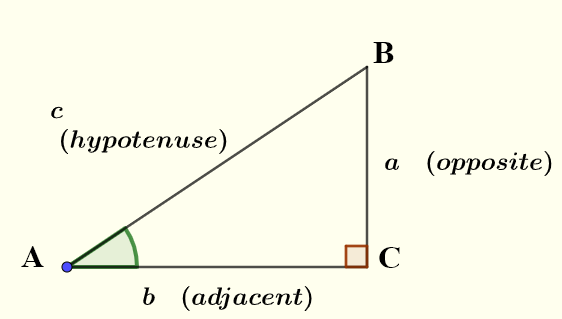
In a right triangle, choose one acute angle \(\theta\). The side across from that angle is the opposite side, the side next to the angle is the adjacent side, and the longest side across from the right angle is the hypotenuse. The six trig ratios are:
These definitions explain why \(\sin\) and \(\cos\) values for acute angles are between \(0\) and \(1\): the opposite and adjacent legs are shorter than the hypotenuse. Tangent can be less than \(1\), equal to \(1\), or greater than \(1\), because it compares the two legs rather than a leg and the hypotenuse.
The reciprocal functions are undefined when their denominator is zero. Since \(\csc(\theta)=1/\sin(\theta)\), cosecant is undefined where sine is zero. Since \(\sec(\theta)=1/\cos(\theta)\), secant is undefined where cosine is zero. Since \(\cot(\theta)=1/\tan(\theta)\), cotangent is undefined where tangent is zero. The calculator will warn you when a function is undefined or too close to undefined for a reliable decimal result.
In geometry, trig ratios are often used after identifying a right triangle. In broader coordinate geometry, the same ratios extend through the unit circle. The trig values may be positive or negative depending on the quadrant of the angle. A \(30^\circ\) reference angle gives positive sine in Quadrants I and II, but negative sine in Quadrants III and IV.
| Function | Right-triangle ratio | Common use |
|---|---|---|
| \(\sin(\theta)\) | opposite / hypotenuse | Find height, vertical component, wave displacement. |
| \(\cos(\theta)\) | adjacent / hypotenuse | Find horizontal component or projected length. |
| \(\tan(\theta)\) | opposite / adjacent | Find slope, angle of elevation, or height from distance. |
| \(\csc(\theta)\) | hypotenuse / opposite | Reciprocal of sine; appears in identities and calculus. |
| \(\sec(\theta)\) | hypotenuse / adjacent | Reciprocal of cosine; appears in identities and calculus. |
| \(\cot(\theta)\) | adjacent / opposite | Reciprocal of tangent; useful in algebraic trig manipulation. |
Degrees and Radians
Trigonometry uses two common angle measures: degrees and radians. A full turn is \(360^\circ\), while the same full turn is \(2\pi\) radians. A half turn is \(180^\circ\), or \(\pi\) radians. A quarter turn is \(90^\circ\), or \(\frac{\pi}{2}\) radians. Both systems measure the same angle; they just use different units.
This calculator lets you choose degrees or radians. For normal trig functions, that choice tells the tool how to interpret the input angle. For inverse trig functions, that choice controls the output angle unit. For example, if you calculate \(\arcsin(0.5)\) in degrees, the result is \(30^\circ\). If you calculate it in radians, the result is \(\frac{\pi}{6}\), approximately \(0.523599\).
A common mistake is entering a degree value while the calculator is set to radians. For instance, \(\sin(30^\circ)=0.5\), but \(\sin(30)\) in radians is approximately \(-0.988\). The number \(30\) radians is many full rotations plus an extra angle, not \(30^\circ\). Always check the unit setting before interpreting the result.
Radians are especially important in calculus. Derivative rules such as \(\frac{d}{dx}\sin x=\cos x\) work in their standard form when \(x\) is measured in radians. That is why AP Calculus, IB Mathematics, and higher-level algebra often prefer radians for functions, graphs, derivatives, and integrals. If you only need a unit conversion, the Radians to Degrees Converter is a focused tool for that specific task.
Special Angles and Exact Values
A calculator gives decimal values, but many math courses expect exact trig values for common angles. The most important angles are \(0^\circ\), \(30^\circ\), \(45^\circ\), \(60^\circ\), and \(90^\circ\), plus their radian equivalents. These values come from the unit circle and from special right triangles.
| Angle | Radians | \(\sin(\theta)\) | \(\cos(\theta)\) | \(\tan(\theta)\) |
|---|---|---|---|---|
| \(0^\circ\) | \(0\) | \(0\) | \(1\) | \(0\) |
| \(30^\circ\) | \(\frac{\pi}{6}\) | \(\frac{1}{2}\) | \(\frac{\sqrt3}{2}\) | \(\frac{\sqrt3}{3}\) |
| \(45^\circ\) | \(\frac{\pi}{4}\) | \(\frac{\sqrt2}{2}\) | \(\frac{\sqrt2}{2}\) | \(1\) |
| \(60^\circ\) | \(\frac{\pi}{3}\) | \(\frac{\sqrt3}{2}\) | \(\frac{1}{2}\) | \(\sqrt3\) |
| \(90^\circ\) | \(\frac{\pi}{2}\) | \(1\) | \(0\) | undefined |
Decimal results are convenient for measurement and applied problems, but exact values show mathematical structure. For example, the calculator may return \(0.707107\) for \(\sin(45^\circ)\). The exact value is \(\frac{\sqrt2}{2}\). If a problem asks for an exact answer, use the exact form. If a problem asks for a decimal answer or a real-world measurement, a rounded decimal is normally acceptable.
The special angles also help you check whether a result is reasonable. If \(\sin(30^\circ)\) does not return about \(0.5\), the unit setting may be wrong. If \(\tan(45^\circ)\) does not return about \(1\), check that the input is \(45\) degrees rather than \(45\) radians.
Inverse Trigonometric Functions
Inverse trigonometric functions answer angle-finding questions. If \(\sin(\theta)=0.5\), then \(\arcsin(0.5)\) returns the principal angle whose sine is \(0.5\). In degrees, that principal value is \(30^\circ\). In radians, it is \(\frac{\pi}{6}\).
The domains matter. Sine and cosine outputs never go below \(-1\) or above \(1\), so \(\arcsin(x)\) and \(\arccos(x)\) are defined only for \(-1\le x\le1\). Tangent can produce any real number, so \(\arctan(x)\) is defined for all real \(x\). Reciprocal inverse functions have their own restrictions. Since \(\arcsec(x)\) and \(\arccsc(x)\) involve reciprocals of cosine and sine, their real-valued domains satisfy \(|x|\ge1\).
| Inverse function | Input domain | Common principal-value range |
|---|---|---|
| \(\arcsin(x)\) | \(-1\le x\le1\) | \(-\frac{\pi}{2}\le y\le\frac{\pi}{2}\) |
| \(\arccos(x)\) | \(-1\le x\le1\) | \(0\le y\le\pi\) |
| \(\arctan(x)\) | all real \(x\) | \(-\frac{\pi}{2}<y<\frac{\pi}{2}\) |
| \(\arccsc(x)\) | \(|x|\ge1\) | depends on convention; calculator uses \(\arcsin(1/x)\) |
| \(\arcsec(x)\) | \(|x|\ge1\) | depends on convention; calculator uses \(\arccos(1/x)\) |
| \(\arccot(x)\) | all real \(x\) in this calculator | calculator uses \(\arctan(1/x)\), with \(\arccot(0)=\frac{\pi}{2}\) |
Inverse trig functions return principal values, not every possible solution. For example, \(\sin(\theta)=0.5\) has infinitely many solutions because sine is periodic. The calculator's \(\arcsin(0.5)\) returns \(30^\circ\), but \(150^\circ\) also has sine \(0.5\), and so do angles obtained by adding full rotations. If you are solving a trigonometric equation, use the inverse function to find a reference or principal angle, then apply quadrant and periodicity rules.
For more equation-focused work, the RevisionTown page on trigonometric equations is a better fit than this calculator page. This page helps evaluate and interpret functions; a full equation solution also requires identities, intervals, and general solution notation.
Important Trigonometric Identities
Trig identities are equations that are true for all values where both sides are defined. They are used to simplify expressions, solve equations, rewrite functions, prove relationships, and prepare for calculus. The most important identity is the Pythagorean identity:
This identity comes from the unit circle and the Pythagorean theorem. On the unit circle, the point at angle \(\theta\) has coordinates \((\cos\theta,\sin\theta)\). Since the radius is \(1\), the coordinate equation is:
Other common identities include:
Reciprocal identities connect the secondary functions to sine, cosine, and tangent:
Identities are not only abstract algebra. They help you verify calculator output. If the calculator gives \(\sin(\theta)=0.6\) and \(\cos(\theta)=0.8\), then \(0.6^2+0.8^2=1\), so the values are consistent for an angle in Quadrant I. If the same calculation gives values whose squares do not sum close to \(1\), check rounding, angle units, or input errors. For a deeper identity lesson, use the verified RevisionTown guide on trigonometric identities.
Trigonometry in the Unit Circle
The unit circle extends trigonometry beyond acute angles in right triangles. A unit circle is a circle with radius \(1\) centered at the origin. For an angle \(\theta\), the point on the circle has coordinates:
This definition explains the signs of trig functions in different quadrants. In Quadrant I, both \(x\) and \(y\) are positive, so sine and cosine are positive. In Quadrant II, \(x\) is negative and \(y\) is positive, so sine is positive and cosine is negative. In Quadrant III, both are negative. In Quadrant IV, cosine is positive and sine is negative.
Tangent is the ratio:
This means tangent is undefined when \(\cos\theta=0\), such as at \(90^\circ\) and \(270^\circ\). It also explains why tangent has period \(\pi\) radians, or \(180^\circ\): the sine and cosine signs both change after a half turn, so their ratio repeats.
The unit circle is also the bridge to graphing. As an angle rotates, the sine value is the vertical coordinate and the cosine value is the horizontal coordinate. This motion creates the sine and cosine waves. The tangent graph has vertical asymptotes where cosine is zero.
Trigonometric Graphs and Periodicity
Trig functions repeat. This repeating behavior is called periodicity. Sine and cosine have period \(2\pi\) radians, or \(360^\circ\):
Tangent has period \(\pi\) radians, or \(180^\circ\):
Periodicity is why one inverse trig value is not the same as a complete equation solution. If \(\sin(\theta)=0.5\), there are infinitely many angles that work. The inverse sine gives a principal angle, but solving over an interval requires finding all matching angles in that interval.
Graphs also help explain amplitude and transformations. A function such as \(y=3\sin(2x)\) has amplitude \(3\) and period \(\pi\), because the coefficient \(2\) inside the function compresses the period:
This calculator evaluates values, but graph interpretation is a separate skill. Use it to check points on a graph, verify special values, and test whether a transformation is producing expected outputs.
Worked Trigonometry Calculator Examples
Example 1: Calculate \(\sin(30^\circ)\)
Select \(\sin(x)\), enter \(30\), and choose degrees. The calculator returns \(0.5\). In exact form:
This means the opposite side is half the hypotenuse in a right triangle with a \(30^\circ\) angle.
Example 2: Calculate \(\cos(\frac{\pi}{3})\)
Choose \(\cos(x)\), enter approximately \(1.0471975512\), and select radians. The result is \(0.5\). Since \(\frac{\pi}{3}=60^\circ\), the exact value is:
Example 3: Find an angle from a tangent ratio
If \(\tan(\theta)=1\), select \(\arctan(x)\), enter \(1\), and choose degrees. The calculator returns \(45^\circ\). In radians, it returns \(\frac{\pi}{4}\), approximately \(0.785398\).
Example 4: Check an undefined tangent
If you calculate \(\tan(90^\circ)\), tangent is undefined because \(\cos(90^\circ)=0\), and \(\tan(\theta)=\frac{\sin(\theta)}{\cos(\theta)}\). Decimal calculators may show a very large number if the input is close to \(90^\circ\) because of floating-point rounding, but mathematically the value is undefined.
Using Trigonometry for Right Triangles
Right-triangle trigonometry is one of the most practical uses of trig ratios. If you know one acute angle and one side, you can often find another side. The key is choosing the correct ratio based on the side you know and the side you need.
Suppose a ladder is \(10\) meters long and makes a \(70^\circ\) angle with the ground. The height reached is opposite the angle, and the ladder is the hypotenuse. Use sine:
Suppose you know the height of a building is \(30\) meters and the angle of elevation from a point on the ground is \(40^\circ\). The height is opposite the angle, and the horizontal distance is adjacent. Use tangent:
When two sides are known and the angle is unknown, use an inverse trig function. If opposite \(=5\) and hypotenuse \(=13\), then:
If a problem only gives side lengths and asks for a missing side, it may be a Pythagorean theorem problem rather than a trig problem. The Pythagorean Theorem Calculator is useful for that situation, while this trigonometry calculator is best when angles and trig ratios are involved.
Trigonometry in Calculus and Advanced Math
Trigonometry becomes even more important in calculus. Sine and cosine are smooth periodic functions used to model oscillation, waves, circular motion, alternating current, and many repeating patterns. Their derivatives and integrals are central formulas:
These standard calculus rules assume \(x\) is in radians. If an angle is measured in degrees, additional conversion factors appear. This is one reason radians are the natural angle unit in higher mathematics.
Students preparing for AP Precalculus should be comfortable with unit-circle values, graphs, identities, transformations, and inverse trig functions. Students in AP Calculus AB should also understand derivatives and integrals of trig functions. For IB courses, RevisionTown's IB Mathematics resources and the AA SL, AA HL, AI SL, and AI HL course pages can help place trigonometry into the right syllabus pathway.
For broad review of trig concepts beyond calculation, see RevisionTown's lessons on trigonometric functions, trigonometric identities, and trigonometric equations.
How to Use the Calculator Correctly
- Choose the function. Pick sine, cosine, tangent, a reciprocal function, or an inverse function.
- Enter the value of \(x\). For normal trig functions, \(x\) is an angle. For inverse trig functions, \(x\) is a ratio.
- Select degrees or radians. This controls the input unit for normal trig functions and the output unit for inverse functions.
- Check the domain. \(\arcsin(x)\) and \(\arccos(x)\) require \(-1\le x\le1\). \(\arcsec(x)\) and \(\arccsc(x)\) require \(|x|\ge1\).
- Interpret the result. Decide whether you need a decimal, an exact value, a principal inverse angle, or all solutions to an equation.
A calculator result is not the same as a complete mathematical explanation. If a geometry problem asks for a side length, state the ratio you used. If an equation problem asks for all solutions on an interval, list every valid angle in that interval. If a calculus problem uses trig functions, make sure the input is in radians unless the problem explicitly states otherwise.
Common Mistakes with Trig Calculations
Using the wrong angle unit
Entering \(30\) as radians gives a completely different result from entering \(30^\circ\).
Forgetting inverse domains
\(\arcsin(2)\) is not real because sine values cannot exceed \(1\).
Expecting all solutions from inverse trig
\(\arcsin(0.5)\) returns one principal angle, not every angle with sine \(0.5\).
Using tangent where sine is needed
Choose the ratio based on the sides involved: opposite, adjacent, and hypotenuse.
Another mistake is treating undefined values as zero. \(\tan(90^\circ)\) is undefined, not \(0\). \(\sec(90^\circ)\) is also undefined because \(\cos(90^\circ)=0\). When a denominator is zero, the function is undefined. A decimal calculator may display a very large number near a vertical asymptote, but the exact mathematical value at the asymptote does not exist.
Reference Angles and Quadrant Signs
A trigonometry calculator can evaluate any angle, but understanding reference angles helps you predict the sign and size of the answer before calculating. A reference angle is the acute angle between the terminal side of an angle and the \(x\)-axis. For example, \(150^\circ\) has reference angle \(30^\circ\), because its terminal side is \(30^\circ\) away from the negative \(x\)-axis.
Reference angles let you use familiar special-angle values in all quadrants. Since \(150^\circ\) is in Quadrant II, sine is positive and cosine is negative. Therefore:
The signs are determined by the quadrant. In Quadrant I, sine, cosine, and tangent are positive. In Quadrant II, sine is positive while cosine and tangent are negative. In Quadrant III, tangent is positive while sine and cosine are negative. In Quadrant IV, cosine is positive while sine and tangent are negative. This pattern is often remembered as "all, sine, tangent, cosine" by quadrant.
| Quadrant | Angle range | Positive primary functions | Example |
|---|---|---|---|
| I | \(0^\circ\) to \(90^\circ\) | \(\sin,\cos,\tan\) | \(\sin(30^\circ)>0\) |
| II | \(90^\circ\) to \(180^\circ\) | \(\sin\) | \(\cos(150^\circ)<0\) |
| III | \(180^\circ\) to \(270^\circ\) | \(\tan\) | \(\tan(225^\circ)>0\) |
| IV | \(270^\circ\) to \(360^\circ\) | \(\cos\) | \(\sin(330^\circ)<0\) |
This matters for inverse trig functions. If \(\sin(\theta)=\frac{1}{2}\), the principal inverse value is \(30^\circ\), but there is also a solution at \(150^\circ\) in the interval \(0^\circ\le\theta<360^\circ\). A calculator gives a principal value; a trig equation solution requires reference angles, quadrants, and interval restrictions.
Exact Answers vs Decimal Calculator Answers
Decimal answers are useful, especially in applied problems, but exact answers are often expected in algebra, precalculus, trigonometric identities, and exams. A calculator may return \(0.8660254038\) for \(\sin(60^\circ)\). The exact answer is \(\frac{\sqrt3}{2}\). Both describe the same value, but they are used for different purposes.
Exact answers preserve structure. If a problem asks you to simplify an expression such as \(2\sin(60^\circ)\), writing \(2\cdot\frac{\sqrt3}{2}=\sqrt3\) is cleaner than writing \(2(0.8660254038)=1.7320508076\). Exact values are also better when later algebra will cancel terms or combine radicals.
Decimal answers are preferred when a measurement is approximate or when a real-world answer needs units. If a ladder-height calculation gives \(9.3969\) meters, you might report \(9.40\) meters. If a survey angle gives a distance of \(183.728\) meters, you might round based on measurement precision. The calculator's decimal output is helpful in these cases.
A good rule is to use exact values when the input angle is a special angle and the problem is symbolic, and use decimals when the input is a measurement or the problem asks for a decimal approximation. If the instructions say "exact value," do not round. If the instructions say "to three significant figures," round at the end.
Some calculator results look like very small nonzero numbers because of floating-point arithmetic. For example, \(\cos(90^\circ)\) may appear as \(6.12323\times10^{-17}\) in some systems. Mathematically, the exact value is \(0\). The calculator on this page treats values extremely close to zero as zero for display and uses domain checks to avoid presenting undefined values as valid results.
Solving Right Triangles: A Practical Workflow
A right-triangle problem usually asks for a missing side or a missing acute angle. The most reliable workflow is to label the triangle first. Mark the given angle, label the opposite side, adjacent side, and hypotenuse relative to that angle, then choose the trig ratio that connects the known and unknown quantities.
If the unknown is a side, use a normal trig function. Suppose an angle is \(35^\circ\), the hypotenuse is \(20\), and the opposite side is unknown. Since sine compares opposite and hypotenuse:
If the unknown is an angle, use an inverse trig function. Suppose the opposite side is \(8\) and the adjacent side is \(15\). Since tangent compares opposite and adjacent:
The third side may sometimes be found using the Pythagorean theorem instead of trigonometry. If a right triangle has two known sides and the missing value is the third side, use \(a^2+b^2=c^2\). If an angle is involved, use a trig ratio. In multi-step problems, you may use both. For example, you might use the Pythagorean theorem to find the hypotenuse, then use inverse sine to find an angle.
When solving real-world right triangles, draw a diagram. Words such as "angle of elevation," "angle of depression," "height," "distance from the base," and "line of sight" become much easier once the triangle is visible. The angle of elevation is measured upward from a horizontal line. The angle of depression is measured downward from a horizontal line. These two angles are often equal by alternate interior angles when the horizontal lines are parallel.
Trig Function Domains, Ranges, and Undefined Values
Every trigonometric function has a domain and range. For sine and cosine, the domain is all real angles, and the range is \([-1,1]\). That means \(\sin(\theta)\) and \(\cos(\theta)\) can never be greater than \(1\) or less than \(-1\). Tangent is defined for all angles except where cosine is zero, and its range is all real numbers.
| Function | Domain restriction | Range | Undefined when... |
|---|---|---|---|
| \(\sin x\) | all real \(x\) | \([-1,1]\) | never undefined for real \(x\) |
| \(\cos x\) | all real \(x\) | \([-1,1]\) | never undefined for real \(x\) |
| \(\tan x\) | \(\cos x\ne0\) | all real values | \(x=\frac{\pi}{2}+k\pi\) |
| \(\csc x\) | \(\sin x\ne0\) | \((-\infty,-1]\cup[1,\infty)\) | \(x=k\pi\) |
| \(\sec x\) | \(\cos x\ne0\) | \((-\infty,-1]\cup[1,\infty)\) | \(x=\frac{\pi}{2}+k\pi\) |
| \(\cot x\) | \(\sin x\ne0\) | all real values | \(x=k\pi\) |
Domain restrictions come from denominators. Tangent is \(\frac{\sin x}{\cos x}\), so it is undefined when \(\cos x=0\). Cosecant is \(\frac{1}{\sin x}\), so it is undefined when \(\sin x=0\). Secant is \(\frac{1}{\cos x}\), so it is undefined when \(\cos x=0\). Cotangent is \(\frac{\cos x}{\sin x}\), so it is undefined when \(\sin x=0\).
Inverse functions reverse these restrictions. Since sine's range is \([-1,1]\), the input domain of \(\arcsin x\) is \([-1,1]\). Since secant's range is \((-\infty,-1]\cup[1,\infty)\), the input domain of \(\arcsec x\) is \(|x|\ge1\). This is why a trig calculator must check domains before returning a real result.
Trigonometry Calculator for Graph Checks
A trigonometry calculator is useful when checking points on sine, cosine, and tangent graphs. For example, if you are graphing \(y=2\sin x\), the value at \(x=\frac{\pi}{6}\) is:
If you are graphing \(y=\cos(2x)\), the period is shorter than the period of \(y=\cos x\). The period formula is:
For \(y=\cos(2x)\), the period is \(\pi\). This means the graph completes one full cycle from \(0\) to \(\pi\). A calculator can verify key points, but graphing requires understanding amplitude, period, phase shift, and vertical shift.
A transformed sine or cosine function is often written as:
Here \(|a|\) is the amplitude, \(\frac{2\pi}{|b|}\) is the period, \(c\) is the horizontal shift, and \(d\) is the vertical shift. The calculator helps evaluate particular inputs, while the transformation rules explain the whole graph.
Tangent graphs are different because tangent has vertical asymptotes. The basic tangent graph has period \(\pi\) and vertical asymptotes at \(x=\frac{\pi}{2}+k\pi\). If a tangent calculation returns a very large magnitude near one of these values, the graph is close to a vertical asymptote.
Solving Trig Equations After Using the Calculator
A calculator can help find a reference angle, but solving a trig equation requires more work. Consider:
The calculator gives \(\arcsin(\frac{1}{2})=\frac{\pi}{6}\). That is the principal angle, but sine is positive in Quadrants I and II. Therefore the two solutions in the interval are:
For tangent, the period is \(\pi\), so equations often produce solutions separated by \(\pi\). If \(\tan x=1\), the principal solution is \(\frac{\pi}{4}\), and the general solution is:
For cosine, pay attention to symmetry. If \(\cos x=\frac{1}{2}\) on \(0\le x<2\pi\), the solutions are \(\frac{\pi}{3}\) and \(\frac{5\pi}{3}\), because cosine is positive in Quadrants I and IV.
This is why an all-in-one trigonometry calculator is best used as a support tool. It gives function values and principal inverse angles. A complete equation answer also needs quadrants, interval restrictions, and periodicity. The RevisionTown trigonometric equations page is better for full equation methods.
Real-Life Uses of Trigonometry
Trigonometry appears whenever angles and distances are connected. Surveyors use angles to calculate inaccessible distances. Engineers use trig components to resolve forces. Architects and builders use trig to work with roof pitch, ramps, slopes, and sight lines. Physics uses sine and cosine to model waves, circular motion, oscillation, and projectile components.
In navigation, bearings and distances can be broken into north-south and east-west components using sine and cosine. In computer graphics, rotations are built from trigonometric functions. In electronics and signal processing, sine waves model alternating current and sound. In astronomy, trig is used to describe angular separation and apparent motion.
The calculator is useful in these contexts when a quick value is needed, but the model still matters. For a ramp, you must know whether the angle is measured from the ground or from a vertical wall. For a force vector, you must know whether the component needed is adjacent or opposite to the angle. For a wave, you must know whether the angle is in degrees or radians and whether the input represents time, phase, or position.
Trigonometry is therefore not just a set of buttons. The calculator handles the numeric evaluation; the user must interpret the geometry, units, and context. That distinction is important for students, teachers, engineers, and anyone using trig in a real problem.
Final Checklist Before Trusting a Trig Result
Before using a trigonometry result in homework, an exam, or a real-world calculation, check five things. First, confirm the angle unit. Degrees and radians produce very different outputs if confused. Second, confirm whether \(x\) is an angle or a ratio. Normal trig functions take angles; inverse trig functions take ratios and return angles.
Third, check the domain. If a value is outside the real domain of an inverse function, there is no real answer. Fourth, check whether the problem asks for one principal value or all solutions. Inverse trig gives a principal value, while equations may have multiple solutions. Fifth, check whether an exact answer is required. A decimal approximation may not be acceptable for special-angle problems.
If you are solving a triangle, label opposite, adjacent, and hypotenuse before choosing a function. If you are solving an equation, use quadrants and periods. If you are working in calculus, use radians. If you are checking a graph, use amplitude, period, phase shift, and vertical shift rules in addition to point evaluation.
A well-used trigonometry calculator does more than produce a number. It helps confirm a mathematical relationship. The best results come when calculation, diagram, formula, and interpretation all agree.
Reciprocal Trig Functions and Notation Conventions
Cosecant, secant, and cotangent are sometimes less familiar than sine, cosine, and tangent, but they are not new geometric ideas. They are reciprocal functions. If \(\sin(\theta)=0.5\), then \(\csc(\theta)=2\). If \(\cos(\theta)=0.25\), then \(\sec(\theta)=4\). If \(\tan(\theta)=3\), then \(\cot(\theta)=\frac{1}{3}\). The calculator evaluates these directly so that you do not need to calculate the primary function first and then take the reciprocal.
The notation can be confusing. In many textbooks and calculators, \(\sin^{-1}(x)\) means \(\arcsin(x)\), not \(\frac{1}{\sin(x)}\). The reciprocal of sine is written \(\csc(x)\), not \(\sin^{-1}(x)\), in standard function notation. This distinction matters because \(\arcsin(x)\) returns an angle, while \(\csc(x)\) returns a ratio.
Reciprocal functions also have different domains from their primary partners. Sine is defined for every real angle, but cosecant is undefined where sine equals zero. Cosine is defined for every real angle, but secant is undefined where cosine equals zero. Tangent is undefined where cosine equals zero, while cotangent is undefined where sine equals zero.
In advanced algebra and calculus, reciprocal functions often appear because they simplify certain derivatives, integrals, identities, and transformations. For example, \(1+\tan^2 x=\sec^2 x\) is central in calculus and trigonometric simplification. Even if a basic right-triangle problem only uses sine, cosine, and tangent, understanding the reciprocal functions makes later trigonometry much easier.
Bearings, Components, and Direction Problems
Trigonometry is often used to split a distance, velocity, force, or displacement into components. If an object moves at an angle \(\theta\) from the positive horizontal direction, the horizontal component is commonly found with cosine and the vertical component with sine:
For example, a force of \(80\) newtons acting at \(25^\circ\) above the horizontal has horizontal component \(80\cos(25^\circ)\) and vertical component \(80\sin(25^\circ)\). The calculator can evaluate those trig values, but the diagram tells you which component uses sine and which uses cosine.
Bearing problems require extra care because bearings are often measured clockwise from north rather than counterclockwise from the positive \(x\)-axis. A standard mathematical angle of \(0^\circ\) usually points right along the positive \(x\)-axis, while a navigation bearing of \(0^\circ\) points north. Before using sine or cosine, translate the bearing into the coordinate convention required by the problem.
Direction problems also show why signs matter. A component to the left is negative in the usual \(x\)-axis convention. A component downward is negative in the usual \(y\)-axis convention. The unit circle automatically includes signs by quadrant, but a word problem may require a careful sketch to decide the quadrant correctly.
When This Calculator Is Enough and When You Need More
This calculator is ideal for evaluating trig functions, checking special-angle values, converting inverse trig outputs between degrees and radians, testing identities numerically, and verifying values used in right-triangle or unit-circle problems. It gives direct numeric support and explains the related formulas on the same page.
However, some tasks require a broader method. If you need all solutions of a trigonometric equation on an interval, use the calculator only to find a principal or reference angle, then apply quadrant and periodicity rules. If you need a full graph, use graphing methods involving amplitude, period, phase shift, vertical shift, intercepts, and asymptotes. If you need to solve a non-right triangle, you may need the sine rule, cosine rule, or area formula rather than the basic right-triangle ratios.
If your expression combines many operations, radicals, powers, or algebraic simplification, a broader Scientific Calculator can be useful. If the problem is geometry-heavy, the Geometry Calculators hub may be a better starting point. Use this page when the central question is about a trigonometric function value, an inverse trig output, a degree-radian choice, or a quick check against the unit circle.
A Practical Study Workflow for Trigonometry
To study trigonometry effectively, begin with right-triangle ratios. Make sure you can identify opposite, adjacent, and hypotenuse from a diagram. Then learn special angles and exact values. The \(30^\circ\)-\(60^\circ\)-\(90^\circ\) triangle and \(45^\circ\)-\(45^\circ\)-\(90^\circ\) triangle explain many of the exact values in the table above.
Next, move to the unit circle. The unit circle explains signs, quadrants, radians, periodicity, and why sine and cosine are coordinates. After that, study graphs of sine, cosine, and tangent. Graphs connect trig values to waves, transformations, and asymptotes. Once the graphs are comfortable, learn identities and equation solving. Identities help simplify expressions, while equation solving requires principal angles, reference angles, intervals, and periods.
Finally, connect trigonometry to applications. Use right-triangle trigonometry for heights and distances, unit-circle trigonometry for periodic functions, and calculus trig rules for rates of change and accumulation. As you work, use the calculator to check values, but write the formula and reasoning in your solution. That habit makes the calculator a learning tool rather than a shortcut.
Radians in Calculus: Why the Unit Matters
Radians are not just another way to label an angle. In advanced mathematics, radians make the main trigonometric relationships work cleanly because a radian measures angle as a ratio of arc length to radius:
In this formula, \(s\) is arc length and \(r\) is radius. Because both quantities are lengths, the radian measure is dimensionless. That is why the calculus rules for trigonometric functions are written in radians. The familiar derivative
is true in its standard form when \(x\) is measured in radians. If \(x\) is measured in degrees, a conversion factor appears because degrees are scaled differently from radians. Since \(180^\circ=\pi\) radians, one degree equals \(\frac{\pi}{180}\) radians. That scale factor changes rates of change.
This difference matters when a calculator is used to check calculus work. Suppose a problem asks for the slope of \(y=\sin x\) at \(x=\frac{\pi}{3}\). The correct derivative value is \(\cos(\frac{\pi}{3})=\frac{1}{2}\). If a calculator is accidentally left in degree mode and the input is typed as \(1.0472\), it will treat the number as about \(1.0472^\circ\), not \(\frac{\pi}{3}\) radians. The output will be close to \(0.0183\) for sine rather than the intended \(\frac{\sqrt3}{2}\), and the mistake may not be obvious unless the unit is checked.
Radians also make graph transformations easier. For \(y=\sin(bx)\), the period is:
For \(y=\tan(bx)\), the period is:
These formulas are most natural in radians because a full rotation is \(2\pi\) and half a rotation is \(\pi\). Degree versions can be written, but they are usually less convenient in calculus and function analysis. This is why students moving from right-triangle trigonometry into AP Calculus AB, AP Precalculus, or IB Mathematics should build the habit of asking, "Is this angle in degrees or radians?" before pressing calculate.
A practical rule is simple: use the unit stated in the problem, but expect radians when the question involves functions, graphs, limits, derivatives, integrals, angular velocity, or periodic motion. Use degrees when the problem is written as a geometry diagram, navigation bearing, construction angle, or everyday measurement. If no unit is stated, look at the surrounding notation. Values like \(\frac{\pi}{6}\), \(\frac{3\pi}{4}\), and \(2\pi\) strongly suggest radians, while values like \(30^\circ\), \(135^\circ\), and \(360^\circ\) clearly use degrees.
The calculator on this page supports both modes so that you can check either type of problem without changing tools. The important step is not the calculation itself; it is matching the input mode to the mathematical context. A correct formula with the wrong angle unit can produce a precise but incorrect answer.
Practice Questions
- Calculate \(\sin(60^\circ)\) exactly and as a decimal.
- Calculate \(\cos(\frac{\pi}{4})\) exactly and as a decimal.
- Find \(\tan(45^\circ)\).
- Find \(\arcsin(0.5)\) in degrees and radians.
- Find \(\arctan(1)\) in degrees.
- Explain why \(\tan(90^\circ)\) is undefined.
- A right triangle has opposite side \(7\) and hypotenuse \(12\). Find the acute angle using inverse sine.
- A ramp makes a \(12^\circ\) angle with the ground and has horizontal run \(8\) meters. Use tangent to estimate the height.
Show answers
- \(\sin(60^\circ)=\frac{\sqrt3}{2}\approx0.866025\).
- \(\cos(\frac{\pi}{4})=\frac{\sqrt2}{2}\approx0.707107\).
- \(\tan(45^\circ)=1\).
- \(\arcsin(0.5)=30^\circ=\frac{\pi}{6}\) radians.
- \(\arctan(1)=45^\circ\).
- \(\tan(\theta)=\frac{\sin\theta}{\cos\theta}\), and \(\cos(90^\circ)=0\), so the denominator is zero.
- \(\theta=\arcsin(\frac{7}{12})\approx35.69^\circ\).
- \(\text{height}=8\tan(12^\circ)\approx1.70\) meters.
Trigonometry Calculator FAQ
What is a trigonometry calculator?
A trigonometry calculator evaluates trig functions such as sine, cosine, tangent, cosecant, secant, cotangent, and inverse trig functions. It can work in degrees or radians depending on the selected unit.
Should I use degrees or radians?
Use degrees when the problem gives angle measures with degree notation or in basic geometry contexts. Use radians for calculus, unit-circle graphing, and most advanced function work unless the problem states otherwise.
Why is tangent undefined at \(90^\circ\)?
Tangent is \(\tan(\theta)=\frac{\sin(\theta)}{\cos(\theta)}\). At \(90^\circ\), cosine is \(0\), so tangent would require division by zero and is undefined.
Why do inverse trig functions return only one angle?
Trig functions are periodic, so many angles can have the same sine, cosine, or tangent value. Inverse trig functions return a principal value from a restricted range. Solving a trig equation may require additional angles.
Can this calculator solve all trigonometric equations?
No. It evaluates functions and principal inverse values. For full equation solving, you also need interval restrictions, identities, quadrant analysis, and periodic solution notation.
What is the difference between \(\sin^{-1}(x)\) and \(\frac{1}{\sin(x)}\)?
In most calculator and textbook contexts, \(\sin^{-1}(x)\) means \(\arcsin(x)\), the inverse sine function. The reciprocal of sine is \(\csc(x)=\frac{1}{\sin(x)}\). These are different functions.