
Geometry Calculator | Area, Heron, SAS and Coordinates
Triangle Area Calculator
Calculate the area of any triangle using the information you already know: base and perpendicular height, three side lengths, two sides with the included angle, coordinates of the vertices, an equilateral side length, or the two legs of a right triangle.
Triangle Area
Triangle Area Calculator Guide
A triangle area calculator finds the amount of two-dimensional space inside a triangle. The simplest method uses base and perpendicular height, but triangle problems rarely arrive in only one form. Sometimes you know three sides but no height. Sometimes you know two sides and the included angle. Sometimes the triangle is drawn on a coordinate grid. Sometimes the triangle is right-angled or equilateral. This page gives a calculator and a complete guide for choosing the correct area formula from the information you have.
The area of a triangle is always measured in square units. If the side lengths are in centimeters, area is in square centimeters. If the measurements are in feet, area is in square feet. The numerical formula can change from one method to another, but the geometric meaning is always the same: area measures the flat region enclosed by the three sides.
Triangle area is one of the most useful ideas in geometry because triangles are the building blocks of larger shapes. Any polygon can be split into triangles. Surveyors use triangles to estimate land area. Engineers use triangular sections and trusses because triangles are stable. Architects, builders and landscapers use triangle calculations for roofs, ramps, gables, plots, paving, tiles and irregular spaces. Students use triangle area in geometry, trigonometry, coordinate geometry, calculus foundations and standardized exams.
This page is focused specifically on triangle area. If you need a general area hub for many shapes, RevisionTown also provides an Area Calculator and another quick area calculator for common shapes. If you are solving a right-triangle side-length problem before calculating area, use the Pythagorean Theorem Calculator. If the area problem depends on sine, cosine, tangent, or an angle in degrees or radians, the Trigonometry Calculator is a useful companion.
Use base and height
Best when you know one side of the triangle and the perpendicular distance from that side to the opposite vertex.
Use Heron's formula
Best when you know all three side lengths but do not know the height or any angle.
Use SAS or coordinates
Best when the triangle is defined by two sides and their included angle, or by three points on a coordinate plane.
Triangle Area by Base and Height
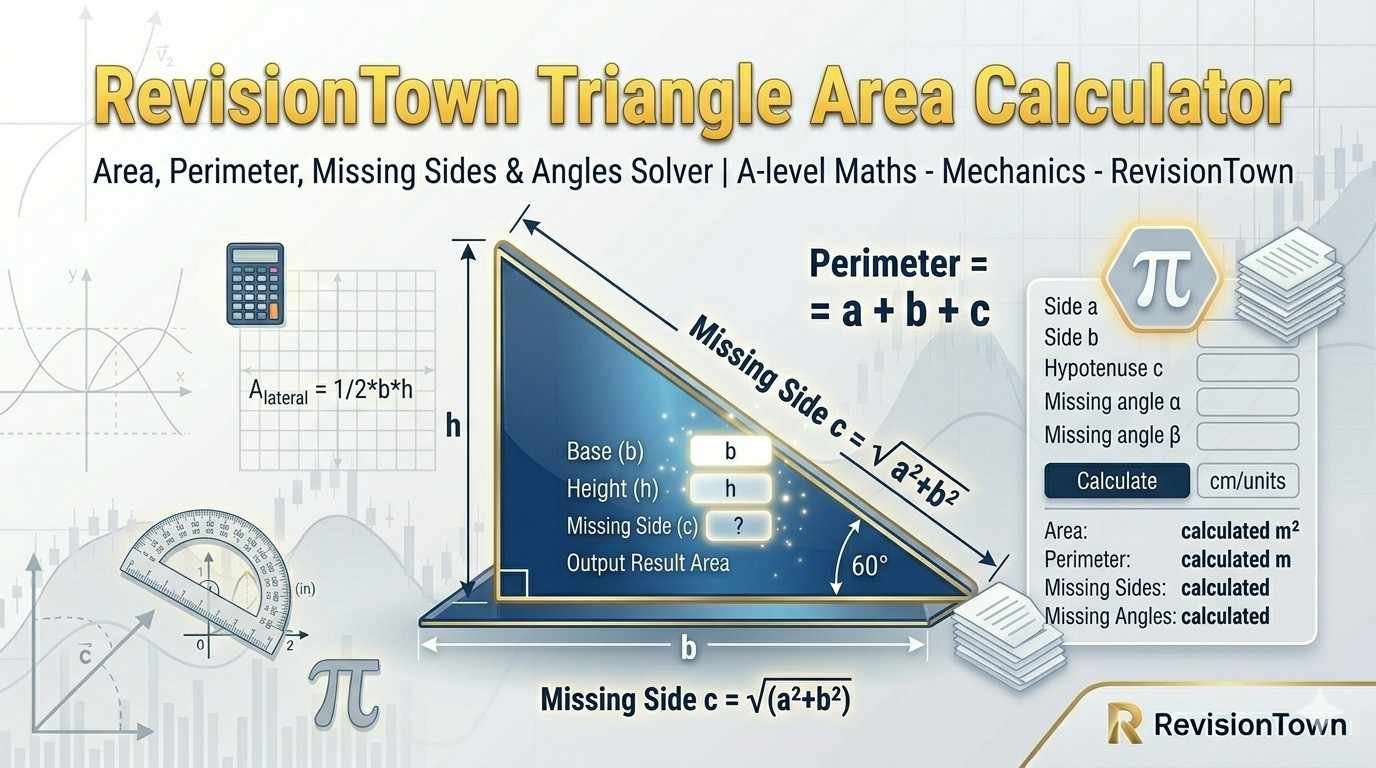
The most familiar triangle area formula is:
\(A=\frac{1}{2}bh\)In this formula, \(A\) is area, \(b\) is the base and \(h\) is the perpendicular height. The height must meet the base at a right angle. It is not always the same as a slanted side of the triangle. The word perpendicular is the key idea. If the height leans, the formula no longer represents the true vertical distance from the base to the opposite vertex.
The formula comes from the area of a parallelogram. Two congruent copies of a triangle can be arranged to form a parallelogram with the same base and height. The parallelogram area is \(bh\), and one triangle is half of that parallelogram. Therefore the triangle area is \(\frac{1}{2}bh\).
\(\text{Area of parallelogram}=bh\quad\Rightarrow\quad\text{Area of one triangle}=\frac{bh}{2}\)This method is best when the height is directly given in the diagram or can be measured. It is also the most common method in elementary and middle-school geometry. However, the same idea remains important in advanced mathematics. In coordinate geometry, vector geometry, calculus and physics, many more complicated formulas are extensions of base times perpendicular distance divided by two.
For example, if a triangle has base \(10\text{ cm}\) and perpendicular height \(6\text{ cm}\), then:
\(A=\frac{1}{2}(10)(6)=30\text{ cm}^2\)The result is \(30\text{ cm}^2\), not \(30\text{ cm}\). Area is two-dimensional, so square units must be used. If the base and height use different units, convert them first. A base in meters and a height in centimeters cannot be substituted together until both measurements use the same unit system.
Quick check: if the base doubles and the height stays the same, the area doubles. If both base and height double, the area becomes four times larger because \(2b\cdot2h=4bh\).
Triangle Area from Three Sides: Heron's Formula
When you know all three side lengths but not the height, use Heron's formula. Let the side lengths be \(a\), \(b\), and \(c\). First calculate the semi-perimeter \(s\), which is half the perimeter:
\(s=\frac{a+b+c}{2}\)Then calculate area using:
\(A=\sqrt{s(s-a)(s-b)(s-c)}\)Heron's formula works for any valid triangle: scalene, isosceles, equilateral, acute, right or obtuse. It is especially useful in land measurement, surveying and construction because measuring three edges is often easier than measuring a perpendicular height. A triangular plot may have boundary lengths available while the altitude is difficult to locate physically.
Before using Heron's formula, the side lengths must satisfy the triangle inequality:
\(a+b>c,\quad a+c>b,\quad b+c>a\)If the sum of any two sides is less than or equal to the third side, the three lengths cannot form a real triangle. For example, side lengths \(2\), \(3\), and \(8\) fail because \(2+3\le8\). A calculator should reject that input rather than returning a meaningless square root.
Suppose a triangle has side lengths \(5\), \(6\), and \(7\). The semi-perimeter is:
\(s=\frac{5+6+7}{2}=9\)Now substitute into Heron's formula:
\(A=\sqrt{9(9-5)(9-6)(9-7)}=\sqrt{9\cdot4\cdot3\cdot2}=\sqrt{216}\approx14.70\)The area is approximately \(14.70\) square units. If the sides were measured in meters, the area would be \(14.70\text{ m}^2\). Heron's formula produces the same area you would get from base and height, but it avoids the need to know the height directly.
Triangle Area from Two Sides and the Included Angle
If you know two side lengths and the angle between them, use the SAS area formula:
\(A=\frac{1}{2}ab\sin(C)\)Here \(a\) and \(b\) are the two known sides, and \(C\) is the included angle, meaning the angle formed by those two sides. This formula is useful in trigonometry, navigation, force diagrams, surveying and any problem where an angle is measured more easily than a height.
The formula comes from the base-height formula. If side \(a\) is treated as the base, then the perpendicular height from the other side is \(b\sin(C)\). Substituting that height into \(A=\frac{1}{2}bh\) gives:
\(h=b\sin(C)\quad\Rightarrow\quad A=\frac{1}{2}a[b\sin(C)]=\frac{1}{2}ab\sin(C)\)For example, if \(a=8\), \(b=10\), and the included angle is \(35^\circ\), then:
\(A=\frac{1}{2}(8)(10)\sin(35^\circ)=40\sin(35^\circ)\approx22.94\)The area is approximately \(22.94\) square units. Notice that the sine function depends on the angle unit. If the angle is entered in degrees, the calculator must convert it to radians before using JavaScript's sine function. If you are working by hand, make sure your calculator is in degree mode for degree measures or radian mode for radian measures.
This method also explains why a triangle with fixed side lengths \(a\) and \(b\) can have different areas if the included angle changes. When \(C\) is small, \(\sin(C)\) is small and the triangle is narrow. When \(C=90^\circ\), \(\sin(C)=1\), and the area is \(\frac{1}{2}ab\), the right-triangle formula.
Triangle Area from Coordinates
If the vertices of a triangle are given as points on a coordinate plane, use the coordinate area formula. For points \((x_1,y_1)\), \((x_2,y_2)\), and \((x_3,y_3)\), the area is:
\(A=\frac{1}{2}\left|x_1(y_2-y_3)+x_2(y_3-y_1)+x_3(y_1-y_2)\right|\)The absolute value is required because the algebraic expression can be positive or negative depending on the order of the vertices. Area itself cannot be negative. This formula is closely related to the determinant method and the shoelace formula used for polygon area.
For example, suppose the vertices are \((0,0)\), \((6,0)\), and \((2,5)\). Substitute the coordinates:
\(A=\frac{1}{2}|0(0-5)+6(5-0)+2(0-0)|=\frac{1}{2}|30|=15\)The area is \(15\) square units. This result also makes sense visually: the base from \((0,0)\) to \((6,0)\) has length 6, and the perpendicular height to the point \((2,5)\) is 5, so \(A=\frac{1}{2}(6)(5)=15\).
Coordinate methods are useful when a triangle appears on a grid, map, CAD drawing, screen layout or analytic geometry problem. If you first need to find distances between points, use a distance formula or a dedicated distance tool. Coordinate differences form right triangles, so the Pythagorean theorem is often working in the background.
For IB or advanced geometry revision, RevisionTown's Prior Learning Formulae AA SL & AA HL page is helpful because it collects geometry, distance, midpoint and area formulas used across many algebra and geometry topics.
Special Triangle Area Formulas
Right Triangle Area
A right triangle has one \(90^\circ\) angle. The two sides that form the right angle are perpendicular, so either leg can be the base and the other leg can be the height. If the legs are \(a\) and \(b\), then:
\(A=\frac{1}{2}ab\)For a right triangle with legs \(3\) and \(4\), the area is:
\(A=\frac{1}{2}(3)(4)=6\)If you know the hypotenuse and one leg but not the other leg, use the Pythagorean theorem first, then calculate area. For right-triangle side solving, the Pythagorean Theorem Calculator is the appropriate companion tool.
Equilateral Triangle Area
An equilateral triangle has three equal sides and three \(60^\circ\) angles. If the side length is \(a\), the height is \(\frac{\sqrt{3}}{2}a\), so the area is:
\(A=\frac{\sqrt{3}}{4}a^2\)For an equilateral triangle with side \(12\), the area is:
\(A=\frac{\sqrt{3}}{4}(12)^2=36\sqrt{3}\approx62.35\)This formula is faster than using base and height because the height is built into the expression. It is common in geometry, tiling, triangular grids, equilateral design patterns and problems involving regular hexagons, which can be divided into six equilateral triangles.
Isosceles Triangle Area
An isosceles triangle has two equal sides. If the equal sides are \(a\) and the base is \(b\), the altitude from the top vertex splits the base into two equal halves. The height is:
\(h=\sqrt{a^2-\left(\frac{b}{2}\right)^2}\)Then area is:
\(A=\frac{1}{2}b\sqrt{a^2-\left(\frac{b}{2}\right)^2}\)This is another example of combining the Pythagorean theorem with the base-height formula. The same idea appears in roof trusses, gable ends and symmetric triangular designs.
Units, Precision and Rounding
Triangle area must be reported in square units. If base and height are measured in meters, the area is in square meters. If side lengths are in inches, area is in square inches. If measurements mix units, convert them before using any formula. A base of \(2\text{ m}\) and height of \(50\text{ cm}\) should not be entered as 2 and 50 unless both are converted to the same unit. The correct conversion is \(50\text{ cm}=0.5\text{ m}\), so area is \(\frac{1}{2}(2)(0.5)=0.5\text{ m}^2\).
Precision depends on the measurements you start with. If a construction measurement is only accurate to the nearest inch, reporting an area to six decimal places creates false precision. If a geometry exercise gives exact values involving radicals, an exact area such as \(36\sqrt{3}\) may be preferable to a decimal approximation. The calculator provides decimal values for convenience, but classwork may require exact form.
In practical work, rounding can affect material estimates and cost. If a triangular garden bed has area \(14.2\text{ m}^2\), you may need to buy enough mulch for \(15\text{ m}^2\) because materials come in fixed bag sizes and some waste is expected. For construction and landscaping cost planning, RevisionTown's Construction Calculator and Square Footage Cost Calculator can support broader project calculations after the triangle area is known.
Unit rule: area is always length squared. If the input unit is ft, the output area is ft². If the input unit is m, the output area is m². Keep one unit system throughout the calculation.
Real-World Uses of Triangle Area
Triangle area is not just a school formula. It appears whenever a space or surface can be divided into triangular regions. Builders use triangular calculations for gables, roof faces, braces and diagonal layouts. Landscapers use triangle area for irregular garden beds, triangular lawns and paving sections. Designers use triangles in logos, tiling, user-interface geometry, meshes and 3D models. Surveyors use triangles because distances and angles can define land areas that are difficult to measure as rectangles.
In architecture, triangular shapes are common in roof structures and facades. A gable end may be approximated as a triangle, so its area affects siding, paint, insulation or cladding estimates. In structural engineering, triangular trusses distribute forces efficiently. While area alone does not determine structural strength, accurate geometry is part of load estimation and material planning.
In mapping and surveying, irregular plots are often split into triangles. If a field or parcel does not form a simple rectangle, dividing it into triangles allows each part to be calculated with base-height, Heron's formula or coordinates. The total area is the sum of the triangle areas:
\(A_{\text{total}}=A_1+A_2+A_3+\cdots+A_n\)In physics and engineering diagrams, triangles are used to resolve vectors, calculate slopes and interpret forces. A right triangle may represent horizontal and vertical components, and its area may appear in geometry-based derivations. In trigonometry, the relationship between sides, angles and area leads naturally to formulas involving sine and cosine.
In education, triangle area is a bridge topic. It connects arithmetic, units, proportional reasoning, square units, coordinate geometry, trigonometry and proof. Students who understand why \(A=\frac{1}{2}bh\) works can more easily understand parallelogram area, trapezoid area, polygon area, vector cross products and integration-based area later.
Common Triangle Area Mistakes
Mistake 1: Forgetting the One-Half
The triangle area formula is not \(bh\). That is the area of a parallelogram or rectangle with base \(b\) and height \(h\). A triangle with the same base and height is half as large, so the correct formula is \(A=\frac{1}{2}bh\).
Mistake 2: Using a Slanted Side as the Height
The height must be perpendicular to the base. In a non-right triangle, a side length is usually not the height. If the diagram gives a slanted side and an angle, use trigonometry or the SAS formula instead of pretending the slanted side is perpendicular.
Mistake 3: Ignoring the Triangle Inequality
Three side lengths must form a real triangle before Heron's formula can be used. If one side is too long, the triangle collapses into a line or cannot exist. Always check \(a+b>c\), \(a+c>b\), and \(b+c>a\).
Mistake 4: Mixing Units
Do not enter base in meters and height in centimeters without conversion. Mixed units produce a mixed-unit answer that is not a clean area. Convert all lengths to the same unit first.
Mistake 5: Confusing Perimeter and Area
Perimeter measures distance around the triangle and uses linear units. Area measures space inside the triangle and uses square units. The formulas and meanings are different:
\(P=a+b+c\qquad\text{but}\qquad A=\frac{1}{2}bh\)Mistake 6: Using Degrees as Radians
In the formula \(A=\frac{1}{2}ab\sin(C)\), the sine function depends on the angle unit. Make sure the calculator or software knows whether \(C\) is in degrees or radians.
Worked Triangle Area Examples
Example 1: Base and Height
A triangle has base \(18\text{ cm}\) and height \(7\text{ cm}\). Use the base-height formula:
\(A=\frac{1}{2}(18)(7)=63\text{ cm}^2\)The area is \(63\text{ cm}^2\).
Example 2: Heron's Formula
A triangle has side lengths \(9\), \(10\), and \(17\). First check the triangle inequality. Since \(9+10>17\), \(9+17>10\), and \(10+17>9\), the triangle is valid. Calculate the semi-perimeter:
\(s=\frac{9+10+17}{2}=18\)Now apply Heron's formula:
\(A=\sqrt{18(18-9)(18-10)(18-17)}=\sqrt{18\cdot9\cdot8\cdot1}=\sqrt{1296}=36\)The area is \(36\) square units.
Example 3: Two Sides and Included Angle
A triangle has sides \(12\) and \(15\) with included angle \(40^\circ\). Use:
\(A=\frac{1}{2}ab\sin(C)=\frac{1}{2}(12)(15)\sin(40^\circ)\) \(A=90\sin(40^\circ)\approx57.85\)The area is approximately \(57.85\) square units.
Example 4: Coordinate Triangle
Find the area of the triangle with vertices \((1,2)\), \((7,2)\), and \((4,8)\). Use the coordinate formula:
\(A=\frac{1}{2}|1(2-8)+7(8-2)+4(2-2)|\) \(A=\frac{1}{2}|-6+42+0|=18\)The area is \(18\) square units. Visually, the base from \((1,2)\) to \((7,2)\) is 6 units and the height to \((4,8)\) is 6 units, so \(A=\frac{1}{2}(6)(6)=18\).
Example 5: Equilateral Triangle
An equilateral triangle has side length \(10\). Use the equilateral formula:
\(A=\frac{\sqrt{3}}{4}(10)^2=25\sqrt{3}\approx43.30\)The exact area is \(25\sqrt{3}\), and the decimal approximation is \(43.30\) square units.
How to Choose the Right Triangle Area Method
A triangle area problem becomes much easier when you match the formula to the information given. Many mistakes happen because students memorize several formulas but do not know when each one is appropriate. The best first step is not calculation; it is identification. Ask what information is known, what information is missing, and whether the given lengths and angles actually belong together in the formula you plan to use.
If the problem gives a base and a perpendicular height, use \(A=\frac{1}{2}bh\). This is the most direct method. Do not look for Heron's formula or trigonometry when the altitude is already given. If the problem gives three side lengths and no angle or altitude, use Heron's formula. If the problem gives two sides and the angle between them, use \(A=\frac{1}{2}ab\sin(C)\). If the problem gives coordinates, use the coordinate formula or convert the coordinates into a base and height when the geometry is simple.
A useful decision path is:
- Base and perpendicular height known? Use \(A=\frac{1}{2}bh\).
- All three sides known? Check the triangle inequality, then use Heron's formula.
- Two sides and their included angle known? Use \(A=\frac{1}{2}ab\sin(C)\).
- Three coordinate points known? Use the coordinate area formula.
- Equilateral triangle known? Use \(A=\frac{\sqrt{3}}{4}a^2\).
- Right triangle legs known? Use \(A=\frac{1}{2}ab\).
The word included is important in the SAS formula. If the known angle is not between the two known sides, \(A=\frac{1}{2}ab\sin(C)\) may not apply directly. You may need the Law of Sines, Law of Cosines or another step to find the included angle or a missing side first. Similarly, if a diagram labels a height outside an obtuse triangle, that height is still valid as long as it is perpendicular to the extended base line. The altitude does not always fall inside the triangle.
After calculating, check whether the answer is reasonable. Area should be positive. A very long, very flat triangle can have a small area even if its perimeter is large. A triangle with side lengths close to violating the triangle inequality may have a surprisingly small area because it is nearly a straight line. A right triangle with legs \(10\) and \(10\) has area \(50\), so a triangle with similar dimensions should not produce an area of \(5000\) unless the units or formula were misused.
For practical projects, choose the method that matches how the measurements were obtained. In a classroom diagram, height may be clearly marked. In a yard or building site, measuring three boundary lengths may be easier than establishing a perpendicular altitude, so Heron's formula is useful. On a map or digital drawing, coordinates are often more reliable than manually measuring a height. In trigonometry or surveying, angles may be the most accurate data, making the SAS formula the natural choice.
Verification habit: when possible, calculate area using a second method. For example, find area from coordinates and then check with base and height if one side is horizontal. Agreement between two methods is a strong sign that the answer is reliable.
Triangle Area Formula Reference
| Known information | Formula | Use when |
|---|---|---|
| Base and perpendicular height | \(A=\frac{1}{2}bh\) | Height is given or easy to measure |
| Three sides | \(A=\sqrt{s(s-a)(s-b)(s-c)}\), \(s=\frac{a+b+c}{2}\) | All side lengths are known |
| Two sides and included angle | \(A=\frac{1}{2}ab\sin(C)\) | Two sides and the angle between them are known |
| Coordinates of vertices | \(A=\frac{1}{2}|x_1(y_2-y_3)+x_2(y_3-y_1)+x_3(y_1-y_2)|\) | Triangle is on a coordinate plane |
| Equilateral side | \(A=\frac{\sqrt{3}}{4}a^2\) | All three sides are equal |
| Right triangle legs | \(A=\frac{1}{2}ab\) | The two known sides meet at \(90^\circ\) |
| Area and base | \(h=\frac{2A}{b}\) | You need the missing height |
For broader geometry tools, RevisionTown's Math Calculator and Advanced All-in-One Converter and Calculator can help locate related calculators for circles, rectangles, distance, volume and surface area. Use this page when the main task is specifically triangle area.
Triangle Area Calculator FAQs
The easiest method is \(A=\frac{1}{2}bh\), but only when you know the base and perpendicular height. If height is not known, use Heron's formula, the SAS formula, or coordinate geometry depending on the given information.
Yes. Use Heron's formula. First calculate \(s=\frac{a+b+c}{2}\), then use \(A=\sqrt{s(s-a)(s-b)(s-c)}\). Make sure the three sides satisfy the triangle inequality.
If the legs are \(a\) and \(b\), the area is \(A=\frac{1}{2}ab\). The legs must be the two sides that meet at the right angle. The hypotenuse is not used as the height unless a perpendicular altitude to it is known.
No. Area cannot be negative. Coordinate formulas may produce a negative signed value depending on vertex order, but the final area uses the absolute value.
The side lengths cannot form a real triangle. The sum of any two sides must be greater than the third side. If this condition fails, Heron's formula should not be used.
Rearrange \(A=\frac{1}{2}bh\) to get \(h=\frac{2A}{b}\). For example, if \(A=30\) and \(b=10\), then \(h=\frac{60}{10}=6\).