
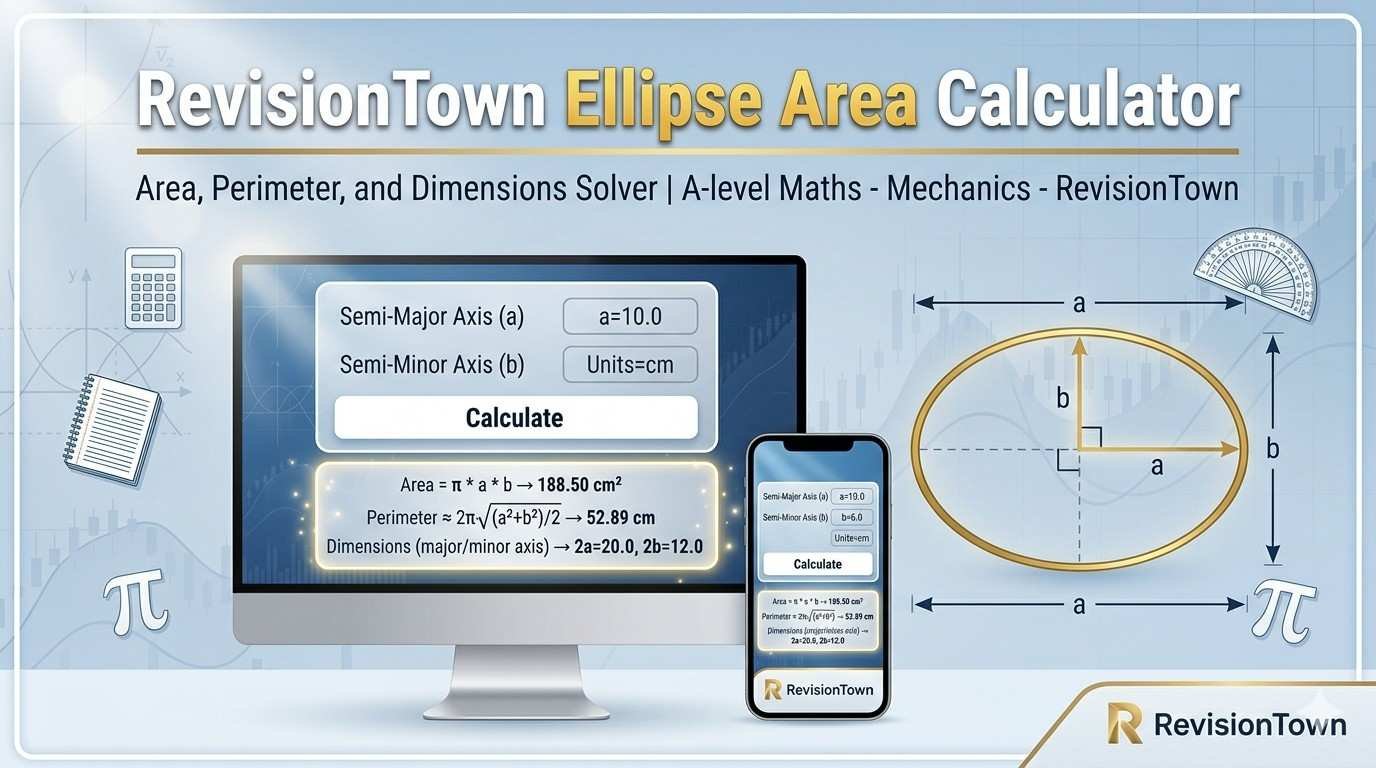
Geometry calculator
Ellipse Area Calculator: Calculate Oval Area, Perimeter & Dimensions
Use this ellipse area calculator to find the area of an ellipse or oval from its semi-major and semi-minor axes, full length and width, or practical square-footage measurements. The tool also estimates perimeter, eccentricity, focal distance, axis lengths, and material quantities for geometry problems, garden beds, pools, tabletops, rugs, design layouts, and engineering sketches.
The core formula is simple: \(\text{area}=\pi ab\). The careful part is choosing the right values for \(a\) and \(b\). In ellipse geometry, \(a\) and \(b\) are half-lengths, not full diameters. If an oval is 20 feet long and 12 feet wide, the semi-major axis is 10 feet and the semi-minor axis is 6 feet, so the area is \(\pi \times 10 \times 6\), not \(20 \times 12\).
Ellipse and Oval Calculator
Choose the calculation you need, enter positive measurements, and the calculator will show the result with the most important supporting dimensions. Use semi-axis mode when you already know \(a\) and \(b\). Use full-dimensions mode when you measured the total length and total width of an oval object.
Calculate Ellipse Area from Semi-Axes
Formula used: \(A=\pi ab\)
Estimate Ellipse Perimeter
Uses Ramanujan's accurate approximation and a simpler comparison estimate.
Oval Square Footage from Full Length and Width
Best for landscaping, flooring, pool covers, rugs, and material estimates.
Complete Ellipse Analysis
Find area, perimeter, eccentricity, focal distance, distance between foci, and bounding rectangle comparison.
Ellipse Area Formula
An ellipse is a closed curve stretched differently in two perpendicular directions. The longest diameter is called the major axis, and the shortest diameter is called the minor axis. The semi-major axis is half the major axis, and the semi-minor axis is half the minor axis. In most diagrams the semi-major axis is written as \(a\), the semi-minor axis as \(b\), and the area as \(A\).
\[ A=\pi ab \]
Where \(A\) is the area, \(a\) is the semi-major axis, \(b\) is the semi-minor axis, and \(\pi \approx 3.141592653589793\).
If you are given the full length \(L\) and full width \(W\), first convert them to semi-axes:
\[ a=\frac{L}{2}, \qquad b=\frac{W}{2} \]
\[ A=\pi \left(\frac{L}{2}\right)\left(\frac{W}{2}\right)=\frac{\pi LW}{4} \]
This second version is useful for real objects because people often measure an oval table, rug, pond, or garden bed by its overall length and width. For example, an oval that is 20 feet long and 12 feet wide has \(L=20\) and \(W=12\). The area is \(\frac{\pi \times 20 \times 12}{4}=60\pi\), which is about \(188.50\text{ ft}^2\).
The ellipse area formula is closely related to the circle area formula. A circle is an ellipse whose two semi-axes are equal. If \(a=b=r\), then \(A=\pi ab\) becomes \(A=\pi r^2\). If your shape is perfectly circular rather than oval, the dedicated circle area calculator is the more direct tool. If you are comparing multiple flat shapes, RevisionTown also has a broader area calculator for square, rectangle, triangle, circle, and other common figures.
What the Calculator Measures
The calculator above is designed for four common tasks. The area tab is for a mathematical ellipse where you already know \(a\) and \(b\). The perimeter tab estimates the distance around the boundary of the oval. The square-footage tab is for practical measurements where you know the full length and full width of an oval object. The complete-analysis tab returns the area, approximate perimeter, eccentricity, focal distance, and comparison with the bounding rectangle.
The distinction between area and perimeter matters. Area measures the surface covered by the oval and uses square units such as \(\text{cm}^2\), \(\text{m}^2\), or \(\text{ft}^2\). Perimeter measures the boundary length and uses linear units such as centimeters, meters, or feet. In a garden project, area helps estimate soil, mulch, turf, seed, paint, fabric, or flooring. Perimeter helps estimate edging, fencing, trim, border stones, or rope length.
The calculator intentionally shows full axis lengths and semi-axis lengths together because most errors happen at that step. Mathematical formulas use semi-axes. Everyday measurements use full dimensions. The result can be off by a factor of four if full length and full width are used directly in \(A=\pi ab\). For a 20 by 12 oval, using \(20\) and \(12\) as \(a\) and \(b\) gives \(240\pi\), but the correct semi-axes are \(10\) and \(6\), giving \(60\pi\).
Ellipse, Oval, and Circle: How They Differ
In everyday language, people often use "oval" for any smooth egg-shaped or stretched round shape. In mathematics, an ellipse has a precise definition: it is the set of all points for which the sum of the distances to two fixed points, called foci, is constant. A circle is the special case where the two foci coincide at the center. Many real ovals are close enough to ellipses that the ellipse formula gives a useful estimate, especially for landscaping, interior design, and classroom geometry.
There is one important limitation. If a real object is egg-shaped, irregular, flat on one side, or made from arcs that are not elliptical, then the calculator gives an ellipse approximation rather than a perfect physical measurement. For most practical estimates this is still useful. For precise fabrication, surveying, or engineering drawings, measure from the actual plan or use a model that matches the exact boundary.
When the two axes are equal, the shape is a circle. When the axes are different, the shape is elliptical. A shape with \(a=10\) and \(b=10\) is a circle of radius 10. A shape with \(a=10\) and \(b=6\) is an ellipse. A very narrow ellipse might have \(a=20\) and \(b=3\). The area formula still works, but the perimeter and shape interpretation change because the boundary becomes much more elongated.
Quick rule: if you measured the whole oval from end to end, divide each dimension by 2 before using \(A=\pi ab\). If the calculator asks for full length and width, it does that conversion for you.
Ellipse Perimeter and Oval Circumference
The perimeter of an ellipse is often called oval circumference in practical contexts. Unlike circle circumference, there is no simple exact formula made from elementary operations. The exact expression involves an elliptic integral, so calculators usually use a highly accurate approximation. The most widely used practical approximation is one of Ramanujan's formulas.
\[ P \approx \pi \left[3(a+b)-\sqrt{(3a+b)(a+3b)}\right] \]
Another common version uses the value \(h\):
\[ h=\frac{(a-b)^2}{(a+b)^2} \]
\[ P \approx \pi(a+b)\left(1+\frac{3h}{10+\sqrt{4-3h}}\right) \]
The calculator uses the \(h\)-form because it behaves well for a wide range of ellipses and is easy to compare programmatically. For near-circular ellipses, most reasonable perimeter approximations give nearly the same answer. For very stretched ellipses, Ramanujan's approximation is preferred because simple averages become less reliable.
Do not use \(2(a+b)\) as an ellipse perimeter. That expression is related to a rectangle-like path and does not describe the smooth curve. Do not use \(2\pi a\) unless the ellipse is actually a circle with radius \(a\). If you need exact circular boundary length, the circle circumference calculator is built for that special case. For an ellipse, the perimeter tab provides a practical estimate appropriate for edging, borders, trim, and classroom work.
Axis Lengths, Semi-Axes, and Dimensions
An ellipse has two perpendicular axes that cross at the center. The major axis is the longest distance across the ellipse. The minor axis is the shortest distance across it. The semi-major axis \(a\) runs from the center to one end of the major axis, and the semi-minor axis \(b\) runs from the center to one end of the minor axis. In a standard horizontal ellipse, \(a\) is usually drawn horizontally and \(b\) vertically. If the ellipse is vertical, the names still refer to length, not direction: the longer semi-axis is the semi-major axis.
If you enter values with \(b>a\), the calculator still computes area correctly because multiplication is symmetric. For eccentricity and foci, it treats the larger value as the semi-major axis and the smaller value as the semi-minor axis. This avoids a negative expression under the square root in the eccentricity formula. In formal geometry writing, it is best to define \(a \geq b\) before using focal formulas.
\[ \text{major axis}=2a, \qquad \text{minor axis}=2b \]
\[ \text{bounding rectangle area}=(2a)(2b)=4ab \]
\[ \frac{\text{ellipse area}}{\text{bounding rectangle area}}=\frac{\pi ab}{4ab}=\frac{\pi}{4}\approx 0.7854 \]
This ratio is a useful mental check. An ellipse covers about \(78.54\%\) of the rectangle that tightly contains it. If an oval lawn is drawn inside a 20 by 12 rectangle, the bounding rectangle is \(240\text{ ft}^2\), and the ellipse is about \(188.5\text{ ft}^2\). This helps catch mistakes when a result looks too close to length times width.
Step-by-Step Ellipse Area Examples
Example 1: Area from Semi-Major and Semi-Minor Axes
Problem: Find the area of an ellipse with \(a=10\text{ cm}\) and \(b=6\text{ cm}\).
Step 1: Write the formula.
\[ A=\pi ab \]
Step 2: Substitute the values.
\[ A=\pi(10)(6)=60\pi \]
Step 3: Approximate with \(\pi \approx 3.14159\).
\[ A\approx 60(3.14159)=188.50\text{ cm}^2 \]
Answer: The ellipse area is approximately \(188.50\text{ cm}^2\).
Example 2: Area from Full Length and Full Width
Problem: An oval table is 72 inches long and 48 inches wide. Estimate the tabletop area.
Step 1: Convert full dimensions to semi-axes.
\[ a=\frac{72}{2}=36\text{ in}, \qquad b=\frac{48}{2}=24\text{ in} \]
Step 2: Apply the area formula.
\[ A=\pi(36)(24)=864\pi \]
Step 3: Convert to square feet if needed. Since \(1\text{ ft}^2=144\text{ in}^2\), divide by 144.
\[ 864\pi \approx 2714.34\text{ in}^2 \]
\[ \frac{2714.34}{144}\approx 18.85\text{ ft}^2 \]
Answer: The oval tabletop area is about \(2714.34\text{ in}^2\), or about \(18.85\text{ ft}^2\).
Example 3: Find a Missing Axis from Area
Problem: An ellipse has area \(150\pi\text{ m}^2\) and semi-major axis \(a=15\text{ m}\). Find the semi-minor axis \(b\).
Step 1: Start with the area formula.
\[ A=\pi ab \]
Step 2: Substitute the known values.
\[ 150\pi=\pi(15)b \]
Step 3: Divide both sides by \(15\pi\).
\[ b=\frac{150\pi}{15\pi}=10\text{ m} \]
Answer: The semi-minor axis is \(10\text{ m}\), so the full minor axis is \(20\text{ m}\).
Oval Square Footage for Gardens, Pools, Rugs, and Rooms
Square footage is one of the most common reasons people search for an oval area calculator. Landscapers may need to estimate mulch for an elliptical garden bed. A homeowner may need the surface area of an oval pool cover. A designer may need the coverage of an oval rug. A contractor may need a quick approximation for an oval floor feature. In all of these cases, the measurement usually starts with full length and full width.
The square-footage workflow is practical:
- Measure the longest distance across the oval. This is the full major axis \(L\).
- Measure the shortest distance across the oval through the center. This is the full minor axis \(W\).
- Use \(A=\frac{\pi LW}{4}\) to calculate area.
- Keep the result in square feet if the original measurements were in feet.
- Add a waste factor for real materials such as mulch, stone, fabric, sod, tile, or edging.
For loose materials, the area is only the first step. Mulch, soil, and gravel often require depth as well. If the oval bed is \(188.5\text{ ft}^2\) and you want a 3-inch layer of mulch, convert depth to feet: \(3\text{ in}=0.25\text{ ft}\). Volume is approximately \(188.5 \times 0.25=47.125\text{ ft}^3\). Since many landscaping products are sold by cubic yard, divide by 27 to get about \(1.75\text{ yd}^3\), before adding a practical allowance.
For floor coverings or rugs, the waste factor depends on whether material must be cut from rectangular sheets. Because an ellipse is inside a rectangle, a fabric or flooring roll may require more material than the final visible area. The ellipse itself occupies about \(78.54\%\) of its bounding rectangle, but offcuts may or may not be reusable. The calculator gives the mathematical area; purchasing decisions should include layout, cutting pattern, seams, and installation method.
Reference Table for Common Oval Areas
| Full Length | Full Width | Semi-Axes | Area Formula | Area Approximation | Typical Use |
|---|---|---|---|---|---|
| 6 ft | 4 ft | \(a=3\), \(b=2\) | \(6\pi\) | \(18.85\text{ ft}^2\) | Small flower bed or rug |
| 10 ft | 6 ft | \(a=5\), \(b=3\) | \(15\pi\) | \(47.12\text{ ft}^2\) | Garden island or seating feature |
| 12 ft | 8 ft | \(a=6\), \(b=4\) | \(24\pi\) | \(75.40\text{ ft}^2\) | Large rug or patio inset |
| 20 ft | 12 ft | \(a=10\), \(b=6\) | \(60\pi\) | \(188.50\text{ ft}^2\) | Oval pool, lawn, or garden bed |
| 30 ft | 18 ft | \(a=15\), \(b=9\) | \(135\pi\) | \(424.12\text{ ft}^2\) | Landscape feature or event area |
Complete Ellipse Properties
Area and perimeter are the most common values, but a complete ellipse analysis includes eccentricity and foci. These quantities matter in coordinate geometry, astronomy, physics, conic sections, and advanced design. They also help describe how round or stretched an ellipse is.
\[ c=\sqrt{a^2-b^2} \]
\[ e=\frac{c}{a}=\sqrt{1-\frac{b^2}{a^2}} \]
Here \(c\) is the distance from the center to each focus, and \(e\) is eccentricity. The value of \(e\) ranges from 0 to values approaching 1 for an ellipse. A circle has \(e=0\). A mildly stretched ellipse might have \(e=0.3\). A strongly stretched ellipse might have \(e=0.8\) or higher. In school geometry, eccentricity is a concise way to compare ellipses that may have different absolute sizes.
For an ellipse with \(a=10\) and \(b=6\), the focal distance is \(c=\sqrt{100-36}=\sqrt{64}=8\). The eccentricity is \(e=\frac{8}{10}=0.8\). That means each focus is 8 units from the center along the major axis, and the full distance between foci is 16 units. The ellipse is noticeably elongated, not close to circular.
These values are not normally needed for a simple landscaping estimate. They are useful, however, when a problem asks for foci, a standard equation, or a conic-section graph. The standard horizontal ellipse centered at the origin has equation:
\[ \frac{x^2}{a^2}+\frac{y^2}{b^2}=1 \]
If the center is \((h,k)\), the equation becomes:
\[ \frac{(x-h)^2}{a^2}+\frac{(y-k)^2}{b^2}=1 \]
When the vertical axis is the major axis, the larger denominator appears under the \(y\)-term. The area formula remains \(A=\pi ab\), because rotation or direction does not change area.
How to Choose the Right Geometry Calculator
This page is specifically for ellipses and practical ovals. If your shape is not elliptical, a different calculator may be better. A rectangle uses length times width, so the rectangle area calculator is a better fit for a rectangular room, slab, panel, or tabletop. A square is a rectangle with equal sides, and the square area calculator handles that case directly. A triangle uses base and height, so triangular plots and cross-sections belong with the triangle area calculator.
If a shape has one pair of parallel sides, use a trapezoid model rather than an oval model; RevisionTown has a trapezoid area calculator for that. If the shape is a slanted four-sided figure with parallel opposite sides, the parallelogram area calculator is the natural tool. If your figure is a slice of a circle with a radius and angle, use the sector area calculator. For shape study and definitions, the shapes in geometry guide can help classify the figure before you calculate.
For three-dimensional oval-like objects, area and volume are different tasks. A flat ellipse has area. An ellipsoid has surface area and volume. If you are working with a football-like solid, capsule-like tank, or stretched sphere, compare this page with the ellipsoid surface area calculator and ellipsoid volume calculator. Those tools address curved surfaces and 3D capacity rather than the flat area of an oval.
Real-World Uses of Ellipse Area
Landscaping and Garden Beds
Oval garden beds are common because they soften straight paths and rectangular yards. The area calculation estimates soil, compost, mulch, ground cover, turf, or planting density. The perimeter estimate helps with edging, bricks, pavers, flexible border strips, or low fencing. Add a practical waste factor because edges are rarely perfect and materials settle.
Pools, Ponds, and Covers
Many above-ground pools and decorative ponds are oval. Surface area helps estimate covers, liners, cleaning treatment, heat loss, and evaporation. If the shape is an actual manufactured oval pool, use manufacturer dimensions where available. If it is irregular, use the ellipse result as a planning estimate.
Interior Design and Furniture
Oval tables, mirrors, rugs, trays, and wall features often require approximate area. The result can help with material cost, finish coverage, seating footprint, or scale in a room. If fabric, veneer, glass, or stone must be cut from a rectangular blank, remember that purchase size may follow the bounding rectangle, not only the visible ellipse.
Architecture and Drafting
Elliptical openings, atriums, arches, skylights, and ceiling features appear in design drawings. Area and perimeter support early estimates, while foci and standard equations can support construction geometry, CAD checks, and mathematical descriptions. Detailed construction still requires plan-specific measurements.
Astronomy and Physics
Planetary and cometary orbits are modeled as ellipses, with eccentricity describing how stretched an orbit is. This calculator is not an orbital mechanics simulator, but its eccentricity and focal-distance outputs connect the geometry of ellipses to the same vocabulary used in astronomy.
Classroom Geometry
Students use ellipse formulas in conic sections, coordinate geometry, area comparison, and algebraic manipulation. Seeing the calculator output beside formulas helps verify manual work without skipping the reasoning. It is especially useful for checking whether full axes or semi-axes were used correctly.
Common Mistakes in Ellipse Area Problems
Mistake 1: using full axes as semi-axes. If the problem gives total length and width, divide by 2 first. A 20 by 12 oval has \(a=10\) and \(b=6\), not \(a=20\) and \(b=12\).
Mistake 2: forgetting square units. Area is measured in square units. If the axes are in centimeters, the result is in square centimeters. If the axes are in feet, the result is in square feet.
Mistake 3: using rectangle area. The ellipse is not \(L \times W\). It is \(\frac{\pi LW}{4}\), which is about \(78.54\%\) of the bounding rectangle.
Mistake 4: using a circle formula when the axes differ. A circle has one radius. An ellipse has two semi-axes. Use \(A=\pi r^2\) only when \(a=b=r\).
Mistake 5: expecting an exact simple perimeter formula. Ellipse perimeter is normally approximated. Ramanujan's formula is the practical choice for calculator work.
Unit Conversion Notes
Always convert measurements before calculating if the two axes are in different units. If length is given in meters and width in centimeters, convert one so both match. The area will then be in the square of that unit. For example, if \(a=2\text{ m}\) and \(b=80\text{ cm}\), convert \(80\text{ cm}\) to \(0.8\text{ m}\), then calculate \(A=\pi(2)(0.8)=1.6\pi\text{ m}^2\).
Some common conversions are:
\[ 1\text{ ft}=12\text{ in}, \qquad 1\text{ yd}=3\text{ ft}, \qquad 1\text{ m}\approx 3.28084\text{ ft} \]
\[ 1\text{ m}^2\approx 10.7639\text{ ft}^2, \qquad 1\text{ yd}^2=9\text{ ft}^2, \qquad 1\text{ ft}^2=144\text{ in}^2 \]
Notice that area conversions are squared. Multiplying a length by 3.28084 converts meters to feet, but converting square meters to square feet uses \(3.28084^2\), which is about 10.7639. The square-footage tab handles common conversions for full oval dimensions, but the safest habit is still to keep all entered dimensions in one unit.
Accuracy and Rounding
Ellipse area is exact when \(a\) and \(b\) are exact and \(\pi\) is left symbolically. For decimal answers, rounding enters through the approximation of \(\pi\) and the measured dimensions. If the input measurements are rough, a result with many decimal places may look more precise than the real-world measurement supports. For a school problem, follow the requested number of decimal places or significant figures. For material estimates, round in a practical direction and allow waste.
For example, if a garden bed is measured as 19.8 feet by 11.9 feet, it may be reasonable to call it 20 feet by 12 feet for ordering mulch. If a metal or glass part is being fabricated, the same rounding would be unacceptable. The calculator can return decimal results, but the final precision should match the purpose of the calculation.
Perimeter is different because even with exact \(a\) and \(b\), the calculator is using an approximation. Ramanujan's approximation is accurate enough for most educational and practical uses, but it is still not the same as writing an exact elliptic integral. This distinction is important in advanced mathematics, but it rarely affects everyday estimates for borders, trim, and edging.
Using Ellipse Area in Algebra Problems
Some questions give the area and one axis, then ask for the other axis. Because \(A=\pi ab\), you can solve for either \(a\) or \(b\) by division:
\[ a=\frac{A}{\pi b}, \qquad b=\frac{A}{\pi a} \]
If the area is written as a multiple of \(\pi\), the algebra is often clean. Suppose \(A=84\pi\) and \(a=12\). Then \(84\pi=\pi(12)b\), so \(b=7\). If the area is given as a decimal, divide by \(\pi\) first or use the calculator to check the final value.
Problems may also compare an ellipse with a rectangle or circle. If the ellipse is inscribed in a rectangle with the same full length and width, its area is \(\frac{\pi}{4}\) of the rectangle. If an ellipse has the same area as a circle with radius \(r\), then \(\pi ab=\pi r^2\), so \(ab=r^2\). This type of relationship is useful for algebraic reasoning, optimization, and design constraints.
Coordinate Geometry Connection
In coordinate geometry, an ellipse centered at the origin is usually written as \(\frac{x^2}{a^2}+\frac{y^2}{b^2}=1\). The intercepts are \((\pm a,0)\) and \((0,\pm b)\) for a horizontal ellipse. These intercepts show the semi-axis lengths directly. Once \(a\) and \(b\) are known from the equation, the area is still \(A=\pi ab\).
For example, consider:
\[ \frac{x^2}{25}+\frac{y^2}{9}=1 \]
Here \(a^2=25\) and \(b^2=9\), so \(a=5\) and \(b=3\). The area is \(15\pi\). The foci are found from \(c=\sqrt{25-9}=4\), so they are at \((\pm 4,0)\). The eccentricity is \(e=\frac{4}{5}=0.8\). A single equation therefore provides area, axes, foci, and eccentricity.
If the equation is shifted, such as \(\frac{(x-2)^2}{25}+\frac{(y+1)^2}{9}=1\), the center is \((2,-1)\). The area remains \(15\pi\), because translating a shape does not change its size. A rotated ellipse also keeps the same area as long as its semi-axis lengths are unchanged.
Comparison with Other Area Formulas
| Shape | Common Formula | What the Inputs Mean | When to Use |
|---|---|---|---|
| Ellipse | \(A=\pi ab\) | \(a\) and \(b\) are semi-axis lengths | Oval regions and conic-section ellipses |
| Circle | \(A=\pi r^2\) | \(r\) is a single radius | Perfectly round figures with equal axes |
| Rectangle | \(A=lw\) | \(l\) and \(w\) are full side lengths | Rooms, panels, fields, and rectangular surfaces |
| Triangle | \(A=\frac{1}{2}bh\) | \(b\) is base and \(h\) is perpendicular height | Triangular plots, cross-sections, and geometry problems |
| Sector | \(A=\frac{\theta}{360^\circ}\pi r^2\) | \(\theta\) is central angle in degrees | Pizza-slice shapes and circular sectors |
Seeing formulas side by side helps prevent formula swapping. The ellipse formula looks like a circle formula with two radii because that is essentially what it is: one radius in the major-axis direction and one radius in the minor-axis direction. But unlike a rectangle, the full length and width are not multiplied directly. Unlike a sector, no angle is needed for a full ellipse.
Practical Measuring Tips
When measuring an actual oval, choose the longest clean line from one end to the other. This is the major axis. Then measure the width through the center at a right angle to that line. If the shape is symmetrical, this is straightforward. If the boundary is irregular, take several width measurements and decide whether an ellipse approximation is still appropriate.
For gardens and lawns, use stakes and a tape measure. Mark the longest line first, then find the midpoint and measure the widest cross-line perpendicular to it. For rugs and tables, measure edge to edge across the center. For digital drawings, use the plan dimensions rather than screen measurements whenever possible.
If a project requires material ordering, add context to the mathematical result. Paint coverage depends on surface texture and coats. Mulch coverage depends on depth. Fabric and flooring depend on cut direction. Stone and edging depend on waste and breakage. The calculator gives a reliable geometric starting point, but final orders should include the realities of installation.
When an Ellipse Approximation Is Not Enough
Not every oval-looking shape is an ellipse. Some ovals are made from semicircles and straight sides, such as a stadium or running-track shape. Some are egg-shaped, with one end wider than the other. Some are hand-drawn curves with no consistent axis symmetry. For these shapes, an ellipse area calculator may produce a reasonable rough estimate, but it is not exact.
A stadium shape, for example, is better modeled as a rectangle plus two semicircles. An egg-shaped pond may need grid estimation, tracing, CAD area measurement, or subdivision into smaller shapes. A rounded rectangle is not an ellipse, and its area depends on corner radius. If the goal is a school ellipse problem, use the ellipse formula. If the goal is field measurement, choose the model that best matches the physical boundary.
For broader shape classification, the geometry shapes resource and geometry calculators page can help you move from "what shape is this?" to the correct calculation method. That step is often more important than the arithmetic itself.
Worked Perimeter Example
Estimate the Perimeter of an Ellipse
Problem: Estimate the perimeter of an ellipse with \(a=10\) and \(b=6\).
Step 1: Use Ramanujan's approximation.
\[ P \approx \pi \left[3(a+b)-\sqrt{(3a+b)(a+3b)}\right] \]
Step 2: Substitute \(a=10\) and \(b=6\).
\[ 3(a+b)=3(16)=48 \]
\[ (3a+b)(a+3b)=(30+6)(10+18)=36 \times 28=1008 \]
\[ \sqrt{1008}\approx 31.749 \]
Step 3: Finish the calculation.
\[ P\approx \pi(48-31.749)\approx 51.05 \]
Answer: The estimated perimeter is about 51.05 units.
Using the Calculator for Schoolwork
For students, the calculator should be used as a verification tool, not as a replacement for showing work. Write the formula first, identify \(a\) and \(b\), substitute values, then simplify. If the problem gives full axes, show the division by 2. If it asks for exact form, leave the answer in terms of \(\pi\), such as \(60\pi\text{ cm}^2\). If it asks for a decimal, round as directed.
When a question includes an ellipse equation, first read \(a^2\) and \(b^2\) from the denominators. Then take square roots to find \(a\) and \(b\). Be careful with equations that are not yet in standard form. For example, \(9x^2+25y^2=225\) should be divided by 225 to become \(\frac{x^2}{25}+\frac{y^2}{9}=1\). Only then can you read \(a=5\) and \(b=3\).
If you are practicing broader geometry topics, area and perimeter often appear together. The RevisionTown area and perimeter resource gives a wider overview of these ideas across shapes. This ellipse page stays focused on ovals so it does not duplicate those broader lessons.
Teacher and Parent Guidance
Ellipse area can be introduced after students understand rectangle and circle area. A useful sequence is rectangle area, circle area, then ellipse area as a stretched circle idea. Start with a circle of radius \(r\). Then ask what happens if the horizontal radius and vertical radius are different. The formula \(A=\pi ab\) becomes easier to remember because it mirrors \(A=\pi r^2\).
For visual learners, draw the bounding rectangle around an ellipse. Show that the oval is less than the rectangle but more than half of it. Then show the ratio \(\frac{\pi}{4}\). This gives students a reasonableness check. If the answer is larger than the bounding rectangle, something went wrong. If the answer equals length times width, they probably used the rectangle formula.
For practical learning, measure objects: an oval tray, rug, table, plate, or printed ellipse. Ask students to calculate area from full dimensions and from semi-axes. Then compare the two workflows. The repeated conversion from full axes to semi-axes is the main habit students need to build.
Checklist Before You Trust the Answer
- Are both measurements in the same unit before calculation?
- Are \(a\) and \(b\) semi-axis lengths, not full length and width?
- Does the answer use square units for area?
- Is the ellipse area less than the bounding rectangle \(LW\)?
- If the axes are equal, does the result match the circle formula?
- If you calculated perimeter, did you use an ellipse approximation rather than a rectangle formula?
- For practical materials, did you add a waste factor or coverage allowance?
- For schoolwork, did you show the formula and substitution steps?
Planning Material Quantities from Oval Area
After the calculator gives the oval area, the next step is often a real purchasing decision. Area by itself tells you the flat coverage, but most materials are bought in bags, rolls, sheets, gallons, cubic feet, cubic yards, or linear pieces. That means the ellipse result should be combined with the way the material is sold. A careful estimate saves money because it reduces both under-ordering and excessive leftovers.
For surface materials such as paint, sealant, turf, carpet, pond liner, or fabric, begin with the area \(A=\pi ab\). Then divide by the coverage rate. If one gallon of coating covers \(350\text{ ft}^2\) and the oval area is \(188.5\text{ ft}^2\), the theoretical amount is \(\frac{188.5}{350}\approx 0.54\) gallons for one coat. For two coats, double it to about 1.08 gallons before adding waste. In practice, you would usually buy enough for touch-ups, overlap, texture, and application loss.
For depth materials such as mulch, soil, sand, gravel, or concrete fill, convert area into volume by multiplying by depth. The depth must be in the same linear unit as the area. If the area is in square feet, depth should be in feet. A 2-inch layer is \(\frac{2}{12}=\frac{1}{6}\text{ ft}\), and a 3-inch layer is \(0.25\text{ ft}\). The volume formula becomes:
\[ V=A \times d \]
\[ V=\pi ab d \]
Suppose an oval bed has full dimensions 16 feet by 10 feet. Then \(a=8\), \(b=5\), and \(A=40\pi\approx 125.66\text{ ft}^2\). For a 3-inch mulch depth, the volume is \(125.66 \times 0.25\approx 31.42\text{ ft}^3\). Since \(1\text{ yd}^3=27\text{ ft}^3\), this is about \(1.16\text{ yd}^3\). With a 10% allowance, the estimate becomes about \(1.28\text{ yd}^3\).
For edging and border materials, the perimeter estimate matters more than the area. If the calculator gives a perimeter of 42 feet, ordering exactly 42 feet is risky because joins, cuts, curves, and installation errors consume material. A 5% to 15% allowance is common for small garden borders, depending on the product and how forgiving the layout is. Flexible edging follows an ellipse more easily than rigid stones or straight boards, so the waste factor depends on the material.
For sheet goods such as plywood, acrylic, glass, metal, laminate, or stone, the bounding rectangle may control the order size. An ellipse with full dimensions 72 inches by 48 inches has a visible area of about \(2714\text{ in}^2\), but it cannot be cut from a sheet smaller than 72 by 48 inches unless the design is segmented. In that case, the visible area helps estimate finish coverage or weight, while the rectangle size helps estimate the blank material.
Practice Problems with Answers
Use these problems to check your understanding before relying on the calculator alone. Each one emphasizes a common decision: identifying semi-axes, converting full dimensions, using square units, or choosing area instead of perimeter.
Practice 1: Basic Area
Question: Find the area of an ellipse with \(a=7\text{ cm}\) and \(b=4\text{ cm}\).
Answer: \(A=\pi(7)(4)=28\pi\approx 87.96\text{ cm}^2\).
Practice 2: Full Dimensions
Question: An oval rug is 9 feet long and 6 feet wide. Estimate its area.
Answer: \(a=4.5\text{ ft}\) and \(b=3\text{ ft}\). Therefore \(A=\pi(4.5)(3)=13.5\pi\approx 42.41\text{ ft}^2\).
Practice 3: Compare with a Rectangle
Question: An ellipse fits exactly inside a 14 by 8 rectangle. What percentage of the rectangle does it cover?
Answer: Every ellipse inscribed in its bounding rectangle covers \(\frac{\pi}{4}\approx 0.7854\), so it covers about \(78.54\%\) of the rectangle. The rectangle area is \(112\), and the ellipse area is \(28\pi\approx 87.96\).
Practice 4: Missing Semi-Axis
Question: An ellipse has area \(96\pi\text{ m}^2\) and \(a=12\text{ m}\). Find \(b\).
Answer: \(96\pi=\pi(12)b\), so \(b=8\text{ m}\). The full minor axis is \(16\text{ m}\).
Practice 5: Eccentricity Check
Question: Find the eccentricity of an ellipse with \(a=13\) and \(b=5\).
Answer: \(e=\sqrt{1-\frac{25}{169}}=\sqrt{\frac{144}{169}}=\frac{12}{13}\approx 0.9231\). The ellipse is highly elongated.
Interpreting Results in Context
A correct numerical answer is only useful when it is interpreted in the right context. In a school problem, an answer such as \(60\pi\text{ cm}^2\) may be better than \(188.50\text{ cm}^2\) because it is exact. In a landscaping problem, \(188.50\text{ ft}^2\) may be less helpful than "order for about 210 square feet after allowance" because materials are not installed with perfect mathematical efficiency. In a design drawing, both values may be needed: exact formula for documentation and rounded decimal for planning.
When comparing two ellipses, area scales with both axes. Doubling only \(a\) doubles the area. Doubling both \(a\) and \(b\) makes the area four times as large. This is the same scaling pattern seen in other two-dimensional shapes. If a printed oval is enlarged by a scale factor of 3 in both directions, its area becomes \(3^2=9\) times as large. Perimeter does not scale in exactly the same formulaic way with two independent axes, but if every linear dimension is multiplied by the same scale factor, the perimeter also multiplies by that factor.
For estimation, remember three benchmark facts. First, the ellipse is always smaller than its bounding rectangle. Second, it is about \(78.54\%\) of that rectangle. Third, if the axes become equal, the ellipse becomes a circle. These checks help you decide whether a calculator result is sensible before you use it in homework, ordering, or a design decision.
Key Takeaways
The area of an ellipse is found with \(A=\pi ab\), where \(a\) and \(b\) are the semi-major and semi-minor axes. If the full length and width are known, use \(A=\frac{\pi LW}{4}\). The area is always in square units. The perimeter of an ellipse does not have a simple exact formula, so practical tools use approximations such as Ramanujan's formula. Eccentricity describes how stretched the ellipse is, and focal distance connects the calculator to coordinate geometry and conic sections.
For everyday use, the most important habit is identifying whether your measurements are full axes or semi-axes. Once that is clear, the arithmetic is straightforward. The calculator above supports both mathematical inputs and real-world measurements, so it can be used for homework, checking a geometry solution, estimating oval square footage, planning landscape materials, or comparing an ellipse with related shapes.
Frequently Asked Questions
How do you calculate the area of an ellipse?
Use \(A=\pi ab\), where \(a\) is the semi-major axis and \(b\) is the semi-minor axis. If you are given full length \(L\) and full width \(W\), use \(A=\frac{\pi LW}{4}\).
What is the formula for oval area?
For a mathematical oval modeled as an ellipse, the formula is \(A=\pi ab\). With full dimensions, the formula is \(A=\frac{\pi LW}{4}\). The answer is in square units.
Is oval area length times width?
No. Length times width is the area of the bounding rectangle. An ellipse inside that rectangle has area \(\frac{\pi}{4}\) times the rectangle area, or about \(78.54\%\) of it.
How do I find square footage of an oval garden?
Measure the longest full length and the widest full width in feet. Then calculate \(A=\frac{\pi LW}{4}\). Add a practical allowance for waste, edge irregularities, and material depth if you are ordering mulch, soil, gravel, or sod.
How do you calculate ellipse perimeter?
Use an approximation. A common accurate option is \(P \approx \pi[3(a+b)-\sqrt{(3a+b)(a+3b)}]\). The calculator also uses a Ramanujan-style approximation suitable for practical work.
What is the difference between an ellipse and a circle?
A circle has equal semi-axes, so \(a=b=r\). An ellipse has two semi-axes that may be different. The circle formula \(A=\pi r^2\) is a special case of the ellipse formula \(A=\pi ab\).
What is eccentricity in an ellipse?
Eccentricity measures how stretched an ellipse is. It can be calculated with \(e=\sqrt{1-\frac{b^2}{a^2}}\) when \(a\geq b\). A circle has eccentricity 0, while a more elongated ellipse has a value closer to 1.
Can I use this calculator for an egg-shaped oval?
You can use it for an estimate if the shape is close to an ellipse. If the object is strongly irregular, egg-shaped, or made from straight segments and arcs, the ellipse result is only an approximation.