
Geometry calculator
Trapezoid Area Calculator: Calculate Area, Perimeter & Height
Use this trapezoid calculator to find area, height, missing base, perimeter, midline and isosceles trapezoid side values from the measurements you know. The tool uses exact trapezoid formulas and shows the calculation path, so it is useful for homework, classroom checking, construction sketches, design estimates and geometry review.
Trapezoid Calculator
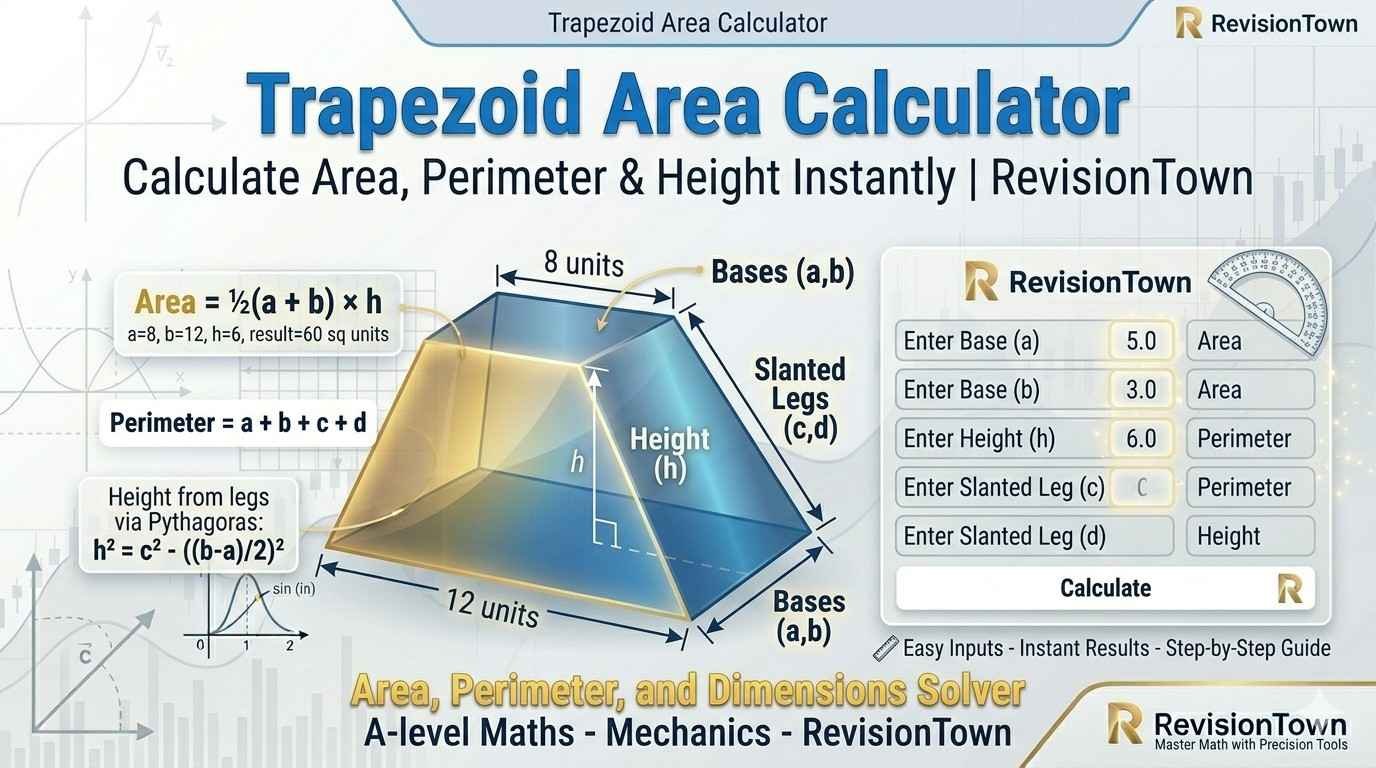
A trapezoid is a quadrilateral with one pair of parallel sides. Those parallel sides are usually called the bases. If the bases are \(a\) and \(b\), and the perpendicular height between them is \(h\), the area is:
\(A=\dfrac{a+b}{2}\times h\)The calculator below works with the main trapezoid relationships. Enter the known values, choose the calculation type, and the result panel will show the relevant formula, numerical answer and useful related values. If you are comparing several shapes in one assignment, the broader area calculator and geometry calculators pages can help you choose the correct tool for the next figure.
What the Trapezoid Area Calculator Does
The trapezoid area calculator is designed for problems where a four-sided figure has two opposite sides that are parallel. Those two parallel sides are the bases, and the shortest perpendicular distance between the bases is the height. The most common task is to find the region enclosed by the trapezoid, but real geometry problems often ask for more than area. A question may give the area and bases and ask for height. A design sketch may give the height, one base and area and ask for the other base. A perimeter question may give all four side lengths and ask for the boundary distance. An isosceles trapezoid question may ask for the equal legs when the height and base difference are known.
The calculator handles these related tasks because they all come from the same geometry model. A trapezoid is not only an area formula; it is a shape with bases, legs, height, midline and sometimes symmetry. The best solution starts by identifying which values are parallel, which value is perpendicular, and whether the slanted sides are known or can be inferred. When those roles are clear, the formulas are short and reliable.
For most school and practical work, the bases are labeled \(a\) and \(b\). Some textbooks use \(b_1\) and \(b_2\), while others use \(B\) for the longer base and \(b\) for the shorter base. The labels do not change the formula. The area depends on the average of the two base lengths multiplied by the height. This is why the formula can be written as \(A=\frac{a+b}{2}h\), \(A=\frac{1}{2}(b_1+b_2)h\), or \(A=mh\), where \(m\) is the midline length.
Use this page when the search intent is specifically a trapezoid calculation. If you need a library of formulas across many shapes, use geometry formulas. If you are solving a general geometry homework set and are not sure which calculator applies, start with geometry calculators. This page stays focused on trapezoids so the examples, warnings and formulas match the shape you are actually measuring.
Trapezoid Area Formula
The area of a trapezoid is one half of the sum of the two parallel bases multiplied by the perpendicular height. In symbols:
\(A=\dfrac{a+b}{2}\times h\)Here, \(a\) and \(b\) are the parallel side lengths, \(h\) is the perpendicular height, and \(A\) is the area. The expression \(\frac{a+b}{2}\) is the average of the two bases. Therefore, the formula can also be understood as:
\(A=(\text{average of the parallel bases})\times(\text{height})\)This interpretation is often easier than memorizing a formula mechanically. If the two parallel sides are 8 units and 14 units, their average is 11 units. If the height is 6 units, the area is \(11\times 6=66\) square units. The trapezoid behaves like a rectangle whose width is the average of the two bases and whose height is the distance between them.
The formula uses perpendicular height, not slanted side length. If a side leans inward or outward, that slanted measurement is a leg, not the height. The height must meet the bases at a right angle. In diagrams, the height is often drawn as a dashed vertical segment inside or outside the trapezoid. If a problem gives a slanted leg but not the perpendicular height, you may need the Pythagorean theorem, trigonometry or additional information before using the area formula.
Key idea: Add the parallel sides first, divide by 2 to get the midline or average base, then multiply by the perpendicular height. The unit of area is always square units, such as \(\text{cm}^2\), \(\text{m}^2\), \(\text{in}^2\) or \(\text{ft}^2\).
Why the Formula Works
The trapezoid area formula is not arbitrary. One common explanation is to duplicate the trapezoid, rotate the copy and join the two shapes together. The pair forms a parallelogram whose base is \(a+b\) and whose height is \(h\). The area of that parallelogram is \((a+b)h\). Since the parallelogram is made from two congruent trapezoids, one trapezoid has half that area:
\(2A=(a+b)h\) \(A=\dfrac{(a+b)h}{2}\)This proof also explains why both bases appear in the formula. A rectangle uses only one constant width, but a trapezoid changes width as you move from one base to the other. The average width of that change is the average of the two base lengths. Multiplying the average width by the height gives the exact area for a trapezoid because the side boundaries are straight.
Another way to understand the formula is to break the trapezoid into a rectangle and two triangles, or into one rectangle and one triangle depending on the shape. The rectangle contributes a predictable \(bh\) area, and the triangular pieces add or subtract the remaining area. When the algebra is simplified, the same \(\frac{a+b}{2}h\) formula appears. This is useful in class because it connects trapezoids to formulas students already know, such as the rectangle formula and the triangle formula. If your diagram can be broken into triangles, the triangle area calculator can be used to verify the decomposition.
The duplicated-shape proof is usually the fastest for memory. It tells you that a trapezoid is closely related to a parallelogram. The formula \(A=mh\), where \(m\) is the midline, is especially memorable because the midline is exactly the average of the bases. If \(m=\frac{a+b}{2}\), then \(A=mh\).
Step-by-Step: How to Find Trapezoid Area
Use this process when the two bases and the height are known.
1. Identify the bases
Find the two parallel sides. Label them \(a\) and \(b\). The longer base does not have to be first.
2. Identify the height
Use the perpendicular distance between the bases. Do not use a slanted leg unless it is also perpendicular.
3. Average the bases
Calculate \(\frac{a+b}{2}\). This is the trapezoid midline length.
4. Multiply by height
Compute \(A=\frac{a+b}{2}h\) and write the answer in square units.
For example, suppose a trapezoid has bases 10 cm and 18 cm and height 7 cm. Add the bases: \(10+18=28\). Divide by 2: \(28/2=14\). Multiply by height: \(14\times 7=98\). The area is \(98\ \text{cm}^2\).
\(A=\dfrac{10+18}{2}\times 7=14\times 7=98\ \text{cm}^2\)If the dimensions are in meters, the result is square meters. If they are in inches, the result is square inches. Keep all lengths in the same unit before calculating. Do not mix centimeters and meters in the same formula unless you convert first.
Finding Height from Area and Bases
Many trapezoid questions reverse the standard area formula. Instead of asking for area, they give area and the two bases, then ask for height. Start with the area formula:
\(A=\dfrac{a+b}{2}h\)To solve for height, multiply both sides by 2 and divide by the sum of the bases:
\(h=\dfrac{2A}{a+b}\)For example, if the area is \(120\ \text{m}^2\), the bases are 12 m and 18 m, then:
\(h=\dfrac{2(120)}{12+18}=\dfrac{240}{30}=8\ \text{m}\)This height is a linear measurement, not a square measurement. The area is square meters because it covers a two-dimensional region. The height is meters because it is a length. When rearranging formulas, the unit can help you check the result: \(\text{m}^2/\text{m}=\text{m}\), so the height unit is correct.
A common error is to divide the area by only one base. That would be a rectangle-style shortcut, not a trapezoid calculation. For a trapezoid, the effective width is the average of the two bases, so both base lengths must be used. The height formula \(h=\frac{2A}{a+b}\) keeps that average built in.
Finding a Missing Base
If you know the area, height and one base, you can solve for the other base. Start with the formula and isolate the unknown base. Suppose \(b\) is missing:
\(A=\dfrac{a+b}{2}h\) \(\dfrac{2A}{h}=a+b\) \(b=\dfrac{2A}{h}-a\)For example, a trapezoid has area \(84\ \text{cm}^2\), height 6 cm and one base of 10 cm. The missing base is:
\(b=\dfrac{2(84)}{6}-10=28-10=18\ \text{cm}\)The same method works if \(a\) is missing. Because the bases are added in the formula, the two base labels are interchangeable:
\(a=\dfrac{2A}{h}-b\)When a missing base answer is negative, the inputs are inconsistent. A positive area and positive height require the sum of the bases to be positive. If one known base is larger than \(\frac{2A}{h}\), the missing base would have to be negative, which cannot represent a real side length. In that case, check whether the height, area or known base was copied correctly.
Trapezoid Perimeter Formula
The perimeter of a trapezoid is the total boundary length. If the bases are \(a\) and \(b\), and the non-parallel sides are \(c\) and \(d\), the perimeter is:
\(P=a+b+c+d\)Unlike area, perimeter does not use height unless the height is needed to find an unknown side. If all four side lengths are given, add them directly. For example, if \(a=8\), \(b=14\), \(c=7\), and \(d=7\), then:
\(P=8+14+7+7=36\)The perimeter unit is a linear unit, such as cm, m, in or ft. Do not write square units for perimeter. Area measures the amount of surface inside the trapezoid; perimeter measures the distance around the outside. If you want a wider review of that distinction, the area and perimeter guide is the most natural next reference.
Perimeter can be harder than area when the legs are not given. A diagram may show two bases and a height, but that is not always enough to determine both slanted sides. An isosceles trapezoid gives extra information because the legs are equal and the horizontal offsets match. A general trapezoid may need angles, coordinates or additional lengths before its perimeter can be found.
Isosceles Trapezoid Calculations
An isosceles trapezoid has equal non-parallel sides. It is symmetric: the two base angles at each base are equal, and the left and right horizontal offsets are the same. If the bases are \(a\) and \(b\), with \(b\) longer than \(a\), the offset on each side is half the base difference:
\(x=\dfrac{|b-a|}{2}\)If the height is \(h\), each leg forms a right triangle with vertical side \(h\) and horizontal side \(x\). The leg length is found using the Pythagorean theorem:
\(s=\sqrt{h^2+\left(\dfrac{b-a}{2}\right)^2}\)Then the perimeter of an isosceles trapezoid is:
\(P=a+b+2s\)For example, let the bases be 10 and 18 and the height be 6. The half-difference is \(\frac{18-10}{2}=4\). The leg length is \(s=\sqrt{6^2+4^2}=\sqrt{52}\approx 7.21\). The perimeter is \(10+18+2(7.21)\approx 42.42\).
This method only applies when the trapezoid is isosceles or when the diagram clearly shows equal offsets. If the trapezoid leans more on one side than the other, the two legs may have different lengths. In that case, height and bases alone are not enough to find perimeter. You may need side lengths, angles or coordinates. For coordinate-based side lengths, a 2D distance calculator can help find the length between two vertices before adding the perimeter.
Midline of a Trapezoid
The midline, also called the median or midsegment, is the segment that joins the midpoints of the two legs. It is parallel to both bases, and its length is the average of the two bases:
\(m=\dfrac{a+b}{2}\)This turns the area formula into a very short expression:
\(A=mh\)If the bases are 9 and 15, the midline is 12. If the height is 5, the area is \(12\times 5=60\). This is the same result as \(\frac{9+15}{2}\times 5\), but the midline form is often cleaner when the midpoint segment is drawn in the diagram.
The midline also gives a useful visual explanation of the area formula. A trapezoid does not have a constant width from top to bottom, but the midline represents its average width. Multiplying average width by height gives the area. This is similar to using average speed times time to find distance when speed changes linearly, although the geometry context is different.
Trapezoid vs Trapezium
Terminology can vary by country and curriculum. In many US classrooms, a trapezoid is a quadrilateral with at least one pair of parallel sides. In some UK and Commonwealth contexts, the word trapezium may be used for this same shape, while trapezoid may refer to a quadrilateral with no parallel sides. Some courses also distinguish between an inclusive definition, where parallelograms count as trapezoids because they have at least one pair of parallel sides, and an exclusive definition, where a trapezoid has exactly one pair of parallel sides.
The calculator is built for the common geometry problem where two opposite sides are treated as the parallel bases. The area formula \(A=\frac{a+b}{2}h\) works when \(a\) and \(b\) are parallel and \(h\) is the perpendicular distance between them. If both pairs of opposite sides are parallel, the figure may be a parallelogram. The trapezoid formula still simplifies correctly when the two bases are equal, but the dedicated parallelogram area calculator is usually clearer for that shape.
When solving exams or textbook problems, follow the terminology used by the course. The formula depends on the geometry, not the word alone. If the diagram shows two parallel sides and a perpendicular height, the trapezoid area method is appropriate. If no sides are parallel, more information is needed and the trapezoid formulas on this page do not apply directly.
Worked Area Examples
Example 1: Basic area
A trapezoid has bases \(a=6\) cm and \(b=10\) cm. Its height is \(h=4\) cm. Find the area.
\(A=\dfrac{6+10}{2}\times 4=8\times 4=32\ \text{cm}^2\)The area is \(32\ \text{cm}^2\).
Example 2: Decimal dimensions
A trapezoid has bases 3.5 m and 7.2 m and height 2.4 m.
\(A=\dfrac{3.5+7.2}{2}\times 2.4=5.35\times 2.4=12.84\ \text{m}^2\)The area is \(12.84\ \text{m}^2\). If the measurements were rounded to one decimal place, a final rounded area may be appropriate depending on the instructions.
Example 3: Height from area
A trapezoid has area \(150\ \text{ft}^2\), bases 20 ft and 30 ft. Find height.
\(h=\dfrac{2A}{a+b}=\dfrac{2(150)}{20+30}=\dfrac{300}{50}=6\ \text{ft}\)The height is 6 ft.
Example 4: Missing base
A trapezoid has area \(72\ \text{in}^2\), height 8 in and one base 11 in. Find the other base.
\(b=\dfrac{2(72)}{8}-11=18-11=7\ \text{in}\)The missing base is 7 in.
Example 5: Isosceles perimeter
An isosceles trapezoid has bases 12 and 20 and height 3. The half-difference is \(4\), so each leg is:
\(s=\sqrt{3^2+4^2}=\sqrt{25}=5\) \(P=12+20+2(5)=42\)The perimeter is 42 units.
Common Trapezoid Formula Table
The table below summarizes the formulas used by the calculator. Choose the row that matches the unknown you need to find.
| Goal | Formula | Values required | Unit of result |
|---|---|---|---|
| Area | \(A=\dfrac{a+b}{2}h\) | Two bases and height | Square units |
| Height | \(h=\dfrac{2A}{a+b}\) | Area and two bases | Linear units |
| Missing base | \(b=\dfrac{2A}{h}-a\) | Area, height and one base | Linear units |
| Perimeter | \(P=a+b+c+d\) | All four side lengths | Linear units |
| Midline | \(m=\dfrac{a+b}{2}\) | Two bases | Linear units |
| Isosceles leg | \(s=\sqrt{h^2+\left(\dfrac{b-a}{2}\right)^2}\) | Two bases, height and isosceles condition | Linear units |
These formulas assume the inputs describe the same trapezoid. If a calculated height, base or side length is impossible, the issue is usually inconsistent data or a copied measurement error.
Area vs Perimeter: Do Not Mix Them
Area and perimeter answer different questions. Area tells how much two-dimensional space is inside the trapezoid. Perimeter tells how far it is around the outside. Area uses square units; perimeter uses linear units. A trapezoid can have a large perimeter but a smaller area if it is very thin, and it can have a larger area with a moderate perimeter if the height is substantial.
The area formula uses bases and height because it measures coverage. The perimeter formula uses all four sides because it measures boundary length. The legs do not appear in the basic area formula unless they are needed to find height. The height does not appear in the basic perimeter formula unless it is needed to find a missing leg. Keeping these roles separate prevents most mistakes.
For example, a trapezoid with bases 8 and 14, height 6 and legs 7 and 7 has area \(66\) square units and perimeter \(36\) units. Those answers are not comparable because they measure different things. Writing \(66\) units for area or \(36\) square units for perimeter would be incorrect. If a problem asks for fencing, trim, border or outline, it usually wants perimeter. If it asks for flooring, paint coverage, land area or surface coverage, it usually wants area.
When a word problem involves cost, identify whether the cost is per square unit or per linear unit. A price per square foot uses area. A price per foot of edging uses perimeter. If both materials are needed, calculate both separately and keep the units visible.
Units and Measurement Consistency
All lengths in a trapezoid calculation must be in the same unit before you apply a formula. If one base is measured in centimeters and another is measured in meters, convert first. The formula does not know which unit each number represents. It simply combines numbers. Unit consistency is what makes the result meaningful.
Suppose a trapezoid has bases 0.8 m and 120 cm and height 50 cm. You should not calculate \(\frac{0.8+120}{2}\times 50\). Convert everything to centimeters or meters first. In centimeters, the bases are 80 cm and 120 cm, and the height is 50 cm:
\(A=\dfrac{80+120}{2}\times 50=100\times 50=5000\ \text{cm}^2\)In meters, the bases are 0.8 m and 1.2 m, and the height is 0.5 m:
\(A=\dfrac{0.8+1.2}{2}\times 0.5=1.0\times 0.5=0.5\ \text{m}^2\)These two answers are equivalent because \(0.5\ \text{m}^2=5000\ \text{cm}^2\). The important point is that the calculation must be consistent from start to finish. If you are switching among shape tools, the same rule applies to square area, rectangle area and trapezoid area problems.
Real-World Uses of Trapezoid Area
Trapezoids appear in many practical sketches because real objects often have one width at the top and another width at the bottom. A landscaped bed may taper from one end to another. A concrete panel may have sloped sides. A road shoulder, roof section, retaining wall face, ramp side panel, fabric pattern or sheet-metal piece may be approximated as a trapezoid. The area formula gives a quick way to estimate coverage when the two parallel widths and the perpendicular length between them are known.
For construction and design estimates, the two bases might represent two parallel edges of a surface. The height is the perpendicular distance between those edges. If the edges are not parallel or the sides are curved, the trapezoid formula may only be an approximation. For a shape made of several straight pieces, break it into rectangles, triangles and trapezoids, calculate each area, then add the results. The area formulas in geometry formulas can help organize those composite-shape calculations.
In land measurement, trapezoid-like regions are common in plots and boundary sketches. However, real property measurements should be handled with appropriate surveying methods and legal documents. The calculator is useful for mathematical estimation and learning, not as a replacement for professional measurement when legal or financial decisions depend on exact boundaries.
In classroom contexts, trapezoids are especially useful because they connect several geometry ideas: parallel lines, height, area, average, decomposition, symmetry and the Pythagorean theorem. A single trapezoid problem can test whether a student understands which measurements are necessary and which are extra.
Coordinate Geometry with Trapezoids
Sometimes a trapezoid is given by coordinates instead of side lengths. In that case, you usually need to identify the parallel sides, find their lengths, and find the perpendicular distance between the parallel lines. If the bases are horizontal, this can be straightforward. For example, if one base lies on \(y=2\) and the other lies on \(y=8\), the height is \(8-2=6\). The base lengths can be found by subtracting x-coordinates.
If the bases are not horizontal, the work is more involved. You may need the distance formula to find side lengths and the distance between parallel lines to find height. The distance between two points \((x_1,y_1)\) and \((x_2,y_2)\) is:
\(d=\sqrt{(x_2-x_1)^2+(y_2-y_1)^2}\)This is useful for finding the base lengths from endpoints. If the trapezoid is part of a coordinate geometry problem and you need point-to-point lengths, the 2D distance calculator can help check those values before applying the area or perimeter formula.
Coordinate problems also require you to prove or confirm which sides are parallel. Two line segments are parallel when their slopes are equal. Once the parallel sides are known, label them as bases. Do not assume the top and bottom of a drawing are bases unless the coordinate data confirms that they are parallel.
Common Mistakes to Avoid
Using a slanted side as height
The height must be perpendicular to the bases. A slanted leg is not the height unless it meets the bases at a right angle.
Forgetting to average the bases
The formula uses \(\frac{a+b}{2}\), not just \(a+b\). Omitting the division by 2 doubles the area.
Mixing units
Convert all lengths to the same unit before calculating. Mixed units create meaningless results.
Writing wrong units
Area uses square units. Perimeter, height, base and side lengths use linear units.
Assuming all trapezoids are isosceles
Equal legs require a stated condition or a symmetric diagram. A general trapezoid may have unequal legs.
Using perimeter when area is requested
Perimeter adds side lengths around the outside. Area measures the surface inside the trapezoid.
How to Check Your Answer
A quick reasonableness check can catch many trapezoid errors. First, compare the area with rectangles using the shorter and longer bases. If the bases are \(a\) and \(b\), and \(a Second, check whether the answer changes in the expected direction. If height doubles while bases stay the same, area should double. If both bases increase while height stays the same, area should increase. If the two bases are equal, the trapezoid behaves like a parallelogram or rectangle-style shape, and the area becomes \(bh\). Third, check units. If the input lengths are meters, the area must be square meters. If the perimeter is requested, the result must be meters. Unit errors are easy to fix if you catch them before submitting the answer. Fourth, substitute back when solving for height or a missing base. If you find \(h=8\), place it into \(A=\frac{a+b}{2}h\) and verify that the original area returns. If you find a missing base, add it to the known base, average the bases, multiply by height, and confirm the area.
Practice Problems
Try these trapezoid calculations before using the answer column. Each problem uses the same core formulas, but the unknown changes.
| Problem | Setup | Answer |
|---|---|---|
| Find area when \(a=5\), \(b=11\), \(h=4\). | \(\frac{5+11}{2}\times 4\) | \(32\) square units |
| Find area when \(a=9\), \(b=15\), \(h=8\). | \(\frac{9+15}{2}\times 8\) | \(96\) square units |
| Find height when \(A=70\), \(a=6\), \(b=14\). | \(\frac{2(70)}{6+14}\) | \(7\) units |
| Find missing base when \(A=45\), \(h=5\), \(a=7\). | \(\frac{2(45)}{5}-7\) | \(11\) units |
| Find perimeter when sides are 8, 12, 5 and 6. | \(8+12+5+6\) | \(31\) units |
| Find isosceles leg when bases are 10 and 16, height is 4. | \(\sqrt{4^2+3^2}\) | \(5\) units |
If you missed a problem, identify whether the mistake was formula choice, arithmetic, unit labeling or using the wrong measurement as height. Most trapezoid mistakes fall into one of those categories.
When to Use Another Shape Formula
The trapezoid formula is precise for a trapezoid, but many geometry diagrams include shapes that look similar at first glance. If both pairs of opposite sides are parallel, the figure may be a parallelogram, and \(A=bh\) is the simplest formula. If the figure has three sides, use triangle area. If all angles are right angles, a rectangle formula may be more direct. If the boundary is curved, use a circle, ellipse or sector formula rather than a trapezoid formula.
This distinction matters in composite figures. A roof face may include a rectangle under a trapezoid. A landscaping area may include a rectangle, two triangles and a curved border. In those cases, calculate each part with the right formula and add or subtract areas as needed. Do not force the entire figure into a trapezoid formula unless the top and bottom edges are parallel and the side boundaries are straight.
Adjacent calculators can make this faster. Use rectangle area for rectangular sections, triangle area for triangular cutouts, circle area for round regions, and ellipse area for oval regions. If the task is only to add lengths around the outside, use the perimeter guide instead of an area formula.
Composite Trapezoid Area Problems
Composite problems are common because a trapezoid often appears as one part of a larger figure. The safest approach is to draw boundaries that separate the figure into familiar shapes. Then calculate each piece and add or subtract the results. The trapezoid formula should be used only for the trapezoid part, not for the whole drawing unless the whole drawing has a pair of parallel bases and straight non-parallel sides.
Suppose a garden plan contains a rectangular walkway beside a trapezoid planting bed. The rectangle is 4 m by 9 m, so its area is \(36\ \text{m}^2\). The trapezoid bed has bases 5 m and 11 m and height 6 m, so its area is:
\(A=\dfrac{5+11}{2}\times 6=8\times 6=48\ \text{m}^2\)The total area is \(36+48=84\ \text{m}^2\). If a material is priced per square meter, this total area is the value you would use for coverage. If a border is also needed around the outside, that is a separate perimeter calculation. Do not multiply the total area by a price per meter, and do not multiply perimeter by a price per square meter.
Now consider a trapezoid with a triangular cutout. The outer trapezoid has bases 16 cm and 24 cm and height 10 cm. Its area is \(\frac{16+24}{2}\times 10=200\ \text{cm}^2\). A triangular notch inside the shape has base 6 cm and height 4 cm, so its area is \(\frac{1}{2}\times 6\times 4=12\ \text{cm}^2\). The remaining area is \(200-12=188\ \text{cm}^2\). The subtraction step matters because the triangle is removed from the region, not added to it.
Composite diagrams can become visually busy. Label each part, write the formula beside that part, and keep units visible. If a trapezoid is split into a rectangle and two right triangles, you can either add the pieces or use the trapezoid formula directly. Both methods should match. When they do not, the difference usually comes from using a slanted side as height, measuring a non-parallel side as a base, or forgetting a cutout.
Word Problem Strategy
Trapezoid word problems often hide the formula behind practical language. Words such as "top width," "bottom width," "parallel edges," "upper base," "lower base," "distance between edges," "height," "depth," "altitude," "border," "trim," "surface," "coverage" and "capacity estimate" all point to different measurements. The first step is to translate the words into a diagram or a list of variables.
If a problem says a sign is 1.2 m wide at the top, 2.0 m wide at the bottom and 0.9 m tall, the two widths are the bases and the height is 0.9 m. The area is:
\(A=\dfrac{1.2+2.0}{2}\times 0.9=1.6\times 0.9=1.44\ \text{m}^2\)If paint covers \(8\ \text{m}^2\) per liter, one liter is enough for one coat because \(1.44<8\). If the problem asks for two coats, the required coverage becomes \(2.88\ \text{m}^2\), still less than one liter at that coverage rate. The geometry answer is only part of the word problem; the final practical answer depends on what the question asks next.
If a problem says a road shoulder is 2 ft wide at one end, 5 ft wide at the other end and 60 ft long between the parallel widths, the trapezoid area is:
\(A=\dfrac{2+5}{2}\times 60=3.5\times 60=210\ \text{ft}^2\)Here, the long distance of 60 ft is the height in the formula because it is the perpendicular distance between the parallel widths. Many students expect height to be vertical on the page, but in applied drawings it may run horizontally across a plan. Height means perpendicular distance between bases, not necessarily "up and down" on the page.
If a word problem asks for fencing around a trapezoid plot, it wants perimeter, not area. If it asks for grass seed, carpet, paint, mulch coverage or surface material, it usually wants area. If it asks for both, calculate both and keep them separate. A strong answer states the quantity, the unit and what it represents: for example, "The planting area is \(210\ \text{ft}^2\)" or "The border length is 74 ft."
Rounding, Precision and Significant Figures
The formulas on this page are exact relationships, but real measurements are often rounded. If a base is recorded as 8 cm, it may mean the true length was rounded to the nearest centimeter. If a base is recorded as 8.00 cm, it suggests a more precise measurement. The calculator can display many decimal places, but the final answer should match the precision of the problem or the measurement context.
For classroom problems, follow the instruction. If the question says "round to the nearest tenth," keep one decimal place. If it says "give the exact answer," leave square roots or fractions when appropriate. If no rounding instruction is given, a clean decimal or exact fraction is usually acceptable, depending on the course.
Consider an isosceles trapezoid with bases 10 and 17 and height 6. The half-difference is \(3.5\), so the leg is \(s=\sqrt{6^2+3.5^2}=\sqrt{48.25}\). The exact form is \(\sqrt{48.25}\), and the decimal approximation is about 6.946. If you use this leg in perimeter, avoid rounding too early. Use the unrounded value for the calculation, then round the final perimeter. Rounding the leg to 6.9 first would create a slightly different perimeter than rounding at the end.
For area, rounding is usually less complicated because the standard formula uses only addition, division by 2 and multiplication. Still, decimals can accumulate. If \(a=12.4\), \(b=19.7\), and \(h=8.3\), then:
\(A=\dfrac{12.4+19.7}{2}\times 8.3=16.05\times 8.3=133.215\)If rounded to one decimal place, the area is \(133.2\) square units. If rounded to the nearest whole unit, it is \(133\) square units. The correct rounded form depends on the instruction and the reliability of the measurements.
Advanced Checks for Isosceles Trapezoids
Isosceles trapezoid problems deserve one extra check because they combine area, right triangles and symmetry. The equal legs do not automatically make the bases equal. Instead, the shorter base is centered over the longer base, so the difference between the bases is split evenly on the two sides. That is why the offset is \(\frac{|b-a|}{2}\), not simply \(b-a\).
For example, if the bases are 9 and 21, the difference is 12. Each side offset is \(6\), not 12. If the height is 8, the equal leg length is:
\(s=\sqrt{8^2+6^2}=\sqrt{100}=10\)The perimeter is \(9+21+2(10)=50\). If you accidentally used the full base difference as the horizontal leg of the right triangle, you would calculate \(\sqrt{8^2+12^2}\), which is too long. That would overstate the perimeter.
You can also solve backward. If an isosceles trapezoid has bases 9 and 21 and equal legs 10, the half-difference is 6. The height is:
\(h=\sqrt{10^2-6^2}=\sqrt{64}=8\)Once the height is known, the area is \(\frac{9+21}{2}\times 8=120\). This chain shows how side length, height and area connect, but only under the isosceles condition. Without that condition, the same bases and leg length may not determine a unique trapezoid.
Frequently Asked Questions
What is the formula for trapezoid area?
The formula is \(A=\frac{a+b}{2}h\), where \(a\) and \(b\) are the parallel bases and \(h\) is the perpendicular height.
How do you calculate trapezoid perimeter?
Add all four side lengths: \(P=a+b+c+d\). The bases and legs are all included in perimeter.
How do you find trapezoid height from area?
Use \(h=\frac{2A}{a+b}\). This comes from rearranging \(A=\frac{a+b}{2}h\).
Can I use a slanted side as the height?
No, not unless it is perpendicular to the bases. The height is the shortest perpendicular distance between the parallel bases.
What is the midline of a trapezoid?
The midline is the segment joining the midpoints of the legs. Its length is \(m=\frac{a+b}{2}\), and the area can be written as \(A=mh\).
How do I find the leg of an isosceles trapezoid?
If the bases are \(a\) and \(b\), height is \(h\), and the trapezoid is isosceles, the leg is \(s=\sqrt{h^2+\left(\frac{b-a}{2}\right)^2}\).
Are trapezoid and trapezium the same?
It depends on the country or curriculum. This calculator uses trapezoid to mean a quadrilateral with a pair of parallel sides used as bases.
What units should trapezoid area use?
Area uses square units, such as \(\text{cm}^2\), \(\text{m}^2\), \(\text{in}^2\) or \(\text{ft}^2\). Perimeter, bases, height and side lengths use linear units.
Final Trapezoid Checklist
Before finalizing a trapezoid answer, confirm that you have identified the two parallel bases correctly. Use the perpendicular height for area, not a slanted side. Add the bases, divide by 2, and multiply by height. Use square units for area and linear units for perimeter, height and side length. If a missing height or base is required, rearrange the same formula rather than guessing from a rectangle formula.
For isosceles trapezoids, use the equal-leg condition only when it is stated or clearly shown. For coordinate problems, find lengths and height from coordinates first. For composite figures, break the diagram into simpler shapes and use the correct calculator for each part. These checks keep the work accurate, readable and consistent with the geometry of the figure.