College Board SAT schedule, international testing, digital SAT
College Board International SAT Dates and Deadlines 2026-2027
This guide organizes the official College Board SAT dates for the August 2026 through June 2027 testing cycle, with registration deadlines, late registration and change deadlines, score release dates, international fee notes, test-date strategy, and planning advice for students applying to universities in the United States and abroad.
Official International SAT Dates and Deadlines 2026-2027
The College Board's August 2026 to June 2027 SAT schedule applies to both U.S. and international students taking the SAT. That point matters because older SAT cycles sometimes caused confusion about domestic and international availability. For this cycle, the main weekend SAT dates are shared across locations, though test center seats, fees, and local availability still vary by country and city.
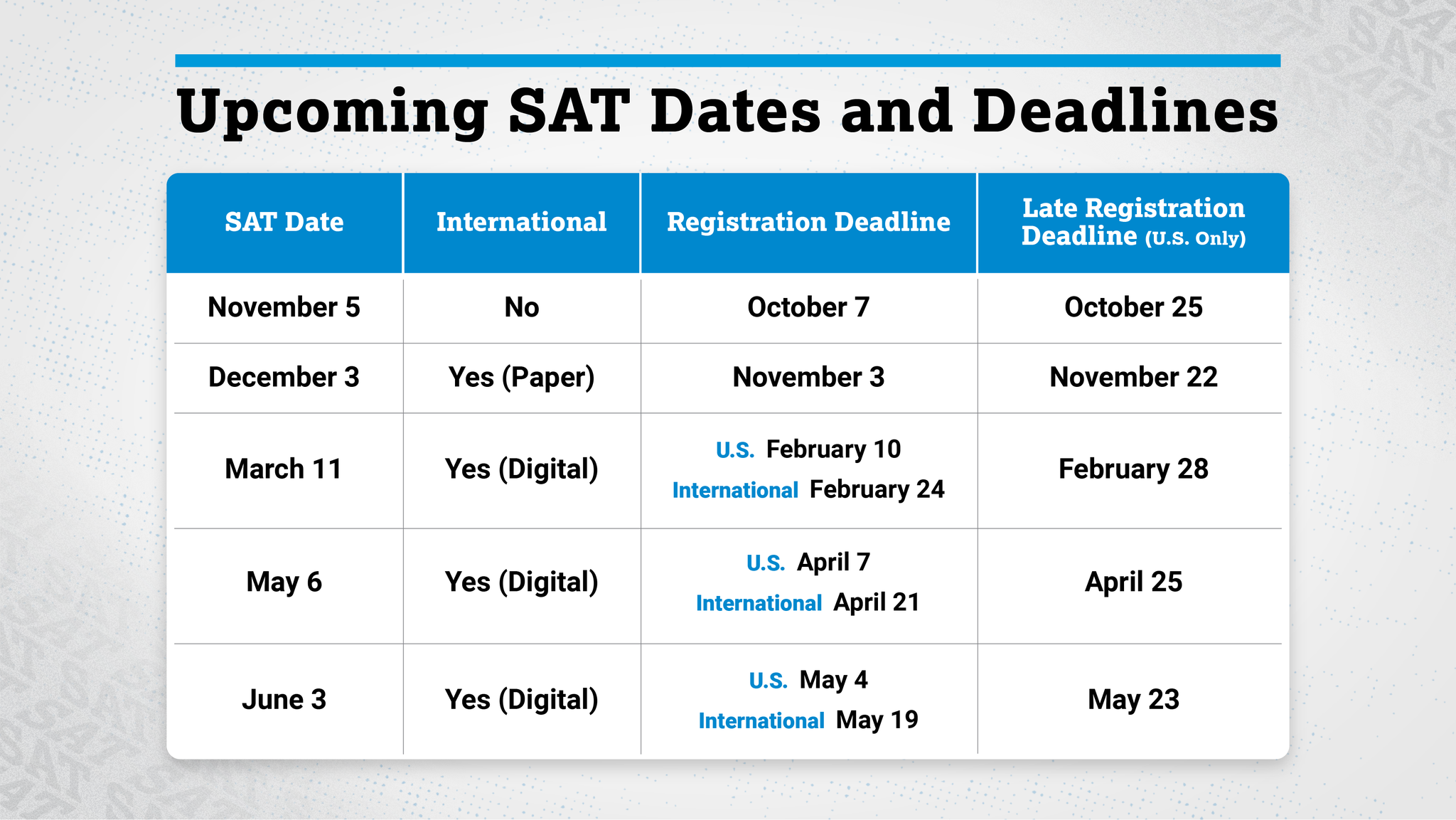
The table below uses the College Board schedule verified on July 8, 2026. It includes three dates for each SAT administration: the test date, the regular registration deadline, and the deadline for changes, regular cancellation, and late registration.
| SAT test date | Regular registration deadline | Deadline for changes, regular cancellation, and late registration | Planning note |
|---|---|---|---|
| August 22, 2026 | August 7, 2026 | August 11, 2026 | Strong first senior-year option for students who prepared during summer. |
| September 12, 2026 | August 28, 2026 | September 1, 2026 | Useful for early applicants who need a fall score before November deadlines. |
| October 3, 2026 | September 18, 2026 | September 22, 2026 | Often the last practical SAT date for many early-action and early-decision plans. |
| November 7, 2026 | October 23, 2026 | October 27, 2026 | Useful for regular-decision applications and for students improving after October. |
| December 5, 2026 | November 20, 2026 | November 24, 2026 | Common final attempt for many regular-decision deadlines, depending on each college. |
| March 6, 2027 | February 19, 2027 | February 23, 2027 | Strong first attempt for grade 11 students planning ahead for the 2027-2028 cycle. |
| May 1, 2027 | April 16, 2027 | April 20, 2027 | Useful after spring preparation and before many school final exam periods. |
| June 5, 2027 | May 21, 2027 | May 25, 2027 | Good end-of-school-year option before summer senior-year planning begins. |
Registration for a date does not guarantee that every nearby test center will have seats. Test center availability can change as seats fill, centers open, centers close, or local conditions affect administration. For that reason, students in high-demand cities should register as soon as they know their preferred date, especially for August, September, October, and December.
2026-2027 SAT Score Release Dates
The College Board international calendar also lists score release dates for the 2026-2027 weekend SAT. Score timing matters because a test date is only useful if the score arrives early enough for your target universities, scholarship programs, or school reporting deadlines.
| SAT test date | Scores available to students | Scores available to educators | What to do after release |
|---|---|---|---|
| August 22, 2026 | September 4, 2026 | September 8, 2026 | Compare the result with your target score and decide quickly whether September or October is needed. |
| September 12, 2026 | September 25, 2026 | September 28, 2026 | Useful for deciding whether to sit again in October before early deadlines. |
| October 3, 2026 | October 16, 2026 | October 19, 2026 | Check score-sending policies immediately if applying early. |
| November 7, 2026 | November 20, 2026 | November 23, 2026 | Good for regular-decision review if colleges accept November scores. |
| December 5, 2026 | December 18, 2026 | December 21, 2026 | Often the final practical score for January regular-decision deadlines. |
| March 6, 2027 | March 19, 2027 | March 22, 2027 | Use the result to plan May or June retakes with focused preparation. |
| May 1, 2027 | May 14, 2027 | May 17, 2027 | Useful for grade 11 students deciding whether June is necessary. |
| June 5, 2027 | June 21, 2027 | June 21, 2027 | Gives students summer time to evaluate whether a fall 2027 retake is needed. |
A scheduled score release date is not the same as a college application deadline. Students should allow time for reviewing scores, deciding whether to send them, and checking how each institution receives official score reports. If a university accepts self-reported scores, your timeline may be more flexible. If it requires official score reports by a fixed deadline, plan with more buffer.
What Matters for International SAT Students in 2026-2027
For international students, the SAT date is only one part of the decision. You also need to consider local test center access, national school calendars, university application deadlines, time-zone differences, passport or ID requirements, device readiness, travel logistics, and how quickly scores can be used for applications.
College Board states that Sunday testing is available only for students who cannot test on Saturday for religious reasons, and Sunday dates immediately follow Saturday dates. That means most international students should plan around the listed Saturday administrations unless they qualify and complete the required Sunday-testing process.
Students who need to borrow a device from College Board must register and request the device earlier than the regular registration deadline. College Board states this should be at least 30 days before test day. This is one of the most important details for students who do not have a compatible device for the digital SAT. Missing the device-request window can make a test date unusable even if the regular registration deadline has not passed.
The SAT is now digital, so preparation should include content practice and platform readiness. Students should be comfortable with the digital interface, timing, calculator use, adaptive modules, and the way questions appear on screen. For content review, use focused work in SAT Mathematics, SAT Reading practice, and SAT Writing practice rather than treating the test date as only an administrative deadline.
Key SAT Scheduling Terms
SAT scheduling language can be confusing because "deadline," "late registration," "change deadline," "score release," and "test date" sound similar but affect different decisions. Understanding the terms prevents last-minute mistakes.
| Term | Meaning | Why it matters |
|---|---|---|
| Test date | The Saturday when the SAT is administered at test centers. | This is the date you build your preparation schedule around. |
| Regular registration deadline | The final date to register without late registration status. | Seats may fill earlier, so this should be treated as a last safety point, not a target. |
| Late registration deadline | The final listed date for late registration, changes, and regular cancellation. | Additional fees apply, and availability may be limited. |
| Score release date | The date scores are scheduled to become available to students. | This determines whether a test date can support application deadlines. |
| Educator score release | The date scores are scheduled to be available to educators. | Useful for school counselors and school-based advising timelines. |
| Device request timing | Earlier action required for students who need to borrow a device. | Plan at least 30 days before test day if using College Board device lending. |
How to Choose the Right 2026-2027 SAT Date
The best SAT date is not simply the next available test. It is the date that gives you enough preparation time, fits your school calendar, leaves room for a retake if needed, and produces scores before your application deadlines. International students should also consider travel time and the risk that nearby test centers may fill quickly.
August 22, 2026
The August SAT is ideal for students who have prepared during the summer and want a score before the school year becomes crowded. It can be especially useful for rising seniors applying early in the United States, Canada, Singapore, Hong Kong, Europe, or other competitive admissions systems. The advantage is timing: scores are scheduled for September 4, which leaves time to decide whether September or October is needed.
The risk is that summer preparation requires discipline. Students who are travelling, attending camps, or completing school projects may not get enough consistent practice. If August is your target, begin serious work by May or June, not in August.
September 12, 2026
September is useful for students who want one more early fall opportunity before October. It is often a practical date for seniors who were not ready for August, or for juniors in schools that begin their academic year early. Since scores are scheduled for September 25, students can still evaluate whether October is worth taking.
The main challenge is that September arrives quickly after the academic year begins. If school workload increases suddenly, students may struggle to maintain practice. This date works best when most of the preparation is already complete before classes restart.
October 3, 2026
October is one of the most important SAT dates for early application plans. With scores scheduled for October 16, it may still support many November 1 early-action or early-decision deadlines, depending on each institution's score policy. Students should not assume every college accepts October scores for early deadlines; check each university's testing policy directly.
October is also a strong date for juniors who want an early benchmark. If the score is already high, they can reduce test pressure later. If it is below target, they still have several future administrations.
November 7, 2026
November is more useful for regular-decision applications than for early deadlines. It can also help students who took October and need another attempt. Scores are scheduled for November 20, which may be too late for some early plans but useful for many January deadlines.
November can be difficult for students with heavy school assessments, predicted-grade deadlines, extracurricular commitments, or national exam preparation. Choose it only if your preparation plan is realistic.
December 5, 2026
December is often the final realistic SAT date for students applying to many regular-decision universities with January deadlines. Scores are scheduled for December 18. This gives limited but often workable time before early January application deadlines. However, students must check whether each college accepts December SAT scores and whether official reports are required by the application deadline.
December is not a good date for experimentation. If it is your last attempt, you should enter with a clear target score, practice-test evidence, and a defined plan for whether to send scores.
March 6, 2027
March is a strong first SAT date for grade 11 students planning for applications in the next cycle. It gives enough time to learn from the result, target weak areas, and retest in May, June, August, or later. It also avoids the stress of making a first attempt in senior year.
May 1 and June 5, 2027
May and June are useful for students who want to finish SAT testing before summer. May gives a score by May 14, while June gives a score by June 21. These dates are popular among juniors because they leave summer for essays, university lists, internships, campus visits, or targeted retake preparation.
Students taking IB, A-Level, AP, national board exams, or school final exams should be careful with May. If May is too crowded, June may be better. If June conflicts with school finals or family travel, March or August may be safer.
SAT Date Strategy for Early and Regular Applications
A strong SAT plan works backward from application deadlines. Start with your earliest university deadline, then identify the latest score release date that can realistically support it. From there, choose a test date that gives you preparation time and a backup attempt.
For early U.S. applications with deadlines around November 1 or November 15, the August, September, and October SAT dates are usually the most relevant. The November SAT may be too late for many early plans, though some institutions may accept it. Always check the college's admissions page rather than relying on a general rule.
For regular-decision deadlines in January, August through December can all be useful. December may be the last workable date for many students, but it leaves little room for delays or a retake. If you are applying to competitive colleges and aiming for scholarships, August or September gives more control.
For students applying outside the United States, deadlines vary widely. Some universities have rolling admissions. Some require scores before scholarship review. Some accept SAT results after the application is submitted. Some do not require SAT scores at all but may use them for course placement, scholarship decisions, or international applicant evaluation. Do not treat "test optional" as "test irrelevant." A strong SAT score can still support your file if the institution accepts it.
Registration, Changes, Cancellation, and Late Deadlines
SAT registration is completed through a College Board account. Students select a test date, test center, personal details, and payment method. International students should check that the name on the College Board account matches the identification they will bring on test day.
Regular registration deadlines are about two weeks before the test date in this cycle. Late registration and changes are available for a few more days, but they should not be part of your default plan. Late registration can mean extra cost, fewer seats, less choice of test center, and more stress close to test day.
If you need to change a test center, change a registration detail, or cancel before the regular cancellation deadline, use the College Board account process and check the relevant fees. If you need to change the test date, College Board generally requires canceling and registering for a new date rather than simply moving the registration.
For international students, the practical registration checklist is:
- Create or check your College Board account early.
- Confirm your legal name, birth date, and identification details.
- Check test centers in your city and backup cities.
- Register before the regular deadline, not during late registration.
- Convert 11:59 p.m. ET to your local time zone.
- If borrowing a device, complete the device request at least 30 days before test day.
- Download or prepare the required digital testing app and complete readiness checks.
- Save confirmation details and test center information.
International SAT Fees and Cost Planning
College Board lists the SAT registration fee and an additional international fee for students testing outside the United States. As of the official page checked on July 8, 2026, the SAT registration fee is listed as $68, plus a $43 international fee. Additional services can carry extra charges, including late registration, cancellation, test center changes, additional score reports, rush reports, archived scores, and other score services.
International students should budget beyond the base exam fee. Depending on location, there may also be a test center fee at selected centers. Travel costs, passport renewal, transport on test morning, tutoring, practice materials, and score report fees can all affect the total cost.
A practical cost plan looks like this:
\[ \text{Total SAT cost} = \text{registration fee} + \text{international fee} + \text{optional service fees} + \text{travel costs} \]
The formula is simple, but it helps families avoid underestimating the real cost of testing. If a student may need two attempts, budget for two registrations from the beginning. A planned second attempt is usually less stressful than discovering late that another score is needed.
SAT Timeline Planning Formulas
Timeline formulas are not a replacement for official dates, but they help students build a safe plan. The 2026-2027 SAT cycle generally places regular registration deadlines about 15 days before test day, late deadlines a few days after regular deadlines, and score release around two weeks after the test date.
Use these formulas for planning, then verify the exact date in the official schedule:
\[ \text{Regular registration buffer} = \text{test date} - \text{regular registration deadline} \]
\[ \text{Late deadline buffer} = \text{test date} - \text{late registration deadline} \]
\[ \text{Score wait time} = \text{student score release date} - \text{test date} \]
For example, the October 3, 2026 SAT has a regular deadline of September 18, 2026:
\[ \text{Regular registration buffer} = 15 \text{ days} \]
Its student score release date is October 16, 2026:
\[ \text{Score wait time} = 13 \text{ days} \]
For application planning, the most important formula is:
\[ \text{Safe latest test date} = \text{application deadline} - \text{score processing buffer} \]
The score processing buffer should include time for score release, score review, score sending if needed, and any college-specific processing. For competitive early deadlines, a safer buffer is often three to four weeks, not just the published score release time.
Study Plan by Test Date
A test date is only useful if your preparation timeline supports it. The SAT is not just a calendar task; it is a performance task. Students should connect each registration decision to practice-test evidence.
Eight-week plan for a first attempt
An eight-week plan is practical when a student already has the required school foundation but needs SAT-specific training. It should include a diagnostic test, targeted review, timed section practice, full-length practice, and final digital readiness checks.
- Week 1: Take a diagnostic test and identify the largest score gaps.
- Weeks 2-3: Review core content in Reading and Writing plus Math.
- Weeks 4-5: Complete timed drills and review every mistake.
- Week 6: Take a full practice test and compare section performance.
- Week 7: Focus on weak question types and pacing.
- Week 8: Complete final review, digital setup, sleep schedule, and test-day logistics.
Students looking for a broader preparation path can use the SAT exam preparation page, then reinforce timing through SAT practice tests and official-style practice materials.
Four-week plan for a retake
A retake plan should not repeat the same study method blindly. Start by analyzing the prior score report. If the Reading and Writing score is stable but Math is weaker, spend most of the time on Math. If timing is the issue, use timed modules. If accuracy is the issue, slow down during practice and classify mistakes.
A simple retake formula is:
\[ \text{Retake priority} = \text{highest scoring opportunity} - \text{skills already mastered} \]
In plain English, do not spend most of your retake preparation on topics you already answer correctly. Focus on the question types that can realistically add points before the next test date.
Common International SAT Scheduling Mistakes
Most SAT scheduling problems are avoidable. They usually happen because a student treats the test date as isolated instead of connecting it to registration, travel, score release, and application deadlines.
Best Test-Date Combinations for 2026-2027
Instead of choosing only one SAT date, many students should choose a sequence. A sequence gives a planned first attempt, a backup attempt, and a final attempt if necessary. The right sequence depends on grade level and application timeline.
| Student profile | Recommended SAT sequence | Reason |
|---|---|---|
| Senior applying early in fall 2026 | August 22, September 12, October 3 | Creates two or three score opportunities before many November early deadlines. |
| Senior applying regular decision | August or September, then November or December | Provides a first score early and a later improvement opportunity. |
| Junior starting early | March 6, May 1, June 5 | Finishes first testing cycle before senior-year applications begin. |
| Student balancing IB, A-Level, AP, or national exams | August, September, March, or June depending on school calendar | Avoids crowded months when school exams or predicted grades dominate. |
| Student needing major score growth | First available realistic date plus a retake at least 6-8 weeks later | Allows time for focused practice between attempts. |
How SAT Scores Fit With College Planning
SAT scores should support the rest of your application, not replace it. A strong score can help demonstrate academic readiness, especially for students applying internationally from different grading systems. It can also support scholarship applications, honors programs, placement decisions, or applications to test-flexible universities.
Students comparing SAT performance with grades can use tools like the SAT score calculator and, where relevant, the SAT percentile to letter grade converter. Those tools do not replace official College Board scoring, but they can help students interpret progress during preparation.
If you are deciding between SAT and ACT, compare formats early rather than switching late. The ACT guide for registration and SAT vs ACT planning and the ACT to SAT converter can help frame the decision. A student who performs better on the ACT may not need to force another SAT attempt, and a student who performs better on the SAT should focus on SAT-specific preparation.
Month-by-Month Planning Calendar for 2026-2027
A good SAT calendar is built month by month, not only date by date. The official test date tells you when you sit the exam, but the months around it determine whether the test is useful. International students often balance SAT preparation with school exams, predicted grades, national curriculum deadlines, visa planning, university research, scholarship forms, and travel. A month-by-month plan keeps those tasks from colliding.
June and July 2026
Students targeting August or September should already be in active preparation by June or July. This is the time for a diagnostic test, content review, and a realistic target-score decision. If the target university list is still unclear, build a score range rather than a single number. For example, a student might decide that a 1350 is the minimum useful score, a 1450 is the competitive target, and a 1500+ is the stretch score for more selective programs.
July is also the best time to check identification documents. International students should confirm passport validity, name spelling, and the exact name used in the College Board account. Small differences can create test-day problems, especially when local ID rules are strict. If travel to another city is required, July is also the time to compare transport and accommodation options.
August 2026
August has two different roles. For students taking the August 22 SAT, it is the final review month. That means fewer new topics and more timed practice, digital readiness checks, and sleep schedule control. For students not taking August, it is still a key registration month because September's regular deadline is August 28.
After the August score is released on September 4, students should make a fast but calm decision. If the score is already strong enough, move attention to essays, university research, and school grades. If the score is close but not enough, September or October may be useful. If the score is far below target, identify whether the issue is content knowledge, pacing, test anxiety, or unfamiliarity with the digital format before registering for every remaining date.
September and October 2026
September and October are the busiest SAT months for many international seniors. They sit close to early university deadlines and often overlap with school coursework. The September 12 test releases scores on September 25, and the October 3 test releases scores on October 16. That timing can be helpful, but only if students are ready to act quickly after scores arrive.
Students applying early should prepare their university list, score-send policy notes, and application accounts before October scores are released. Waiting until the score appears to research every university's SAT policy is inefficient. By the time scores arrive, you should already know which colleges accept self-reported scores, which require official reports, and which are test optional.
November and December 2026
November and December are usually regular-decision dates. They are useful, but they are not ideal for every student. A November score released on November 20 can support many regular-decision plans, while a December score released on December 18 may still work for January deadlines. However, December creates little margin for score delays, holiday closures, school counselor availability, or unexpected application issues.
If December is your final attempt, do not wait until December 18 to decide how you will use the result. Make a score-use plan in advance. For example, decide what score you will send everywhere, what score you will send only to target or safety schools, and what score you will withhold if your colleges are test optional.
January and February 2027
January and February are transition months. Seniors may be finishing applications or scholarship requirements, while juniors begin preparing for the March SAT. The regular deadline for the March 6, 2027 SAT is February 19, and the late deadline is February 23. Students who want March as a first attempt should not wait until February to start studying. A March first attempt is most useful when January and February are used for diagnostic testing, content review, and timed module practice.
March through June 2027
The spring 2027 dates are especially useful for juniors. March gives an early benchmark, May gives a second attempt after additional preparation, and June gives an end-of-year result before summer. Students should use the March score report to decide whether May or June is needed. If the March result is close to target, May may be enough. If the March result shows larger gaps, June may provide more preparation time.
The May date can conflict with AP, IB, A-Level, or school final preparation. Students in exam-heavy programs should compare calendars carefully. June may be calmer for some students and worse for others depending on school systems. The right answer depends on your local academic year, not only the College Board calendar.
Score Sending Strategy for International Applicants
Choosing a test date is only half the SAT planning process. You also need a score-sending strategy. Some universities require official score reports from College Board. Others allow self-reported scores at application time and request official reports only after admission or enrollment. Some are test optional, test flexible, or test blind. These differences change how urgent each SAT score release date really is.
If a college accepts self-reported scores, the scheduled student score release date may be enough for application planning. You can view the score, decide whether to report it, and enter it into the application. If a college requires official reports by the deadline, you need extra time. Official reporting can take additional processing time, and rush decisions close to a deadline create avoidable risk.
A strong score-sending plan has four columns: college name, application deadline, SAT policy, and latest acceptable score. Add a fifth column for action: send official, self-report, do not submit, or decide after score release. This simple table prevents panic when multiple deadlines arrive in the same week.
Students should also understand superscoring. Some colleges consider the highest section scores across multiple SAT dates. Others consider the highest single sitting. Some do not use superscoring. If a college superscores, a retake can be useful even if only one section is likely to improve. If it does not superscore, the total score from one test date matters more.
Do not send scores automatically to every college without thinking. If your colleges are test optional, you should compare the score against admitted-student ranges and your academic context. A score that strengthens one application may be unnecessary for another. The goal is not to submit the SAT everywhere; the goal is to use the SAT where it helps.
International Calendar Risks to Check Before Registering
College Board publishes a global SAT schedule, but students live inside local calendars. Before choosing a date, check whether that weekend conflicts with local public holidays, school exams, religious observances, sports travel, family travel, national university entrance tests, or major school events. A date that looks perfect on the official SAT calendar may be poor in your country or school.
Students in IB Diploma programs should check internal assessment deadlines, predicted-grade periods, extended essay deadlines, and mock exam windows. Students in A-Level programs should check school-assessed work, mock exams, and final exam preparation. Students in AP-heavy schools should be careful with May because AP exams often dominate that month. Students in national curriculum systems should compare SAT dates with board exam preparation and local entrance exams.
Travel is another risk. Some international students must travel to another city or country to test. If that applies, choose a date that allows reliable travel the day before, not the morning of the test. Consider weather, border rules, visa requirements, flight reliability, public transport schedules, and accommodation. A lower-stress test morning can be worth more than a slightly earlier test date.
Time zone conversion also matters for registration. A deadline listed for 11:59 p.m. ET can fall on the next calendar day in parts of Asia, the Middle East, and Oceania, but students should not rely on last-minute conversion. Registering early removes the risk of payment errors, website traffic, account problems, or confusion about daylight saving time.
Parent and Counselor Checklist
Parents and school counselors can help students manage the administrative side of SAT testing without taking over the academic work. The best support is practical: keeping dates visible, checking deadlines early, and making sure the student's test plan fits the university plan.
| Checklist item | Why it matters | When to confirm |
|---|---|---|
| College Board account access | Students need reliable login access for registration, admission ticket details, and scores. | Before registration opens or as soon as a date is chosen. |
| Name and ID match | Mismatch between registration and identification can cause test-day problems. | Before paying for registration. |
| Test center distance | Long travel increases stress and creates punctuality risks. | Before selecting the center. |
| Device readiness | The digital SAT requires a compatible setup or an approved borrowed device. | At least 30 days before test day if borrowing is needed. |
| Application deadline map | The SAT date must support actual university deadlines. | Before choosing a senior-year test sequence. |
| Retake decision rule | Students should know in advance what score would trigger another attempt. | Before score release. |
Counselors should also remind students that a test plan is not a complete admissions plan. SAT preparation should sit alongside grades, course rigor, activities, essays, recommendations, financial aid documents, and university research. A student who spends all fall chasing a small SAT improvement may lose time needed for stronger essays or better school performance.
How to Update an Older SAT Dates Page Correctly
Many SAT date pages become inaccurate because they update the headline but leave old dates in the body, FAQ, schema, or tables. A correct 2026-2027 update must change every date-dependent part of the page: title, meta description, H1, test-date table, registration deadlines, late deadlines, score release dates, FAQ answers, structured data, and any planning examples.
This page now focuses only on the August 2026 through June 2027 College Board schedule. Historical SAT dates from older cycles should not remain in the final published article unless a page is explicitly comparing past schedules. For this optimized version, the visible tables, FAQ answers, structured data, planning examples, and score-release guidance all point to the current 2026-2027 cycle.
Structured data also matters. If FAQPage schema says one testing cycle while the visible article says another, search engines and readers receive conflicting information. The same applies to HowTo schema, dateModified fields, and table captions. Date pages require stricter cleanup than evergreen study guides because a single stale line can mislead a student into missing a deadline.
Official Sources Used for This Schedule
The dates in this article are based on College Board's SAT Dates and Deadlines page and the 2026-2027 international SAT calendar. Because testing schedules, fees, center availability, and policies can change, students should verify directly with College Board before paying for registration or making travel plans.
- College Board SAT Dates and Deadlines
- College Board 2026-2027 International SAT Calendar PDF
- College Board International SAT Fees
- College Board overview of what is on the SAT
Frequently Asked Questions
Are the 2026-2027 SAT dates the same for U.S. and international students?
College Board states that the listed August 2026 through June 2027 SAT dates and deadlines apply to all students, U.S. and international, taking the SAT. Local test center availability can still vary by country and city.
What is the first SAT date in the 2026-2027 cycle?
The first listed SAT date in this cycle is August 22, 2026. The regular registration deadline is August 7, 2026, and the late registration and change deadline is August 11, 2026.
What is the final SAT date in the 2026-2027 cycle?
The final listed date in this cycle is June 5, 2027. The regular registration deadline is May 21, 2027, and the late registration and change deadline is May 25, 2027.
Which SAT date should international seniors choose for early applications?
August 22, September 12, and October 3, 2026 are usually the most relevant dates for early applications because their scores are scheduled before many November early deadlines. However, each university sets its own score policy, so check every college on your list.
Can I register after the regular SAT deadline?
College Board states that late registration is available worldwide, but additional fees apply. Late registration should be treated as a backup, not a plan, because test center seats may be limited.
What time do SAT registration deadlines expire?
College Board states that all deadlines expire at 11:59 p.m. ET, U.S. If you are outside the United States, convert Eastern Time to your local time zone and register early.
When should I request a device for the digital SAT?
If you need to borrow a device from College Board, College Board states you must register and request the device earlier than the registration deadline, at least 30 days before test day.
How long is the digital SAT?
The digital SAT has Reading and Writing plus Math sections. Students should plan for testing time, check-in, setup, breaks, and test center procedures, not just the time spent answering questions.
Does every SAT test center offer every listed date?
Not necessarily. The main SAT dates are listed by College Board, but individual test centers can vary in availability. Seats can fill, and centers can change. Always check availability in your College Board account.
Is December 5, 2026 too late for regular-decision applications?
December can work for many regular-decision plans because scores are scheduled for December 18, 2026. However, some colleges may have earlier score deadlines or require official reports by a specific date. Check each institution.
Should juniors take the SAT in March, May, or June 2027?
March is good for an early benchmark, May is useful after spring preparation, and June can work well before summer. The best choice depends on school exams, preparation level, and whether the student wants room for a fall retake.
Where should I practice after choosing my SAT date?
Start with full-length practice and then target weak areas. RevisionTown has SAT practice tests, hard SAT Math questions, Standard English Conventions practice, and SAT section guides for focused review.
Final Planning Advice
The best international SAT plan is built backward from application deadlines and forward from current readiness. Do not choose a date only because it is available. Choose it because it supports your target score, preparation schedule, score release needs, school calendar, and university deadlines.
If you are applying in the 2026-2027 admissions cycle, prioritize August, September, and October if early applications matter. Use November and December carefully for regular-decision plans. If you are a junior planning ahead, March, May, and June 2027 can reduce senior-year pressure. Whatever date you choose, register early, verify local test center availability, complete device readiness checks, and keep a backup plan.