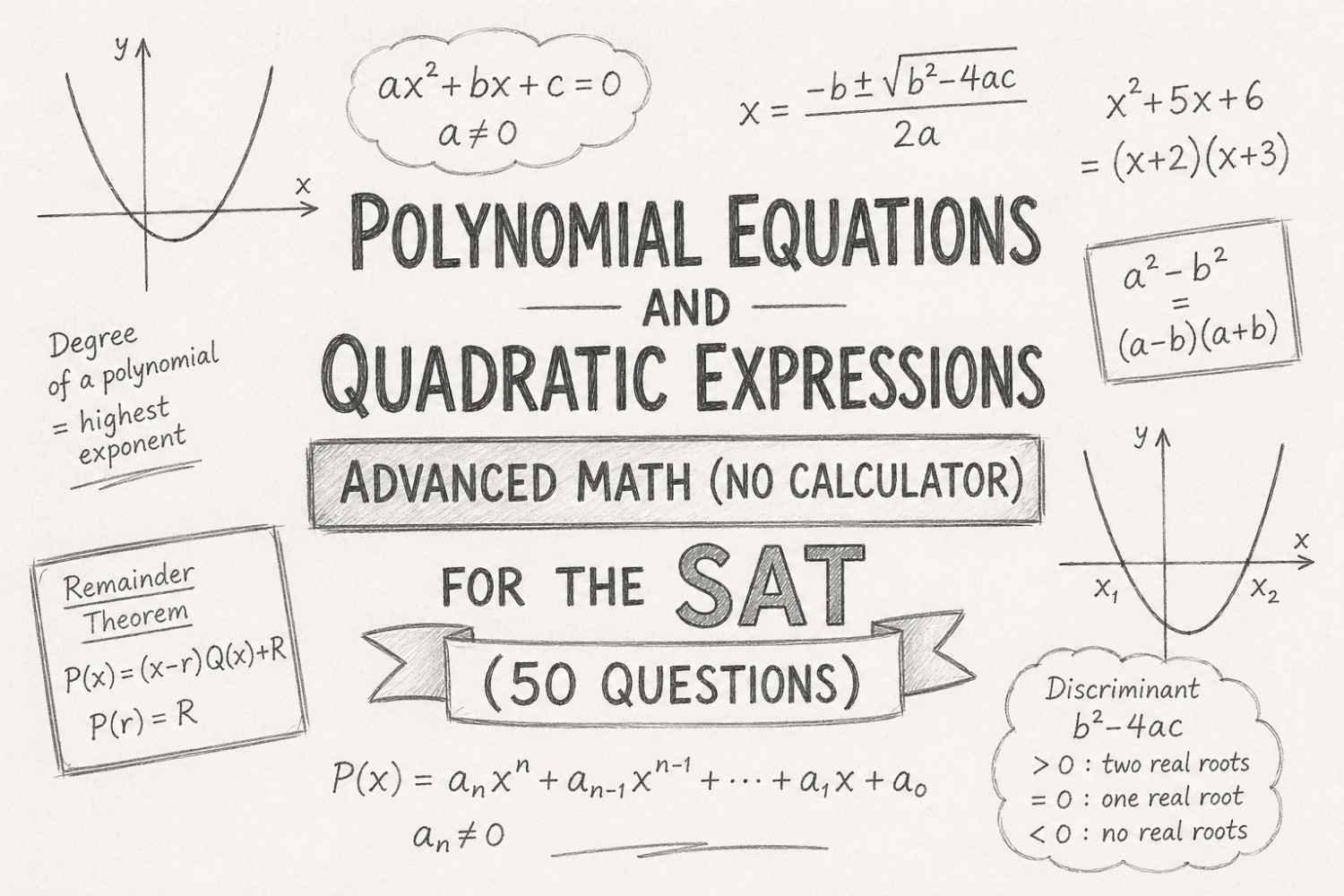
Polynomial Equations and Quadratic Expressions – Advanced Math (No Calculator) for the SAT (50 Questions)
Build speed and accuracy on SAT polynomial equations and quadratic expressions without relying on a calculator. This guide reviews the core algebra, shows when to factor, complete the square or use structure, and provides 50 targeted practice questions with worked solutions.
How to Use This No-Calculator Practice Set
Polynomial and quadratic questions test whether you can recognize algebraic structure quickly. On the SAT no-calculator section, you should not expect long arithmetic. Instead, expect expressions that reward factoring, substitution, pattern recognition, the zero product property, and careful handling of signs. The goal is not to memorize isolated tricks; the goal is to know which algebra move fits the expression in front of you.
This page is focused on polynomial equations and quadratic expressions. For a broader overview of the test, use the SAT Math section overview and SAT Mathematics. If you want nearby no-calculator practice after this set, continue with linear equations and systems, word problems involving algebraic models, and ratios, proportions, percentages and unit conversions.
SAT Strategy for Polynomial and Quadratic Questions
The SAT usually rewards the shortest legal algebra path. If a quadratic factors cleanly, factor it. If it is already written as a product, use the zero product property. If the question asks about roots, sum, product, or discriminant, use the structure of the equation rather than expanding everything. If the expression contains a repeated binomial, preserve the binomial and avoid unnecessary arithmetic.
For a quadratic \(ax^2+bx+c=0\), first ask whether the expression factors over the integers. If \(a=1\), look for two numbers that multiply to \(c\) and add to \(b\). If \(a\neq1\), use the \(ac\) method or recognize a common SAT pattern such as a difference of squares. Only use the quadratic formula when factoring is not efficient or when the question is about the discriminant.
For polynomial expressions of degree three or higher, look for a greatest common factor, grouping, a difference of squares, a sum or difference of cubes, or a substitution such as \(u=x^2\). The SAT does not expect advanced symbolic manipulation under time pressure. It expects you to notice patterns like \(x^4-5x^2+4\), which can be treated as a quadratic in \(x^2\).
Use this practice set in two passes. On the first pass, work every question without opening the solution. On the second pass, review the solution and name the main move: GCF, factoring by grouping, difference of squares, quadratic formula, completing the square, discriminant, roots and coefficients, or remainder theorem. Naming the move helps you transfer the skill to new SAT questions.
Core Formulas and Patterns
Zero Product Property
If \(ab=0\), then \(a=0\) or \(b=0\).Use this after factoring a polynomial equation. It turns one product equation into smaller linear or quadratic equations.
Difference of Squares
\(a^2-b^2=(a-b)(a+b)\)This appears constantly in no-calculator algebra because it avoids expansion and keeps arithmetic small.
Perfect Square Trinomial
\(a^2+2ab+b^2=(a+b)^2\)Recognize expressions like \(x^2+10x+25\) or \(9x^2-12x+4\) quickly.
Quadratic Formula
\(x=\dfrac{-b\pm\sqrt{b^2-4ac}}{2a}\)Use it when factoring is not clean or when the discriminant is the point of the question.
Roots and Coefficients
For \(ax^2+bx+c=0\): sum \(=-b/a\), product \(=c/a\).This is faster than solving when the question asks for a sum or product of roots.
Remainder Theorem
Remainder after division by \(x-r\) is \(f(r)\).Evaluate the polynomial at \(r\) instead of performing long division.
For concept refreshers beyond SAT practice, the algebra free learning resources, quadratics, polynomials, fundamental theorem of algebra, and quadratic equation standard form pages are useful companions.
Skill Map for the 50 Questions
The practice set is organized to move from direct factoring to more advanced recognition. Early questions test foundational moves, middle questions test equations and roots, and later questions combine ideas such as parameter values, remainder theorem, transformations, and hidden quadratics. This mirrors the way SAT advanced math often works: the algebra is not long, but the structure must be seen quickly.
| Question range | Main skills | No-calculator focus |
|---|---|---|
| 1-10 | Basic factoring, difference of squares, GCF, grouping | Recognize common forms before expanding. |
| 11-20 | Solving quadratics, completing squares, roots, discriminant | Choose factoring or formula only when appropriate. |
| 21-30 | Rational simplification, factor theorem, polynomial identities | Use structure to avoid heavy arithmetic. |
| 31-40 | Root sums/products, special quadratics, polynomial division | Use coefficients and known factors efficiently. |
| 41-50 | Parameters, repeated roots, quartics, SAT-style expressions | Translate conditions into equations quickly. |
If these questions feel comfortable, move next to linear, quadratic and exponential functions for SAT algebra and nonlinear equations and complex systems. For a broader challenge set, use hard SAT math questions.
Common No-Calculator Mistakes
Expanding too early
If an expression is already factored, do not expand unless the question requires standard form. Factored form often gives roots and signs faster.
Losing negative signs
Quadratics with negative constants or negative middle terms are common traps. Track signs while splitting the middle term.
Forgetting both roots
Equations like \(x^2=49\) have two real solutions, \(x=7\) and \(x=-7\), unless a domain restriction is given.
Using the wrong theorem
The remainder theorem gives \(f(r)\) for division by \(x-r\). For division by \(x+3\), use \(r=-3\).
Ignoring restrictions
When simplifying rational expressions, excluded values remain excluded even after cancellation.
Overusing the formula
The quadratic formula works, but many SAT no-calculator questions are designed to factor cleanly.
No-Calculator Decision Tree for Quadratics
When a quadratic appears on the SAT, do not start by doing the longest method you know. Start by asking what form the expression is already in. If it is factored, use the factors. If it is close to a perfect square, complete the square. If it has a clear GCF, factor that out before doing anything else. If the question asks for the number of real solutions, the discriminant may be faster than solving. If it asks for a sum or product of roots, use the coefficient relationships rather than finding the roots individually.
A practical decision tree begins with this question: "Is the expression equal to zero?" If it is not, move all terms to one side only if you need to solve. If the expression is only being simplified or factored, do not create an equation. Next ask whether there is a greatest common factor. For example, \(6x^2-18x\) should become \(6x(x-3)\) immediately. Factoring out the GCF reduces the size of the problem and can reveal simpler factors.
If the quadratic is monic, meaning the coefficient of \(x^2\) is 1, look for two numbers with product \(c\) and sum \(b\). For \(x^2-11x+30\), the numbers are \(-5\) and \(-6\), so the factorization is \((x-5)(x-6)\). If the leading coefficient is not 1, use the \(ac\) method. For \(6x^2+x-2\), \(ac=-12\), and the pair 4 and \(-3\) adds to 1, so the middle term can be split as \(4x-3x\).
If the expression has two squared terms separated by subtraction, look for a difference of squares. The SAT often hides this pattern inside coefficients: \(25x^2-49\), \(9(x-2)^2-16\), or \(x^4-81\). The form \(a^2-b^2=(a-b)(a+b)\) is one of the fastest no-calculator tools because it converts a quadratic or quartic expression into factors with almost no arithmetic.
If the quadratic does not factor cleanly and the answer choices contain radicals, the quadratic formula may be appropriate. Still, inspect the discriminant first. The expression under the radical, \(b^2-4ac\), tells you whether roots are rational, irrational, repeated, or nonreal. In a no-calculator setting, the SAT usually keeps the discriminant manageable or asks about its sign rather than requiring a complicated radical simplification.
Finally, match the method to the question. If the question asks "which expression is equivalent," factor or expand as needed. If it asks "what are the solutions," set factors equal to zero. If it asks "how many solutions," use the discriminant or graph behavior. If it asks for a parameter, substitute the given root or compare coefficients. This habit saves time because you stop solving more than the question asks.
Factoring Patterns SAT Students Should Know Cold
Factoring is the main no-calculator skill for polynomial and quadratic questions. You should know the patterns so well that you can identify them before expanding. The first pattern is the greatest common factor. If every term contains \(x\), a number, or a shared binomial, pull it out first. For example, \(4x^3+8x^2=4x^2(x+2)\). This simple step often turns a difficult-looking expression into a familiar one.
The second pattern is the monic quadratic. For \(x^2+bx+c\), find two numbers that multiply to \(c\) and add to \(b\). If \(c\) is positive, the two numbers have the same sign. If \(c\) is negative, the two numbers have opposite signs. For \(x^2+2x-35\), the product is \(-35\) and the sum is 2, so the numbers are 7 and \(-5\). The factorization is \((x+7)(x-5)\).
The third pattern is the non-monic quadratic. For \(ax^2+bx+c\), multiply \(a\) and \(c\), then split the middle term using two numbers with product \(ac\) and sum \(b\). For \(3x^2+10x+8\), \(ac=24\), and 6 and 4 add to 10. Rewrite as \(3x^2+6x+4x+8\), then group: \(3x(x+2)+4(x+2)=(3x+4)(x+2)\).
The fourth pattern is the difference of squares. Expressions like \(x^2-64\), \(16x^2-1\), and \((x+1)^2-25\) should be factored almost automatically. Remember that \(a^2-b^2=(a-b)(a+b)\). The SAT may test this pattern as a direct factorization, a simplification inside a rational expression, or a hidden step in solving an equation.
The fifth pattern is the perfect square trinomial. Expressions such as \(x^2+12x+36\), \(x^2-14x+49\), and \(4x^2+20x+25\) can be written as a squared binomial. Perfect square recognition helps with vertex form, repeated roots, and completing the square. If the first and last terms are squares and the middle term is twice the product of their square roots, the trinomial is a perfect square.
The sixth pattern is grouping. Grouping often appears in four-term polynomial expressions. The goal is to create a shared binomial factor. For \(x^3+4x^2+2x+8\), group as \(x^2(x+4)+2(x+4)\), then factor \((x+4)(x^2+2)\). If the first grouping does not work, try grouping different pairs or factoring out a negative from one group.
The seventh pattern is sum and difference of cubes. The identities \(a^3-b^3=(a-b)(a^2+ab+b^2)\) and \(a^3+b^3=(a+b)(a^2-ab+b^2)\) are less common than quadratics, but they do appear in advanced algebra review. The sign pattern matters: the binomial factor keeps the original sign, while the trinomial alternates for a sum of cubes.
Quadratic Structure Without Solving
Not every SAT quadratic question asks you to solve. Some ask for a coefficient, a sum of roots, the product of roots, the number of solutions, or an equivalent form. These questions reward structural thinking. For \(ax^2+bx+c=0\), the sum of roots is \(-b/a\), and the product of roots is \(c/a\). If a problem asks for the sum of the solutions of \(4x^2-12x+7=0\), you do not need the solutions. The sum is \(-(-12)/4=3\).
When a root is given, substitution is often faster than full factorization. If \(x=2\) is a solution of \(x^2+kx-10=0\), substitute 2: \(4+2k-10=0\), so \(2k=6\), and \(k=3\). The given root turns the polynomial equation into a linear equation in the unknown parameter. This is a common SAT move because it tests understanding rather than long computation.
When a factor is given, convert it to a root. If \(x-5\) is a factor, then \(x=5\) is a root. If \(x+4\) is a factor, then \(x=-4\) is a root. This is the factor theorem. For example, if \(x+4\) is a factor of \(x^2+px-12\), then \((-4)^2+p(-4)-12=0\). That gives \(16-4p-12=0\), so \(p=1\).
When the graph is involved, remember what the algebra means. A quadratic with two distinct real roots crosses the \(x\)-axis twice. A quadratic with one repeated real root touches the \(x\)-axis once at its vertex. A quadratic with no real roots does not cross the \(x\)-axis. The discriminant \(b^2-4ac\) tells you which case applies without requiring the roots themselves.
Equivalent forms also matter. Standard form \(ax^2+bx+c\) is useful for coefficients and discriminants. Factored form \(a(x-r)(x-s)\) is useful for roots. Vertex form \(a(x-h)^2+k\) is useful for the vertex and minimum or maximum value. On the SAT, converting between forms is often the whole question. If you can identify what each form reveals, you can avoid unnecessary work.
Remainder Theorem and Factor Theorem on the SAT
The remainder theorem says that when a polynomial \(f(x)\) is divided by \(x-r\), the remainder is \(f(r)\). This is much faster than polynomial long division when only the remainder is needed. If the divisor is \(x-3\), evaluate \(f(3)\). If the divisor is \(x+2\), evaluate \(f(-2)\). The sign comes from setting the divisor equal to zero.
The factor theorem is a special case of the remainder theorem. If \(f(r)=0\), then \(x-r\) is a factor of \(f(x)\). If \(x-r\) is a factor, then \(r\) is a root. This relationship links roots, zeros, factors, and remainders. SAT questions may use any of those words, so translate them into the same idea.
Example: let \(f(x)=x^3-4x^2-7x+10\). To find the remainder after division by \(x-1\), compute \(f(1)=1-4-7+10=0\). The remainder is 0, so \(x-1\) is also a factor. If the question only asked for the remainder, stop there. If it asked for the full factorization, divide or group further.
Parameter questions often use the same theorem. If \(x-2\) is a factor of \(x^3+kx^2-4x-8\), then \(f(2)=0\). Substitute: \(8+4k-8-8=0\), so \(4k-8=0\), and \(k=2\). This is a clean no-calculator problem because the arithmetic is small when you use the theorem correctly.
Do not confuse divisor signs. Division by \(x-5\) uses \(r=5\). Division by \(x+5\) uses \(r=-5\). Division by \(2x-6\) is different because the divisor is not \(x-r\) until it is written as \(2(x-3)\). The zero of \(2x-6\) is still \(x=3\), so evaluating at 3 gives the remainder relative to the divisor structure, but SAT no-calculator questions usually keep the divisor in the simple \(x-r\) form.
Completing the Square and Vertex Thinking
Completing the square is useful when a quadratic does not factor nicely, when the vertex is needed, or when a question asks for a minimum or maximum value. The basic move is to take half of the coefficient of \(x\), square it, and create a squared binomial. For \(x^2+8x+3\), half of 8 is 4, and \(4^2=16\). Write \(x^2+8x+3=(x+4)^2-16+3=(x+4)^2-13\).
Vertex form \(a(x-h)^2+k\) reveals the vertex \((h,k)\). Be careful with the sign: \((x-h)^2\) has vertex \(x=h\), while \((x+4)^2\) has vertex \(x=-4\). In the example above, \((x+4)^2-13\) has vertex \((-4,-13)\). This is faster than using the formula \(x=-b/(2a)\) and then substituting, although both methods agree.
Completing the square also explains repeated roots. A quadratic like \(x^2-10x+25\) becomes \((x-5)^2\). It equals zero only at \(x=5\), so the root is repeated. Its discriminant is also zero, because \(b^2-4ac=100-100=0\). Perfect squares, repeated roots, and zero discriminant all describe the same situation.
On no-calculator SAT questions, completing the square usually involves friendly numbers. If the coefficient of \(x^2\) is not 1, factor it out of the squared terms first. For \(2x^2+12x+5\), write \(2(x^2+6x)+5\). Inside the parentheses, half of 6 is 3, and \(3^2=9\). Then \(2(x^2+6x+9)-18+5=2(x+3)^2-13\).
Do not complete the square when factoring is much faster. For \(x^2+7x+12\), factoring gives \((x+3)(x+4)\) immediately. Completing the square would work, but it is not the efficient no-calculator move. SAT success often depends on choosing the method that reveals exactly what the question asks.
Worked Mini-Lesson: Ten Fast Recognition Examples
Example A: \(x^2-49\). This is a difference of squares: \((x-7)(x+7)\). Do not use the quadratic formula.
Example B: \(x^2+14x+49\). This is a perfect square: \((x+7)^2\). The repeated root of \(x^2+14x+49=0\) is \(x=-7\).
Example C: \(2x^2-18\). First factor the GCF: \(2(x^2-9)\). Then factor the difference of squares: \(2(x-3)(x+3)\).
Example D: \(x^2-3x-28\). The numbers that multiply to \(-28\) and add to \(-3\) are \(-7\) and 4, so the factorization is \((x-7)(x+4)\).
Example E: \(3x^2+11x+6\). Multiply \(a\cdot c=18\). The pair 9 and 2 adds to 11. Then \(3x^2+9x+2x+6=3x(x+3)+2(x+3)=(3x+2)(x+3)\).
Example F: \(x^3+5x^2+2x+10\). Group: \(x^2(x+5)+2(x+5)=(x+5)(x^2+2)\). The shared binomial is the signal that grouping works.
Example G: \(x^4-10x^2+9\). Let \(u=x^2\). Then \(u^2-10u+9=(u-1)(u-9)\). Substitute back to get \((x^2-1)(x^2-9)\), which factors further.
Example H: \(f(x)=x^3-2x+1\), divided by \(x+1\). Use \(f(-1)\), not \(f(1)\). The value is \(-1+2+1=2\), so the remainder is 2.
Example I: \(x^2+px+18\) has root \(-3\). Substitute: \(9-3p+18=0\), so \(27-3p=0\), and \(p=9\).
Example J: The sum of roots of \(2x^2-8x+5=0\) is \(-b/a=8/2=4\). There is no need to solve for the individual roots.
These examples show the SAT pattern: identify the structure first, then use the shortest exact method. If you have to write many lines, pause and ask whether a simpler algebraic feature is being tested.
Timing Plan for SAT No-Calculator Algebra
Timing on the no-calculator section is not only about moving quickly. It is about refusing to do unnecessary work. Polynomial and quadratic questions can often be solved in under one minute if the structure is recognized. They can also consume three minutes if you expand, rearrange, use the quadratic formula, simplify radicals, and then discover that the question only asked for a sum of roots.
Use a three-pass approach. On the first pass, answer questions whose structure is immediate: simple factoring, difference of squares, GCF, root substitution, and direct coefficient relationships. On the second pass, work questions that need more setup: completing the square, parameter values, or hidden quadratics. On the third pass, return to any question where the first method did not work.
If you get stuck for more than about 40 seconds, write one useful transformation and move on. For example, factor a GCF, write the discriminant, or substitute a given root. Even if you do not finish immediately, that partial work may make the question easier when you return. Do not stare at an expression hoping the pattern will appear.
Use answer choices strategically when they are available. If the choices are factored forms, you can compare roots or expand only the middle term. If the choices are numbers, substitution may be faster than full solving. If the choices are expressions, check whether they are equivalent under a simple value of \(x\), but be careful: one test value can eliminate choices, not always prove the final answer.
After practice, track time by skill. If factoring is slow, drill factor pairs. If theorem questions are slow, drill sign translation for \(x-r\) and \(x+r\). If completing the square is slow, practice halving the middle coefficient. Targeted timing review is more effective than repeating random questions without diagnosis.
50 SAT Polynomial and Quadratic Practice Questions
Work each question before opening the solution. The displayed tags are there to help your review after the attempt, not to tell you the move before you think. If you miss a problem, write down the reason: wrong pattern, arithmetic error, sign error, theorem confusion, or timing pressure.
Question 1. Factor completely: \(x^2+5x+6\). factoring
Find two numbers that multiply to 6 and add to 5. The numbers are 2 and 3, so \(x^2+5x+6=(x+2)(x+3)\). This is the standard monic quadratic pattern.
Answer: \((x+2)(x+3)\).
Question 2. Factor completely: \(2x^2+9x+10\). ac method
Multiply \(a\cdot c=2\cdot10=20\). The pair 5 and 4 adds to 9. Rewrite \(9x\) as \(5x+4x\): \(2x^2+5x+4x+10=x(2x+5)+2(2x+5)\).
Answer: \((2x+5)(x+2)\).
Question 3. Solve \(x^2-x-6=0\). zero product
Factor the quadratic: \(x^2-x-6=(x-3)(x+2)\). By the zero product property, \(x-3=0\) or \(x+2=0\).
Answer: \(x=3\) or \(x=-2\).
Question 4. Factor \(x^2-16\). difference of squares
Use \(a^2-b^2=(a-b)(a+b)\). Here \(x^2-16=x^2-4^2\), so the factorization is immediate.
Answer: \((x-4)(x+4)\).
Question 5. Factor \(4x^2-25\). difference of squares
Write \(4x^2-25=(2x)^2-5^2\). Apply the difference of squares formula.
Answer: \((2x-5)(2x+5)\).
Question 6. Factor \(3x^2-12x\). GCF
The greatest common factor is \(3x\). Pull it out of both terms: \(3x^2-12x=3x(x-4)\). Always check for a GCF before using a more complicated method.
Answer: \(3x(x-4)\).
Question 7. Factor by grouping: \(x^3+2x^2+3x+6\). grouping
Group the first two and last two terms: \((x^3+2x^2)+(3x+6)=x^2(x+2)+3(x+2)\). Factor the shared binomial.
Answer: \((x+2)(x^2+3)\).
Question 8. Factor \(6x^2-7x-3\). ac method
Here \(a\cdot c=6(-3)=-18\). The pair \(-9\) and 2 adds to \(-7\). Then \(6x^2-9x+2x-3=3x(2x-3)+1(2x-3)\).
Answer: \((2x-3)(3x+1)\).
Question 9. Solve \(2x^2+3x-2=0\). solving
Factor: \(2x^2+3x-2=(2x-1)(x+2)\). Set each factor equal to zero.
Answer: \(x=\frac{1}{2}\) or \(x=-2\).
Question 10. What value of \(c\) makes \(x^2+8x+c\) a perfect square trinomial? completing square
Half of 8 is 4, and \(4^2=16\). Then \(x^2+8x+16=(x+4)^2\).
Answer: \(c=16\).
Question 11. Find the vertex of \(y=x^2-6x+5\). vertex form
Complete the square: \(x^2-6x+5=(x-3)^2-9+5=(x-3)^2-4\). The vertex is the point where the squared term is zero.
Answer: \((3,-4)\).
Question 12. How many real roots does \(x^2-4x+7=0\) have? discriminant
The discriminant is \(b^2-4ac=(-4)^2-4(1)(7)=16-28=-12\). A negative discriminant means no real roots.
Answer: 0 real roots.
Question 13. For \(3x^2-5x-2=0\), find the product of the roots. roots
For \(ax^2+bx+c=0\), the product of roots is \(c/a\). Here \(c=-2\) and \(a=3\).
Answer: \(-\frac{2}{3}\).
Question 14. Write a monic quadratic with roots 2 and \(-3\). roots to equation
If the roots are 2 and \(-3\), the factors are \((x-2)\) and \((x+3)\). Multiply: \((x-2)(x+3)=x^2+x-6\).
Answer: \(x^2+x-6\).
Question 15. Find the remainder when \(f(x)=x^3-2x^2+4x-5\) is divided by \(x-2\). remainder theorem
By the remainder theorem, the remainder is \(f(2)\). Compute \(8-8+8-5=3\).
Answer: 3.
Question 16. Factor \(x^3-27\). cubes
Use \(a^3-b^3=(a-b)(a^2+ab+b^2)\). Here \(a=x\) and \(b=3\).
Answer: \((x-3)(x^2+3x+9)\).
Question 17. Factor \(x^3+8\). cubes
Use \(a^3+b^3=(a+b)(a^2-ab+b^2)\). Since \(8=2^3\), \(x^3+8=(x+2)(x^2-2x+4)\).
Answer: \((x+2)(x^2-2x+4)\).
Question 18. Solve \(x^4-5x^2+4=0\). hidden quadratic
Let \(u=x^2\). Then \(u^2-5u+4=0=(u-1)(u-4)\), so \(u=1\) or \(u=4\). Thus \(x^2=1\) or \(x^2=4\).
Answer: \(x=\pm1,\pm2\).
Question 19. Solve \((x-1)(x+4)=14\). quadratic equation
Expand only enough to set the equation to zero: \(x^2+3x-4=14\), so \(x^2+3x-18=0\). Factor: \((x+6)(x-3)=0\).
Answer: \(x=3\) or \(x=-6\).
Question 20. If \(x^2+kx+16\) is a perfect square trinomial and \(k>0\), what is \(k\)? perfect square
A positive perfect square form is \((x+4)^2=x^2+8x+16\). Since \(k>0\), use the positive middle coefficient.
Answer: \(k=8\).
Question 21. Simplify \(\frac{x^2-9}{x-3}\), where \(x\neq3\). rational expression
Factor the numerator: \(x^2-9=(x-3)(x+3)\). Cancel the common factor \(x-3\), while keeping the restriction \(x\neq3\).
Answer: \(x+3\), with \(x\neq3\).
Question 22. Solve \(x^2=49\). square roots
Both positive and negative values square to 49. Do not give only the principal square root when solving an equation.
Answer: \(x=7\) or \(x=-7\).
Question 23. Solve \(3x^2=12x\). GCF
Move all terms to one side: \(3x^2-12x=0\). Factor \(3x(x-4)=0\).
Answer: \(x=0\) or \(x=4\).
Question 24. Factor completely: \(2x^3-8x\). GCF and squares
Factor the GCF first: \(2x(x^2-4)\). Then use difference of squares: \(x^2-4=(x-2)(x+2)\).
Answer: \(2x(x-2)(x+2)\).
Question 25. Show that \(x=3\) is a root of \(f(x)=x^3-6x^2+11x-6\). factor theorem
Use the factor theorem by evaluating \(f(3)\): \(27-54+33-6=0\). Since \(f(3)=0\), \(x=3\) is a root and \(x-3\) is a factor.
Answer: \(f(3)=0\).
Question 26. Factor \(x^3-4x^2+x+6\), given that \(x=2\) is a root. known root
Since \(x=2\) is a root, \(x-2\) is a factor. Dividing gives \(x^2-2x-3\), which factors as \((x-3)(x+1)\).
Answer: \((x-2)(x-3)(x+1)\).
Question 27. Expand \((x-4)^2\). identity
Use \((a-b)^2=a^2-2ab+b^2\). Here \(a=x\) and \(b=4\), so the middle term is \(-8x\).
Answer: \(x^2-8x+16\).
Question 28. Rewrite \(x^2+10x+9\) in completed-square form. complete square
Half of 10 is 5, and \(5^2=25\). Add and subtract 25: \(x^2+10x+9=(x+5)^2-25+9\).
Answer: \((x+5)^2-16\).
Question 29. Solve \(x^2+10x+9=0\). factoring
Look for two numbers that multiply to 9 and add to 10. They are 1 and 9, so \(x^2+10x+9=(x+1)(x+9)\).
Answer: \(x=-1\) or \(x=-9\).
Question 30. If \(x^2+px+12\) has factor \(x+3\), find \(p\). factor theorem
If \(x+3\) is a factor, then \(x=-3\) is a root. Substitute: \(9-3p+12=0\), so \(21-3p=0\).
Answer: \(p=7\).
Question 31. For \(5x^2+2x-7=0\), find the product of the roots. root product
For \(ax^2+bx+c=0\), the product is \(c/a\). Here \(c=-7\) and \(a=5\).
Answer: \(-\frac{7}{5}\).
Question 32. For \(x^2-9x+20=0\), find the sum of the roots. root sum
The sum of roots for \(ax^2+bx+c=0\) is \(-b/a\). Here \(b=-9\) and \(a=1\), so the sum is 9.
Answer: 9.
Question 33. Factor \(y^2-2y-35\). factoring
Find two numbers that multiply to \(-35\) and add to \(-2\). The numbers are \(-7\) and 5.
Answer: \((y-7)(y+5)\).
Question 34. Solve \(x^2+4x+4=0\). repeated root
The left side is a perfect square: \(x^2+4x+4=(x+2)^2\). A square equals zero only when its base is zero.
Answer: \(x=-2\).
Question 35. If \(f(x)=x^2-1\), what values of \(a\) satisfy \(f(a)=0\)? function roots
Set \(a^2-1=0\). Factor: \((a-1)(a+1)=0\).
Answer: \(a=1\) or \(a=-1\).
Question 36. Divide \(x^2+5x+6\) by \(x+2\). division
Factor \(x^2+5x+6=(x+2)(x+3)\). Dividing by \(x+2\) leaves the other factor.
Answer: quotient \(x+3\), remainder 0.
Question 37. Find the remainder when \(x^3+x^2-x+1\) is divided by \(x+1\). remainder theorem
For division by \(x+1\), use \(x=-1\). Evaluate: \((-1)^3+(-1)^2-(-1)+1=-1+1+1+1=2\).
Answer: 2.
Question 38. Factor \(x^4-16\) completely over the real numbers. difference of squares
First \(x^4-16=(x^2-4)(x^2+4)\). Then \(x^2-4=(x-2)(x+2)\). Over the real numbers, \(x^2+4\) does not factor further.
Answer: \((x-2)(x+2)(x^2+4)\).
Question 39. Solve \(x^2-2x=15\). quadratic equation
Move all terms to one side: \(x^2-2x-15=0\). Factor: \((x-5)(x+3)=0\).
Answer: \(x=5\) or \(x=-3\).
Question 40. If one root of \(x^2-6x+c=0\) is 2, find \(c\). parameter
Substitute \(x=2\): \(4-12+c=0\), so \(c=8\). You can also use root sum: the other root is 4, and the product is 8.
Answer: \(c=8\).
Question 41. A monic quadratic has consecutive integer roots with sum 7. Write the equation. roots
The consecutive integers are 3 and 4. The factors are \((x-3)(x-4)\), so the equation is \(x^2-7x+12=0\).
Answer: \(x^2-7x+12=0\).
Question 42. Factor \(9x^2+12x+4\). perfect square
This is a perfect square trinomial: \(9x^2=(3x)^2\), \(4=2^2\), and the middle term is \(2(3x)(2)=12x\).
Answer: \((3x+2)^2\).
Question 43. Solve \(9x^2-1=0\). difference of squares
Factor \(9x^2-1=(3x-1)(3x+1)\). Set each factor equal to zero.
Answer: \(x=\frac{1}{3}\) or \(x=-\frac{1}{3}\).
Question 44. Factor \(x^3-x^2-x+1\). grouping
Group: \((x^3-x^2)+(-x+1)=x^2(x-1)-1(x-1)\). Then factor the shared binomial: \((x-1)(x^2-1)\). Continue with difference of squares.
Answer: \((x-1)^2(x+1)\).
Question 45. Find the remainder when \(2x^3-3x+4\) is divided by \(x-1\). remainder theorem
The remainder is \(f(1)\). Compute \(2(1)^3-3(1)+4=2-3+4=3\).
Answer: 3.
Question 46. A monic cubic has roots 1, 2, and 3. Write it in factored form. polynomial roots
If roots are 1, 2, and 3, the factors are \(x-1\), \(x-2\), and \(x-3\). Since it is monic, the leading coefficient is 1.
Answer: \((x-1)(x-2)(x-3)\).
Question 47. A quadratic has a double root at \(x=5\). Write the monic quadratic. double root
A double root at 5 means the factor \(x-5\) appears twice. Thus the quadratic is \((x-5)^2\), which expands to \(x^2-10x+25\).
Answer: \(x^2-10x+25\).
Question 48. If \(x^2+cx+25\) is a perfect square trinomial and \(c<0\), find \(c\). perfect square
Since \(25=5^2\), the square with negative middle term is \((x-5)^2=x^2-10x+25\).
Answer: \(c=-10\).
Question 49. Find the real solutions of \(x^4=16\). quartic
Rewrite as \(x^4-16=0\), or \((x^2-4)(x^2+4)=0\). Over the real numbers, \(x^2+4=0\) gives no real solutions. From \(x^2-4=0\), \(x=\pm2\).
Answer: \(x=2\) or \(x=-2\).
Question 50. If \(x^2+ax+15=(x+3)(x+b)\), find \(a+b\). SAT structure
Expand the right side: \((x+3)(x+b)=x^2+(b+3)x+3b\). Match constants: \(3b=15\), so \(b=5\). Then \(a=b+3=8\). Therefore \(a+b=13\).
Answer: 13.
How SAT Wording Signals the Algebra Move
SAT math questions often hide the method inside the wording. If a question says "factor completely," your job is not to solve for \(x\) unless an equation is provided. If it says "solve," move everything to one side, factor if possible, and use the zero product property. If it says "which expression is equivalent," compare forms rather than finding roots. If it says "what is the remainder," think of the remainder theorem immediately. Learning to translate the wording prevents you from doing extra work.
The phrase "has a factor" usually means the factor theorem. If a polynomial has factor \(x-4\), then \(x=4\) makes the polynomial equal zero. If it has factor \(x+4\), then \(x=-4\) is the useful input. Many parameter questions become one-line substitutions once this translation is automatic. This is why sign discipline matters: \(x+4\) and \(x-4\) point to different test values.
The phrase "sum of the solutions" or "product of the solutions" often means you should not solve. For a quadratic, use \(-b/a\) for the sum and \(c/a\) for the product. If a question asks for the sum of roots of \(7x^2+3x-2=0\), the answer is \(-3/7\) without using the quadratic formula. If it asks for the product, the answer is \(-2/7\).
The phrase "minimum value" or "maximum value" usually points to vertex form. For a quadratic with positive leading coefficient, the minimum occurs at the vertex. For a quadratic with negative leading coefficient, the maximum occurs at the vertex. Completing the square turns \(x^2+bx+c\) into a form where the vertex value is visible. This is especially useful in no-calculator problems because the SAT typically uses coefficients that complete the square cleanly.
The phrase "no real solutions," "one solution," or "two real solutions" points to the discriminant. You may not need the roots. If \(b^2-4ac>0\), there are two real roots. If \(b^2-4ac=0\), there is one repeated real root. If \(b^2-4ac<0\), there are no real roots. This is a fast way to answer root-count questions without graphing or solving.
The phrase "for all \(x\)" usually means an identity. If two polynomial expressions are equal for all \(x\), their corresponding coefficients must match. For example, if \(x^2+ax+15=(x+3)(x+b)\) for all \(x\), you compare the constant terms and the coefficients of \(x\). This method is faster and safer than testing random values when variables are unknown.
Building Factor-Pair Fluency
Fast factoring depends on quick factor-pair recognition. For no-calculator SAT work, you should instantly know pairs for common numbers such as 6, 10, 12, 15, 18, 20, 24, 30, 35, 36, 40, 42, 48, 56, and 60. Many factoring problems are slow only because the student spends too long searching for pairs. The algebra method may be correct, but weak arithmetic recall consumes time.
For positive constants, same-sign pairs matter. If \(x^2+11x+30\) appears, the constant is positive and the middle coefficient is positive, so both numbers are positive. The pair 5 and 6 multiplies to 30 and adds to 11. If the expression is \(x^2-11x+30\), both numbers are negative, giving \((x-5)(x-6)\).
For negative constants, opposite-sign pairs matter. If \(x^2+x-30\) appears, one factor number is positive and the other is negative. You need a pair with difference 1, so the numbers are 6 and \(-5\). The factorization is \((x+6)(x-5)\). Thinking in terms of difference, not just sum, makes negative-constant quadratics faster.
For non-monic quadratics, factor-pair fluency applies to \(ac\). In \(4x^2+11x+6\), the product \(ac\) is 24, and the pair 8 and 3 adds to 11. In \(4x^2-11x+6\), the pair is \(-8\) and \(-3\). In \(4x^2+x-6\), the pair is 4 and \(-3\). The method is the same, but signs must match both product and sum.
A good drill is to list factor pairs and possible sums. For 24, the positive pairs are \(1,24\), \(2,12\), \(3,8\), and \(4,6\). Their sums are 25, 14, 11, and 10. Their differences are 23, 10, 5, and 2. That one list helps with many quadratics involving \(ac=24\). This kind of mental preparation is more useful than memorizing a long set of isolated factorizations.
When factoring under time pressure, write only the necessary pair. Do not list every possibility unless you are stuck. If the target sum is 11 and the product is 24, jump directly to 3 and 8. If the target sum is 10, jump to 4 and 6. The more fluent the pairs become, the more mental space you save for the harder structure of the problem.
Reviewing the 50 Questions by Error Type
After finishing the 50 questions, mark each missed problem by error type. A pattern error means you did not recognize the intended algebra form. An execution error means you chose the right method but made an arithmetic or sign mistake. A translation error means you misunderstood what the question was asking. A timing error means you eventually solved it but took too long for SAT conditions.
Pattern errors should be reviewed with similar examples. If you missed difference of squares, practice expressions like \(x^2-81\), \(16x^2-9\), and \((x+2)^2-25\). If you missed grouping, practice four-term polynomials until the shared binomial becomes easy to see. If you missed hidden quadratics, practice replacing \(x^2\) with a temporary variable and then substituting back.
Execution errors require slower written work, not more theory. If you wrote \((x-3)(x+2)\) but solved \(x=3\) and \(x=2\), the issue is sign handling in the zero product step. If you split the middle term correctly but grouped incorrectly, rewrite the factorization line by line. If you forgot the second root of \(x^2=49\), create a reminder that solving a square equation gives both signs unless a restriction is stated.
Translation errors are best fixed by underlining command words. Words such as factor, solve, simplify, equivalent, remainder, root, solution, product, and sum each point to different work. Before doing algebra, say the task in your own words. For example, "find the product of solutions" becomes "use \(c/a\), not solve." This small pause often prevents unnecessary computation.
Timing errors should be reviewed with a stopwatch after accuracy is stable. Rework the missed question and ask, "What should I have noticed first?" The answer might be a GCF, a perfect square, a given root, or a coefficient relationship. Your goal is not just to get the answer; it is to identify the first move faster next time.
Keep a short error log with three columns: problem number, error type, and corrected first move. An entry might say "Q30, translation, factor \(x+3\) means substitute \(-3\)." Another might say "Q18, pattern, treat \(x^4-5x^2+4\) as quadratic in \(x^2\)." This log turns a long practice set into a targeted study plan.
When to Move Beyond This Practice Set
You are ready to move beyond this set when you can solve most of the questions without opening the solutions, explain why each method works, and identify the intended move within a few seconds. Accuracy matters first, but speed matters too. On SAT no-calculator math, a method that works but takes too long may still hurt your score if it steals time from later questions.
After this page, practice mixed algebra so you do not become dependent on knowing the topic in advance. The real SAT will not label a question "difference of squares" or "remainder theorem." It will place polynomial and quadratic ideas beside linear equations, ratios, functions, geometry, and data analysis. Mixed practice teaches you to recognize the topic from the expression itself.
If you consistently miss the same kind of question, do not rush into harder material. Review the underlying concept first. For example, if root-product questions feel confusing, revisit the relationship between factored form and standard form. If completing the square feels slow, practice five examples a day until the halving-and-squaring step becomes automatic. If polynomial factors feel abstract, connect them to roots by using the factor theorem.
When you are ready for broader SAT work, combine this page with the RevisionTown SAT resources already linked above. Use focused pages to build individual skills, then use mixed sets to develop test readiness. That sequence is more effective than doing only random hard questions before the core methods are stable.
How to Review Your Results
Do not review this set by simply counting correct answers. Classify each miss. If you missed a question because you did not recognize a pattern, put it into a pattern review list. If you missed it because of arithmetic, rewrite the solution with each sign checked. If you opened the solution too early, redo the question the next day without looking.
A strong SAT review cycle has three parts: solve, diagnose, and repeat. Solving builds familiarity. Diagnosing turns mistakes into useful data. Repeating under timed conditions builds retrieval speed. Polynomial and quadratic questions become much easier when you can quickly see whether the problem is asking for roots, factors, coefficients, remainder, or structure.
For continued SAT math preparation, use SAT exam preparation, SAT math flashcards, and SAT helpful resources. For deeper algebra background, review polynomial functions and rates of change.
A Practical 7-Day Review Plan
Day 1: review the formulas and complete Questions 1-10 slowly, writing every factor pair. Day 2: complete Questions 11-20 and focus on discriminants, completing the square, and hidden quadratics. Day 3: complete Questions 21-30 and review restrictions, given roots, and factor theorem language. Day 4: complete Questions 31-40 and use coefficients whenever the question asks for sums or products of roots. Day 5: complete Questions 41-50 under light timing pressure. Day 6: redo every missed question without viewing the solution. Day 7: make a one-page mistake log with the exact first move you should have used.
This plan works because it separates learning from testing. Early days are for accuracy and method recognition. Later days are for speed, memory, and mixed retrieval. If you can explain each solution without copying the wording, you are much more likely to recognize a similar polynomial or quadratic question on test day.
Keep the practice no-calculator even when the arithmetic feels inconvenient. The point of this set is to build algebraic judgment, not button fluency. If you can factor, compare coefficients, and evaluate small polynomial values mentally, the actual SAT no-calculator questions become far less intimidating. Review the hardest examples again after a short break and write one corrected takeaway clearly.