
Formula reference
The Complete Algebra Cheat Sheet
Use this complete algebra cheat sheet as a practical formula reference for expressions, equations, linear graphs, systems, quadratics, polynomials, functions, exponents, logarithms, sequences, inequalities, complex numbers, and matrices. Every major formula is written in MathJax-ready notation so it renders clearly on the page, and every section explains when to use the formula, not only what to memorize.
1. Algebra Foundations And Number Sets
Algebra begins when arithmetic is generalized. Instead of calculating only with known numbers, algebra uses variables to represent unknowns, changing quantities, or entire classes of numbers. A variable such as \(x\) may represent one number in an equation, every number in an identity, or an input value in a function. The context decides what the symbol means.
The real number system is the normal working universe for most school algebra. Natural numbers count objects, whole numbers include zero, integers include negatives, rational numbers can be written as fractions, and irrational numbers cannot be written as exact ratios of integers. Together, rational and irrational numbers form the real numbers.
Common number sets:
\[\mathbb{N}=\{1,2,3,\ldots\}\]
\[\mathbb{Z}=\{\ldots,-2,-1,0,1,2,\ldots\}\]
\[\mathbb{Q}=\left\{\frac{p}{q}:p,q\in\mathbb{Z},q\ne0\right\}\]
\[\mathbb{R}=\{\text{all rational and irrational numbers}\}\]
Every algebraic step must obey the properties of real numbers. The commutative property says that order can change for addition and multiplication. The associative property says grouping can change for addition and multiplication. The distributive property connects multiplication with addition and is one of the most important moves in algebra.
Commutative property: \(a+b=b+a\), and \(ab=ba\)
Associative property: \((a+b)+c=a+(b+c)\), and \((ab)c=a(bc)\)
Distributive property: \(a(b+c)=ab+ac\)
Additive inverse: \(a+(-a)=0\)
Multiplicative inverse: \(a\cdot \frac{1}{a}=1\), where \(a\ne0\)
The most common early error is distributing only to the first term inside parentheses. For example, \(-3(x-4)\) becomes \(-3x+12\), not \(-3x-4\). The negative sign belongs to the multiplier, so it must affect every term inside the parentheses. This same idea appears later in factoring, polynomial division, and matrix operations.
If you need a broader introduction before this formula reference, the RevisionTown guide on what algebra means with basic examples is a useful starting point. For a topic library, the algebra learning resources page gives a wider route through notes and practice.
2. Expressions, Equations, And Rearranging
An expression is a mathematical phrase such as \(3x+5\). It can be simplified, expanded, factored, or evaluated for a chosen value of \(x\), but it cannot be solved because it does not claim equality. An equation contains an equals sign, such as \(3x+5=14\). Solving an equation means finding every value of the variable that makes the statement true.
The central rule is balance. Whatever operation you do to one side of an equation, do the same operation to the other side. Addition, subtraction, multiplication, division by a nonzero number, powers, roots, and logarithms can all be valid, but each operation has conditions. Squaring both sides may introduce extra solutions, and dividing by an expression can lose a solution if that expression could be zero.
One-step solving pattern:
\[x+a=b \Rightarrow x=b-a\]
\[ax=b,\ a\ne0 \Rightarrow x=\frac{b}{a}\]
\[\frac{x}{a}=b,\ a\ne0 \Rightarrow x=ab\]
For multi-step equations, clear brackets, combine like terms, move variable terms to one side, move constants to the other side, and divide by the coefficient. If fractions are present, multiply through by the least common denominator early. If decimals are present, you may multiply by a power of ten to remove them, but only if you apply it to every term on both sides.
Worked example: solve a linear equation
Solve \(4(2x-3)-5=3x+18\).
\[8x-12-5=3x+18\]
\[8x-17=3x+18\]
\[5x=35\]
\[x=7\]
Check in the original equation: \(4(14-3)-5=39\), and \(21+18=39\), so \(x=7\) is correct.
Rearranging formulas is the same process, but the target is a variable rather than a number. If \(A=lw\) and you want \(w\), divide both sides by \(l\): \(w=\frac{A}{l}\), where \(l\ne0\). This skill is essential in science, finance, statistics, geometry, and calculator-based work. The page on algebraic equations gives more practice with this solving style.
3. Linear Equations And Coordinate Formulas
A linear equation has a highest variable power of one. Its graph is a straight line. Linear algebra in school usually begins with slope, intercepts, and equation forms. These ideas appear in coordinate geometry, rates of change, financial models, physics graphs, and data interpretation.
Slope between two points:
\[m=\frac{y_2-y_1}{x_2-x_1}\]
Slope-intercept form:
\[y=mx+b\]
Point-slope form:
\[y-y_1=m(x-x_1)\]
Standard form:
\[Ax+By=C\]
The slope \(m\) measures rate of change. A positive slope rises from left to right. A negative slope falls from left to right. A zero slope is horizontal, such as \(y=4\). A vertical line has undefined slope and is written \(x=c\). In \(y=mx+b\), the number \(b\) is the \(y\)-intercept, where the line crosses the \(y\)-axis.
Parallel lines have equal slopes. Perpendicular lines have slopes that are negative reciprocals, so \(m_1m_2=-1\), provided neither line is vertical or horizontal in the special-case pairing. These facts are frequently tested in coordinate geometry and analytic geometry questions.
Distance formula:
\[d=\sqrt{(x_2-x_1)^2+(y_2-y_1)^2}\]
Midpoint formula:
\[M=\left(\frac{x_1+x_2}{2},\frac{y_1+y_2}{2}\right)\]
The distance formula comes from the Pythagorean theorem: horizontal change and vertical change form the legs of a right triangle. The midpoint formula averages the \(x\)-coordinates and the \(y\)-coordinates. For a focused formula page, use the verified slope-intercept formula guide or the point-slope equation formula page.
4. Systems Of Equations
A system of equations asks for values that satisfy more than one equation at the same time. Graphically, a two-variable linear system asks where two lines intersect. Algebraically, you can solve by substitution, elimination, or matrix methods. Systems may have one solution, no solution, or infinitely many solutions.
| Case | Graph meaning | Algebra clue |
|---|---|---|
| One solution | Lines intersect once. | Different slopes. |
| No solution | Lines are parallel. | Same slope, different intercepts. |
| Infinitely many solutions | Lines are the same line. | Equations are equivalent after simplification. |
Substitution is best when one equation is already solved for a variable, such as \(y=2x+1\). Elimination is best when coefficients line up or can be made to line up quickly. Graphing is useful for understanding but less reliable for exact fractional answers. For a full explanation of cases, see systems of linear equations with unique, infinite, and no solutions.
Worked example: elimination
Solve the system \(2x+3y=13\) and \(4x-3y=5\).
Add the equations: \((2x+3y)+(4x-3y)=13+5\).
\[6x=18\]
\[x=3\]
Substitute into \(2x+3y=13\): \(6+3y=13\), so \(3y=7\), and \(y=\frac{7}{3}\). The solution is \(\left(3,\frac{7}{3}\right)\).
5. Quadratics And The Quadratic Formula
A quadratic is a degree-two polynomial. Its graph is a parabola, and its standard form is \(y=ax^2+bx+c\), where \(a\ne0\). Quadratics appear in projectile motion, area problems, optimization, revenue modeling, and graph transformations.
Standard form: \[y=ax^2+bx+c\]
Vertex form: \[y=a(x-h)^2+k\]
Axis of symmetry: \[x=\frac{-b}{2a}\]
Vertex \(y\)-value: \[k=f\left(\frac{-b}{2a}\right)\]
To solve \(ax^2+bx+c=0\), first look for factoring. If the quadratic factors cleanly, use the zero product property. If not, use completing the square or the quadratic formula. The quadratic formula is universal for all quadratics with \(a\ne0\).
Quadratic formula:
\[x=\frac{-b\pm\sqrt{b^2-4ac}}{2a}\]
Discriminant:
\[\Delta=b^2-4ac\]
The discriminant tells you the type of roots before you finish solving. If \(\Delta\gt0\), there are two distinct real roots. If \(\Delta=0\), there is one repeated real root. If \(\Delta\lt0\), there are two complex conjugate roots and no real \(x\)-intercepts. This is one of the fastest checks for a quadratic graph.
| Discriminant | Roots | Graph interpretation |
|---|---|---|
| \(\Delta\gt0\) | Two distinct real roots | Parabola crosses the \(x\)-axis twice. |
| \(\Delta=0\) | One repeated real root | Parabola touches the \(x\)-axis at the vertex. |
| \(\Delta\lt0\) | Two complex conjugate roots | Parabola does not cross the \(x\)-axis. |
For deeper practice, use the quadratic formula guide, quadratic equations page, and graphing quadratic equations resource.
6. Polynomials And Factoring Identities
A polynomial is built from variables, constants, addition, subtraction, multiplication, and nonnegative integer exponents. Factoring rewrites a polynomial as a product. Expansion rewrites a product as a sum. Good algebra requires moving in both directions.
Difference of squares: \[a^2-b^2=(a-b)(a+b)\]
Perfect square trinomial: \[a^2+2ab+b^2=(a+b)^2\]
\[a^2-2ab+b^2=(a-b)^2\]
Sum of cubes: \[a^3+b^3=(a+b)(a^2-ab+b^2)\]
Difference of cubes: \[a^3-b^3=(a-b)(a^2+ab+b^2)\]
Binomial cube: \[(a+b)^3=a^3+3a^2b+3ab^2+b^3\]
The Factor Theorem says that \(x-c\) is a factor of \(P(x)\) if and only if \(P(c)=0\). The Remainder Theorem says that when \(P(x)\) is divided by \(x-c\), the remainder is \(P(c)\). These theorems are essential for cubics and higher-degree polynomials, where simple factoring is not always visible.
Remainder Theorem: If \(P(x)\) is divided by \(x-c\), the remainder is \(P(c)\).
Factor Theorem: \(x-c\) is a factor of \(P(x)\) exactly when \(P(c)=0\).
Fundamental Theorem of Algebra: a degree \(n\) polynomial has \(n\) complex roots counting multiplicity.
For more detail, use the verified pages on the Factor and Remainder Theorem, the Fundamental Theorem of Algebra, and understanding polynomials.
Rational expressions are fractions whose numerator and denominator are polynomials. Always factor first, identify values that make the denominator zero, and then simplify. A canceled factor creates a removable discontinuity, often called a hole. A remaining denominator zero creates a vertical asymptote.
7. Functions, Domain, Range, And Transformations
A function assigns each input exactly one output. The input set is the domain, and the output set is the range. Algebraically, the two most common domain restrictions are division by zero and even roots of negative values. For example, \(f(x)=\frac{1}{x-3}\) has \(x\ne3\), and \(g(x)=\sqrt{x+2}\) has \(x\ge -2\).
Composition: \[(f\circ g)(x)=f(g(x))\]
Inverse relationship: If \(f(a)=b\), then \(f^{-1}(b)=a\).
Inverse check: \[f(f^{-1}(x))=x,\quad f^{-1}(f(x))=x\]
To find an inverse, write \(y=f(x)\), swap \(x\) and \(y\), then solve for \(y\). The graph of an inverse reflects across the line \(y=x\). Not every function has an inverse unless it is one-to-one on the domain being used.
Transformation model:
\[y=a f(b(x-h))+k\]
\(h\) shifts horizontally, \(k\) shifts vertically, \(a\) affects vertical stretch and reflection, and \(b\) affects horizontal scale and reflection.
Inside changes are often counterintuitive: \(f(x-3)\) shifts right, while \(f(x+3)\) shifts left. Outside changes are more direct: \(f(x)+4\) shifts up, and \(f(x)-4\) shifts down. For curriculum-specific formula support, see functions formulae for IB Mathematics AA or the general guide on understanding functions.
8. Exponents, Radicals, And Logarithms
Exponents describe repeated multiplication. Radicals are fractional exponents. Logarithms reverse exponentials. These three topics form one connected family, and many algebra mistakes happen when students apply exponent laws to addition or forget logarithm domain restrictions.
Exponent laws:
\[x^m x^n=x^{m+n}\]
\[\frac{x^m}{x^n}=x^{m-n},\quad x\ne0\]
\[(x^m)^n=x^{mn}\]
\[(xy)^n=x^n y^n\]
\[x^{-n}=\frac{1}{x^n},\quad x\ne0\]
\[x^{m/n}=\sqrt[n]{x^m}\]
Do not write \(x^m+x^n=x^{m+n}\). Exponent laws above apply to multiplication, division, and powers, not ordinary addition. If terms are like terms, such as \(3x^2+5x^2\), combine coefficients to get \(8x^2\), not \(8x^4\).
Logarithm definition:
\[\log_a(x)=y \Longleftrightarrow a^y=x\]
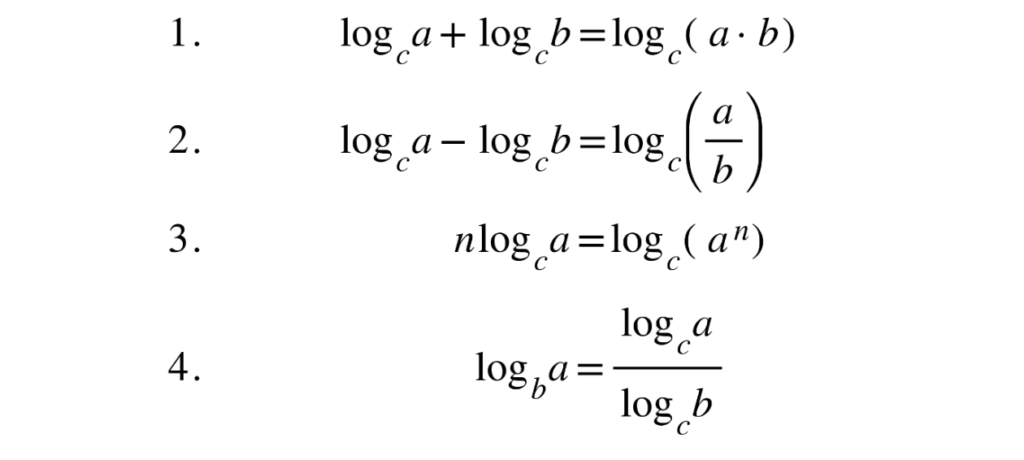
Product rule: \[\log_a(xy)=\log_a(x)+\log_a(y)\]
Quotient rule: \[\log_a\left(\frac{x}{y}\right)=\log_a(x)-\log_a(y)\]
Power rule: \[\log_a(x^r)=r\log_a(x)\]
Change of base: \[\log_b(a)=\frac{\log_c(a)}{\log_c(b)}\]
Logarithms require positive arguments. Any solution that makes a log argument zero or negative must be rejected. For more detailed notes, use exponents and logarithms, exponents, or the focused exponent calculator.
9. Sequences And Series
A sequence is an ordered list of terms. A series is the sum of terms. Arithmetic sequences add a constant difference. Geometric sequences multiply by a constant ratio. This distinction connects algebra to linear growth, exponential growth, compound interest, and recursive modeling.
Arithmetic nth term: \[u_n=u_1+(n-1)d\]
Arithmetic sum: \[S_n=\frac{n}{2}(u_1+u_n)\]
\[S_n=\frac{n}{2}(2u_1+(n-1)d)\]
Geometric nth term: \[u_n=u_1r^{n-1}\]
Geometric sum: \[S_n=\frac{u_1(1-r^n)}{1-r},\quad r\ne1\]
Infinite geometric sum: \[S_\infty=\frac{u_1}{1-r},\quad |r|\lt1\]
If the difference between consecutive terms is constant, use arithmetic formulas. If the ratio is constant, use geometric formulas. If neither is constant, the sequence may be quadratic, recursive, or another pattern entirely. In exam work, identifying the type is usually more important than memorizing every possible variant.
Sigma notation compresses repeated addition. The expression \(\sum_{k=1}^{5}2k\) means \(2(1)+2(2)+2(3)+2(4)+2(5)\). When a problem uses sigma notation, identify the index, starting value, ending value, and term formula before calculating.
10. Inequalities And Absolute Value
Inequalities compare values using \(\lt\), \(\gt\), \(\le\), and \(\ge\). They solve much like equations, except for one critical rule: multiplying or dividing by a negative number reverses the inequality sign. This rule comes from number order. For example, \(2\lt5\), but after multiplying by \(-1\), \(-2\gt-5\).
If \(a\lt b\) and \(c\gt0\): \(ac\lt bc\)
If \(a\lt b\) and \(c\lt0\): \(ac\gt bc\)
Absolute value less than: \[|x|\lt a \Longleftrightarrow -a\lt x\lt a,\quad a\gt0\]
Absolute value greater than: \[|x|\gt a \Longleftrightarrow x\lt -a\ \text{or}\ x\gt a,\quad a\gt0\]
For compound inequalities, keep the expression centered while applying the same operation to all parts. For example, \(-3\lt2x+1\lt9\) becomes \(-4\lt2x\lt8\), then \(-2\lt x\lt4\). For absolute value inequalities, remember that absolute value measures distance from zero, so "less than" produces an interval and "greater than" produces two outside regions.
11. Complex Numbers And Matrices
Complex numbers extend the real number system by defining \(i=\sqrt{-1}\), so \(i^2=-1\). A complex number has the form \(z=a+bi\), where \(a\) is the real part and \(b\) is the imaginary part. Complex roots naturally appear when a quadratic has a negative discriminant.
\[i^1=i,\quad i^2=-1,\quad i^3=-i,\quad i^4=1\]
Complex conjugate: If \(z=a+bi\), then \(\overline{z}=a-bi\).
Euler formula: \[e^{i\theta}=\cos\theta+i\sin\theta\]
Matrices are rectangular arrays of numbers. A \(2\times2\) matrix is common in school algebra because its determinant and inverse are easy to state. Matrix multiplication is generally not commutative, so \(AB\ne BA\) in most cases.
If \(A=\begin{bmatrix}a&b\\c&d\end{bmatrix}\), then
\[\det(A)=ad-bc\]
If \(\det(A)\ne0\), then
\[A^{-1}=\frac{1}{ad-bc}\begin{bmatrix}d&-b\\-c&a\end{bmatrix}\]
For a broader conceptual article, see RevisionTown's guide on understanding matrices. For advanced algebra context, linear algebra explained expands the connection between matrices, transformations, engineering, and data science.
12. Formula Selection Map: Which Algebra Tool Should You Use?
A strong algebra student does not choose formulas randomly. The first step is to classify the structure of the problem. Once the structure is clear, the correct method is usually obvious. This is why a cheat sheet should not only list formulas; it should also train your decision-making process.
If the expression contains only first powers of the variable, think linear. If it contains \(x^2\) and no higher power, think quadratic. If it contains higher whole-number powers, think polynomial factoring, synthetic division, or graph behavior. If the variable is in a denominator, think rational expression and domain restrictions. If the variable is inside a radical, think radical equations and possible extraneous roots. If the variable appears in an exponent, think logarithms. If the variable is inside a logarithm, think exponentials.
| Problem signal | Likely topic | First method to try | Check before final answer |
|---|---|---|---|
| \(ax+b=c\) | Linear equation | Undo operations in reverse order. | Substitute the value back into the original equation. |
| \(ax^2+bx+c=0\) | Quadratic equation | Factor first; use the quadratic formula if needed. | Use the discriminant to confirm root type. |
| Two equations in \(x\) and \(y\) | System of equations | Substitution or elimination. | Check the ordered pair in both equations. |
| Variable in denominator | Rational expression or equation | Factor and identify excluded values. | Reject any answer that makes a denominator zero. |
| Variable under a square root | Radical equation | Isolate the radical, then square both sides. | Substitute answers back because squaring can create extras. |
| \(a^x=b\) | Exponential equation | Use logarithms or rewrite with the same base. | Check domain and approximation instructions. |
| \(\log_a(x)=b\) | Logarithmic equation | Rewrite as \(x=a^b\). | Every log argument must be positive. |
| Repeated differences or ratios | Sequence or series | Test arithmetic difference and geometric ratio. | Confirm whether the question asks for a term or a sum. |
When the method is unclear, simplify the expression before classifying it. For example, \(\frac{x^2-9}{x-3}\) looks rational, but factoring gives \(\frac{(x-3)(x+3)}{x-3}\). The simplified expression behaves like \(x+3\), but the original domain still excludes \(x=3\). Algebra often tests whether you remember the original restrictions after simplification.
In calculator-permitted exams, technology can help you check graphs, roots, and intersections, but it should not replace algebraic reasoning. Use a graph to estimate, then use algebra to prove. Use a calculator to confirm, then write the exact value when the question asks for exact form. RevisionTown's math calculator page is useful for computation support, while this cheat sheet is designed to keep the reasoning visible.
13. Algebra Formula Dictionary With Usage Notes
This section works like a compact dictionary for the formulas above. It explains what each formula is for, the most common trigger words, and the mistake to avoid. Use it when a problem looks familiar but you are unsure which formula fits.
| Formula or rule | Use it when | Watch for |
|---|---|---|
| \(m=\frac{y_2-y_1}{x_2-x_1}\) | You know two points and need slope, gradient, or rate of change. | Keep point order consistent. Do not subtract \(x\)-values in the opposite order from \(y\)-values. |
| \(y=mx+b\) | You know slope and intercept, or you need a fast graph. | The intercept \(b\) is the \(y\)-value when \(x=0\), not always the first number written. |
| \(y-y_1=m(x-x_1)\) | You know one point and a slope. | Keep the signs from the point. If the point is \((-2,5)\), then \(x-x_1=x+2\). |
| \(d=\sqrt{(x_2-x_1)^2+(y_2-y_1)^2}\) | You need the length between two coordinate points. | Square both coordinate differences before adding. |
| \(x=\frac{-b\pm\sqrt{b^2-4ac}}{2a}\) | A quadratic does not factor quickly or exact roots are needed. | Use the entire denominator \(2a\). A missing pair of parentheses changes the answer. |
| \(\Delta=b^2-4ac\) | You need the number or type of quadratic roots. | A positive discriminant does not automatically mean integer roots. |
| \(a^2-b^2=(a-b)(a+b)\) | You see two perfect squares separated by subtraction. | There is no real-number factoring pattern for a simple sum of squares \(a^2+b^2\). |
| \(\log_a(x)=y\Longleftrightarrow a^y=x\) | You need to convert between logarithmic and exponential form. | The base must be positive and not equal to 1, and the log argument must be positive. |
| \(u_n=u_1+(n-1)d\) | A sequence has a constant difference. | The first term is \(u_1\), so the multiplier is \(n-1\), not \(n\). |
| \(u_n=u_1r^{n-1}\) | A sequence has a constant ratio. | Check the ratio is constant for all consecutive pairs, not only the first two. |
Formula dictionaries are useful because algebra questions often use different words for the same operation. A question asking for "gradient" is asking for slope. A question asking for "zeros" is asking for roots or \(x\)-intercepts. A question asking where two graphs "meet" is asking for a system solution. A question asking for "turning point" is usually asking for a quadratic vertex or a function's maximum or minimum.
The same formula can also appear in different subjects. Slope appears in coordinate geometry as gradient, in physics as velocity on a distance-time graph, and in economics as marginal change on a linear model. Exponential rules appear in compound interest, population growth, radioactive decay, and logarithmic scales. A formula is easier to remember when you connect it to the structure it describes.
When using a formula sheet in revision, practice translating words into formulas. If a problem says "the line passes through \((4,-1)\) with gradient 3", write \(y+1=3(x-4)\). If it says "a rectangle has area \(48\) and width \(x+2\)", write \(A=lw\) and build the missing expression. Translation is the bridge between reading and solving.
Another useful habit is to annotate formulas with restrictions. Write \(a\ne0\) beside the quadratic formula, \(x\ne0\) beside negative exponent rules, \(r\ne1\) beside the finite geometric sum formula, and \(|r|\lt1\) beside the infinite geometric sum formula. Restrictions are not decoration. They tell you when a formula is legal.
Finally, do not confuse a formula with a method. The quadratic formula gives roots, but it does not automatically explain the graph. The slope formula gives gradient, but it does not create a line until you also use a point or intercept. The log laws simplify expressions, but they only work when the arguments are positive. A formula gives a move; the method tells you why the move is valid.
14. Worked Algebra Example Bank
The examples below show how the formulas in this cheat sheet appear in real problems. The goal is not to memorize the examples, but to notice the decision process: identify the structure, choose the method, carry out the algebra, and check restrictions.
Example 1: Rearranging a formula
Make \(t\) the subject of \(s=ut+\frac{1}{2}at^2\) when the equation is treated as a quadratic in \(t\).
First move all terms to one side:
\[\frac{1}{2}at^2+ut-s=0\]
This is quadratic in \(t\), with \(A=\frac{1}{2}a\), \(B=u\), and \(C=-s\). Apply the quadratic formula:
\[t=\frac{-u\pm\sqrt{u^2-4\left(\frac{1}{2}a\right)(-s)}}{2\left(\frac{1}{2}a\right)}\]
Simplify:
\[t=\frac{-u\pm\sqrt{u^2+2as}}{a}\]
This example matters because students often try to "divide by \(t\)" too early. Since \(t\) appears in two different powers, the equation must be treated as a quadratic unless extra information is given.
Example 2: Solving a system by substitution
Solve \(y=3x-4\) and \(2x+y=11\). Because the first equation already gives \(y\), substitution is the fastest method. Replace \(y\) in the second equation with \(3x-4\):
\[2x+(3x-4)=11\]
\[5x-4=11\]
\[5x=15\]
\[x=3\]
Now substitute back into \(y=3x-4\):
\[y=3(3)-4=5\]
The solution is \((3,5)\). Check in the second equation: \(2(3)+5=11\), so the solution satisfies both equations.
Example 3: Factoring before using the quadratic formula
Solve \(x^2-7x+10=0\). Because the coefficient of \(x^2\) is 1, look for two numbers that multiply to 10 and add to \(-7\). The numbers are \(-5\) and \(-2\):
\[x^2-7x+10=(x-5)(x-2)\]
Use the zero product property:
\[(x-5)(x-2)=0\]
\[x=5\quad\text{or}\quad x=2\]
The quadratic formula would also work, but factoring is faster and produces exact roots immediately. A good exam habit is to try factoring before reaching for a longer formula.
Example 4: Quadratic formula with irrational roots
Solve \(2x^2-3x-1=0\). Factoring over integers is not obvious, so use \(a=2\), \(b=-3\), and \(c=-1\):
\[x=\frac{-(-3)\pm\sqrt{(-3)^2-4(2)(-1)}}{2(2)}\]
\[x=\frac{3\pm\sqrt{9+8}}{4}\]
\[x=\frac{3\pm\sqrt{17}}{4}\]
The exact answers are \(\frac{3+\sqrt{17}}{4}\) and \(\frac{3-\sqrt{17}}{4}\). If the exam asks for exact form, do not convert these to decimals unless requested.
Example 5: Rational expression restriction
Simplify \(\frac{x^2-4}{x^2-5x+6}\). First factor:
\[\frac{x^2-4}{x^2-5x+6}=\frac{(x-2)(x+2)}{(x-2)(x-3)}\]
Cancel the common factor \(x-2\), but keep the original restrictions:
\[\frac{x+2}{x-3},\quad x\ne2,\ x\ne3\]
The expression simplifies to \(\frac{x+2}{x-3}\), but \(x=2\) is still excluded because the original denominator was zero there. This is the difference between simplifying a formula and changing the original domain.
Example 6: Finding an inverse function
Find the inverse of \(f(x)=\frac{2x-1}{x+3}\). Write \(y=\frac{2x-1}{x+3}\), then swap \(x\) and \(y\):
\[x=\frac{2y-1}{y+3}\]
Multiply both sides by \(y+3\):
\[x(y+3)=2y-1\]
\[xy+3x=2y-1\]
Collect the \(y\)-terms:
\[xy-2y=-1-3x\]
Factor and divide:
\[y(x-2)=-(1+3x)\]
\[y=\frac{-1-3x}{x-2}\]
Therefore \(f^{-1}(x)=\frac{-1-3x}{x-2}\). The denominator shows that \(x\ne2\) in the inverse's domain.
Example 7: Solving a logarithmic equation
Solve \(\log_2(x-1)+\log_2(x+3)=3\). First use the product rule:
\[\log_2((x-1)(x+3))=3\]
Rewrite in exponential form:
\[(x-1)(x+3)=2^3\]
\[x^2+2x-3=8\]
\[x^2+2x-11=0\]
Use the quadratic formula:
\[x=\frac{-2\pm\sqrt{4+44}}{2}=\frac{-2\pm\sqrt{48}}{2}=-1\pm2\sqrt{3}\]
Now check the logarithm domain. We need \(x-1\gt0\) and \(x+3\gt0\), so \(x\gt1\). The answer \(-1-2\sqrt{3}\) is rejected. The valid answer is \(x=-1+2\sqrt{3}\).
Example 8: Arithmetic versus geometric sequences
Consider the sequence \(5,8,11,14,\ldots\). The difference is always 3, so it is arithmetic. The nth term is:
\[u_n=5+(n-1)3=3n+2\]
Now consider \(5,10,20,40,\ldots\). The ratio is always 2, so it is geometric. The nth term is:
\[u_n=5\cdot2^{n-1}\]
The two sequences both start with 5, but one grows linearly and one grows exponentially. Identifying the pattern before choosing the formula prevents most sequence errors.
15. Common Algebra Mistakes And How To Avoid Them
Most algebra mistakes are not caused by not knowing any formula. They happen because a rule is applied outside its conditions, a sign is lost, a denominator restriction is forgotten, or a solution is not checked. The following habits catch many errors before they become final answers.
Dropping negative signs
Write subtraction as adding a negative when distributing. For example, \(-2(x-5)=-2x+10\). If a negative sign sits before parentheses, it affects every term inside.
Combining unlike terms
You can combine \(3x^2+5x^2\) into \(8x^2\), but you cannot combine \(3x^2+5x\) into a single power. Like terms must have the same variable part.
Misusing exponent laws
Exponent laws work for multiplication, division, and powers. They do not turn \(x^2+x^3\) into \(x^5\). Addition requires like terms or factoring.
Forgetting domain restrictions
Before simplifying rational expressions, note denominator zeros. Before solving logs, require positive arguments. Before taking square roots, check nonnegative radicands when working in real numbers.
Not reversing inequality signs
When multiplying or dividing by a negative number, reverse the inequality sign. This rule is not optional; it preserves order on the number line.
Rounding too early
Keep exact forms such as \(\sqrt{17}\) or \(\frac{7}{3}\) until the final step. Early decimals can create avoidable rounding error.
A reliable checking routine is short: substitute solutions into the original equation, confirm domain restrictions, compare with graph behavior when useful, and ask whether the answer's size makes sense. For example, if a quadratic opens upward and the vertex is below the \(x\)-axis, two real roots are plausible. If your discriminant says no real roots, something is inconsistent and worth checking.
Students preparing for SAT-style algebra can connect these habits with the SAT mathematics resources. IB students can connect them with IB Mathematics, while AP students can use the AP Mathematics page for a broader course route.
16. A Practical Algebra Revision Plan
Algebra improves through spaced practice, not one long memorization session. A practical revision plan should move from recognition to execution to mixed problem solving. Recognition means identifying the topic and formula. Execution means carrying out the method accurately. Mixed problem solving means choosing the method without being told the topic first.
Start with linear equations and formula rearrangement. These skills appear everywhere else. Then review factoring, because factoring helps with quadratics, rational expressions, polynomial roots, graph intercepts, and simplification. Next, practice quadratics by solving the same equation three ways: factoring, completing the square, and using the quadratic formula. This builds flexibility.
After quadratics, move to functions. Practice domain and range, graph transformations, inverse functions, and composition. Then study exponents and logarithms together, because logs are inverse operations for exponentials. Finally, use mixed sets that combine rational expressions, radicals, inequalities, systems, sequences, and matrices.
| Revision stage | Focus | Target skill |
|---|---|---|
| Day 1 | Linear equations and rearranging | Balance operations, isolate variables, check answers. |
| Day 2 | Coordinate algebra | Use slope, intercepts, midpoint, and distance correctly. |
| Day 3 | Systems | Choose substitution or elimination and classify solution types. |
| Day 4 | Quadratics | Factor, use discriminant, apply the quadratic formula. |
| Day 5 | Polynomials and rational expressions | Factor, simplify, and preserve domain restrictions. |
| Day 6 | Functions, exponents, and logarithms | Use inverse relationships and check domains. |
| Day 7 | Mixed review | Choose the method without topic labels. |
Use this cheat sheet actively. Cover the formula, try to write it from memory, then check. Work one example immediately after reviewing the formula. At the end of a study session, write down the two errors you made most often. The next session should begin with those errors, not with the easiest topic.
For additional course-level practice, the verified free math resources, GCSE maths complete guide, and formula sheets pages can support a wider revision plan.
17. Interactive Quadratic Formula Calculator
Enter \(a\), \(b\), and \(c\) for \(ax^2+bx+c=0\). The calculator computes the discriminant and gives real or complex roots.
Discriminant: \(\Delta=1\). Two distinct real roots.
For a dedicated calculator page, use RevisionTown's quadratic equation calculator. This embedded version is included to support the cheat sheet explanation.
18. How To Use This Algebra Cheat Sheet
A cheat sheet is most useful when it becomes a retrieval tool, not a substitute for thinking. First, identify the topic. Is the problem linear, quadratic, exponential, rational, or a system? Second, write the known information and the target. Third, choose the formula that matches the structure. Fourth, solve carefully and check the result in the original problem.
For exams, build fluency in transformations, factoring, solving equations, manipulating fractions, and recognizing restrictions. Most difficult algebra questions are not difficult because the formula is rare; they are difficult because the problem hides a familiar formula behind messy notation. Simplify the structure before trying advanced techniques.
Fast formula selection
If the highest power is one, use linear tools. If the highest power is two, try factoring or the quadratic formula. If variables appear in exponents, use exponent and logarithm rules. If denominators contain variables, check restrictions before simplifying.
Checking answers
Substitute equation solutions back into the original. Check log arguments are positive. Check denominators are nonzero. Check inequalities after multiplying by negatives. Check quadratic root types with the discriminant.
For course-specific review, the IB Mathematics AA number and algebra formulae, K-12 algebra formulas, and Algebra 1 formulae booklet are useful companion pages. For practice generation, use the math worksheet generator.
19. Algebra Memory Aids That Actually Help
Memory aids work only when they support understanding. The best algebra memory tricks remind you what a formula is doing, not just what symbols to copy. For slope, remember "rise over run" because the formula compares vertical change with horizontal change. For midpoint, remember "average the coordinates" because the midpoint sits halfway between two endpoints in both directions. These descriptions are harder to forget than isolated symbols.
For the quadratic formula, group it in three parts: the center \(\frac{-b}{2a}\), the spread \(\frac{\sqrt{b^2-4ac}}{2a}\), and the discriminant \(b^2-4ac\). This helps you see why two roots appear symmetrically around the axis of symmetry. The formula is not random; it is built around the parabola's center line and root distance.
For logarithms, always say the conversion sentence: "\(\log_a(x)=y\) means \(a^y=x\)." If you can say that sentence, you can solve most basic logarithm equations. The base raised to the answer gives the argument. This also reminds you that log arguments must be positive, because no positive base raised to a real power gives a negative result.
For sequences, use the operation test. Constant addition means arithmetic. Constant multiplication means geometric. If the difference is fixed, the formula uses \(d\). If the ratio is fixed, the formula uses \(r\). The name "arithmetic" points to repeated addition, and "geometric" points to repeated multiplication.
For inequalities, remember the number line. Multiplying by a negative flips direction because the order of numbers reverses after reflection across zero. This is not a special exception to memorize; it is a geometric fact about order. When in doubt, test with simple numbers like \(2\lt5\). Multiplying by \(-1\) gives \(-2\gt-5\), so the sign must reverse.
For factoring, read expressions like patterns. Two terms with subtraction and perfect squares suggest difference of squares. Three terms with first and last terms as squares suggest a perfect square trinomial. Four terms may suggest grouping. Higher-degree polynomials may suggest the Factor Theorem. Pattern recognition grows through repeated exposure, so review solved examples before attempting timed practice.
For checking work, build a final-answer routine. Ask: did I use the original equation, did I preserve restrictions, did I divide by an expression that could be zero, did I round only at the end, and does the answer match the graph or context? These five questions catch a large share of algebra errors. They also train you to see algebra as a chain of justified moves rather than a hunt for a memorized answer.
20. FAQ
What is the difference between an expression and an equation?
An expression has no equals sign, such as \(3x+5\). It can be simplified or evaluated. An equation has an equals sign, such as \(3x+5=14\), and can be solved for values that make it true.
When should I use the quadratic formula?
Use the quadratic formula when \(ax^2+bx+c=0\) and factoring is not obvious or not possible over simple integers. The formula works for every quadratic with \(a\ne0\).
What does the discriminant tell me?
The discriminant \(\Delta=b^2-4ac\) tells the number and type of roots. Positive means two real roots, zero means one repeated real root, and negative means two complex roots.
How do I know whether a relation is a function?
A relation is a function if every input has exactly one output. On a graph, use the vertical line test: if a vertical line crosses the graph more than once, the relation is not a function.
Why do I reverse an inequality sign when multiplying by a negative?
Multiplying by a negative reverses order on the number line. For example, \(2\lt5\), but multiplying by \(-1\) gives \(-2\gt-5\).
Are matrix products commutative?
Usually no. In general, \(AB\ne BA\). The dimensions may also allow one order but not the other.
1.1 Sequences
Arithmetic: +/− common difference
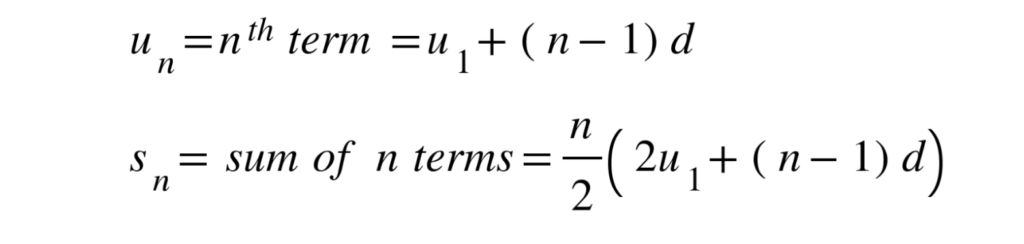
with u1 = a = 1st term, d = common difference.
Geometric: ×/÷ common ratio
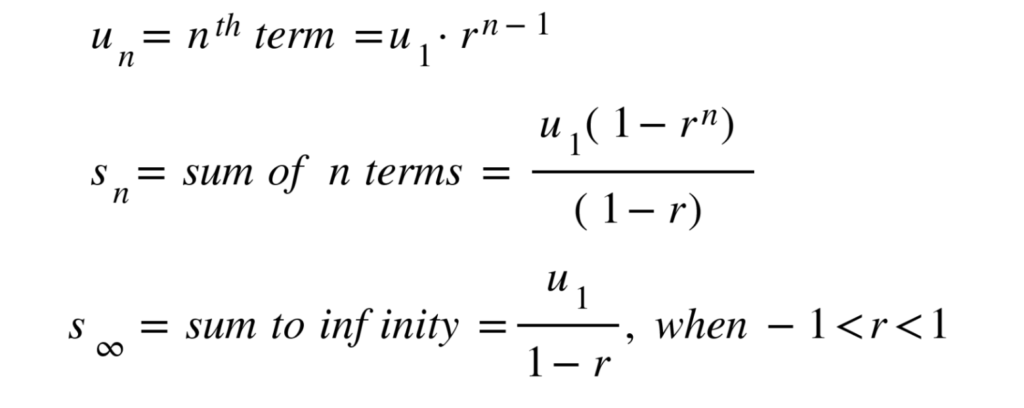
with u1 = a = 1st term, r = common ratio.
Sigma notation
A shorthand to show the sum of a number of terms in a sequence.
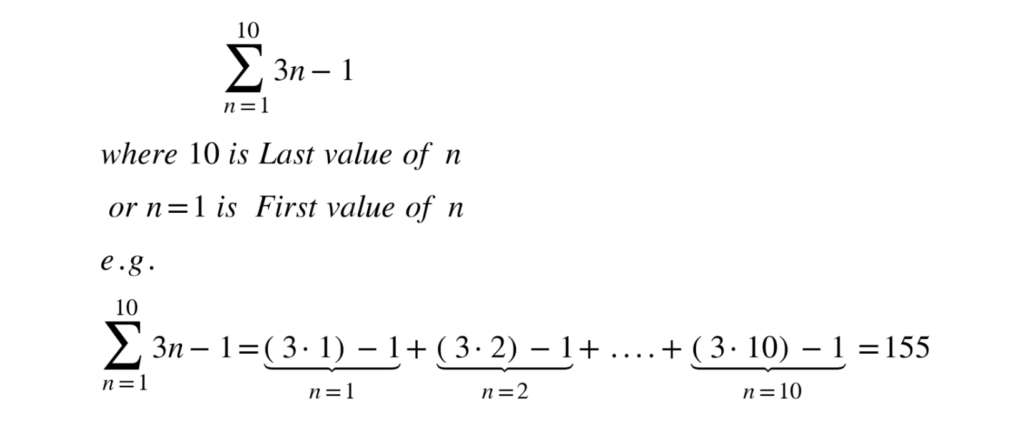
1.2 Exponents and logarithms
Exponents
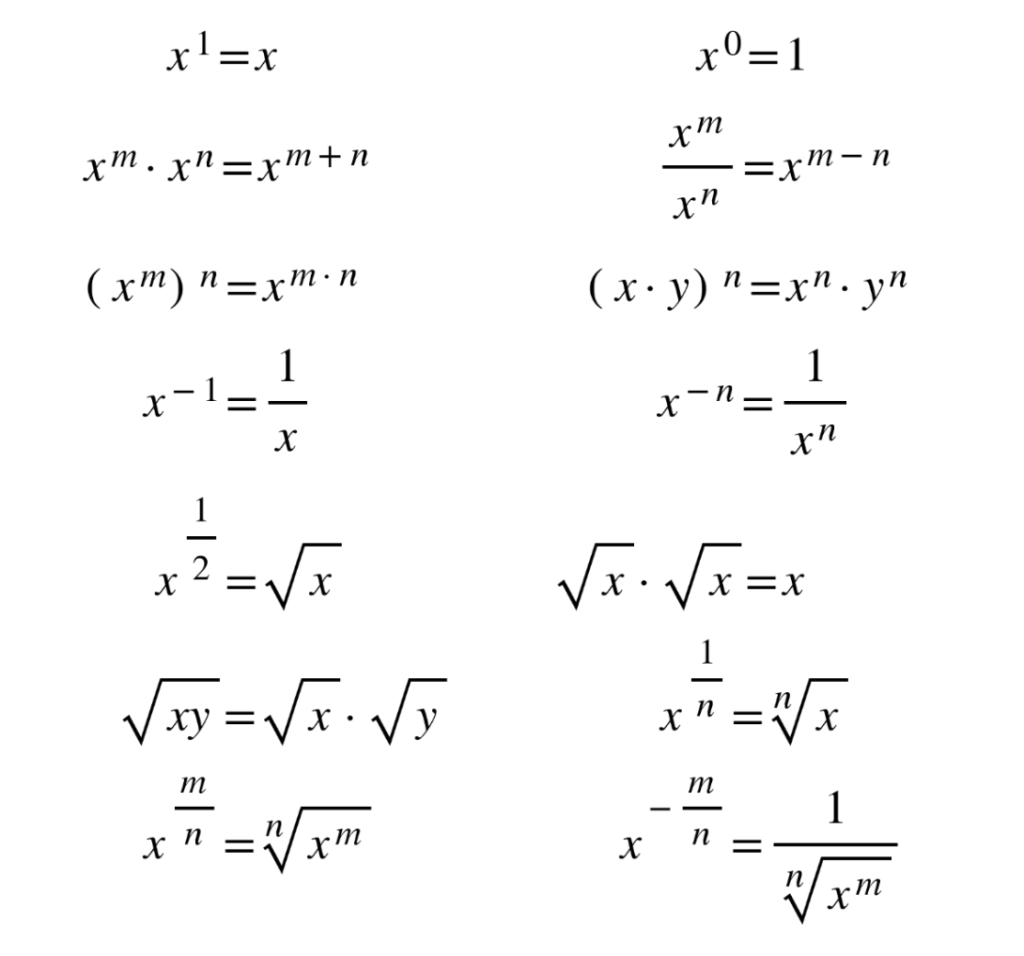
Logarithms
loga ax = x
aloga b = b
Let ax = b, isolate x from the exponent: loga ax = x = loga b
Let loga x = b, isolate x from the logarithm: aloga x = x = ab
Laws of logarithms
1.3. Binomial Expansion
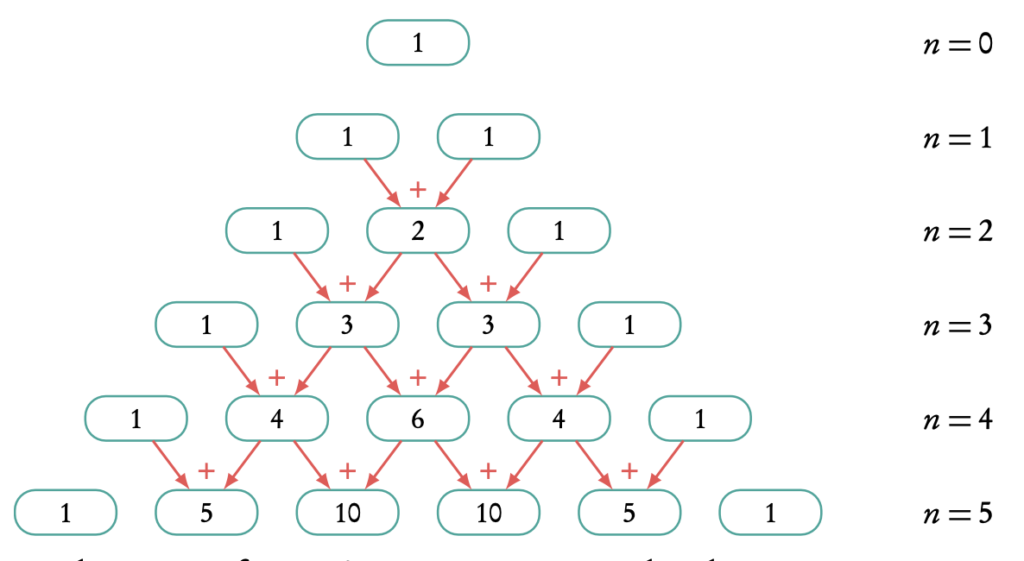
In an expansion of a binomial in the form (a + b)n . Each term can be described as nCran−rbr, where nCr is the coefficient.
The full expansion can be written thus

Find the coefficient using either pascals triangle
Or the nCr function on your calculator