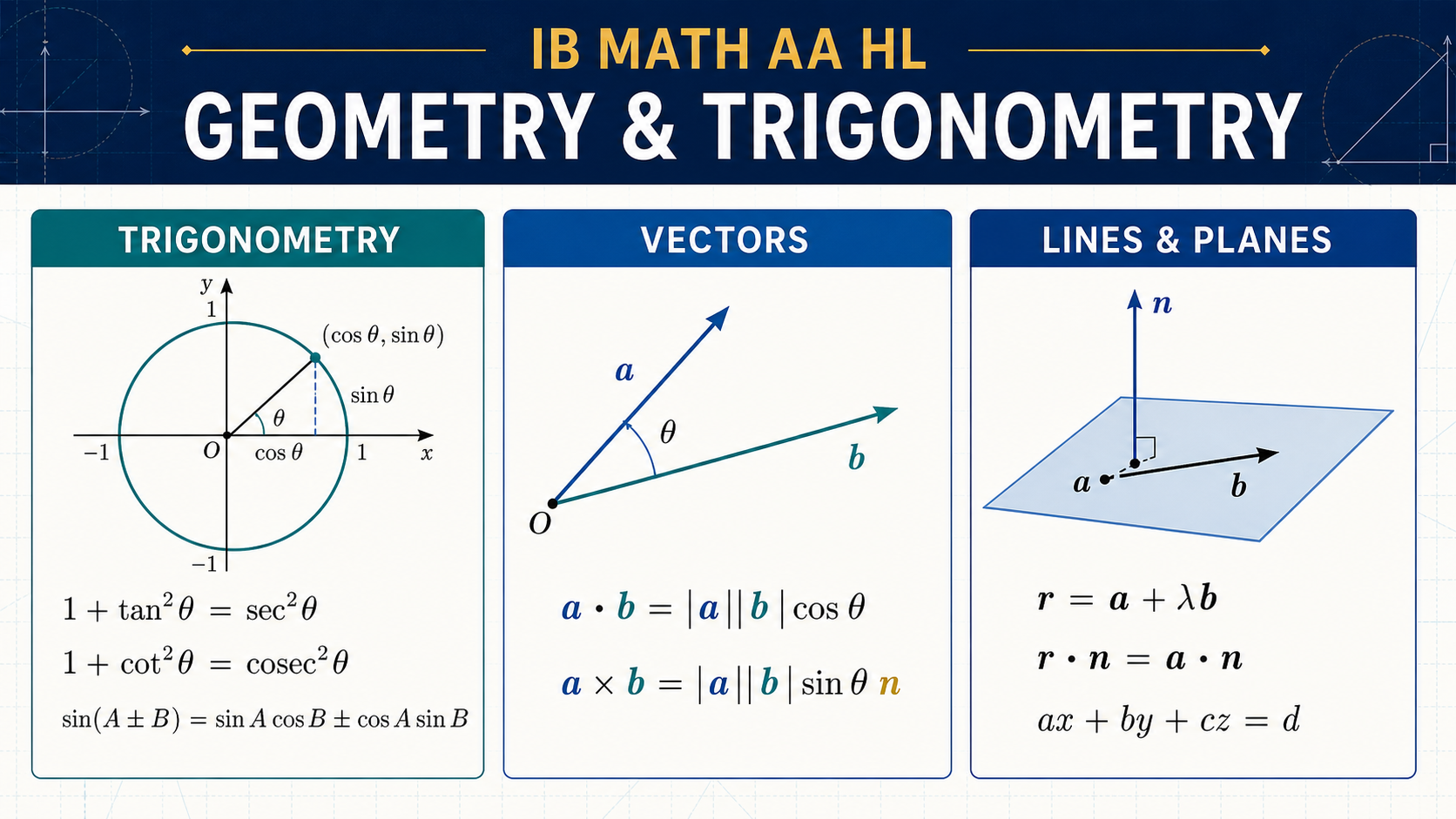
IB Mathematics: Analysis and Approaches
Geometry and Trigonometry Formulae for AA SL and HL
A complete educator-written guide to the geometry and trigonometry studied by every IB Mathematics AA student: three-dimensional geometry, triangle methods, radians, circular functions, identities, graphs, modelling and finite-interval equations.
Geometry and trigonometry are often presented as a list of formulas, but successful IB Mathematics AA work depends on decisions. You must turn words into a labelled diagram, identify the correct triangle or circular relationship, keep degree and radian modes under control, preserve exact values, solve within a stated interval and interpret the result in context. A formula sheet helps only after you understand what each symbol represents.
This guide develops that understanding. Each section explains the formula, the conditions under which it is valid, a reliable solution method, common errors and the link to later functions or calculus. It is designed for revision, topic repair and final exam preparation rather than last-minute memorisation.

What geometry and trigonometry do AA SL and HL share?
The official course structure begins Topic 3 with standard-level content. AA SL students study that content; AA HL students study it too and then continue into additional higher-level material. The shared sequence includes distance and midpoint in three dimensions, surface area and volume, angles in three-dimensional objects, right-triangle ratios, sine and cosine rules, triangle area, applications and diagram construction, radians, unit-circle definitions, exact trigonometric values, the ambiguous sine-rule case, identities, circular-function graphs, transformations, real-life models and finite-interval trigonometric equations.
That distinction matters for revision. Vectors are important in AA HL, but placing vector lines and planes inside a shared SL/HL formula list misrepresents what an SL student is expected to learn. Conversely, an HL student cannot skip the shared material. Vector geometry, calculus and complex numbers repeatedly rely on fluent trigonometry, exact values and diagram reasoning.
AA SL student
Master every shared section on this page. Practise technology and non-technology methods, exact values and clear diagram communication.
AA HL student
Master this entire foundation, then continue to reciprocal identities, inverse functions, compound-angle work and two- and three-dimensional vectors.
If prerequisite geometry is weak—Pythagoras, basic right-angle trigonometry, circle vocabulary or elementary area and volume—repair it first with the AA SL and HL prior-learning guide. Topic formulas become much easier when the underlying shapes and units are familiar.
IB Math AA geometry and trigonometry quick formula sheet
| Idea | Formula or relationship | Use it when |
|---|---|---|
| 3D distance | d = √[(x2−x1)2+(y2−y1)2+(z2−z1)2] | Distance between two Cartesian points in space |
| 3D midpoint | M = ((x1+x2)/2, (y1+y2)/2, (z1+z2)/2) | Point halfway along a 3D segment |
| Pythagoras | a2+b2=c2 | Right triangle; c is the hypotenuse |
| Right-triangle ratios | sin θ = opposite/hypotenuse; cos θ = adjacent/hypotenuse; tan θ = opposite/adjacent | A right triangle with a labelled reference angle |
| Sine rule | a/sin A = b/sin B = c/sin C | A known opposite side-angle pair; includes ambiguous case later |
| Cosine rule | c2=a2+b2−2ab cos C | SAS for a side or SSS for an angle |
| Triangle area | K = ½ab sin C | Two sides and their included angle |
| Degree-radian conversion | 180° = π radians | Convert angle units before using a formula or model |
| Arc length | s=rθ | θ is in radians |
| Sector area | A=½r2θ | θ is in radians |
| Tangent definition | tan θ = sin θ / cos θ | Connect the three circular functions; cos θ ≠ 0 |
| Pythagorean identity | sin2 θ + cos2 θ = 1 | Replace a squared ratio or find possible exact values |
| Double-angle sine | sin 2θ = 2 sin θ cos θ | Rewrite products or double-angle expressions |
| Double-angle cosine | cos 2θ = cos2 θ − sin2 θ = 2cos2 θ−1 = 1−2sin2 θ | Select the form matching the rest of the expression |
| Sinusoidal model | f(x)=a sin(b(x+c))+d | Amplitude |a|, midline y=d, period 2π/|b| |
Three-dimensional coordinates: distance, midpoint and angles
The three-dimensional distance formula is Pythagoras extended across three perpendicular coordinate directions. The differences in x, y and z form the three orthogonal components of the displacement. Squaring makes the sign of each difference irrelevant, but keeping corresponding coordinates together prevents substitution mistakes.
Worked example: distance and midpoint
Let P=(−2, 1, 4) and Q=(4, 9, −2). The coordinate changes are 6, 8 and −6. Therefore PQ=√(6²+8²+(−6)²)=√136=2√34. The midpoint is ((−2+4)/2, (1+9)/2, (4−2)/2)=(1,5,1). Check the midpoint by subtracting it from each endpoint: the resulting displacement vectors have equal magnitude and opposite direction.
For an angle between a line and a plane in a solid, first identify the perpendicular projection of the line onto the plane. The original line, its projection and the perpendicular height form a right triangle. The requested angle is between the line and its projection—not automatically between the line and a vertical edge. Draw that triangle separately and then use sine, cosine or tangent.
Worked example: angle of a space diagonal
A cuboid measures 6 cm by 8 cm by 12 cm. The base diagonal is √(6²+8²)=10 cm. The space diagonal and its base projection form a right triangle with vertical height 12 cm. If α is the angle between the space diagonal and the base, tan α=12/10, so α≈50.2°. A common error is to use 6 cm or 8 cm as the adjacent side instead of the diagonal projection.
Volumes and surface areas of three-dimensional solids
Volume measures three-dimensional capacity and uses cubic units. Surface area measures exposed two-dimensional area and uses square units. Identify whether a question asks for total surface area, curved surface area, an open container or a compound solid before substituting.
| Solid | Volume | Surface-area facts |
|---|---|---|
| Prism | V=Ah, where A is constant cross-sectional area | Add the two end faces and rectangular lateral faces |
| Cylinder | V=πr2h | Curved area 2πrh; closed total 2πrh+2πr2 |
| Right pyramid | V=⅓Ah | Base area plus triangular faces; use slant heights where required |
| Right cone | V=⅓πr2h | Curved area πrl; closed total πrl+πr2 |
| Sphere | V=4πr3/3 | Surface area 4πr2 |
| Hemisphere | V=2πr3/3 | Curved area 2πr2; include base for total 3πr2 |
Compound solids require a construction plan: split the object into recognizable parts, decide whether to add or subtract, use a consistent unit and include only exposed surfaces. A joined circular face inside a cylinder-and-hemisphere model is not externally visible, so it should not be counted in total external surface area.
Worked example: cylinder with a hemispherical top
A tank has radius 3 m, cylindrical height 8 m and a hemispherical top. Its volume is π(3²)(8)+(2/3)π(3³)=72π+18π=90π m³. Its external area, excluding the base, is the cylinder’s curved area plus the hemisphere’s curved area: 2π(3)(8)+2π(3²)=48π+18π=66π m². The shared circular join is internal and must not be added.
Right and non-right triangles: choosing the correct method
Right triangles
Start by marking the right angle and choosing the reference angle. The hypotenuse is opposite the right angle, not merely the longest-looking side in a sketch. The labels opposite and adjacent depend on the selected angle. Use Pythagoras when two side lengths determine a third; use a trigonometric ratio when an acute angle connects the known and unknown sides.
When finding an angle, use the appropriate inverse operation and report the result in the required unit. If the context is a triangle and your calculator produces an acute angle, check that it fits the diagram. Technology cannot detect that you labelled the wrong sides.
Non-right triangles
The sine rule is efficient when you know an opposite side-angle pair. The cosine rule is suited to side-angle-side data when finding the third side, or side-side-side data when finding an angle. The area formula ½ab sin C uses two sides and their included angle.
c2 = a2+b2−2ab cos C
K = ½ab sin C
Worked example: cosine rule and area
Two sides of a triangle are 8 cm and 11 cm, with included angle 52°. The opposite side is c=√(8²+11²−2(8)(11)cos52°)≈8.76 cm. Its area is ½(8)(11)sin52°≈34.7 cm². Both calculations use the same included angle; the side found by the cosine rule is opposite that angle.
The ambiguous case of the sine rule
The shared AA course extends the sine rule to the ambiguous case. It arises with side-side-angle data when the known angle is not between the two known sides. Because sin θ = sin(180°−θ), one inverse-sine value can correspond to two possible interior angles.
Suppose the calculation gives sin B=0.8. The calculator gives the reference value B1≈53.13°. A second possibility is B2=180°−53.13°≈126.87°. Test each against the remaining angle sum and the side-length ordering. A proposed triangle is invalid if the known angle plus B is at least 180°, or if the side-angle relationships contradict the data.
Worked example: two possible triangles
In triangle ABC, A=30°, a=7 and b=10. From the sine rule, sin B=10sin30°/7=5/7. Therefore B1≈45.58° or B2≈134.42°. Both leave a positive third angle: C1≈104.42° and C2≈15.58°. Consequently two triangles satisfy the data. A complete solution must report both, not only the calculator’s first inverse-sine answer.
Labelled diagrams, bearings, elevation and depression
Construction of a labelled diagram from a written statement is assessed mathematical thinking, not decoration. Mark north lines for bearings, horizontal lines for elevation or depression, right angles, equal lengths, known sides and the precise requested quantity. Avoid making the drawing look to scale if the data do not support that assumption.
Three-figure bearings are measured clockwise from north and written with three digits, such as 035° or 270°. When two locations have separate north lines, those lines are parallel; alternate and corresponding angles can reveal an interior triangle angle. An angle of elevation is measured upward from a horizontal at the observer. An angle of depression is measured downward from a horizontal and is often equal to an alternate interior angle at the lower object.
Worked example: bearing and sine rule
A boat travels 12 km from A on a bearing of 040°, then 18 km from B on a bearing of 130°. The back bearing from B to A is 220°, so the included angle ABC is 220°−130°=90°. The direct distance AC is therefore √(12²+18²)=6√13≈21.6 km. The bearing of C from A then requires a second angle calculation and correct clockwise measurement from north. The diagram prevents subtraction of the wrong bearings.
In extended questions, a good diagram also identifies dependencies. You may need to calculate a base distance before finding a height, or calculate an angle before applying the sine rule. Keep unrounded values in the calculator between stages to avoid accumulated error.
Radians, arc length and sector area
A radian measures angle through the ratio of arc length to radius. One full turn is 2π radians, a half turn is π and a quarter turn is π/2. The conversion relationship is 180°=π radians. To convert degrees to radians, multiply by π/180; to convert radians to degrees, multiply by 180/π.
θ degrees = θ radians × 180/π
When θ is in radians, arc length and sector area take especially simple forms:
The formula conditions matter. If the given angle is 60°, convert it to π/3 before using s=rθ. Length units follow the radius; sector area uses the corresponding square units. For a major arc or major sector, the central angle is greater than π. For a segment, subtract a triangle area from the sector area for a minor segment; examine the diagram before choosing the operation.
Worked example: sector perimeter and area
A sector has radius 9 cm and angle 5π/12. Its arc length is 9(5π/12)=15π/4 cm. Its area is ½(9²)(5π/12)=135π/8 cm². The sector perimeter is not just the arc: it is 15π/4+18 cm because the two radii are also boundary edges.
Radian fluency becomes essential in calculus because derivatives and integrals of sine and cosine take their standard forms only when angles are measured in radians. Treat radians as a natural unit, not a degree conversion trick.
Unit circle definitions, exact values and quadrants
On the unit circle, the point reached by an angle θ has coordinates (cos θ, sin θ). Tangent is sin θ/cos θ whenever cos θ≠0. This definition extends trigonometry beyond acute triangles and explains signs, periodicity, symmetry and exact values.
| Angle | 0 | π/6 | π/4 | π/3 | π/2 |
|---|---|---|---|---|---|
| sin θ | 0 | 1/2 | √2/2 | √3/2 | 1 |
| cos θ | 1 | √3/2 | √2/2 | 1/2 | 0 |
| tan θ | 0 | √3/3 | 1 | √3 | undefined |
Use the reference angle to obtain the magnitude, then use the quadrant to choose the sign. In quadrant I all three ratios are positive. In quadrant II sine is positive; in quadrant III tangent is positive; in quadrant IV cosine is positive. For example, cos(3π/4)=−√2/2 because the reference angle is π/4 and cosine is negative in quadrant II.
Useful symmetry and periodic relationships include cos(−x)=cos x, sin(−x)=−sin x, sin(x+2π)=sin x, cos(x+2π)=cos x and tan(x+π)=tan x. Rather than memorising isolated statements, locate the corresponding points or slopes on the unit circle.
Worked example: exact ratio from a quadrant
Given sin θ=3/5 and π/2<θ<π, θ lies in quadrant II, where cosine is negative. From sin²θ+cos²θ=1, cos²θ=1−9/25=16/25, so cos θ=−4/5. Then tan θ=(3/5)/(−4/5)=−3/4. The interval determines the sign that a square root alone cannot decide.
Pythagorean and double-angle identities
An identity is true for every value in its domain, whereas an equation is true only for particular solutions. To verify an identity, transform one side into the other without assuming the desired conclusion. Factor, find a common denominator or replace expressions using a known identity.
tan θ=sin θ/cos θ
sin 2θ=2sin θ cos θ
cos 2θ=cos2 θ−sin2 θ=2cos2 θ−1=1−2sin2 θ
The three cosine double-angle forms are equivalent. Choose the one that removes the unwanted function. If an expression contains only sin²θ, use cos2θ=1−2sin²θ; if it contains only cos²θ, use cos2θ=2cos²θ−1.
Worked example: simplify without finding the angle
If cos θ=4/5 and θ is acute, then sin θ=3/5. Therefore sin2θ=2(3/5)(4/5)=24/25 and cos2θ=2(4/5)²−1=32/25−1=7/25. A useful check is (24/25)²+(7/25)²=1.
Do not divide by a trigonometric expression without checking whether it could equal zero. Dividing an equation by sin x, for example, can lose solutions for which sin x=0. Factor and test zero factors separately.
Circular-function graphs and transformations
The functions sin x, cos x and tan x are periodic. Sine and cosine have period 2π and range [−1,1]. Tangent has period π, range all real numbers and vertical asymptotes where cos x=0. A sketch should show axes, scale, intercepts, extrema and asymptotes where relevant.
For f(x)=a sin(b(x+c))+d or the corresponding cosine model:
- amplitude is |a|;
- period is 2π/|b| when x is measured in radians;
- horizontal shift is −c because the bracket is x+c;
- vertical shift and midline are d and y=d;
- maximum and minimum are d+|a| and d−|a|.
Worked example: analyse a sinusoidal model
For h(t)=4cos(π(t−2)/6)+7, the amplitude is 4, the midline is 7 and the period is 2π÷(π/6)=12. The range is [3,11]. Because the cosine input is zero at t=2, the graph has a maximum of 11 there. In a Ferris-wheel context, 7 may represent centre height and 4 the radius, while the model period is 12 time units.
Technology is valuable for checking windows, intersections and regression models, but a display can hide behaviour if the window is poorly chosen. Use algebra to predict amplitude, period and midline, then select a viewing interval that contains at least one full cycle.
Solving trigonometric equations in a finite interval
A complete answer must include every solution in the stated interval. The general process is: simplify; isolate a trigonometric ratio when possible; find reference values; generate all relevant quadrant solutions; use periodicity; and filter endpoints carefully. Degrees and radians must match both the interval and calculator mode.
Worked example: a basic finite interval
Solve 2sin x=1 for 0≤x≤2π. Then sin x=1/2. The reference angle is π/6, and sine is positive in quadrants I and II. Therefore x=π/6 or 5π/6. Adding 2π produces values outside the interval.
Worked example: a quadratic in cosine
Solve 2cos²x−cos x−1=0 for 0≤x≤2π. Let u=cos x. Then (2u+1)(u−1)=0, so cos x=−1/2 or cos x=1. The solutions are x=2π/3, 4π/3, 0 and 2π. Both endpoints are included and represent distinct interval values even though they occupy the same unit-circle point.
Worked example: use an identity first
Solve 2sin²x+5cos x+1=0. Replace sin²x with 1−cos²x: 2(1−cos²x)+5cos x+1=0. This becomes 2cos²x−5cos x−3=0 after multiplying by −1. Factor to (2cos x+1)(cos x−3)=0. The value cos x=3 is impossible, leaving cos x=−1/2. Finish using the requested interval.
Graphical solutions are also legitimate when requested or when technology is appropriate. Enter the two sides as separate functions and read all intersections inside the domain. State the solutions with suitable precision; a screenshot or unexplained list is not a mathematical argument.
Exact values, rounding and calculator discipline
Preserve π, radicals and fractions when an exact answer is requested. Avoid converting √3/2 or 5π/12 into a decimal too early. In multi-step geometry, store full calculator values or use an answer variable; rounding intermediate lengths can noticeably alter a final angle or surface area.
Before every trigonometric calculation, inspect the unit indicator. A degree-mode calculator evaluating sin(π/6) does not produce the intended radian value. After an inverse-trig result, compare its size with the diagram and determine whether another quadrant or ambiguous-case answer exists.
Write the equation before the decimal. A response such as “x=8.42” gives the examiner little evidence if the calculator entry was wrong. A labelled substitution into the sine rule, cosine rule or model communicates method and may earn credit even when arithmetic fails.
Exam strategy: a reliable geometry and trigonometry workflow
- Extract the geometry. Underline known lengths, angles, units, bearings and interval restrictions.
- Draw or redraw. Make a clean labelled diagram and identify right angles, projections, opposite pairs and included angles.
- Choose the relationship. State the formula symbolically before substituting.
- Check units and mode. Convert lengths and angle units; set degrees or radians deliberately.
- Calculate with full precision. Keep exact forms or stored values through intermediate stages.
- Generate all solutions. Test ambiguous triangles, quadrants, periodic copies and interval endpoints.
- Interpret. Reject negative lengths, impossible angles or values outside the physical and stated domains.
- Communicate. Add units, appropriate accuracy and a sentence answering the context.
Common mistakes and their repairs
| Mistake | Why it fails | Repair |
|---|---|---|
| Using degrees in s=rθ | The compact formula assumes radians | Convert first using θrad=θdegπ/180 |
| Mismatching sine-rule pairs | A side must match its opposite angle | Annotate opposite pairs in the diagram before writing ratios |
| Wrong cosine-rule angle | The angle must oppose the isolated side | Write the side-angle correspondence explicitly |
| One inverse-sine answer | A second supplementary angle may form a valid triangle | Test 180°−θ and the angle sum |
| Counting hidden joined faces | Internal faces are not part of external area | Shade only the exposed boundary |
| Confusing slant and vertical height | Volume uses perpendicular height; cone area uses slant height | Mark the right triangle linking them |
| Wrong phase shift sign | x+c shifts left by c | Find where the bracket equals zero |
| Losing solutions by division | Dividing by sin x or cos x removes zero cases | Factor and test every factor separately |
| Rounding early | Intermediate error propagates | Store values and round only the final result |
| Unlabelled calculator output | It does not demonstrate mathematical method | Show the model, equation and interval reasoning |
How AA SL and AA HL expectations differ
AA HL students complete the shared SL content and then extend it. The additional higher-level topic introduces reciprocal ratios and their Pythagorean identities, inverse trigonometric functions with domains and ranges, further compound-angle and double-angle identities, symmetry properties, and vectors in two and three dimensions. Vector work then develops scalar and vector products, lines, planes, intersections and angles.
This page intentionally keeps the core formula guide focused on shared content. For the extension, continue to the AA HL-only geometry and trigonometry guide. Keeping the sequence clear helps SL students avoid unnecessary overload and helps HL students diagnose whether an error comes from foundational trigonometry or from an additional vector technique.
Fourteen-day geometry and trigonometry revision plan
| Day | Focus | Evidence of mastery |
|---|---|---|
| 1 | Prerequisite Pythagoras, SOHCAHTOA and units | Choose ratios without topic labels and explain side names |
| 2 | 3D distance and midpoint | Exact coordinates and distance, checked geometrically |
| 3 | Solids and compound volume | Correct split, cubic units and internal-face decisions |
| 4 | Surface area and line-plane angles | Correct projection, slant height and exposed surfaces |
| 5 | Sine rule | Opposite pairs labelled before substitution |
| 6 | Cosine rule and triangle area | Method selected from SAS, SSS or included-angle data |
| 7 | Ambiguous case | Every valid triangle reported and invalid cases rejected |
| 8 | Bearings, elevation and diagrams | Accurate north lines, horizontals and multi-stage plan |
| 9 | Degrees, radians, arcs and sectors | Conversions exact and sector perimeter distinguished from arc |
| 10 | Unit circle and exact values | Reference angle plus quadrant sign, without decimal rescue |
| 11 | Identities | Transform one side logically and state domain restrictions |
| 12 | Graphs and transformations | Amplitude, period, midline, shift and range identified |
| 13 | Finite-interval equations | All quadrant, periodic and endpoint solutions included |
| 14 | Mixed examination set and error log | Method chosen independently; repeated errors repaired |
On each day, begin with two retrieval questions from earlier topics, study one worked example, complete several single-skill questions and finish with one mixed problem. Mark the work by error type: diagram, formula choice, algebra, exact value, calculator mode, interval or communication. Reattempt errors from a blank page after two days.
Geometry and trigonometry connect strongly to the AA SL and HL functions guide, especially transformations, inverse operations and graphical solutions. Algebraic manipulation from the Number and Algebra guide is equally important when identities or equations become quadratic.
Final mastery checklist
- I can find distance and midpoint in three dimensions exactly.
- I can extract a right triangle from a solid and identify a line’s projection.
- I distinguish perpendicular height, slant height, curved area and total area.
- I select between Pythagoras, right-triangle ratios, sine rule and cosine rule.
- I test the ambiguous sine-rule case instead of accepting one inverse-sine value.
- I construct labelled diagrams for bearings, elevation, depression and multi-stage geometry.
- I convert degrees and radians and apply arc and sector formulas with correct units.
- I derive exact values from reference angles and quadrant signs.
- I use identities without cancelling possible zero solutions.
- I read amplitude, period, phase shift, midline and range from a sinusoidal model.
- I solve trigonometric equations completely within a finite interval.
- I preserve exact values, use full precision and communicate a contextual final answer.
Frequently asked questions
Is this geometry and trigonometry content required for both AA SL and AA HL?
Yes. The standard-level Topic 3 sequence is studied by AA SL students and forms required foundation for AA HL students, who then add higher-level identities and vectors.
Are vectors included in the AA SL formula list?
No. Vector content belongs to the additional higher-level sequence. AA SL students still work with three-dimensional coordinates, distance, midpoint, solids and right-triangle geometry.
When should I use the sine rule instead of the cosine rule?
Use the sine rule when you know an opposite side-angle pair. Use the cosine rule for SAS when finding a side or SSS when finding an angle. Always check for the ambiguous case with suitable side-side-angle data.
Do arc length and sector area formulas require radians?
The compact forms s=rθ and A=½r²θ require θ in radians. Convert degree data first.
Are radians assumed in IB Math AA examinations?
The official guide states that radian measure should be assumed unless otherwise indicated. Read each question and calculator mode carefully.
Do I need exact trigonometric values?
Yes. Know the standard unit-circle values and derive related angles with reference angles and quadrant signs. Exact fractions, radicals and multiples of π are often required.
What is the ambiguous sine-rule case?
Because sin θ equals sin(180°−θ), side-side-angle data can produce zero, one or two valid triangles. Test the supplementary angle and the triangle angle sum.
How do I find an angle between a line and a plane?
Construct the perpendicular projection of the line onto the plane. The line, projection and perpendicular height form a right triangle; the requested angle lies between the line and projection.
How can I avoid losing solutions in trigonometric equations?
Do not divide by an expression that could equal zero without testing that case. Factor where possible, generate quadrant and periodic solutions, and filter only after comparing with the closed or open interval.
Is calculator graphing enough for a solution?
Technology can locate intersections and check work, but show the functions, interval, relevant algebra or interpretation, and solutions to suitable accuracy. An unexplained screenshot is not a complete mathematical argument.
What should an AA HL student study next?
Continue to the dedicated AA HL-only guide for reciprocal ratios, inverse trig functions, compound-angle identities and vector geometry.
Will the first-assessment-2029 course change this page?
The IB describes the update as refinement and has published a transition timeline. Students assessed in May 2029 or later should use the new guide and formula booklet assigned by their school; this page should be checked against that session’s official documents.
Official sources and related RevisionTown guides
This guide was checked against the official IB Mathematics: Analysis and Approaches guide, the IB Diploma mathematics overview and the official Mathematics AA course-update page.
Continue with Geometry and Trigonometry AA HL Only, Functions Formulae AA SL and HL, Number and Algebra Formulae AA SL and HL, or revisit Prior Learning Formulae AA SL and HL.
Editorial note: educational guide, independently written by RevisionTown. Always use your school’s official IB documents for your examination session. Last reviewed: 20 August 2026.