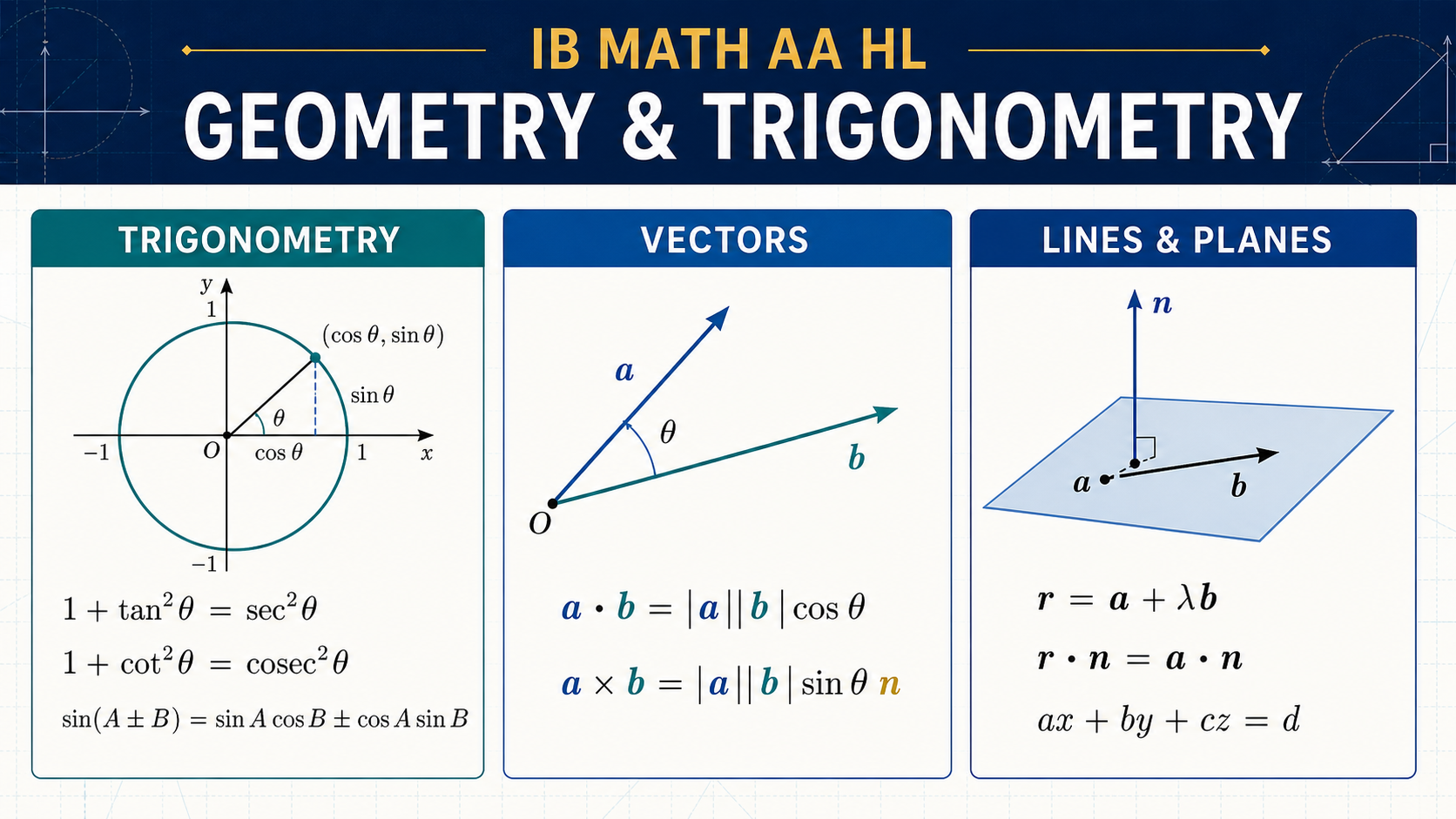
Geometry and Trigonometry Formulae for IB Math AI HL Only
This RevisionTown page is built for students taking IB Mathematics: Applications and Interpretation Higher Level. It focuses on the Geometry and Trigonometry formulae that matter most for AI HL, especially the HL-only content: radians, trigonometric identities, transformation matrices, 3D vectors, vector equations of lines, scalar product, vector product, angle between vectors, and area from cross products.
AI HL geometry is not just about memorizing formulae. It is about recognizing a situation, choosing the correct model, using technology efficiently, writing mathematical notation clearly, and interpreting the result in context. This page gives you the formulae, diagrams, calculators, exam guidance, scoring strategy, common mistakes, and practice prompts needed to use Topic 3 confidently in Paper 1, Paper 2, Paper 3, and the Internal Assessment.
Course
IB Math AI HL, first assessed from 2021 under the current course structure.
Topic focus
Topic 3: Geometry and Trigonometry, with emphasis on HL-only formulae and applications.
Exam use
Paper 1, Paper 2, and Paper 3 allow technology and require clear working, interpretation, and notation.
AI HL Geometry & Trigonometry Formula Finder
Select a formula group to see the key formula, when to use it, and the most common exam mistake.
Arc Length & Sector Area Tool
Use this for AHL 3.7 radian-measure questions.
Vector Dot, Cross & Angle Tool
Enter two 3D vectors to calculate magnitude, scalar product, angle, vector product, and parallelogram area.
Transformation Matrix Builder
Choose a transformation and generate the matrix.
AI HL Score Planning Tool
This estimates a weighted percentage using the standard AI HL assessment weighting. It is a planning guide only, not an official grade boundary calculator.
What Is Geometry and Trigonometry in IB Math AI HL?
Geometry and Trigonometry in IB Mathematics: Applications and Interpretation HL is a practical, modelling-driven topic. Students meet familiar shapes, triangles, circles, sectors, 3D coordinates, vectors, and transformations, but the AI HL expectation is deeper than simply substituting into a formula. You are expected to connect diagrams, coordinates, vectors, matrix transformations, technology, and context. A problem may begin with a shape, move into a vector model, ask for a distance or angle, and finish by requiring a conclusion about a real situation such as navigation, design, motion, image transformation, robotics, architecture, or spatial modelling.
In AI HL, geometry often appears through applied contexts. You may be given a map, a route, a 3D object, a vector line, or an image transformation. Your job is to translate the context into mathematics, decide whether the angle is in degrees or radians, choose between scalar product and vector product, set up a transformation matrix, or use a graphing calculator efficiently. This means a strong formula page must do more than list equations. It must show when each formula is useful, what each symbol means, how to avoid the common traps, and how formulae connect with exam scoring.
The geometry formulae in Topic 3 can be grouped into four big ideas. The first idea is measurement: distances, midpoints, lengths, areas, volumes, and sectors. The second is triangle trigonometry: sine rule, cosine rule, and area of a triangle using two sides and the included angle. The third is transformation geometry: matrices that rotate, reflect, stretch, and enlarge points or objects. The fourth is vector geometry: magnitude, vector equations of lines, dot product, cross product, angle between vectors, and area of a parallelogram. AI HL students need all four because Paper 3 problem-solving questions frequently combine multiple topics inside a single extended investigation.
IB Math AI HL Course Context
Mathematics: Applications and Interpretation is designed for students who want mathematics connected to modelling, technology, data, real-world applications, and interpretation. The higher level course is broader and deeper than standard level. A typical AI HL student studies number and algebra, functions, geometry and trigonometry, statistics and probability, calculus, and a mathematical exploration. Geometry and trigonometry at HL is a significant topic because it strengthens spatial reasoning and supports modelling in many other areas of the course.
The IB recommends 240 teaching hours for higher level subjects and 150 teaching hours for standard level subjects. In the AI HL curriculum model, Geometry and Trigonometry is allocated a substantial recommended teaching time because it includes both shared content and additional higher level content. For AI HL, this topic connects naturally with functions, matrices, vectors, statistics, optimization, and technology. Students should therefore revise it both as a standalone topic and as part of mixed exam practice.
All external assessments in AI use technology. That does not mean that working can be skipped. In IB mathematics, calculator results normally need supporting working, suitable notation, and interpretation. If a graphing display calculator is used to find an intersection, solve an equation, compute a matrix product, or find an angle, the written solution should still show what was done mathematically. A clear formula, correct substitution, correct units, and a final sentence in context often separate a strong answer from an answer that only contains a number.
AI HL Geometry and Trigonometry Formulae: HL-Only Core Table
The following table is the core of this page. It summarizes the HL-only formulae and methods from Geometry and Trigonometry that AI HL students should be able to use confidently. These formulae are especially important in vector geometry, transformation geometry, and radian measure.
| AI HL reference | Formula / method | MathJax formula | Use it when... |
|---|---|---|---|
| AHL 3.7 | Length of an arc | \(l=r\theta\) | The angle is measured in radians and you need the curved length along a circle. |
| AHL 3.7 | Area of a sector | \(A=\frac{1}{2}r^2\theta\) | The angle is measured in radians and you need the area of a slice of a circle. |
| AHL 3.8 | Pythagorean identity | \(\cos^2\theta+\sin^2\theta=1\) | You need to simplify trigonometric expressions or connect sine and cosine. |
| AHL 3.8 | Tangent identity | \(\tan\theta=\frac{\sin\theta}{\cos\theta}\) | You need to rewrite tangent using sine and cosine or interpret a gradient angle. |
| AHL 3.9 | Reflection matrix | \(\begin{pmatrix}\cos 2\theta&\sin 2\theta\\ \sin 2\theta&-\cos 2\theta\end{pmatrix}\) | You reflect a point or object in the line \(y=(\tan\theta)x\). |
| AHL 3.9 | Horizontal stretch | \(\begin{pmatrix}k&0\\0&1\end{pmatrix}\) | You stretch parallel to the \(x\)-axis by scale factor \(k\). |
| AHL 3.9 | Vertical stretch | \(\begin{pmatrix}1&0\\0&k\end{pmatrix}\) | You stretch parallel to the \(y\)-axis by scale factor \(k\). |
| AHL 3.9 | Enlargement about origin | \(\begin{pmatrix}k&0\\0&k\end{pmatrix}\) | You scale both coordinates from the origin by the same factor. |
| AHL 3.9 | Anticlockwise rotation | \(\begin{pmatrix}\cos\theta&-\sin\theta\\ \sin\theta&\cos\theta\end{pmatrix}\) | You rotate a point or shape anticlockwise about the origin. |
| AHL 3.9 | Clockwise rotation | \(\begin{pmatrix}\cos\theta&\sin\theta\\ -\sin\theta&\cos\theta\end{pmatrix}\) | You rotate a point or shape clockwise about the origin. |
| AHL 3.10 | Magnitude of a 3D vector | \(|\mathbf v|=\sqrt{v_1^2+v_2^2+v_3^2}\) | You need length, speed, displacement magnitude, or unit-vector work. |
| AHL 3.11 | Vector equation of a line | \(\mathbf r=\mathbf a+\lambda\mathbf b\) | A line is described using a point vector and a direction vector. |
| AHL 3.11 | Parametric line equation | \(x=x_0+\lambda l,\;y=y_0+\lambda m,\;z=z_0+\lambda n\) | You need coordinate equations from a vector line in 3D. |
| AHL 3.13 | Scalar product | \(\mathbf v\cdot\mathbf w=v_1w_1+v_2w_2+v_3w_3\) | You need the dot product from components. |
| AHL 3.13 | Scalar product angle form | \(\mathbf v\cdot\mathbf w=|\mathbf v||\mathbf w|\cos\theta\) | You need the angle between two vectors or a perpendicularity test. |
| AHL 3.13 | Angle between two vectors | \(\cos\theta=\frac{v_1w_1+v_2w_2+v_3w_3}{|\mathbf v||\mathbf w|}\) | You need the acute or obtuse angle between two directions. |
| AHL 3.13 | Vector product | \(\mathbf v\times\mathbf w=\begin{pmatrix}v_2w_3-v_3w_2\\v_3w_1-v_1w_3\\v_1w_2-v_2w_1\end{pmatrix}\) | You need a vector perpendicular to two vectors or area from cross product. |
| AHL 3.13 | Magnitude of vector product | \(|\mathbf v\times\mathbf w|=|\mathbf v||\mathbf w|\sin\theta\) | You need area or a relationship involving the angle between two vectors. |
| AHL 3.13 | Area of a parallelogram | \(A=|\mathbf v\times\mathbf w|\) | Two adjacent sides of a parallelogram are given as vectors. |
Supporting SL/HL Formulae AI HL Students Still Need
Although this page is titled for AI HL-only formulae, the AI HL exam is cumulative. Students are not tested only on the additional higher level rows. They can also be tested on shared SL/HL geometry and trigonometry formulae. These formulae are the foundation that often appears before an HL extension. For example, a Paper 2 problem might begin with a 3D distance, use cosine rule in a triangle, then extend into a vector interpretation.
| Formula type | Formula | Notes for AI HL |
|---|---|---|
| 3D distance | \(d=\sqrt{(x_1-x_2)^2+(y_1-y_2)^2+(z_1-z_2)^2}\) | Use for distance between points in 3D coordinate models. |
| 3D midpoint | \(\left(\frac{x_1+x_2}{2},\frac{y_1+y_2}{2},\frac{z_1+z_2}{2}\right)\) | Use for midpoint, centre, average position, and geometric modelling. |
| Right pyramid volume | \(V=\frac{1}{3}Ah\) | \(A\) is base area and \(h\) is perpendicular height. |
| Right cone volume | \(V=\frac{1}{3}\pi r^2h\) | Be careful to use perpendicular height, not slant height. |
| Curved surface area of cone | \(A=\pi rl\) | \(l\) is slant height; it is different from vertical height. |
| Sphere volume | \(V=\frac{4}{3}\pi r^3\) | Common in modelling volume, design, and optimization contexts. |
| Sphere surface area | \(A=4\pi r^2\) | Useful for surface coverage, material cost, and scaling questions. |
| Sine rule | \(\frac{a}{\sin A}=\frac{b}{\sin B}=\frac{c}{\sin C}\) | Use when you know an opposite side-angle pair. |
| Cosine rule | \(c^2=a^2+b^2-2ab\cos C\) | Use for SAS or SSS triangle situations. |
| Cosine rule for angle | \(\cos C=\frac{a^2+b^2-c^2}{2ab}\) | Use when three sides are known and an angle is required. |
| Triangle area | \(A=\frac{1}{2}ab\sin C\) | Use two sides and the included angle. |
| Degree arc length | \(l=\frac{\theta}{360}\times 2\pi r\) | Use only when \(\theta\) is in degrees. |
| Degree sector area | \(A=\frac{\theta}{360}\times \pi r^2\) | Use only when \(\theta\) is in degrees. |
Diagram 1: Radian Arc Length and Sector Area
The key difference between SL sector formulae and HL-only AHL 3.7 formulae is the angle unit. In HL, the elegant formulae \(l=r\theta\) and \(A=\frac{1}{2}r^2\theta\) work when \(\theta\) is measured in radians. If the angle is in degrees, convert it first using \(\theta_{\text{rad}}=\theta_{\degree}\times\frac{\pi}{180}\). A large number of exam errors happen because students use the radian formula with a degree value.
AHL 3.7: Arc Length and Sector Area in Radians
The HL-only arc and sector formulae are among the simplest formulae on the page, but they are also among the easiest to misuse. The formula \(l=r\theta\) gives the length of the arc when the central angle is in radians. The formula \(A=\frac{1}{2}r^2\theta\) gives the area of a sector when the central angle is in radians. Radians are natural in higher mathematics because they connect circular geometry directly with calculus, trigonometric functions, and modelling.
A good AI HL answer should state or imply the unit conversion when needed. If a question gives \(120^\circ\), then \[ \theta=120\times\frac{\pi}{180}=\frac{2\pi}{3}. \] After conversion, the radian formulae can be used. If the question gives \(\theta=1.4\), assume radians only when the question makes that clear or when the context is explicitly in radians. When using a calculator, check whether the angle mode affects the calculation. Arc and sector formulae are algebraic, but if sine, cosine, or tangent are used in the same question, the calculator angle mode matters.
In exam contexts, sector questions may combine geometry with optimization, modelling, or rates. For example, a sector could represent a field of view, a radar sweep, a slice of material, a rotating arm, or a component of a circular design. AI HL students should be ready to interpret the answer. An arc length might be a distance travelled. A sector area might be a covered region. The final answer should therefore include units such as cm, m, km, cm\(^2\), or m\(^2\), depending on the question.
Worked Example: Radian Sector
A sector has radius \(r=8\) cm and central angle \(\theta=1.25\) radians.
\[ l=r\theta=8(1.25)=10\text{ cm} \]
\[ A=\frac{1}{2}r^2\theta=\frac{1}{2}(8^2)(1.25)=40\text{ cm}^2 \]
The arc length is \(10\) cm and the sector area is \(40\text{ cm}^2\). The units are part of the mathematical answer, not decoration. Missing units can weaken a contextual answer.
AHL 3.8: Trigonometric Identities
AI HL students need two central trigonometric identities in this part of the formula booklet: \[ \cos^2\theta+\sin^2\theta=1 \] and \[ \tan\theta=\frac{\sin\theta}{\cos\theta}. \] These identities are compact, but they unlock many transformations. The first identity connects sine and cosine through the unit circle. The second identity connects tangent with a ratio. Together they help simplify expressions, verify relationships, interpret gradients, and transform trigonometric models.
The notation \(\cos^2\theta\) means \((\cos\theta)^2\), not \(\cos(\theta^2)\). This is a common notation trap. In written work, students should avoid ambiguous calculator notation. A strong solution uses clear mathematical notation, such as \(\sin^2 x+\cos^2 x=1\), and then explains the step if it is part of a simplification.
Tangent is especially useful in geometry because it links angle with gradient. If a line makes an angle \(\theta\) with the positive \(x\)-axis, then its gradient is often written as \(m=\tan\theta\), provided the line is not vertical. This is why the reflection matrix in AHL 3.9 uses the line \(y=(\tan\theta)x\). The line is described by its angle through tangent, and the reflection matrix then uses \(\cos 2\theta\) and \(\sin 2\theta\). Students who understand this connection usually find transformation geometry easier.
AHL 3.9: Transformation Matrices
Transformation matrices describe how points and shapes move in the coordinate plane. In AI HL, students should be able to apply matrices to points, interpret the transformation, and sometimes combine transformations through matrix multiplication. A point is usually represented as a column vector: \[ \begin{pmatrix}x\\y\end{pmatrix}. \] A transformation matrix \(M\) maps the point to a new point: \[ \begin{pmatrix}x'\\y'\end{pmatrix}=M\begin{pmatrix}x\\y\end{pmatrix}. \]
The rotation matrices are particularly important. For an anticlockwise rotation about the origin, \[ M=\begin{pmatrix}\cos\theta&-\sin\theta\\ \sin\theta&\cos\theta\end{pmatrix}. \] For a clockwise rotation about the origin, \[ M=\begin{pmatrix}\cos\theta&\sin\theta\\ -\sin\theta&\cos\theta\end{pmatrix}. \] These formulae look similar, but the sign positions are different. A wrong sign changes the direction of rotation.
Stretch and enlargement matrices are easier to read. A horizontal stretch uses \[ \begin{pmatrix}k&0\\0&1\end{pmatrix}, \] which multiplies the \(x\)-coordinate by \(k\) while leaving \(y\) unchanged. A vertical stretch uses \[ \begin{pmatrix}1&0\\0&k\end{pmatrix}. \] An enlargement about the origin uses \[ \begin{pmatrix}k&0\\0&k\end{pmatrix}, \] which scales both coordinates by \(k\).
Reflection in the line \(y=(\tan\theta)x\) uses \[ \begin{pmatrix} \cos 2\theta & \sin 2\theta\\ \sin 2\theta & -\cos 2\theta \end{pmatrix}. \] Notice the double angle. Students often substitute \(\theta\) instead of \(2\theta\), which produces the wrong reflection. A reliable strategy is to write the line angle first, then write \(2\theta\) clearly before calculating the matrix entries.
AHL 3.10: Magnitude of a Vector
A vector in three dimensions can be written as \[ \mathbf v=\begin{pmatrix}v_1\\v_2\\v_3\end{pmatrix}. \] Its magnitude is \[ |\mathbf v|=\sqrt{v_1^2+v_2^2+v_3^2}. \] This is the 3D extension of Pythagoras. The magnitude represents length, distance, speed, displacement, or size depending on context. If \(\mathbf v\) is a displacement vector, then \(|\mathbf v|\) is the straight-line distance moved. If \(\mathbf v\) is a velocity vector, then \(|\mathbf v|\) is speed.
Magnitude is often needed before using the scalar product angle formula. It is also needed when normalizing a vector. A unit vector in the direction of \(\mathbf v\) is \[ \frac{\mathbf v}{|\mathbf v|}. \] Even if the unit-vector formula is not displayed as a separate formula in the table above, it is a natural consequence of vector magnitude and is frequently useful in AI HL work.
AHL 3.11: Vector Equation of a Line
A vector line in 3D is written as \[ \mathbf r=\mathbf a+\lambda\mathbf b. \] Here \(\mathbf a\) is a position vector for a known point on the line, \(\mathbf b\) is a direction vector, and \(\lambda\) is a scalar parameter. As \(\lambda\) changes, the point \(\mathbf r\) moves along the line.
The parametric form is \[ x=x_0+\lambda l,\quad y=y_0+\lambda m,\quad z=z_0+\lambda n. \] This form is useful when you need to find a specific coordinate, check whether a point lies on a line, or solve for an intersection condition. For example, if a point \(P(5,2,7)\) lies on a line, the same value of \(\lambda\) must satisfy all three coordinate equations. If the values of \(\lambda\) disagree, the point is not on the line.
In AI HL, vector lines are often used in motion, routes, beams of light, drone paths, navigation, engineering, and spatial design. A high-scoring response does not only calculate. It interprets. If \(\lambda=3\) gives the position of a drone after three time units, say that. If two lines do not intersect, explain whether they are parallel, skew, or simply not meeting within the context of the model.
AHL 3.13: Scalar Product, Vector Product, and Angles
The scalar product, also called dot product, is \[ \mathbf v\cdot\mathbf w=v_1w_1+v_2w_2+v_3w_3. \] It also satisfies \[ \mathbf v\cdot\mathbf w=|\mathbf v||\mathbf w|\cos\theta. \] Combining these gives \[ \cos\theta=\frac{v_1w_1+v_2w_2+v_3w_3}{|\mathbf v||\mathbf w|}. \] This formula is the standard way to find the angle between two vectors in AI HL.
The dot product is also a fast test for perpendicular vectors. If \(\mathbf v\cdot\mathbf w=0\) and neither vector is the zero vector, then the vectors are perpendicular. This is because \(\cos 90^\circ=0\). In exam work, always state the reason: “Since \(\mathbf v\cdot\mathbf w=0\), the two direction vectors are perpendicular.”
The vector product, also called cross product, is \[ \mathbf v\times\mathbf w= \begin{pmatrix} v_2w_3-v_3w_2\\ v_3w_1-v_1w_3\\ v_1w_2-v_2w_1 \end{pmatrix}. \] This produces a vector perpendicular to both \(\mathbf v\) and \(\mathbf w\). Its magnitude is \[ |\mathbf v\times\mathbf w|=|\mathbf v||\mathbf w|\sin\theta. \] If \(\mathbf v\) and \(\mathbf w\) form two adjacent sides of a parallelogram, then the area is \[ A=|\mathbf v\times\mathbf w|. \]
Students often confuse dot product and cross product. Dot product gives a scalar and is useful for angles and projection ideas. Cross product gives a vector and is useful for perpendicular direction and area. A quick memory rule is: dot gives a number; cross gives a vector. In a written solution, this distinction matters because using the wrong product changes the mathematical meaning.
AI HL Exam Assessment, Score Guidelines, and 2026 Timetable
AI HL assessment combines external examination papers and an internal mathematical exploration. Paper 1 contains compulsory short-response questions. Paper 2 contains compulsory extended-response questions. Paper 3 is only for HL and contains extended-response problem-solving questions. The internal exploration is assessed separately and contributes to the final grade. Technology is allowed in the external papers, but students must still show mathematical reasoning.
| Component | Typical AI HL role | Time / marks | Weighting | Geometry & trig strategy |
|---|---|---|---|---|
| Paper 1 | Compulsory short-response questions | 2 hours; specimen maximum 110 marks | 30% | Know formula selection quickly. Show substitutions, units, diagrams, and exact values where possible. |
| Paper 2 | Compulsory extended-response questions | 2 hours; specimen maximum 110 marks | 30% | Expect modelling, multi-step interpretation, 3D geometry, technology, and contextual conclusions. |
| Paper 3 | HL-only extended problem solving | May 2026 schedule: 1 hour 15 minutes | 20% | Connect vectors, matrices, trigonometry, functions, and reasoning. Explain patterns and conclusions. |
| Exploration | Internal mathematical investigation | School deadline; internally assessed and externally moderated | 20% | Good IA topics can use vectors, transformations, optimization, spatial design, or trigonometric modelling. |
Next Official May 2026 AI HL Exam Timetable
| Paper | Date | Session | Scheduled duration | Preparation focus |
|---|---|---|---|---|
| Mathematics: Applications and Interpretation HL Paper 1 | Thursday 14 May 2026 | Afternoon | 2 hours | Formula recognition, short-response fluency, GDC setup, exact/3 s.f. answers. |
| Mathematics: Applications and Interpretation HL Paper 2 | Friday 15 May 2026 | Morning | 2 hours | Extended-response modelling, written interpretation, diagrams, and technology-supported working. |
| Mathematics: Applications and Interpretation HL Paper 3 | Wednesday 20 May 2026 | Afternoon | 1 hour 15 minutes | HL problem solving, mixed-topic reasoning, unfamiliar contexts, vectors and modelling. |
Score Guideline Table for Planning
IB subject grades are awarded on a 1–7 scale. Official grade boundaries are not fixed before the session; they are set through the assessment process after examiners review candidate performance. The table below is therefore a practical RevisionTown planning guide, not an official IB boundary table. Use it to set safe revision targets, especially for AI HL where boundaries may change by session and component.
| Planning grade | Safe weighted target | Performance description | Geometry/trig evidence to show |
|---|---|---|---|
| 7 | 80%+ | Excellent command with strong reasoning, efficient technology, clear notation, and context-aware conclusions. | Can combine vectors, matrices, trigonometry, diagrams, and interpretation in unfamiliar problems. |
| 6 | 68–79% | Very strong performance with only minor errors or occasional gaps in interpretation. | Uses most formulae correctly and explains methods clearly in extended responses. |
| 5 | 55–67% | Good understanding of common methods, but complex multi-step problems may be inconsistent. | Can apply standard formulae but may need more practice on Paper 3-style linking. |
| 4 | 43–54% | Satisfactory understanding with routine success but frequent errors in unfamiliar contexts. | Can use basic trigonometry and distance formulae but struggles with vector interpretation. |
| 3 | 30–42% | Partial knowledge; some routine procedures are correct but explanations and notation are limited. | Needs formula recognition drills and clearer written working. |
| 2 | 15–29% | Limited knowledge and weak technology use; many questions may be attempted without a clear method. | Focus first on formula meaning, calculator setup, and basic substitution. |
| 1 | 0–14% | Minimal demonstrated understanding. | Start with definitions, diagrams, and guided examples. |
How to Use This Formula Page for a Level 7 Revision Strategy
A strong AI HL revision strategy uses formulae actively. Do not read the table passively and assume that memorization is enough. For each formula, ask four questions. First, what does each symbol mean? Second, what conditions are required? Third, what common mistake could happen? Fourth, how might the formula appear in a real-world model? This approach turns a formula list into exam-ready knowledge.
For radian arc length, the condition is radians. For sector area, the same condition applies. For transformation matrices, the transformation is normally about the origin unless the question says otherwise. For vector equations, the parameter must be interpreted consistently. For scalar product, the vectors must be non-zero if an angle formula is used. For cross product, the order matters because \(\mathbf v\times\mathbf w=-(\mathbf w\times\mathbf v)\). The magnitude of the cross product gives area, so the sign of the vector direction does not affect the area.
Paper 1 practice should be fast and accurate. Time yourself on short formula-selection tasks. Paper 2 practice should be slower and more explanatory. Write complete sentences after calculations, especially when a result affects a conclusion. Paper 3 practice should focus on connected reasoning. You may not know immediately which formula to use. Read the whole question, identify what is being built, write down known quantities, and look for relationships between diagrams, vectors, functions, or matrices.
Your graphing display calculator is important, but it is not a substitute for mathematical communication. Use it to compute values, solve systems, check matrix products, find angles, and verify numerical answers. Then write the mathematical setup. A student who writes \( \cos\theta=\frac{\mathbf v\cdot\mathbf w}{|\mathbf v||\mathbf w|} \) before using the calculator shows far more understanding than a student who only writes a decimal angle.
Common Mistakes in AI HL Geometry and Trigonometry
| Mistake | Why it happens | Correct exam habit |
|---|---|---|
| Using \(l=r\theta\) with degrees | The radian condition is ignored. | Convert degrees to radians first: \(\theta_{\text{rad}}=\theta_{\degree}\frac{\pi}{180}\). |
| Mixing up clockwise and anticlockwise rotation matrices | The sign of sine is memorized without meaning. | Test with \(90^\circ\): anticlockwise sends \((1,0)\) to \((0,1)\). |
| Forgetting \(2\theta\) in reflection matrix | The line angle is used directly. | Write the reflection line \(y=(\tan\theta)x\), then explicitly calculate \(2\theta\). |
| Using dot product when cross product is needed | Both involve two vectors, so the purpose is confused. | Dot product gives angle-related scalar; cross product gives perpendicular vector and area. |
| Not checking zero vectors | The angle formula is applied automatically. | Angle between vectors is undefined if either vector has zero magnitude. |
| Missing contextual interpretation | The numerical answer is treated as the final goal. | Add a sentence explaining what the number means in the problem. |
| Rounding too early | Intermediate decimals are copied repeatedly. | Store calculator values and round final answers as instructed. |
| Weak notation | Calculator syntax replaces mathematical notation. | Use vectors, matrices, equations, and units in standard notation. |
30-Day Geometry and Trigonometry Revision Plan for AI HL
Use this plan if you have about one month before the exam. If you have less time, compress the plan by combining days. If you have more time, repeat the practice cycle with harder past-paper questions.
- Days 1–3: Revise 3D distance, midpoint, sine rule, cosine rule, triangle area, volumes, and surface areas.
- Days 4–6: Practise degree and radian sector questions. Convert between degrees and radians until it is automatic.
- Days 7–9: Work on trigonometric identities, gradients, tangent interpretation, and exact values where relevant.
- Days 10–13: Practise transformation matrices. Rotate and reflect points manually, then verify with technology.
- Days 14–17: Study vector magnitude, vector lines, and parametric line equations in 3D.
- Days 18–21: Practise scalar product, angle between vectors, perpendicularity, and contextual vector questions.
- Days 22–24: Practise cross product, area of parallelogram, and mixed vector-product questions.
- Days 25–27: Complete mixed Paper 1 and Paper 2 geometry/trigonometry questions under timed conditions.
- Days 28–29: Complete Paper 3-style linked investigations involving vectors, matrices, and interpretation.
- Day 30: Review mistakes, rewrite your personal formula sheet from memory, and practise explaining each formula in words.
Practice Questions
- A sector has radius \(9\) cm and angle \(1.6\) radians. Find the arc length and sector area.
- Convert \(135^\circ\) into radians and use the radian sector formula for a circle of radius \(12\) m.
- Rotate the point \((4,1)\) anticlockwise by \(90^\circ\) about the origin using a matrix.
- Reflect the point \((3,5)\) in the line \(y=x\). Explain why the matrix works.
- Find \(|\mathbf v|\) for \(\mathbf v=\begin{pmatrix}2\\-6\\3\end{pmatrix}\).
- For \(\mathbf v=\begin{pmatrix}1\\2\\2\end{pmatrix}\) and \(\mathbf w=\begin{pmatrix}3\\0\\4\end{pmatrix}\), find \(\mathbf v\cdot\mathbf w\).
- Use the scalar product to find the angle between \(\mathbf v=\begin{pmatrix}1\\2\\2\end{pmatrix}\) and \(\mathbf w=\begin{pmatrix}3\\0\\4\end{pmatrix}\).
- Find \(\mathbf v\times\mathbf w\) for \(\mathbf v=\begin{pmatrix}2\\3\\1\end{pmatrix}\) and \(\mathbf w=\begin{pmatrix}4\\-1\\2\end{pmatrix}\).
- Find the area of the parallelogram formed by adjacent sides \(\mathbf v=\begin{pmatrix}2\\3\\1\end{pmatrix}\) and \(\mathbf w=\begin{pmatrix}4\\-1\\2\end{pmatrix}\).
- Write the vector equation of the line passing through \((1,2,3)\) with direction vector \(\begin{pmatrix}4\\-1\\2\end{pmatrix}\).
Short Answers
- \(l=14.4\) cm and \(A=64.8\text{ cm}^2\).
- \(135^\circ=\frac{3\pi}{4}\), so \(A=\frac{1}{2}(12^2)\frac{3\pi}{4}=54\pi\text{ m}^2\).
- \(\begin{pmatrix}0&-1\\1&0\end{pmatrix}\begin{pmatrix}4\\1\end{pmatrix}=\begin{pmatrix}-1\\4\end{pmatrix}\).
- Reflection in \(y=x\) swaps coordinates, so \((3,5)\mapsto(5,3)\).
- \(|\mathbf v|=\sqrt{2^2+(-6)^2+3^2}=7\).
- \(\mathbf v\cdot\mathbf w=1(3)+2(0)+2(4)=11\).
- \(\cos\theta=\frac{11}{3\cdot5}=\frac{11}{15}\), so \(\theta\approx42.8^\circ\).
- \(\mathbf v\times\mathbf w=\begin{pmatrix}7\\0\\-14\end{pmatrix}\).
- \(A=\sqrt{7^2+0^2+(-14)^2}=7\sqrt5\).
- \(\mathbf r=\begin{pmatrix}1\\2\\3\end{pmatrix}+\lambda\begin{pmatrix}4\\-1\\2\end{pmatrix}\).
Frequently Asked Questions
What formulae are HL-only in AI HL Geometry and Trigonometry?
The main HL-only formulae include radian arc length and sector area, trigonometric identities, transformation matrices, magnitude of a vector, vector equation of a line, parametric line equations, scalar product, angle between vectors, vector product, and area of a parallelogram using cross product.
Do AI HL students still need SL geometry formulae?
Yes. AI HL includes shared SL/HL content as well as additional HL content. You should know 3D distance, midpoint, sine rule, cosine rule, triangle area, volumes, surface areas, and sector formulae.
When should I use \(l=r\theta\)?
Use \(l=r\theta\) only when \(\theta\) is measured in radians. If the angle is in degrees, convert it to radians first or use the degree version of the arc length formula.
What is the difference between dot product and cross product?
Dot product gives a scalar and is mainly used for angles, perpendicularity, and projection ideas. Cross product gives a vector perpendicular to the two original vectors and is used for perpendicular direction and area.
How is the angle between two vectors calculated?
Use \(\cos\theta=\frac{\mathbf v\cdot\mathbf w}{|\mathbf v||\mathbf w|}\). First find the dot product and the magnitudes of both vectors, then use inverse cosine.
What is the formula for a vector equation of a line?
The vector equation is \(\mathbf r=\mathbf a+\lambda\mathbf b\), where \(\mathbf a\) is a point on the line, \(\mathbf b\) is the direction vector, and \(\lambda\) is a scalar parameter.
How do transformation matrices work?
A transformation matrix multiplies a coordinate column vector. If \(M\) is the transformation matrix, then \(\begin{pmatrix}x'\\y'\end{pmatrix}=M\begin{pmatrix}x\\y\end{pmatrix}\). The result is the transformed point.
What is the May 2026 timetable for AI HL mathematics?
For the May 2026 session, AI HL Paper 1 is scheduled for Thursday 14 May afternoon, Paper 2 for Friday 15 May morning, and Paper 3 for Wednesday 20 May afternoon. Always confirm exact local start time and exam zone with your school.
Can I get a Level 7 by memorizing formulae?
Formula memory helps, but it is not enough. A Level 7 response needs strong understanding, correct notation, efficient technology use, problem-solving in unfamiliar contexts, and clear interpretation of results.
Is this page an official IB formula booklet?
No. This is a RevisionTown study page built to explain and practise the formulae. In examinations, use only the official materials and instructions provided by the IB and your school.
Conclusion
Geometry and Trigonometry in IB Math AI HL is a high-value topic because it combines visual reasoning, modelling, technology, and algebraic precision. The formulae are manageable, but they must be used with conditions. Radian formulae require radians. Transformation matrices require the correct direction, sign, and centre. Vector equations require a point and a direction. Scalar product is for angles and perpendicularity. Vector product is for perpendicular vectors and area. Strong students do not merely identify formulae; they explain why the formula fits the context.
To prepare effectively, practise formula selection, calculator-supported working, and written interpretation. Build your confidence from the table, test yourself with the tools, review the diagrams, and then apply the methods to mixed AI HL questions. The goal is not only to remember \(l=r\theta\), \(\mathbf r=\mathbf a+\lambda\mathbf b\), or \(\mathbf v\times\mathbf w\). The goal is to know exactly when these formulae model a situation, how to calculate accurately, and how to communicate the result in a way that earns marks.