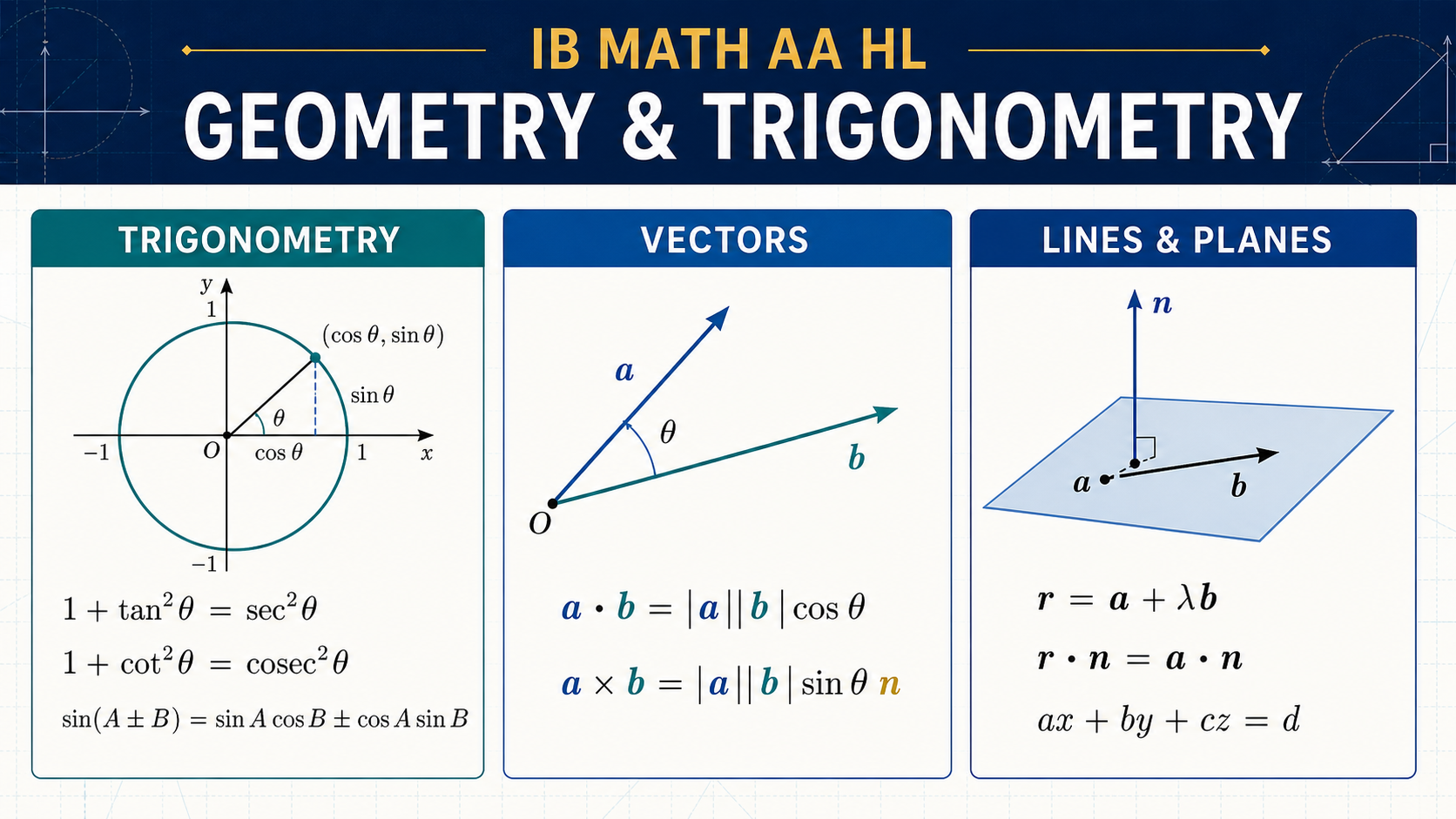
Geometry and Trigonometry Formulae for IB Mathematics: Applications and Interpretation SL & HL
This RevisionTown guide is a complete formula page, study guide, and practice toolkit for the Geometry and Trigonometry topic in IB Mathematics: Applications and Interpretation. It covers the formulae that AI SL students must know, the extra AI HL formulae that extend the topic, and the exam skills needed to use those formulae correctly in Paper 1, Paper 2, Paper 3, and the mathematical exploration.
The goal is simple: help you move from memorising symbols to choosing the right formula under exam pressure. Geometry and trigonometry questions in AI often appear inside modelling, data, navigation, architecture, optimization, transformations, vectors, three-dimensional measurement, circular motion, and real-world contextual problems. This page gives you formulas, diagrams, calculators, examples, score guidance, revision strategy, and exam timetable information in one place.
Interactive IB Math AI Geometry & Trigonometry Formula Finder
Select a formula category to see the formula, when to use it, common exam traps, and a quick worked idea.
What This Page Covers
Geometry and trigonometry in IB Mathematics: Applications and Interpretation is not just a list of static formulae. It is a toolkit for measuring space, interpreting angles, building mathematical models, using technology, and explaining answers in real contexts. A typical AI question may begin with a diagram, a coordinate system, a three-dimensional object, a triangle, a circular sector, a movement path, a transformation, or a real-world scenario. The student then has to decide which formula applies, substitute values carefully, use appropriate units, and interpret the answer. That final interpretation is essential because Math AI emphasizes applications and interpretation, not only mechanical calculation.
At Standard Level, the core formulae include coordinate geometry in three dimensions, volumes and surface areas of common solids, triangle rules, and circular-sector formulae in degrees. At Higher Level, students continue with deeper radian-based circular relationships, trigonometric identities, and transformation matrices. HL students also meet questions where a formula is embedded in a larger modelling task, especially in Paper 3, where extended problem-solving is assessed.
Practice Calculators for Geometry and Trigonometry
These mini tools are designed for practice and checking. They are not a replacement for showing working in an exam. Use them to test whether your substitution, angle mode, and units make sense before you write a final answer.
Triangle Calculator: Cosine Rule + Area Formula
Enter two sides and the included angle \(C\). The tool calculates the opposite side \(c\) and area.
Sector Calculator: Arc Length + Sector Area
Choose degrees or radians, then calculate arc length and sector area.
3D Coordinate Calculator
Calculate distance and midpoint for two points in three-dimensional space.
3D Solids Calculator
Calculate common volume and surface formulae from the SL geometry section.
IB Math AI SL & HL Score Planner
This planner estimates your scaled course percentage using the official component weights. It is a revision planning tool only. It does not predict official IB grade boundaries because official boundaries are set after marking and can change by session, timezone, difficulty, and cohort performance.
IB Math AI SL Geometry and Trigonometry Formulae
The Standard Level geometry and trigonometry formulae are the foundation for both SL and HL students. Even if you are an HL student, you cannot treat these as “easy” formulae because HL questions often combine basic formulae with modelling, proof, or interpretation. The safest approach is to know the meaning of every variable and to practise deciding when a formula is appropriate.
| Subtopic | Formula | Meaning | Exam use |
|---|---|---|---|
| SL 3.1 Distance in 3D | \[d=\sqrt{(x_1-x_2)^2+(y_1-y_2)^2+(z_1-z_2)^2}\] | Finds the straight-line distance between two 3D points. | Use in coordinate geometry, cuboids, vectors, modelling positions, or spatial measurement. |
| SL 3.1 Midpoint in 3D | \[\left(\frac{x_1+x_2}{2},\frac{y_1+y_2}{2},\frac{z_1+z_2}{2}\right)\] | Finds the centre point between two endpoints. | Useful in geometry, design, centres, routes, and symmetry problems. |
| SL 3.1 Right pyramid volume | \[V=\frac{1}{3}Ah\] | \(A\) is the area of the base and \(h\) is the perpendicular height. | Use for pyramids, roof models, packaging, and volume comparisons. |
| SL 3.1 Right cone volume | \[V=\frac{1}{3}\pi r^2h\] | \(r\) is radius and \(h\) is perpendicular height. | Use for cone-shaped containers, funnels, piles, and modelling capacity. |
| SL 3.1 Curved surface area of cone | \[A=\pi r l\] | \(l\) is slant height, not vertical height. | Use for wrapping material, cone surfaces, and manufacturing contexts. |
| SL 3.1 Sphere volume | \[V=\frac{4}{3}\pi r^3\] | Volume inside a sphere. | Use for balls, planets, bubbles, tanks, and scale problems. |
| SL 3.1 Sphere surface area | \[A=4\pi r^2\] | Total surface area of a sphere. | Use for coating, covering, heat transfer, and surface modelling. |
| SL 3.2 Sine rule | \[\frac{a}{\sin A}=\frac{b}{\sin B}=\frac{c}{\sin C}\] | Relates sides and opposite angles in any triangle. | Use when you have angle-opposite side pairs, including ASA, AAS, and ambiguous SSA cases. |
| SL 3.2 Cosine rule | \[c^2=a^2+b^2-2ab\cos C\] | Finds a side using two sides and the included angle. | Use for SAS triangles or to find angles when three sides are known. |
| SL 3.2 Cosine rule angle form | \[\cos C=\frac{a^2+b^2-c^2}{2ab}\] | Finds angle \(C\) from side lengths. | Use when three side lengths are given and an angle is required. |
| SL 3.2 Triangle area | \[A=\frac{1}{2}ab\sin C\] | Area using two sides and their included angle. | Use when perpendicular height is not given. |
| SL 3.4 Arc length in degrees | \[l=\frac{\theta}{360}\times 2\pi r\] | \(\theta\) is measured in degrees. | Use for circular paths, wheels, tracks, and partial circumference questions. |
| SL 3.4 Sector area in degrees | \[A=\frac{\theta}{360}\times \pi r^2\] | \(\theta\) is measured in degrees. | Use for pizza slices, fan-shaped regions, circular sectors, and probability by area. |
IB Math AI HL Geometry and Trigonometry Formulae
Higher Level extends the same ideas into more powerful notation and more abstract relationships. The largest shift is that angle measurement in radians becomes more central. Radian measure simplifies circular formulae and is essential for calculus, periodic modelling, and many advanced trigonometric applications. HL also adds trigonometric identities and transformation matrices, which allow geometry to be represented algebraically.
| Subtopic | Formula | Meaning | Exam use |
|---|---|---|---|
| HL 3.7 Arc length in radians | \[l=r\theta\] | \(r\) is radius and \(\theta\) is measured in radians. | Use for circular motion, periodic functions, rotational distance, and calculus-linked problems. |
| HL 3.7 Sector area in radians | \[A=\frac{1}{2}r^2\theta\] | Sector area when \(\theta\) is in radians. | Use in optimization, geometry modelling, and angle-based area problems. |
| HL 3.8 Pythagorean identity | \[\cos^2\theta+\sin^2\theta=1\] | Links sine and cosine for the same angle. | Use to simplify expressions, solve equations, and check trigonometric relationships. |
| HL 3.8 Tangent identity | \[\tan\theta=\frac{\sin\theta}{\cos\theta}\] | Defines tangent using sine and cosine. | Use for transformations, equations, and interpreting gradients in trigonometric contexts. |
| HL 3.9 Rotation matrix | \[\begin{pmatrix}\cos\theta&-\sin\theta\\ \sin\theta&\cos\theta\end{pmatrix}\] | Rotates a point anticlockwise about the origin by angle \(\theta\). | Use for coordinate transformations and modelling rotations. |
| HL 3.9 Reflection matrix in line making angle \(\theta\) | \[\begin{pmatrix}\cos 2\theta&\sin 2\theta\\ \sin 2\theta&-\cos 2\theta\end{pmatrix}\] | Reflects points in a line through the origin making angle \(\theta\) with the positive \(x\)-axis. | Use in linear transformation questions and coordinate geometry. |
Diagram 1: Triangle Labels for the Sine Rule and Cosine Rule
Triangle formulae only work cleanly when side and angle labels are matched correctly. In standard notation, side \(a\) is opposite angle \(A\), side \(b\) is opposite angle \(B\), and side \(c\) is opposite angle \(C\). Many mistakes happen because students use the included angle incorrectly or pair a side with the wrong opposite angle.
Diagram 2: Sector Formulae in Degrees and Radians
Sector questions are common because they test formula choice, angle units, and interpretation. In SL, degrees are commonly used through fractions of a full circle. In HL, radian measure gives shorter formulae.
How to Choose the Correct Formula
A strong IB Math AI answer starts before calculation. You should read the question, identify the object or relationship, decide whether the information is two-dimensional or three-dimensional, check whether angles are in degrees or radians, and then write the relevant formula. This habit reduces careless errors and also makes your working easier for examiners to follow.
| Question clue | Most likely formula | Check before substituting |
|---|---|---|
| Two points in 3D coordinates | \(d=\sqrt{(x_1-x_2)^2+(y_1-y_2)^2+(z_1-z_2)^2}\) | Keep coordinate order consistent. Squaring removes negative signs, but subtraction must still be correct. |
| Two endpoints and centre point required | Midpoint formula | Average each coordinate separately. |
| Triangle with two sides and included angle | \(A=\frac{1}{2}ab\sin C\) or \(c^2=a^2+b^2-2ab\cos C\) | The angle must be between the two given sides. |
| Triangle with opposite side-angle pair | Sine rule | Match each side with its opposite angle. |
| Three sides known, angle required | \(\cos C=\frac{a^2+b^2-c^2}{2ab}\) | Use inverse cosine and check calculator degree/radian mode. |
| Part of a circle with angle in degrees | Degree arc or sector formula | Use \(\theta/360\). Do not use radian formula unless angle is in radians. |
| Part of a circle with angle in radians | \(l=r\theta\), \(A=\frac{1}{2}r^2\theta\) | Radians are dimensionless. Do not multiply by \(180/\pi\) unless converting. |
| Point rotated or reflected | Transformation matrix | Use correct matrix order and angle convention. |
Worked Example 1: Cosine Rule and Triangle Area
Suppose a triangle has \(a=7\), \(b=9\), and the included angle \(C=48^\circ\). To find side \(c\), use the cosine rule:
\[c^2=a^2+b^2-2ab\cos C\]
\[c^2=7^2+9^2-2(7)(9)\cos 48^\circ\]
The area can be found directly because we know two sides and the included angle:
\[A=\frac{1}{2}ab\sin C\]
\[A=\frac{1}{2}(7)(9)\sin 48^\circ\]
This is a typical AI-style setup because it rewards choosing the right formula, using the correct angle, and rounding appropriately. Unless the question says otherwise, answers in IB mathematics papers are commonly given exactly or to three significant figures.
Worked Example 2: Sector Area with Degrees
A circular garden has radius \(6\) m and a sector angle of \(75^\circ\). To find the area of the sector:
\[A=\frac{\theta}{360}\times \pi r^2\]
\[A=\frac{75}{360}\times \pi(6)^2\]
The units are square metres because the formula calculates area. A common mistake is to give the answer in metres rather than square metres.
Worked Example 3: Arc Length with Radians for HL
If a wheel has radius \(0.45\) m and turns through an angle of \(2.8\) radians, the distance travelled along the arc is:
\[l=r\theta\]
\[l=0.45(2.8)=1.26\text{ m}\]
This formula works directly because the angle is measured in radians. If the angle had been given in degrees, you would first convert or use the SL degree formula.
Worked Example 4: Distance Between Two Points in 3D
Find the distance between \(P(2,3,4)\) and \(Q(8,11,1)\).
\[d=\sqrt{(2-8)^2+(3-11)^2+(4-1)^2}\]
\[d=\sqrt{(-6)^2+(-8)^2+3^2}\]
\[d=\sqrt{36+64+9}=\sqrt{109}\]
This formula is simply the three-dimensional version of Pythagoras. It is useful whenever a question asks for the direct distance between two points in space.
Geometry and Trigonometry in the IB Math AI Course
IB Mathematics: Applications and Interpretation is designed for students who want to use mathematics to interpret real situations, model data, apply technology, and solve practical problems. Geometry and trigonometry fit this purpose perfectly because they allow students to model the physical world. Heights, distances, angles, rotations, sectors, spheres, cones, paths, shadows, maps, buildings, trajectories, and transformations can all be represented mathematically.
The AI course is offered at both Standard Level and Higher Level. Standard Level provides the essential structure: coordinate geometry, measurement, triangle rules, and circle formulae. Higher Level goes deeper, adding more advanced trigonometric language, radian measure, identities, and transformation matrices. The HL course also has Paper 3, which can test extended reasoning and problem solving. This means HL students need to practise not only applying formulae but also linking several ideas in a longer solution.
The internal assessment, often called the mathematical exploration, is compulsory for both SL and HL. Geometry and trigonometry can be excellent exploration topics because they naturally connect to real measurements and modelling. Examples include analysing the viewing angle in sports, modelling the shape of a dome, optimizing packaging, studying architectural shadows, estimating the volume of irregular solids, modelling circular motion, or using transformation matrices in design. A strong IA does not simply paste formulae. It uses formulae to investigate a clear question, interprets results, reflects on limitations, and communicates mathematics precisely.
IB Math AI Score Guidelines and Planning Table
IB subject grades are awarded from 1 to 7. The final grade is based on weighted components, not a simple single exam percentage. For AI SL, Paper 1 and Paper 2 each carry a major share of the final grade, and the exploration contributes a separate internal assessment component. For AI HL, Paper 1, Paper 2, Paper 3, and the exploration all contribute to the final grade.
The important point is that official grade boundaries are not fixed before the exam. They are determined after assessment using evidence such as candidate work, component weighting, grade descriptors, and statistical review. Therefore, any online table that says “this exact percentage always equals a 7” is oversimplified. A better revision strategy is to aim for a safe performance buffer above your target.
| Level | Component | Typical duration | Raw mark used in planner | Weighting | Revision priority |
|---|---|---|---|---|---|
| AI SL | Paper 1 | 1 hour 30 minutes | 80 | 40% | Short-response questions. Practise speed, formula recognition, and technology use. |
| AI SL | Paper 2 | 1 hour 30 minutes | 80 | 40% | Extended-response questions. Practise interpretation and full working. |
| AI SL | Exploration / IA | Coursework | 20 | 20% | Use personal engagement, correct mathematics, reflection, and clear communication. |
| AI HL | Paper 1 | 2 hours | 110 | 30% | Short-response questions across the syllabus. |
| AI HL | Paper 2 | 2 hours | 110 | 30% | Extended-response questions with stronger modelling and interpretation. |
| AI HL | Paper 3 | 1 hour | 55 | 20% | Two compulsory extended problem-solving questions. |
| AI HL | Exploration / IA | Coursework | 20 | 20% | High-quality modelling, reflection, mathematical communication, and coherence. |
Planning Bands for Revision Targets
The table below is not an official IB grade boundary table. It is a practical planning guide for revision. Use it to set personal targets, not to claim a guaranteed final grade.
| Target grade | Planning scaled score target | What this usually means in practice |
|---|---|---|
| 7 | 75%+ | Consistently accurate methods, strong interpretation, few careless errors, and confident use of technology. |
| 6 | 65%–74% | Strong conceptual control with occasional errors in algebra, notation, or interpretation. |
| 5 | 52%–64% | Good understanding of most routine methods, but extended problems may be inconsistent. |
| 4 | 40%–51% | Basic competence across the course, with some difficulty in multi-step or unfamiliar contexts. |
| 3 | 28%–39% | Some correct methods, but weak formula selection and limited interpretation. |
| 2 | 15%–27% | Fragmented knowledge. Revision should focus on core formulae, calculator use, and common question types. |
| 1 | 0%–14% | Very limited evidence of mathematical understanding. Start with formula recognition and basic substitution. |
Next IB Math AI Exam Timetable: May 2026 and November 2026
Exam dates can vary by session and students must always confirm their personal exam schedule with their IB coordinator and school. The information below is included as a student planning summary for Math AI SL and HL. Morning and afternoon start times depend on the school’s IB exam zone.
| Session | Date | Paper | Session | Duration | Who takes it? |
|---|---|---|---|---|---|
| May 2026 | Thursday 14 May 2026 | Mathematics: applications and interpretation Paper 1 | Afternoon | HL: 2h; SL: 1h 30m | AI SL and AI HL |
| May 2026 | Friday 15 May 2026 | Mathematics: applications and interpretation Paper 2 | Morning | HL: 2h; SL: 1h 30m | AI SL and AI HL |
| May 2026 | Wednesday 20 May 2026 | Mathematics: applications and interpretation HL Paper 3 | Afternoon | 1h 15m | AI HL only |
| November 2026 | Monday 9 November 2026 | Mathematics: applications and interpretation Paper 1 | Afternoon | HL: 2h; SL: 1h 30m | AI SL and AI HL |
| November 2026 | Tuesday 10 November 2026 | Mathematics: applications and interpretation Paper 2 | Morning | HL: 2h; SL: 1h 30m | AI SL and AI HL |
| November 2026 | Thursday 12 November 2026 | Mathematics: applications and interpretation HL Paper 3 | Morning | 1h 15m | AI HL only |
How to Study Geometry and Trigonometry Formulae for AI SL & HL
The best revision method is not to copy formulae repeatedly. Formula memorisation is useful, but IB Math AI rewards flexible application. You should train your brain to connect question clues with formula choice. For example, if a problem gives two sides and an included angle, your immediate thought should be the cosine rule or the area formula. If a circular question gives an angle in radians, your immediate thought should be \(l=r\theta\) and \(A=\frac{1}{2}r^2\theta\). If a question gives coordinates in three dimensions, distance and midpoint should be ready.
Start by building a one-page formula map. Put coordinate formulae in one section, three-dimensional solids in another, triangle rules in another, circle formulae in another, and HL-only formulae in a final section. Then practise mixed questions. Mixed practice is important because exams do not usually tell you which formula to use in the heading. The wording and diagram are the clues.
After formula recognition, practise substitution. Most geometry errors are not caused by a student having no idea. They are caused by using the wrong height, confusing radius and diameter, mixing slant height with vertical height, pairing a side with the wrong angle, rounding too early, or leaving the calculator in the wrong angle mode. These are preventable errors. Every time you practise, write a small check beside your answer: units, angle mode, formula, and reasonableness.
HL students should add a second layer of revision. You need to practise explaining transformations, using matrix notation correctly, and moving between degrees and radians. Paper 3 can place these ideas inside a longer chain of reasoning. This means the correct final answer may depend on several smaller decisions. A good Paper 3 strategy is to write down what each part has established before moving to the next part. This keeps your reasoning visible and reduces the risk of losing the thread of the problem.
Common Mistakes in Geometry and Trigonometry
| Mistake | Why it happens | How to avoid it |
|---|---|---|
| Using diameter instead of radius | Circle and sphere formulae use \(r\), but questions often give diameter. | Write \(r=\frac{d}{2}\) before substituting. |
| Using vertical height instead of slant height in cone surface area | \(A=\pi rl\) uses slant height \(l\), not height \(h\). | Draw the cone and label \(h\), \(r\), and \(l\). Use Pythagoras if needed. |
| Wrong angle mode | Calculator left in radians or degrees from a previous question. | Check mode before every trigonometry calculation. |
| Wrong side-angle pairing in sine rule | Students match \(a\) with the adjacent angle instead of opposite angle. | Mark opposite pairs clearly on the diagram. |
| Rounding too early | Intermediate rounded values reduce final accuracy. | Store values in the calculator and round only at the end. |
| Forgetting square units or cubic units | Students focus on numerical calculation only. | Write units in the final line: area uses units squared, volume uses units cubed. |
| Using degree sector formula with radians | Both formula styles look similar but are not interchangeable. | Degrees use \(\theta/360\); radians use \(r\theta\) and \(\frac{1}{2}r^2\theta\). |
| Matrix multiplication order error | Transformation matrices must multiply coordinate vectors in the correct order. | Write the matrix and column vector clearly before multiplying. |
AI SL vs AI HL: What Changes?
AI SL is broad and application-focused. It expects students to use mathematical technology, interpret results, and solve problems across the main syllabus topics. In geometry and trigonometry, SL students should become fluent with formulas involving distance, midpoint, three-dimensional measurement, triangle rules, and circle sectors in degrees.
AI HL includes all SL material but adds more depth and more demanding problem solving. HL students spend more time on the course overall, meet additional content, and take Paper 3. In geometry and trigonometry, HL students should treat radian measure and transformation matrices as high-value topics. These ideas are easy to mix up if studied only from formula lists. They need actual problem practice.
AI SL student priority
- Know the SL formulae without hesitation.
- Practise calculator mode checks.
- Use correct units for length, area, and volume.
- Explain answers in context.
- Practise Paper 1 and Paper 2 mixed questions.
AI HL student priority
- Master all SL formulae first.
- Use radians confidently.
- Connect identities to equations and simplification.
- Understand transformation matrices visually and algebraically.
- Practise Paper 3 extended problem-solving.
Using Technology Without Losing Method Marks
Math AI allows technology, but technology does not remove the need for mathematical communication. In exams, students should show formula choice, substitution, method, and interpretation. A calculator can compute a value, but it cannot prove that you understood which formula was relevant. If you write only a final decimal, you may lose marks even if the number is correct.
A strong answer usually has four visible layers:
- State or imply the correct formula.
- Substitute the values with correct units and angle mode.
- Calculate accurately, avoiding premature rounding.
- Interpret the result in the context of the question.
For example, a sector area answer should not simply say \(23.6\). It should say approximately \(23.6\text{ m}^2\), and the sentence should make clear that this is the area of the sector, not the full circle.
Revision Plan for This Topic
| Day | Focus | Task | Success check |
|---|---|---|---|
| Day 1 | Formula map | Rewrite all SL formulae by category and label variables. | You can explain each variable without looking. |
| Day 2 | Triangle rules | Practise sine rule, cosine rule, and area formula questions. | You can choose the correct formula from the diagram. |
| Day 3 | Circles and sectors | Practise degree formulae; HL students add radian formulae. | You check angle units before calculating. |
| Day 4 | 3D geometry | Practise volumes, surface areas, distance, and midpoint. | You use correct length, area, and volume units. |
| Day 5 | Mixed exam questions | Complete a timed mixed set from Paper 1 and Paper 2 style questions. | You identify formula choice quickly. |
| Day 6 | HL extension | Practise identities, radians, and transformation matrices. | You can explain what a transformation matrix does geometrically. |
| Day 7 | Error review | Create a correction log of every mistake made during the week. | You can state the cause and prevention method for each error. |
Practice Questions
- Find the distance between \(A(1,4,2)\) and \(B(7,-2,5)\).
- Find the midpoint of the line segment joining \(P(-3,6,8)\) and \(Q(5,2,-4)\).
- A cone has radius \(4\text{ cm}\) and height \(9\text{ cm}\). Find its volume.
- A sphere has radius \(6\text{ m}\). Find its surface area and volume.
- In triangle \(ABC\), \(a=8\), \(b=11\), and \(C=37^\circ\). Find \(c\).
- In triangle \(ABC\), \(a=8\), \(b=11\), and \(C=37^\circ\). Find the area.
- A sector has radius \(10\text{ cm}\) and angle \(42^\circ\). Find the arc length.
- A sector has radius \(10\text{ cm}\) and angle \(42^\circ\). Find the sector area.
- HL: A sector has radius \(5\text{ m}\) and angle \(1.8\) radians. Find the arc length and sector area.
- HL: Rotate the point \((3,4)\) anticlockwise by \(90^\circ\) about the origin using a matrix.
Practice Answers
- \[d=\sqrt{(1-7)^2+(4+2)^2+(2-5)^2}=\sqrt{81}=9\]
- \[\left(\frac{-3+5}{2},\frac{6+2}{2},\frac{8-4}{2}\right)=(1,4,2)\]
- \[V=\frac{1}{3}\pi(4)^2(9)=48\pi\text{ cm}^3\]
- \[A=4\pi(6)^2=144\pi\text{ m}^2,\qquad V=\frac{4}{3}\pi(6)^3=288\pi\text{ m}^3\]
- \[c^2=8^2+11^2-2(8)(11)\cos37^\circ\]
- \[A=\frac{1}{2}(8)(11)\sin37^\circ\]
- \[l=\frac{42}{360}\times2\pi(10)=\frac{7\pi}{3}\text{ cm}\]
- \[A=\frac{42}{360}\times\pi(10)^2=\frac{35\pi}{3}\text{ cm}^2\]
- \[l=5(1.8)=9\text{ m},\qquad A=\frac{1}{2}(5)^2(1.8)=22.5\text{ m}^2\]
- \[\begin{pmatrix}0&-1\\1&0\end{pmatrix}\begin{pmatrix}3\\4\end{pmatrix}=\begin{pmatrix}-4\\3\end{pmatrix}\]
How to Use This Page for Fast Revision
Use the page in three passes. In the first pass, read the formula tables and diagrams slowly. The goal is to understand the meaning of each formula. In the second pass, use the interactive formula finder and calculators. Enter your own values and compare the displayed working with your handwritten working. In the third pass, attempt the practice questions without looking at the answers. Only check after you have written complete methods.
The formulae on this page are especially useful during the final week before exams because they compress a large topic into a structured revision path. However, formula pages are most powerful when paired with exam questions. After reviewing a formula, immediately solve one question that uses it. This builds retrieval strength. Retrieval practice is more effective than passive reading because it trains you to recall the formula under pressure.
Everything Students Should Remember Before the Exam
- Read the whole question before choosing a formula.
- Check whether angles are in degrees or radians.
- Label diagrams clearly before substituting values.
- Use the formula booklet strategically, but do not rely on it as a substitute for understanding.
- Show working even when using a graphic display calculator.
- Keep exact values where possible and round only at the final step.
- Use appropriate units: length, square units, or cubic units.
- For HL, practise longer chained problems, not only isolated formulas.
- For the IA, use geometry and trigonometry to investigate a real question, not just to demonstrate a formula.
- Review mistakes systematically. A correction log is one of the fastest ways to raise your score.
Frequently Asked Questions
What geometry and trigonometry formulae are needed for IB Math AI SL?
AI SL students should know the 3D distance and midpoint formulae, volumes and surface areas for common solids, sine rule, cosine rule, triangle area formula, arc length in degrees, and sector area in degrees.
What extra geometry and trigonometry formulae are needed for IB Math AI HL?
AI HL students also need radian formulae for arc length and sector area, trigonometric identities, and transformation matrices such as rotation and reflection matrices.
Are calculators allowed in IB Math AI?
Yes. Technology is allowed in Math AI assessments. However, students still need to show appropriate mathematical working, choose correct formulae, and interpret answers clearly.
Is the formula booklet enough for scoring well?
No. The formula booklet helps, but strong scores require knowing when to use each formula, understanding the variables, avoiding unit errors, and interpreting answers in context.
What is the difference between arc formulae in degrees and radians?
In degrees, arc length is \(l=\frac{\theta}{360}\times2\pi r\). In radians, the formula is shorter: \(l=r\theta\). The radian formula only works directly when \(\theta\) is measured in radians.
Why do students lose marks in trigonometry questions?
Common reasons include wrong calculator angle mode, wrong side-angle pairing, premature rounding, missing units, and using the wrong formula for the given triangle information.
How is IB Math AI SL assessed?
AI SL is assessed through Paper 1, Paper 2, and the mathematical exploration. Paper 1 and Paper 2 are external exams, while the exploration is an internally assessed component moderated through IB processes.
How is IB Math AI HL assessed?
AI HL is assessed through Paper 1, Paper 2, Paper 3, and the mathematical exploration. Paper 3 is HL-only and focuses on extended problem solving.
Are IB grade boundaries fixed every year?
No. Grade boundaries are not fixed percentages. They are determined after assessment using evidence such as candidate work, grade descriptors, component weighting, and statistical review.
Can geometry and trigonometry be used for the Math AI IA?
Yes. Geometry and trigonometry can support strong IA topics when they are connected to a clear real-world investigation, appropriate modelling, interpretation, and reflection.
Conclusion
Geometry and trigonometry formulae are among the most practical tools in IB Mathematics: Applications and Interpretation. They help students measure space, solve triangles, model circular movement, analyse three-dimensional objects, and represent transformations. For SL students, the main target is fluent formula recognition and accurate application. For HL students, the target is deeper connection: radians, identities, matrices, and extended problem solving.
To score well, do not treat this topic as a memorisation task only. Build a formula map, practise mixed questions, check angle mode, write units, show working, and interpret answers. Formulae are the starting point; clear reasoning is what turns formulae into exam marks.