
IB Mathematics: Analysis and Approaches Higher Level
Geometry & Trigonometry Formulae for AA HL Only
A precise, exam-focused guide to the current Higher Level extension: reciprocal and inverse trigonometric functions, identities, vectors, scalar and vector products, lines, planes, intersections, angles and three-dimensional problem solving.
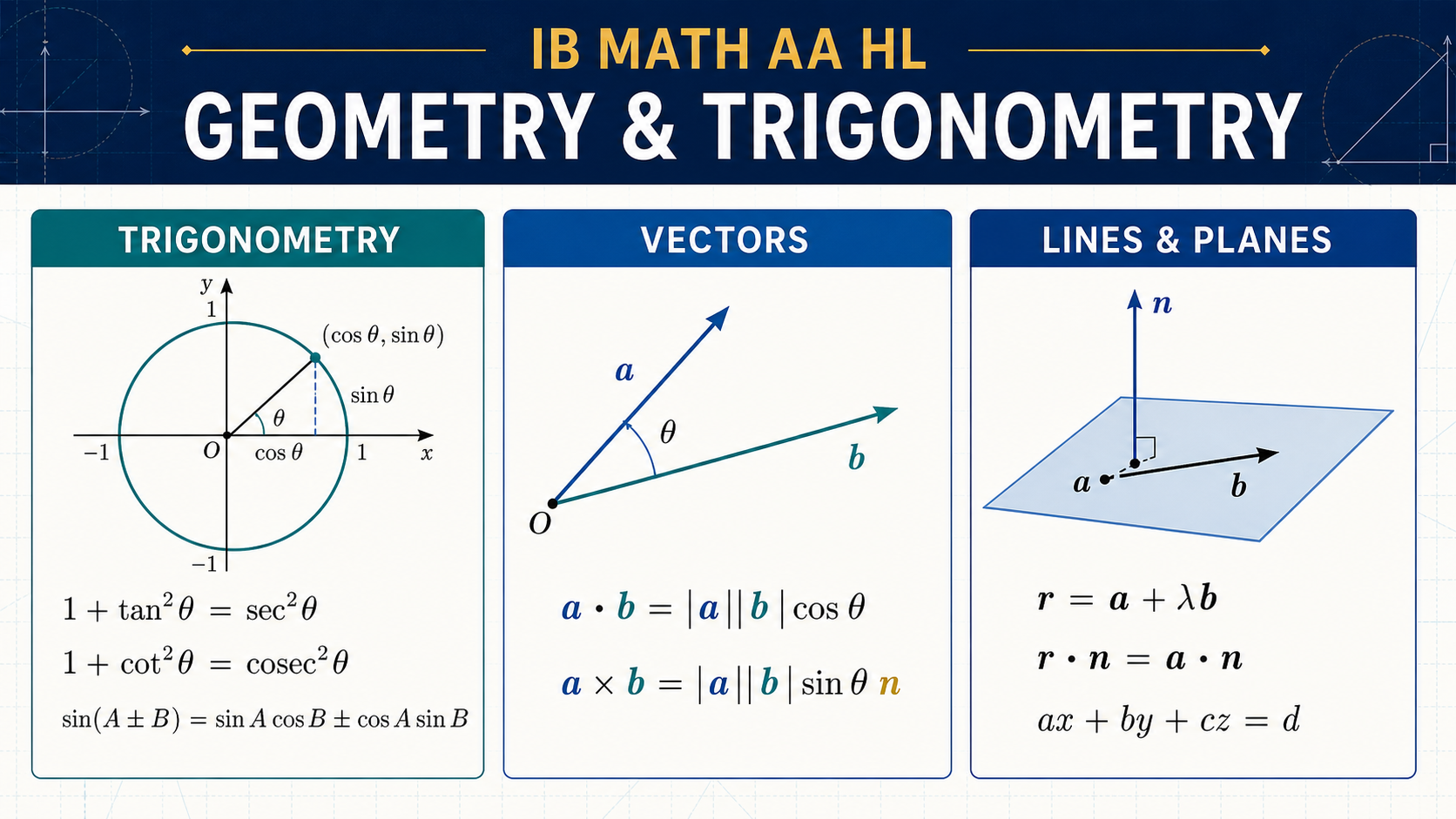
Geometry and Trigonometry at AA Higher Level is not simply a longer list of formulas. The topic asks you to move fluently between diagrams, algebra, functions and vector representations. A trigonometric identity may unlock an equation; a direction vector may describe motion; a scalar product may decide whether objects are perpendicular; a vector product may construct a normal to a plane; and a system of equations may reveal how lines or planes meet in space. Each calculation therefore has a geometric meaning, and strong solutions explain that meaning instead of presenting disconnected numbers.
This guide keeps the boundary accurate. It covers the present AA HL extension from reciprocal trigonometric functions through intersections and angles between lines and planes. It does not import graph theory, Voronoi diagrams or other material from Mathematics: Applications and Interpretation. It also avoids presenting useful but non-essential university formulas as if they were named IB syllabus requirements. Where a result is derived, the reasoning is shown so you can rebuild it under examination pressure.
- Current AHL 3.9–3.18 syllabus map
- Reciprocal, inverse and compound-angle trigonometry
- Vector foundations, scalar product and vector product
- Lines, relationships and kinematics
- Planes, intersections and angles in space
- Worked AA HL examples
- Exam workflow, technology and common mistakes
- Practice, revision plan and FAQs
Current AA HL syllabus map
| Syllabus point | What you need to know | Main tools |
|---|---|---|
| AHL 3.9 | Reciprocal trigonometric ratios, Pythagorean identities, and inverse sine, cosine and tangent functions with their domains, ranges and graphs. | sec, cosec, cot, arcsin, arccos, arctan |
| AHL 3.10 | Compound-angle identities and the double-angle identity for tangent; derive double-angle identities from compound angles. | sin(A ± B), cos(A ± B), tan(A ± B) |
| AHL 3.11 | Relationships between trigonometric functions and the symmetry of their graphs. | Unit circle, periodicity, odd/even symmetry |
| AHL 3.12 | Vectors in two and three dimensions, components, magnitude, unit vectors, position and displacement vectors, and vector proofs. | i, j, k, vector algebra, |v| |
| AHL 3.13 | Scalar product, angle between vectors, and tests for perpendicular or parallel vectors. | a · b, cos θ |
| AHL 3.14 | Vector, parametric and Cartesian forms of a line; angle between lines; simple kinematic applications. | r = a + λb, direction vectors |
| AHL 3.15 | Coincident, parallel, intersecting and skew lines, including finding points of intersection. | Simultaneous parameter equations |
| AHL 3.16 | Vector product, its properties, parallel-vector test and geometric interpretation as area. | a × b, right-hand rule |
| AHL 3.17 | Vector and Cartesian equations of planes. | r = a + λb + μc, r · n = a · n, ax + by + cz = d |
| AHL 3.18 | Intersections of a line with a plane, two planes and three planes; angles between a line and a plane or between two planes. | Systems of equations, dot and cross products |
The sequence is deliberate. The trigonometric section extends your ability to rewrite expressions and solve equations. The vector section begins with representation, adds two different products, and then uses those products to describe the geometry of lines and planes. AHL 3.18 brings everything together: an intersection becomes a system of equations, an angle becomes a scalar-product calculation, and the nature of the solution must be interpreted geometrically.
What the shared SL foundation still contributes
An “HL-only” page does not mean that SL formulas disappear. Higher Level problems regularly mix the extension with shared content. You may need the cosine rule before expressing a result as a vector, exact unit-circle values before simplifying a compound angle, or radian measure before using a trigonometric model. In an examination, the syllabus is not divided into isolated boxes. Treat the shared foundation as the language in which the advanced work is written.
Shared trigonometry
Be secure with radians, exact values, the unit circle, sine and cosine graphs, the sine and cosine rules, triangle area, bearings, and finite-interval equations. These ideas are frequently embedded inside HL identity and modelling questions.
Shared geometry
Coordinate geometry, gradient, midpoint, distance, perpendicularity and transformations remain useful when a vector problem has a two-dimensional interpretation. A diagram can expose relationships that are harder to see from components alone.
Reciprocal trigonometric functions
The reciprocal functions are defined wherever their denominators are non-zero. This qualification is essential: an algebraic expression can hide a restriction, but the graph exposes its vertical asymptotes. Use “cosec” or “csc” according to your teacher or calculator; they name the same reciprocal of sine.
Reciprocal definitions
sec θ = 1/cos θ, cosec θ = 1/sin θ, cot θ = cos θ/sin θ = 1/tan θ.
Pythagorean identities
1 + tan2 θ = sec2 θ, 1 + cot2 θ = cosec2 θ.
The identities follow by dividing sin2 θ + cos2 θ = 1 by cos2 θ or sin2 θ. Remember the order: dividing by cos2 produces tan2 and sec2; dividing by sin2 produces cot2 and cosec2. This derivation is safer than memorizing two similar-looking equations.
The graph of y = sec x has asymptotes wherever cos x = 0, so x = π/2 + kπ. The graph of y = cosec x has asymptotes wherever sin x = 0, so x = kπ. The graph of y = cot x has the same domain exclusions as cosec x and period π. When solving an equation, test any value that would make an original denominator zero; algebraic manipulation cannot turn an excluded value into a solution.
Inverse sine, cosine and tangent
Sine, cosine and tangent are not one-to-one on their full natural domains. To define inverse functions, each is restricted to a principal interval. The output of an inverse function is therefore a principal angle, not every possible angle with the same trigonometric ratio.
| Inverse function | Input domain | Principal output range |
|---|---|---|
| arcsin x or sin−1 x | −1 ≤ x ≤ 1 | −π/2 ≤ y ≤ π/2 |
| arccos x or cos−1 x | −1 ≤ x ≤ 1 | 0 ≤ y ≤ π |
| arctan x or tan−1 x | All real x | −π/2 < y < π/2 |
Compound-angle and double-angle identities
sin(A ± B) = sin A cos B ± cos A sin B
cos(A ± B) = cos A cos B ∓ sin A sin B
tan(A ± B) = (tan A ± tan B)/(1 ∓ tan A tan B)
sin 2A = 2 sin A cos A
cos 2A = cos2 A − sin2 A = 2cos2 A − 1 = 1 − 2sin2 A
tan 2A = 2tan A/(1 − tan2 A)
The sign pattern causes many avoidable errors. Sine keeps the sign. Cosine changes it. Tangent keeps the sign in its numerator and changes it in its denominator. Instead of relying only on a mnemonic, test a simple case. For example, cos(A + 0) must equal cos A; the compound formula should reduce correctly when B = 0.
The double-angle identities are obtained by setting B = A. The three versions of cos 2A are equally valid but useful in different contexts. If an expression contains only cos2 A, use 2cos2 A − 1. If it contains only sin2 A, use 1 − 2sin2 A. If it contains both squares, cos2 A − sin2 A may be most direct. Choosing the appropriate version is part of the problem, not a cosmetic choice.
Worked identity: exact value of sin 75°
Write 75° = 45° + 30°. Then
sin 75° = sin 45° cos 30° + cos 45° sin 30°
= (√2/2)(√3/2) + (√2/2)(1/2) = (√6 + √2)/4.
The same method works in radians, for example by writing 5π/12 = π/4 + π/6.
Symmetry, periodicity and equivalent angles
Graph symmetry explains many identities that otherwise appear unrelated. Sine is odd, cosine is even and tangent is odd:
sin(−θ) = −sin θ, cos(−θ) = cos θ, tan(−θ) = −tan θ.
sin(π − θ) = sin θ, cos(π − θ) = −cos θ, tan(π − θ) = −tan θ.
Periodicity adds every coterminal solution: sine and cosine repeat after 2π, while tangent repeats after π. In a finite-interval question, first find reference angles or use inverse functions, generate all relevant angles using unit-circle symmetry, and then retain only the values inside the stated interval. Never stop at the principal inverse value unless the interval guarantees that it is the only solution.
Worked equation
Solve 2cos2 x − 3sin x = 0 for 0 ≤ x < 2π.
Use cos2 x = 1 − sin2 x:
2(1 − sin2 x) − 3sin x = 0, so 2sin2 x + 3sin x − 2 = 0.
Factor: (2sin x − 1)(sin x + 2) = 0. Since sin x cannot equal −2, sin x = 1/2. Therefore x = π/6 or 5π/6.
Vector foundations in two and three dimensions
A vector has magnitude and direction. It can be represented geometrically by a directed line segment or algebraically by components. In three dimensions, write v = v1i + v2j + v3k or v = (v1, v2, v3). The basis vectors i, j and k point in the positive x-, y- and z-directions.
If v = (v1, v2, v3), then |v| = √(v12 + v22 + v32).
If v ≠ 0, the unit vector in its direction is v/|v|.
If OA = a and OB = b, then AB = b − a.
Vector addition joins displacements, scalar multiplication changes length and may reverse direction, and subtraction finds the displacement from one point to another. Parallel non-zero vectors are scalar multiples. A vector proof usually starts by expressing each relevant side or diagonal in terms of a small set of base vectors. Equal vectors can prove a parallelogram; a scalar multiple can prove parallelism; a zero scalar product can prove a right angle.
The scalar product (dot product)
If a = (a1, a2, a3) and b = (b1, b2, b3), then
a · b = a1b1 + a2b2 + a3b3 = |a||b|cos θ.
Therefore cos θ = (a · b)/(|a||b|), for non-zero a and b.
The scalar product returns a number. Its sign describes the angle: positive for an acute angle, zero for a right angle and negative for an obtuse angle. For non-zero vectors, a · b = 0 is equivalent to perpendicularity. Parallel vectors satisfy |a · b| = |a||b|, but the sign distinguishes the same and opposite directions.
Always decide whether a problem wants the angle between directed vectors or the acute angle between undirected lines. The angle between two lines is conventionally the smaller angle, so use the absolute value of the dot product if necessary. Keep full calculator precision until the last line and verify that your result lies in the correct range.
Worked dot-product example
Let a = (2, −1, 2) and b = (1, 2, 2). Then a · b = 2 − 2 + 4 = 4. Also |a| = 3 and |b| = 3, so cos θ = 4/9. Hence θ = arccos(4/9) ≈ 1.110 radians, or about 63.6°. The positive dot product agrees with an acute angle.
Equations of lines in two and three dimensions
A line is determined by a point and a non-zero direction vector. If the line passes through the point with position vector a and has direction b, its vector equation is
Vector form: r = a + λb.
Parametric form: x = x0 + λl, y = y0 + λm, z = z0 + λn.
Cartesian/symmetric form: (x − x0)/l = (y − y0)/m = (z − z0)/n, when the relevant direction components are non-zero.
The vector a locates one point; it is not the direction. The vector b controls direction; any non-zero scalar multiple of b describes the same line. The parameter λ ranges over real numbers. When a component of the direction vector is zero, do not divide by it in symmetric form. Keep that coordinate as a constant equation instead—for example, if b = (2, 0, −1), then y = y0.
Angle between two lines
Use their direction vectors d1 and d2. For the acute angle θ between the lines,
cos θ = |d1 · d2|/(|d1||d2|).
The absolute value is appropriate because reversing a direction vector does not change the geometric line. Without it, equivalent direction choices could produce supplementary angles for the same pair of lines.
Coincident, parallel, intersecting and skew lines
| Relationship | Direction vectors | Common-point test |
|---|---|---|
| Coincident | Parallel | A point on one line also lies on the other; infinitely many common points |
| Distinct parallel | Parallel | No common point |
| Intersecting | Not parallel | One consistent parameter pair gives one common point |
| Skew | Not parallel | No common point in three-dimensional space |
To test two lines, first compare direction vectors. If they are parallel, test whether one known point lies on the other line. If they are not parallel, equate corresponding coordinates. In three dimensions the same two parameter values must satisfy all three coordinate equations. Solving only two equations and ignoring the third can falsely label skew lines as intersecting.
Worked line-intersection example
Consider L1: r = (1, 0, 2) + λ(1, 2, −1) and L2: r = (3, 4, 0) + μ(2, −1, 1). The direction vectors are not scalar multiples. On L1, λ = 2 gives (3, 4, 0), which is the point on L2 when μ = 0. Therefore the lines intersect at (3, 4, 0).
Simple vector kinematics
If position is modelled by r = a + tb, the parameter t may represent time, a is the initial position and b is a constant velocity vector. The speed is |b|. For two moving objects, use different time-dependent position vectors, set them equal to test collision, and remember that occupying the same geometric path is not enough: both objects must reach the same point at the same time.
A closest-approach problem often begins with a relative-position vector. If r1(t) and r2(t) are positions, then r2(t) − r1(t) is the separation vector and its magnitude is the distance. Squaring the distance can simplify calculus because minimizing |s(t)| and minimizing |s(t)|2 give the same time when distance is non-negative. This connects the geometry topic to techniques developed in the AA Calculus formulae guide.
The vector product (cross product)
The vector product is defined in three dimensions. Unlike the dot product, it returns a vector perpendicular to both inputs.
a × b = |a||b|sin θ n, where n is the unit normal determined by the right-hand rule.
If a = (a1,a2,a3) and b = (b1,b2,b3), then
a × b = (a2b3 − a3b2, a3b1 − a1b3, a1b2 − a2b1).
The order matters: a × b = −(b × a). Also a × a = 0, and for non-zero vectors a × b = 0 is equivalent to parallelism. The magnitude |a × b| is the area of the parallelogram spanned by a and b; half of it is the area of the corresponding triangle.
Worked cross-product example
Let a = (1, 2, 0) and b = (0, 1, 3). Then a × b = (6, −3, 1). Its magnitude is √(36 + 9 + 1) = √46. The parallelogram area is √46 and the triangle area is √46/2. A quick check confirms (6, −3, 1) · a = 0 and (6, −3, 1) · b = 0.
Equations of planes
A plane can be described by a point plus two non-parallel directions within the plane, or by a point plus a normal vector perpendicular to it. The Cartesian coefficients are the components of a normal.
Two-direction vector form: r = a + λb + μc, where b and c are non-parallel vectors in the plane.
Normal form: r · n = a · n.
Cartesian form: ax + by + cz = d, with normal n = (a, b, c).
To convert from two-direction form, calculate n = b × c and use a known point. To convert from Cartesian form, read off the normal immediately. To find two direction vectors inside the plane, choose vectors whose dot products with the normal are zero. Many answers are possible because multiplying a normal or direction vector by a non-zero scalar does not change the plane.
Worked plane equation
Find the plane through P(1, −2, 3) with normal n = (2, 1, −1).
Use n · (r − p) = 0:
2(x − 1) + (y + 2) − (z − 3) = 0.
Therefore 2x + y − z + 3 = 0. Substituting P gives 2 − 2 − 3 + 3 = 0, which verifies the constant term.
Intersections involving lines and planes
Line with a plane
Substitute the parametric coordinates of the line into the plane equation. One parameter value gives one intersection point. No solution indicates a distinct parallel line; an identity indicates that the line lies in the plane.
For r = (1, 0, 2) + t(2, 1, −1) and the plane x + y + z = 6, substitution gives (1 + 2t) + t + (2 − t) = 6. Thus 3 + 2t = 6 and t = 3/2. The intersection is (4, 3/2, 1/2). Substitute the point into the plane to check: 4 + 3/2 + 1/2 = 6.
Two planes
Distinct non-parallel planes intersect in a line. If n1 and n2 are their normals, a direction vector for the intersection line is n1 × n2. Find one point satisfying both plane equations, then combine that point with the direction. Parallel normals mean the planes are parallel or coincident, so compare their constants after scaling.
The planes x + y + z = 6 and x − y + z = 2 have normals n1 = (1,1,1) and n2 = (1,−1,1). Their cross product is proportional to (1,0,−1). Subtracting the equations gives 2y = 4, so y = 2; then x + z = 4. Taking z = t gives the intersection line r = (4,2,0) + t(−1,0,1).
Three planes
Solve the three Cartesian equations simultaneously, using algebra or an approved technological method. A unique solution represents a single common point. No solution means there is no point common to all three planes. Infinitely many solutions may describe a common line or coincident planes. Do not report only “no unique solution”; interpret the reduced system geometrically. This connects directly to systems of linear equations in the AA HL Number and Algebra formulae guide.
Angles in three-dimensional space
Angle between a line and a plane
Let d be the line direction and n the plane normal. The angle β between d and n is complementary to the acute angle α between the line and the plane. Therefore
sin α = |d · n|/(|d||n|), 0 ≤ α ≤ π/2.
You can instead find β with cosine and calculate α = π/2 − β, but the sine formula reduces one step. If d · n = 0, the line is parallel to the plane and α = 0. If d is parallel to n, the line is perpendicular to the plane and α = π/2.
For d = (1,2,2) and n = (2,−1,2), d · n = 4 and both magnitudes are 3. Hence sin α = 4/9, so α ≈ 0.461 radians or 26.4°.
Angle between two planes
The acute angle between two planes is the acute angle between their normals:
cos θ = |n1 · n2|/(|n1||n2|).
Parallel normals give parallel planes and angle zero. Perpendicular normals give perpendicular planes and angle π/2. The absolute value ensures that reversing a normal does not alter the geometric angle.
A complete mixed worked problem
Problem: The line L is r = (1, 2, −1) + t(2, −1, 2). The plane Π is 2x + y − 2z = 9.
- Intersection: substitute x = 1 + 2t, y = 2 − t and z = −1 + 2t. Then 2(1 + 2t) + (2 − t) − 2(−1 + 2t) = 9, so 6 − t = 9 and t = −3. The intersection is (−5, 5, −7). Check: −10 + 5 + 14 = 9.
- Angle: the line direction is d = (2, −1, 2) and the plane normal is n = (2, 1, −2). Their dot product is 4 − 1 − 4 = −1. Both magnitudes are 3. Thus sin α = 1/9 and α ≈ 0.111 radians, about 6.38°.
- Interpretation: the small angle is reasonable because the direction is almost perpendicular to the normal, so the line is almost parallel to the plane.
This example models an effective written solution: name the direction and normal, show substitution, solve the parameter, give the coordinate, verify it, choose the correct angle formula and interpret the result. A calculator can evaluate the inverse sine, but it cannot decide which vectors represent the geometry.
A reliable exam workflow
- Identify the object. Is it an angle, vector, line, plane, identity or intersection?
- Extract structural data. For a line, mark a point and direction. For a plane, mark a point and normal. For a trig equation, note the interval and angle unit.
- Choose the representation. Parametric form is efficient for substitution; Cartesian plane form exposes the normal; a compound identity may expose exact values.
- Write the formula before numbers. This makes your intention clear and reduces sign errors.
- Solve without premature rounding. Preserve exact vectors, radicals and parameter values where practical.
- Verify. Substitute an intersection into every original equation. Dot a claimed normal with in-plane directions. Check a trig solution against the interval and original denominator.
- Interpret. State “skew,” “intersects at,” “parallel,” “acute angle,” “area,” or the appropriate geometric conclusion.
Using a GDC intelligently
A graphing calculator can solve simultaneous equations, evaluate inverse trigonometric expressions, display graphs and perform row reduction. It is valuable for checking a model and handling arithmetic, but you still need to construct the model. Enter vectors with their components in a consistent order. Confirm radians or degrees. Store full-precision intermediate values. If a matrix command reports a dependent or inconsistent system, translate that result back into the geometry of the lines or planes.
For identities, graphing both sides can suggest whether an equation is plausible, but matching graphs are not a proof. For vector products, calculator functionality varies; even when the machine supplies a cross product, show enough structure for the examiner to see how it is used. On non-calculator work, exact values and transparent algebra matter even more.
Common mistakes and their fixes
| Mistake | Why it fails | Better habit |
|---|---|---|
| Treating sin−1 x as 1/sin x | Inverse and reciprocal functions are different | Use arcsin for the inverse and cosec for the reciprocal |
| Using the same sign pattern for sine and cosine compound identities | Cosine changes the internal sign | Write the identity before substitution and test B = 0 |
| Reporting only the principal inverse-trig angle | Finite intervals may contain several solutions | Use unit-circle symmetry and periodicity, then filter the interval |
| Writing AB = a − b | The displacement direction is reversed | Use end position minus start position: AB = b − a |
| Confusing dot and cross products | The dot product is a scalar; the cross product is a perpendicular vector | Ask whether the result should measure angle/projection or construct a normal/area |
| Ignoring the third coordinate when testing line intersection | Two equations can agree even when the third makes lines skew | Check the same parameter pair in all three coordinates |
| Using a plane direction as its normal | In-plane vectors and normals are perpendicular | Read the normal from Cartesian coefficients or calculate a cross product |
| Using cosine directly for a line–plane angle | Cosine with the normal gives the complementary angle | Use sine with direction and normal, or subtract from π/2 |
| Giving a coordinate without verification | A parameter or sign error may survive unnoticed | Substitute the point into every original line or plane equation |
| Rounding vectors or angles early | Error accumulates and exact structure disappears | Round only the final requested answer |
Mixed practice with guided solutions
1. Rewrite sec2 x − tan2 x and state any relevant identity.
From 1 + tan2 x = sec2 x, rearrange to sec2 x − tan2 x = 1. The identity applies wherever both functions are defined.
2. Find the exact value of cos 15°.
Use 15° = 45° − 30°. Then cos 15° = cos45°cos30° + sin45°sin30° = (√6 + √2)/4.
3. Find a unit vector in the direction v = (2, −3, 6).
|v| = √(4 + 9 + 36) = 7. Therefore the unit vector is (2/7, −3/7, 6/7).
4. Decide whether a = (1, 2, −1) and b = (3, −1, 1) are perpendicular.
a · b = 3 − 2 − 1 = 0. Since both are non-zero, they are perpendicular.
5. Find the area of the triangle generated by a = (1,0,2) and b = (0,3,1).
a × b = (−6, −1, 3), whose magnitude is √46. The triangle area is half the parallelogram area, so √46/2.
6. Write a line through (2, −1, 4) parallel to (3, 0, −2).
One vector equation is r = (2, −1, 4) + λ(3, 0, −2). Equivalent non-zero scalar multiples of the direction also describe the same line.
7. Write the plane through (1, 0, −2) with normal (2, −3, 1).
Use 2(x − 1) − 3(y − 0) + (z + 2) = 0. This simplifies to 2x − 3y + z = 0.
8. How do you know that a line lies entirely in a plane?
A point on the line must satisfy the plane equation, and the line direction must be perpendicular to the plane normal. Equivalently, substituting the line into the plane equation produces an identity for every parameter value.
A focused 14-day revision plan
Days 1–3: advanced trigonometry
Rebuild the reciprocal and Pythagorean identities, sketch inverse-function ranges, practise compound and double angles, and solve finite-interval equations without relying on principal values alone.
Days 4–6: vector language
Practise components, magnitude, unit vectors, displacement and short vector proofs. Add dot-product angle and perpendicularity questions.
Days 7–9: lines and products
Move between line forms, classify pairs of lines and find intersections. Calculate cross products and interpret their directions and magnitudes.
Days 10–12: planes and systems
Construct plane equations, find line–plane and plane–plane intersections, and interpret unique, inconsistent and dependent systems.
Day 13: angles and mixed questions
Mix line–line, line–plane and plane–plane angles. State the vectors used and verify whether the requested angle is acute.
Day 14: timed review
Complete a timed mixed set, mark it by error type, and rewrite every incorrect solution with a one-line verification.
Frequently asked questions
Is this page only for IB Mathematics AA Higher Level?
Yes. It focuses on AHL 3.9–3.18. AA SL students should use the shared SL/HL Geometry and Trigonometry guide instead. HL students need both the shared foundation and this extension.
Are radians assumed in AA HL examinations?
Yes, unless the question states otherwise. Always confirm the calculator angle mode before evaluating inverse functions or checking a graph.
What is the difference between inverse and reciprocal trigonometric functions?
arcsin x reverses a restricted sine function and returns an angle. cosec x is 1/sin x. Similar distinctions apply to arccos versus sec and arctan versus cot.
Do I need to memorize every compound-angle identity?
You should know the required identities and be able to use them efficiently. Understanding the sign patterns and how double-angle results follow is more reliable than memorizing isolated strings.
What does a dot product tell me?
It measures directional alignment. It supports angle calculations and perpendicularity tests. Its result is a scalar, not a vector.
What does a cross product tell me?
It creates a vector perpendicular to two three-dimensional vectors. Its magnitude gives a parallelogram area, and half the magnitude gives the corresponding triangle area.
How can I distinguish parallel and coincident lines?
Both have parallel direction vectors. Coincident lines also share a point; distinct parallel lines do not.
What are skew lines?
Skew lines are non-parallel lines in three-dimensional space that do not intersect. They cannot occur as a pair of lines confined to the same plane.
How do I find a plane normal?
Read it from the coefficients of ax + by + cz = d, or take the cross product of two non-parallel directions in the plane.
Why is the line–plane angle formula based on sine?
The dot product naturally gives the angle between the line direction and the plane normal. The line–plane angle is complementary to that angle, so the equivalent direct formula uses sine.
Can a GDC decide whether three planes have a common point?
It can solve or row-reduce the system, but you must interpret the output. A unique solution is one common point; dependent or inconsistent systems have different geometric meanings.
What should I verify before finishing a vector answer?
Check magnitudes are non-negative, claimed perpendicular vectors have zero dot product, claimed normals are perpendicular to in-plane directions, and intersection points satisfy every original equation.
Continue your AA HL formula revision
- Geometry and Trigonometry formulae for AA SL and HL
- Number and Algebra formulae for AA HL only
- Functions formulae for AA HL only
- Calculus formulae for AA SL and HL
- Statistics and Probability formulae for AA HL only
Final checklist
- I can state reciprocal, Pythagorean, compound-angle and double-angle identities accurately.
- I know the principal ranges of arcsin, arccos and arctan.
- I can find magnitudes, unit vectors, displacements, dot products and cross products.
- I can construct and interpret equations of lines and planes.
- I can classify lines and solve intersections without ignoring a coordinate.
- I can distinguish line–line, line–plane and plane–plane angle formulas.
- I verify points, normals, directions, intervals and angle units before finishing.
RevisionTown is an independent educational resource and is not affiliated with or endorsed by the International Baccalaureate Organization. “IB” and “International Baccalaureate” are trademarks of their respective owner.


