Health calculator
Ideal Weight Calculator
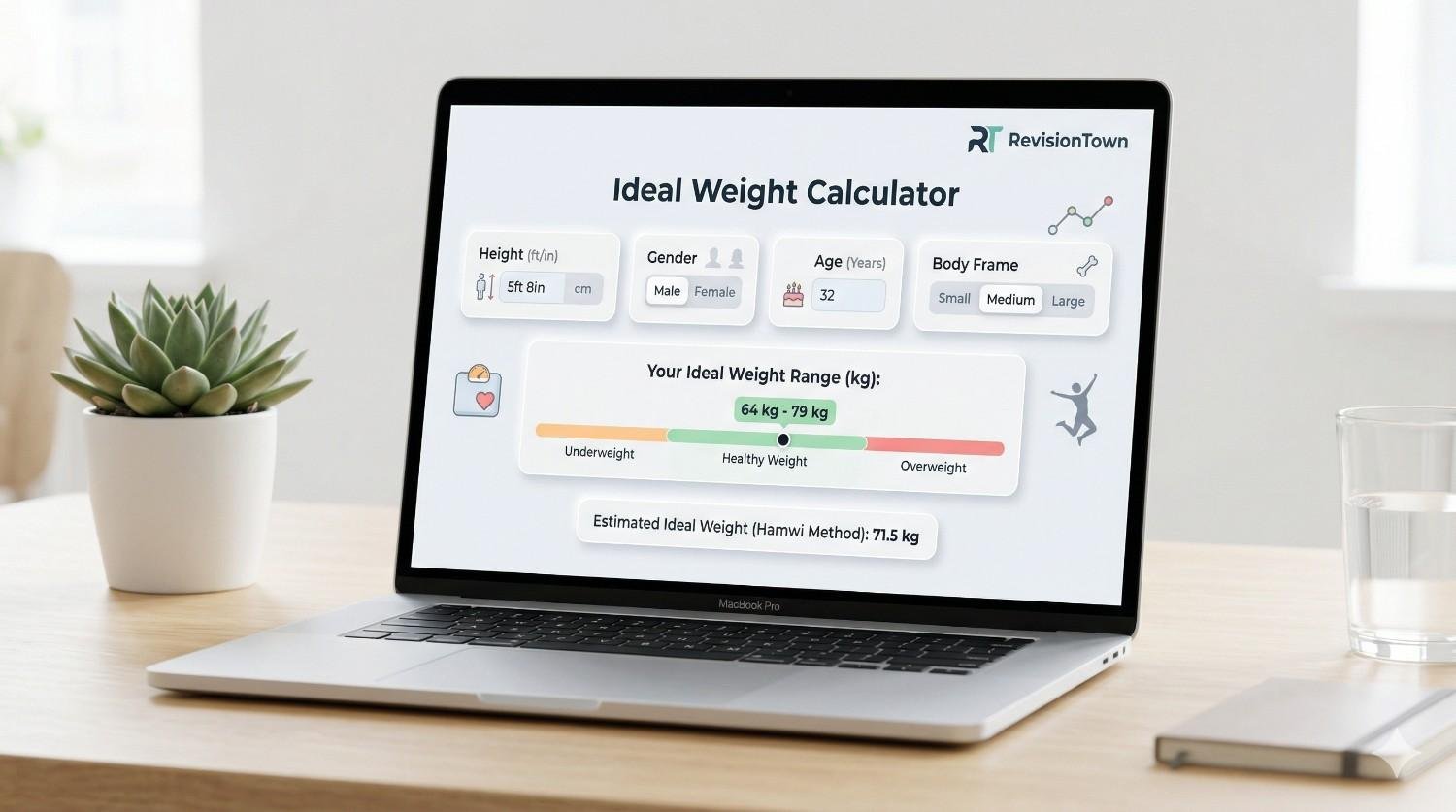
Use this Ideal Weight Calculator to estimate adult body weight reference points from height, sex, body frame, and BMI-based healthy weight ranges. The calculator compares several common ideal body weight equations, including Devine, Robinson, Miller, and Hamwi, then shows a practical range rather than treating one formula as a universal target.
Ideal weight is not a diagnosis and it is not the same thing as body composition, athletic performance, metabolic health, or personal comfort. A useful target weight should be interpreted alongside BMI, waist measurements, lean body mass, body fat percentage, medical history, training goals, and sustainable habits. For broader context, compare this page with the BMI calculator, body fat calculator, and lean body mass calculator.
Calculate Ideal Weight
Enter your details to estimate formula-based ideal weight, healthy BMI range, and current-weight context.
What the Ideal Weight Calculator Estimates
The Ideal Weight Calculator gives adult reference weights from two complementary approaches. The first approach uses classic ideal body weight equations. These formulas start with a base weight at 5 feet and then add or subtract weight for each inch above or below 5 feet. The second approach uses BMI to calculate a healthy weight range for a given height. Together, the methods give a useful planning window rather than a single absolute answer.
This distinction matters because ideal weight is not one perfect number. Two adults can have the same height and very different healthy weights because of lean mass, bone structure, sex, age, training history, ethnicity, waist size, and body fat distribution. A strength athlete may weigh more than a formula estimate and still have excellent health markers. A sedentary person may sit near a formula estimate while carrying low muscle mass and higher body fat. A good calculator should make that nuance visible.
The tool on this page is designed for general wellness education, goal setting, and comparison. It is not a replacement for a clinician, dietitian, or qualified health professional. Use it to understand approximate ranges, then compare with body composition tools such as the body fat percentage calculator and energy tools such as the calorie calculator when planning nutrition or training.
Ideal Weight Is a Range, Not a Fixed Rule
The phrase ideal weight can be misleading if it suggests that every person of the same height should aim for the same scale number. In practice, a healthy adult weight is better understood as a range. Formula-based equations provide one reference point, BMI provides another, and body composition adds important context. The calculator therefore shows an average formula estimate, a formula range, a BMI healthy range, and a frame-adjusted reference.
Ranges are more practical than single targets because weight is influenced by tissue type. Muscle, bone, water, organs, and fat all contribute to body weight. A person who gains muscle through training may weigh more while becoming healthier and stronger. A person who loses muscle during aggressive dieting may weigh less while becoming less functional. A scale number without context can miss those differences.
For most adults, a sensible target weight should answer four questions. Is the weight compatible with healthy blood pressure, blood lipids, glucose control, and medical history? Is the weight sustainable with normal eating and activity? Does it support daily function, energy, and training? Does the person feel well physically and psychologically while maintaining it? If the answer to those questions is yes, the exact formula value matters less.
Ideal Body Weight Formulas Used by the Calculator
The calculator compares four common formulas. These equations are simple and height-based. They do not measure fat mass or muscle mass, but they are useful reference points because they are widely used in educational and clinical discussions of ideal body weight.
Devine Formula
Here, \(x\) is inches over 5 feet and the result is in kilograms. The Devine formula is one of the most familiar ideal body weight equations and is often discussed in medication dosing and clinical reference contexts. Its popularity does not mean it is perfect; it means it is simple and widely recognized.
Robinson Formula
The Robinson formula modifies the slope of the Devine-style relationship. It often produces slightly different estimates, especially for taller adults. Comparing it with Devine helps show why a range is more realistic than a single target.
Miller Formula
The Miller formula has a higher base value and a smaller inch-by-inch increase. For some heights, it produces higher estimates near 5 feet and lower estimates for taller adults compared with formulas that use steeper height adjustments.
Hamwi Formula
The Hamwi equation is another common reference. Because its slope differs from the other methods, it can widen the range for taller users. That difference is useful: it reminds users that formula selection is an assumption, not a direct measurement of health.
BMI-Based Healthy Weight Range
BMI, or body mass index, relates body weight to height. For adults, the standard BMI healthy weight category is often described as 18.5 to less than 25. This calculator uses 18.5 and 24.9 to estimate the lower and upper weights for that adult category. Unlike formula equations, BMI produces a range for any height.
To calculate a weight from a selected BMI value, rearrange the formula:
For a person who is 1.70 m tall, the BMI-based healthy range is:
This range is wider than many formula estimates, which is useful. It allows for differences in muscle mass and frame size. A 1.70 m adult does not need to weigh one exact number to be in the adult BMI healthy range.
Worked Example: 175 cm Adult
Suppose an adult is 175 cm tall. First convert height to inches:
Then calculate inches over 5 feet:
Using the male Devine formula:
Using the female Devine formula:
Now compare with the BMI healthy range. A height of 175 cm is 1.75 m:
The formula result sits inside the BMI healthy range. That does not prove it is the best personal target, but it indicates that the formula estimate is within a common adult reference window. If the person has high lean mass, a higher weight may still be reasonable. If the person has low muscle mass or metabolic risk factors, body composition and medical markers may matter more than the formula result.
How Body Frame Changes the Interpretation
Body frame is a practical way to acknowledge skeletal differences. A large-framed adult may naturally carry more weight than a small-framed adult of the same height. The calculator applies a simple 10% adjustment around the Devine reference when the user selects small or large frame. This is not a diagnostic measurement. It is a planning adjustment that shows how much the target can shift when body structure is considered.
| Frame choice | Calculator adjustment | How to interpret it |
|---|---|---|
| Small frame | Devine estimate minus 10% | May suit adults with lighter skeletal structure and narrower build. |
| Medium frame | No adjustment | Uses the formula estimate as the central reference. |
| Large frame | Devine estimate plus 10% | May suit adults with broader skeletal structure and naturally higher weight. |
Frame size should not be used to ignore health markers. A large frame can justify some additional body weight, but it does not automatically explain high waist circumference, low fitness, or elevated health risk markers. A small frame can explain a lower natural weight, but it should not encourage under-fueling or an unrealistic target. Use frame size as context, not as a standalone rule.
How to Read Your Result
The calculator output has four main parts. The average formula estimate is the mean of the Devine, Robinson, Miller, and Hamwi results. The formula range shows the lowest and highest of those four results. The BMI healthy range shows the adult weight range associated with BMI 18.5 to 24.9 for the entered height. The frame-adjusted reference shows how the central estimate changes when small, medium, or large frame context is applied.
If your current weight is inside the BMI range and near the formula range, your scale weight may already sit within common adult reference values. That does not automatically mean every health marker is perfect, but it means a weight-loss goal should be chosen carefully. It may be more useful to focus on strength, waist size, nutrition quality, sleep, and fitness rather than chasing a lower number.
If your current weight is above the BMI range, the calculator can show how far it is from the upper reference point. That number should not be treated as an immediate target. For many adults, losing 5% to 10% of starting weight can produce meaningful health improvements even if the person has not reached a formula-based ideal weight. Sustainable intermediate goals are often better than a distant target that feels discouraging.
If your current weight is below the BMI range, the calculator can show the minimum adult healthy range by BMI. A low weight may reflect genetics, high activity, low appetite, illness, disordered eating, or other factors. The right response depends on the individual. If low weight is accompanied by fatigue, menstrual changes, dizziness, weakness, poor recovery, or unintentional weight loss, professional guidance is important.
What the Formula Spread Tells You
The gap between the lowest and highest formula result is not a problem to hide. It is useful information. A narrow spread suggests that the formulas agree closely for the entered height and sex. A wider spread means the chosen equation has a larger influence on the final number. Taller adults often see more formula variation because each method adds a different amount per inch above 5 feet.
When the spread is small, the formula average can be a reasonable central reference. When the spread is large, it is better to think in bands. The lower part of the band may suit a smaller frame or lower lean mass. The middle may suit an average frame. The upper part may suit a larger frame or more muscular build. The BMI range then acts as a broader boundary for adult weight interpretation.
For example, if the formulas produce 68 kg, 70 kg, 72 kg, and 77 kg, the exact method changes the target by 9 kg. That spread is too large to pretend that 72 kg is the only correct answer. A practical user would ask why the methods differ, then compare with current weight, waist size, body composition, and health goals. In many cases, the best target is not the average itself but a maintainable range around it.
The formula spread also helps prevent all-or-nothing thinking. If a person is 3 kg above one formula but inside the BMI range and close to another formula, the result should be interpreted calmly. The calculator is giving reference points, not a pass-or-fail grade.
Ideal Weight vs BMI
Ideal weight formulas and BMI answer different questions. Ideal weight formulas ask, "What reference weight does this height-based equation estimate?" BMI asks, "What category does this height and weight combination fall into?" Neither question measures body fat directly. Neither question evaluates blood pressure, blood glucose, cholesterol, fitness, sleep, nutrition quality, pain, or mental health.
BMI is useful because it is simple, standardized, and associated with population-level health risk. However, it can misclassify some individuals. Muscular adults may have a higher BMI without high body fat. Older adults may have a normal BMI while carrying low muscle mass. People of different ethnic backgrounds can have different risk patterns at the same BMI. That is why BMI should be interpreted alongside waist circumference, body composition, and clinical context.
Formula-based ideal weight can be useful for comparison, but it is even less complete than BMI because it depends mostly on height and sex. A formula cannot know whether the weight comes from muscle, fat, bone, or water. It cannot see training history or medical history. Use formula estimates as a starting point, then use other tools and professional advice when decisions carry health consequences.
Ideal Weight vs Body Fat Percentage
Body fat percentage describes body composition more directly than scale weight. Two adults can both weigh 75 kg and have very different levels of fat mass and lean mass. One may have high muscle and lower body fat; another may have lower muscle and higher body fat. The scale cannot distinguish those situations, but body composition can.
This is why ideal weight is most useful when paired with body composition. If a person is above formula weight but has strong fitness, healthy waist circumference, and good body composition, weight loss may not be necessary. If a person is at formula weight but has low muscle mass and higher body fat, improving strength and nutrition may be more important than losing weight.
When the goal is appearance, performance, or metabolic health, compare calculator output with the body fat calculator, body fat percentage calculator, and lean body mass calculator. A target weight should protect lean mass, not simply reduce the scale number.
Using Ideal Weight for Fat Loss Planning
When an adult wants to lose weight, ideal weight can provide a long-term reference point, but the immediate plan should usually be smaller and more practical. A person who is 30 kg above a formula estimate does not need to lose all 30 kg before health improves. Early goals such as losing 5% of starting body weight, improving waist circumference, increasing walking, and building regular meals can be more useful.
A sustainable fat-loss plan usually starts with maintenance calories, a moderate deficit, adequate protein, resistance training, and repeatable activity. Use the maintenance calorie calculator or advanced TDEE calculator to estimate daily energy needs. Then use the advanced macro calculator to divide calories into protein, carbohydrates, and fat.
The ideal weight number should not force an aggressive deficit. Large deficits can increase hunger, reduce training quality, worsen mood, and raise the chance of rebound. A better strategy is to set a realistic first milestone, review progress every few weeks, and adjust gradually. If body weight is falling but strength, sleep, or energy are collapsing, the plan may be too aggressive even if the final target appears mathematically reasonable.
Using Ideal Weight for Muscle Gain or Recomposition
Ideal weight calculators can confuse people who are gaining muscle. If a person starts strength training, gains lean mass, and loses fat, the scale may stay the same or even rise. That does not mean the person is moving away from health. It may mean body composition is improving. This is especially relevant for athletes, lifters, and people returning to exercise after long inactivity.
For muscle gain, the target is not usually the lowest weight inside the BMI range. It is a weight that supports training, recovery, and body composition. A leaner adult with more muscle may sit near the upper end of the BMI healthy range or slightly above it. In that case, waist circumference, body fat percentage, blood markers, and performance matter more than a formula average.
For recomposition, the goal is to reduce fat mass while preserving or increasing lean mass. Scale weight can move slowly. Use progress photos, measurements, strength performance, waist circumference, and body fat estimates. A formula-based ideal weight may still be useful, but it should not override the evidence of improved body composition.
How Age Changes Ideal Weight Interpretation
Age does not directly appear in the classic ideal body weight formulas, but age changes the way results should be interpreted. Younger adults may be building muscle, establishing activity habits, and moving through life stages where weight naturally shifts. Middle-aged adults may notice changes in activity, sleep, work demands, hormones, and recovery. Older adults may face gradual losses in muscle mass and bone density, making strength, balance, protein intake, and functional independence especially important.
For older adults, the lowest formula value is not automatically the best target. A very low body weight may increase concern if it reflects low muscle, frailty, poor appetite, or unintentional weight loss. A slightly higher weight with good strength, mobility, and stable health markers may be more appropriate than a strict formula target. This is one reason the calculator presents a range and includes a medical-use note.
For younger adults with high activity or strength training, a formula result may sit below a realistic performance weight. Someone who plays sport, lifts weights, or works a physically demanding job may need more muscle and energy availability. In that situation, body composition and function should guide the target. A useful weight is one that supports training, normal energy, recovery, and long-term health rather than one chosen only because a formula prints it.
Across adulthood, the best use of an ideal weight estimate is comparison over time. If weight changes, ask what changed with it. Did strength improve or decline? Did waist measurement change? Did blood pressure or glucose markers improve? Did energy and sleep improve? Those answers create a fuller picture than age-blind formulas alone.
Why Waist Measurement Matters Alongside Ideal Weight
Waist measurement adds context because it gives a simple clue about fat distribution. Two people can have the same BMI and the same formula distance from ideal weight, but different waist measurements. Central fat distribution can carry different health implications than weight stored elsewhere. This is why clinicians often look beyond height and weight when assessing risk.
A waist measurement is not a perfect body composition test, but it is practical. It can be measured at home with a flexible tape, taken under consistent conditions, and tracked over time. If weight is stable but waist measurement is decreasing while strength improves, body composition may be improving even if the scale appears unchanged. If weight is near an ideal estimate but waist measurement is high, the formula result may look reassuring while risk context suggests more review is needed.
Measure waist consistently. Stand relaxed, avoid pulling the tape too tightly, and measure at the same anatomical location each time. Do not compare one person’s waist directly with another person’s without considering height, sex, frame, and body composition. The most useful comparison is usually your own trend over time.
Waist data can also protect against unrealistic weight goals. If a person loses weight but waist measurement, strength, and energy all move in the wrong direction, the plan may be reducing lean mass or creating too much stress. If a person weighs more than a formula estimate but has a reasonable waist, good fitness, and healthy medical markers, the formula may be less important than the broader evidence.
Ethnicity, Risk, and Individual Context
Standard adult BMI categories are useful for broad screening, but risk patterns can differ between populations. Some people may experience metabolic risk at lower BMI values than standard categories suggest. Others may have different body proportions or fat distribution at the same BMI. This does not make BMI useless; it means BMI should be interpreted with context.
Ideal weight formulas have similar limitations. Many equations were not designed from globally representative modern datasets. They simplify a complex human body into height and sex inputs. That simplicity is why the formulas are easy to use, but it is also why the output should not be treated as a universal truth. A person’s family history, ethnicity, waist size, blood pressure, blood glucose, blood lipids, medications, and activity level can all change what a healthy target should look like.
If you know that your background is associated with health risk at lower BMI levels, use the calculator as a starting point and discuss interpretation with a qualified professional. If you have a strong family history of type 2 diabetes, cardiovascular disease, or hypertension, a weight inside the general BMI range may still need attention to waist size, nutrition quality, exercise, and clinical markers.
The practical takeaway is not to reject calculators. It is to use them correctly. A calculator can organize numbers quickly. It cannot know your ancestry, lab values, symptoms, family history, or long-term health priorities. That final interpretation belongs in a wider health conversation.
Choosing a Target Inside the Range
After the calculator shows a range, the next challenge is choosing a target inside it. A good target is realistic, measurable, and connected to the user’s actual goal. If the goal is lower health risk, the target should be judged alongside waist circumference, blood pressure, blood markers, and fitness. If the goal is performance, the target should support training quality. If the goal is comfort and daily function, the target should be sustainable without extreme restriction.
One practical method is to divide the target into three levels. The first level is the next milestone, such as moving 5 kg closer to the BMI range or losing 5% of current weight. The second level is the medium-term working range, such as the upper half of the BMI healthy range or the formula range adjusted for frame size. The third level is the long-term maintenance range, which may only become clear after habits, activity, and body composition improve.
Choosing a target should also consider the cost of maintaining it. A weight that requires constant hunger, social isolation, overtraining, or anxiety may not be a healthy personal target even if it appears inside a formula range. A slightly higher but stable weight supported by good nutrition, regular activity, strength, and normal life may be more sustainable.
If the calculator gives several different estimates, do not average them blindly and turn that into a strict rule. Use the average as one anchor. Then ask whether your current body composition, frame, medical context, and lifestyle make the lower, middle, or upper part of the range more realistic.
Maintaining Weight After Reaching a Target
Reaching a target weight is only part of the process. Maintenance is where the target proves whether it is realistic. Many people can reach a lower weight temporarily through aggressive restriction, but the weight returns when the plan becomes too difficult to maintain. A better goal is to build habits that still work after active weight loss ends.
Maintenance usually requires a calorie intake close to new total daily energy needs, adequate protein, consistent activity, and monitoring that does not become obsessive. The maintenance range may be wider than expected. It is normal for body weight to move up and down from water, carbohydrate intake, sodium, digestion, menstrual cycle changes, travel, and training soreness. A range of several pounds or a couple of kilograms is often more realistic than one exact number.
Use the calculator result to define a maintenance zone, not a fragile line. For example, if the target is 70 kg, a maintenance zone might be 68 kg to 72 kg depending on the person. If weight moves above the zone for several weeks, adjust food or activity calmly. If it dips below the zone with low energy or poor recovery, increase intake or reduce training stress. This approach prevents daily fluctuations from turning into unnecessary panic.
Maintenance is also when body composition goals can continue. A person may maintain scale weight while gaining strength and losing waist size. In that case, the ideal weight calculator has done its job: it helped define a reasonable range, but ongoing progress is judged by broader indicators.
When to Use a More Detailed Calculator
This page is designed to be practical and readable. It gives standard formula estimates, a BMI healthy range, frame adjustment, and current-weight context. Some users need a deeper tool because their question is more specific. If you want expanded formula comparison, more input options, or a more detailed interface, the highly advanced ideal weight calculator can provide a broader calculation workflow.
Use the standard calculator on this page when you want a quick adult reference range and clear explanation. Use a more detailed tool when you want to compare more assumptions or explore a complex situation. Use a healthcare professional when the result is connected to medical treatment, medication dosing, disordered eating, pregnancy, rapid weight change, chronic disease, or symptoms.
It is also useful to combine calculators by intent. Use ideal weight to estimate a reference range. Use BMI to categorize height relative to weight. Use body fat tools to understand composition. Use BMR and TDEE tools to estimate energy needs. Use macro tools to plan nutrition. Use activity tools to estimate movement. Each calculator answers a narrower question; together they create a clearer picture.
Current Weight, Target Weight, and Time Frame
After calculating a reference range, the next question is how quickly a person should move toward a target. The calculator intentionally does not prescribe a weekly rate of change because appropriate rates vary by starting weight, health status, age, medical history, training load, and professional guidance. However, it is useful to think in stages rather than treating the final target as the next step.
For weight loss, a staged plan might use the upper BMI range as one reference, the formula range as another, and a 5% to 10% first milestone as the immediate goal. For weight gain, a staged plan might aim for the lower healthy BMI range first, then reassess strength, energy, and health markers. For maintenance, the goal might be to stay within a chosen range while improving fitness.
Time frame matters because fast changes often come with tradeoffs. Rapid weight loss can include water, glycogen, muscle, and digestive content, not only fat. Rapid weight gain can include fat gain if training and nutrition are not aligned. Sustainable progress usually requires a plan that can be repeated through normal life, not only during a short burst of motivation.
Healthy Weight and Daily Energy Needs
Once a target range is estimated, daily energy needs determine how to move toward it. Basal metabolic rate is the energy used at rest. Total daily energy expenditure includes resting metabolism, activity, digestion, and exercise. If you want to connect ideal weight to calorie planning, start with the highly advanced BMR calculator and then compare daily expenditure with an activity-based tool.
The basic relationship is:
If intake is below expenditure over time, weight usually trends down. If intake is above expenditure over time, weight usually trends up. If intake and expenditure are close, weight tends to remain stable. The word "over time" is important because daily scale changes can reflect water, sodium, carbohydrate intake, hormones, digestion, and soreness rather than true fat change.
Activity can support the process, but exercise calories should be estimated carefully. The calories burned calculator can help estimate activity energy, while the calorie calculator can help translate the goal into a daily intake target.
When a Formula Result May Be Misleading
Formula results can be misleading in several common situations. The first is athletic build. People with high muscle mass may exceed formula estimates without excess fat. The second is older adulthood. Muscle and bone changes can make body composition more important than the scale. The third is ethnicity and risk profile. Some groups have increased metabolic risk at lower BMI values, so a standard BMI range may need professional interpretation.
The fourth situation is medical history. Fluid retention, thyroid disorders, gastrointestinal disease, cancer treatment, kidney disease, medication changes, pregnancy, and eating disorders can all change body weight in ways that formula calculators cannot interpret. Unintentional weight loss or rapid unexplained weight gain should not be treated as a calculator problem; it should be discussed with a qualified professional.
The fifth situation is extreme height. Many ideal weight equations are linear and were not designed to perfectly represent every height. Very short or very tall adults may find that formulas spread farther apart or feel less realistic. In those cases, BMI range, body composition, and medical assessment become especially important.
How to Measure Height and Weight Correctly
Calculator accuracy starts with accurate input. Measure height without shoes, standing tall with heels together, eyes forward, and hair flattened if needed. If height is entered in feet and inches, include the extra inches carefully. A difference of one inch can shift both formula and BMI-based results.
Measure weight under consistent conditions. The most consistent method is usually in the morning after using the bathroom, before eating or drinking, and with similar clothing. A single weigh-in can be misleading. A 7-day average is usually more informative because it smooths normal fluctuations from water, sodium, carbohydrate intake, and digestion.
If your current weight seems far from the calculator output, do not panic. First confirm height and unit inputs. Then compare formula range, BMI range, and body composition. If the result still raises concern, use it as a prompt for a more complete review rather than as a judgment.
Ideal Weight Table by Height
The table below shows approximate BMI-based healthy ranges for common adult heights. It is included to make the relationship between height and weight easier to see. The calculator above gives more specific results and formula comparisons.
| Height | BMI 18.5 | BMI 24.9 | How to use the range |
|---|---|---|---|
| 150 cm | 41.6 kg | 56.0 kg | Formula estimates may sit near the middle depending on sex and frame. |
| 160 cm | 47.4 kg | 63.7 kg | Body composition determines where inside the range is realistic. |
| 170 cm | 53.5 kg | 72.0 kg | Many adults have a broad healthy window at this height. |
| 180 cm | 59.9 kg | 80.7 kg | Higher lean mass can push healthy adults toward the upper range. |
| 190 cm | 66.8 kg | 89.9 kg | Taller adults should compare formulas with BMI range and frame size. |
If you need to convert between feet, inches, centimeters, and meters before using the calculator, the height converter can help ensure the input is consistent.
Special Contexts: Fitness, Occupation, and Standards
Some users calculate ideal weight because a school, employer, sport, or uniformed service uses height and weight standards. Those standards may have a different purpose from personal health planning. For example, a standard may screen a large population quickly, while personal health assessment should account for body composition, performance, and medical context.
If you are comparing general ideal weight with a formal height and weight standard, read the standard carefully. Some systems allow tape measurements, body fat estimates, or other follow-up assessments when scale weight exceeds a height table. The army height and weight calculator is useful when the question is specifically about that type of standard rather than general wellness.
Occupational demands also matter. A firefighter, soldier, dancer, endurance athlete, powerlifter, desk worker, and older adult may all have different ideal performance weights. The healthiest weight is the one that supports the person’s real life, not only the one that satisfies an equation.
Practical Steps After You Calculate
- Compare ranges. Look at formula average, formula spread, BMI healthy range, and frame-adjusted reference together.
- Review current context. Consider waist circumference, body fat estimate, activity level, strength, sleep, energy, and health markers.
- Set a first milestone. Choose a realistic short-term target rather than focusing only on the final number.
- Build a repeatable plan. Align calories, protein, movement, and strength training with the goal.
- Track trends. Use weekly averages for weight and measurements instead of reacting to daily fluctuations.
- Reassess regularly. A target that made sense at the start may change after fitness, muscle mass, or health markers improve.
If you want one place to continue planning, the health and fitness calculators hub brings related tools together for body composition, energy needs, activity, and wellness calculations.
Common Mistakes With Ideal Weight Calculators
- Treating one formula as a command. Formula output is a reference, not a medical order.
- Ignoring body composition. Scale weight cannot separate muscle from fat.
- Using adult ranges for children. Children and adolescents require age- and sex-specific growth charts, not adult formulas.
- Forgetting frame size. Skeletal structure can shift a reasonable target weight.
- Chasing the lowest number. Lower is not always healthier, especially if strength, energy, or recovery suffer.
- Comparing unrelated people. Two people of the same height may have different healthy ranges.
- Ignoring medical symptoms. Unexplained weight change, fatigue, dizziness, or eating distress deserves professional attention.
- Skipping maintenance planning. A target weight only helps if the habits that support it are sustainable.
Practice Problems
Problem 1: BMI range
An adult is 1.80 m tall. Estimate the BMI-based healthy weight range.
Problem 2: Devine estimate
A male adult is 5 feet 10 inches tall. Inches over 5 feet:
Problem 3: Frame adjustment
If a Devine estimate is 70 kg, a simple large-frame adjustment is:
Problem 4: Current BMI
If a person is 75 kg and 1.70 m tall, BMI is:
This is above the adult healthy BMI category, but interpretation should still include waist size, body composition, and health markers.
Important Use Notes
This calculator provides educational estimates only. It is not medical advice, a diagnosis, an eating plan, or a prescription. It is not appropriate for children, adolescents, pregnancy, eating disorder care, urgent medical concerns, or medication dosing without professional guidance.
If weight change is unintentional, rapid, distressing, or accompanied by symptoms such as dizziness, weakness, shortness of breath, chest pain, fainting, digestive changes, swelling, or severe fatigue, seek qualified medical support. If weight goals create anxiety, restrictive eating, binge eating, purging, or compulsive exercise, professional support is important.
Frequently Asked Questions
There is no single best formula for everyone. Devine, Robinson, Miller, and Hamwi provide reference estimates, but body composition, frame size, health markers, and personal context should guide interpretation.
No. Ideal weight is usually a formula-based estimate. Healthy weight is broader and includes BMI range, body composition, waist size, medical history, fitness, and sustainability.
Different formulas use different base weights and height adjustments. Showing several values makes the uncertainty visible and helps users think in ranges rather than one fixed number.
Yes. Athletes and strength-trained adults may weigh more because of higher lean mass. Body fat percentage, waist circumference, performance, and health markers are more useful in that situation.
Not always. The middle can be a useful reference, but the best personal target depends on body composition, frame size, medical history, and what is sustainable.
No. Children and adolescents need age- and sex-specific growth assessment. Adult ideal weight formulas and adult BMI categories should not be used as child weight targets.