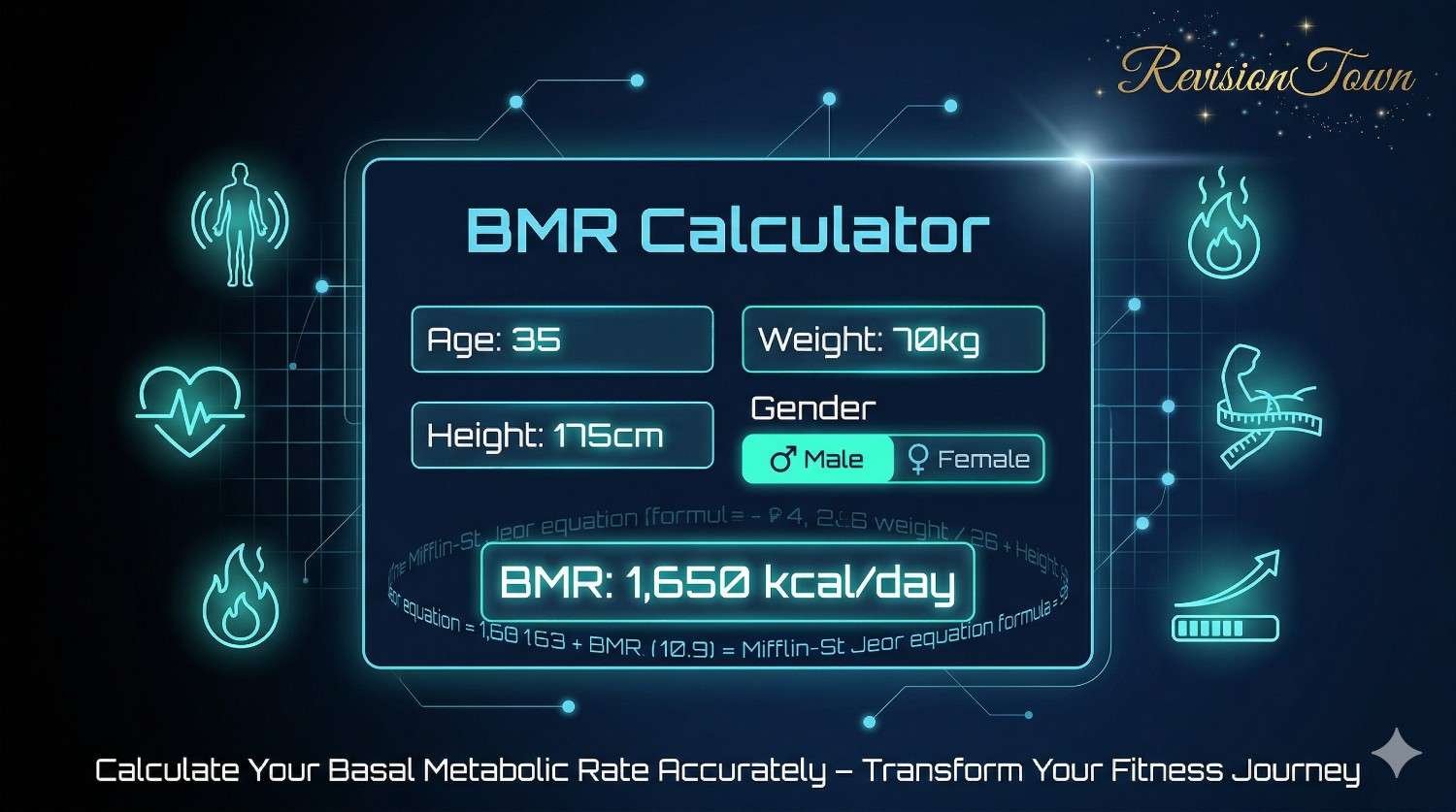
Highly advanced BMR calculator
Highly Advanced BMR Calculator
Estimate basal metabolic rate with Mifflin-St Jeor, revised Harris-Benedict, Katch-McArdle, or an equation comparison. Add activity level to estimate TDEE, review conservative calorie targets, and learn how to use BMR as a planning estimate rather than a medical diagnosis.
Calculate BMR, TDEE, and Goal Calories
Enter height, weight, age, sex, optional body fat percentage, and activity level. Use Mifflin-St Jeor for most adults, Katch-McArdle when you have a reliable body fat estimate, or compare formulas when you want to see the spread between equations.
Results
Use the estimate for planning, then adjust based on body-weight trend, training, recovery, hunger, and professional guidance when needed.
What the Advanced BMR Calculator Does
The Highly Advanced BMR Calculator estimates basal metabolic rate, compares major predictive equations, and connects the result to total daily energy expenditure. BMR is the estimated energy used at rest to support essential functions such as breathing, circulation, temperature regulation, cellular repair, nervous system activity, kidney filtration, and hormone production. It is not the same as daily calorie needs, because daily needs also include movement, training, digestion, and spontaneous activity.
This page is intentionally focused on BMR equation selection and interpretation. If your main goal is a daily calorie budget, use the highly advanced calorie calculator or advanced TDEE calculator after reviewing your BMR. If your goal is macronutrient planning, pair the result with the advanced macro calculator, advanced protein calculator, advanced carbohydrate calculator, and advanced fat intake calculator. If you need body composition context, compare with the highly advanced body fat calculator or body fat percentage calculator.
The calculator is designed for adults and general wellness planning. It does not measure true metabolic rate in a lab. A real measured resting metabolic rate can differ from an equation estimate because of genetics, thyroid function, medication, recent dieting, illness, training status, body composition, sleep, stress, and measurement conditions. Treat the result as a starting estimate, then refine it with observed data.
BMR, RMR, and TDEE
BMR, RMR, and TDEE are related but not identical. Basal metabolic rate is traditionally measured under strict conditions: rest, fasting, thermoneutral environment, and no recent activity. Resting metabolic rate is measured under less strict resting conditions and is often slightly higher. In everyday calculator use, BMR and RMR are often discussed together because both estimate resting energy expenditure. TDEE is broader: it estimates total energy expenditure for a full day.
Activity factors are approximations. They compress formal exercise, occupational movement, walking, standing, chores, and non-exercise activity thermogenesis into one multiplier. That makes the method easy, but not exact. Two people with the same training schedule can have different TDEE values if one sits all day and the other has an active job.
The calculator reports BMR first, then multiplies by the selected activity factor to estimate TDEE. This keeps the purpose clear: BMR is the resting foundation; TDEE is the practical daily estimate used for maintenance, loss, or gain planning.
Mifflin-St Jeor Formula
The Mifflin-St Jeor equation is widely used for estimating resting energy expenditure in adults. It uses weight in kilograms, height in centimeters, age in years, and a sex-specific constant.
Here, \(W\) is weight in kilograms, \(H\) is height in centimeters, and \(A\) is age in years. For a 30-year-old male who weighs 80 kilograms and is 180 centimeters tall:
The result is about 1,780 kilocalories per day at rest. In nutrition writing, kilocalories are usually called calories. This value is not the recommended daily intake by itself; it is the resting baseline before activity is added.
Revised Harris-Benedict Formula
The revised Harris-Benedict equation is an older, traditional BMR equation that remains common in calculators and nutrition references. It uses weight, height, age, and sex-specific coefficients.
For the same 30-year-old male at 80 kilograms and 180 centimeters, the revised Harris-Benedict result is:
This is higher than the Mifflin-St Jeor estimate for the same person. Seeing a difference between equations is normal. Predictive equations are statistical estimates, not direct measurements. The difference between equations is one reason users should adjust calorie targets based on real-world trends rather than trusting one number absolutely.
Katch-McArdle Formula
The Katch-McArdle formula uses lean body mass instead of total body weight. It can be useful for people with a reliable body fat percentage estimate, especially when muscle mass is unusually high or low compared with body weight.
If a person weighs 80 kilograms and has 20% body fat, estimated lean body mass is:
The Katch-McArdle estimate is:
The formula is only as good as the body fat estimate. A rough body fat guess can create a false sense of precision. If the body fat number comes from a consumer scale, skinfold estimate, or visual estimate, use the result as an approximation. If it comes from a well-conducted DEXA or similar assessment, Katch-McArdle may be more informative.
Which BMR Equation Should You Use?
| Equation | Best use | Main limitation |
|---|---|---|
| Mifflin-St Jeor | General adult estimates when height, weight, age, and sex are known. | Does not directly account for body fat or lean mass. |
| Revised Harris-Benedict | Traditional comparison and situations where a user wants to compare older and newer equations. | Often differs from Mifflin-St Jeor and may be less representative for some modern populations. |
| Katch-McArdle | People with a reliable body fat estimate or known lean body mass. | Body fat input error can strongly affect the result. |
| Equation comparison | Planning a reasonable range instead of relying on one exact number. | Requires interpretation; the average is not automatically more accurate. |
For most adults, Mifflin-St Jeor is a practical default. If you know body fat percentage with reasonable confidence, compare it with Katch-McArdle. If the formulas differ by 50 to 150 calories, that is normal. If they differ by much more, review the body fat input, height, weight, and unit selections before building a nutrition plan around the result.
Activity Factors and TDEE
After estimating BMR, activity factors convert resting expenditure into estimated total daily energy expenditure. The calculator uses the common multiplier approach:
| Activity factor | Multiplier | Practical interpretation |
|---|---|---|
| Sedentary | 1.2 | Mostly seated days with little planned training. |
| Lightly active | 1.375 | Light exercise or sport 1 to 3 days per week, or modest daily walking. |
| Moderately active | 1.55 | Moderate training 3 to 5 days weekly or a mix of movement and exercise. |
| Very active | 1.725 | Hard training most days or an active job with structured exercise. |
| Extremely active | 1.9 | Physical job, high training volume, or two-a-day training blocks. |
The multiplier is the least precise part of many BMR-based estimates. Many users overestimate formal exercise and underestimate sedentary time. If weight does not behave as predicted after two to four weeks, the activity factor is often the first assumption to review.
Worked Example: Maintenance Calories
A person has a Mifflin-St Jeor BMR of 1,780 calories per day and chooses moderately active, which uses a multiplier of 1.55. TDEE is:
The maintenance estimate is about 2,759 calories per day. If body weight stays stable around that intake for several weeks, the estimate is reasonable. If weight rises or falls consistently, the true TDEE is probably different from the calculated estimate.
Worked Example: Goal Adjustment
Using the same estimated TDEE of 2,759 calories, a moderate deficit of 500 calories gives:
A small surplus of 250 calories gives:
These are starting targets, not guaranteed outcomes. Real progress depends on adherence, tracking accuracy, activity, water changes, digestion, menstrual cycle, training stress, and metabolic adaptation.
Factors That Affect BMR
Lean body mass
Lean tissue is a major driver of resting energy expenditure. People with more lean mass often have higher BMR than people of the same scale weight with less lean mass. This is why resistance training and adequate protein can support long-term energy expenditure during weight management.
Age
BMR often decreases with age, partly because lean mass tends to decline unless it is actively maintained. The age term in Mifflin and Harris equations lowers the estimate as age rises. Strength training, protein intake, sleep, and general activity can help preserve function and lean tissue, but formulas still estimate rather than measure.
Sex-specific constants
Mifflin-St Jeor and Harris-Benedict use sex-specific constants because the equations were built from group-level data. They do not capture every individual difference. A person with hormone therapy, endocrine conditions, unusual body composition, or non-binary identity may need individualized interpretation beyond binary equation constants.
Thyroid and medical conditions
Thyroid hormones, fever, illness, injury, medications, pregnancy, lactation, and chronic disease can affect energy expenditure. A calculator cannot diagnose or adjust for all of these factors. If weight change is unexpected or symptoms are present, professional medical review matters more than a calculator estimate.
Recent dieting and energy availability
Prolonged calorie restriction can lower energy expenditure through changes in body mass, movement, hormones, and spontaneous activity. This does not mean metabolism is broken; it means the body adapts. BMR equations may overestimate needs after aggressive dieting, and real-world tracking may be needed to recalibrate.
Using BMR for Weight Loss
For weight loss planning, BMR is not the calorie target by itself. The more practical starting point is estimated TDEE. A deficit is created from TDEE, not from BMR. For many adults, a small to moderate deficit is more sustainable than an aggressive one. A plan that preserves lean mass, training performance, sleep, and daily function is usually more useful than a plan that only makes the initial scale drop quickly.
Common planning steps are:
- Estimate BMR with Mifflin-St Jeor or another appropriate equation.
- Multiply by an activity factor to estimate TDEE.
- Choose a modest deficit, often 250 to 500 calories per day for many adults.
- Track body-weight trend for two to four weeks under consistent conditions.
- Adjust intake or activity based on real outcomes rather than the initial estimate alone.
Very low calorie intake can be risky for some people and may require medical supervision. People with a history of eating disorders, pregnancy, lactation, chronic disease, or medication-related weight changes should not use a generic calculator as their only guide.
Using BMR for Muscle Gain and Recomposition
For muscle gain, BMR helps establish the resting baseline, but the practical target is usually a controlled surplus above TDEE. A small surplus often supports training and muscle gain while limiting unnecessary fat gain. Larger surpluses may be appropriate in some athletic phases but can also increase fat gain if training stimulus, recovery, and protein intake are not sufficient.
Body recomposition is different from pure weight gain. A person may want to lose fat and gain muscle at the same time. In that case, scale weight and BMI may change slowly even while body composition improves. The lean body mass calculator and body fat tools can add context that BMR alone cannot provide.
Protein and training quality matter. A calorie target without adequate protein, progressive resistance training, and recovery is incomplete. After estimating BMR and TDEE, many users should next estimate protein intake, carbohydrate needs for training, and dietary fat range with the related macro tools.
Thermic Effect of Food, NEAT, and Exercise
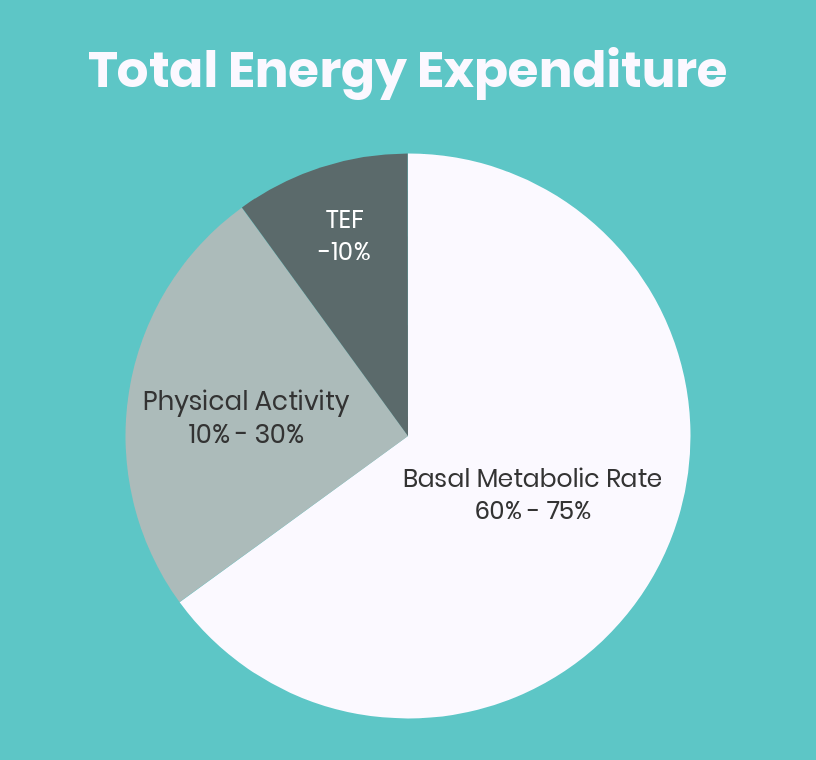
Total daily energy expenditure can be described as several parts: resting expenditure, thermic effect of food, non-exercise activity, and exercise. BMR covers the resting part. The thermic effect of food is the energy used to digest, absorb, and process nutrients. Protein generally has a higher thermic effect than carbohydrate or fat, but the difference is not large enough to replace overall calorie balance.
Non-exercise activity thermogenesis, often called NEAT, includes walking around the house, standing, fidgeting, posture, chores, carrying groceries, and moving during work. NEAT can vary substantially between people and can change during dieting. A person who eats less may unconsciously move less. Another person may have an active job that makes TDEE much higher than a simple exercise schedule suggests.
Formal exercise is only one part of the activity multiplier. A one-hour workout does not make the whole day very active if the rest of the day is seated. Conversely, a person with no gym routine but a physically demanding job may have high TDEE. This is why activity-factor selection should reflect the whole week, not just planned workouts.
Why BMR Estimates Can Be Wrong
BMR equations are built from population data. They predict a typical value for people with similar inputs, but individuals are not averages. Even a well-chosen equation can be off by several percent. At a BMR near 1,800 calories, a 10% difference is about 180 calories per day. That is enough to affect long-term weight trends.
Common reasons for mismatch include inaccurate height or weight, incorrect unit conversion, overestimated activity, inaccurate body fat percentage, metabolic adaptation after dieting, thyroid conditions, medication effects, changes in water balance, and inconsistent food tracking. The solution is not to keep switching formulas every day. Use a reasonable starting point, track outcomes, and adjust calmly.
One useful method is trend calibration. If estimated maintenance is 2,500 calories but weight rises for four weeks under consistent tracking, actual maintenance may be lower. If weight falls, actual maintenance may be higher or intake may be underreported. The formula opens the process; observed data refines it.
BMR and Special Populations
Children and adolescents need specialized growth-aware nutrition assessment. Adult BMR equations are not designed to set calorie targets for growing bodies. Pregnancy and lactation also require specialized guidance because energy needs change to support fetal development, milk production, and maternal health. Athletes with high training loads may require performance-oriented nutrition planning rather than simple equation-based targets.
Older adults may need additional attention to muscle mass, strength, appetite, medication effects, and unintended weight loss. A lower calorie target may not be the right priority if the main risk is loss of lean tissue or poor intake. People with chronic disease, endocrine disorders, eating disorders, recent surgery, or unexplained weight changes should use clinical guidance rather than generic calculator targets.
The calculator can still be educational for these groups, but it should not replace individualized assessment. The more complex the situation, the more important it is to use BMR as one data point, not the decision-maker.
Measurement and Unit Accuracy
Accurate inputs matter. Height should be measured without shoes. Weight should be measured consistently, ideally on the same scale and under similar conditions. If using imperial inputs, convert feet and inches to total inches correctly. Five feet ten inches is 70 inches, not 5.10 feet. If using metric inputs, height must be in centimeters for the formulas shown here and weight must be in kilograms.
Body fat percentage is the most fragile input. A small body fat error can shift Katch-McArdle results. For example, an 80 kilogram person at 20% body fat has 64 kilograms of lean mass. At 25% body fat, lean mass is 60 kilograms. The Katch-McArdle BMR estimate changes by \(21.6\times4=86.4\) calories per day. That is not trivial.
If your body fat estimate is uncertain, compare Katch-McArdle with Mifflin-St Jeor instead of trusting it automatically. If the estimates are close, the practical target will likely be similar. If they differ sharply, use real-world tracking to decide which estimate fits better.
How to Build a Practical Nutrition Workflow
A useful BMR workflow is simple: estimate, apply activity, choose a goal adjustment, monitor, and revise. Start with a calorie estimate that is plausible and safe. Track food intake with reasonable accuracy for a few weeks if your goal requires precision. Track body-weight trend, training performance, hunger, mood, digestion, sleep, and recovery. Then adjust by small amounts.
If the goal is fat loss and weight is not changing after several weeks, review food tracking, weekend intake, beverages, cooking oils, snacks, and activity level before assuming the formula is wrong. If the goal is muscle gain and weight is not increasing, add a modest amount of energy and review training progression. If energy is low, sleep is poor, or hunger is extreme, the target may be too aggressive.
BMR connects naturally to other calculators. Use the BMI calculator for weight-status context, the highly advanced ideal weight calculator for height-based reference ranges, and the maintenance calorie calculator to compare maintenance estimates. If training pace is part of the plan, the highly advanced pace calculator can help with cardio planning.
Practice Problems
Problem 1: Mifflin-St Jeor
A 35-year-old female weighs 65 kilograms and is 165 centimeters tall. Mifflin-St Jeor gives:
Estimated BMR is about 1,345 calories per day.
Problem 2: TDEE
If the same person chooses lightly active, the multiplier is 1.375:
Estimated TDEE is about 1,849 calories per day.
Problem 3: Katch-McArdle
A person weighs 90 kilograms and has an estimated body fat percentage of 25%. Lean body mass is \(90\times(1-0.25)=67.5\) kilograms. Katch-McArdle gives:
Estimated BMR is about 1,828 calories per day.
Problem 4: Equation spread
If Mifflin-St Jeor gives 1,780 and Harris-Benedict gives 1,838, the spread is 58 calories per day. That is a small difference. If two equations differ by several hundred calories, check inputs before using either number for a calorie target.
Calibrating a BMR Estimate With Real-World Data
The most reliable way to use a BMR calculator is to treat the first answer as a starting estimate, then compare it with what happens in real life. BMR equations estimate resting energy needs from a few measurable variables. They do not know how many steps you take, how accurate your food tracking is, whether your workday is seated or physical, how training affects appetite, or how much your spontaneous movement changes when you diet. A good calculator gives a useful first number. Your trend data turns that number into a practical plan.
A simple calibration method is to select one equation, choose an activity factor honestly, and follow the resulting calorie target for two to four weeks. During that period, weigh under similar conditions, such as after waking and using the bathroom. Daily scale readings can fluctuate because of water, sodium, carbohydrate intake, digestion, soreness, and menstrual cycle changes, so the weekly average is more useful than one isolated reading. If weekly average weight stays nearly stable, your target is close to maintenance. If average weight rises gradually, your intake is above maintenance or activity is lower than assumed. If average weight falls, your intake is below maintenance or activity is higher than assumed.
Calibration works best when the inputs are consistent. If you change your activity factor, change your training, stop tracking weekends, or alter food portions without recording them, it becomes harder to interpret the outcome. This does not mean life has to be rigid. It means the more variable the situation is, the wider the estimate range should be. A person trying to maintain general health can use a broader range. A person preparing for a weight-class sport, physique event, medical nutrition target, or performance block needs tighter data and often professional guidance.
A practical adjustment is usually small. If calculated maintenance is 2,400 calories and body weight is rising steadily when intake is logged around 2,400, reduce by 100 to 200 calories or increase daily activity modestly. If weight is falling and maintenance is the goal, add a similar amount. Large corrections can create unnecessary swings. BMR-based planning is not about chasing a perfect number every morning; it is about using a reasonable estimate, watching the trend, and making controlled changes.
Small corrections also protect training and adherence. Many people react to a slow week by cutting calories sharply, then experience fatigue, hunger, lower performance, and reduced movement. That response can make the next week harder to interpret. A calibrated approach is more patient: confirm the trend, review tracking accuracy, then adjust only enough to move the outcome in the desired direction.
How to Choose a Goal Target From BMR and TDEE
The calculator includes goal adjustments because most users are not only curious about resting metabolism; they want a practical daily target. The key is to choose the adjustment from TDEE, not from BMR. BMR is the resting baseline. TDEE is the estimate of total daily expenditure after activity is included. A goal target is then created by adding or subtracting from TDEE.
For maintenance, the goal target should be close to estimated TDEE. Maintenance does not mean scale weight never changes. It means body weight stays within a normal range over time. A maintenance range is often more realistic than one exact number. For example, if estimated TDEE is 2,300 calories, a practical maintenance range might be about 2,200 to 2,400 calories depending on day-to-day activity, tracking precision, and appetite. Athletes may prefer higher intake on hard training days and lower intake on rest days while keeping the weekly average close to maintenance.
For fat loss, a moderate deficit is usually easier to sustain than an aggressive one. A daily deficit of 250 to 500 calories is common for many adults, but context matters. A smaller person, an older adult, or someone with lower TDEE may need a smaller deficit. A larger person with high TDEE may tolerate a larger deficit for a period, but recovery, training quality, sleep, and hunger still matter. The result should support a realistic trend, not simply produce the lowest possible calorie number.
For weight gain or muscle gain, a small surplus often works better than a large surplus. The goal is to provide enough energy for training adaptation, recovery, and muscle protein synthesis without adding excessive fat. Many people begin with a surplus of about 150 to 300 calories per day and then review weight trend and training performance. If body weight is not increasing after several weeks, the surplus may be too small or tracking may be inconsistent. If weight rises too quickly and waist measurements climb rapidly, the surplus may be larger than needed.
For recomposition, the target may sit near maintenance or slightly below maintenance while resistance training and protein intake are prioritized. Recomposition is more common in beginners, people returning after time away from training, people with higher body fat, or people improving training and nutrition quality at the same time. Because scale weight may move slowly during recomposition, waist measurements, progress photos, strength trends, and body composition estimates can be more informative than scale weight alone.
The formula is simple, but the interpretation is personal. The best target is one that matches the goal, supports health and performance, and can be followed consistently enough to generate useful feedback. If the target causes persistent fatigue, dizziness, obsessive tracking, disrupted sleep, or loss of normal function, it should be reconsidered with qualified support.
Understanding the Formula Comparison Output
The advanced calculator shows Mifflin-St Jeor, revised Harris-Benedict, and Katch-McArdle values side by side because a single BMR number can look more exact than it really is. When the formulas are close, you can be more confident that the starting estimate is reasonable. When the formulas are far apart, the difference tells you something important about the assumptions behind the inputs.
Mifflin-St Jeor and revised Harris-Benedict both use age, sex, height, and weight. They do not ask for body fat percentage, so two people with the same age, sex, height, and weight receive the same estimate even if one has substantially more lean mass. Katch-McArdle uses lean body mass, so it can produce a higher estimate for a muscular person and a lower estimate for someone with less lean tissue at the same body weight. This is useful only when the body fat input is reasonably accurate.
If Mifflin and Harris are similar but Katch is much higher, one possibility is that body fat percentage is entered too low. Another possibility is that the person genuinely has high lean mass. If Katch is much lower, the body fat estimate may be too high, or the person may have lower lean mass relative to weight. The calculator cannot decide which explanation is correct. It can only show the effect of the assumptions.
When comparing formulas, focus on the range rather than the exact last digit. Suppose Mifflin gives 1,650 calories, Harris gives 1,710, and Katch gives 1,780. The practical message is that estimated BMR probably sits around the high 1,600s to high 1,700s if the inputs are reasonable. After multiplying by activity, that range may become a difference of 150 to 250 calories in TDEE. That difference is meaningful, but it is still smaller than many tracking errors in ordinary food logs.
A good workflow is to start with Mifflin-St Jeor for a general adult estimate, compare Katch-McArdle if body fat is known, and use observed maintenance to refine the target. Avoid changing equations repeatedly because the scale changed for one day. Formula hopping can create confusion. Pick a defensible estimate, track outcomes, and adjust based on trend.
A small spread suggests the equations agree reasonably well. A large spread suggests the user should review height, weight, sex selection, age, unit system, body fat percentage, and activity factor before relying on the result. In practice, the activity factor often creates more uncertainty than the BMR equation itself, so formula comparison should be paired with honest activity selection.
Common Input Mistakes That Change BMR Results
Most surprising BMR results come from input errors rather than rare metabolic issues. The first common mistake is mixing metric and imperial units. Mifflin-St Jeor and Harris-Benedict formulas use kilograms and centimeters in the versions shown on this page. If pounds are entered as kilograms, the estimate becomes dramatically too high. If inches are entered as centimeters, the height term becomes too low. The calculator converts imperial inputs automatically when the imperial option is selected, but the selected unit system still needs to match the values entered.
The second mistake is entering height in a decimal-feet format. A height of 5 feet 10 inches is not 5.10 feet. It is 5 feet plus 10 inches, or 70 total inches. In metric, it is about 177.8 centimeters. This is why the calculator separates feet and inches in imperial mode. Keeping those fields separate reduces conversion errors.
The third mistake is using a goal weight instead of current weight. BMR formulas estimate current resting expenditure from current body size. If you enter a future goal weight, the calculator estimates the BMR you might have at that future body size, not the BMR you have now. That can be useful for planning later phases, but it should not be confused with current maintenance. For current calorie targets, enter current body weight. For a separate future estimate, run the calculator again with the goal weight and label it clearly.
The fourth mistake is treating body fat percentage as exact. Consumer body fat scales can vary with hydration, food intake, skin temperature, menstrual cycle, and device algorithm. Visual estimates can be biased. Skinfolds depend on technique. DEXA and other lab methods have their own limits. If body fat is uncertain, Katch-McArdle should be interpreted as a scenario, not a fact.
The fifth mistake is overestimating activity. Many users choose a high multiplier because they train several times per week, but the rest of the day may be seated. A person who lifts weights for one hour four days per week and sits most of the day may be lightly or moderately active, not very active. Another person with a manual job and no formal exercise may need a higher multiplier. Activity factors describe the full day and week, not only gym sessions.
The sixth mistake is rounding too early. BMR equations can output decimals, but daily calorie planning does not require precision to the single calorie. Round the final result, not every intermediate step. Rounding each step can introduce small differences, especially when activity factors and goal adjustments are applied. A final target rounded to the nearest 10 or 25 calories is usually more realistic than a target that implies impossible precision.
Scenario Guide: Reading Your Result in Context
Sedentary office worker
A mostly seated worker may have a BMR that looks normal but a TDEE that is much lower than expected. In this scenario, the activity factor is critical. A person may train two or three times per week and still have a low daily step count. If fat loss is the goal, adding walking or standing breaks can sometimes be easier than cutting food further. If maintenance is the goal, the person should avoid comparing intake targets with highly active friends whose work and movement patterns are different.
Student with changing weekly activity
Students often have inconsistent schedules: long seated study days, active campus days, exam weeks, sports sessions, and irregular sleep. A single activity multiplier may not describe every week well. A practical approach is to estimate an average week, then watch the trend. During exam periods, activity may drop and appetite may change. During sports seasons, expenditure may rise. Recalculating every day is not necessary, but reviewing the estimate when the routine changes is sensible.
Strength-trained person
A strength-trained person may find Katch-McArdle useful if body fat is measured well. More lean mass can raise BMR compared with someone of the same scale weight and less lean tissue. However, muscle gain is gradual, and even meaningful changes in lean mass do not require constant BMR recalculation. The bigger practical variables are training volume, daily steps, food adherence, recovery, and whether the calorie surplus or deficit is appropriate for the phase.
Endurance athlete
An endurance athlete may have high TDEE because of training volume, but BMR is still only the resting component. Long runs, rides, swims, or high-volume conditioning can make daily expenditure vary widely. The average weekly intake may matter more than the exact same target every day. High-output days may require more carbohydrate and total energy for performance and recovery. The BMR calculator is useful for the baseline, but training nutrition should be matched to the sport and workload.
Dieting after previous weight loss
Someone who has already lost significant weight may discover that older calorie targets no longer work. This can happen because a lighter body uses less energy, but also because activity, NEAT, and training performance may have changed. The calculator should be rerun using current weight and current activity. If the estimate still seems high compared with observed results, a slower adjustment and maintenance period may be useful, especially if fatigue and hunger are high.
Person returning from inactivity
After a long break from exercise, it is tempting to choose a high activity factor based on planned workouts. It is usually better to choose based on current reality, then update the estimate after the routine is established. A new training plan may increase energy expenditure, but it may also increase appetite, soreness, and fatigue. Starting conservatively creates a more stable baseline.
When to Recalculate BMR
BMR does not need to be recalculated every day. The formula changes when the inputs change, and most inputs do not change meaningfully overnight. Recalculate when body weight changes by a meaningful amount, when activity level changes for more than a short period, when training volume changes substantially, when body composition changes enough to affect Katch-McArdle, or when a new phase begins.
A useful rule is to recalculate after a weight change of about 5% to 10% of body weight. For example, a person who weighs 90 kilograms may rerun the estimate after losing or gaining about 4.5 to 9 kilograms. Smaller updates can be useful for very precise goals, but for ordinary planning, frequent recalculation can create more noise than clarity. If the weekly calorie target is working and health markers are good, the exact equation output is less important than the outcome.
Recalculate after a lifestyle shift. Moving from a seated job to a physical job changes energy needs. Beginning marathon training, stopping a sport season, recovering from injury, changing commute patterns, or caring for a newborn can alter expenditure. The BMR component may change only slightly, but TDEE can change substantially because activity and recovery demands change.
Recalculate after a body composition assessment if you use Katch-McArdle. If lean mass changes, Katch-McArdle changes. However, do not overreact to one body fat reading. Repeated measurements under similar conditions are more useful. If a scale says body fat changed by several percentage points overnight, that is likely measurement noise rather than true tissue change.
Recalculate when the goal changes. A maintenance phase, fat-loss phase, muscle-gain phase, and performance phase may all use the same BMR baseline but different goal adjustments. The calculator can show how small changes around TDEE affect the daily target. The art is choosing the target that fits the current priority.
BMR, Macros, and Food Quality
BMR and TDEE estimate total energy, but they do not decide how that energy should be distributed across protein, carbohydrate, and fat. Two diets can have the same calories and very different effects on hunger, training, digestion, food satisfaction, and nutrient adequacy. After choosing a calorie target, many users benefit from setting a protein range, choosing enough dietary fat for health and preference, and placing carbohydrates around training or active parts of the day.
Protein is especially important during fat loss and muscle gain. During a deficit, adequate protein helps preserve lean mass and can improve satiety. During a surplus, protein supports muscle repair and adaptation, but more is not always better once needs are met. Carbohydrates are useful for high-intensity training, endurance work, and glycogen restoration. Fat supports essential fatty acid intake, hormone production, fat-soluble vitamin absorption, and food satisfaction. A balanced plan should not reduce any major nutrient to an unnecessarily extreme level.
The thermic effect of food means the body uses some energy to process nutrients. Protein has a higher thermic effect than carbohydrate or fat, but total calories and adherence still dominate the long-term energy balance. It is more practical to use thermic effect as a reason to include adequate protein and whole foods than as a reason to ignore total intake.
Food quality also affects the success of a calorie target. A target built mostly from highly processed, low-fiber foods may be harder to follow because hunger and cravings can rise. A target built from lean proteins, fruits, vegetables, legumes, whole grains, healthy fats, and enjoyable planned foods is often more sustainable. The calculator can estimate the energy budget; food choices determine how livable that budget feels.
Hydration, sodium, fiber, and meal timing can all influence scale readings. A higher-carbohydrate day can increase stored glycogen and water. A salty restaurant meal can increase water retention. A higher-fiber day can increase gut contents. These changes are not fat gain. When using BMR and TDEE to evaluate progress, compare trends over time instead of reacting to short-term fluctuations.
Reading Scale Changes Without Misusing BMR
Many people calculate BMR, set a calorie target, and then judge the target by the next morning's scale weight. That is too short a timeline. Body weight is a noisy measurement. A person can be in a real calorie deficit and still weigh more the next day because of water, food volume, constipation, soreness, travel, stress, menstrual cycle stage, or sleep loss. A person can also see a sudden drop from water loss and assume the calorie target is more aggressive than it really is.
Use the scale as a trend tool. Daily measurements are optional, but if they are used, average them. Weekly averages reduce noise. If daily weighing causes anxiety or obsessive behavior, less frequent weighing or another metric may be more appropriate. Waist measurement, clothing fit, training logs, progress photos, resting heart rate, energy, and hunger can all provide context.
The energy balance equation is useful, but it is not a perfect daily prediction:
The approximation becomes more meaningful across weeks than across one day. Energy expenditure is not fixed; it changes with body mass, movement, training, adaptation, and sometimes medical factors. Energy intake is also hard to measure perfectly. Food labels can vary, restaurant meals are estimates, cooking oils are easy to miss, and portion sizes can drift. The calculator gives a planning framework, not a courtroom-level accounting system.
If the trend is not moving as expected, ask practical questions before assuming something is wrong with metabolism. Were weekends tracked? Were beverages included? Were bites and snacks counted? Did step count drop? Did training change? Was the goal adjustment too small to detect through normal water fluctuation? Was the body fat input realistic? These questions often solve the mismatch.
Responsible Tracking Checklist
A good BMR-based plan should improve decision-making without turning food and body data into a source of constant stress. Use this checklist to keep the process practical:
- Use current height, current weight, current age, and the correct unit system.
- Select an equation for a clear reason rather than switching formulas whenever the result feels too high or too low.
- Choose an activity factor based on the whole week, including work, steps, chores, and training.
- Set the goal adjustment from estimated TDEE, not directly from BMR.
- Keep the first adjustment moderate unless a qualified professional gives a different plan.
- Track outcomes for enough time to see a trend, usually two to four weeks.
- Use weekly averages rather than one-day scale changes.
- Review food tracking and activity consistency before making large changes.
- Recalculate when body weight, activity, or goal phase changes meaningfully.
- Stop using the calculator as the main guide if symptoms, medical concerns, disordered eating patterns, or rapid unexplained weight changes appear.
The calculator is most useful when it reduces uncertainty. It should help users understand the relationship between resting metabolism, activity, and goal calories. It should not encourage extreme restriction, fear of food, or daily panic over normal weight fluctuation. A professional, practical approach uses the numbers as tools and keeps the person at the center of the plan.
Important Use Notes
This calculator provides educational estimates only. It is not medical advice, a diagnosis, or a replacement for a physician, registered dietitian, or qualified healthcare professional. Predictive equations can be inaccurate for individuals, especially during pregnancy, lactation, adolescence, illness, eating disorder recovery, aggressive dieting, endocrine disorders, medication changes, athletic training blocks, and unexplained weight change.
Do not use the calculator to justify extreme calorie restriction. If you have symptoms, a medical condition, rapid weight change, or concerns about eating patterns, get individualized care. BMR is a useful planning number, not a safety guarantee.
Frequently Asked Questions
BMR stands for basal metabolic rate. It estimates the energy your body uses at rest to support essential functions such as breathing, circulation, cell maintenance, temperature regulation, and nervous system activity.
Mifflin-St Jeor is a practical default for many adults. Katch-McArdle can be useful when body fat percentage is measured reliably. Harris-Benedict is often used for comparison. None of them is exact for every individual.
No. BMR estimates resting energy expenditure. TDEE estimates total daily energy expenditure after activity is added. TDEE is usually the better starting point for maintenance, weight loss, or weight gain planning.
Generic calculators cannot determine a safe minimum intake. Long-term aggressive restriction can be risky for some people. If you are considering a very low calorie target, use professional medical or dietetic guidance.
BMR estimates change when weight, age, body composition, or selected equation changes. True energy expenditure can also change with dieting, training, illness, medications, sleep, and hormones.
You cannot confirm true BMR from an equation alone. Use the estimate as a starting point, then compare predicted maintenance calories with body-weight trends over several weeks. Lab-based indirect calorimetry is a more direct measurement.