Advanced Fat Intake Calculator
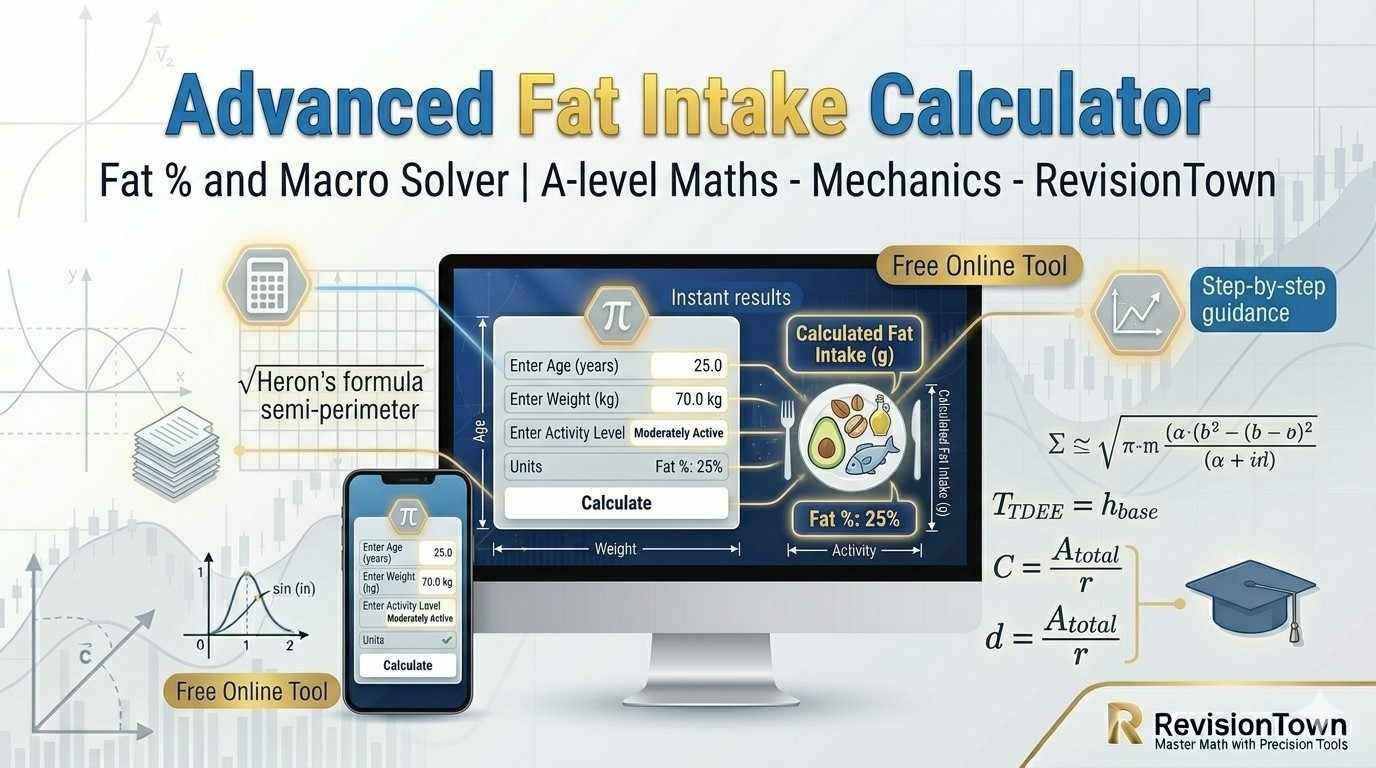
Calculate a practical daily fat target from calories, body size, activity level, goal and preferred eating style. This advanced fat intake calculator estimates total fat grams, saturated fat limits, unsaturated fat targets, BMR, TDEE and macro context so you can plan meals with clearer numbers instead of guessing.
Calculate Your Daily Fat Intake
Use this tool to estimate your daily fat range from energy needs. The calculator uses the Mifflin-St Jeor BMR equation, multiplies by an activity factor, adjusts calories for your goal, and then converts a selected percentage of calories into grams of dietary fat. If you only need a quick basic result, the simpler fat intake calculator is useful; this advanced version is better when you want BMR, TDEE, goal calories and fat-quality guidance in one place.
Fat Intake Formulas Used by the Calculator
Fat intake is calculated from calories because dietary fat is an energy-containing macronutrient. Carbohydrate and protein each provide about 4 calories per gram, while fat provides about 9 calories per gram. That higher energy density explains why small portions of oils, nuts, butter, cheese and dressings can change daily calories quickly.
BMR
\[ \text{BMR}_{male}=10W+6.25H-5A+5 \]
\[ \text{BMR}_{female}=10W+6.25H-5A-161 \]
Where \(W\) is body weight in kilograms, \(H\) is height in centimetres and \(A\) is age in years.
TDEE
\[ \text{TDEE}=\text{BMR}\times\text{Activity Factor} \]
\[ \text{Goal Calories}=\text{TDEE}+\text{Goal Adjustment} \]
Total fat grams
\[ \text{Fat Grams}=\frac{\text{Goal Calories}\times\text{Fat Percentage}}{9} \]
For example, at 2,400 calories and 30% of calories from fat:
\[ \frac{2400\times0.30}{9}=80\text{ g fat/day} \]
Saturated fat limit
\[ \text{Saturated Fat Limit}=\frac{\text{Goal Calories}\times\text{Limit Percentage}}{9} \]
At 2,000 calories, a 10% ceiling equals about \(22\text{ g}\) saturated fat per day. A 6% heart-health target equals about \(13\text{ g}\) per day.
These equations are useful for planning, but they are still estimates. BMR equations do not know your exact lean mass, thyroid status, medication effects, adaptive thermogenesis, training history or daily movement. Treat the result as a starting point. If body weight, gym performance, hunger, blood markers or energy levels move in the wrong direction for two to four weeks, adjust calories, protein, carbohydrate and fat together rather than changing fat alone.
How Much Fat Should You Eat Per Day?
For most adults, a practical daily fat target falls somewhere between 20% and 35% of total calories. This range is commonly used because it allows enough essential fatty acids and fat-soluble vitamin absorption while leaving room for protein, carbohydrate, fibre and micronutrient-rich foods. The calculator includes a balanced 25-35% option because many people find it easier to build satisfying meals inside that range.
The 2025-2030 Dietary Guidelines for Americans continue to place a general ceiling on saturated fat at no more than 10% of total daily calories, while the American Heart Association is more conservative for heart health and recommends less than 6% of total calories from saturated fat. The best target depends on your medical history, LDL cholesterol, family history, dietary pattern and clinician guidance. This page therefore shows both a general ceiling and a stricter heart-health option instead of pretending that one number fits everyone.
The simplest fat equation is not enough by itself. A 70 g fat target can be built from olive oil, salmon, avocado, nuts and seeds, or it can be built from pastries, fried foods, processed meats and high-saturated-fat convenience meals. Those two patterns may have the same total grams of fat but very different effects on fibre intake, sodium, micronutrients, LDL cholesterol, inflammation, satiety and overall diet quality. Use the calculator for the number, then use the rest of this guide to improve the sources.
| Daily calories | 20% fat | 25% fat | 30% fat | 35% fat | 10% saturated fat ceiling |
|---|---|---|---|---|---|
| 1,600 kcal | 36 g | 44 g | 53 g | 62 g | 18 g |
| 2,000 kcal | 44 g | 56 g | 67 g | 78 g | 22 g |
| 2,400 kcal | 53 g | 67 g | 80 g | 93 g | 27 g |
| 2,800 kcal | 62 g | 78 g | 93 g | 109 g | 31 g |
| 3,200 kcal | 71 g | 89 g | 107 g | 124 g | 36 g |
If you are also setting protein and carbohydrate targets, start with the complete energy picture. Estimate maintenance calories with the advanced calorie calculator or maintenance calorie calculator, estimate resting needs with the advanced BMR calculator, then distribute calories across protein, carbohydrate and fat. The advanced macro calculator is the best companion when you want all three macronutrients in one workflow.
Types of Dietary Fat and Why Quality Matters
Dietary fat is not one substance. Foods contain different fatty acids, and those fatty acids affect food texture, cooking stability, cell membranes, lipoproteins, inflammation, hormones and satiety differently. Most whole foods contain a mixture. Olive oil is mostly monounsaturated fat but still contains some saturated and polyunsaturated fat. Salmon contains monounsaturated fat, saturated fat and long-chain omega-3 fats. Nuts and seeds contain a mixture of monounsaturated and polyunsaturated fats plus fibre, minerals and plant compounds.
Unsaturated fats
Unsaturated fats include monounsaturated fats and polyunsaturated fats. They are generally emphasised in heart-healthy eating patterns because replacing saturated fat with unsaturated fat can improve blood lipid patterns. Common sources include extra-virgin olive oil, avocado, nuts, seeds, tahini, nut butters, olives, oily fish and some plant oils. These foods also make meals more satisfying, which can help adherence when calories are controlled.
Omega-3 fats
Omega-3 fats include ALA from plant foods such as flaxseed, chia seed and walnuts, plus EPA and DHA from fish and algae. EPA and DHA are especially relevant for cardiovascular, neurological and inflammatory pathways. People who do not eat fish may consider algae-based options, while people taking blood thinners or managing medical conditions should ask a clinician before supplementing.
Saturated fats
Saturated fat is found in butter, cheese, cream, fatty meats, processed meats, coconut oil, palm oil and many baked or convenience foods. It is not necessary to avoid every gram, but it is wise to keep a ceiling and replace frequent high-saturated-fat choices with unsaturated sources when possible. A practical pattern might use olive oil more often than butter, nuts more often than pastries, and fish more often than processed meat.
Trans fats
Artificial trans fats from partially hydrogenated oils are the fat type to avoid. They raise cardiovascular risk and have no nutritional requirement. Many countries have removed or restricted them, but checking labels is still sensible, especially for older packaged foods, deep-fried foods, commercial baked goods and imported snacks. If a label lists partially hydrogenated oil, choose a different product.
The point is not to micromanage every fatty acid at every meal. The goal is to build a repeatable default: mostly minimally processed foods, enough protein, plenty of plants, appropriate calories, and fat sources that support the rest of the diet rather than crowding it out.
What Fat Does in the Body
Fat is often discussed only in relation to body weight, but dietary fat has many functions that explain why very low-fat diets can be difficult to sustain. Fat slows gastric emptying, increases meal satisfaction, carries flavour, provides essential fatty acids and helps the body absorb fat-soluble vitamins. Vitamins A, D, E and K are better absorbed when a meal contains some fat, which is why a salad with a modest amount of olive oil, avocado, nuts or seeds can be more nutritionally useful than a completely fat-free bowl of vegetables.
Fat is also part of cell membrane structure. Cell membranes need the right balance of fluidity and stability to support signalling, nutrient transport and tissue function. Omega-3 and omega-6 fatty acids are precursors to signalling molecules involved in inflammatory and immune pathways. The body can make many fatty acids, but it cannot make the essential omega-6 and omega-3 parent fatty acids in sufficient amounts, so diet matters.
Hormone production is another reason to avoid unnecessarily extreme restriction. Very low energy intake, very low fat intake or a combination of hard training and inadequate recovery can contribute to menstrual disruption, low libido, low mood, poor sleep, impaired performance and poor adherence. Fat intake is not the only factor in those problems, but it is part of the overall energy availability picture.
At the same time, more fat is not automatically better. Fat is calorie dense. One tablespoon of oil can add around 120 calories; a handful of nuts can add 160-200 calories; restaurant dressings and sauces can add more than expected. People pursuing fat loss often do better by keeping healthy fats in the diet but measuring oils, nuts, nut butters, cheese and dressings until portions become intuitive.
Best Food Sources for a Healthy Fat Intake
The best fat sources tend to be foods that bring other nutrients with them. Nuts and seeds provide minerals and fibre. Fish provides protein and omega-3 fats. Avocado provides potassium and fibre. Extra-virgin olive oil is useful for cooking and dressing, but because it is pure fat, portion size still matters. Eggs, dairy and meat can fit many diets, but the overall saturated fat total should be watched, especially for people managing LDL cholesterol.
| Food | Typical serving | Approximate fat | Best use | Planning note |
|---|---|---|---|---|
| Extra-virgin olive oil | 1 tablespoon | 14 g | Salads, vegetables, moderate-heat cooking | Measure portions during fat-loss phases. |
| Avocado | 1/2 medium | 10-15 g | Meals needing fibre-rich fat | Pairs well with lean protein and vegetables. |
| Almonds or walnuts | 1 ounce | 14-18 g | Snacks, oats, yogurt, salads | Easy to overeat from the bag; pre-portion if needed. |
| Chia or flaxseed | 1-2 tablespoons | 4-8 g | Oats, smoothies, yogurt | Provides ALA omega-3 and fibre. |
| Salmon, sardines or mackerel | 3-5 ounces | 8-20 g | Protein plus omega-3 fats | Useful when balancing protein and fat in one food. |
| Peanut or almond butter | 2 tablespoons | 14-18 g | Toast, fruit, smoothies | Choose versions without partially hydrogenated oils. |
| Eggs | 1 large egg | 5 g | Breakfast or mixed meals | Useful protein-fat combination; context matters. |
| Cheese | 1 ounce | 7-10 g | Flavour and protein | Often higher in saturated fat and sodium. |
If you are planning meals around specific protein goals, combine this page with the advanced protein calculator or the protein requirement calculator. For food-specific protein examples, the 200 gm chicken protein guide can help you understand how lean protein affects macro balance when fat is adjusted separately.
Fat Intake by Goal
A useful fat target depends on the goal. The same person may use different fat ranges during maintenance, fat loss, muscle gain, endurance training, pregnancy, lactation or a medically supervised dietary intervention. The calculator gives a numerical range, but the explanation below helps you choose the right part of that range.
Fat loss
During fat loss, calories matter, but fat should not be pushed so low that meals become unsatisfying or nutrient absorption suffers. A practical range for many people is 20-30% of calories from fat while keeping protein high enough to support lean mass. If hunger is high, a slightly higher fat intake from whole foods may improve adherence, but calories must still fit the deficit.
Muscle gain
During muscle gain, fat often lands around 25-35% of calories while protein and carbohydrate are set for training. Higher calories make it easier to include nuts, olive oil, eggs, dairy or fattier fish without crowding out carbohydrate. If gym performance is poor, review carbohydrate intake with the advanced carbohydrate calculator.
Endurance training
Endurance athletes may oxidise more fat during low-intensity work, but high-quality carbohydrate is still important for hard sessions. Fat intake should support hormones, satiety and energy needs without displacing too much carbohydrate around key workouts. A balanced 25-35% range is common, adjusted by training phase.
Ketogenic-style diets
Ketogenic-style diets usually use much higher fat and much lower carbohydrate than standard macro planning. They may be chosen for personal preference or specific medical contexts, but they are not necessary for fat loss and are not appropriate for everyone. People with diabetes medication, pregnancy, eating-disorder risk, gallbladder disease or lipid concerns should not start a ketogenic diet without professional guidance.
PCOS, pregnancy and lactation
Some readers need more individualized nutrition planning. If PCOS is part of the context, the PCOS calorie calculator may be a better starting point. During lactation, energy needs are different, so the breastfeeding mom calorie calculator is more relevant than a generic fat target.
Body composition tracking
If fat intake is being adjusted for physique or performance goals, pair it with measurements that show whether the plan is working. The advanced body fat calculator, body fat percentage calculator and advanced BMI calculator can help track different parts of the picture.
How to Build Meals Around Your Fat Target
The easiest way to use a fat target is to divide it across meals. If your target is 75 g of fat per day and you eat three meals plus one snack, you might plan 20 g at breakfast, 20 g at lunch, 25 g at dinner and 10 g at a snack. That is more useful than saving the entire number for the end of the day and discovering that one restaurant meal used the whole budget.
Start with protein, then add plants, then add a fat source. For example, a meal might include grilled chicken, rice, vegetables and olive oil dressing. Another might include salmon, potatoes and salad. Another might include tofu, noodles, vegetables and sesame dressing. The fat source should improve the meal, not dominate it. If every meal contains cheese, heavy sauces, fried sides and large portions of oil, the day can exceed the target quickly.
For fat loss, visible fats are the easiest to adjust. Instead of removing all fat, reduce the amount of oil from two tablespoons to one, choose a measured nut portion, use avocado as a topping rather than a whole avocado, or use a leaner protein at one meal and a fattier protein at another. These changes preserve diet quality while creating a calorie deficit. For weight gain, the same foods can be increased in a controlled way because olive oil, nut butter, trail mix, avocado and fattier fish raise calories efficiently.
Track your average, not one perfect day. A day with 60 g of fat and another with 90 g may average well if calories and food quality are appropriate. The goal is a repeatable eating pattern that supports health, energy and body composition over weeks and months.
Common Mistakes When Calculating Fat Intake
| Mistake | Why it matters | Better approach |
|---|---|---|
| Using one fixed gram target for everyone | A 55 kg sedentary person and a 95 kg athlete do not have the same calorie needs. | Calculate fat from goal calories, then adjust based on results. |
| Ignoring saturated fat | Total fat can look reasonable while saturated fat is high. | Use a separate saturated fat ceiling and replace frequent high-saturated-fat foods with unsaturated options. |
| Removing fat too aggressively | Meals may become unsatisfying and micronutrient absorption may suffer. | Keep a reasonable minimum and reduce calories through the whole diet, not fat alone. |
| Confusing dietary fat with body fat | Eating fat does not automatically create body fat; a calorie surplus does. | Track total energy intake, protein, carbohydrate, fat and activity together. |
| Not counting oils, dressings and sauces | Added fats can be the largest hidden calorie source in a meal. | Measure oils and dressings while learning portions. |
| Relying on supplement claims | Fat burners and oil supplements do not replace basic nutrition planning. | Prioritize food quality, calories, protein, fibre, sleep and training. |
Fat Intake, Calories and Energy Balance
Fat intake sits inside energy balance. If calories are consistently above expenditure, body weight tends to increase. If calories are consistently below expenditure, body weight tends to decrease. The type of fat affects health and satiety, but it does not remove the need to understand energy intake. That is why this advanced calculator estimates daily calories first, then calculates grams of fat.
If your main question is how many calories you burn, use the calories burned calculator for exercise estimates and the universal calorie calculator for a broader calorie workflow. If you are converting food energy units for labels or science work, the calories to kJ conversion, kJ to calories conversion, and calories to kcal conversion pages can help you avoid unit confusion.
A useful weekly review is simple: compare your planned fat grams with your actual average, your planned calories with actual average calories, and your body-weight trend with your goal. If fat grams are high but calories are on target and health markers are good, there may be no problem. If fat grams are high because of low-quality foods and calories are also high, changing fat sources and portions can improve both nutrition and weight control.
When to Use a More Personalized Nutrition Plan
A calculator is useful for education and planning, but some people need individualized care. If you have high LDL cholesterol, high triglycerides, cardiovascular disease, diabetes, pancreatitis history, liver disease, gallbladder removal or gallbladder symptoms, kidney disease, pregnancy, lactation, bariatric surgery, unexplained weight change or a history of disordered eating, a generic fat target is not enough. A clinician or registered dietitian can interpret labs, medications, symptoms, personal history and food preferences in a way this tool cannot.
This is especially important for supplements. Fish oil, high-dose omega-3 products, MCT oil and ketogenic products are widely marketed, but they are not automatically appropriate. Omega-3 supplements can interact with anticoagulant or antiplatelet therapy in some contexts. MCT oil can cause gastrointestinal symptoms. Very high-fat diets can be difficult for some people with gallbladder or lipid issues. The safest nutrition plan is the one that fits your health status, labs, budget, culture and adherence.
How to Choose the Right Fat Percentage
The calculator offers several fat-percentage styles because the best percentage depends on the rest of the diet. A person eating 1,600 calories while trying to lose weight has much less room for high-fat extras than a person maintaining on 3,000 calories. A runner doing hard intervals may need more carbohydrate around training than someone walking for general health. A person with high LDL cholesterol may need stricter saturated-fat control than someone with excellent blood markers. A person who enjoys Mediterranean-style meals may feel best at moderate fat, while a person using a ketogenic diet may intentionally push fat much higher under careful planning.
Start with the balanced range if you are unsure. At 25-35% of calories from fat, there is usually enough room for olive oil, eggs, nuts, avocado or oily fish while still leaving calories for protein, fruit, vegetables, whole grains, beans, potatoes or other carbohydrate-rich foods. This range also works well for people who do not want an extreme diet label. It is flexible, easy to repeat, and compatible with many cultural food patterns.
Use the lower-fat range only when there is a reason. It can help some people create a calorie deficit because fat is energy dense, but it requires attention to food satisfaction and essential fatty acids. A lower-fat day should still include some unsaturated fat, not zero fat. For example, a low-fat meal pattern might include lean protein, beans, grains, vegetables and a measured amount of olive oil, avocado or seeds. If lower fat makes you hungry, low mood, cold, low in libido, poor in training performance or preoccupied with food, the plan may be too aggressive.
Use the higher-fat range when it fits the goal and the rest of the diet. Higher fat can be helpful for people who prefer lower-carbohydrate meals, need more calories in smaller food volumes, or feel better with more fat at breakfast and lunch. The tradeoff is that high-fat patterns can crowd out carbohydrate and fibre if not built carefully. A higher-fat meal plan should still include vegetables, protein and fibre-rich foods, not only oils, cheese and meat.
Ketogenic-style percentages are a separate category. They are not just "a bit more fat." They usually require very low carbohydrate intake, careful electrolyte management, and a plan for protein. Some people use ketogenic diets successfully, but they are not necessary for weight loss and are not automatically heart healthy. If you choose that setting, treat the output as a mathematical estimate rather than a medical recommendation.
Meal Planning Examples Using the Calculator Result
Suppose the calculator gives you a target of 80 g fat per day. That number becomes practical only when it is divided into meals. One simple structure is 20 g at breakfast, 25 g at lunch, 25 g at dinner and 10 g in snacks. Another is 15 g at breakfast, 20 g at lunch, 35 g at dinner and 10 g in snacks. There is no single correct distribution. The best distribution is the one that supports hunger control, training, digestion, culture, budget and schedule.
A moderate-fat breakfast might include eggs, oats, berries and a spoon of nut butter. A leaner breakfast might use Greek yogurt, fruit and a small portion of nuts. A higher-fat breakfast might include eggs, avocado and whole-grain toast. Each approach can be reasonable if the day as a whole fits your calories and food-quality targets. Do not judge a single meal in isolation.
Lunch can be built around a protein source, a fibre-rich carbohydrate, vegetables and a measured fat source. A chicken rice bowl might include grilled chicken, rice, vegetables and one tablespoon of olive-oil dressing. A vegetarian option might use beans, tofu, quinoa, vegetables and tahini. A higher-fat option might use salmon with potatoes and salad. If lunch regularly causes an afternoon energy crash, review the whole plate: not only fat, but also fibre, protein, portion size, hydration and sleep.
Dinner is often where hidden fat accumulates. Restaurant meals, takeaways, creamy sauces, fried sides, cheese toppings and large oil portions can add more fat than expected. That does not mean dinner should be dry or restrictive. It means fat should be intentional. Choose whether the main fat source is olive oil, avocado, cheese, nuts, salmon, dressing, butter or sauce, then portion it. Multiple high-fat toppings in the same meal can be delicious, but they can also make the day exceed the target quickly.
Snacks are easiest to manage when they have a purpose. If the goal is satiety, nuts, yogurt, fruit with peanut butter, hummus or eggs can work. If the goal is pre-workout energy, a lower-fat carbohydrate snack may digest better. If the goal is adding calories during a lean-gain phase, trail mix, smoothies with nut butter, whole milk yogurt or olive oil added to meals can help. Match the snack to the problem you are trying to solve.
| Daily fat target | Breakfast idea | Lunch idea | Dinner idea | Snack idea |
|---|---|---|---|---|
| 50 g/day | Greek yogurt, berries, 10 g nuts | Lean protein bowl with 1 tsp olive oil | White fish, potatoes, vegetables, small dressing | Fruit and low-fat cottage cheese |
| 70 g/day | Eggs, toast and fruit | Chicken salad with avocado | Salmon, rice and vegetables | Apple with peanut butter |
| 90 g/day | Oats with nut butter and seeds | Tofu bowl with tahini dressing | Lean meat or fish with olive-oil vegetables | Trail mix portion |
| 120 g/day | Eggs, avocado and whole-grain toast | Salmon or tempeh bowl with olive oil | Protein, vegetables and higher-fat side | Yogurt smoothie with nut butter |
Reading Food Labels for Fat Intake
Food labels are useful, but they need context. The total fat line tells you grams of fat per serving, not necessarily per package. The saturated fat line helps you monitor your ceiling. The trans fat line is useful, but ingredient lists still matter because very small amounts can be rounded. Check for partially hydrogenated oils when buying packaged baked goods, frostings, microwave popcorn, shelf-stable snacks or imported products.
Serving size is the most common trap. A label may show 8 g fat per serving, but the package may contain three servings. If you eat the package, that is 24 g fat. Oils, dressings and nut butters create a second trap because a serving may be one tablespoon or two tablespoons, while the amount poured by eye can be much larger. Measuring for one or two weeks can recalibrate your estimates without requiring lifelong tracking.
The ingredient list tells you more about food quality than the macro panel alone. A snack with 12 g fat from nuts and seeds is not nutritionally identical to a snack with 12 g fat from shortening and refined flour. Look for whole-food ingredients most of the time: nuts, seeds, olive oil, fish, eggs, avocado, dairy, legumes and minimally processed grains. Highly processed foods can still fit occasionally, but they should not be the foundation of daily fat intake.
Some labels advertise "low fat" as if that automatically means healthy. Low-fat products can be useful when calories are limited, but they may contain more added sugar, starch or sodium to improve taste. Other labels advertise "keto" or "high fat" as if that automatically means healthy. Those products can be calorie dense and low in fibre. The better question is: does this food help the whole day meet calories, protein, fibre, micronutrients and fat quality?
How Fat Intake Interacts With Protein and Carbohydrate
Fat should not be set in isolation. If fat rises while calories stay fixed, calories from protein, carbohydrate or alcohol must fall. If fat falls while calories stay fixed, another energy source must rise. This is why macro planning is a tradeoff. A high-fat, high-carbohydrate, high-protein diet can easily become a high-calorie diet unless portions are controlled.
Protein is often set first for body-composition goals because it supports muscle retention, satiety and recovery. Once protein is set, the remaining calories are divided between carbohydrate and fat. Athletes doing repeated hard training usually need enough carbohydrate to support intensity. People who prefer lower-carbohydrate meals may allocate more calories to fat and rely on lower-carb vegetables, protein and fats for satiety. Neither structure is automatically superior; adherence and health markers matter.
Carbohydrate is often misunderstood in fat-intake planning. If you lower fat dramatically, carbohydrate often rises. If that carbohydrate comes from fruit, beans, potatoes, oats, whole grains and vegetables, the diet may be nutrient rich. If it comes mainly from refined snacks and sugary drinks, it may not be. Similarly, a higher-fat diet based on fish, olive oil, nuts and vegetables differs from a higher-fat diet based on processed meats, fried foods and pastries.
Alcohol also affects the equation. Alcohol provides about 7 calories per gram and can displace calories that would otherwise be used for protein, carbohydrate or fat. It may also change appetite and food choices. If you drink alcohol, include it in the energy picture rather than treating it as separate from the macro plan.
Troubleshooting Your Fat Intake Result
If the calculator result looks too low, check whether the calorie estimate is too low, the activity level is understated, or the chosen fat style is too restrictive. A small person in a fat-loss phase may receive a lower gram target than expected because calories are limited. That does not mean fat is unimportant. It means portions must be deliberate. In that situation, choose mostly unsaturated fats and avoid spending a large share of the fat budget on foods that do not keep you full.
If the result looks too high, check whether activity level is overstated, the weight-gain setting is too aggressive, or the high-fat/keto setting was selected unintentionally. High fat targets can be appropriate for some plans, but they are not required for general health. If your goal is heart health, body recomposition or endurance performance, a moderate target may be easier to balance with protein, fibre and carbohydrate.
If you are hitting the fat target but not your body-weight goal, review total calories. Many people track fat grams accurately but miss liquid calories, weekend meals, restaurant portions or snack bites. Others hit calories but under-eat protein, which can make hunger worse. The solution is not always to cut fat. Sometimes the better fix is raising protein, adding fibre, improving meal timing or reducing highly processed foods.
If blood lipids worsen after increasing fat, look at saturated fat, trans fat exposure, fibre intake, alcohol intake, weight change, genetics and medical context. Some people are more responsive to saturated fat than others. Replacing butter, coconut oil, high-fat processed meat and large cheese portions with olive oil, nuts, seeds, fish, beans and high-fibre foods may improve the pattern, but lab interpretation belongs with a qualified clinician.
A Practical Four-Week Fat Intake Adjustment Plan
Week one is for measurement. Use the calculator result, but do not overhaul everything at once. Track your usual meals for several days and identify where fat currently comes from. Separate intentional fats, such as olive oil or nuts, from hidden fats, such as sauces, pastries, fried foods, processed meats and restaurant dressings. This gives you a baseline.
Week two is for substitutions. Keep the foods you enjoy, but make one or two swaps: olive oil instead of butter more often, fish instead of processed meat once or twice, a measured nut portion instead of grazing, avocado instead of creamy dressing, or grilled instead of fried. If saturated fat is high, focus there first. If total calories are high, focus on portions of oils, nuts, cheese and sauces.
Week three is for distribution. Move fat to the meals where it helps most. Some people need more fat at breakfast to stay full. Others prefer lower-fat meals before training and more fat at dinner. The best timing is personal, but it should support energy, digestion and adherence. If a high-fat pre-workout meal makes you feel heavy or slow, move that fat later and use easier-digesting carbohydrate before training.
Week four is for review. Compare your average fat intake, average calories, body-weight trend, hunger, training and digestion. If the plan is working, keep it stable. If weight is not moving as intended, adjust calories slightly. If hunger is high, consider a little more protein, fibre or meal volume before cutting fat further. If labs or symptoms are involved, review with a professional rather than experimenting indefinitely.
Advanced Notes for Athletes and Active People
Athletes need enough fat for health, but the optimal amount depends on sport demands. Strength athletes often prioritise protein and total calories, then use fat and carbohydrate to support training. Endurance athletes often need enough carbohydrate for intensity and enough fat for overall energy and hormone support. Team-sport athletes may need a flexible pattern because training days, match days and rest days differ.
Pre-workout meals are usually not the best place for large fat portions because fat slows gastric emptying. That can be helpful for satiety at normal meals, but it may feel heavy before intense training. Many athletes prefer lower-fat, higher-carbohydrate pre-workout meals and then include more fat at meals further away from training. For long low-intensity activity, fat oxidation matters physiologically, but that does not mean every athlete needs a very high-fat diet.
Recovery meals should consider the whole macro picture. Protein supports repair, carbohydrate restores glycogen, and fat can make the meal satisfying. A very high-fat recovery meal may slow digestion, which may or may not matter depending on how soon the next session occurs. If you train twice daily, nutrient timing becomes more important than if you train three times per week.
Active people should also avoid confusing leanness with health. Extremely low fat intake combined with high training load can contribute to low energy availability. Warning signs can include poor recovery, frequent illness, sleep problems, irritability, menstrual disruption, low libido, stress fractures or persistent fatigue. Those signs deserve professional attention.
Fat Intake for Plant-Based and Vegetarian Diets
Plant-based diets can provide excellent fat quality, but they still require planning. Nuts, seeds, avocado, olives, soy foods and plant oils can cover total fat needs. Flaxseed, chia seed, hemp seed and walnuts provide ALA omega-3, while algae oil can provide DHA and EPA for people who do not eat fish. Because conversion from ALA to EPA and DHA is limited, strict vegans may want to discuss algae-based DHA/EPA with a dietitian or clinician.
Vegetarian diets can vary widely. A vegetarian diet based on beans, tofu, whole grains, vegetables, nuts, seeds and olive oil is very different from one based heavily on cheese, butter, pastries and refined grains. Saturated fat can still become high if full-fat dairy and cheese are frequent. A simple improvement is to rotate fat sources: nuts one day, avocado another, olive oil dressing another, tofu or tempeh another, and seeds in breakfast meals.
Plant-based eaters should also watch total calories. Nut butters, tahini, granola, trail mix and oils can support energy needs, but portions add up quickly. This is helpful for people who struggle to eat enough, and challenging for people trying to lose fat. The calculator number gives a boundary so plant-based fat sources can be used intentionally.
Advanced Fat Intake Calculator FAQ
What is the best fat intake percentage?
Many adults do well somewhere between 20% and 35% of calories from fat. A balanced starting point is often 25-35%, with the exact target adjusted for calories, protein needs, training, food preference, medical context and blood lipid response.
How do I calculate fat grams from calories?
Multiply daily calories by the fat percentage, then divide by 9 because fat provides about 9 calories per gram. For example, 2,000 calories at 30% fat gives \((2000 \times 0.30) / 9 = 67\text{ g}\) of fat per day.
Is eating fat bad for weight loss?
No. Weight loss depends mainly on sustained energy balance. Fat can fit a weight-loss plan, but portions matter because fat is calorie dense. Many people lose weight successfully with moderate fat intake, high protein, high-fibre foods and consistent calorie control.
Should I use the 10% or 6% saturated fat option?
The 10% option is a general ceiling used in dietary guidance. The 6% option is a stricter heart-health target commonly used when lowering LDL cholesterol is a priority. If you have high LDL cholesterol or cardiovascular risk, ask a clinician which target is appropriate.
Do I need omega-3 supplements?
Not always. People who regularly eat oily fish may already get meaningful EPA and DHA. People who do not eat fish may consider algae-based EPA/DHA, but supplement decisions should account for medications, bleeding risk, medical conditions and clinician advice.
Can I use this calculator for children?
This version is designed for older teens and adults. Children have different growth and development needs, so a paediatric clinician or registered dietitian is the better source for child-specific fat targets.
Why does the calculator ask for sex?
The Mifflin-St Jeor equation uses different constants for male and female BMR estimates. This is a calculation input, not a complete picture of individual metabolism. Lean mass, hormones, medication and health status can all shift real energy needs.
What is the difference between this and a macro calculator?
This page focuses deeply on dietary fat. A macro calculator distributes calories across protein, carbohydrate and fat together. Use the macro calculator if you want a full macro split.
Evidence and Safety Notes
This page uses broadly accepted nutrition planning principles: fat provides about 9 calories per gram; total fat is often planned as a percentage of calories; saturated fat is commonly limited; artificial trans fat should be avoided; and food quality matters as much as the gram total. For further reading, review the Dietary Guidelines for Americans 2025-2030, the American Heart Association’s guidance on saturated fats, the FDA information on trans fat, and the WHO fact sheet on trans fat elimination.
Educational disclaimer: this calculator and article are for general learning and meal-planning support. They are not medical advice, diagnosis, treatment, or a substitute for personal care from a qualified health professional.