Macro Calculator
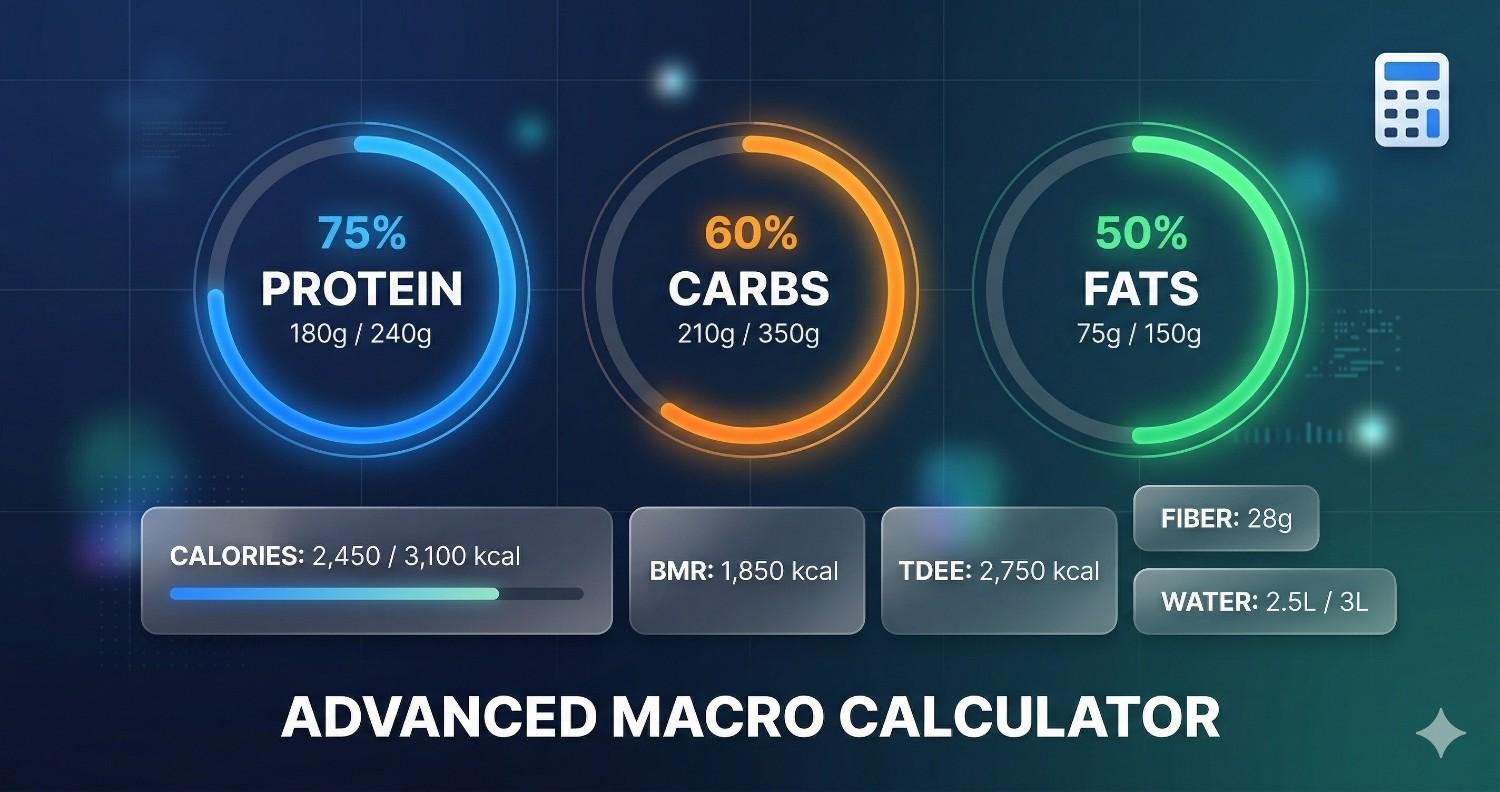
Use this macro calculator to turn a daily calorie target into grams of carbohydrates, protein, and fat. It is designed for people who want a practical macronutrient split for weight maintenance, fat loss, muscle gain, training support, or flexible dieting. Enter known calories or estimate calories from body size and activity, choose a preset split or custom ratio, and the calculator returns daily grams, calories by macro, and average grams per meal.
Macro tracking is useful because it connects food choices to the structure of a diet. Calories determine the size of the energy budget, but macros decide how that budget is divided. Protein supports tissue repair and satiety, carbohydrates provide accessible training fuel and many fiber-rich foods, and fats support essential fatty acid intake, food satisfaction, and absorption of fat-soluble vitamins. A strong macro plan does not worship one nutrient. It gives each nutrient a job.
This page targets the broad Macro Calculator and IIFYM intent: calculate a complete macro split quickly, understand the math, and learn how to apply the result to meals. If you need more detailed scenario handling after this baseline, use the Advanced Macro Calculator. If you need a single-nutrient focus, the Protein Calculator, Carbs Calculator, and Fat Intake Calculator each go deeper into one macro.
Daily Macro Calculator
What This Macro Calculator Measures
This calculator turns daily calories into three macro targets: carbohydrate grams, protein grams, and fat grams. It uses the standard macronutrient energy values: carbohydrates provide 4 calories per gram, protein provides 4 calories per gram, and fat provides 9 calories per gram. After applying your selected percentages, it shows calories from each macro, grams per day, and average grams per meal.
The calculator also includes an optional TDEE estimate. If you enter height, weight, age, sex equation, activity level, and a calorie adjustment, it estimates a daily calorie target with the Mifflin-St Jeor equation and then applies the macro split. If you already know your calories, you can skip the optional fields and use your own number. This is useful for people who already calculated maintenance calories elsewhere or who are following a coach, dietitian, or measured food-log target.
Macro targets are not a medical prescription. They are a planning framework. Two people can eat the same calories but feel very different depending on macro distribution. A high-carbohydrate endurance athlete, a strength trainee in a lean-gain phase, a person trying to reduce hunger during fat loss, and someone following a lower-carbohydrate preference may all choose different splits. The calculator gives the math; the article helps you decide whether the result fits your goal.
Macro Calculator Formulas
The percentage method starts by multiplying daily calories by the percentage assigned to each macronutrient. That creates calories from carbohydrate, calories from protein, and calories from fat. The calories are then divided by the energy value for that macro. Carbohydrate and protein use 4 calories per gram. Fat uses 9 calories per gram.
For example, a 2200-calorie plan using 50% carbs, 25% protein, and 25% fat gives \(2200 \times 0.50 \div 4 = 275\) grams of carbohydrate, \(2200 \times 0.25 \div 4 = 137.5\) grams of protein, and \(2200 \times 0.25 \div 9 = 61.1\) grams of fat. The calorie math still balances because 275 grams of carbs supplies 1100 calories, 137.5 grams of protein supplies 550 calories, and 61.1 grams of fat supplies about 550 calories.
Meal targets use a simple division. If the plan has 275 grams of carbohydrate and four meals, the average is about 69 grams per meal. That does not mean every meal must be identical. A pre-workout meal might contain more carbohydrates and less fat, while dinner might contain more fat and fewer carbohydrates. The average helps you build realistic portions.
How To Use The Calculator Well
- Start with calories. Macro targets are only meaningful after the total energy budget is known.
- Choose a preset split that matches your goal, or enter custom percentages that add to 100%.
- Check the resulting protein grams against body weight. Percentage-based protein can be too low on low calories or very high on high calories.
- Check whether the carbohydrate target supports your training, school, work, digestion, and food preferences.
- Check whether the fat target leaves enough room for essential fats and food satisfaction without pushing calories too high.
- Use the per-meal values as guides, then adjust timing around workouts and appetite.
If you need to set one macro more carefully, calculate it separately before choosing the full split. For example, set protein with the Protein Calculator, then use this page to distribute remaining calories. Or set fat with the Advanced Fat Intake Calculator, then adjust carbohydrates based on training. Macro planning is more reliable when the numbers match the person, not just a preset.
Choosing A Macro Split
A macro split is a starting point, not a personality. A balanced 50/25/25 split works for many general users because it gives substantial carbohydrate, strong protein, and moderate fat. A higher-protein split can help during fat loss because protein supports satiety and lean mass retention. A performance split gives more carbohydrate to users who train hard. A lower-carbohydrate split may suit people who prefer higher fat and protein, while a keto-style split is a deliberate dietary style that needs careful planning.
| Macro split | Best use | Planning notes |
|---|---|---|
| 50% carbs / 25% protein / 25% fat | Balanced maintenance or general fitness | Flexible, easy to build with common meals, and usually leaves room for fiber-rich carbohydrates and satisfying fats. |
| 45% carbs / 30% protein / 25% fat | Fat loss, strength training, appetite control | Protein is emphasized while still leaving room for carbohydrates and moderate fat. |
| 55% carbs / 20% protein / 25% fat | Endurance training or high activity | Carbohydrates support repeated training sessions, but protein should still meet body-weight needs. |
| 40% carbs / 30% protein / 30% fat | Moderate lower-carb preference | A middle-ground split for users who want less carbohydrate than balanced but do not want a very high-fat plan. |
| 30% carbs / 35% protein / 35% fat | Lower-carbohydrate fat-loss style | Can be filling, but users should monitor fiber, training energy, and fat quality. |
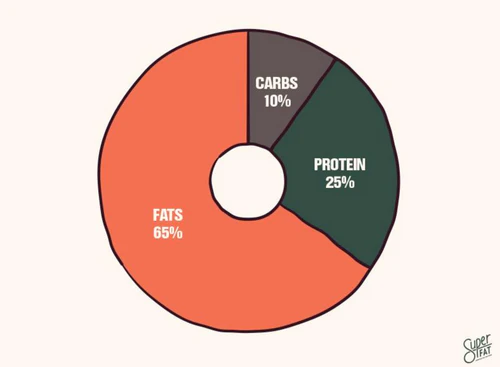
| 5% carbs / 20% protein / 75% fat | Keto-style planning | Highly specific and restrictive. It requires attention to fiber, micronutrients, medical context, and food quality. |
Do not assume the most extreme split is the most effective. Many people get better results by using a moderate plan they can repeat. A macro target should improve decisions at meals, not make every social situation or grocery trip difficult.
Macros For Fat Loss
Fat loss requires a calorie deficit over time. The macro split affects how that deficit feels. Higher protein often makes a deficit easier because it supports fullness and helps preserve lean mass when paired with resistance training. Carbohydrates can support workouts, walking, and daily energy. Fats make meals satisfying and help prevent the diet from feeling dry or joyless. A useful fat-loss split is therefore not simply the lowest carbohydrate or lowest fat plan; it is the split that keeps calories controlled and behavior consistent.
A person eating 1800 calories might choose 40% carbs, 30% protein, and 30% fat. That gives 180 grams of carbohydrate, 135 grams of protein, and 60 grams of fat. Another person may prefer 45% carbs, 30% protein, and 25% fat, giving about 203 grams of carbohydrate, 135 grams of protein, and 50 grams of fat. Both can work if calories, food quality, and adherence are strong. The better plan is the one the person can follow while staying active and feeling reasonably satisfied.
During fat loss, watch for two common errors. The first is setting protein too low because the percentage looks normal but calories are low. The second is setting fat or carbohydrate too low in a way that makes meals hard to repeat. If the calculator result looks mathematically correct but difficult to follow, adjust the split in small steps rather than abandoning macro planning entirely.
Macros For Muscle Gain
Muscle gain usually requires progressive resistance training, adequate protein, enough total calories, and enough carbohydrates to support hard sessions. A macro calculator helps because a calorie surplus can easily become too large if food choices are unstructured. A modest surplus with a clear macro split gives the body resources for training and recovery while limiting unnecessary fat gain.
Many lifters do well with protein near 1.6 to 2.2 grams per kilogram of body weight, carbohydrates high enough to train well, and fats in a moderate range. Percentage presets can be useful, but body-weight protein should still be checked. For example, 25% protein on a 3200-calorie diet equals 200 grams of protein. That may be appropriate for a large lifter but excessive for a smaller person. A 30% protein target on low calories may still be modest in grams. Always translate percentages into grams.
Carbohydrates are often underrated during muscle gain. They help replenish glycogen and support training volume. If a lifter raises fat too high and lowers carbohydrate too much, gym performance may suffer even when calories are adequate. A strong muscle-gain plan usually includes adequate protein, sufficient carbohydrates, moderate fat, and consistent meal timing around training.
Macros For Training And Performance
Performance-oriented macro planning depends on the sport. Endurance athletes often need more carbohydrate because long sessions and repeated training days rely heavily on glycogen. Strength athletes need enough carbohydrate for repeated high-quality sets, plus enough protein for recovery. Team-sport athletes may need a balanced approach because practices combine running, sprinting, contact, skill work, and strength training. The calculator's performance preset is a starting point, not a sport-specific prescription.
Meal timing matters more as training becomes frequent. A high-fat meal may be fine at dinner but uncomfortable right before a hard session because fat slows digestion. A pre-workout meal may be higher in carbohydrate and lower in fat. A post-workout meal may include protein and carbohydrate to support recovery. Daily totals remain the foundation, but timing can improve comfort and consistency.
If training feels flat after changing macros, review the carbohydrate target first. If hunger is high despite adequate calories, review protein, fiber, and fat distribution. If digestion is poor, review meal size, timing, and food sources. The Calories Burned Calculator can help contextualize activity energy, but food intake should still be adjusted based on real-world results.
How Macro Calories Add Up
A macro split should always add back to the calorie target. If it does not, the percentages or gram conversions are wrong. This calculator shows the calories for each macro so you can check the total. Carbohydrate calories are \( \text{carb grams} \times 4 \), protein calories are \( \text{protein grams} \times 4 \), and fat calories are \( \text{fat grams} \times 9 \). The sum should be very close to daily calories, allowing for rounding.
For a 2500-calorie plan with 45% carbs, 30% protein, and 25% fat, carbohydrate calories are 1125, protein calories are 750, and fat calories are 625. The gram targets are 281 grams of carbohydrate, 188 grams of protein, and 69 grams of fat. Rounding may make the total appear off by a few calories, but the plan is coherent. Large mismatches usually happen when users mix calorie percentages with gram targets without converting properly.
Food labels can add another small mismatch because fiber, sugar alcohols, rounding rules, and database methods may not perfectly match the 4-4-9 formula. That is normal. The 4-4-9 method is a planning approximation, not a laboratory analysis. It is still useful because it keeps the diet internally consistent and easy to apply.
Why Calories Come Before Macros
A macro split is a division of calories, so calories must come first. A 50/25/25 split on 1600 calories is very different from the same split on 3000 calories. On 1600 calories, that split gives 200 grams of carbohydrates, 100 grams of protein, and 44 grams of fat. On 3000 calories, it gives 375 grams of carbohydrates, 188 grams of protein, and 83 grams of fat. The percentages match, but the food amounts are not remotely the same.
This is why the calculator asks for calories before it asks for percentages. If you do not know your calories, estimate them with the optional TDEE fields or use a dedicated tool such as the Calorie Calculator, Maintenance Calorie Calculator, or Advanced TDEE Calculator. Once calories are clear, macro percentages become useful. Without calories, percentages are only labels.
Calorie targets should also match the goal. Maintenance calories aim to keep body weight relatively stable. A fat-loss target is below maintenance, often by a modest deficit that can be repeated. A muscle-gain target is above maintenance, usually by a controlled surplus. If a person uses maintenance calories while expecting rapid fat loss, the macro split cannot fix the mismatch. If a person uses an overly large surplus while expecting lean gain only, the macro split cannot prevent all unwanted fat gain.
Think of calories as the size of the container and macros as the compartments inside it. Changing the compartments matters, but it does not change the size of the container unless calories change. Good macro planning begins by choosing the right container for the goal.
Protein Body-Weight Checks
Protein is the macro most likely to need a body-weight check. A percentage can look reasonable but produce a gram target that is too low or unnecessarily high for the person's size. For example, 20% protein on 1400 calories gives only 70 grams of protein. That might be enough for a smaller sedentary adult but low for a larger strength trainee in a calorie deficit. On the other hand, 35% protein on 3500 calories gives more than 300 grams, which may be far beyond what many people need or want to eat.
A common practical method is to compare daily protein grams with body weight in kilograms. If the calculator returns 140 grams of protein for a 75 kg person, the result is \(140 \div 75 = 1.87 \text{ g/kg/day}\). That may fit a strength or fat-loss goal. If the calculator returns 70 grams for the same person, the result is \(70 \div 75 = 0.93 \text{ g/kg/day}\), which may be more of a basic maintenance-style target. Context matters, but the calculation reveals what the percentage actually means.
If protein is too low, raise protein percentage and reduce carbohydrate or fat. If protein is much higher than necessary, lower protein and give calories back to carbohydrate or fat depending on training and preference. This is one reason users often set protein first, fat second, and carbohydrate third. Protein is tied closely to body size and recovery. Fat has a practical minimum and quality considerations. Carbohydrate often becomes the most flexible macro after those needs are met.
For more precise protein planning, use the dedicated protein pages before returning to this calculator. The single-macro calculation can make the final macro split more realistic because it prevents a preset from silently underfeeding or overfeeding protein.
Carbohydrates, Fiber, And Training Fuel
Carbohydrate is often the macro people adjust most dramatically, but it should be adjusted for a reason. Carbohydrates include starches, sugars, and fiber. Many carbohydrate-rich foods also supply vitamins, minerals, water, and plant compounds. Fruits, vegetables, legumes, oats, rice, potatoes, whole grains, and dairy foods can all fit a macro plan. A carbohydrate target should support activity and food quality, not simply follow a trend.
Higher-carbohydrate targets often suit endurance training, high step counts, physically demanding work, and sports with repeated bursts of effort. Moderate carbohydrate targets suit many general fitness and body-composition plans. Lower-carbohydrate targets can suit some preferences and appetite patterns, but they need careful attention to fiber and training energy. If lowering carbs causes workouts, mood, or digestion to worsen, the split may need adjustment.
Fiber is a special consideration because it is counted inside total carbohydrate on many labels. A diet can technically hit carbohydrate grams while still being low in fiber if most carbs come from refined foods. A stronger plan includes fruits, vegetables, legumes, whole grains, and other fiber-rich foods where tolerated. Fiber supports fullness, digestion, and general health, so macro planning should not push those foods out unless there is a specific medical reason and professional guidance.
Use the carbohydrate target as a budget. Spend much of that budget on foods that support the day: breakfast oats, rice or potatoes around training, fruit in snacks, beans or lentils in meals, and vegetables across the day. Enjoyment foods can still fit, but they should not use the entire carbohydrate budget while leaving little room for fiber and micronutrients.
Fat Quality And Saturated Fat
Fat is the most calorie-dense macro, so its gram target is smaller than carbohydrate and protein targets at the same calorie percentage. That does not make fat less important. Dietary fat supports essential fatty acid intake, food texture, satiety, and absorption of vitamins A, D, E, and K. The main challenge is portion awareness. Oils, nuts, seeds, avocado, cheese, butter, dressings, and sauces can change calories quickly because small portions contain many calories.
The calculator includes a saturated fat reference because total fat does not describe fat quality. A macro plan might allow 80 grams of fat, but if most of those grams come from butter, processed meats, fried foods, and high-fat desserts, the diet is very different from one built with olive oil, nuts, seeds, fish, tofu, avocado, and measured dressings. The total macro number is only part of the story.
A practical saturated fat check uses a calorie percentage. At 10% of calories on a 2200-calorie plan, the saturated fat ceiling is \(2200 \times 0.10 \div 9 = 24.4\) grams. Some heart-health guidance uses stricter limits, which is why the calculator includes lower reference options. If a healthcare professional has given you a specific saturated fat target, follow that personal guidance rather than a generic preset.
When fat grams are too high, reduce the fats you do not notice first. Measure cooking oil, use smaller cheese portions, choose leaner meats sometimes, and keep sauces on the side. When fat grams are too low and meals feel unsatisfying, add measured portions of unsaturated fats. The goal is not to eliminate fat; it is to make the fat budget intentional.
Worked Examples
Example 1: Balanced maintenance
A person eating 2200 calories chooses 50% carbs, 25% protein, and 25% fat. Carbs are \(2200 \times 0.50 \div 4 = 275\) grams. Protein is \(2200 \times 0.25 \div 4 = 137.5\) grams. Fat is \(2200 \times 0.25 \div 9 = 61.1\) grams. Four meals would average about 69 grams of carbs, 34 grams of protein, and 15 grams of fat per meal.
Example 2: Higher-protein fat loss
A person cutting on 1800 calories chooses 40% carbs, 30% protein, and 30% fat. Carbs are 180 grams, protein is 135 grams, and fat is 60 grams. This split can be filling because protein is high enough to support satiety, while carbohydrates and fats are still present in useful amounts.
Example 3: Performance focus
A cyclist eating 3000 calories chooses 55% carbs, 20% protein, and 25% fat. Carbs are \(3000 \times 0.55 \div 4 = 412.5\) grams. Protein is 150 grams, and fat is about 83 grams. The high carbohydrate target supports training fuel, while protein and fat remain adequate.
Example 4: Lower-carb preference
A person eating 2100 calories chooses 30% carbs, 35% protein, and 35% fat. Carbs are about 158 grams, protein is about 184 grams, and fat is about 82 grams. This may feel satisfying for some people, but the user should check fiber, fat quality, and whether training energy remains strong.
IIFYM And Flexible Dieting
IIFYM stands for if it fits your macros. The useful version of IIFYM is not a permission slip to ignore food quality. It is a way to create flexibility within a structured macro budget. You can include favorite foods while still meeting protein, carbohydrate, fat, calories, fiber, and micronutrient priorities. The structure prevents a flexible diet from becoming random eating.
A practical flexible diet starts with mostly nutrient-dense foods: lean proteins, legumes, dairy or alternatives, grains, fruits, vegetables, nuts, seeds, and healthy fats. Then a smaller portion of the calorie budget can be used for foods chosen mainly for enjoyment. If those foods are included honestly in the macro budget, they do not ruin progress. If they displace protein, fiber, fruits, vegetables, or essential fats every day, the plan becomes weaker even if the macro totals appear correct.
The best IIFYM approach keeps two standards at the same time: hit the numbers well enough, and choose foods that support health and performance. A macro calculator gives the numbers. Food quality and routine decide whether the numbers become a sustainable diet.
Food Quality Still Matters
Macro tracking can create the false impression that only grams matter. In reality, the source of the grams matters too. Carbohydrates from oats, potatoes, beans, fruit, and whole grains are different from carbohydrates that arrive mostly as refined sugars with little fiber. Protein from fish, lean meats, eggs, dairy, soy, legumes, and varied plant sources brings different nutrients. Fat from olive oil, nuts, seeds, avocado, fish, and measured oils differs from fat that comes mostly from fried foods and processed meats.
Food quality influences hunger, digestion, blood lipids, blood sugar, training, and micronutrient intake. A person can technically hit macros while eating a narrow diet, but that does not mean the plan is good. A stronger approach uses macros as the skeleton and food quality as the substance. Aim for enough fiber, adequate hydration, varied protein sources, mostly unsaturated fats, and plenty of fruits or vegetables where they fit the calorie budget.
The RevisionTown pages on human nutrition, carbohydrates and lipids, and biological macromolecules can help readers who want the science background behind the calculator.
Reading Labels For Macros
Nutrition labels are one of the easiest ways to apply macro targets, but only when serving size is handled correctly. The label values apply to the listed serving. If a container has two servings and you eat the whole container, you double the calories and every macro. If you use half a serving, you halve them. Many tracking errors happen because a person records the label values without adjusting for the amount actually eaten.
Total carbohydrate on a label includes dietary fiber, total sugars, and added sugars. Protein is listed in grams. Total fat includes saturated fat and trans fat, while some labels may voluntarily list monounsaturated and polyunsaturated fats. If you are using this macro calculator for flexible dieting, the main entries you need are calories, total carbohydrate, protein, and total fat. If you are also managing food quality, check fiber, saturated fat, sodium, and added sugars.
Restaurant nutrition information can be less exact than packaged-food labels because preparation varies. A cook may use more oil, a portion may be larger, or a sauce may be heavier than the posted average. Use the numbers as estimates and look at weekly trends. If your results do not match expectations, restaurant meals and hidden fats are often the first place to review.
Labels also use rounding. A food listed as 100 calories may not calculate perfectly from the visible macros. That does not mean the label is useless. It means macro tracking is a practical estimate. Consistent estimating is more important than chasing mathematical perfection in every food entry.
Meal Planning From Macro Targets
Daily macro numbers become useful only when they turn into meals. If the result is 200 grams of carbohydrates, 150 grams of protein, and 70 grams of fat, you need a way to distribute those numbers across the day. Four similar meals would average 50 grams of carbs, 38 grams of protein, and 18 grams of fat. That might become oatmeal, yogurt, and fruit at breakfast; rice, chicken, vegetables, and oil at lunch; a snack with protein and fruit; and potatoes, fish, salad, and dressing at dinner.
Not every meal needs every macro in the same proportion. Some people prefer a lower-fat pre-workout meal, a higher-carbohydrate post-workout meal, and a more satisfying dinner. Others prefer equal meals because it is easier to repeat. The calculator's per-meal numbers are a benchmark. They help you see whether breakfast is too low in protein, lunch is too low in carbohydrate, or dinner uses nearly all daily fat.
Start with meals you already eat. Replace vague portions with more predictable portions. If breakfast is usually toast and coffee, add a protein source and decide how much fat belongs there. If lunch is usually takeout, identify the approximate macro pattern and adjust dinner accordingly. Macro planning works best when it improves normal routines rather than replacing them with unrealistic menus.
Budget And Grocery Planning
Macro planning becomes easier when groceries are chosen with the targets in mind. A protein list might include eggs, Greek yogurt, cottage cheese, tofu, tempeh, fish, lean poultry, beans, lentils, or protein powder if needed. A carbohydrate list might include oats, rice, potatoes, pasta, fruit, vegetables, legumes, and whole-grain bread. A fat list might include olive oil, nuts, seeds, avocado, nut butter, eggs, and fatty fish. Having these categories available makes it easier to assemble meals without starting from scratch every day.
Budget-friendly macro planning is usually built on repeatable staples. Rice, oats, potatoes, beans, lentils, eggs, canned fish, frozen vegetables, yogurt, tofu, and seasonal fruit can cover a large part of a macro plan without relying on expensive specialty foods. Protein bars and branded macro snacks can be convenient, but they are not required. A simple meal with a protein anchor, a carbohydrate source, vegetables or fruit, and a measured fat source can be cheaper and more satisfying.
Batch cooking also reduces decision fatigue. Cook a carbohydrate base, prepare a protein source, wash or roast vegetables, and portion fats or sauces. Then meals can be adjusted by changing portions: more rice for training days, more vegetables for volume, more lean protein when the protein target is behind, or less oil when fat grams are nearly used. Macro tracking becomes easier when the refrigerator already contains foods that match the plan.
Do not ignore taste. A perfectly calculated meal that you dislike will not be repeated. Use herbs, spices, sauces, acids such as lemon or vinegar, and measured fats to make meals enjoyable. The goal is not bland precision. The goal is controlled flexibility.
Restaurant And Social Meals
Macro tracking does not require avoiding restaurants or social meals. It does require planning. Restaurant meals often contain extra oil, butter, sauces, dressings, cheese, and larger portions. That makes fats and total calories easy to underestimate. Carbohydrates may also be larger than expected when bread, fries, rice, pasta, drinks, or desserts are included. Protein may be adequate in the entree but lower than expected if the meal is mostly appetizer-style foods.
A practical approach is to decide which part of the meal matters most. If you want dessert, choose a leaner main course. If you want a richer main course, keep sides simpler. If you want drinks, account for those calories. If the meal is unknown, estimate generously and return to normal meals afterward. One meal does not ruin a macro plan, but repeated underestimation can change the weekly average.
For social meals, avoid trying to force exact gram targets in a way that makes the situation stressful. Use the macro plan to guide choices before and after the event. Eat enough protein earlier in the day, leave some calories available, and choose portions intentionally. Flexible dieting works best when it creates room for real life without turning every event into a numbers-only exercise.
Presets Versus Custom Ratios
Presets are helpful because they give beginners a starting point. A balanced preset is easy to understand and usually works well for general health and fitness. A higher-protein preset may help when hunger control and lean mass are priorities. A performance preset can support users who train often and feel better with more carbohydrate. A lower-carbohydrate preset may suit preferences where fat and protein make meals more satisfying.
Custom ratios are useful when you already know one or more macro targets. For example, suppose a 75 kg lifter wants 150 grams of protein and 70 grams of fat on 2400 calories. Protein contributes 600 calories, and fat contributes 630 calories. That leaves 1170 calories for carbohydrate, or about 293 grams. As percentages, the plan is 49% carbohydrate, 25% protein, and 26% fat. A custom ratio can match that more closely than a preset.
Custom ratios also help when medical guidance or personal tolerance sets a limit. Someone may need a lower saturated fat pattern, a specific carbohydrate range, or a protein target based on professional advice. The calculator can convert those decisions into daily grams, but the reason for the ratio should come from the user's goal and context, not from copying a random split.
Troubleshooting Your Macro Results
If the calculator gives too many carbohydrates for your preference, reduce the carbohydrate percentage and add calories to protein or fat. Before lowering carbs dramatically, ask whether the current carbohydrate target supports training and fiber. If the calculator gives too little carbohydrate and workouts feel poor, increase carbs and reduce fat or protein if protein is already adequate.
If protein is too low, raise protein percentage or set protein manually with a body-weight target. If protein is too high, lower it and give the calories to carbohydrate or fat. Excessive protein can make meals repetitive and may crowd out foods that provide fiber and fats. Adequate protein is valuable; unnecessarily extreme protein is not automatically better.
If fat is too low, meals may feel unsatisfying and very lean. Add measured unsaturated fats or choose slightly higher-fat protein sources. If fat is too high, measure oils and portions of nuts, cheese, sauces, and spreads. Fat adjustments often require small changes because fat is calorie dense.
If the full macro plan feels impossible, simplify. Hit calories and protein first. Then aim for a reasonable carbohydrate and fat range rather than perfect numbers. Many users get most of the benefit from consistent calories, adequate protein, sufficient fiber, and reasonably controlled fats. Precision can increase later if needed.
Common Mistakes
| Mistake | Why it matters | Better approach |
|---|---|---|
| Starting with macro percentages before calories | A percentage has no meaning until the total calorie budget is known. | Estimate calories first, then choose the split. |
| Using protein percentage only | Protein grams may be too low or too high depending on calories and body size. | Check protein in grams and grams per kilogram of body weight. |
| Ignoring fiber and food quality | Macros can look correct while the diet lacks fruits, vegetables, legumes, or whole grains. | Use macro targets inside a varied, nutrient-dense pattern. |
| Making the split too extreme | Very low carb or very low fat targets can be hard to sustain and may affect training or satisfaction. | Use the least restrictive split that supports the goal. |
| Changing targets every day | Constant changes make results impossible to evaluate. | Run one plan for two to four weeks before major adjustments. |
Adjusting Macros Over Time
Macro targets should be reviewed after consistent use. If weight is changing as intended, training feels good, digestion is normal, and hunger is manageable, the split may be working. If weight is not changing, calories may need adjustment before macro percentages. If hunger is high, protein, fiber, food volume, and fat distribution may need review. If training performance drops, carbohydrate may be too low or calories may be too aggressive.
Change one variable at a time. If fat loss stalls, reduce calories modestly or increase activity, but keep protein steady. If workouts feel weak, move more carbohydrate around training before changing every macro. If meals are dry and hard to repeat, raise fat slightly and reduce carbohydrate or calories elsewhere. If digestion is uncomfortable, spread fiber and fat more evenly and review food sources.
Use weekly averages. One high-carb day or one higher-fat restaurant meal does not define the plan. The average pattern matters. A sustainable macro plan allows normal variation while keeping the weekly direction aligned with the goal.
Special Situations And Cautions
This calculator is for general education and everyday planning. People with diabetes, kidney disease, liver disease, heart disease, gallbladder disease, eating disorder history, pregnancy, breastfeeding, food allergies, medically prescribed diets, or complex health conditions should use qualified professional guidance before changing macros substantially. A calculator cannot interpret labs, medications, symptoms, or clinical history.
Children and adolescents also need individualized guidance because diets must support growth and development. Very restrictive macro plans are not appropriate for young people without professional supervision. Athletes with high training volume may need sport-specific nutrition advice, especially around carbohydrate timing, hydration, sodium, and recovery.
If a clinician or registered dietitian has given you a specific target for protein, carbohydrate, fat, fiber, sodium, saturated fat, or calories, use that instruction over a generic calculator preset. The calculator can still help convert percentages and grams, but medical priorities come first.
Daily Macro Planning Checklist
- Set calories before percentages.
- Choose a macro split that matches your goal and food preferences.
- Convert percentages into grams and check that calories add up.
- Check protein against body weight.
- Check carbohydrate against training demands and fiber needs.
- Check fat against meal satisfaction and saturated fat limits.
- Build repeatable meals before worrying about perfect daily tracking.
- Review results after two to four weeks of consistent data.
For broader planning, the Health and Fitness Calculators hub connects this calculator with body composition, calories, activity, and single-macro tools.
Frequently Asked Questions
What is a macro calculator?
A macro calculator converts daily calories into carbohydrate, protein, and fat targets. It uses macro percentages and the standard calorie values of 4 calories per gram for carbohydrates, 4 calories per gram for protein, and 9 calories per gram for fat.
What macro split should I use?
A balanced split such as 50% carbs, 25% protein, and 25% fat works for many general users. Fat-loss users may prefer higher protein, endurance users may prefer higher carbohydrate, and lower-carbohydrate users may prefer more fat. The best split is the one that supports your calories, training, health context, and adherence.
Do macros matter more than calories?
Calories determine the total energy budget, while macros influence how that budget feels and functions. For weight change, calories are central. For body composition, hunger, performance, and food quality, macros matter too.
Should protein be calculated by percentage or body weight?
Both views are useful. Percentage keeps protein inside the calorie budget, while body-weight planning checks whether grams are appropriate for your size and training. If the two methods disagree strongly, adjust the split.
Can I use this for IIFYM?
Yes. The calculator gives daily macro targets and meal averages that work well for flexible dieting. For best results, combine flexibility with adequate fiber, varied protein, mostly unsaturated fats, fruits, vegetables, and foods you can repeat.
Why do label calories sometimes not match my macro math exactly?
Food labels and databases use rounding and may handle fiber or other components differently. The 4-4-9 rule is a practical planning method, so small differences are normal.
Key Takeaway
A macro calculator is most useful when it turns calories into decisions you can repeat. Set a realistic calorie target, choose a macro split that fits your goal, translate percentages into grams, and build meals around those numbers. The best macro plan is not the most complicated one. It is the plan that supports energy, health, training, hunger control, and consistency inside your real routine.
This calculator provides educational estimates for general nutrition planning. It is not a diagnosis, prescription, or replacement for advice from a physician, registered dietitian, or qualified health professional.