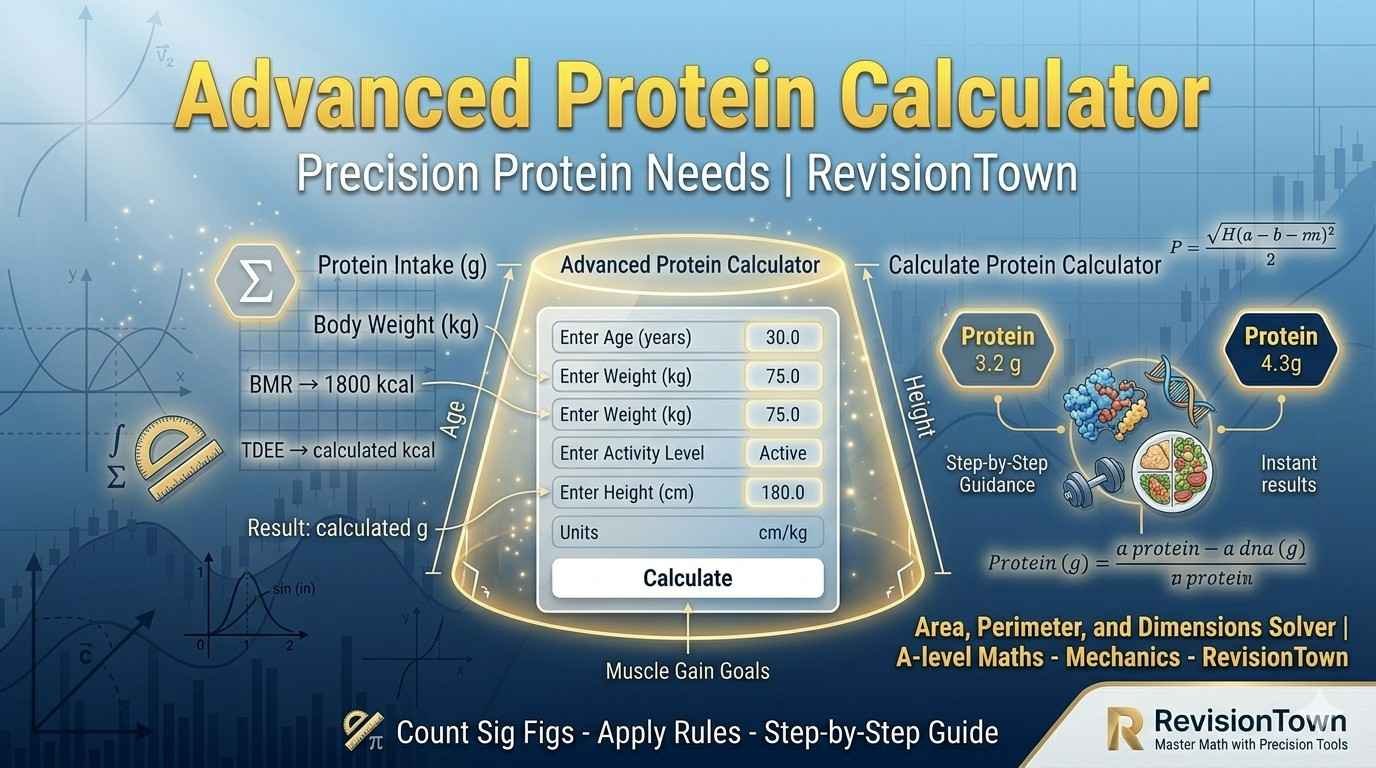
Protein Calculator (Protein Intake Calculator)
Use this protein calculator to estimate a practical daily protein target from body weight, calories, training goal, and meal schedule. It is designed for people who want a clear answer in grams per day, grams per meal, calories from protein, and grams per kilogram of body weight without turning nutrition planning into guesswork.
The calculator supports two common approaches. If you already know your daily calorie target, it can convert a protein percentage into grams using the standard energy value of protein. If you prefer body-weight planning, it can estimate protein from a selected grams-per-kilogram target. When both inputs are available, the tool shows both views so you can compare whether your macro percentage and your body-weight target are pointing in the same direction.
Daily Protein Calculator
What This Protein Calculator Measures
A useful protein target needs more context than a single number copied from a diet plan. Body size, training load, calorie intake, age, appetite, food preferences, and health status all affect how a protein goal feels in real life. This calculator is built around the two most useful everyday calculations: grams per kilogram of body weight and percentage of daily calories. The body-weight method is simple because it begins with your size. The calorie method is helpful when you are planning a full macro split and need protein to fit inside a fixed energy budget.
The default strength-training target uses \(1.6 \text{ g/kg/day}\) because it is a practical middle value for many active adults. That does not mean every person needs that amount. A sedentary adult using the calculator for basic adequacy may select \(0.8 \text{ g/kg/day}\). Someone lifting weights several days per week may choose \(1.6 \text{ g/kg/day}\). Someone in a calorie deficit who wants to keep meals filling and preserve lean mass may choose a higher target, then confirm that the number still fits their calories, appetite, and medical situation.
If you are building a complete eating plan, use this page alongside RevisionTown's Calorie Calculator, Maintenance Calorie Calculator, and Macro Calculator. Those pages answer different questions. Calories set the size of the total energy budget, macros divide that budget between protein, carbohydrate, and fat, and this page focuses on making the protein portion specific enough to use at meals.
Protein Intake Formulas
The simplest protein formula multiplies body weight by a selected target. When body weight is entered in pounds, the calculator first converts pounds to kilograms because most nutrition references express protein as grams per kilogram. The conversion is \(1 \text{ lb}=0.45359237 \text{ kg}\). Once weight is in kilograms, the protein target is direct.
For example, a 75 kg person using \(1.6 \text{ g/kg/day}\) would calculate \(75 \times 1.6 = 120\) grams of protein per day. If that person eats four meals or protein feedings per day, the meal target is \(120 \div 4 = 30\) grams per feeding. This does not require every meal to be identical; it simply gives a practical benchmark for planning breakfast, lunch, dinner, and a snack.
The calorie method starts with daily calories and a chosen protein percentage. Protein supplies 4 calories per gram, so the calculator converts protein calories into grams by dividing by 4. If a person eats 2400 kcal per day and sets protein to 25% of calories, protein calories are \(2400 \times 0.25 = 600\) kcal. Since each gram supplies 4 kcal, the daily protein amount is \(600 \div 4 = 150\) grams.
The calculator also displays the percentage of calories created by the body-weight target when daily calories are available. This is useful because a body-weight target can accidentally become too large or too small inside a calorie budget. A 120 gram protein target supplies \(120 \times 4 = 480\) kcal. On a 2400 kcal diet, that is \(480 \div 2400 = 20\%\) of calories. On a 1500 kcal diet, the same 120 grams supplies 32% of calories. The grams are identical, but the macro balance is very different.
How To Use The Calculator Well
- Enter body weight in the unit system you normally use. If you choose imperial, the calculator converts pounds to kilograms internally.
- Select the goal that best matches your current situation rather than your ideal future situation. A new exerciser does not need an elite athlete target.
- Enter daily calories if you know them. If you do not know them, you can leave the field blank or use the optional TDEE fields for an estimate.
- Choose the number of meals or protein feedings you can realistically repeat. Four balanced feedings are often easier than one very high-protein dinner.
- Compare the body-weight target with the calorie-percentage target. If the two are far apart, adjust the protein percentage or grams-per-kilogram target until the result fits your actual eating plan.
The optional height, age, sex, activity, and calorie-adjustment fields estimate energy needs with the Mifflin-St Jeor equation. This estimate is not a replacement for a full nutrition assessment, but it helps when you do not already have a calorie target. For a more detailed energy estimate, use the Advanced TDEE Calculator or Highly Advanced BMR Calculator before returning here to set protein grams.
Common Protein Targets By Goal
Protein targets are best understood as planning ranges. The low end covers minimum adequacy for many healthy adults, while higher values are commonly used when training, dieting, recovering, or trying to preserve lean mass. The right target is not the highest number on the table; it is the number that supports your goal while leaving enough calories for carbohydrates, fats, fiber, micronutrients, and foods you can sustain.
| Situation | Common planning range | What it means in practice |
|---|---|---|
| Basic adult reference | \(0.8 \text{ g/kg/day}\) | A common reference point for avoiding inadequate intake in healthy sedentary adults. It is a floor for many people, not necessarily the best target for every active person. |
| General health and light activity | \(1.0\) to \(1.2 \text{ g/kg/day}\) | Often more practical for adults who want protein at each meal, especially when improving diet quality or managing appetite. |
| Regular training | \(1.2\) to \(1.6 \text{ g/kg/day}\) | Useful for people doing repeated endurance, mixed fitness, or recreational strength sessions during the week. |
| Strength training and muscle gain | \(1.6\) to \(2.2 \text{ g/kg/day}\) | Commonly used when lifting weights and trying to support muscle protein synthesis, recovery, and lean mass gain. |
| Fat loss while training | \(1.6\) to \(2.4 \text{ g/kg/day}\) | Can help meals feel more filling and support lean mass retention, but it must still fit the calorie deficit and individual health context. |
| Older active adults | \(1.0\) to \(1.5 \text{ g/kg/day}\) | Often paired with resistance training and evenly distributed meals because aging can reduce the muscle-building response to each feeding. |
If your goal is specifically to compare protein with other macros, use the Advanced Macro Calculator after estimating your daily grams here. If your goal is to focus only on minimum daily requirements, the Protein Requirement Calculator is a narrower companion tool. This page is most useful when you want to turn a protein goal into meals, macro percentages, and daily planning decisions.
Protein, Calories, And Macro Balance
Protein is only one part of a diet. Increasing protein without looking at calories can improve meal structure, but it can also crowd out carbohydrate and fat if the total budget is small. That matters because carbohydrates support high-intensity exercise, fiber-rich foods, fruits, grains, and many plant foods. Fats support essential fatty acid intake, hormone production, and absorption of fat-soluble vitamins. A strong protein target should therefore be high enough to support the goal and moderate enough to leave space for the rest of the diet.
A person eating 3000 kcal has far more room for protein than a person eating 1600 kcal. At 25% protein, the 3000 kcal diet gives \(3000 \times 0.25 \div 4 = 187.5\) grams. At the same percentage, the 1600 kcal diet gives \(1600 \times 0.25 \div 4 = 100\) grams. If both people weigh 75 kg, their grams-per-kilogram values are very different: 2.5 g/kg for the higher-calorie person and 1.33 g/kg for the lower-calorie person. This is why the calculator shows both body-weight and calorie-percentage views instead of pretending one method solves every case.
When planning the rest of your macros, use the Carbs Calculator to set carbohydrate grams and the Fat Intake Calculator or Advanced Fat Intake Calculator to check dietary fat. For most people, a successful macro plan is not the plan with the most extreme protein number. It is the plan where calories, protein, carbohydrate, and fat all support training, hunger control, sleep, digestion, and food enjoyment.
Why Protein Matters
Protein is made from amino acids, which the body uses to build and repair tissues, enzymes, transport proteins, immune proteins, and many signaling molecules. Some amino acids are essential, meaning they must come from food. A protein target is therefore not only about muscle. It also supports ordinary maintenance: skin, hair, connective tissue, blood proteins, enzymes, and recovery from daily wear. The body can use protein for energy when needed, but using protein only as a calorie source misses its main role as structural and functional material.
For people who exercise, protein helps repair the muscle damage created by training. Resistance training and sufficient protein work together. Lifting without enough protein can limit recovery, while high protein without a training stimulus cannot force muscle growth by itself. The calculator is most powerful when it supports a routine that also includes progressive training, adequate total calories, sleep, and consistency. For users tracking body composition, RevisionTown's Body Fat Calculator and Lean Body Mass Calculator can provide helpful context, especially when body weight alone does not tell the whole story.
Protein also affects appetite. Many people find that a breakfast containing meaningful protein keeps them full longer than a breakfast built mostly from refined carbohydrate. This does not make protein magic, and it does not mean every meal must be meat-heavy. It means protein can be a practical tool for building meals that are more satisfying. A meal with protein, fiber-rich carbohydrate, vegetables or fruit, and a moderate amount of fat is often easier to sustain than a meal that is technically low calorie but not filling.
Protein Quality And Food Sources
Protein quality depends on amino acid profile, digestibility, and the rest of the food package. Eggs, dairy, fish, poultry, lean meats, soy foods, and many protein powders supply complete protein. Beans, lentils, peas, nuts, seeds, and grains can also contribute substantially, especially when varied across the day. A plant-based eater does not need to combine every amino acid perfectly at every single meal, but the day should include a variety of legumes, grains, soy, nuts, seeds, and other protein-containing foods.
Food quality matters because protein sources come with different nutrients. Salmon provides protein plus omega-3 fats. Greek yogurt provides protein plus calcium. Beans provide protein plus carbohydrate and fiber. Lean poultry provides a high protein-to-calorie ratio. Nuts provide protein but also a large amount of fat and calories, which can be useful or excessive depending on the goal. The calculator gives grams, but food choices determine whether those grams come with fiber, sodium, saturated fat, iron, calcium, and other nutrients.
When reading labels, compare the grams of protein with serving size and calories. A snack with 10 grams of protein may be useful if it is a small 150 kcal serving, but less useful if it is a 450 kcal dessert marketed as high-protein. The same logic applies to shakes and bars. They can help when time is limited, but they should not replace basic meal quality. If you are studying food groups and nutrition concepts, the RevisionTown pages on human nutrition, proteins, and carbohydrates and lipids give helpful background for how macronutrients function beyond the calculator.
Meal Distribution: Turning A Daily Target Into Food
A daily number is useful only when it becomes meals you can repeat. If your result is 120 grams per day, there are many workable patterns. Four feedings of 30 grams each is simple. Three meals of 35 grams plus a 15 gram snack also works. Two small meals and one very large protein dinner may hit the daily number, but it may be less comfortable and less evenly distributed. For muscle-focused goals, spreading protein through the day is usually more practical than saving most of it for the evening.
Consider a student or office worker who calculates 130 grams per day. A realistic pattern might be Greek yogurt and eggs at breakfast for 30 grams, chicken or tofu at lunch for 35 grams, a protein-rich snack for 20 grams, and fish, lean meat, beans, or soy at dinner for 45 grams. Another person might prefer three meals: 40 grams at breakfast, 45 grams at lunch, and 45 grams at dinner. The calculator's per-meal output is a benchmark, not a rule that every plate must match exactly.
Practical plate check
If a meal is far below your per-meal target, add a clear protein anchor: eggs, yogurt, cottage cheese, tofu, tempeh, lentils, beans, fish, chicken, lean meat, protein powder, or a higher-protein grain. If a meal is far above your target and feels heavy, move some of that protein to breakfast or a snack instead of forcing one large serving.
Worked Examples
Example 1: General fitness
A 68 kg adult exercises three times per week and chooses \(1.2 \text{ g/kg/day}\). The calculation is \(68 \times 1.2 = 81.6\), so the practical target is about 82 grams per day. If the person eats three meals, that is about \(82 \div 3 = 27\) grams per meal. If daily calories are 2100, those 82 grams supply \(82 \times 4 = 328\) kcal, which is about 16% of total calories.
Example 2: Strength training
A 90 kg lifter chooses \(1.6 \text{ g/kg/day}\). The calculation is \(90 \times 1.6 = 144\) grams per day. With four feedings, the target is 36 grams per feeding. If this person is eating 2800 kcal, protein calories are \(144 \times 4 = 576\), which is about 21% of daily calories. That leaves plenty of space for carbohydrate and fat.
Example 3: Fat loss phase
A 75 kg person in a calorie deficit chooses \(1.8 \text{ g/kg/day}\). The target is \(75 \times 1.8 = 135\) grams. On 1800 kcal, that protein provides 540 kcal, or 30% of calories. The number is high enough to support filling meals, but it still leaves 1260 kcal for carbohydrates and fats. If hunger is high, the person may keep protein steady and adjust food quality before changing the target.
Example 4: Calorie percentage first
A person eating 2400 kcal wants protein to be 25% of calories. The formula is \(2400 \times 0.25 \div 4 = 150\) grams. If that person weighs 80 kg, the result is \(150 \div 80 = 1.875 \text{ g/kg/day}\). That is a high but common training-oriented target. If the same person was sedentary, they might lower the percentage or choose a body-weight target closer to general health needs.
Body Weight, Lean Mass, And When To Adjust
Most protein calculators use total body weight because it is easy to measure. That works well for many people, but it can overestimate protein for people with a very high body weight relative to lean mass. In those cases, a lean-mass estimate or an adjusted target may be more practical. For example, two people may both weigh 110 kg, but one may be a trained athlete and the other may be a beginner with a much lower lean mass. The same grams-per-kilogram target may fit one person better than the other.
If you have a recent body composition estimate, you can use lean body mass as a second check. Lean body mass is total body weight minus estimated fat mass. A simplified formula is \( \text{lean body mass} = \text{body weight} \times \left(1 - \text{body fat percent} \div 100\right) \). After estimating lean body mass, many users still compare the result with total-body-weight guidance rather than replacing one method completely. The goal is practical consistency, not mathematical perfection.
Adjust protein gradually. If your current intake is 60 grams per day and the calculator suggests 140 grams, jumping there overnight may create digestive discomfort or make meals feel forced. Move toward the target over one to three weeks by adding one protein anchor at a time. First improve breakfast, then lunch, then snacks. Keep an eye on total calories, fiber, hydration, and food enjoyment. A technically ideal target that you cannot follow is less useful than a slightly lower target you can repeat for months.
Protein During Fat Loss
Protein becomes especially useful during fat loss because a calorie deficit increases the risk of losing lean mass along with fat. Resistance training provides the signal to keep muscle. Protein supplies amino acids to support that signal. Sleep, recovery, and a reasonable deficit also matter. A very aggressive deficit can make even a high-protein plan hard to sustain because hunger, fatigue, and training performance may decline.
When cutting calories, do not increase protein so much that the rest of the diet becomes unbalanced. A person eating 1500 kcal and targeting 160 grams of protein would spend 640 kcal on protein, leaving 860 kcal for all carbohydrates and fats. That may be workable for some experienced dieters but too restrictive for many. A more sustainable plan might use 110 to 135 grams, more vegetables, high-fiber carbohydrates, and enough fat for palatability. Use the calculator result as a range to refine, not a command to follow blindly.
For body composition tracking, use multiple measures: scale trend, waist measurement, training performance, progress photos, hunger, energy, and consistency. If weight is dropping too fast and workouts are suffering, calories may be too low even if protein is adequate. If weight is stable and the goal is fat loss, calories may need adjustment. Protein supports the process, but the overall energy balance still drives weight change.
Protein For Muscle Gain And Strength Training
Muscle gain requires more than protein. It usually requires progressive resistance training, enough total calories, adequate carbohydrate for hard sessions, enough sleep, and time. Protein is a key part of the system because muscle tissue is constantly being broken down and rebuilt. A sensible target helps ensure that a lack of amino acids is not the limiting factor.
Many strength-focused users do well in the \(1.6\) to \(2.2 \text{ g/kg/day}\) range. The lower end is often enough when calories are at maintenance or in a surplus. The higher end may be useful when training volume is high, meal timing is inconsistent, or the person prefers more protein-rich foods. However, more protein does not automatically mean more muscle. Once the target is adequate, better training, recovery, and total calories usually matter more than pushing protein higher.
Carbohydrate should not be ignored during muscle gain. High-quality training depends on energy. If protein is pushed so high that carbohydrate becomes too low, performance may suffer. The best plan is usually balanced: sufficient protein, enough carbohydrate for training, enough dietary fat for health and satisfaction, and enough total calories to support gradual progress.
Protein For Plant-Based Diets
Plant-based diets can meet protein needs, but they require more attention to variety and total intake. Beans, lentils, peas, tofu, tempeh, edamame, soy milk, seitan, quinoa, nuts, seeds, and higher-protein grains can all help. The challenge is that many plant protein foods also bring significant carbohydrate or fat, which can affect calorie planning. That is not a problem; it simply means plant-based protein planning often uses meals rather than isolated protein portions.
A vegan athlete, for example, might combine oats and soy milk at breakfast, lentils and rice at lunch, a soy or pea protein shake after training, and tofu or tempeh at dinner. The full day can easily reach a strong protein target, but it may require deliberate choices. If appetite is low, dense options such as tofu, tempeh, seitan, soy yogurt, or protein powder can make the target easier. If fiber is very high and digestion is uncomfortable, increase protein gradually and distribute legumes across meals.
Plant-based users may choose the higher end of a planning range if much of their protein comes from sources with lower digestibility. This does not mean plant protein is inferior for overall health; it means the calculator result may need a small practical buffer. Food quality still matters. A varied plant-based diet can provide protein, fiber, minerals, and beneficial plant compounds in the same meals.
Protein Labels And Portion Estimation
Protein labels are useful, but they must be read with serving size. The protein number on a package applies to the listed serving, not necessarily the portion you actually eat. If a container has two servings and you eat the whole container, you double the protein and calories. If a scoop of protein powder is listed as 30 grams of powder and you use a larger scoop, the nutrition changes. For accurate tracking, weigh or measure a few common foods until you understand your usual portions.
Common protein anchors are easy to estimate after practice. A serving of cooked lean meat, poultry, or fish about the size of a deck of cards often provides roughly 20 to 30 grams of protein. A cup of Greek yogurt may provide about 15 to 25 grams depending on brand. A large egg provides a smaller amount, so eggs often need to be paired with dairy, meat, beans, or another protein source when building a high-protein meal. Beans and lentils provide useful protein, but they also count as carbohydrate-rich foods, so they affect multiple macro categories.
Use labels to check the ratio of protein to calories. A food with 25 grams of protein and 150 kcal is a concentrated protein source. A food with 10 grams of protein and 350 kcal may still be tasty and useful, but it is not a high-protein anchor for most diets. This distinction helps users who are trying to hit protein without accidentally overshooting calories.
When To Be Careful With Protein Targets
This calculator is intended for general planning by healthy users. People with kidney disease, liver disease, metabolic disorders, eating disorder history, complex medical conditions, or medically prescribed diets should not make major protein changes without professional guidance. Pregnancy, breastfeeding, adolescence, competitive sport, older age, surgery recovery, and illness can also change protein needs. In those cases, the calculator can help you understand the math, but a clinician or registered dietitian should personalize the target.
Very high protein targets may also be difficult from a digestive standpoint. Some users experience constipation, bloating, or reduced appetite if they rapidly increase protein while reducing fiber-rich foods. The solution is not always to abandon the target. Often it is to increase gradually, drink enough fluids, keep fruits, vegetables, whole grains, and legumes in the diet, and choose a wider range of protein sources.
Another warning sign is a diet that becomes too narrow. If every meal becomes a protein shake, chicken breast, and little else, micronutrient variety may suffer. A better high-protein approach uses different foods: fish, eggs, yogurt, legumes, soy, lean meats, seeds, whole grains, and vegetables. Protein should improve the diet structure, not make it monotonous.
Common Mistakes
| Mistake | Why it matters | Better approach |
|---|---|---|
| Using only percentage of calories | Protein grams can become too low on low calories or unnecessarily high on very high calories. | Compare percentage-based grams with a body-weight target. |
| Saving most protein for dinner | The daily total may be correct, but meals earlier in the day may be less filling. | Spread protein across meals and snacks that fit your routine. |
| Counting food as high-protein because of marketing | Some packaged foods contain modest protein but many calories. | Read grams of protein, serving size, and calories together. |
| Ignoring carbohydrate and fat | An extreme protein target can leave too little space for training fuel and essential fats. | Set a full macro plan after choosing protein. |
| Changing too much at once | Large jumps can cause digestive discomfort and poor adherence. | Add one protein-rich meal or snack at a time. |
Daily Protein Planning Checklist
- Choose a target in grams per day, not only a vague goal such as eat more protein.
- Check the target against body weight using \( \text{grams} \div \text{kg body weight} \).
- Check the target against calories using \( \text{grams} \times 4 \div \text{daily calories} \times 100 \).
- Divide the daily target into meals you actually eat.
- Choose at least two or three protein sources you enjoy and can prepare consistently.
- Keep enough carbohydrate and fat in the plan to support training, hormones, digestion, and satisfaction.
- Review progress after two to four weeks instead of changing targets every day.
For a wider set of fitness tools, the Health and Fitness Calculators hub can help you move between calories, body composition, activity, and macro planning without mixing unrelated calculators into one page.
How To Adjust Your Protein Target Over Time
A protein target should not be treated as permanent. It is a working estimate that can change when body weight changes, training changes, appetite changes, or medical circumstances change. If you begin at 90 kg and later weigh 82 kg, the same grams-per-kilogram target gives a lower daily number. If you move from sedentary work to regular resistance training, the target may rise. If you stop training for a period, appetite falls, or calories decrease sharply, a lower but still adequate target may be easier to maintain.
Review the target after a consistent block of two to four weeks. Daily intake will naturally vary, so do not overreact to one low-protein day. Instead, look at the weekly average. If your average is close to the calculator result and you feel recovered, satisfied, and consistent, the target is likely useful. If you regularly miss the target by a large margin, inspect the meal pattern before changing the number. Many people miss protein goals because breakfast is too low, snacks are mostly refined carbohydrate, or dinner is expected to carry the full day.
Adjust in small steps. Adding 15 to 25 grams per day is often enough to make progress without disrupting the rest of the diet. That could be one cup of high-protein yogurt, a larger tofu serving, a scoop of protein powder, a tuna or bean salad, extra egg whites, or a larger portion of lean meat or fish. If you feel uncomfortably full, reduce the increase and spread it across more meals. Protein planning is easier when changes feel boringly repeatable rather than dramatic.
When body composition is the goal, do not judge protein by scale weight alone. If weight is stable but strength is improving and waist measurement is decreasing, the plan may be working. If weight is dropping quickly and strength is falling, the calorie deficit may be too large, even if protein is high. If weight is rising faster than intended, calories may be too high, not necessarily protein. For users who want a more detailed body-composition view, the Advanced Protein Calculator can be used as a companion when the simple daily target needs more context.
Protein For Endurance, Field Sports, And Mixed Training
Endurance athletes and field-sport athletes often make the mistake of thinking protein is only for bodybuilding. Running, cycling, swimming, football, basketball, tennis, and other repeated-effort sports all create muscle damage and recovery demands. Protein helps repair tissue, supports immune function, and contributes to adaptation. However, endurance athletes also need enough carbohydrate to train hard, so protein should not be increased in a way that makes carbohydrate intake too low for the sport.
A recreational runner may do well near the moderate active range, especially if calories are adequate and meals contain protein consistently. A cyclist training long hours may need a higher total intake simply because the body is doing more work, but that person also needs a large carbohydrate budget. A football or basketball player who lifts weights, sprints, practices, and plays matches may use a strength-oriented target because the sport combines endurance, power, and repeated collisions or accelerations. The calculator does not know your exact training week, so your job is to match the selected goal to actual training stress.
For mixed training, start with a target you can support with meals. A common pattern is protein at breakfast, protein and carbohydrate after training, a balanced lunch, and a protein-containing dinner. If you train twice a day, convenient protein sources may become more important because long gaps between meals can make recovery harder. If you train in the evening, a dinner with adequate protein and carbohydrate may be more useful than a small shake alone. Total daily intake remains the foundation, but meal timing becomes more practical as training frequency rises.
During competition weeks, do not use the calculator as a reason to make large experimental changes. New foods, very high protein, or unfamiliar supplements can create digestive problems. Keep protein steady, emphasize familiar meals, and adjust calories and carbohydrates around the event. After the event, a meal containing protein, carbohydrate, fluids, and sodium can support recovery better than protein by itself.
Budget-Friendly Protein Planning
High-protein eating does not need to be expensive. Many people associate protein with powders, bars, steak, and specialty products, but basic foods can cover most targets. Eggs, canned tuna, canned salmon, Greek yogurt, cottage cheese, milk, tofu, tempeh, lentils, beans, split peas, chickpeas, frozen fish, chicken thighs, lean ground meat, and bulk protein powders can all be cost-effective depending on location and diet preference. The best value is not always the food with the lowest price per package. It is the food with useful grams of protein per serving, acceptable calories, and a preparation method you will actually use.
Batch preparation helps. Cook a pot of lentils, roast tofu or chicken, boil eggs, portion yogurt, or prepare a bean salad at the start of the week. When protein is ready, meals become easier to assemble. A low-protein lunch often happens because the easiest available foods are bread, chips, sweets, or plain noodles. Keeping a prepared protein anchor in the refrigerator changes the default choice.
Compare foods by protein per calorie and protein per cost. Beans may be inexpensive and nutrient-dense, but they bring carbohydrate too. That can be excellent for active people and less ideal for someone with a very small calorie budget. Chicken breast is lean and protein-dense, but may cost more than eggs or lentils. Greek yogurt is convenient, but sweetened versions may add calories that do not help the protein target. The right answer depends on the whole diet, not only the protein grams.
Supplements can be economical when used carefully. A basic whey, casein, soy, or pea protein powder can provide 20 to 30 grams per serving with minimal preparation. It should still be treated as food, not a shortcut around diet quality. Use it to fill gaps, not to replace every meal. If you use protein powder, check serving size, protein grams, calories, added sugars, and whether the product fits your tolerance and dietary restrictions.
How This Page Differs From Related Protein Tools
RevisionTown includes more than one protein-related page because users arrive with different questions. This page is built for the broad query protein calculator and protein intake calculator. It gives a daily gram target, a calorie-percentage comparison, and a per-meal split. That is the right intent for someone who wants to know how many grams of protein to eat per day and how to use that number in meals.
The separate Protein Calculator page is useful for users who want a shorter daily protein estimate with fewer explanatory layers. The Protein Requirement Calculator focuses more closely on recommended daily intake language and basic requirement style calculations. The advanced tool is better for users who want deeper scenario handling. Keeping these intents separate helps readers choose the right page without forcing one calculator to do everything.
In practice, you may use several tools in sequence. First, estimate maintenance calories. Second, decide whether the goal is maintenance, fat loss, or muscle gain. Third, set protein here. Fourth, use a macro calculator to distribute the remaining calories. Fifth, return after two to four weeks and adjust based on adherence and results. This sequence is more reliable than starting with a random meal plan because every number is connected to your current body size, activity, and goal.
The important point is that calculators are decision aids, not replacements for judgment. If a result looks unrealistic, it probably needs adjustment. A 50 kg person and a 110 kg person should not blindly follow the same grams. A sedentary person and a competitive athlete should not use the same training target. Someone with a medical condition should not copy a fitness influencer's number. The right calculator gives structure, and the right user applies context.
Troubleshooting Your Result
If the calculator gives a number that seems too high, first check units. Entering pounds while metric is selected will create a much larger body-weight value than intended. Entering centimeters while imperial height is selected can distort the optional TDEE estimate. Next, check the selected goal. A fat-loss or high-training target will naturally be higher than a basic adult reference. If the number is mathematically correct but still too difficult, choose a lower target and build upward gradually.
If the calorie-percentage result is much lower than the body-weight result, your protein percentage may be too low for your body size or training goal. For example, a large strength athlete eating in a modest calorie deficit may need a higher protein percentage to reach a body-weight target. If the calorie-percentage result is much higher, the selected percentage may be unnecessarily high, especially if it makes meals repetitive or crowds out carbohydrate and fat. The best result is often the range where both methods feel plausible.
If you are consistently hungry, protein may help, but also check fiber, food volume, sleep, and calorie deficit size. A high-protein diet with very little fruit, vegetables, legumes, or whole grains may still feel unsatisfying. If you feel heavy or low-energy during training, check whether carbohydrates became too low after increasing protein. If digestion is poor, spread protein more evenly, drink fluids, increase fiber gradually, and vary sources instead of relying on one food.
If you cannot hit the target with normal meals, make the target more meal-based. Decide what breakfast protein will be, what lunch protein will be, what dinner protein will be, and what snack or shake fills the gap. A daily target becomes manageable when each meal has a job. If your daily goal is 140 grams, four feedings of 35 grams is easier to plan than trying to remember a large abstract number all day.
Frequently Asked Questions
How much protein do I need per day?
For many healthy adults, \(0.8 \text{ g/kg/day}\) is a common reference intake. Active people often use higher planning ranges such as \(1.2\) to \(1.6 \text{ g/kg/day}\), while strength training or fat loss phases may use \(1.6\) to \(2.2 \text{ g/kg/day}\) or slightly higher in specific cases. Your best target depends on body size, training, calories, health status, and diet preference.
Should I use grams per kilogram or percent of calories?
Use both when possible. Grams per kilogram ties protein to body size. Percent of calories ties protein to the total diet. If your body-weight target and calorie-percentage target are close, the plan is likely coherent. If they are far apart, adjust the target or review calories.
How many calories are in a gram of protein?
Protein supplies 4 calories per gram. The calculator uses \( \text{protein calories} = \text{protein grams} \times 4 \) and \( \text{protein grams} = \text{protein calories} \div 4 \).
Is more protein always better for muscle gain?
No. Once protein is sufficient, training quality, progressive overload, sleep, total calories, and consistency usually matter more. Very high protein can crowd out other nutrients and may not produce extra muscle gain.
Can I meet protein goals without supplements?
Yes. Supplements are convenient but not required. Whole foods such as eggs, dairy, fish, poultry, lean meat, tofu, tempeh, beans, lentils, soy foods, nuts, seeds, and higher-protein grains can all contribute. Supplements can help when appetite, schedule, or travel makes whole-food intake difficult.
Is high protein safe for everyone?
Not everyone should increase protein aggressively. People with kidney disease, liver disease, medically prescribed diets, pregnancy, breastfeeding, or complex medical conditions should get individualized guidance from a qualified professional.
Key Takeaway
The best protein target is specific, practical, and connected to the rest of your diet. Start with body weight, compare the result with calories, divide the number across meals, and choose protein sources that fit your budget, culture, digestion, and routine. A clear target such as 120 grams per day is easier to act on than a broad instruction to eat more protein, but the number is only useful when it becomes meals you can repeat.
This calculator gives educational estimates for general nutrition planning. It is not a diagnosis, prescription, or replacement for care from a physician, registered dietitian, or qualified health professional.