Pregnancy date estimation tool
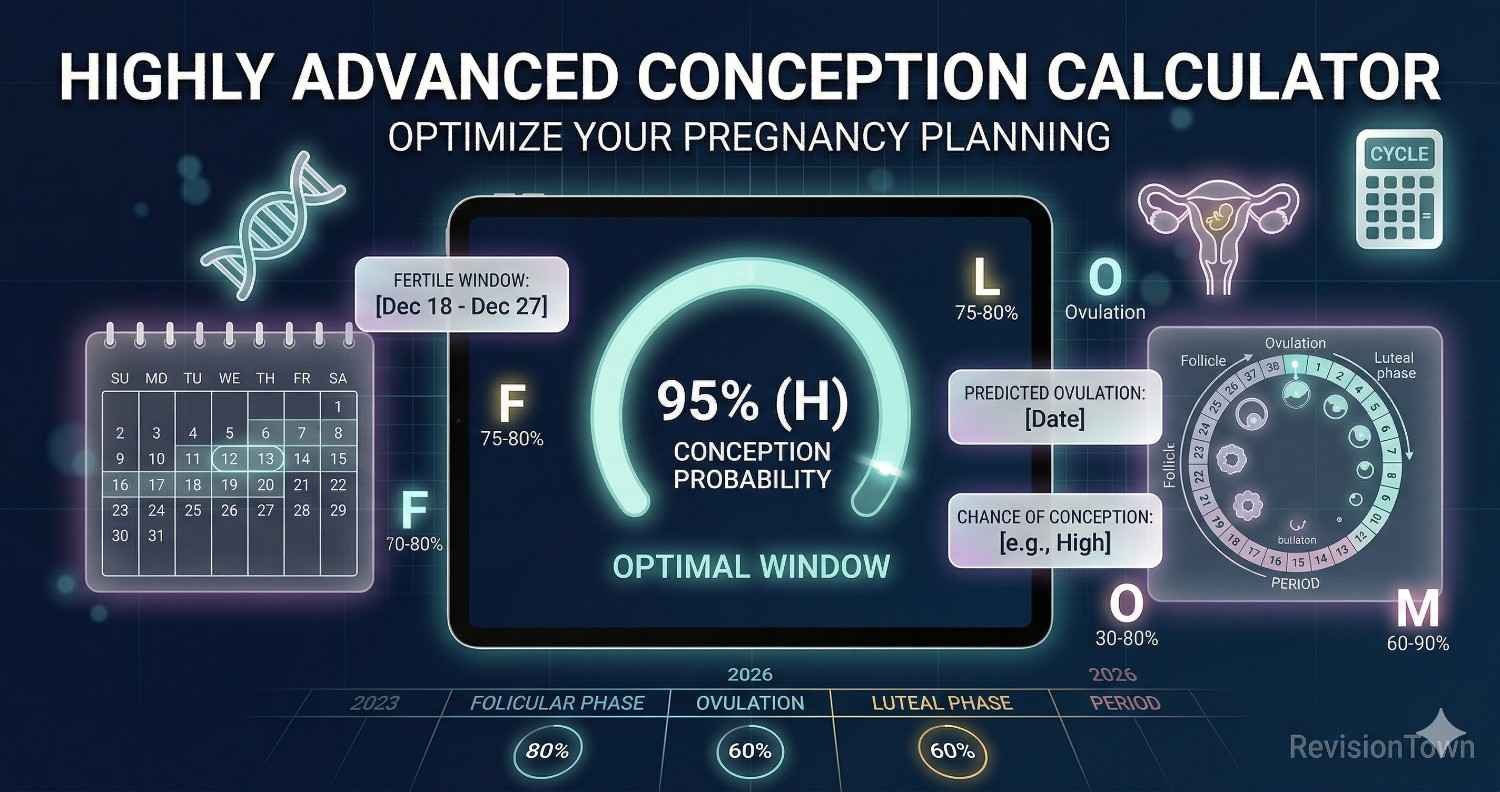
Highly Advanced Conception Calculator
Use this highly advanced conception calculator to estimate a likely conception date, fertile window, due date, pregnancy week, gestational age, trimester, and important pregnancy date ranges. You can calculate from the first day of the last menstrual period, a known conception or ovulation date, an estimated due date, or IVF timing. The results are designed for planning and education, not for confirming pregnancy or replacing clinical dating by a qualified healthcare professional.
Conception Date Calculator
Choose the date you know best. For natural cycles, the calculator uses cycle length and an estimated luteal phase to approximate ovulation. For IVF, select retrieval, fertilization, or transfer timing. Every result is an estimate because ovulation, fertilization, implantation, and fetal dating can vary.
Your results will appear here. Enter a known date to estimate conception timing, due date, pregnancy week, trimester, and a likely fertile window.
Date estimates can differ from ultrasound dating and clinical assessment. If dates are uncertain, symptoms are concerning, or pregnancy care decisions depend on timing, speak with an obstetric clinician, midwife, or qualified healthcare provider.
What a Conception Calculator Can and Cannot Tell You
A conception calculator estimates the most likely time fertilization may have happened. It does this by working backward or forward from dates such as the first day of the last menstrual period, a known ovulation date, an estimated due date, or IVF transfer information. The result is useful for planning, understanding pregnancy timing, and organizing questions for prenatal care. It is not a way to prove exactly when conception occurred in every situation.
Exact conception timing is often uncertain in natural cycles. Ovulation does not always happen on day 14. Sperm can survive in the reproductive tract for several days, and an egg is usually fertilizable for a shorter period after ovulation. This means intercourse several days before ovulation may lead to fertilization later. A calculator can estimate a likely fertile window, but it cannot identify one exact intercourse date as the cause of pregnancy unless assisted reproduction timing or very limited exposure history makes the situation clearer.
Pregnancy dating also uses a special convention: pregnancy weeks are usually counted from the first day of the last menstrual period, not from the day fertilization occurred. That is why someone can be called 4 weeks pregnant even though conception may have happened about 2 weeks earlier. This convention is used because the last menstrual period is often easier to identify than ovulation or fertilization. Ultrasound, especially early ultrasound, may later confirm or revise the estimated date.
This page is focused on conception-date estimation. For a broader pregnancy timeline, use the Highly Advanced Pregnancy Calculator. For a direct due date workflow, use the Highly Advanced Due Date Calculator. If you are tracking ovulation before pregnancy, the Highly Advanced Ovulation Calculator is the better starting point.
Short answer: A conception calculator estimates a likely fertilization date or fertile window. It cannot confirm pregnancy, prove exact conception timing, or replace a clinical due date based on medical history and ultrasound.
Core Date Formulas
Most pregnancy date calculations are built from a few standard relationships. A pregnancy is commonly estimated as 280 days, or 40 weeks, from the first day of the last menstrual period. When conception or fertilization is known, the estimated due date is commonly calculated as about 266 days, or 38 weeks, after that date. Cycle length matters because ovulation often occurs about one luteal phase before the next period, not always exactly 14 days after the last period begins.
\[Estimated\ Ovulation = LMP + (Cycle\ Length - Luteal\ Phase)\]
\[Estimated\ Due\ Date = LMP + 280\ days\]
\[Estimated\ Due\ Date = Conception + 266\ days\]
\[Gestational\ Age = Reference\ Date - LMP\ Equivalent\]
For a 28-day cycle and a 14-day luteal phase, ovulation is estimated around day 14. For a 32-day cycle with the same luteal phase, ovulation is estimated around day 18. For a 24-day cycle, ovulation may be estimated around day 10. These are simplified estimates. Real cycles can vary from month to month because of stress, illness, travel, sleep disruption, breastfeeding, stopping hormonal contraception, perimenopause, polycystic ovary syndrome, thyroid disorders, and other factors.
The calculator also gives an estimated fertile window. A standard planning window includes the ovulation day and the five days before it, because sperm may remain capable of fertilization for several days. The wider setting adds extra uncertainty around ovulation. This is useful when cycles are irregular or when a person wants a broader planning range rather than a narrow estimate.
Conception, Ovulation, and Implantation
Ovulation is the release of an egg from the ovary. Fertilization usually happens when sperm meets the egg after ovulation, commonly in the fallopian tube. Conception is often used in everyday language to mean fertilization, although some medical and legal contexts may use terms differently. Implantation is a later step, when the early embryo attaches to the uterine lining. These events are related, but they do not all happen on the same day.
The fertile window exists because sperm and egg have different survival times. Intercourse before ovulation can still lead to fertilization if sperm are present when the egg is released. Intercourse after the egg is no longer viable is less likely to result in conception. That is why the calculator does not treat the conception estimate as a single guaranteed date. A likely window is usually more honest than one exact answer.
Implantation often occurs several days after fertilization. Pregnancy tests detect human chorionic gonadotropin, commonly called hCG, which rises after implantation begins. Testing too early can produce a negative result even if conception occurred because hCG may not yet be high enough. A missed period is often a more reliable time to test than a very early date after suspected ovulation.
If pregnancy timing is medically important, clinical evaluation matters. Early ultrasound can help estimate gestational age. IVF timing can also provide a more precise reference because fertilization or embryo age is known. Natural conception estimates are usually less exact because ovulation and fertilization are not directly observed.
Last Menstrual Period Method
The last menstrual period method begins with the first day of the last normal menstrual period. This date is used as the start of gestational age even though conception usually happens later. For many people with regular cycles, this method gives a reasonable starting estimate. It is also the reason pregnancy is described as lasting about 40 weeks from the last period, while fetal development from conception is closer to 38 weeks.
The standard due date estimate from the last menstrual period is \(LMP + 280\ days\). This assumes a 28-day cycle with ovulation around day 14. The calculator improves the conception estimate by using your average cycle length and luteal phase. For example, if the first day of the last period was March 1, the cycle length is 30 days, and the luteal phase is 14 days, ovulation is estimated about 16 days after March 1. That gives an estimated ovulation and conception date near March 17, with a fertile window in the days leading up to that date.
LMP dating can be less reliable when periods are irregular, the last bleed was not a true period, cycles are very long or short, hormonal contraception was recently stopped, breastfeeding is affecting ovulation, or the date is uncertain. In those cases, early ultrasound or clinical judgment may be more useful than a calculator. A calculator can still help you understand the likely range, but it should not be treated as the final medical date.
Known Conception or Ovulation Date Method
If a conception date or ovulation date is known with reasonable confidence, the calculator can estimate a due date by adding 266 days. This method is often more intuitive because it starts with the likely fertilization date rather than the last period. It can be useful when ovulation was tracked with luteinizing hormone tests, basal body temperature, cervical mucus, ultrasound monitoring, or a single well-defined fertile event.
Even with careful tracking, “known conception date” can be slightly misleading in natural cycles. Ovulation tests predict ovulation; they do not show fertilization. Basal body temperature confirms that ovulation likely happened after the fact; it does not prove the exact hour. Intercourse timing identifies exposure; it does not prove which exposure led to fertilization if there were multiple possible days. For these reasons, the calculator gives a likely estimate and window instead of a claim of certainty.
This method is most precise when the date is tied to assisted reproduction or clinical monitoring. For natural cycles, it is still helpful, but the result should be understood as an estimate. If the calculated due date differs from a clinician’s ultrasound-based due date, ask which date should be used for care decisions.
Due Date Backward Method
Sometimes the only date available is an estimated due date from a previous calculator, healthcare visit, or ultrasound. In that case, a conception calculator can work backward. The estimated conception date is approximately \(Due\ Date - 266\ days\). The LMP equivalent for pregnancy-week counting is approximately \(Due\ Date - 280\ days\). This backward method is useful when you want to understand the likely conception period from a known expected delivery date.
The backward method inherits the uncertainty of the due date itself. If the due date came from a rough LMP estimate, the conception estimate will also be rough. If the due date came from an early ultrasound or IVF information, it may be more reliable. Later ultrasound estimates are usually less precise for dating because individual fetal growth varies more as pregnancy progresses.
Use the backward method for planning and understanding, not for making sensitive conclusions about exact timing. A due date represents the best available estimate of pregnancy timing, not a promise that birth will happen that day and not a precise timestamp of conception.
IVF and Embryo Transfer Timing
IVF dating can be more precise because embryo age and transfer timing are known. If the known date is egg retrieval or fertilization, the estimated due date is often calculated by adding 266 days. If the known date is a day 3 embryo transfer, the embryo is already about 3 days past fertilization, so the due date is estimated by adding about 263 days. If the known date is a day 5 blastocyst transfer, the due date is estimated by adding about 261 days.
\[EDD = Retrieval\ or\ Fertilization + 266\ days\]
\[EDD = Day\ 3\ Transfer + 263\ days\]
\[EDD = Day\ 5\ Transfer + 261\ days\]
These IVF calculations are still estimates for birth timing, but they can be more precise for pregnancy dating than natural-cycle LMP estimates. Your fertility clinic or obstetric clinician may provide an official estimated due date based on treatment records. Use that clinical date for medical scheduling, screening windows, and care decisions.
The Highly Advanced Pregnancy Conception Calculator may be useful if you want another pregnancy-specific date workflow. If the question is mostly ovulation planning before pregnancy, use the Highly Advanced Ovulation Calculator instead.
Gestational Age and Pregnancy Week
Gestational age is the pregnancy age counted from the LMP equivalent. It is usually written in weeks and days, such as 9 weeks 4 days. The calculator estimates gestational age on the reference date you choose. If you leave the reference date as today, it estimates how far along the pregnancy would be today. If you enter a future appointment date, it estimates the pregnancy week at that appointment.
Gestational age is not the same as embryonic or fetal age from conception. In a typical 28-day cycle, gestational age is about two weeks ahead of conception age. For example, a pregnancy at 8 weeks gestational age may be about 6 weeks after conception. This difference can confuse people when they compare pregnancy weeks to intercourse dates. The convention exists because the last menstrual period has historically been the most accessible starting point.
The calculator also labels the trimester. Many references group the first trimester through about week 12 or 13, the second trimester through week 27, and the third trimester from week 28 to birth. Exact boundary wording can vary slightly by source. The trimester label is useful for general orientation, but clinical care schedules should follow the healthcare provider’s timeline.
Fertile Window Interpretation
The fertile window is the group of days when intercourse could plausibly lead to conception. It is not only the ovulation day. Because sperm may survive for several days, the most useful window includes the days leading up to ovulation. The calculator’s standard setting estimates the window from five days before ovulation through ovulation day. The wider setting gives more room for cycle uncertainty.
If the calculator estimates ovulation on April 18, the standard fertile window may run approximately April 13 to April 18. This does not mean conception definitely happened on one of those dates, and it does not prove the exact day. It means those dates are biologically plausible based on the inputs. When cycles are irregular, the true window may be earlier or later.
For people trying to conceive, the fertile window can help time intercourse or insemination. For people already pregnant, it can help understand the likely timing. For people trying to make sensitive personal decisions about timing, it is important to remember that a calculator estimate is not proof. Clinical records, ultrasound dating, ovulation tracking records, and professional guidance may all matter.
Why Due Dates Are Estimates
An estimated due date is not a guaranteed birth date. It is a reference point used for prenatal care, screening windows, growth assessment, and planning. Many births occur before or after the due date. A normal term pregnancy covers a range, and individual timing varies. First pregnancies, family patterns, maternal health, fetal factors, and clinical decisions can all affect birth timing.
Due date accuracy depends on the information used. LMP estimates are useful when periods are regular and the date is known. Early ultrasound can be more reliable when LMP is uncertain or cycles are irregular. IVF dates can be very helpful because embryo timing is documented. Later pregnancy measurements can support growth assessment, but they are less ideal for assigning the original due date because babies naturally vary in size.
Once a clinician establishes an estimated due date, it is usually not changed casually. Frequent date changes can create confusion around screening windows and care decisions. If a calculator result differs from your clinical due date, use the clinical date for healthcare planning and ask your provider why that date was chosen.
Pregnancy Milestones by Date
Date estimates can help you understand major pregnancy milestones. The first positive pregnancy test often happens around the missed period, though timing varies by ovulation and implantation. The first prenatal visit commonly happens early in pregnancy, often after pregnancy is confirmed. Early ultrasound, if performed, may help assess dating and viability. Screening tests and anatomy scans occur in specific gestational-age windows, which is why accurate dating matters.
| Milestone | Typical timing | Why the date matters |
|---|---|---|
| Missed period and home test | Around 4 weeks gestational age in a typical cycle | hCG may be high enough for many urine tests, though early negatives can happen. |
| Early clinical visit | Often early in the first trimester | Confirms pregnancy, reviews history, medications, symptoms, and prenatal planning. |
| Dating ultrasound | Often most useful in the first trimester | Can help confirm or revise estimated gestational age when dates are uncertain. |
| Second-trimester anatomy scan | Commonly around the middle of pregnancy | Assesses fetal anatomy and growth, but is not usually the best first dating method. |
| Term window | Late pregnancy around the due date range | Birth may occur before or after the estimated due date. |
The exact schedule depends on country, clinic, risk level, medical history, and provider recommendations. Use the calculator to understand the timeline, then follow the prenatal schedule given by your healthcare team.
Early Pregnancy Testing and Timing
Pregnancy tests look for hCG, a hormone that rises after implantation. Testing before implantation or very soon after it can produce a negative result even if fertilization occurred. This is why testing around or after the missed period is usually more reliable than testing immediately after a suspected conception date. First-morning urine can be more concentrated, which may help early detection.
A negative test followed by no period may need repeat testing. A positive test should be followed by appropriate prenatal care. If there is heavy bleeding, severe pain, one-sided pelvic pain, fainting, shoulder pain, or other concerning symptoms, seek medical attention promptly. Calculators cannot rule out complications such as ectopic pregnancy or miscarriage.
Do not use symptoms alone to confirm pregnancy. Breast tenderness, fatigue, nausea, spotting, mood changes, and cramping can overlap with premenstrual symptoms or other conditions. Testing and clinical care provide better information than symptom guessing.
Irregular Cycles and Uncertain Dates
Irregular cycles make conception estimates less certain. If cycle length varies widely, the average cycle length may not describe the month when conception occurred. Ovulation can happen earlier or later than expected, and the luteal phase can also vary. In this situation, a calculator can provide a broad estimate, but early ultrasound or clinical assessment may be more useful for dating.
Uncertain bleeding can also affect dating. Not every bleed is a true menstrual period. Some people have spotting around ovulation, implantation, hormonal changes, or early pregnancy. If the date entered as the last period was not actually the start of a normal period, LMP dating may be off. This is another reason medical history and ultrasound can matter.
If you recently stopped hormonal contraception, cycles may take time to become predictable. If you are breastfeeding, approaching perimenopause, or have a condition that affects ovulation, cycle-based estimates may be less reliable. Use a wider fertile window and discuss timing with a healthcare provider when the date affects care decisions.
First Prenatal Care Steps
Once pregnancy is suspected or confirmed, early prenatal care helps establish dating, review health history, and plan next steps. A clinician may ask about the last menstrual period, cycle regularity, prior pregnancies, medical conditions, medications, supplements, allergies, family history, and symptoms. They may order blood tests, urine tests, ultrasound, or other screening depending on timing and risk factors.
Folic acid or a prenatal vitamin is commonly recommended before and during early pregnancy because early neural tube development happens before many people know they are pregnant. Medication review is also important. Some medicines and supplements are safe, some need adjustment, and some should be avoided. Do not stop prescribed medication without medical guidance; ask promptly so benefits and risks can be reviewed.
If you have diabetes, high blood pressure, thyroid disease, kidney disease, autoimmune disease, seizure disorder, prior pregnancy complications, fertility treatment, recurrent loss, or other medical concerns, early contact with a healthcare provider is especially important. A calculator can organize dates, but clinical care personalizes the plan.
Healthy Planning After a Positive Test
After a positive pregnancy test, the first practical step is to confirm what kind of care you need and when. Many people schedule a prenatal appointment, begin or continue prenatal vitamins, avoid alcohol, review medications, and consider lifestyle changes that support pregnancy. Nutrition, hydration, sleep, movement, and stress support all matter, but recommendations should be individualized when medical conditions exist.
Exercise is often beneficial in uncomplicated pregnancies, but the right type and intensity depend on pre-pregnancy fitness, symptoms, and provider guidance. Some activities may need modification, especially those with high fall risk, abdominal trauma risk, overheating, or lying flat later in pregnancy. Nutrition needs also change, but “eating for two” does not mean doubling intake. Pregnancy weight-gain goals depend on pre-pregnancy body mass index and clinical factors; the Highly Advanced Pregnancy Weight Gain Calculator can help with general planning once your provider has confirmed the pregnancy timeline.
If you are using the calculator before pregnancy, cycle tracking can be helpful. The Highly Advanced Period Calculator can help organize cycle dates, and the ovulation calculator can estimate fertile timing. If you are already pregnant and want a week-by-week age estimate, the Gestational Age Calculator may be useful.
Common Mistakes With Conception Dates
| Mistake | Why it matters | Better approach |
|---|---|---|
| Assuming ovulation always happens on day 14 | Cycle length and ovulation timing vary. | Use cycle length, ovulation tracking, or clinical dating when available. |
| Treating the calculator result as exact | Natural conception timing is usually a range, not a single proven date. | Use the likely fertile window and confirm pregnancy dating clinically. |
| Confusing gestational age with fetal age | Pregnancy weeks usually count from LMP, about two weeks before conception. | Use gestational age for pregnancy care and conception age only for explanation. |
| Using late ultrasound as the first dating source | Later fetal size varies more between pregnancies. | Ask a clinician which date is the best obstetric estimate. |
| Ignoring irregular cycles | A cycle average may not describe the conception cycle. | Use a wider range and seek medical dating if timing matters. |
| Using due date as a guaranteed birth date | Birth commonly occurs before or after the estimated date. | Use the due date as a care-planning reference, not a promise. |
How This Calculator Differs From Related Tools
This page estimates conception timing and related pregnancy dates from several possible starting points. A due date calculator starts with delivery timing. An ovulation calculator focuses on predicting fertile days before pregnancy. A gestational age calculator focuses on how far along a pregnancy is on a given date. A period calculator focuses on menstrual-cycle timing. These tools overlap, but each has a different main question.
For date arithmetic outside pregnancy, the Date Calculator, Days Between Two Dates, and Add or Subtract from a Date tools may be useful. For classroom biology background, RevisionTown also has pregnancy and reproduction learning resources such as Pregnancy IGCSE and O Level and Fertilisation, Development and Gestation.
Keeping the question clear helps avoid confusion. If you want to know “When might conception have happened?”, use this page. If you want to know “When might the baby be due?”, use the due date calculator. If you want to know “When am I likely to ovulate?”, use the ovulation calculator. If you want to know “How many weeks pregnant am I?”, use a gestational age tool or your provider’s dating information.
Clinical Dating vs Calculator Dating
A calculator gives a mathematical estimate from the information entered. Clinical dating uses a broader set of information: menstrual history, cycle regularity, assisted reproduction records, physical findings, ultrasound measurements, and the clinician’s judgment about which source is most reliable. This difference matters because prenatal care depends on gestational age. Screening windows, growth assessment, viability discussions, medication timing, and birth planning all use the best available pregnancy date.
If your calculator result and healthcare provider’s result differ, that does not automatically mean either is careless. They may be using different assumptions. The calculator may be using an average cycle and luteal phase. The clinician may be using an ultrasound measurement, IVF record, or more detailed menstrual history. If the difference is meaningful, ask which date is being used for care and why. Once an official estimated due date is established, it is usually best to use that date consistently for appointments and medical decisions.
Clinical dating is especially important when the last menstrual period is uncertain, cycles are irregular, ovulation was medically induced, pregnancy followed fertility treatment, bleeding occurred in early pregnancy, or the first positive test date does not fit the expected timeline. These situations do not make calculator estimates useless, but they do make them less definitive. Use the calculator to understand possibilities and use clinical care to establish the working date.
Ultrasound Dating and Why Timing Matters
Ultrasound can help estimate gestational age, especially early in pregnancy. In the first trimester, embryo or fetal measurements tend to be more useful for dating because growth variation is smaller. Later in pregnancy, babies naturally vary more in size, so measurements are better for monitoring growth than for deciding the original conception date. This is why a first-trimester ultrasound may confirm or revise a due date when LMP is uncertain, while a much later scan may not be used the same way.
The calculator cannot see ultrasound measurements. It cannot measure crown-rump length, confirm fetal heartbeat, check whether the pregnancy is located in the uterus, or assess development. It also cannot distinguish between a true period and early pregnancy bleeding. If ultrasound dating differs from a calculator estimate, the clinical date may be more appropriate, particularly if the scan was performed early and interpreted by a qualified professional.
Ultrasound dating also has limits. It is not a perfect timestamp of conception. It estimates gestational age from fetal size and development, then translates that into a due date. The result is usually more clinically useful than a rough cycle estimate when dates are uncertain, but it is still an estimate. The phrase “estimated due date” is deliberate.
Understanding the Uncertainty Range
The most honest conception result is usually a range. If ovulation is estimated on one date, conception may have occurred from intercourse before that date, with fertilization happening when the egg and sperm met. If cycles are regular and ovulation is tracked, the range may be narrower. If cycles are irregular, the range may be wider. If the known date is IVF fertilization or embryo transfer, the fertilization reference is much clearer, but the delivery date is still an estimate.
Uncertainty increases when the input date is less reliable. A remembered LMP from months ago may be off by a day or more. A bleed may be mistaken for a period. Cycle length may not be the same every month. Ovulation may shift because of stress, illness, travel, or hormonal changes. Home ovulation tests can identify a hormone surge but not the exact time of egg release. Basal body temperature can suggest ovulation after it happens but can be affected by sleep, illness, and measurement timing.
For sensitive timing questions, avoid drawing strong conclusions from one calculator result. Use a wider window and consider clinical dating. If the question has legal, relationship, or medical importance, a calculator is not enough. The output can help organize questions, but it should not be presented as proof of an exact day. Biology rarely provides that level of certainty in natural cycles.
When discussing conception dates with a clinician, bring the dates you know: first day of last normal period, typical cycle length, positive ovulation test dates, basal body temperature shift, intercourse or insemination dates if relevant, first positive pregnancy test, bleeding episodes, IVF transfer details, and any ultrasound reports. More complete information helps the clinician interpret the timeline.
Practical Scenarios
Regular 28-day cycle
For a regular 28-day cycle, the calculator usually estimates ovulation around day 14 if the luteal phase is set to 14 days. The fertile window begins several days before that. The due date estimate from LMP is about 280 days after the first day of the last period. This is the simplest scenario and the one many basic calculators assume.
Longer cycle
For a 34-day cycle with a 14-day luteal phase, ovulation may be estimated around day 20. If a basic calculator assumes day 14, it may place conception almost a week too early. This can shift the due date estimate if conception-based dating is used. Cycle-adjusted calculations are therefore more useful for people whose cycles are consistently longer than 28 days.
Shorter cycle
For a 24-day cycle with a 14-day luteal phase, ovulation may be estimated around day 10. A calculator that assumes day 14 may place conception too late. Short cycles can also make the fertile window begin soon after bleeding ends. If cycles are very short, irregular, or changing, medical advice may be helpful to understand ovulation patterns.
Known IVF transfer date
For IVF, embryo age is known. A day 5 transfer means the embryo is already about 5 days beyond fertilization, so the due date estimate adds fewer days to the transfer date than it would to a fertilization date. This is why the calculator includes separate IVF options. Use clinic-provided dates for official care planning.
Appointment Planning From the Results
A pregnancy date calculator can help you prepare for appointments, but it should not replace scheduling advice from your provider. If the calculator suggests you are early in pregnancy, you can use the estimated week to ask when your first visit, blood work, or ultrasound may be appropriate. If you are later than expected, you may need care sooner. If dates are uncertain, say so when scheduling.
For a first appointment, it is useful to bring a list of dates and questions. Include the first day of the last normal period, average cycle length, any ovulation tracking, positive test dates, medications, supplements, medical conditions, prior pregnancy history, and symptoms. If you used IVF, bring retrieval, fertilization, embryo transfer day, embryo age, and clinic due date if provided. This information can make the visit more efficient.
Date estimates can also help you understand screening windows. Some prenatal tests are offered during specific gestational-age ranges. If the pregnancy is dated incorrectly, a screening test might be scheduled too early or too late. This is one reason clinical dating matters. Use calculator dates for planning questions, then confirm exact windows with the clinician.
When to Seek Prompt Medical Care
Most calculator users are looking for dates, but symptoms should always take priority over date estimates. Seek prompt medical care for heavy bleeding, severe abdominal or pelvic pain, shoulder pain, fainting, dizziness, fever, severe vomiting with dehydration, one-sided pain, or symptoms that feel alarming. These symptoms need clinical assessment and cannot be interpreted by a date calculator.
If pregnancy is confirmed and there is severe pain or heavy bleeding, do not wait for a due date calculation. If there is reduced fetal movement later in pregnancy, contact maternity care promptly according to local guidance. If you have a history of ectopic pregnancy, miscarriage, infertility treatment, or high-risk pregnancy, ask your provider how early you should be seen.
Even when symptoms are mild, it is reasonable to ask for guidance if you are worried. Early pregnancy can be emotionally stressful, especially when dates are uncertain. A calculator can answer arithmetic questions; healthcare professionals can assess health, risk, and next steps.
Using the Result Before Trying to Conceive
People who are not yet pregnant can use the same date logic for planning. If you know your cycle length, the calculator can illustrate where ovulation may fall and how the fertile window is related to the next expected period. This can help you decide when to use ovulation tests, when to time intercourse or insemination, and when a pregnancy test may be more reliable.
Pre-pregnancy planning is also a good time to review folic acid, medications, chronic conditions, vaccines, lifestyle factors, and any fertility concerns with a clinician. If cycles are very irregular, very long, very short, absent, or accompanied by significant pain or heavy bleeding, medical evaluation may be useful before relying on predicted fertile windows.
If you are trying to avoid pregnancy, do not use a conception calculator as a sole contraceptive method. Fertile-window estimates can be wrong when ovulation shifts. If pregnancy prevention is the goal, use a reliable contraception method and professional advice. A pregnancy date calculator is a planning and education tool, not a protective method.
Privacy and Sensitive Timing Questions
Conception timing can be emotionally sensitive. People may use a calculator because they are excited, anxious, uncertain, or trying to understand a complicated personal timeline. The most important point is that natural conception estimates are ranges. If two possible dates are close together, a calculator may not be able to separate them. Even ultrasound dating may not identify the exact conception day in natural cycles.
When the question is sensitive, avoid overinterpreting a single output. Save the dates you know, document the calculator assumptions, and speak with a qualified professional if the timing matters. In some cases, only later testing or specialist advice can address the underlying question. The calculator can clarify the likely biological window, but it should not be used to make accusations, prove paternity, or make medical decisions without appropriate support.
It is also normal for dates to feel confusing because pregnancy weeks include the time before conception. A person may be described as 6 weeks pregnant even if conception likely occurred about 4 weeks earlier. This does not mean the dates are inconsistent; it reflects the standard gestational-age convention.
If uncertainty remains after using the calculator, keep a written date list and bring it to care visits. Clear records make professional dating discussions easier.
Frequently Asked Questions
Can this calculator tell the exact day I conceived?
No. It estimates the likely conception date or fertile window from the information entered. In natural cycles, exact fertilization timing is often uncertain because ovulation varies and sperm may survive for several days.
Why is pregnancy counted from my last period?
Pregnancy is commonly counted from the first day of the last menstrual period because that date is often easier to identify than ovulation or fertilization. This means gestational age is usually about two weeks ahead of time since conception in a typical cycle.
How do I calculate a due date from conception?
A common estimate adds 266 days, or 38 weeks, to the conception or fertilization date. For pregnancy-week counting, the LMP equivalent is usually about 14 days before conception in a typical cycle.
How does cycle length affect conception estimates?
Cycle length shifts estimated ovulation. With a 28-day cycle and a 14-day luteal phase, ovulation is estimated around day 14. With a longer cycle, ovulation often happens later. With a shorter cycle, it may happen earlier.
Is IVF dating more accurate?
IVF dating can be more precise because fertilization or embryo age is known. Clinics usually provide an official estimated due date from retrieval, fertilization, or embryo transfer records.
What if my periods are irregular?
Use the calculator as a broad estimate only. Irregular cycles make ovulation harder to predict, so early ultrasound or clinical dating may be more reliable.
When should I take a pregnancy test?
Many home tests are more reliable around or after the missed period. Testing too early can produce a negative result because hCG may not yet be high enough. Follow test instructions and seek care if symptoms are concerning.
Should I use the calculator due date or my doctor’s date?
Use the date given by your healthcare provider for medical planning. Clinical dating can incorporate menstrual history, ultrasound, IVF records, and other relevant information.
Key Takeaway
A conception calculator is most useful when it is treated as a careful estimate. It can connect LMP, ovulation, conception, due date, trimester, and gestational age into one timeline, but it cannot confirm the exact fertilization day or replace clinical dating. Use the result to understand the likely window, organize questions, and plan appointments, then rely on qualified prenatal care for medical decisions.