Cycle tracking calculator and practical fertility guide
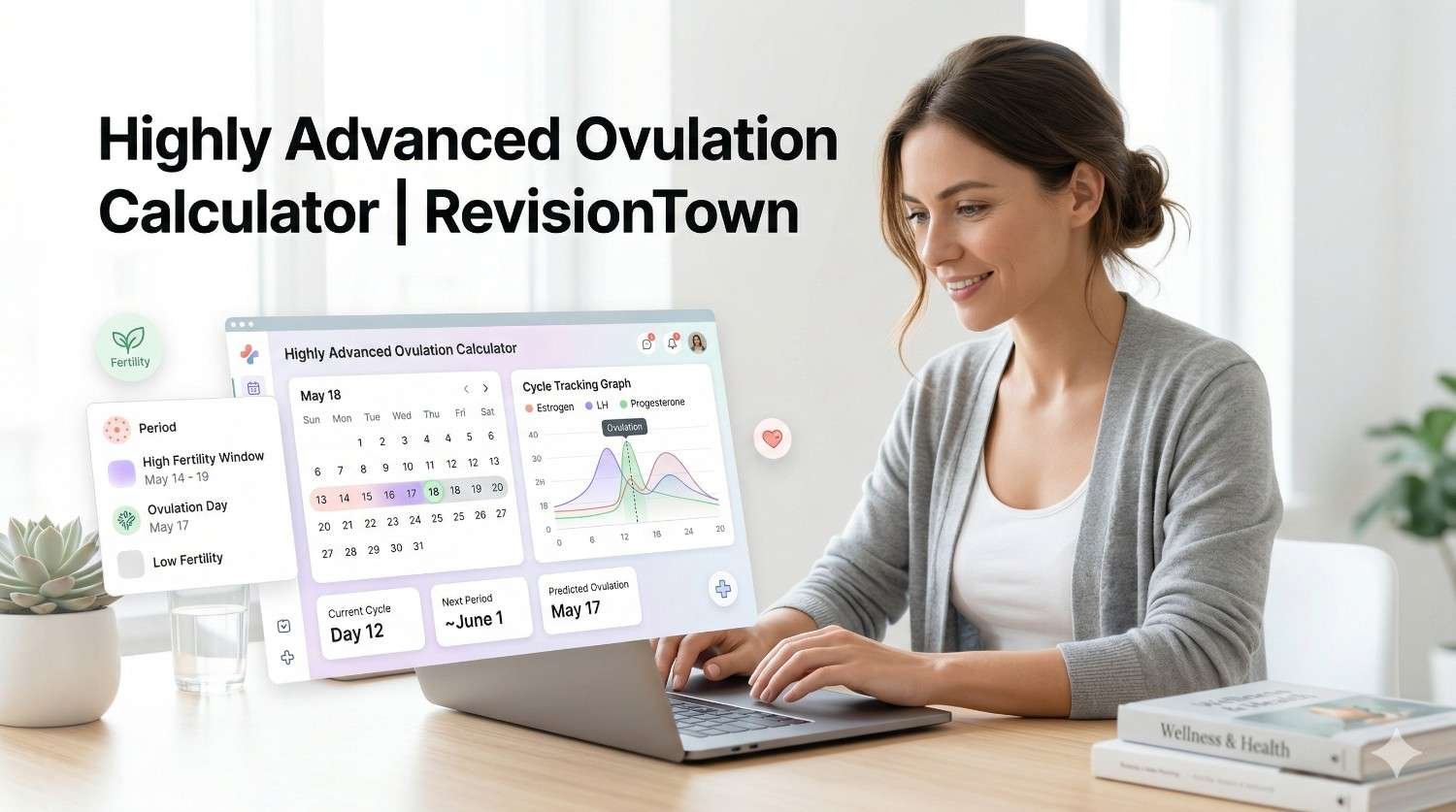
Highly Advanced Ovulation Calculator
Estimate your ovulation date, fertile window, peak fertility days, likely next period, and useful testing dates from the first day of your last period, your average cycle length, luteal phase length, and cycle variation. This page is written for readers who want a careful, practical way to understand cycle timing without confusing ovulation tracking with a pregnancy due date calculator or a conception date calculator.
Ovulation and Fertile Window Calculator
Enter your best available cycle information. If you do not know your luteal phase length, keep the default of 14 days. If your cycle length often changes, use the variation setting so the estimate shows a wider planning range.
Core Formula
The calculator starts with the standard calendar estimate:
For a 28-day cycle with a 14-day luteal phase, ovulation is estimated around cycle day 14. If the luteal phase is 13 days in a 30-day cycle, ovulation is estimated around cycle day 17.
What You Get
- Ovulation date
- Fertile window
- Peak days
- Next period estimate
- Testing dates
- Cycle forecast table
Important Use Note
This tool estimates timing from cycle dates. It cannot confirm that ovulation happened, diagnose a cycle problem, guarantee pregnancy, or replace a healthcare professional. Calendar estimates are especially limited when cycles are irregular, recently affected by hormonal contraception, postpartum changes, breastfeeding, illness, stress, or a known condition such as PCOS.
What an Ovulation Calculator Actually Estimates
An ovulation calculator is a date-estimation tool. It uses the first day of your last period as cycle day 1, then estimates the point in the cycle when an ovary may release an egg. The result is useful because ovulation sits near the center of fertility timing: intercourse before ovulation can lead to pregnancy because sperm may remain viable in the reproductive tract for several days, while the released egg is available for a much shorter time. A calculator cannot see hormones, confirm follicle release, or detect whether a cycle was anovulatory. It simply converts your cycle history into a calendar estimate that can help you plan when to pay closer attention to body signs or ovulation tests.
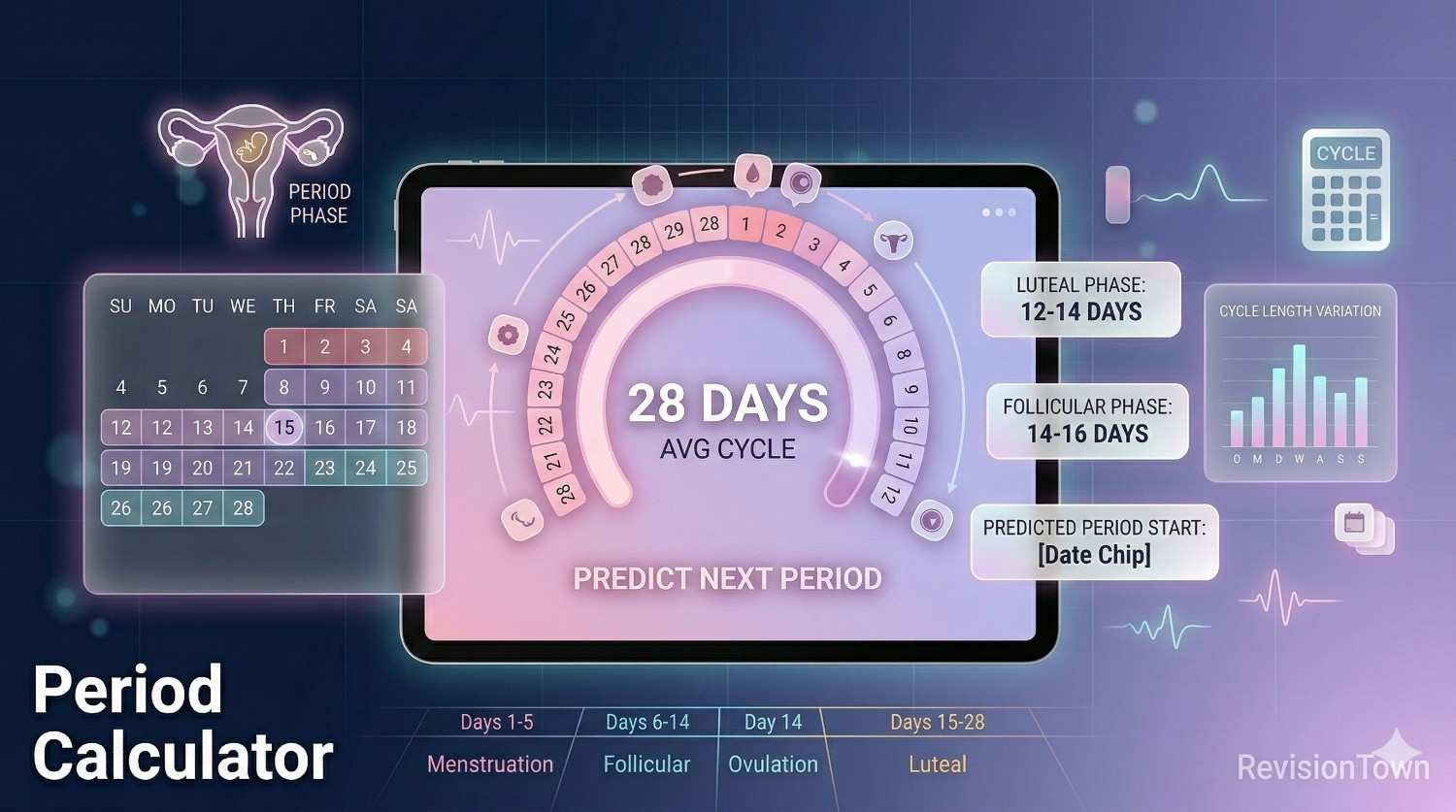
The most important distinction is that ovulation prediction is not the same as pregnancy dating. This page targets the question, "When might I ovulate in this cycle?" A conception calculator works from pregnancy dates or known timing to estimate when conception may have occurred. A due date calculator estimates a birth-date range once pregnancy timing is known or assumed. A period calculator focuses on the next menstrual bleed. Those tools overlap in the calendar data they use, but each answers a different user intent. Keeping those purposes separate makes the result easier to interpret.
For many people, ovulation happens roughly 12 to 14 days before the next period. That is why luteal phase length matters. A simple calculator that always assumes day 14 can be misleading for a 24-day cycle, a 33-day cycle, or a person whose luteal phase is often 12 or 15 days. The highly advanced version above lets you adjust luteal phase length, forecast several cycles, and add a variation range so you can see that the date is a working estimate rather than a promise. If you are tracking to conceive, the result should guide timing and observation, not create pressure around one exact day.
Understanding Cycle Day, Cycle Length, and Luteal Phase
Cycle day 1 is the first day of full menstrual bleeding, not spotting. The average cycle length is the number of days from cycle day 1 to the day before the next period starts. If your period begins on March 1 and the next period begins on March 29, the cycle length is 28 days. If the next period begins on March 31, the cycle length is 30 days. When you enter an average cycle length, it is best to use data from several recent natural cycles rather than one unusually short or long month.
The luteal phase is the part of the cycle after ovulation and before the next period. It is dominated by progesterone, which helps prepare and maintain the uterine lining. In many cycles, the luteal phase is more stable than the follicular phase, which is the pre-ovulation part of the cycle. Stress, travel, illness, weight changes, intense training, and hormonal shifts often delay ovulation by extending the follicular phase; the period then arrives later because ovulation happened later. This is why a late period can sometimes reflect late ovulation rather than pregnancy.
For example, suppose the first day of the last period was April 3, the average cycle length is 30 days, and the luteal phase is 14 days. The estimated ovulation day is cycle day 16 because \(30 - 14 = 16\). Counting forward from April 3 gives an estimated ovulation date around April 18 if April 3 is treated as day 1. If the luteal phase is 12 days, ovulation shifts later to cycle day 18. If the luteal phase is 16 days, ovulation shifts earlier to cycle day 14. Small changes in this input can move the estimate by several days, so it is worth using your best information.
Cycle length should also be interpreted as a pattern, not a fixed identity. A person may say they have a 28-day cycle because that is the textbook number, while their actual recent cycles are 26, 30, 29, 27, and 31 days. In that case, the mean is close to 29 days, but the variation is meaningful. The calculator's variation field widens the fertile-window display to account for this uncertainty. If your cycles vary by more than about a week from month to month, calendar prediction becomes much less reliable and body signs or clinician guidance may be more useful.
What the Fertile Window Means
The fertile window is the group of days in a cycle when intercourse can lead to pregnancy. It is wider than the life of the egg because sperm may survive for several days when cervical mucus is fertile and supportive. The egg itself usually remains available for a much shorter period after release. A practical planning window commonly includes the five days before ovulation, the day of ovulation, and sometimes the day after ovulation. This calculator shows a broad window and highlights peak days so users can see both the wider opportunity and the days closest to ovulation.
Peak fertility does not mean the other fertile-window days are irrelevant. It means timing is usually strongest when sperm are already present before the egg is released. People trying to conceive often find it more practical to plan intercourse every day or every other day through the fertile window rather than waiting for one exact ovulation date. This approach reduces the effect of a prediction error, supports sperm availability, and removes some of the stress that can come from trying to hit a single date on a calendar.
The day after ovulation is included as a cautious educational range, but the chance generally drops quickly because the egg has a limited lifespan. For people trying to avoid pregnancy, this is one reason a calculator alone is not enough. Ovulation can occur earlier or later than predicted, bleeding may be misunderstood, and cycles can change without warning. Fertility awareness for pregnancy prevention requires disciplined daily charting and instruction; a date calculator is only an informational aid. If avoiding pregnancy matters, use a reliable contraception plan discussed with a qualified professional.
| Cycle concept | What it means | How to use it |
|---|---|---|
| Cycle day 1 | The first day of full menstrual bleeding. | Use this date as the starting point for the calculator and for your cycle chart. |
| Average cycle length | The number of days from one period start to the next period start. | Calculate from several recent natural cycles, not from a single unusual month. |
| Luteal phase | The phase after ovulation and before the next period. | Use 14 days if unknown, then refine if charting suggests a different pattern. |
| Fertile window | The days around ovulation when pregnancy can occur. | Use it as a planning range, then combine it with cervical mucus, LH testing, or temperature data. |
| Peak days | The days closest to ovulation when timing is usually most useful for conception. | Plan intercourse before ovulation rather than waiting until the date has passed. |
Why Calendar Prediction Can Be Useful and Limited
Calendar prediction is useful because it is simple, free, and fast. You do not need a device, laboratory test, subscription, or complex chart to get a starting estimate. If your cycles are fairly regular, it can tell you when to begin ovulation predictor tests, when to observe cervical mucus more closely, and when the most fertile part of the cycle may be approaching. It is also helpful for education: seeing the fertile window on a calendar makes the relationship between menstruation, ovulation, and the next period easier to understand.
The limitation is that a period calendar predicts from past pattern, while ovulation is a current biological event. A calculator may estimate ovulation on cycle day 14, but the body may ovulate on day 12, day 18, or not at all in that cycle. The date can shift because of normal variation or because the body responds to stress, illness, sleep disruption, travel, weight change, intense exercise, medication, postpartum hormone changes, breastfeeding, perimenopause, or a condition affecting ovulation. This is why the output should say "estimated" and why a wider range is often more honest than one exact day.
Another limitation is that bleeding patterns can be confusing. Spotting before a period, withdrawal bleeding after hormonal contraception, bleeding in early pregnancy, and irregular bleeding from a medical condition can all be mistaken for a standard period start. If the starting date is wrong, the whole calculation shifts. When your goal is cycle understanding, one unusual month may not matter much. When your goal is pregnancy timing or pregnancy prevention, wrong assumptions can matter. Use the result as a guide and pay attention to body signs and clinical advice when timing has real consequences.
For students learning reproductive biology, this calculator is also a practical example of how a simple model differs from a measured event. The model is arithmetic: period start plus an estimated number of days. The biological event is hormonal and physical: follicle growth, an LH surge, follicle rupture, egg release, and progesterone rise. The model is helpful because it makes planning easier. It is incomplete because the body is not a clock. Good interpretation means using the model while remembering its assumptions.
Ovulation Signs to Track Alongside the Calculator
Cervical mucus is one of the most useful signs to track because it changes before ovulation. After menstruation, some people have dry days or thick, sticky mucus. As estrogen rises before ovulation, mucus often becomes wetter, clearer, stretchier, and more slippery. Many people describe the most fertile mucus as similar to raw egg white. This type of mucus helps sperm move and survive. When you see fertile-quality mucus in the days predicted by the calculator, confidence in the fertile-window estimate improves. After ovulation, progesterone usually makes mucus thicker, drier, or less noticeable.
Basal body temperature, often abbreviated as BBT, is different because it usually confirms ovulation after it happens rather than predicting it in advance. Progesterone causes a small sustained rise in resting temperature after ovulation. To use BBT, measure your temperature immediately after waking, before getting out of bed, speaking, drinking, or moving around. Record it daily with enough precision to see a pattern. A single temperature is not very meaningful; a sustained shift across multiple days is more useful. BBT can help you learn whether your calculator estimate matches your own cycle pattern over time.
Ovulation predictor kits detect a rise in luteinizing hormone, often called LH. A positive test suggests ovulation may be approaching soon, although the timing varies and some conditions can make results harder to interpret. If your calculator predicts ovulation around day 15, you might begin testing a few days earlier so you do not miss a short LH surge. People with irregular cycles may need to test for more days. People with PCOS may see confusing positive or near-positive results because LH patterns can be different. The test is useful, but it is still one piece of the picture.
Some people feel one-sided pelvic discomfort around ovulation. This is sometimes called mittelschmerz. Others notice breast tenderness, bloating, a brief change in mood or libido, or light spotting. These signs can be helpful when they appear in a consistent pattern, but they are less reliable than cervical mucus, LH testing, and temperature charting. Pelvic pain can also come from digestion, ovarian cysts, infection, endometriosis, or other causes. New, severe, persistent, or unusual pain should not be treated as routine ovulation pain without medical evaluation.
Before Ovulation
Estrogen rises, fertile cervical mucus may appear, and the calendar estimate may show the fertile window opening. This is often the most useful time to begin LH testing if you are trying to identify ovulation before it happens.
Around Ovulation
The LH surge, peak-quality mucus, and calendar prediction may overlap. Intercourse in the days before ovulation is often more useful for conception planning than waiting until after the temperature shift appears.
After Ovulation
Progesterone rises, mucus usually becomes less fertile, and BBT may show a sustained increase. The next period is estimated by adding the luteal phase to the ovulation date or adding the full cycle length to the last period start.
How to Use the Result When Trying to Conceive
If you are trying to conceive, treat the fertile window as a practical planning period. For many couples, intercourse every day or every other day through the fertile window is easier and more reliable than aiming for one date. This strategy means sperm are likely to be present before ovulation, which matters because the egg is available for a limited time after release. The calculator's peak-day range is useful, but it should not make the earlier fertile days feel unimportant. The days before ovulation are often the key planning days.
A common routine is to use the calculator early in the cycle, begin observing cervical mucus as the estimated fertile window approaches, and begin LH testing a few days before the estimated ovulation date. When fertile mucus appears or an LH test turns positive, the timing plan becomes more current than the calendar estimate. After the cycle ends, compare the period start date with the predicted next period. If the actual period arrives later, ovulation may have been later than estimated. If it arrives earlier, ovulation or luteal length may have differed from the assumption.
Do not let tracking become a source of excessive pressure. Most healthy couples do not conceive in the first cycle they try. Timing is only one part of fertility; egg quality, sperm quality, tubal health, uterine factors, age, medical history, and chance all matter. If tracking makes intimacy feel mechanical, consider a simpler approach for a few cycles: intercourse every two or three days across the cycle and a little extra attention during fertile mucus days. This can maintain good timing without making the calendar feel like a deadline.
Preconception health also matters. If pregnancy is the goal, consider a preconception visit, especially if you have a medical condition, take regular medication, have irregular cycles, have had pregnancy complications, or are over 35. A clinician can review medications, recommend folic acid or prenatal vitamins, discuss immunizations and chronic conditions, and advise on weight, smoking, alcohol, and other health factors. The calculator helps with dates; it does not replace preparation for a healthy pregnancy.
How to Use the Result When Tracking Cycle Patterns
Many users are not trying to conceive immediately; they simply want to understand what their cycle is doing. In that case, the calculator can be used as a monthly reference point. Enter the first day of the period and compare the predicted fertile window with symptoms, mucus, LH tests, mood, energy, cramps, spotting, and temperature shift. Over several cycles, you may see that ovulation signs usually appear earlier or later than the default estimate. That observation helps you refine cycle length, luteal phase length, and variation.
Cycle tracking is also useful for conversations with healthcare professionals. Instead of saying, "my period is irregular," you can bring dates: period starts, cycle lengths, estimated ovulation windows, LH results, temperature shifts, and symptoms. That record may help a clinician decide whether the pattern looks like normal variation, anovulation, thyroid-related change, PCOS, perimenopause, medication effect, postpartum change, or another issue. A clear record does not diagnose the cause, but it makes the appointment more productive.
If you are studying reproductive health, pair this calculator with RevisionTown's menstrual-cycle learning material. The menstrual cycle lesson explains the biology behind follicular development, ovulation, hormone changes, and menstruation. The calculator shows how those concepts appear as dates on a calendar. Combining both makes it easier to move from textbook terms to a practical timeline.
Why This Is Not a Standalone Pregnancy Prevention Method
A calculator can mark estimated fertile days, but it cannot guarantee safe days. Ovulation can shift without warning, and sperm survival means pregnancy can occur from intercourse before ovulation. A late ovulation can make days that looked low-risk become fertile. Early ovulation can do the same in the other direction. People who use fertility awareness for pregnancy prevention usually need structured education, daily observations, consistent charting, clear rules, and a plan for fertile days. A calendar-only estimate is much less dependable.
It is also important to separate cycle knowledge from contraception. Learning your fertile window can be empowering and useful. Using a simple calculator as the only method to avoid pregnancy is a different matter. If avoiding pregnancy is important, discuss reliable options with a qualified healthcare professional. Barrier methods, hormonal methods, copper or hormonal intrauterine devices, implants, and other options have different benefits and limitations. The right option depends on health history, preference, access, side effects, and pregnancy plans.
Fertility awareness methods also do not protect against sexually transmitted infections. If infection prevention is relevant, use appropriate protection and seek medical testing when needed. The calculator does not know relationship status, infection risk, contraceptive use, medication interactions, or medical history. Its role is limited: it estimates a date range from cycle information. Keeping that boundary clear protects users from overconfidence.
Irregular Cycles, PCOS, Postpartum Changes, and Perimenopause
Irregular cycles require a different mindset. If your cycle length changes by several days each month, the calculator can still provide a rough planning window, but it should not be treated as precise. The variation setting widens the estimate, but it cannot identify why the cycle varies. Ovulation may occur later in long cycles, earlier in short cycles, or not at all in some cycles. If irregularity is new, persistent, or accompanied by other symptoms such as very heavy bleeding, severe pain, missed periods, acne, excess facial hair, milk discharge when not breastfeeding, or sudden weight change, medical evaluation is appropriate.
PCOS can make ovulation prediction especially challenging because cycles may be long, LH patterns can be atypical, and ovulation may not occur regularly. A positive LH test may not always mean ovulation will follow. Basal temperature patterns may be harder to interpret when sleep is disrupted or cycles are long. In this situation, a calendar calculator can still help organize dates, but clinical advice may be more useful for confirming ovulation and discussing treatment options when pregnancy is desired.
Postpartum cycles can also be unpredictable, especially with breastfeeding. Ovulation can occur before the first postpartum period, which means pregnancy can happen before menstrual cycles appear regular again. Hormonal contraception can create withdrawal bleeding that is not the same as a natural cycle, and stopping contraception may be followed by a transition period before regular ovulation resumes. The calculator works best for natural cycles with known period starts. If the cycle is returning after birth, breastfeeding, miscarriage, abortion, or stopping contraception, interpret the result cautiously.
Perimenopause is another time when ovulation timing can become less predictable. Cycles may shorten, lengthen, skip, or vary. Fertility declines with age, but ovulation can still occur until menopause is complete. A calculator cannot determine menopause status or pregnancy risk. If you are in your late 30s, 40s, or experiencing cycle changes, use tracking information as a conversation starter with a clinician rather than a definitive answer.
Example Calculations
Example 1: a person enters a last period start of May 1, a 28-day cycle, and a 14-day luteal phase. The estimated ovulation day is \(28 - 14 = 14\), so ovulation is estimated around cycle day 14. The fertile window begins about five days earlier and runs through the day after the estimated ovulation date. The next period is estimated by adding 28 days to the last period start. If the actual next period starts on May 29, the estimate aligned with a 28-day cycle. If it starts on June 2, ovulation may have been later than predicted.
Example 2: a person enters a 33-day cycle with a 14-day luteal phase. The estimated ovulation day is \(33 - 14 = 19\), not day 14. This is why a one-size-fits-all day-14 rule can be misleading. The fertile window opens around cycle day 14, but peak timing occurs closer to days 17 through 19. If this person begins LH testing on day 10 because of a generic day-14 assumption, they may use many unnecessary tests. If they begin testing a few days before the predicted day 19 estimate, testing is more efficient.
Example 3: a person enters a 25-day cycle with a 13-day luteal phase. Estimated ovulation is on day 12. If they wait until day 14 to begin paying attention, they may miss the most useful days before ovulation. Shorter cycles can have earlier fertile windows. This does not mean every short cycle is abnormal; it means the calculator must use the actual cycle pattern rather than the textbook average.
Example 4: a person enters a 31-day cycle, a 14-day luteal phase, and high variation of 7 days because recent cycles range from 26 to 35 days. The calculator will show a broader range around the estimated ovulation date. That wider range is more honest than a narrow date. It tells the user to start observing signs earlier and continue later. For trying to conceive, a broad timing plan or additional tracking may be more useful than relying on one predicted date.
How Ovulation Links to Period, Conception, Pregnancy, and Gestational Age Dates
Ovulation sits between period tracking and pregnancy dating. The period start gives the calculator a cycle anchor. The estimated ovulation date gives a likely fertile-window center. If pregnancy occurs, conception usually relates closely to ovulation timing, although exact conception cannot be proven from a calculator alone. Later, pregnancy dating often uses the last menstrual period, ultrasound, or known embryo transfer dates depending on the context. That is why different calculators can seem similar while answering different questions.
If your question is "when will my next period likely start?", use the highly advanced period calculator. If your question is "what is my estimated due date?", use the pregnancy calculator or the dedicated due-date tool. If your question is "how many weeks pregnant might I be?", the gestational age calculator is the better fit. If you simply need date arithmetic, the date calculator, add or subtract from a date page, and days between two dates page can help with general calendar counting.
For biology study, the timeline connects to fertilisation, early development, and gestation. RevisionTown's fertilisation, development, and gestation lesson explains what happens after sperm and egg meet. The health, pregnancy, and birth lesson gives broader context. Those educational pages target learning outcomes, while this calculator targets personal date estimation and cycle interpretation.
Reading the Calculator Output Carefully
The "estimated ovulation date" is the center point of the calculation. If you entered variation, the calculator also shows an uncertainty range. The "fertile window" begins several days before the estimated ovulation date. This window is intentionally broader than the peak range because sperm survival extends the time when intercourse can lead to pregnancy. The "peak days" are the days closest to expected ovulation and are especially useful when trying to conceive.
The "next period estimate" assumes the cycle length entered is accurate for the current cycle. If ovulation occurs later than expected, the next period may also arrive later. The "earliest test date" and "more reliable test date" are planning aids, not guarantees. Testing too early can lead to false negatives because hormone levels may not yet be high enough to detect. If a period is late and a home test is negative, repeat testing or professional guidance may be appropriate depending on symptoms, timing, and risk.
The forecast table is useful for planning but becomes less certain as it looks farther ahead. A three-cycle forecast assumes future cycles follow the same average length. Real cycles can change. Use the future rows as an organizational tool, not a prediction that the body must follow. If you are scheduling travel, appointments, or testing, the forecast helps you plan. If you need medical certainty, it does not provide it.
Quality Inputs Create Better Estimates
The best input is a real period-start date from a natural cycle. The next best input is a carefully recorded estimate. Avoid using a spotting date if full menstrual bleeding began later. Avoid using a withdrawal bleed from hormonal contraception as if it were a natural cycle unless you understand how that method affects bleeding. If your cycles have recently changed, use the most recent natural cycles rather than an old average from years ago.
To calculate average cycle length, record the first day of each period for several months. Add the cycle lengths and divide by the number of cycles. For example, if recent cycles were 27, 29, 30, and 28 days, the average is \( (27 + 29 + 30 + 28) \div 4 = 28.5 \), so entering 29 days is reasonable. If the cycles were 24, 34, 28, and 41 days, the average alone hides significant variation. In that case, use a variation setting and interpret the result cautiously.
Luteal phase length is harder to know without tracking. A sustained temperature rise, a well-timed progesterone blood test, or consistent charting may suggest your typical luteal phase. If you do not know it, use 14 days. If your period consistently arrives 12 days after a confirmed ovulation sign, you may enter 12. If it consistently arrives 15 or 16 days later, you may enter that. Do not assume a longer cycle always means a longer luteal phase; often it means later ovulation.
Practical Tracking Routine for One Cycle
- Record the first day of full bleeding as cycle day 1.
- Enter the date, average cycle length, and luteal phase in the calculator.
- Note the estimated fertile-window start and ovulation date.
- Begin observing cervical mucus as the fertile window approaches.
- If using LH tests, start a few days before the estimated ovulation date.
- Record positive LH tests, fertile mucus, ovulation pain, spotting, and temperature shift if tracking BBT.
- When the next period starts, compare the actual date with the calculator's estimate.
- Update your average cycle length after several cycles, not after one unusual month.
This routine works because it combines prediction, observation, and reflection. The calculator gives a forecast. Your body signs give current-cycle data. The next period confirms how the cycle ended. Over time, the comparison teaches you whether your default inputs are accurate. If the calculator is consistently early or late, adjust the cycle length or luteal phase based on recorded evidence.
Common Mistakes When Estimating Ovulation
The first mistake is assuming everyone ovulates on day 14. Day 14 is a convenient teaching example for a 28-day cycle with a 14-day luteal phase, not a universal law. Shorter cycles often ovulate earlier, longer cycles often ovulate later, and irregular cycles may not follow a predictable pattern. The second mistake is waiting until the estimated ovulation day to act when trying to conceive. Because the days before ovulation matter, timing should begin before the predicted date.
The third mistake is treating a positive ovulation test as a guarantee. LH rise suggests ovulation may happen soon, but it does not confirm that an egg was released. The fourth mistake is treating a temperature rise as a prediction. BBT usually confirms after the fact. The fifth mistake is ignoring unusual symptoms. Severe pain, very heavy bleeding, bleeding after intercourse, absent periods, or signs of infection should not be explained away by a calculator.
The sixth mistake is overtracking without a purpose. More data is not always better if it creates anxiety or confusion. Decide what you need to know. If you are simply learning your cycle, period dates and mucus notes may be enough. If you are trying to conceive, LH tests and timing notes may help. If you are investigating irregular cycles, temperature charts and symptom records may be useful for a clinician. Let the goal determine the tracking method.
When to Ask for Professional Guidance
Consider medical guidance if periods are absent for several months, cycles are consistently shorter than about 21 days or longer than about 35 days, cycle length varies widely, bleeding is very heavy, pain is severe, or there are signs of a hormonal condition. If pregnancy is the goal, many clinicians recommend seeking help after about 12 months of trying if under 35, after about 6 months if 35 or older, or sooner if there is a known issue such as irregular ovulation, endometriosis, PCOS, recurrent miscarriage, prior pelvic infection, or a known male-factor concern.
Professional evaluation may include cycle history, medication review, thyroid testing, prolactin testing, ovarian reserve tests, progesterone testing after suspected ovulation, ultrasound, tubal evaluation, and semen analysis. The exact workup depends on age, history, symptoms, and how long pregnancy has been attempted. A calculator cannot replace those tests. It can, however, help you bring a clear record of dates and patterns to the appointment.
Privacy and Data Awareness
This calculator runs in the browser and does not require you to create an account. Even so, cycle dates can be personal information. Be thoughtful about where you store screenshots, notes, exports, or shared calendars. If you use a period-tracking app, read its privacy settings and understand how data may be stored. For some users, a paper chart or a simple local note may feel more appropriate. The right choice depends on your privacy needs and how much tracking detail you want.
When sharing results with a partner, clinician, or teacher, share only what is needed. A clinician may need exact dates and symptoms. A classroom exercise may only need example dates. A partner may need the fertile-window timing if trying to conceive. Keeping context in mind helps you use the calculator without oversharing personal health information.
Frequently Asked Questions
How accurate is an ovulation calculator?
An ovulation calculator can be reasonably useful for regular cycles, but it is still an estimate. It predicts from dates and assumptions; it does not confirm hormone levels or egg release. Accuracy improves when you use a realistic cycle length, adjust luteal phase if known, and compare the result with cervical mucus, LH tests, or basal temperature patterns.
What if I do not know my luteal phase length?
Use 14 days as a default. Many calculators use this assumption because ovulation often occurs about two weeks before the next period. If you later chart several cycles and see a consistent pattern, adjust the luteal phase input. A shorter or longer luteal phase shifts the estimated ovulation date.
Can I ovulate without noticing symptoms?
Yes. Some people have clear mucus changes, ovulation discomfort, or a noticeable temperature pattern. Others notice very little. Lack of obvious symptoms does not prove that ovulation did not occur. If you need confirmation, LH testing, BBT charting, progesterone testing, or clinician-guided monitoring may be useful.
Can I get pregnant outside the fertile window?
Pregnancy requires sperm and egg timing to overlap. The fertile window estimate is built around sperm survival before ovulation and the egg's shorter availability after ovulation. The challenge is that predicted dates can be wrong. What looks outside the window on a calendar may actually be fertile if ovulation shifts.
Why does the calculator include the day after ovulation?
The day after ovulation is included as a broad educational range because exact timing is hard to know from a calendar. The egg's availability drops quickly after release, so the strongest timing is usually before and around ovulation. A broad range is more cautious than pretending an exact cutoff is known.
Should I use ovulation tests with this calculator?
Ovulation tests can be helpful, especially when cycles are regular enough to know when to begin testing. Use the calculator to choose a start date, then follow the test instructions. If cycles are irregular, you may need more testing days or professional guidance. A positive LH test suggests ovulation may be approaching, but it does not confirm egg release.
What is the difference between ovulation date and conception date?
Ovulation date is the estimated day an egg is released. Conception date is the estimated time when sperm fertilizes the egg. Conception usually occurs close to ovulation, but a calculator cannot prove the exact moment. If you need a conception-focused estimate, use the related conception calculator rather than this ovulation-focused page.
Can stress delay ovulation?
Stress can affect hormones and may delay ovulation for some people. Illness, travel, sleep disruption, weight change, and intense exercise can also shift timing. If ovulation is delayed, the period often arrives later because the post-ovulation phase starts later.
Why did my period arrive even though the fertile window was correct?
Correct timing does not guarantee pregnancy. Even with good timing, many cycles do not result in pregnancy. Fertilization, implantation, egg quality, sperm quality, tubal health, uterine factors, age, and chance all matter. If pregnancy does not happen after the appropriate trying period, ask a clinician about evaluation.
Is this page only for people trying to get pregnant?
No. The calculator can be used for education, cycle awareness, and planning. The interpretation changes by goal. Someone trying to conceive may use the fertile window for timing. Someone learning biology may use it to connect hormones with dates. Someone avoiding pregnancy should not use the calculator alone as a prevention method.
Key Takeaways
The highly advanced ovulation calculator is best understood as a cycle-timing model. It estimates ovulation by combining last period date, average cycle length, luteal phase length, and cycle variation. It then converts that estimate into a fertile window, peak days, next-period date, and forecast table. The strongest use is planning: when to watch for fertile mucus, when to start LH testing, when intercourse timing may be most useful for conception, and how future cycles may line up.
The safest interpretation is cautious. Bodies vary, cycles shift, and ovulation is not guaranteed by a calendar. If timing matters, combine the calculator with real cycle observations. If pregnancy prevention matters, use reliable contraception rather than a date estimate alone. If cycles are irregular or pregnancy does not happen after the appropriate trying period, seek professional guidance. Used this way, the calculator becomes a practical learning and planning tool rather than a source of false certainty.
Medical Disclaimer
This page provides educational information and date estimates only. It is not medical advice, diagnosis, treatment, pregnancy confirmation, fertility diagnosis, or contraception counseling. Results may be inaccurate for irregular cycles, postpartum cycles, breastfeeding, recent hormonal contraception, perimenopause, PCOS, thyroid disease, stress-related cycle changes, illness, medication effects, or incomplete input data. Speak with a qualified healthcare professional for personal reproductive health advice, fertility evaluation, contraception decisions, pregnancy concerns, severe pain, abnormal bleeding, or persistent cycle changes.