Energy expenditure calculator
TDEE Calculator – Calculate Total Daily Energy Expenditure
Use this TDEE calculator to estimate the calories you burn each day from basal metabolism, normal movement, exercise, and digestion. The result gives you a practical maintenance calorie target, plus optional goal targets for fat loss, slow gain, or performance fueling. The article below explains the formulas, activity multipliers, common mistakes, and the best way to test your number against real progress instead of treating any calculator output as a fixed rule.
TDEE Calculator
Enter your details, choose the activity level that best reflects your average week, and select a goal. The calculator uses the Mifflin-St Jeor BMR equation as the main estimate and can also show a Katch-McArdle comparison when body fat percentage is entered.
Your results will appear here. Use the calculator to estimate BMR, TDEE, maintenance range, and goal calories.
Calculator estimates are for adult planning and education. If you are pregnant, breastfeeding, under 18, managing a medical condition, recovering from disordered eating, or prescribed a clinical diet, use professional guidance instead of relying on a general calculator.
What TDEE Means
Total daily energy expenditure, usually shortened to TDEE, is the estimated number of calories your body uses across a full day. It is not only the energy used during workouts. It includes the energy required to keep you alive at rest, the calories used when you walk, stand, type, clean, commute, train, digest food, regulate temperature, and move through ordinary life. When people ask, “How many calories should I eat per day?”, they are usually asking for a practical TDEE estimate with a goal-based adjustment.
The most useful way to think about TDEE is as your current maintenance calorie estimate. If your true average intake equals your true average expenditure, body weight tends to stay broadly stable over time. If average intake is lower than expenditure, body weight usually trends downward. If average intake is higher, body weight usually trends upward. The word “average” matters because no single day tells the full story. Sodium intake, carbohydrate intake, stress, menstrual cycle changes, soreness, sleep, bowel contents, and hydration can all move scale weight independently of body-fat change.
A TDEE calculator provides a starting number, not a final verdict. The output is based on population equations, unit conversions, activity multipliers, and assumptions about average movement. That is why the best use of this calculator is not “calculate once and obey forever.” The best use is to calculate an informed starting point, track intake and body-weight trends carefully for two to four weeks, then adjust based on evidence. If your calculated maintenance is 2,450 calories but your weight steadily rises at that intake, your current maintenance is probably lower. If your weight steadily falls at that intake, your current maintenance is probably higher.
This page is focused specifically on TDEE: what it is, how it is estimated, how activity multipliers work, and how to use the result for maintenance, fat loss, or weight gain. If you want a broader daily calorie planning page, the Calorie Calculator covers general calorie targets and meal planning. If you want a step-by-step explanation of the full method, the guide on how to calculate your caloric needs expands the process from BMR through real-world tracking. This TDEE page keeps the intent narrower: estimate expenditure and turn it into a usable daily target.
Short answer: TDEE is your estimated daily calorie burn. It begins with BMR, then adds the energy cost of normal movement, formal exercise, and digestion. Use it as your maintenance estimate, then adjust from actual trend data.
TDEE Formula
The calculator starts by estimating basal metabolic rate, or BMR. BMR is the energy your body would use at rest for core functions such as breathing, circulation, cell maintenance, temperature regulation, brain activity, kidney function, liver function, and other basic processes. Because BMR is strongly related to body size, height, age, and sex-specific equation constants, those inputs have a large effect on the calculation.
The main equation used here is the Mifflin-St Jeor equation. It is widely used in calorie calculators because it performs reasonably well for many adults and only requires age, height, weight, and an equation constant. It is still an estimate. It cannot directly see muscle mass, metabolic adaptation, endocrine status, medication effects, recent dieting history, or individual variation in non-exercise movement.
Mifflin-St Jeor BMR for the male constant:
\[BMR = 10W + 6.25H - 5A + 5\]
Mifflin-St Jeor BMR for the female constant:
\[BMR = 10W + 6.25H - 5A - 161\]
Where \(W\) is weight in kilograms, \(H\) is height in centimeters, and \(A\) is age in years.
After BMR is estimated, the calculator multiplies it by an activity factor. This gives the TDEE estimate:
\[TDEE = BMR \times Activity\ Factor\]
Goal calories are then estimated as:
\[Goal\ Calories = TDEE + Calorie\ Adjustment\]
For example, suppose a person has an estimated BMR of 1,650 calories and chooses a moderate activity factor of 1.55. Their estimated TDEE is \(1,650 \times 1.55 = 2,557.5\), which rounds to about 2,558 calories per day. If they choose a small fat-loss deficit of 250 calories, the goal target becomes about 2,308 calories per day. If they choose a slow gain surplus of 250 calories, the target becomes about 2,808 calories per day.
The optional body-fat field gives a second comparison using a lean-mass-based equation. If body fat percentage is entered, the calculator estimates lean body mass and then estimates BMR using Katch-McArdle. This can be useful for people whose body composition differs sharply from what height, weight, age, and sex constants imply. It is only as reliable as the body-fat estimate entered. Tape measurements, smart scales, skinfolds, and visual estimates can vary, so do not treat the comparison as a more exact answer unless your body-composition measurement is dependable.
Katch-McArdle comparison:
\[Lean\ Mass = Body\ Weight \times \left(1 - \frac{Body\ Fat\ Percentage}{100}\right)\]
\[BMR = 370 + 21.6 \times Lean\ Mass\ in\ kg\]
BMR vs TDEE
BMR and TDEE are often confused, but they answer different questions. BMR asks: how much energy would your body use if you were resting, fasting, and doing nothing beyond basic physiological work? TDEE asks: how much energy does your body likely use across your actual day? Since almost nobody spends a normal day in laboratory resting conditions, TDEE is the more useful number for daily calorie planning.
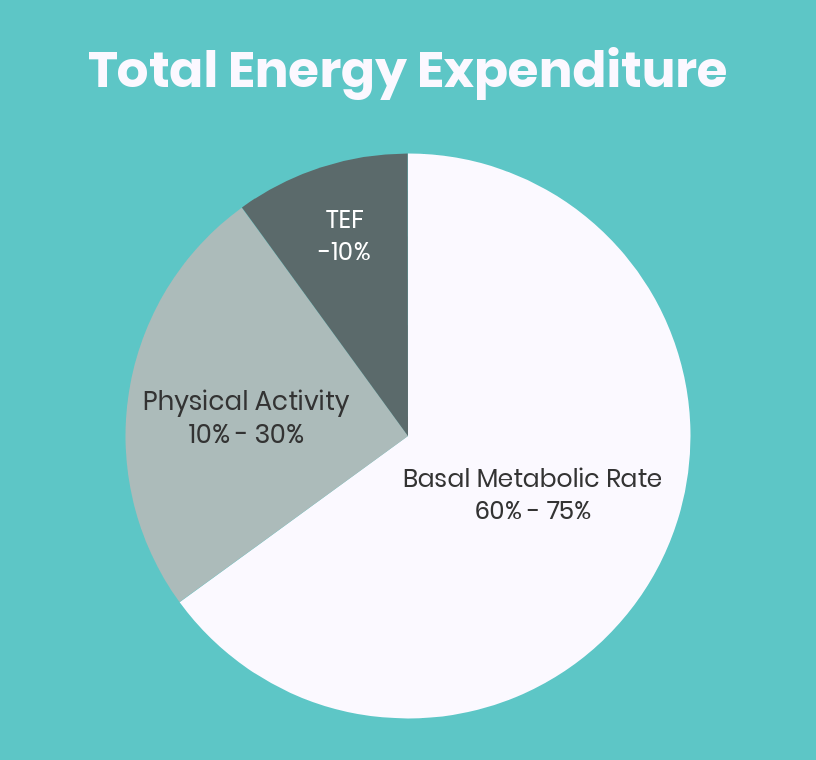
BMR is usually the largest part of TDEE. For many adults it accounts for roughly the majority of daily energy expenditure, but the exact share depends on body size, training, occupation, and movement habits. A person with a physically demanding job may have a smaller BMR share because movement contributes more. A person who sits most of the day may have a larger BMR share because movement contributes less.
The distinction matters because eating at BMR is not the same as eating at maintenance. If your BMR is 1,600 calories and your TDEE is 2,300 calories, eating 1,600 calories is a sizeable deficit, not maintenance. Some people see their BMR result, mistake it for their daily need, then build an unnecessarily aggressive diet. Others see TDEE, mistake it for a guaranteed daily burn, and forget that the activity multiplier may be too high. Good calorie planning requires both numbers: BMR explains the resting baseline, while TDEE estimates the full-day expenditure.
A BMR calculator is useful when you want to compare resting metabolic equations. A TDEE calculator is useful when you want to turn that resting estimate into a daily maintenance target. The two pages should support different decisions: BMR is the base, TDEE is the day-level planning number.
The Four Main Parts of TDEE
TDEE is usually explained through four pieces: basal metabolism, non-exercise activity, exercise activity, and the thermic effect of food. You do not need to calculate each piece separately for daily use, but understanding them helps you interpret why your TDEE changes and why two people of the same body weight can have very different calorie needs.
Basal Metabolic Rate
BMR is the baseline energy cost of staying alive. Organs such as the brain, liver, heart, kidneys, and skeletal muscle all require energy even when you are not exercising. Body weight influences BMR, but the type of weight matters too. Lean tissue is more metabolically active than fat tissue. That is why two people with the same body weight can have different resting energy needs if one has more lean mass.
Non-Exercise Activity Thermogenesis
NEAT is the energy used for daily movement that is not formal exercise. Walking around the house, standing, taking stairs, carrying groceries, doing chores, pacing while on the phone, and posture changes all count. NEAT is often the most underestimated part of TDEE because it is easy to notice a gym session but ignore all the small movement decisions across the day. A person who averages 12,000 steps and stands often can burn far more than someone with the same workout routine who sits for most of the remaining day.
Exercise Activity Thermogenesis
Exercise activity includes planned training such as running, cycling, lifting, swimming, sports, classes, and structured conditioning. Exercise is important for health, strength, cardiovascular fitness, performance, and body composition, but calorie burn estimates from exercise machines and watches can be imprecise. A TDEE multiplier rolls exercise into a weekly average instead of trying to add every workout calorie back meal by meal.
Thermic Effect of Food
The thermic effect of food is the energy cost of digestion, absorption, transport, and storage. Protein generally has a higher thermic effect than carbohydrate or fat, which is one reason high-protein diets can feel helpful during fat loss. Still, TEF is not magic. It is already partly reflected in total energy expenditure. The practical takeaway is to build meals with enough protein, fiber-rich carbohydrates, and dietary fat rather than trying to chase a large calorie burn from digestion alone.
Activity Multipliers
The activity multiplier is the most judgment-based part of a simple TDEE calculator. Age, height, and weight are measurable inputs. Activity level requires interpretation. Most errors happen because people choose a multiplier based on how hard their workouts feel rather than on their entire week. A desk worker who trains hard for three hours per week may still be lightly active if the rest of the week is sedentary. A restaurant server, nurse, warehouse worker, teacher, or parent who walks and stands for much of the day may be more active even without formal workouts.
| Activity level | Multiplier | Best fit | Common mistake |
|---|---|---|---|
| Sedentary | 1.20 | Desk-based routine, low step count, little structured exercise. | Choosing light activity because of one or two short workouts. |
| Lightly active | 1.375 | Light training, regular walking, or a mostly seated job with some planned exercise. | Underestimating weekend sitting or long inactive workdays. |
| Moderately active | 1.55 | Consistent training several days per week plus a reasonable amount of daily movement. | Using this for gym frequency alone while daily steps are low. |
| Very active | 1.725 | Hard training most days, active job, higher step count, or sport practice plus movement. | Selecting it because workouts are intense even though total weekly movement is moderate. |
| Extremely active | 1.90 | Demanding physical work, endurance training blocks, two-a-day training, or very high movement volume. | Using it as a motivational target instead of a description of current life. |
If you are uncertain between two activity levels, choose the lower one first and review your trend. This is especially useful for fat-loss planning because overestimating activity can erase the expected deficit. For maintenance or performance goals, you may prefer to start with the middle option and adjust upward if weight trends downward or energy feels consistently low.
How to Choose the Right Activity Level
Start with your average week, not your best week. Think about your job, commute, chores, steps, training frequency, sport practice, and rest days. A simple step-count check can help. Very low step counts often match sedentary or lightly active. Moderate step counts with regular training often fit light to moderate activity. High step counts, active occupations, and frequent training push the multiplier higher. Step counts are not perfect because cycling, lifting, swimming, and manual labor may not be captured well, but they are a useful reality check.
Do not treat a hard workout as permission to choose a high multiplier automatically. A demanding 60-minute session is valuable, but there are still 23 other hours in the day. If those hours are mostly sitting, the weekly average may still be lower than expected. On the other hand, do not understate physical work. People who stand, walk, lift, clean, care for children, stock shelves, teach, serve tables, or work in healthcare may have high expenditure even without classic exercise.
Seasonal changes matter too. A student may be active during sports season but sedentary during exam periods. A runner may train more in spring than in winter. A parent may move more during school holidays. A construction worker may have different demands depending on project phase. Your TDEE is tied to current behavior, so revisit the activity level when routine changes.
Using TDEE for Maintenance Calories
Maintenance calories are the calories that keep your body weight broadly stable under current conditions. The calculator gives a maintenance estimate and a small practical range. The range matters because exact maintenance is rarely a single fixed number. Your daily burn changes with steps, training, sleep, food intake, stress, and body weight. It is more useful to think in weekly averages than exact daily totals.
For maintenance, start near your calculated TDEE and monitor your seven-day average weight. Weighing daily is optional, but if you do it, compare weekly averages rather than single weigh-ins. If average weight remains stable over two to four weeks, your target is close. If average weight rises slowly, lower intake slightly or increase movement. If average weight falls unintentionally, increase intake slightly. Small adjustments of 100 to 200 calories per day are often enough.
The Maintenance Calorie Calculator is useful if you want a narrower page centered on weight stability. This TDEE page goes one step broader by showing the relationship between resting metabolism, activity multipliers, goal adjustments, and tracking evidence.
Using TDEE for Fat Loss
Fat loss requires an average calorie deficit, but the size of the deficit should fit the person, the timeline, and the need to preserve health, training performance, lean mass, and adherence. A small deficit, such as roughly 250 calories below estimated TDEE, is slower but often easier to sustain. A moderate deficit, such as roughly 500 calories below estimated TDEE, can work for many adults when protein, sleep, and resistance training are in place. Larger deficits may be appropriate in some clinical contexts, but they are not automatically better for everyday self-directed dieting.
A common mistake is to pair an aggressive calorie target with aggressive exercise, then burn out quickly. A more durable approach is to set a reasonable deficit, keep protein adequate, include strength training if possible, and maintain daily movement. If scale weight does not move after two to four weeks, first check tracking accuracy and weekend intake before reducing calories further. The issue is often not the equation itself but inconsistent logging, uncounted snacks, liquid calories, restaurant portions, or a multiplier that was too high.
Another common mistake is evaluating progress too quickly. Body water can hide fat loss for several days, especially after salty meals, intense training, poor sleep, travel, or menstrual cycle shifts. Trend data is more reliable than a single weigh-in. If the average is moving in the intended direction, stay patient. If the trend is flat for several weeks and tracking is consistent, make a small adjustment.
Health note: Very low calorie intakes, rapid weight loss, or dieting during pregnancy, breastfeeding, adolescence, illness, or recovery from disordered eating require professional guidance. A calculator is not a medical assessment.
Using TDEE for Weight Gain and Muscle Gain
For weight gain, add a calorie surplus to estimated TDEE. A slow surplus helps minimize unnecessary fat gain while supporting training, recovery, and muscle growth. Many people start with 200 to 300 calories above maintenance, track body-weight averages, and adjust after a few weeks. Faster gain may require a larger surplus, but a larger surplus does not guarantee proportionally more muscle. Training quality, progressive overload, sleep, protein, genetics, and training age all influence how much of the gain is lean mass.
People who struggle to gain weight often underestimate how much consistency matters. A high-calorie day followed by two low-calorie days may average near maintenance. If appetite is low, calorie-dense foods, smoothies, larger breakfasts, extra olive oil, nuts, trail mix, rice, pasta, milk, and planned snacks can help. If training performance is the priority, put more carbohydrate around training and make sure total energy intake is not chronically below expenditure.
For muscle gain, TDEE is the starting point, not the whole plan. Pair the surplus with a structured resistance training program, enough protein, and enough recovery. The Protein Requirement Calculator can help turn body weight and training goals into a protein range after you estimate TDEE.
How to Validate Your TDEE With Real Data
The best TDEE estimate is the one calibrated to your body and routine. You can validate the calculator result with a simple tracking experiment. First, choose a daily calorie target based on the calculator. Second, eat close to that target for at least two weeks, preferably four. Third, weigh under similar conditions and compare weekly averages. Fourth, adjust based on the trend.
If you aim for maintenance and the average rises by about 0.25 to 0.5 percent of body weight per week, your intake is probably above current maintenance. Lower the target by 100 to 200 calories or increase daily movement. If your average falls by the same amount, your intake is probably below current maintenance. Raise the target slightly. If your goal is fat loss, compare the actual rate of loss to the expected rate. If you expected a moderate deficit but weight is stable for several weeks, check logging accuracy and then adjust.
Use waist measurements, progress photos, performance, hunger, mood, and recovery as supporting evidence. Scale weight is useful, but it is not the only signal. Someone gaining muscle and losing fat may see slower scale changes. Someone increasing carbohydrates may see water weight rise even if fat gain is not occurring. Someone beginning resistance training may retain water from muscle soreness. TDEE validation works best when you look at several signals together.
| Four-week result | Likely interpretation | Practical adjustment |
|---|---|---|
| Weight stable within a small range | Your target is close to maintenance. | Keep the same target or adjust only if your goal changes. |
| Weight slowly rising | Average intake is above expenditure, or water weight is temporarily elevated. | Wait for enough data, then reduce by 100 to 200 calories if the trend continues. |
| Weight slowly falling | Average intake is below expenditure, or a new activity routine increased burn. | Increase by 100 to 200 calories if maintenance is the goal. |
| Energy and training performance falling fast | The deficit may be too large, recovery may be poor, or training volume may be too high. | Use a smaller deficit, review sleep, and consider reducing training stress. |
Example TDEE Calculations
Example 1: Maintenance target
Assume a 30-year-old person uses the male equation constant, weighs 80 kilograms, stands 180 centimeters tall, and chooses moderate activity. The BMR estimate is \(10 \times 80 + 6.25 \times 180 - 5 \times 30 + 5\), which equals 1,780 calories per day. With a 1.55 activity factor, the estimated TDEE is \(1,780 \times 1.55 = 2,759\) calories per day. A practical maintenance range may be about 2,650 to 2,850 calories while trend data is collected.
Example 2: Fat-loss target
Assume a calculated TDEE of 2,200 calories. A small deficit target might be about 1,950 calories. A moderate deficit target might be about 1,700 calories. The smaller deficit will usually be easier to maintain and may support better training. The moderate deficit may move the scale faster but requires more attention to protein, fiber, sleep, and adherence. The right choice depends on starting body size, health context, hunger tolerance, and timeline.
Example 3: Slow gain target
Assume a lifter has an estimated TDEE of 2,600 calories and wants to gain muscle slowly. A starting target of 2,850 calories is reasonable. After three to four weeks, if average body weight is not rising and training performance is not improving, the target may increase by another 100 to 150 calories. If weight rises too quickly and waist measurements jump, the surplus may be larger than needed.
TDEE and Macros
Calories determine the broad energy target, but macronutrients shape how that target feels and performs. After you estimate TDEE, you can divide the calorie target among protein, carbohydrate, and fat. A practical order is to set protein first, set a minimum amount of fat for dietary balance, and place the remaining calories into carbohydrates and fats based on preference, training, appetite, and health needs.
The energy values are usually taught as 4 calories per gram of protein, 4 calories per gram of carbohydrate, and 9 calories per gram of fat. Alcohol has about 7 calories per gram, though it is not a required macronutrient. Fiber, sugar alcohols, and food labels can add small differences, but the 4-4-9 rule is a useful planning tool.
\[Calories = 4(Protein\ grams) + 4(Carbohydrate\ grams) + 9(Fat\ grams)\]
If your target is 2,200 calories and you choose 160 grams of protein, that protein provides 640 calories. If you choose 70 grams of fat, that fat provides 630 calories. The remaining 930 calories can be used for carbohydrate, which is about 232 grams. That is not the only correct split. Endurance athletes may prefer more carbohydrate. Low-appetite gainers may need more calorie-dense fat. People with medical nutrition needs should follow individualized advice.
For calculator support after TDEE, use the Macro Calculator, Advanced Macro Calculator, Protein Calculator, Fat Intake Calculator, and Carbs Calculator. Each page has a narrower purpose, while this page stays centered on total daily expenditure.
TDEE, Body Composition, and Lean Body Mass
Body composition influences TDEE because lean mass contributes to resting metabolic needs and often supports higher training output. Two people can have the same scale weight but different calorie needs if one has more muscle and the other has more fat mass. This is one reason athletes, lifters, and people who have recently gained or lost significant weight may benefit from comparing a standard BMR equation with a lean-mass-based estimate.
Body fat percentage is difficult to measure precisely outside a controlled setting. Smart scales can fluctuate with hydration. Tape methods depend on measurement consistency. Skinfolds depend on technique. Visual estimates are rough. The optional Katch-McArdle output is best treated as a comparison, not a replacement for trend validation. If the Mifflin-St Jeor and Katch-McArdle outputs are close, the standard estimate may be adequate. If they differ substantially, choose a moderate starting point between them and rely on tracking data.
The Body Fat Calculator, Body Fat Percentage Calculator, and Lean Body Mass Calculator can help when body composition is the main question. Once you have a reasonable body-fat estimate, you can enter it here to compare the lean-mass method with the standard method.
TDEE and Exercise Calories
Many people ask whether they should “eat back” exercise calories. For most daily planning, the cleaner approach is to choose an activity multiplier that reflects average exercise and then eat a consistent target. This avoids double counting. If your TDEE multiplier already includes your workouts, adding exercise calories on top of the target may erase a deficit or create a larger surplus than intended.
There are exceptions. Endurance athletes, people with unusually long training sessions, and those with highly variable activity days may need flexible fueling. A long run, bike ride, hike, sport tournament, or physically demanding workday can require extra carbohydrate and total calories. In that case, use TDEE as a weekly average and adjust around demanding sessions rather than treating every day as identical.
The Calories Burned Calculator is useful for estimating the energy cost of a specific activity. Use it for context, but remember that wearable devices, exercise machines, and generic charts can all be imprecise. If you add workout calories, consider adding only part of the estimate at first and watch the trend.
Common TDEE Mistakes
| Mistake | Why it matters | Better approach |
|---|---|---|
| Choosing an activity level from workout intensity only | Total daily movement may be lower than the workout suggests. | Consider job, steps, chores, commute, training, and rest days together. |
| Expecting scale weight to change every day | Water, glycogen, sodium, digestion, and soreness can mask fat changes. | Compare weekly averages across several weeks. |
| Using TDEE as a permanent number | Energy needs change with body weight, activity, diet history, and routine. | Recalculate after meaningful weight change or routine change. |
| Eating back all exercise calories | The activity multiplier may already include exercise, causing double counting. | Use a consistent target first, then adjust only when activity is unusually high. |
| Dropping calories too aggressively | Large deficits can reduce adherence, recovery, and lean-mass retention. | Start with a moderate deficit and adjust using trend data. |
| Ignoring protein and resistance training during fat loss | Weight loss may include more lean mass than necessary. | Set protein deliberately and include strength work when possible. |
When to Recalculate TDEE
Recalculate TDEE when your body weight changes meaningfully, your training volume changes, your job changes, your daily steps change, or your goal changes. A person who loses 20 pounds will generally need fewer calories than before. A person who starts marathon training, switches to a physically active job, or begins walking much more may need more. A person recovering from injury may need less during a lower-activity period but still needs enough nutrition to support healing.
A practical rule is to review your estimate after every 5 to 10 percent body-weight change or after four weeks of trend data that clearly differs from the expected outcome. Do not revise the plan after one unusual day. Do revise it when the trend is consistent. If you are intentionally losing fat and progress slows after substantial weight loss, that does not mean the calculator failed. It often means your smaller body now burns less, your movement changed, or adherence became less consistent.
TDEE for Different Goals
General health and weight stability
For general health, TDEE helps you understand the rough energy level that supports your current body size and activity. You do not need perfect tracking forever. Many people use a calculator to learn portion awareness, then move into flexible habits. Stable routines, regular physical activity, protein-rich meals, fiber-rich foods, and enough sleep often matter more than daily precision.
Fat loss
For fat loss, TDEE helps set a deficit that is large enough to matter but not so large that it disrupts daily life. A person with a high TDEE may tolerate a larger deficit than a smaller person with a lower TDEE. This is why percentage-based thinking is useful. A 500-calorie deficit may be moderate for someone maintaining at 3,000 calories but aggressive for someone maintaining at 1,600 calories.
Muscle gain
For muscle gain, TDEE helps avoid two extremes: eating too little to recover or eating far more than needed. A small surplus paired with progressive resistance training is often a better starting point than a large surplus. Training experience matters. New lifters may gain muscle more quickly, while advanced lifters may need a slower approach.
Endurance performance
For endurance training, TDEE can change sharply across the week. Long sessions, high mileage, and multiple sport sessions increase energy and carbohydrate needs. Instead of using one identical target every day, some athletes use a weekly average with higher intake on demanding days and lower intake on easier days. This supports training quality while keeping the overall goal aligned.
Food Quality Still Matters
TDEE gives the calorie framework, but food quality affects hunger, energy, digestion, training, blood markers, and adherence. A calorie target built mostly from highly processed, low-fiber foods may be harder to sustain than the same target built from protein-rich foods, fruits, vegetables, whole grains, legumes, nuts, seeds, dairy or alternatives, and appropriate fats. The goal is not perfection; it is a repeatable pattern that supports your target without making meals miserable.
Protein supports satiety and lean-mass retention. Carbohydrates support training and daily energy, especially for endurance exercise and higher-volume lifting. Dietary fats support flavor, essential fatty acid intake, and absorption of fat-soluble vitamins. Fiber-rich foods help fullness and digestive regularity. Hydration and sodium affect scale weight, so do not confuse water fluctuation with immediate fat gain or loss.
If you need a health and fitness tool directory, the Health Fitness Calculators page groups related calculators in one place. Use this TDEE tool for expenditure, then choose narrower tools for body composition, macros, or activity estimates as needed.
Safety and Practical Boundaries
General calorie calculators are not clinical nutrition plans. They do not diagnose health conditions, account for medication effects, evaluate lab work, screen for eating disorder risk, or replace a qualified professional. If you have diabetes, kidney disease, thyroid disease, heart disease, gastrointestinal conditions, pregnancy, breastfeeding, a history of disordered eating, or any condition that changes nutritional needs, get individualized guidance.
Be especially cautious with rapid weight loss, very low energy intake, and intense training during a deficit. Warning signs such as persistent fatigue, dizziness, missed menstrual cycles, poor sleep, irritability, unusually poor performance, hair shedding, cold intolerance, or obsessive food thoughts deserve attention. More restriction is not always the answer. Sometimes the better move is a smaller deficit, a maintenance phase, a training deload, or professional support.
A Practical Four-Week TDEE Workflow
The easiest way to make a TDEE estimate useful is to turn it into a short experiment. Start by using the calculator with honest inputs. Choose the activity level that describes your present routine, not the routine you hope to build later. If the result is for maintenance, set your calorie target near the calculated TDEE. If the result is for fat loss, choose a modest deficit that you can repeat on normal weekdays and weekends. If the result is for weight gain, choose a small surplus and pair it with structured training. Write down the target, the reason for choosing it, and the date you will review it.
During week one, focus on accurate observation. Weigh foods when practical, measure calorie-dense items, and log oils, sauces, drinks, snacks, restaurant meals, and weekend extras. This is not about perfection. It is about discovering whether the target is realistic and whether your usual portions match what you think you are eating. Keep meals simple enough to repeat. If every day requires complicated calculations, adherence becomes the limiting factor before the TDEE estimate has a chance to be tested.
During week two, look for routine patterns. If hunger is manageable, training feels normal, and the scale trend is moving as expected, avoid changing the target too soon. If the target is extremely hard to follow, adjust the plan rather than forcing a number that will not survive daily life. For fat loss, this may mean using a smaller deficit, increasing vegetables and lean protein, moving calories toward the evening, or planning higher-calorie meals around social events. For weight gain, it may mean adding a predictable snack, using liquid calories, or increasing breakfast before appetite fades later in the day.
During weeks three and four, compare the average result with the goal. A maintenance plan should keep body weight broadly stable. A fat-loss plan should show a gradual downward trend. A gain plan should show a gradual upward trend. If the trend matches the goal, stay the course. If the trend is clearly too fast or too slow, adjust by 100 to 200 calories per day and continue. Large changes are rarely needed unless the original activity level was clearly wrong or the tracking data shows a major intake mismatch.
Use context before making changes. A sudden weight increase after a salty meal, late dinner, hard leg workout, long flight, or high-carbohydrate day is not the same as fat gain. A sudden drop after a low-carbohydrate day or dehydration is not guaranteed fat loss. Look at averages, waist measurements, training logs, sleep, digestion, mood, and hunger together. TDEE planning works best when it reduces guessing, not when it creates anxiety around every normal fluctuation.
Once the four-week review is complete, decide whether to continue, maintain, or change phases. If fat loss has been consistent and you feel good, you can continue with the same target. If energy, sleep, or training quality is declining, a maintenance period may be a better next step. If muscle gain is the goal and weight has not moved, increase calories slightly. If weight gain is faster than planned, reduce the surplus. The calculator starts the process; the review process turns it into a personalized number.
Frequently Asked Questions
What is a good TDEE?
There is no universal good TDEE. A good estimate is one that matches your body size, activity, and trend data. A smaller sedentary adult may maintain on far fewer calories than a larger endurance athlete. Compare your result to your goal and your real weekly weight trend rather than to someone else’s number.
Is TDEE accurate?
A calculator can be accurate enough to start, but it is still an estimate. The formula cannot know your exact NEAT, metabolic adaptation, lean mass, food tracking accuracy, or exercise efficiency. Treat the result as a first draft. Two to four weeks of consistent tracking will tell you whether it needs adjustment.
Should I use the male or female equation constant?
The Mifflin-St Jeor equation uses different constants because average body composition differs between groups. Choose the constant that best matches the equation set you intend to use. If you have an unusual body-composition profile, the optional body-fat comparison may provide useful context, but real-world trend data remains the final check.
Why is my TDEE lower after dieting?
As body weight decreases, the body usually requires fewer calories. In addition, some people unconsciously move less during calorie restriction, and resting expenditure can adapt downward. This does not mean fat loss is impossible. It means the target may need updating, movement may need attention, or a maintenance phase may be useful.
How often should I update my TDEE?
Update it after meaningful weight change, a new training routine, a job or schedule change, or several weeks of trend data that does not match the expected result. For many people, reviewing every month during active weight change is enough.
Can I use TDEE without tracking food forever?
Yes. Many people track for a short period to understand portions and patterns, then move to habit-based eating. TDEE is a learning tool. Long-term success often depends on repeatable meals, activity habits, sleep, protein, fiber, and flexible routines more than permanent daily tracking.
What if my calculated calories feel too high?
Check the unit system, height, weight, activity level, and goal setting. If the entries are correct, try the target for a reasonable tracking period before assuming it is wrong. If weight rises faster than intended, reduce the target slightly. If the number feels emotionally difficult because of dieting history, consider support from a qualified professional.
What if my calculated calories feel too low?
Make sure you did not choose the wrong activity level or enter height and weight in the wrong units. If the result is still low and you feel hungry, tired, or unable to train, use a smaller deficit or a maintenance target. Very low intakes should not be self-prescribed for long periods.
Key Takeaway
A TDEE calculator is most useful when it is treated as a decision tool, not a rigid command. Estimate your expenditure, choose a realistic goal adjustment, follow the plan consistently, and compare the expected result with actual trend data. If your body-weight average, measurements, recovery, and performance line up with the goal, keep going. If they do not, adjust calmly and gradually. The right target is the one that supports the outcome while still fitting a healthy, repeatable life.