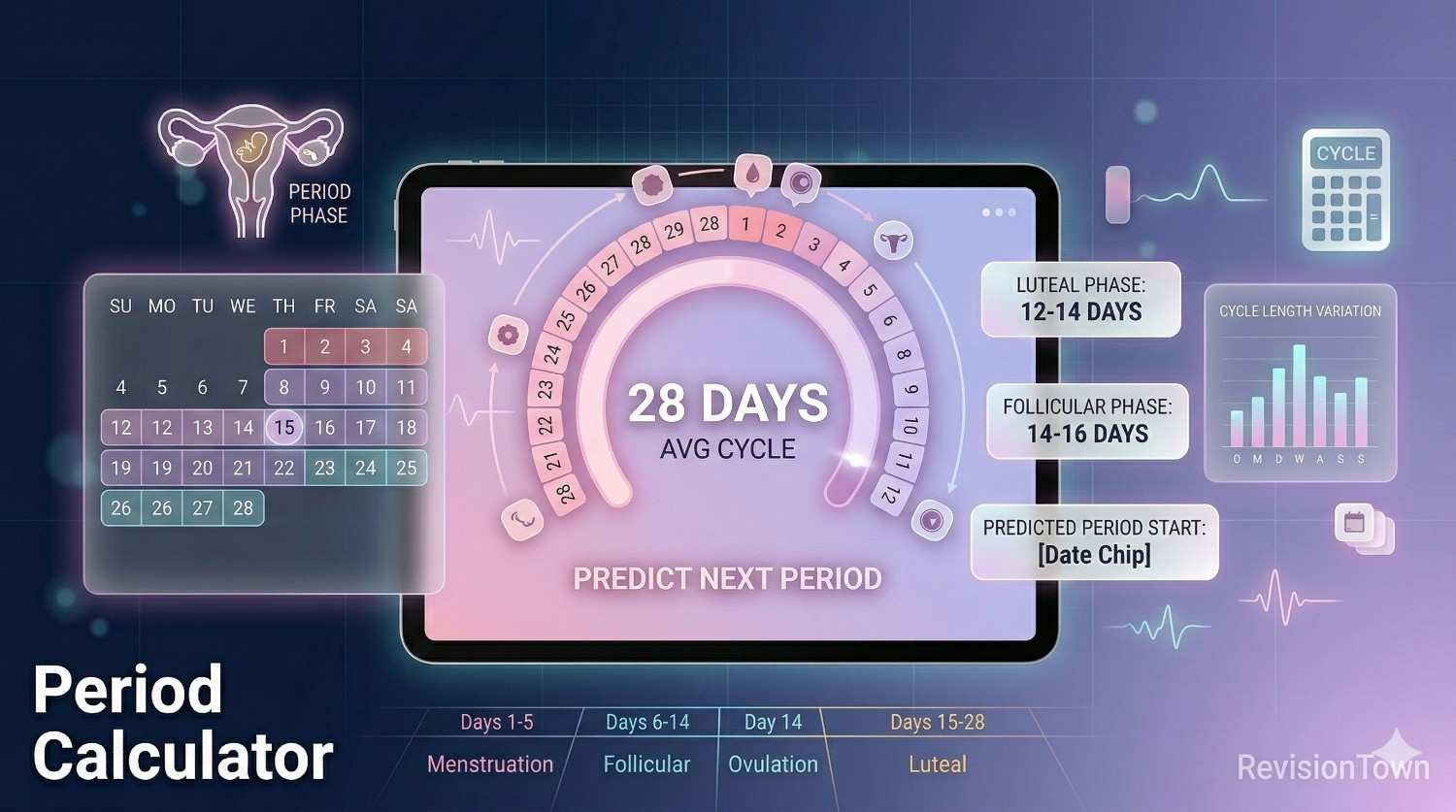
Pregnancy date estimator and practical planning guide
Highly Advanced Due Date Calculator
Estimate your pregnancy due date, current gestational age, trimester, term milestones, and key prenatal planning dates from the first day of the last menstrual period, conception or ovulation date, IVF transfer date, or an ultrasound measurement date. This page is focused on estimated date of delivery, so it stays distinct from ovulation timing, conception-date reconstruction, and general pregnancy week calculators.
Pregnancy Due Date Calculator
Choose the dating method that best matches what you know. LMP dating is common, conception or ovulation dating can be useful when timing is known, IVF transfer dating uses embryo age, and ultrasound dating works from a scan date plus gestational age at that scan.
Main Formulas
EDD means estimated date of delivery. The result is a planning estimate that should be confirmed or revised by your healthcare professional when needed.
Calculator Outputs
- Estimated due date
- Gestational age
- Trimester
- Full-term window
- Late-term date
- Planning milestones
Use Carefully
A due date is not an exact birth-date prediction. It is a clinical and planning reference that helps organize prenatal care, scans, screening windows, and term discussions. If your first-trimester ultrasound or clinician gives a different date, use the date your care team records as the best obstetric estimate.
What a Due Date Calculator Estimates
A due date calculator estimates the date around which a pregnancy is expected to reach 40 weeks of gestational age. It does not predict the exact day labor will start. In prenatal care, the date is often called the estimated due date, estimated date of delivery, or EDD. The estimate matters because it gives clinicians and parents a shared reference point for pregnancy weeks, screening windows, ultrasound timing, fetal growth assessment, term classifications, and planning around birth. A good calculator should make the formula transparent and explain where uncertainty enters the calculation.
The standard last-menstrual-period method counts pregnancy from the first day of the last period, not from the day fertilization occurred. That can feel counterintuitive because conception usually happens roughly two weeks after the start of a typical 28-day cycle. When a clinician says someone is 8 weeks pregnant, the embryo or fetus has usually been developing for about 6 weeks since conception, although the exact difference depends on ovulation timing. This dating convention is used because period dates are often easier to identify than ovulation or fertilization dates.
This due date page targets estimated date of delivery. If your question is "when might I ovulate?", the highly advanced ovulation calculator is the better tool. If your question is "when might conception have happened?", the highly advanced conception calculator is more focused. If you want a broad pregnancy timeline, the highly advanced pregnancy calculator can help. Keeping those tools separate keeps each page useful for its own intent instead of forcing one calculator to answer every reproductive timing question.
How Last-Menstrual-Period Dating Works
The most common due date estimate begins with the first day of the last menstrual period. A typical calculation adds 280 days, or 40 weeks, to that date. The older calendar version is often called Naegele's rule: take the first day of the last period, add seven days, count back three months, and move to the following year. Both approaches express the same 40-week estimate for a typical 28-day cycle. The calculator above also lets you adjust for cycle length, because the classic calculation assumes ovulation around day 14.
If your cycle is usually longer than 28 days, ovulation may happen later than the classic assumption, so the due date estimate may move later. If your cycle is usually shorter than 28 days, ovulation may happen earlier, so the estimate may move earlier. The calculator uses a simple adjustment:
For example, if the first day of the last period was April 1 and the cycle length is 28 days, the estimate is 280 days after April 1. If the cycle is usually 32 days, the adjustment is \(32 - 28 = 4\), so the estimate moves four days later. If the cycle is usually 25 days, the adjustment is \(25 - 28 = -3\), so the estimate moves three days earlier. This adjustment is still an estimate because cycle length does not prove the exact day of ovulation.
LMP dating works best when the period date is reliable, cycles are fairly regular, and there has not been recent hormonal contraception, postpartum bleeding, breastfeeding-related irregularity, miscarriage, abortion, or another reason the bleeding date might not represent a standard menstrual period. When those conditions apply, an early ultrasound or clinician assessment may provide a more reliable estimate. If you are unsure whether a bleeding episode should count as a period, bring the dates and circumstances to a healthcare professional.
Conception, Ovulation, and IVF Transfer Dating
When conception or ovulation date is known with reasonable confidence, a due date can be estimated by adding 266 days, or 38 weeks. This method starts closer to the biological beginning of the pregnancy rather than the menstrual-cycle dating convention. It may be useful when intercourse occurred only once in the fertile window, ovulation was carefully tracked, or a fertility treatment cycle produced a known timing point. Even then, the result remains an estimate of the expected delivery date, not a guarantee of when birth will happen.
IVF dating is more specific because embryo age is known at transfer. A day 3 embryo transfer means the embryo is treated as three days beyond fertilization at transfer, so the due date is estimated by adding \(266 - 3 = 263\) days to the transfer date. A day 5 blastocyst transfer adds \(266 - 5 = 261\) days. A day 6 blastocyst transfer adds \(266 - 6 = 260\) days. This calculator includes those common embryo-age options so IVF users do not have to convert the transfer date manually.
For example, if a day 5 blastocyst transfer took place on June 10, the estimate is June 10 plus 261 days. That gives a more treatment-specific date than a last-period estimate. However, pregnancy care teams may still document dating using their own protocol, ultrasound findings, embryo transfer records, and clinical judgment. Always use the date recorded by your fertility clinic or obstetric team for medical decisions.
Ultrasound Dating and the Best Obstetric Estimate
Ultrasound dating estimates gestational age by measuring the embryo or fetus on a scan date. In early pregnancy, growth is relatively predictable, so ultrasound can be especially useful when the last period date is uncertain or cycles are irregular. Later in pregnancy, babies naturally vary more in size, so ultrasound is less precise for assigning dates. This is why a first-trimester scan often carries more weight for dating than a late scan, although the exact decision depends on clinical standards and the person's history.
Suppose an ultrasound is performed on May 20 and the gestational age on the report is 8 weeks 3 days. First convert the scan age into days: \(8 \times 7 + 3 = 59\). Then subtract 59 from 280, giving 221 days remaining to the 40-week estimate. The estimated due date is May 20 plus 221 days. The calculator above performs that date arithmetic for you. It still does not interpret whether a scan should revise a due date; that is a clinical decision.
The phrase "best obstetric estimate" is important. It means the pregnancy dating used in care should reflect the most appropriate available information, not simply the first date entered into a calculator. A healthcare professional may consider the reported LMP, cycle regularity, early ultrasound, assisted reproduction records, physical findings, and other clinical details. Once a due date is established in prenatal care, it usually should not be changed casually, because changing dates can affect screening, growth assessment, and decisions about early-term or late-term management.
Why the Due Date Is a Planning Date, Not a Deadline
The word "due" can make the date sound exact, but birth rarely follows a calendar with that level of precision. Many babies are born before or after the estimated due date. For a healthy pregnancy, the due date is a reference point that helps organize care rather than a promise that labor will start on that day. This is especially important emotionally. Reaching the EDD without labor does not automatically mean something is wrong. It means your care team will continue monitoring according to their protocols and your individual situation.
Term language is also more precise than many older explanations suggest. In modern obstetric language, early term is 37 weeks 0 days through 38 weeks 6 days, full term is 39 weeks 0 days through 40 weeks 6 days, late term is 41 weeks 0 days through 41 weeks 6 days, and postterm begins at 42 weeks 0 days. These categories matter because important fetal development continues in the final weeks. If there is no medical reason for earlier delivery, many care teams prefer to avoid non-medically indicated delivery before 39 weeks.
The calculator shows term milestones so users can understand the due date in context. The due date itself is 40 weeks 0 days. The full-term window begins at 39 weeks 0 days and runs through 40 weeks 6 days. Late term begins at 41 weeks 0 days. Postterm begins at 42 weeks 0 days. These dates are not instructions to induce, wait, or intervene. They are planning markers. Decisions about monitoring, induction, or delivery timing belong with qualified clinicians who know the pregnancy details.
| Dating method | Best use | Formula used by this calculator | Main limitation |
|---|---|---|---|
| Last menstrual period | Common estimate when the first day of the last period is known. | LMP plus 280 days, adjusted for cycle length. | Assumes period date is accurate and ovulation timing follows the cycle-length assumption. |
| Conception or ovulation date | Useful when ovulation or conception timing is known with reasonable confidence. | Conception or ovulation date plus 266 days. | Many people do not know the exact date, and intercourse date may not equal fertilization date. |
| IVF transfer date | Useful for assisted reproduction cycles with known embryo age. | Transfer date plus 263, 261, or 260 days for day 3, day 5, or day 6 embryo transfer. | Care teams may use clinic-specific records and protocols for the official estimate. |
| Ultrasound date | Useful when a scan reports gestational age on a known date. | Scan date plus the remaining days to 280 days. | Dating accuracy depends on scan timing, measurement quality, and clinical interpretation. |
Understanding Gestational Age
Gestational age is the pregnancy age measured in weeks and days from the dating start point. In LMP dating, gestational age begins on the first day of the last period. That means week 1 and week 2 often occur before conception. This is not a mistake; it is a standard convention used in prenatal care. The calculator reports gestational age on the reference date you choose, usually today. It also shows the trimester based on the calculated number of days.
A simple gestational-age calculation subtracts the estimated LMP-equivalent start from the reference date. For LMP dating, that start is the last period date after cycle adjustment is applied. For conception dating, the equivalent LMP is about 14 days before conception. For IVF dating, the equivalent LMP is calculated from the transfer date and embryo age. For ultrasound dating, the scan date and scan gestational age define the equivalent start. Once the start is known, the week-and-day display is straightforward.
Gestational age is used for screening windows, ultrasound expectations, fetal growth charts, viability conversations, medication decisions, and timing of prenatal visits. This is why accurate dating matters. If the estimated date is off by a week or more, a scan, screening test, or growth interpretation may be misunderstood. For personal planning, a rough estimate may be enough. For clinical care, the official recorded estimate should come from your healthcare team.
Trimester and Prenatal Planning Dates
Pregnancy is commonly divided into three trimesters. The first trimester runs through about 13 weeks 6 days. The second trimester runs from about 14 weeks through 27 weeks 6 days. The third trimester begins around 28 weeks and continues until birth. Exact language can vary by resource, but the trimester framework is useful because symptoms, fetal development, screening options, and appointment patterns change across pregnancy.
The due date calculator includes planning milestones because many users want to know more than one date. It can estimate when 12 weeks, 20 weeks, 28 weeks, 37 weeks, 39 weeks, 40 weeks, 41 weeks, and 42 weeks occur. These dates help you organize questions for care visits, prepare for common scans, understand the term window, and think ahead. They are not a substitute for an appointment schedule, because actual care depends on local guidelines, medical history, test results, and pregnancy risk factors.
First Trimester
Dating, pregnancy confirmation, early symptoms, initial prenatal care, and early screening discussions often happen here. If the period date is uncertain, an early scan may be especially useful for dating.
Second Trimester
Many people have an anatomy scan around the middle of pregnancy. Some symptoms ease, fetal movement may become noticeable, and prenatal planning often becomes more concrete.
Third Trimester
Growth, fetal movement awareness, birth planning, term classification, and delivery discussions become more prominent. The due date acts as the central reference point for these conversations.
How This Calculator Differs From Related Pregnancy Tools
Several pregnancy and cycle calculators use overlapping dates, but they answer different questions. This page answers "What is the estimated date of delivery and how far along is the pregnancy on a reference date?" A gestational age calculator focuses more directly on weeks and days pregnant. A pregnancy conception calculator works backward from pregnancy dates to estimate likely conception timing. The pregnancy weight gain calculator addresses a different prenatal planning need and should not be merged with date estimation.
General date tools can also help when you only need calendar arithmetic. The date calculator, add or subtract from a date page, and days between two dates page are useful for non-medical date counting. This due date calculator adds pregnancy-specific assumptions, term milestones, and gestational-age language, which makes it better for pregnancy planning than a general date tool.
For biology study, the estimated due date connects with the reproductive cycle, fertilization, and gestation. RevisionTown's menstrual cycle lesson explains the cycle background, while the fertilisation, development, and gestation lesson explains what happens after fertilization. The health, pregnancy, and birth lesson provides broader educational context. Those pages teach the science; this calculator turns timing assumptions into practical dates.
Examples of Due Date Calculations
Example 1: the first day of the last period is January 10 and the average cycle length is 28 days. The unadjusted estimate is January 10 plus 280 days. Using Naegele's rule, add seven days to January 10, giving January 17, then count back three months to October 17 and move to the following year. The estimated due date is around October 17. If a clinician later performs a first-trimester ultrasound and records a different official estimate, use the clinician's date for care decisions.
Example 2: the first day of the last period is January 10, but the average cycle length is 34 days. The cycle adjustment is \(34 - 28 = 6\). The adjusted due date is six days later than the classic 280-day estimate. This does not prove ovulation happened exactly six days later; it simply adapts the model to the user's typical cycle. If cycles are irregular, a broad estimate is less reliable, and ultrasound dating may be more helpful.
Example 3: ovulation or conception is estimated on February 1. The conception-based due date is February 1 plus 266 days. The estimated gestational start is about 14 days earlier, because pregnancy weeks are conventionally counted from an LMP-equivalent date. This can help explain why the pregnancy week number seems about two weeks ahead of the time since conception.
Example 4: a day 5 blastocyst transfer occurred on March 12. The IVF estimate adds 261 days because \(266 - 5 = 261\). The calculator uses the transfer date and embryo age, then derives gestational age and term milestones from that estimate. In real care, the fertility clinic's documentation should guide the official date.
Example 5: an ultrasound on April 20 reports gestational age as 9 weeks 2 days. Convert the age into days: \(9 \times 7 + 2 = 65\). There are \(280 - 65 = 215\) days remaining until the 40-week estimate. The estimated due date is April 20 plus 215 days. This calculation is useful for understanding a scan report, but it does not decide whether the scan should replace an existing due date.
When a Due Date May Be Revised
A due date may be revised when the best available evidence shows the original estimate was likely inaccurate. This can happen when the last period date is uncertain, cycles are irregular, conception timing is known, IVF records are available, or an early ultrasound differs meaningfully from LMP dating. Revision is not usually based on a late-pregnancy size estimate alone, because fetal size varies more as pregnancy progresses. A baby measuring large or small later in pregnancy may reflect growth pattern rather than wrong dates.
Changing a due date has consequences. Screening tests have date windows. Growth charts depend on gestational age. Discussions about preterm, early term, full term, late term, and postterm pregnancy depend on accurate dating. For that reason, the official estimate should be set carefully and then used consistently. If a calculator and a clinician's estimate disagree, ask your clinician to explain which method they used and why. Do not silently switch the date in your own planning without understanding the reason.
Common reasons for disagreement include late ovulation, incorrect period recall, implantation bleeding mistaken for a period, recent hormonal contraception, postpartum bleeding, breastfeeding-related cycle changes, and ultrasound measurement differences. The disagreement does not necessarily mean something is wrong. It means the dating inputs do not all point to the same estimate. That is exactly why prenatal care uses clinical context rather than a calculator alone.
Using the Result for Prenatal Organization
Once you have an estimated due date, use it to organize practical tasks rather than to create a rigid countdown. Write down the EDD, current gestational age, trimester, and term milestone dates. Bring the information to your first prenatal visit, along with the date of your last period, usual cycle length, positive pregnancy test date, ovulation test data if any, IVF records if applicable, and any ultrasound reports. The more accurate the history, the easier it is for your care team to confirm or revise dating.
Pregnancy planning often includes appointment scheduling, screening decisions, nutrition and medication review, work planning, travel considerations, childcare planning, birth setting decisions, and postpartum support. The due date helps sequence these tasks, but your care team may recommend different timing based on your health history. People with high-risk pregnancies, multiple pregnancy, hypertension, diabetes, prior preterm birth, or other concerns may have more frequent monitoring or different delivery timing discussions.
Use the estimate to create questions. For example: When should the first scan happen? Which screening tests are time-sensitive? When should fetal movement patterns be discussed? What symptoms should prompt urgent evaluation? When should birth preferences be reviewed? Which medications are safe? What exercise, travel, or work modifications apply? The calculator gives dates, but the best value comes from using those dates to have better conversations.
Information to Bring to a Dating or First Prenatal Visit
A calculator result becomes more useful when it is paired with a clear pregnancy history. Before a first prenatal visit, gather the first day of the last normal period, the usual cycle length, whether the cycle was regular, any spotting or bleeding that might be confused with a period, the date of a positive home pregnancy test, and any ovulation test or basal-temperature records. If conception timing is known because intercourse happened only once in the likely fertile window, note that date but also remember that intercourse date and fertilization date are not always identical. Sperm can remain viable for several days, so a single intercourse date may still produce a range rather than one exact conception moment.
If the pregnancy followed fertility treatment, bring the treatment calendar rather than relying on memory. Helpful details include egg retrieval date, insemination date, embryo transfer date, embryo age at transfer, whether the transfer was fresh or frozen, and any clinic-provided estimated due date. Assisted reproduction records can be more precise than a last-period estimate because ovulation, fertilization, and embryo age may be known. The calculator's IVF setting mirrors that logic, but your clinic's record is the better source for medical documentation.
If an ultrasound has already been performed, keep a copy of the report if available. The report may list crown-rump length, gestational sac findings, fetal heart activity, gestational age by measurement, and an estimated due date. Do not rely only on a verbal summary if the exact dating matters. A written report makes it easier for a new provider, midwife, or specialist to understand which date was assigned and how it was calculated. If the report date and gestational age are known, the ultrasound setting in the calculator can reproduce the approximate due date for learning purposes.
Medication and health history can also affect planning. Bring a list of regular medicines, supplements, allergies, chronic conditions, prior pregnancy complications, surgeries, and family history that may be relevant. These details may not change the due date calculation, but they can change the care plan around that date. For example, someone with a prior preterm birth, high blood pressure, diabetes, multiple pregnancy, or a uterine surgery history may have different monitoring or delivery-timing discussions. A due date is only one organizing point inside a broader prenatal plan.
Reading Pregnancy Weeks Without Getting Confused
Pregnancy weeks are often written as a week number plus extra days, such as 10 weeks 4 days or 10 4/7 weeks. The week number counts completed weeks, not the week currently being lived in casual speech. At 10 weeks 4 days, ten full weeks have passed and the pregnancy is in the eleventh week. This is similar to age: a child who is 10 years old is living in the eleventh year of life. Understanding this convention helps when reading ultrasound reports, appointment notes, and screening windows.
Some users also confuse calendar months with pregnancy months. Forty weeks does not divide neatly into nine calendar months, and month labels vary by source. Medical care is usually organized by weeks and days because weeks are more precise. A person at 28 weeks has entered the third trimester by many systems, but saying "seven months pregnant" can mean different things in different conversations. When dates matter, use weeks and days rather than month labels.
The reference date in the calculator is included for this reason. You may know your due date but want to know how far along you will be at a scan, trip, appointment, family event, or work-planning date. Entering a future reference date converts the due date into gestational age on that day. If the output says 19 weeks 6 days, the next day will be 20 weeks 0 days. This makes it easier to understand whether a planned appointment falls before or after a common milestone.
Important Prenatal Windows the Due Date Helps Organize
Prenatal care schedules vary by country, clinic, risk level, and individual needs, but several windows are commonly discussed. Early pregnancy care often focuses on confirming pregnancy location and dating, reviewing medicines and health history, and discussing symptoms. Around the end of the first trimester, some people discuss screening options for chromosomal conditions. Around the middle of pregnancy, an anatomy scan may be offered to evaluate fetal structures, placenta location, amniotic fluid, and growth. Later visits often focus on growth, blood pressure, fetal movement, glucose screening when appropriate, birth planning, and monitoring for symptoms that need attention.
The due date helps align those windows, but it should not be used rigidly without local care guidance. A screening test done too early or too late may not be valid. A scan done for dating has a different purpose from a scan done for anatomy or growth. A blood test may have a specific gestational-age window. If you are using the calculator to plan questions, ask your care team which tests are optional, which are recommended, what date range applies, and how results will be interpreted. The goal is not to self-manage prenatal care; it is to arrive prepared.
For high-risk pregnancies, the ordinary calendar may be modified. Multiple pregnancy, prior preterm birth, placenta concerns, hypertension, diabetes, fetal growth restriction, autoimmune disease, kidney disease, and other conditions can change appointment frequency and delivery planning. The calculator still provides a basic gestational-age framework, but the clinical plan may not follow a low-risk schedule. If your care team recommends earlier monitoring or delivery, that recommendation is based on health context rather than the calculator's generic milestone table.
Due Date, Viability, and Term Language
People sometimes look to a due date calculator for reassurance about viability or safety. A calculator cannot provide that reassurance. Viability depends on gestational age, fetal development, available medical care, and individual circumstances. Term language begins much later and is not the same as viability. The calculator's milestone dates help users understand the calendar, but they do not make judgments about outcomes. Any concern about early labor, bleeding, pain, fluid leakage, or fetal well-being needs professional evaluation.
Term categories are useful for communication. Early term begins at 37 weeks, but full term begins at 39 weeks. This distinction matters because the final weeks are still important for brain, lung, liver, feeding, temperature regulation, and general readiness. In a healthy pregnancy without a medical reason for earlier birth, care teams often prefer to avoid scheduling delivery before 39 weeks. However, a medical reason can change that plan. Sometimes earlier delivery is the safer option. The date labels support conversation; they do not replace individualized care.
Late term and postterm categories also require careful interpretation. Passing the due date does not automatically mean the pregnancy is unsafe, but monitoring and planning usually become more active. Practices vary, and recommendations depend on maternal health, fetal testing, cervix status, prior birth history, local protocols, and patient preference. Use the calculator to know when 41 and 42 weeks occur, then discuss the meaning of those dates with the care team rather than making assumptions from the calendar alone.
Due Date Planning for Work, Travel, and Family Logistics
The estimated due date often affects non-medical planning: work handover, parental leave, travel decisions, childcare for older children, support from family, hospital bag timing, birth class scheduling, and postpartum help. Because birth can occur before or after the EDD, build flexibility into these plans. A work plan that assumes birth will happen exactly at 40 weeks may create unnecessary stress. A more practical approach is to identify a preparation window and communicate uncertainty clearly.
Travel planning deserves special caution. Airlines, insurers, workplaces, and clinicians may use different pregnancy-week cutoffs. Some travel may be discouraged late in pregnancy or when complications are present. The calculator can show how many weeks pregnant you will be on a travel date, but it cannot decide whether travel is appropriate. Ask your care team about the route, distance from medical care, length of travel, clot risk, pregnancy history, and any destination-specific health issues. Use gestational age as one input, not the whole decision.
Family logistics should also account for the term window, not only the EDD. If a support person plans to arrive for birth, a single due-date flight may miss the actual event. If childcare is needed for older children, arrange backup coverage. If you are preparing a hospital or birth-center bag, use the late third trimester as a preparation period rather than waiting for the due date. Planning around uncertainty is more realistic than trying to control the exact day.
Privacy, Records, and Sharing Pregnancy Dates
Pregnancy dates are personal health information. This calculator runs in the browser and does not require an account, but the way you store or share results still matters. Screenshots, printed copies, calendar entries, and notes may reveal pregnancy status, due date, fertility treatment timing, or ultrasound information. If privacy matters in your work, family, or social situation, think before syncing the result to shared calendars or messaging it to a group.
When communicating with healthcare professionals, share accurate dates and records. When communicating with friends, family, school, or work, share only what is useful. Some people prefer to give a due month rather than an exact date. Others share the full date with a small group and a wider window publicly. The calculator gives you precise output, but you decide how much precision is appropriate outside medical care.
Record-keeping can be simple. Keep one note with the assigned due date, how it was calculated, the first day of the last period, cycle length if relevant, scan dates, and any changes made by the care team. This avoids confusion when different apps or calculators produce slightly different dates. If the official date changes, update the note and include why it changed. A clear record can prevent repeated recalculation and reduce anxiety.
Common Interpretation Mistakes
The first mistake is treating the EDD as an exact deadline. It is an estimate. The second mistake is forgetting that pregnancy weeks are counted from the LMP-equivalent start, not from conception. The third mistake is using a 28-day assumption when cycles are consistently longer or shorter. The fourth mistake is applying late ultrasound size as if it automatically proves the due date is wrong. The fifth mistake is using a calculator result instead of the due date recorded by the care team.
The sixth mistake is using the estimated due date to dismiss symptoms. Bleeding, severe abdominal pain, severe headache, vision changes, swelling with concern, fever, fluid leakage, regular contractions before term, or reduced fetal movement later in pregnancy should not be ignored because a date looks reassuring. A calculator cannot assess maternal or fetal health. It cannot check blood pressure, fetal growth, placenta location, cervical change, or fetal movement. Dates are only one piece of care.
The seventh mistake is assuming every pregnancy should last to exactly 40 weeks. Some medically indicated deliveries happen earlier because that is safer for the pregnant person, baby, or both. Some pregnancies continue beyond the due date with monitoring. The right plan depends on medical context. Use the calculator for understanding and planning, then rely on qualified clinicians for decisions.
Frequently Asked Questions
What is the most common due date formula?
The common formula adds 280 days, or 40 weeks, to the first day of the last menstrual period. A calendar version adds seven days, counts back three months, and moves to the following year. This assumes a typical 28-day cycle, so cycle length may change the estimate.
Why is pregnancy counted from the last period?
Pregnancy is counted from the last period because that date is often easier to identify than ovulation or fertilization. This means gestational age is usually about two weeks more than the time since conception in a typical cycle.
Can I use a conception date instead?
Yes, if you know conception or ovulation timing with reasonable confidence, adding 266 days gives a conception-based due date estimate. This can be useful for tracked cycles, but it still does not predict the exact birth date.
How do IVF due date calculations work?
IVF calculations use the embryo transfer date and embryo age. A day 3 embryo transfer adds 263 days, a day 5 transfer adds 261 days, and a day 6 transfer adds 260 days. Your fertility clinic's recorded date should guide medical care.
What if my ultrasound date is different from my period-based date?
Ask your healthcare professional which date should be used as the official estimate. Early ultrasound can be especially useful when LMP is uncertain or cycles are irregular. Later size differences may reflect growth variation rather than incorrect dates.
What does full term mean?
Modern term language commonly defines full term as 39 weeks 0 days through 40 weeks 6 days. Early term begins at 37 weeks, late term begins at 41 weeks, and postterm begins at 42 weeks. These labels help clinicians discuss timing more precisely.
Can this calculator tell me when labor will start?
No. It estimates the 40-week date and related milestones. Labor can begin before or after the EDD. Symptoms, medical history, fetal status, and clinician assessment matter more than the calculator for delivery decisions.
What should I do if I do not know my last period date?
Use another method if you have reliable conception, IVF, or ultrasound information. If you are unsure, speak with a midwife, obstetrician, or other qualified healthcare professional. A scan may help estimate gestational age.
Why does the calculator ask for a reference date?
The reference date lets the calculator estimate how far along the pregnancy is on a chosen day. It defaults to today, but you can use a visit date, scan date, or future planning date.
Is the result private?
The calculator runs in the browser and does not require an account. Still, pregnancy dates can be personal. Be careful when storing screenshots, printed pages, shared calendars, or app notes that include health information.
Key Takeaways
The highly advanced due date calculator estimates the 40-week pregnancy date from LMP, conception or ovulation timing, IVF transfer records, or ultrasound date plus gestational age. It also shows current gestational age, trimester, full-term window, late-term and postterm markers, and planning milestones. The formulas are simple, but the interpretation must stay careful because every method depends on assumptions and input quality.
Use the result as a planning aid. Bring dates to prenatal care, compare calculator output with ultrasound and clinical records, and ask your care team which date is the official best estimate. A due date is useful because it organizes care, not because it predicts labor with certainty. When symptoms or medical concerns arise, seek professional guidance rather than relying on date arithmetic.
For everyday use, the best habit is to keep one clear pregnancy timeline and update it only when a qualified professional confirms a change. Save the estimated due date, the method used, the date of calculation, and any scan-based revision in the same place. That prevents confusion when different apps, calendars, or online tools produce slightly different answers. A consistent timeline also makes it easier to prepare questions, understand appointment timing, and explain dates accurately when speaking with a midwife, obstetrician, family member, employer, school, or support person.
Medical Disclaimer
This page provides educational information and pregnancy date estimates only. It is not medical advice, diagnosis, pregnancy confirmation, fetal assessment, labor prediction, or a replacement for prenatal care. Estimated due dates can be inaccurate when dates are uncertain, cycles are irregular, ovulation occurred earlier or later than assumed, assisted reproduction records are incomplete, ultrasound timing is misunderstood, or a healthcare professional has assigned a different best obstetric estimate. Seek qualified medical care for pregnancy confirmation, ultrasound interpretation, prenatal screening, bleeding, severe pain, fluid leakage, severe headache, vision changes, fever, signs of preterm labor, reduced fetal movement, or any urgent concern.