Body Fat Percentage Calculator | Navy, Army & Multiple Methods
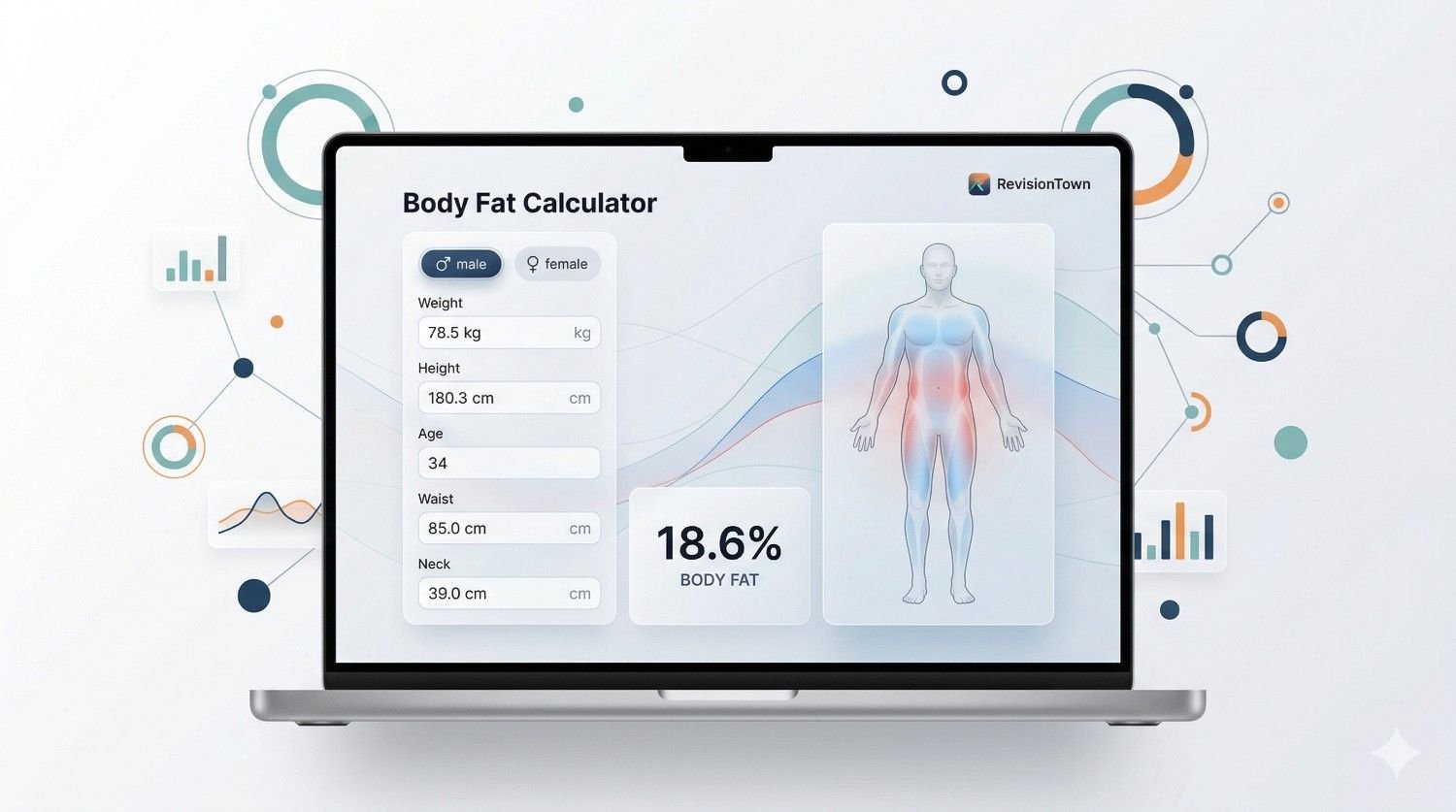
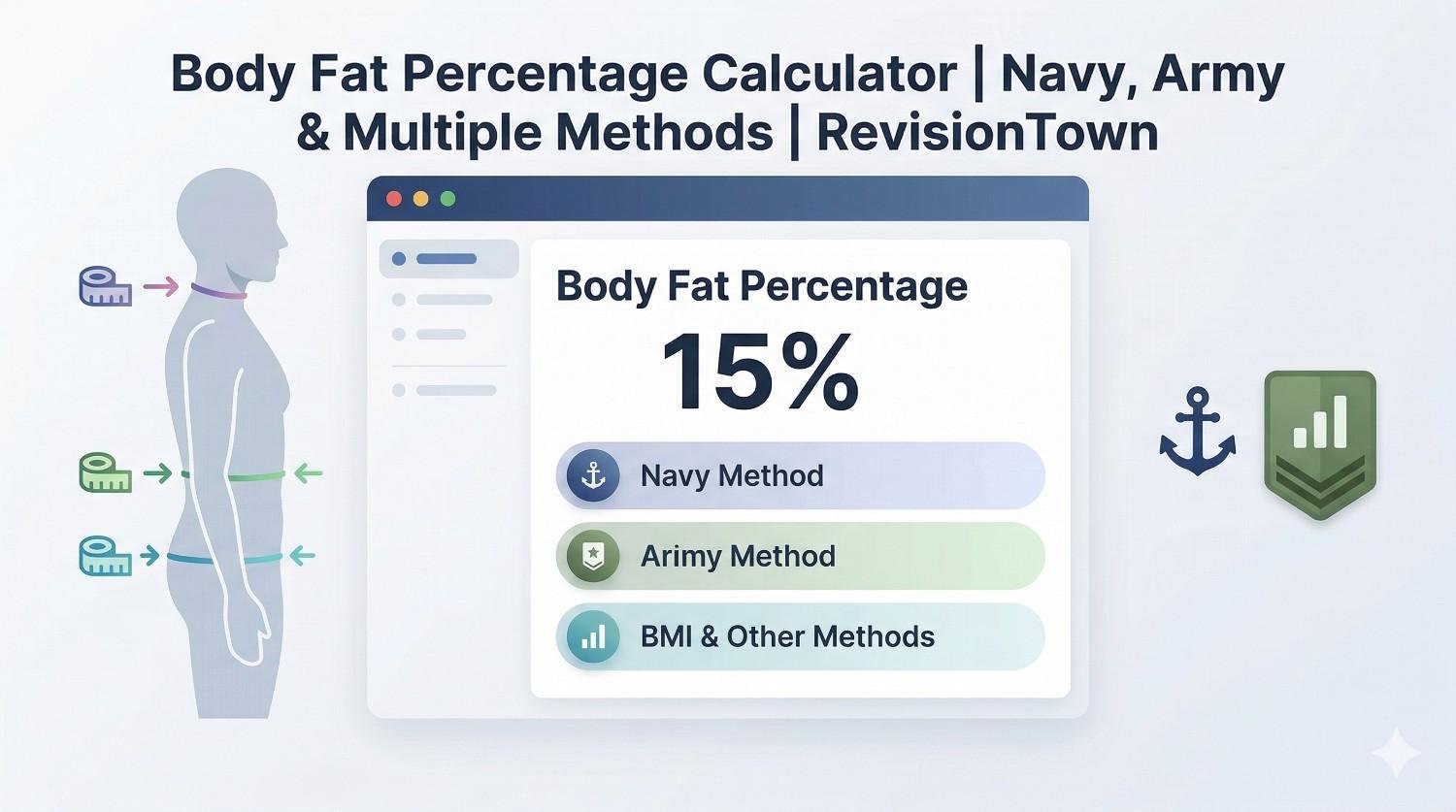
Use this body fat percentage calculator to estimate body composition from practical measurements you can take at home: height, weight, waist, neck, hip and age. The tool supports the classic Navy circumference estimate, a BMI-based body fat estimate, relative fat mass, and an Army-style waist-to-height screen. It also calculates fat mass, lean mass, BMI and FFMI so you can understand the result beyond a single percentage.
Body fat percentage is the share of body weight made up of fat mass. It is often more useful than scale weight alone because two people with the same weight can have very different amounts of lean tissue, water, bone, muscle and stored fat. This page explains the formulas, shows how to measure correctly, compares the methods, and helps you interpret the estimate responsibly.
For personal tracking, use the same method, the same tape location and the same time of day each time. Circumference formulas are estimates, not medical diagnoses and not official military determinations.
- ✓Measure with a non-stretch tape, level to the floor and snug without compressing skin.
- ✓Compare trends over weeks, not tiny day-to-day changes.
- ✓For official Army or Navy requirements, use the current service instructions and authorized personnel.
Body Fat Percentage Calculator
Choose a method, enter your measurements, and calculate an estimate. When the Army method is selected, the tool reports waist-to-height ratio because current Army screening is ratio-based. The calculator also shows a companion body-fat estimate only when the selected method produces a body-fat percentage.
What Body Fat Percentage Means
Body fat percentage is the proportion of your total body mass that is fat mass. If someone weighs 180 lb and has an estimated body fat percentage of 20%, the estimate means that about 36 lb is fat mass and about 144 lb is fat-free mass. Fat-free mass includes skeletal muscle, bone, organs, connective tissue, water and everything else that is not fat. This is why a body fat percentage calculator can be more useful than weight alone: it separates the scale number into a more practical body-composition picture.
A scale can tell you whether body weight changed, but it cannot tell you whether the change came from fat, muscle, water, glycogen or digestive contents. A body fat estimate helps you interpret the direction of change. If your weight stays the same while your waist gets smaller and your estimated body fat percentage falls, your body composition may be improving even though the scale looks unchanged. If weight falls quickly but lean mass also falls, the change may not match your performance, health or appearance goal.
The calculator above is designed for practical tracking. It can estimate body fat percentage with a classic tape method, a BMI-derived equation, relative fat mass or an Army-style waist-to-height screen. These methods are convenient, inexpensive and repeatable, but they are still estimates. They should not be treated like a laboratory measurement. The best use is to repeat the same method under similar conditions, look at the trend, and combine the result with waist measurement, training performance, energy level, sleep, nutrition quality and professional advice when needed.
Body fat is not simply a number to minimize. Some fat is essential for normal physiology. Essential fat supports cell membranes, hormone production, nerve function, reproductive health and organ protection. Storage fat provides energy reserve and insulation. Extremely low body fat can be risky, especially if achieved through dehydration, severe restriction or unsafe training practices. Very high body fat, particularly around the abdomen, can also be associated with higher health risk. The useful question is not only "What is my body fat percentage?" but "What does this estimate mean for my situation, goals and health context?"
For a full picture, compare body fat percentage with related metrics. BMI is a quick weight-to-height screen, and you can cross-check it with the BMI Calculator or the Advanced BMI Calculator. Lean mass tells you the non-fat portion of body weight, which is why the Lean Body Mass Calculator can be useful beside this page. If your goal involves nutrition planning, a body-composition estimate pairs naturally with the Calorie Calculator, Maintenance Calorie Calculator and Protein Calculator.
Quick Example
Suppose a person weighs 82 kg and receives a body fat estimate of 22%. The fat mass estimate is \(82 \times 0.22 = 18.04\) kg. The lean mass estimate is \(82 - 18.04 = 63.96\) kg. If their height is 1.78 m, their FFMI is \(63.96 \div 1.78^2 = 20.19\). This shows why the calculator returns more than one number. The body fat percentage gives the proportion, fat mass gives the amount of fat, lean mass gives the remaining body mass, and FFMI adjusts lean mass for height.
How to Measure for a Body Fat Calculator
Measurement quality matters as much as the formula. A tape formula can look precise because it returns a decimal, but the result depends heavily on where the tape sits, how tightly it is pulled and whether the same location is used each time. A one-inch difference at the waist can meaningfully change the result, especially for the Navy estimate and waist-to-height ratio. Before using the calculator, take a minute to set up consistent measurement conditions.
Use a flexible, non-stretch measuring tape. Stand tall but relaxed. Keep your feet roughly hip-width apart unless an official protocol says otherwise. Keep the tape level to the floor, snug against the skin and not compressing soft tissue. Measure after a normal exhale rather than after forcing air out or holding your breath. If you are tracking progress, measure at the same time of day, ideally before a large meal and under similar hydration conditions. Do not compare a morning fasted measurement with an evening measurement taken after training and a large meal.
Height
Measure standing height without shoes. Keep the head level, eyes forward and heels against a flat surface. Height is used in every method because taller and shorter people can have very different waist measurements at the same health or performance status. In the calculator, height also affects BMI, waist-to-height ratio and FFMI.
Weight
Use a calibrated scale if possible. Weight is needed for BMI, fat mass, lean mass and FFMI. For trend tracking, weigh under repeatable conditions. Daily weight changes can reflect water, sodium, carbohydrate intake, digestion and menstrual-cycle effects, so use a weekly average if you are making nutrition decisions.
Waist
For Army-style waist-to-height screening, measure waist circumference at the navel. For general body-composition tracking, the most important point is consistency. Some classic body-fat calculators use the narrowest waist, while current military protocols may use the navel. Record your chosen location and use it every time.
Neck and Hip
The classic Navy estimate uses neck and waist for men, and neck, waist and hip for women. Measure the neck just below the larynx with the tape sloping slightly down to the front. Measure the hip at the widest point of the buttocks. The hip measurement is only needed for the female Navy estimate.
Take at least two measurements at each site. If two readings are meaningfully different, take a third and use the closest pair or an average. When you are measuring yourself, small errors are common because it is difficult to keep the tape level around the back. A mirror can help, but a trained helper is better. Do not pull the tape tighter to force a better result. If the purpose is progress tracking, accurate repeatability matters more than a flattering number.
If you are using this page beside unit conversions, the calculator accepts imperial and metric entries. For separate unit checks, use RevisionTown's weight converter when you need kg, lb or stone values to match other records.
Body Fat Percentage Formulas Used by This Calculator
The calculator uses different formulas depending on the selected method. Each formula has a different purpose. The classic Navy equation estimates body fat percentage from circumference measurements. The BMI equation estimates body fat from BMI, age and sex. Relative Fat Mass estimates body fat from height-to-waist relationship. The Army selection reports waist-to-height ratio because current Army screening is based on that ratio, not on the older multi-site tape calculation.
Classic Navy Circumference Estimate
The classic Navy method is popular because it uses simple tape measurements and is more body-composition-aware than BMI alone. The calculator converts metric entries to inches before applying the equation. Let \(H\) be height in inches, \(W\) be waist in inches, \(N\) be neck in inches and \(P\) be hip in inches.
This method is useful for home tracking because changes at the waist are reflected in the estimate. It can still be wrong for individuals whose fat distribution is unusual for the equation, athletes with large neck circumference, people with unusual limb or torso proportions, and anyone whose tape measurements are inconsistent.
BMI-Based Body Fat Estimate
The BMI-based body fat equation uses body mass index, age and a sex constant. Let \(S = 1\) for male and \(S = 0\) for female in this formula. BMI itself is calculated from weight and height:
The BMI estimate is convenient when tape measurements are unavailable, but it should be treated as a broad estimate. It can overestimate body fat for muscular people and underestimate body fat for people with lower muscle mass. The CDC describes BMI as a screening measure rather than a diagnosis, which is the right way to use BMI-related estimates as well. For more depth, compare this page with RevisionTown's guide to the most accurate BMI measurement.
Relative Fat Mass (RFM)
Relative Fat Mass is another simple estimate that uses height and waist. It often performs better than BMI for some body-composition comparisons because waist circumference reflects central size more directly than weight alone. Let \(H\) and \(W\) use the same unit, either inches or centimeters:
RFM is easy to repeat, but it is still an estimate. It does not know whether your waist size comes from subcutaneous fat, visceral fat, muscle, posture, bloating, breathing pattern or tape placement. It is best used as a trend signal beside waist measurement and training context.
Army Waist-to-Height Ratio
The current Army-style screen shown in this calculator is waist-to-height ratio, abbreviated WHtR. It is a ratio, not a body fat percentage. Let \(W\) be waist circumference and \(H\) be height in the same unit:
Current Army guidance uses a benchmark below \(0.55\). The calculator displays the ratio and indicates whether it is below that benchmark. It does not determine official compliance, does not replace service instructions and does not reproduce every administrative detail used in official programs. If your goal is specifically Army screening, compare this tool with RevisionTown's Army Height and Weight Calculator.
Fat Mass, Lean Mass and FFMI
Once a method returns an estimated body fat percentage, the calculator converts that percentage into practical body-composition quantities:
FFMI stands for fat-free mass index. It adjusts lean mass for height, which can make it more informative than lean mass alone. A taller person will naturally carry more lean mass than a shorter person, so height adjustment helps compare muscularity more fairly. FFMI is still an estimate because it depends on the body-fat estimate and does not separate muscle from bone, water and organs.
Which Body Fat Method Should You Use?
The best method depends on the decision you are making. If you want a quick personal estimate and can measure carefully, the classic Navy tape method is usually a practical starting point. If you only know height, weight and age, the BMI estimate is better than having no estimate, but it is less specific. If you want a simple waist-focused estimate, RFM is quick and repeatable. If your concern is Army screening, waist-to-height ratio is the relevant ratio in current Army policy.
Do not mix methods when judging progress. A Navy estimate of 21% and an RFM estimate of 24% are not necessarily contradictory; they are different models. Pick the method that fits your measurement access, record the result, and repeat the same method under similar conditions. If you switch methods, start a new trend line rather than treating the new number as a continuation of the old one.
Comparison Table
| Method | Inputs | Best use | Main limitation |
|---|---|---|---|
| Classic Navy circumference estimate | Height, waist, neck, plus hip for women | Home body-composition tracking when tape measurements are available | Sensitive to tape placement and body-fat distribution |
| Army waist-to-height screen | Waist and height | Understanding a current Army-style ratio benchmark | Reports a ratio, not a body fat percentage |
| BMI body-fat estimate | Height, weight, age and sex constant | Rough estimate when no tape measurements are available | Can misread muscular or low-muscle individuals |
| Relative Fat Mass | Height and waist | Simple waist-based estimate for repeated self-checks | Does not account for neck, hip, weight or muscle mass |
| DXA, Bod Pod, hydrostatic weighing | Professional equipment | More formal assessment, research, clinical or athletic settings | Cost, access and protocol differences |
For many people, the most practical approach is layered. Track waist circumference, body weight, body fat estimate, training performance and how clothes fit. If all signs point in the same direction, the estimate is useful. If the numbers conflict, investigate instead of forcing one interpretation. For example, a strength athlete gaining weight and keeping the same waist may not be gaining fat at the same rate as BMI suggests. A person losing weight while strength and energy collapse may be losing too much lean mass. Body-composition estimates are tools for thinking, not verdicts.
For weight goals, body fat percentage should not replace nutrition basics. A fat-loss target depends on energy balance, protein intake, resistance training, sleep, steps, stress management and time. Use the Ideal Weight Calculator to compare weight ranges, then use this page to think about composition rather than scale weight alone. For calorie planning, the Calories Burned Calculator can help estimate activity energy, while maintenance calories give a baseline for gradual adjustments.
Important: A body fat calculator should not be used to justify extreme dieting, dehydration, sauna-based rapid weight cuts, laxatives, diuretics, or any attempt to manipulate a military or athletic measurement. Rapid weight manipulation can be dangerous and can impair performance, judgment and recovery.
Army and Navy Body-Composition Context
Military body-composition language can be confusing because the public often uses "Army body fat calculator" or "Navy body fat calculator" to describe older tape formulas, while current official programs may use different procedures. This page separates practical estimating formulas from official determinations. The calculator can help you understand the math, but it cannot certify compliance with Army, Navy, recruiting, aviation, academy, occupational or command-specific standards.
Current Army guidance uses waist-to-height ratio as the body-composition benchmark. The basic calculation is simple: waist circumference divided by height, using the same unit. A ratio below \(0.55\) is the benchmark described in current Army body-composition materials. The calculator includes this ratio because it is useful, easy to understand and distinct from a body-fat percentage. If the result is close to the benchmark, do not rely on a casual self-measurement. Official measurements have specific instructions and administrative procedures.
The Navy has also updated its Body Composition Assessment guidance. The latest Navy guide describes a two-step BCA process using waist-to-height ratio first, then body-composition calculation tables using height, waist and weight when required. That is different from the classic public "Navy tape formula" that uses neck, waist and hip measurements. This calculator keeps the classic Navy estimate because many users search for it and it remains useful for personal tracking, but it is clearly labeled as an estimate and not as a substitute for current official Navy BCA procedures.
When a page tries to do everything at once, it can accidentally compete with more specific pages. This page is focused on body fat percentage estimation, method comparison and body-composition formulas. It links naturally to related tools when they answer a different question. For example, Army-specific screening belongs on the Army Height and Weight Calculator. BMI-only screening belongs on the Body Mass Index Calculator. Broader fitness planning can start from the Health and Fitness Calculators collection.
How to Interpret Your Body Fat Result
After calculating your estimate, start with the method note. A Navy result means the percentage came from circumference measurements. A BMI result means the percentage came from height, weight, age and sex constants. An RFM result means it came from height and waist. An Army selection means the primary result is waist-to-height ratio. The meaning of the number depends on the method.
Next, look at fat mass and lean mass. A person who weighs 90 kg at 25% body fat has an estimated fat mass of 22.5 kg and lean mass of 67.5 kg. If that person later weighs 86 kg at 22% body fat, fat mass is about 18.9 kg and lean mass is about 67.1 kg. The scale decreased by 4 kg, but the estimate suggests most of the change came from fat mass while lean mass was mostly maintained. That is a different story from simply saying "lost 4 kg."
Body fat category labels can help orient the result, but they are not diagnoses. Common fitness category ranges often list lower percentages for men and higher percentages for women because average fat distribution and essential-fat requirements differ. Athletes can vary widely by sport, sex, age and training phase. A marathon runner, powerlifter, swimmer and recreational lifter may all perform well at different body-fat levels. A healthy target should match the person, not a generic chart alone.
If your result is unusually low, consider whether the formula is being fooled by measurements. A large neck circumference can lower the classic Navy estimate for men. A waist measurement taken too high or too tight can lower any waist-based estimate. Dehydration and intentional tape manipulation can produce a lower number without improving health. If the result is very low and you have fatigue, low libido, menstrual irregularity, cold intolerance, obsessive food thoughts, poor sleep or declining performance, the number should not be celebrated without professional context.
If your result is high, avoid panic and focus on actionable next steps. Body fat can change through sustainable nutrition, resistance training, aerobic activity, sleep and gradual calorie control. A reasonable plan emphasizes consistency rather than drastic restriction. Use the estimate to set a starting point, not to judge your worth or predict your future. Recheck in four to six weeks under similar conditions. A small, consistent change in waist, body weight, strength and body-fat estimate is more useful than a one-day result.
Common Body Fat Category Ranges
The ranges below are general fitness-reference categories often used to interpret body fat estimates. They are not medical cutoffs and are not service-specific standards. A healthcare professional, registered dietitian, coach or official military measurement authority may use different criteria depending on age, sex, sport, medical history and purpose.
| Category | Men | Women | How to read it |
|---|---|---|---|
| Essential fat | 2% to 5% | 10% to 13% | Very low; not usually an appropriate long-term target for most people. |
| Athlete range | 6% to 13% | 14% to 20% | Often seen in trained populations, but sport and individual context matter. |
| Fitness range | 14% to 17% | 21% to 24% | Often associated with a visibly fit composition for recreational training. |
| Average or acceptable | 18% to 24% | 25% to 31% | Common ranges in general adult populations. |
| Higher body fat | 25% and above | 32% and above | May justify a broader health-risk discussion, especially with waist size and other markers. |
Why Body Fat Percentage and BMI Can Disagree
BMI is calculated only from weight and height. It does not know whether weight comes from fat mass, muscle, bone, water or equipment. Body fat percentage tries to estimate composition, so it can tell a different story. A muscular person may have a high BMI but a moderate body fat percentage. A sedentary person may have a normal BMI but a higher body fat percentage because lean mass is lower. This is one reason BMI is useful for broad screening but limited for individual body-composition judgment.
The disagreement can be especially visible in athletes, older adults and people changing body composition through resistance training. Strength training can increase or preserve lean mass while fat mass decreases. During that process, body weight may move slowly, BMI may barely change and waist circumference may improve. A body fat calculator can make that progress easier to see, provided the same method is repeated consistently.
For a practical dashboard, record five numbers: body weight, waist circumference, body fat estimate, training performance and a subjective recovery score. If weight is stable, waist is falling, strength is stable and recovery is good, the plan may be working. If weight is falling quickly, waist is falling, strength is dropping and recovery is poor, the plan may be too aggressive. Numbers are useful because they prompt better questions.
Using Body Fat Percentage for Fitness Goals
For fat loss, body fat percentage helps estimate how much fat mass may need to change. Suppose someone weighs 90 kg at an estimated 28% body fat. Estimated fat mass is 25.2 kg and lean mass is 64.8 kg. If the person wants to reach 22% body fat while maintaining lean mass, an approximate target weight can be estimated by dividing lean mass by \(1 - 0.22\): \(64.8 \div 0.78 = 83.1\) kg. This is only a planning estimate, but it is more informative than choosing a random goal weight.
For muscle gain, body fat percentage helps keep a gaining phase controlled. If body weight rises but waist and body fat estimate rise too quickly, the calorie surplus may be larger than needed. If weight does not rise and performance stalls, the surplus may be too small. Body composition is useful because it turns "bulk" or "cut" into measurable feedback. The goal is not mathematical perfection; the goal is to make adjustments before months pass without progress.
For maintenance, body fat percentage can help you identify your comfortable range. Many people do not need to stay at their leanest sustainable number year-round. A performance athlete may periodize body composition by season. A recreational lifter may prefer a body-fat range that supports training, sleep, hormones and social life. A health-focused adult may prioritize waist reduction, blood pressure, glucose markers and energy over a specific aesthetic percentage.
Common Mistakes That Make Body Fat Estimates Worse
The most common mistake is changing measurement sites. If you measure your waist at the narrowest point one month and at the navel the next, the trend can look worse even if your body did not change. Choose the site that matches your method, write it down and keep it consistent. For Army-style WHtR, use the navel location. For a personal tape trend, consistency is more important than arguing about the perfect location.
The second mistake is pulling the tape too tight. A tape should touch the skin and follow the body surface, but it should not dig in. Compressing soft tissue lowers the measurement and creates a false trend. The same problem happens if you inhale, brace your abdomen or stand unnaturally tall to reduce waist measurement. A body-composition tool is only useful when it reflects normal posture and normal breathing.
The third mistake is overreacting to one estimate. Circumference measurements can change with bloating, digestion, menstrual cycle, hydration and training inflammation. Take the average of several readings or compare monthly results. A one-day increase does not mean fat gain. A one-day decrease does not mean fat loss. The trend matters more than the point.
The fourth mistake is comparing your estimate to someone else's estimate from a different method. A smart scale using bioelectrical impedance, a Navy tape formula, a skinfold test and a DXA scan can all return different values. That does not automatically mean one person is lying or one tool is useless. It means each method has assumptions and error. Use one method for personal trends and a more formal method when the decision deserves it.
Accuracy: What a Home Body Fat Calculator Can and Cannot Do
A home calculator can provide a repeatable estimate. It can help you compare changes in waist, weight and body composition over time. It can help you plan a fat-loss phase, maintenance phase or muscle-gain phase. It can help you understand why BMI and body composition are not the same thing. It can also help you explain your measurements with formulas instead of relying on vague descriptions.
A home calculator cannot see your actual fat tissue. It cannot separate visceral fat from subcutaneous fat. It cannot measure bone density, organ mass, muscle thickness, water shifts or glycogen. It cannot diagnose obesity-related disease, malnutrition, athletic readiness, eating disorder risk or official military compliance. If a decision has health, employment, sport eligibility or medical consequences, use the correct official or clinical process.
Even professional methods have error. DXA results can vary by machine, hydration, software and positioning. Bioelectrical impedance can change with hydration, skin temperature, food intake and exercise. Skinfold results depend on technician skill and equation choice. Hydrostatic weighing and air displacement require controlled protocols. A calculator is less formal, but the same principle applies: the method is only as useful as the measurement process and the interpretation.
Body Fat Percentage and Health Risk
Body fat percentage is one part of a health picture. Waist size and waist-to-height ratio can be useful because central fat distribution is more closely related to cardiometabolic risk than total weight alone in many contexts. Blood pressure, blood lipids, blood glucose, sleep apnea symptoms, family history, smoking status, activity level and medication use may matter more than a single body-composition estimate. A person with a moderately high estimate and excellent clinical markers is different from a person with the same estimate and multiple risk factors.
Low body fat can also carry risk. People often focus on high body fat, but excessively low fat availability can affect hormones, bone health, immune function, mood and performance. In women, menstrual changes can be a warning sign. In men, persistent low energy, low libido and declining training performance can be warning signs. A calculator cannot identify those issues. It can only provide a number that should be interpreted within the broader situation.
For most adults, sustainable habits matter more than chasing an exact percentage. Resistance training helps preserve lean mass. Adequate protein supports recovery and satiety. Moderate calorie control is easier to sustain than severe restriction. Sleep affects hunger, recovery and training quality. Walking and aerobic activity support energy expenditure and heart health. A body fat estimate is useful when it helps you make those habits more consistent.
Practical tracking rule: record body fat percentage only with the method used. Write "Navy estimate: 21.4%" or "RFM estimate: 24.0%," not just "21.4%." That habit prevents confusion when you compare old and new results.
Worked Examples
Example 1: Navy estimate for a male
A male user enters height 70 in, waist 36 in and neck 16 in. The formula uses \(W-N = 20\). The estimate is \(\%BF = 86.010\log_{10}(20) - 70.041\log_{10}(70) + 36.76\), which returns an estimated body fat percentage. If the weight is 180 lb, the calculator then estimates fat mass and lean mass from that percentage.
Example 2: RFM estimate
A female user enters height 165 cm and waist 78 cm. The RFM equation is \(76 - 20 \times (165 \div 78)\). Because height and waist use the same unit, no unit conversion is needed inside the ratio. This makes RFM simple for repeated waist-focused tracking.
Example 3: Army WHtR
A user enters height 70 in and waist 37 in. The waist-to-height ratio is \(37 \div 70 = 0.529\). That is below \(0.55\), so the calculator reports it as below the benchmark. This ratio is not a body fat percentage and should not be compared directly with a Navy estimate.
How Often Should You Recalculate?
For most people, every two to four weeks is enough. Body composition changes slowly, and more frequent estimates can create noise. If you are dieting, waist and weight may change weekly, but body fat formulas are not accurate enough to make daily decisions. If you are maintaining or gaining muscle, monthly checks are usually sufficient. The more aggressive the plan, the more important it is to monitor energy, strength, mood and recovery alongside the estimate.
If you use a professional method such as DXA, schedule it far enough apart for meaningful change. A scan every week is usually unnecessary and may lead to overinterpretation. If you use home tape measurements, two readings per month can show a trend without turning the process into a daily stressor. Consistency beats frequency.
Who Should Be Careful With Body Fat Targets?
Some users should treat body fat targets with extra caution. Teenagers are still developing and should not use adult formulas as personal health targets without professional guidance. Pregnant and postpartum users have changing physiology that makes standard estimates less meaningful. People with a history of eating disorders may find body-composition tracking triggering. Competitive athletes in weight-class sports should avoid rapid manipulation without qualified supervision. Anyone with chronic disease, medication changes or unexplained weight change should speak with a healthcare professional.
Body composition can be a helpful metric, but it should never become the only metric. Health includes strength, endurance, mobility, lab values, menstrual health, sleep, mental health, social function and long-term sustainability. The calculator gives an estimate; it does not replace judgment.
Using This Calculator Without Competing With Other Tools
This page is intentionally focused on estimating body fat percentage and explaining related body-composition methods. If you need only BMI, use a BMI tool. If you need only Army height and weight screening, use the dedicated Army page. If you need calories, protein or maintenance intake, use those nutrition tools. Clear separation helps each calculator answer its own search intent and helps readers choose the correct tool faster.
For example, a reader asking "What is my BMI?" should not need to read a full body-fat method guide. A reader asking "How many calories should I eat?" needs energy planning, not tape formulas. A reader asking "What is my body fat percentage?" needs exactly this page: methods, formulas, measurements, limitations and interpretation. The next calculator should feel like the natural next step, not a detour from the task at hand.
Measurement Checklist Before You Press Calculate
| Step | What to do | Why it matters |
|---|---|---|
| 1 | Choose one method and use it consistently. | Different formulas can return different estimates. |
| 2 | Measure height without shoes and weight under repeatable conditions. | Height affects every ratio; weight affects BMI, fat mass and lean mass. |
| 3 | Measure waist at the correct site and after a normal exhale. | Waist is the most influential tape measurement in most methods. |
| 4 | Keep the tape level and snug, not tight. | Compressing skin or tilting the tape can change the result. |
| 5 | Record the date, method and measurement locations. | Good records make long-term trends easier to interpret. |
Body Fat Percentage Calculator FAQ
What is the best body fat percentage calculator method?
For home use, a tape-based method such as the classic Navy circumference estimate is often more useful than BMI alone because it uses waist, neck and hip measurements. It is still an estimate. For formal decisions, professional methods such as DXA, Bod Pod, hydrostatic weighing or a trained skinfold assessment may be more appropriate.
Is the Army method a body fat percentage formula?
Current Army body-composition screening uses waist-to-height ratio rather than a public body-fat percentage equation. This calculator displays the Army-style WHtR and the \(0.55\) benchmark context. It should not be used as an official Army determination.
Why does the Navy method need neck measurement?
The classic Navy formula uses neck circumference as part of the circumference relationship. In general, a larger neck relative to waist reduces the estimate. This can be useful in some populations but can also underestimate body fat for people with unusually large necks.
Why do women need a hip measurement in the Navy formula?
The classic female Navy equation includes hip circumference because female body-fat distribution often differs from male distribution. The equation uses waist plus hip minus neck, then compares that circumference relationship with height.
Can BMI estimate body fat percentage?
BMI can be used in an equation that estimates body fat percentage from BMI, age and sex. However, BMI does not directly measure fat mass. It is a screening metric and can be misleading for muscular people, older adults with lower muscle mass and anyone whose body composition differs from average assumptions.
What is FFMI?
FFMI means fat-free mass index. It is calculated as lean mass in kilograms divided by height in meters squared. It adjusts estimated lean mass for height, which makes it useful for comparing muscularity more fairly than lean mass alone.
How accurate is a tape body fat calculator?
Accuracy varies by measurement skill, formula fit and body shape. A tape calculator can be useful for trends, but it may be several percentage points away from a laboratory method for an individual. Repeatability is the main advantage.
Should I use inches or centimeters?
Use whichever unit you can measure accurately. The calculator converts internally. For ratio formulas such as RFM and WHtR, height and waist must use the same unit. For the Navy formula, the calculator converts metric measurements to inches before applying the displayed equation.
What body fat percentage should I aim for?
There is no single correct target for everyone. A suitable range depends on sex, age, sport, medical history, lifestyle, performance goals and sustainability. A healthcare professional or qualified coach can help set a target that matches your situation.
Can body fat percentage change without weight changing?
Yes. If fat mass decreases and lean mass increases by similar amounts, scale weight may stay similar while body composition improves. This is common in beginners who start resistance training and improve nutrition.
Can body fat percentage increase while weight decreases?
It can happen if weight loss comes disproportionately from lean mass or water while fat loss is limited. This is one reason resistance training, adequate protein and moderate calorie deficits are often recommended during fat loss.
Is a smart scale more accurate than this calculator?
Not always. Smart scales usually use bioelectrical impedance, which can shift with hydration, food intake, skin temperature and exercise. A smart scale can be useful for trends if used consistently, but it should still be treated as an estimate.
What is the difference between fat mass and lean mass?
Fat mass is the estimated weight of fat tissue. Lean mass is everything else: muscle, bone, organs, water and connective tissue. Lean mass is not the same as muscle mass, but it is still a useful body-composition estimate.
How do I reduce body fat percentage?
Most sustainable plans combine a modest calorie deficit, adequate protein, resistance training, aerobic activity, sleep and consistency. The calculator can track estimates, but the plan should be realistic enough to maintain.
Can I use this calculator for children or teenagers?
This calculator is intended for adults. Children and teenagers should use age-appropriate growth and health guidance from qualified healthcare professionals rather than adult body-fat formulas.
Why did my result change after one day?
One-day changes often reflect measurement noise, bloating, hydration, food volume, sodium intake, training soreness or tape placement. Compare trends over several weeks instead of reacting to a single reading.
Can this calculator confirm military compliance?
No. Official military compliance requires current service instructions, authorized measurements, required forms and command procedures. This calculator is educational and should be used only to understand estimates and related formulas.
Why does this page include an Army link if it is a body fat calculator?
Many readers search for Army body-composition measurements while looking for body fat estimates. This page explains the waist-to-height ratio context, then links to the dedicated Army calculator for readers whose primary goal is Army screening rather than general body-fat estimation.
Official References for Measurement Context
The calculator formulas are provided for education and personal tracking. For official policies and medical screening language, consult primary sources. The U.S. Army describes the current waist-to-height ratio benchmark in Army body-composition materials, the Navy Physical Readiness Program Guide 4 describes Navy BCA procedures, and the CDC explains BMI as a screening measure rather than a diagnostic tool.