Instant body mass index check
Free BMI Calculator Online – Check Your Body Mass Index Instantly
Use this free BMI calculator online to check your body mass index from height and weight in either metric or imperial units. The calculator returns your BMI value, adult weight category, healthy-weight reference range for your height, and practical context so you understand what BMI can and cannot tell you about health.
BMI Calculator
Enter height, weight, and age. Adult BMI categories apply to people 20 and older. For ages 2 through 19, BMI should be interpreted with age- and sex-specific percentiles, so the result below is a number only and should be reviewed with a pediatric growth chart or clinician.
The default example uses 170 cm and 70 kg.
What This BMI Calculator Does
This calculator finds body mass index from height and weight. BMI is a simple screening number that compares weight with height. It is widely used because it is quick, inexpensive, and easy to repeat. A person can calculate BMI at home with a scale and a height measurement, and a clinic can calculate it without specialized body-composition equipment. The result helps place adult weight status into broad categories such as underweight, healthy weight, overweight, and obesity.
The calculator is designed for instant adult BMI checking while still giving important context. It does not diagnose health, body fat percentage, fitness, or disease risk by itself. It also does not interpret children and teens with adult cutoffs. For people aged 2 through 19, BMI must be compared with age- and sex-specific percentiles because healthy growth changes with age. That is why the calculator warns younger users that the number should be read with pediatric growth charts and professional guidance.
Use this page when you need a fast answer to, "What is my BMI?" Use related tools when the question is more specific. The body fat calculator and body fat percentage calculator focus on body composition. The ideal weight calculator estimates reference weight ranges. The lean body mass calculator helps separate lean tissue from fat mass. BMI is useful, but it is only one part of a fuller health picture.
How BMI Is Calculated
The BMI formula uses height squared because weight generally rises with body size. In metric units, first convert height from centimeters to meters. Then divide weight in kilograms by height in meters squared. For example, someone who weighs 70 kg and is 1.70 m tall has \(70\div1.70^2=24.2\). The calculator rounds the final BMI to one decimal place because that is precise enough for weight-category screening.
In imperial units, first convert height to total inches. A height of 5 ft 7 in is \(5\times12+7=67\) inches. Then multiply body weight in pounds by 703 and divide by total inches squared. For example, someone who weighs 154 lb and is 67 in tall has \(154\times703\div67^2=24.1\). The factor 703 adjusts the pounds-and-inches calculation to match the metric BMI scale.
The formula is the same for adult men and women. Sex does not change the adult BMI calculation. However, sex can matter when interpreting children and teens because pediatric BMI uses percentile curves based on age and sex. Sex can also matter when interpreting body composition, waist circumference, fat distribution, and health risk. BMI is a starting number, not a complete assessment.
Adult BMI Categories
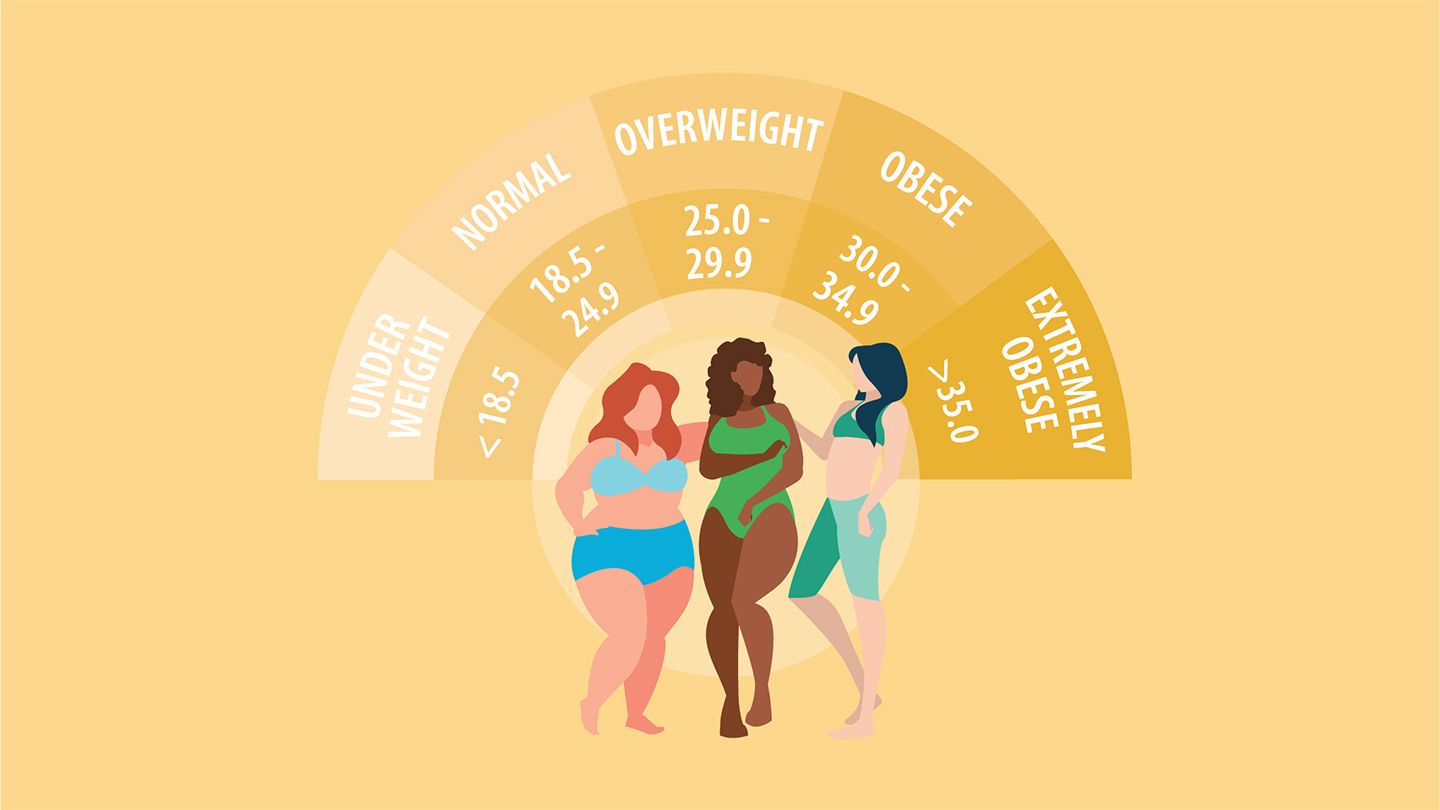
For adults aged 20 and older, standard BMI categories use fixed cutoffs. Underweight is below 18.5. Healthy weight is 18.5 to less than 25. Overweight is 25 to less than 30. Obesity begins at 30, with class 1 from 30 to less than 35, class 2 from 35 to less than 40, and class 3 at 40 or higher. These cutoffs are population screening categories, not personal diagnoses.
| Adult BMI category | BMI range | What it usually means | What to check next |
|---|---|---|---|
| Underweight | Less than 18.5 | Weight is low relative to height. | Review nutrition, unintentional weight loss, medical symptoms, and strength. |
| Healthy weight | 18.5 to less than 25 | Weight falls in the broad adult reference range. | Still consider waist, blood pressure, labs, fitness, and habits. |
| Overweight | 25 to less than 30 | Weight is higher relative to height. | Check waist circumference, body composition, activity, and metabolic markers. |
| Class 1 obesity | 30 to less than 35 | Higher weight category associated with increased health risk in populations. | Discuss risk factors and sustainable lifestyle steps with a clinician if concerned. |
| Class 2 obesity | 35 to less than 40 | Higher category where medical context becomes more important. | Review blood pressure, glucose, lipids, sleep apnea symptoms, and joint pain. |
| Class 3 obesity | 40 or greater | Severe obesity category in adult screening systems. | Professional guidance is strongly recommended for health-risk assessment. |
The category names can feel blunt, but their purpose is screening. They help identify when a person may benefit from further assessment, not whether a person is healthy or unhealthy as a whole. A high BMI may reflect excess fat, high muscle mass, fluid changes, pregnancy, or other factors. A normal BMI may hide high body fat or low muscle mass. The category is useful when paired with other evidence.
Interpreting Your BMI Result
Start with the number, then read the category, then ask what else is true. If your BMI is 23 and you have good energy, normal blood pressure, regular physical activity, and no concerning symptoms, the result is generally reassuring. If your BMI is 23 but waist circumference is high, strength is low, and blood sugar is rising, the BMI alone is not enough. If your BMI is 28 and you are a muscular athlete with normal waist and strong health markers, the category may overstate fatness. If your BMI is 28 with increasing waist, high blood pressure, and low activity, the result may point to a useful health conversation.
For underweight results, context matters as much as the number. Some people naturally have lower body weight, while others may be under-eating, losing weight unintentionally, overtraining, or dealing with illness. A BMI below 18.5 is a reason to review nutrition, symptoms, menstrual health when relevant, energy, strength, and medical history. It should not be ignored, especially if the low weight is new or accompanied by fatigue, digestive symptoms, weakness, or loss of appetite.
For overweight and obesity results, the number can motivate a review of habits and risk factors. It should not lead to panic or crash dieting. Sustainable action usually includes better food structure, enough protein, regular physical activity, sleep, stress management, and medical support when needed. If weight management is your next step, the calorie calculator, maintenance calorie calculator, and caloric needs guide can help connect BMI context with energy planning.
Healthy Weight Range for Your Height
The calculator also shows the adult healthy-weight reference range for your height. It does this by reversing the BMI formula. In metric units, weight equals BMI multiplied by height in meters squared. For the adult healthy-weight category, the lower BMI boundary is 18.5 and the upper boundary is just below 25. If someone is 1.70 m tall, the lower reference weight is \(18.5\times1.70^2=53.5\) kg and the upper reference weight is \(24.9\times1.70^2=72.0\) kg.
This range is not a command. It is a screening reference based on BMI categories. A muscular person may sit above the range with low body fat. An older adult may be in the range while needing more strength and protein. A person with chronic disease may need a clinician-defined weight target. Use the range to understand the scale of the BMI category, then interpret it with body composition, waist, medical history, and quality of life.
BMI for Children and Teens
Children and teens should not be interpreted with adult BMI cutoffs. In ages 2 through 19, BMI is compared with age- and sex-specific percentile charts. A child in the 60th percentile has a BMI higher than 60 percent of children of the same age and sex in the reference population. The categories are percentile-based: underweight is below the 5th percentile, healthy weight is from the 5th percentile to less than the 85th percentile, overweight is from the 85th to less than the 95th percentile, and obesity is at or above the 95th percentile.
This matters because growth is not linear. A BMI that would be unusual for one age may be normal for another. Puberty, growth spurts, sex, and development all influence interpretation. If you are calculating BMI for a child or teen, use a pediatric BMI-for-age calculator or growth chart and discuss concerns with a qualified clinician. Do not put a child on an adult-style diet based only on an adult category table.
The calculator on this page can still compute the mathematical BMI number for a younger person, but the category result is intentionally cautious. The best next step for children and teens is a growth-chart interpretation, not a fixed adult label. Parents and caregivers should focus on supportive routines: regular meals, nutrient-dense foods, sleep, movement, family habits, and medical guidance when growth or weight changes are concerning.
Why BMI Is Useful
BMI is useful because it is simple, standardized, and low cost. Public health systems can use it to study weight patterns across large populations. Clinics can use it as a first screening step. Individuals can use it to understand where their weight sits relative to height. It requires only two measurements and gives a number that can be compared over time. When BMI changes meaningfully, it can signal that weight status is changing and that further review may be helpful.
BMI is also useful because it correlates with health risk at population levels. Higher BMI categories are associated with increased risk for conditions such as high blood pressure, type 2 diabetes, cardiovascular disease, sleep apnea, osteoarthritis, and some cancers. Low BMI can also be associated with health risk, especially when linked to undernutrition, illness, frailty, or unintentional weight loss. These associations do not determine an individual's health, but they explain why BMI remains a common screening tool.
A good screening tool does not need to be perfect to be useful. Blood pressure, cholesterol, waist circumference, and fasting glucose also need interpretation. BMI belongs in that same family: helpful when used with context, misleading when treated as the whole story. The strongest use of BMI is not judging a body; it is deciding whether more information should be gathered.
Why BMI Can Be Misleading
BMI does not directly measure body fat. It cannot distinguish muscle from fat, bone from water, or subcutaneous fat from visceral fat. A strength athlete and a sedentary person can share the same BMI while having very different body compositions. A person with normal BMI can still have high body fat and low muscle. A person with high BMI can still have excellent fitness and favorable lab markers. This is the most important limitation to remember.
BMI also does not show where fat is stored. Abdominal fat, especially visceral fat around internal organs, is more closely linked with metabolic risk than fat stored elsewhere. That is why waist circumference, waist-to-height ratio, and clinician assessment can add value. The calculator includes an optional waist entry to prompt this thinking, although it does not diagnose risk. Waist should be measured consistently, usually around the midpoint or at the level recommended by a clinician or measurement protocol.
Age and ethnicity can affect interpretation. Some populations may develop metabolic risk at lower BMI values, while very muscular populations may have BMI values that overstate fatness. Older adults can lose muscle while maintaining weight, which may make BMI look stable even as body composition changes. Pregnant people should not use standard BMI categories to judge pregnancy weight changes. Use BMI as a starting screen, then bring in the context that applies to you.
BMI, Waist Circumference, and Body Composition
Waist circumference is a practical add-on because it gives information about central body size. A high waist measurement can indicate higher cardiometabolic risk even when BMI is not very high. A lower waist measurement can provide reassurance when BMI is slightly elevated because of muscle or frame size, although it does not replace lab work or clinical review. If BMI and waist both point in the same direction, the signal is stronger. If they disagree, body composition and medical markers become more important.
Body fat percentage estimates can also help. Home scales, tape formulas, skinfolds, DEXA, and other methods each have limitations, but they answer a different question from BMI. BMI asks, "How does weight compare with height?" Body fat percentage asks, "What share of body mass is fat?" Lean body mass asks, "How much of the body is not fat mass?" These questions are related, but not identical. For deeper context, use the highly advanced body fat calculator or advanced body fat calculator.
Fitness measures matter too. Resting heart rate, blood pressure, aerobic capacity, strength, mobility, sleep, and daily energy all help interpret the body-size picture. A person who improves strength, waist, blood pressure, and glucose may be healthier even if BMI changes slowly. A person who loses weight rapidly but loses strength, energy, and menstrual regularity may need a different plan. BMI is a signal, not the scoreboard.
Using BMI for Weight Management
If BMI suggests that weight change may be useful, the next step is not an extreme diet. Start by estimating energy needs, reviewing protein, and choosing a realistic habit target. A small calorie deficit can support fat loss. A controlled surplus can support gain when weight is too low or muscle gain is the goal. Maintenance calories can help stabilize weight and improve consistency. The highly advanced calorie calculator and advanced TDEE calculator can help when energy planning is the next step.
Protein is important in both fat loss and weight gain. During fat loss, adequate protein and resistance training help preserve lean mass. During weight gain, adequate protein supports muscle gain when combined with training. Use the protein requirement calculator or protein intake calculator when building a nutrition plan around the BMI result.
Do not chase a BMI category at the expense of health. For some people, improving waist circumference, blood pressure, glucose, sleep, and fitness is a better first goal than reaching a specific BMI. For others, gaining strength and weight may be the priority. For athletes, a performance-focused plan may matter more than a standard weight table. The best use of BMI is to ask better questions and choose next steps that fit your body and health context.
Worked Examples
Example 1: Metric calculation
A person weighs 72 kg and is 168 cm tall. First convert height to meters: \(168\div100=1.68\). Then square the height: \(1.68^2=2.8224\). BMI is \(72\div2.8224=25.5\). For an adult, this falls in the overweight category. The next step is not to judge the person; it is to review waist, activity, body composition, blood pressure, and goals.
Example 2: Imperial calculation
A person weighs 180 lb and is 5 ft 10 in tall. Total height is \(5\times12+10=70\) inches. BMI is \(180\times703\div70^2=25.8\). For an adult, this is also in the overweight category. If this person is muscular and has a low waist measurement, BMI may overstate fatness. If waist is high and activity is low, the result may be more concerning.
Example 3: Underweight review
A person weighs 50 kg and is 172 cm tall. Height is 1.72 m, and BMI is \(50\div1.72^2=16.9\). For an adult, this is below the underweight cutoff. If the person has lost weight unintentionally or has symptoms such as fatigue, appetite loss, digestive issues, or weakness, the result deserves medical review. A gradual nutrition and strength plan may be appropriate, depending on the cause.
Example 4: Healthy category with context
A person weighs 64 kg and is 165 cm tall. BMI is \(64\div1.65^2=23.5\), which falls in the adult healthy-weight category. That is useful information, but it does not guarantee excellent health. Sleep, physical activity, diet quality, blood pressure, glucose, cholesterol, waist measurement, and strength still matter.
Common BMI Mistakes
| Mistake | Why it matters | Better approach |
|---|---|---|
| Using adult cutoffs for children | Children and teens require age- and sex-specific BMI percentiles. | Use pediatric growth charts or a child and teen BMI calculator. |
| Assuming BMI measures body fat directly | BMI is based only on height and weight. | Add waist, body fat percentage, fitness, and health markers. |
| Ignoring muscle mass | A muscular person can have a high BMI without high body fat. | Use body composition tools for athletes and strength-trained people. |
| Ignoring low muscle at normal BMI | A normal BMI can still hide low lean mass or high visceral fat. | Review strength, waist, diet quality, and metabolic markers. |
| Reacting with a crash diet | Extreme restriction can reduce energy, adherence, and lean mass. | Use moderate calorie changes and sustainable routines. |
| Forgetting medical context | Pregnancy, illness, medications, edema, and eating disorders change interpretation. | Use professional guidance when weight change or symptoms raise concern. |
Practical Next Steps After Checking BMI
If your BMI is in the healthy adult range, maintain the habits that support it and review other markers. Stay active, include strength work, eat enough protein and fiber, sleep well, and monitor waist and routine health checks. If your BMI is underweight, consider whether the result matches your history. Stable lifelong low weight may mean something different from recent unintentional loss. If weight gain is appropriate, focus on nutrient-dense calories, resistance training when suitable, and medical evaluation when symptoms are present.
If your BMI is in the overweight or obesity categories, start with information rather than shame. Check waist circumference. Review blood pressure, glucose, cholesterol, sleep apnea symptoms, joint pain, and family history. Estimate calories if weight loss is a goal, but avoid drastic changes. Add walking or other enjoyable movement. Include protein-rich foods. Build meals around vegetables, fruits, legumes, whole grains, lean proteins, dairy or fortified alternatives, nuts, seeds, and healthy fats when they fit your diet.
If your goal is a structured plan, connect BMI to other calculators. Use the macro calculator to distribute calories into macronutrients. Use the calories burned calculator conservatively when estimating activity. Use the height calculator or weight converter if unit conversions are part of the problem.
When to Talk With a Health Professional
Get personal guidance when BMI is paired with symptoms or medical risk. BMI is a screening tool, not a diagnosis. Speak with a qualified clinician if you have rapid weight change, pregnancy, child growth concerns, eating disorder history, diabetes, kidney disease, heart disease, swelling, unexplained fatigue, digestive symptoms, or a prescribed medical diet.
A clinician can interpret BMI with physical examination, waist circumference, blood pressure, blood tests, medication history, family history, and symptoms. That context matters. A person with BMI 31 and normal markers may need different advice from a person with BMI 27 and type 2 diabetes. A person with BMI 18 and stable health may need different advice from a person with BMI 18 after sudden weight loss. Public calculators cannot see these differences.
Professional support can also make weight management safer and more realistic. Registered dietitians, physicians, physical therapists, mental health professionals, and qualified exercise specialists each bring different tools. The goal is not only changing a number. It is improving health, function, confidence, and sustainability.
How to Measure Height and Weight Correctly
A BMI result is only as accurate as the height and weight entered. Small measurement errors can move the result across a category boundary, especially when BMI is close to 18.5, 25, or 30. Measure height without shoes, standing tall against a flat wall or stadiometer, with the head level and eyes looking straight ahead. Hair, shoes, thick socks, and poor posture can add or subtract enough height to change the calculation. If you have not measured height recently, do not rely on an old number from a driver's license or a school record. Adults can lose height gradually with age because of posture, spinal compression, or bone changes.
Measure weight on a stable scale placed on a hard, flat surface. Weigh at a consistent time of day, such as after waking and using the bathroom, before eating or drinking. Clothing, food volume, hydration, sodium, bowel contents, menstrual cycle changes, and recent exercise can all affect weight. This does not mean the scale is useless; it means one weigh-in is a noisy data point. BMI for a single health visit is often calculated from one measured weight, but personal tracking works better with averages.
If you are using BMI to monitor a change, record weekly average weight rather than reacting to one number. A three-day or seven-day average can smooth out water fluctuations. If your BMI changes by 0.1 from one day to the next, that may mean nothing. If it changes by 1.0 or more across several months, that may reflect a meaningful body-weight trend. Use the calculator to check the number, then use consistent measurement habits to make the trend reliable.
BMI and Waist-to-Height Ratio
Waist-to-height ratio is a simple companion measure. It compares waist circumference with height and is often used to think about central body size. The formula is waist divided by height, using the same units for both measurements. For example, a 34 inch waist and 68 inch height gives \(34\div68=0.50\). A 86 cm waist and 172 cm height also gives \(86\div172=0.50\). Many health discussions use the idea that keeping waist below about half of height can be a useful practical target, although individual risk still depends on age, sex, ethnicity, health history, and clinical markers.
This ratio can add context when BMI is unclear. A person with BMI 27 and a low waist-to-height ratio may have a different risk profile from a person with BMI 27 and a high waist-to-height ratio. It is especially useful because abdominal fat is more strongly linked with metabolic risk than fat stored around hips and thighs. BMI cannot tell where mass is stored. Waist measurements can help fill that gap.
Measure waist consistently. Stand relaxed, breathe normally, and place the tape around the abdomen without compressing the skin. Different organizations use slightly different measurement landmarks, such as the top of the hip bones or the midpoint between the lower rib and hip. For personal tracking, choose one method and repeat it the same way. A waist trend that moves down while strength and energy are stable can be a positive sign even if BMI changes slowly.
BMI for Athletes and Strength-Trained People
Athletes often run into BMI limitations because training changes body composition. Muscle is dense, and athletes may carry more lean mass than the average person of the same height. A sprinter, rower, rugby player, powerlifter, gymnast, or recreational lifter can have a BMI in the overweight range while having a waist measurement, body fat percentage, blood pressure, and fitness level that look healthy. In that situation, BMI is not wrong mathematically; it is simply answering a narrow question about weight relative to height.
Strength-trained people should interpret BMI with body composition and performance data. If BMI rises because muscle and strength are increasing while waist remains stable, the category may not mean the same thing as it would for someone gaining mostly fat. If BMI rises along with waist, blood pressure, and fatigue, the result deserves a different interpretation. The same BMI can tell different stories depending on what else changes.
Athletes should also avoid using BMI as a reason to cut weight unnecessarily. Performance, injury risk, recovery, hormonal health, and sport demands matter. A low BMI does not guarantee better performance, and rapid weight loss can impair training. When weight-class sports are involved, advice should come from qualified coaches and health professionals who understand the sport and the athlete. For general fitness users, body fat, lean mass, waist, training performance, and medical markers give a clearer picture than BMI alone.
BMI for Older Adults
BMI can become harder to interpret with age. Older adults often lose muscle mass if they are inactive, ill, or eating too little protein. This means someone can stay at the same body weight while body composition changes: less muscle, more fat, lower strength, and higher fall risk. BMI may look stable, but function may be declining. Conversely, a slightly higher BMI in an older adult may not carry the same meaning as the same BMI in a younger adult, especially if the person has good strength, mobility, and medical markers.
For older adults, strength, walking speed, balance, appetite, unintentional weight loss, and daily function are important. A sudden drop in weight can be a warning sign even when BMI remains in the adult healthy range. Low BMI paired with weakness, poor appetite, fatigue, or repeated falls should be reviewed. The goal is not simply to fit a category; it is to maintain independence, muscle, bone health, and quality of life.
Nutrition planning in older adults often includes enough protein, vitamin D, calcium, resistance training when possible, and medical review when weight changes are unexpected. If BMI is being used to guide a plan for an older adult, pair it with a broader assessment. The number alone cannot show muscle quality, bone density, appetite, medication effects, or recovery capacity.
BMI and Pregnancy, Postpartum, and Fluid Changes
Standard BMI categories are not designed to judge pregnancy weight gain. Pre-pregnancy BMI may be used by clinicians to discuss recommended pregnancy weight gain ranges, but weight during pregnancy follows a different context because it includes the fetus, placenta, amniotic fluid, blood volume, breast tissue, fluid, and normal maternal changes. A pregnant person should not use this calculator to decide whether pregnancy weight gain is appropriate. Prenatal care is the right setting for that discussion.
Postpartum weight also needs context. Fluid changes, feeding method, sleep deprivation, recovery, hormones, healing, and mental health all affect weight and body composition. BMI can be calculated, but it should not be used as a harsh measure during recovery. Gradual return to activity, adequate nutrition, pelvic floor considerations, and clinical guidance matter more than rushing toward a category.
Fluid retention can also change BMI without reflecting fat change. Edema, certain medications, heart disease, kidney disease, liver disease, inflammation, and menstrual cycle shifts can move weight quickly. If weight changes rapidly over days, especially with swelling, shortness of breath, chest symptoms, or unusual fatigue, BMI is not the main issue; medical advice is needed.
BMI and Health Markers
BMI becomes more useful when it is combined with health markers. Blood pressure can reveal cardiovascular strain. Fasting glucose or A1C can show blood sugar regulation. Lipid panels can show cholesterol and triglyceride patterns. Waist circumference can show central body size. Resting heart rate, aerobic fitness, strength, sleep quality, and pain can show function. A person's risk picture is stronger when several markers point in the same direction.
For example, BMI 31 with high waist circumference, high blood pressure, elevated A1C, snoring, daytime sleepiness, and joint pain suggests a need for professional review and a structured plan. BMI 31 with low waist, high muscle mass, normal labs, good fitness, and no symptoms means the conversation is different. BMI 22 with high waist, low muscle, poor fitness, and abnormal blood sugar also deserves attention. The number helps start the assessment, but the full picture guides decisions.
This is why a BMI calculator should be read calmly. A result in the overweight or obesity category does not tell you what kind of person you are. It tells you that weight relative to height is in a range associated with higher risk for many populations. A result in the healthy range does not give permission to ignore sleep, movement, nutrition, and preventive care. BMI is one measurement in a larger dashboard.
Creating a Sustainable Plan After a BMI Result
If the result suggests a need for weight loss, begin with modest changes. Increase daily movement, improve meal structure, include protein at meals, add fiber-rich foods, reduce calorie-dense extras that are easy to overconsume, and protect sleep. A 5 to 10 percent weight reduction can meaningfully improve many risk markers for some people, even if BMI remains above the healthy range. That means progress should be measured by health and habits, not only by reaching one category.
If the result suggests a need for weight gain, focus on gradual, nourishing increases. Add energy-dense foods such as nuts, seeds, olive oil, avocado, dairy or fortified alternatives, smoothies, grains, and protein-rich meals. Pair weight gain with strength training when appropriate so more of the gain supports lean mass and function. If low BMI is caused by appetite loss, digestive symptoms, illness, anxiety, or food insecurity, the right solution is not only "eat more"; the cause needs attention.
If the result is already in the adult healthy range, focus on maintenance and quality. Keep regular movement, build or maintain strength, eat a varied diet, sleep enough, and monitor changes over time. Many people only notice weight after it has changed substantially. A periodic BMI check can be useful if it leads to early, reasonable adjustments rather than panic.
How BMI Fits With Calorie and Macro Planning
BMI can help identify whether weight management might be worth considering, but it does not tell you how many calories to eat. For that, estimate maintenance calories and choose a realistic adjustment. If BMI is above the preferred range and fat loss is appropriate, a moderate calorie deficit can be used. If BMI is low and weight gain is appropriate, a controlled surplus can be used. If BMI is stable and health markers are good, maintenance may be the right goal.
After calories, plan macronutrients. Protein supports lean mass and fullness. Carbohydrates support training, daily energy, and fiber-rich foods. Fats support essential functions and meal satisfaction. The best macro split depends on goals, food preferences, medical context, and activity. A BMI result alone cannot choose macros for you. It can only prompt the question.
The healthiest plan is the one that produces the intended trend while still supporting daily life. If a calorie target creates fatigue, binge episodes, poor sleep, or loss of strength, it may be too aggressive. If a weight-gain target causes uncomfortable fullness, adjust meal frequency and food choices. BMI starts the conversation. Follow-through depends on a plan that respects behavior, health, and sustainability.
Frequently Asked Questions
What is BMI?
BMI stands for body mass index. It is a calculated number that compares weight with height. In metric units, BMI equals weight in kilograms divided by height in meters squared. In imperial units, BMI equals pounds times 703 divided by inches squared.
What is a healthy BMI for adults?
For adults aged 20 and older, the standard healthy-weight category is 18.5 to less than 25. Underweight is below 18.5, overweight is 25 to less than 30, and obesity begins at 30. These are screening categories, so individual interpretation should include more than BMI alone.
Is BMI accurate?
BMI is useful for screening and population-level tracking, but it is not a direct body-fat measurement. It can be misleading for muscular athletes, older adults with low muscle, pregnant people, and some populations with different body-composition patterns. Use it with waist, body composition, labs, fitness, and medical context.
Can a normal BMI still be unhealthy?
Yes. A normal BMI does not guarantee low visceral fat, adequate muscle, good cardiovascular fitness, or normal blood pressure and blood sugar. Healthy habits and clinical markers still matter even when BMI is in the adult reference range.
Can a high BMI be healthy?
Sometimes a high BMI reflects high muscle mass rather than excess fat, especially in strength athletes. However, in many people, higher BMI categories are associated with higher health risk. Waist circumference, body fat percentage, blood pressure, glucose, cholesterol, and fitness help interpret the result.
Does BMI work for children?
The BMI number can be calculated for children, but adult categories should not be used. Children and teens aged 2 through 19 use BMI-for-age percentiles based on age and sex. Growth and development make pediatric interpretation different from adult interpretation.
Should I use BMI or body fat percentage?
Use both when possible. BMI is simple and standardized. Body fat percentage gives body-composition context. Waist circumference adds information about central body size. Together, these measures are more useful than any one number alone.
How often should I check BMI?
There is no need to check daily. BMI changes meaningfully only when weight changes relative to height. Adults might review it during routine health checks, after a meaningful weight change, or when starting a weight-management plan. Children should be assessed through growth charts at appropriate health visits.
What should I do if my BMI is high?
Review the result with waist, body composition, activity, diet, sleep, and health markers. If weight loss is appropriate, use a moderate calorie deficit, adequate protein, regular physical activity, and professional guidance when health risks are present. Avoid crash dieting.
What should I do if my BMI is low?
If your BMI is below 18.5, consider whether this is longstanding or new. Recent unintentional weight loss, fatigue, appetite changes, digestive symptoms, or weakness should be discussed with a clinician. Weight gain plans should emphasize nutrient-dense foods and strength where appropriate.
Checklist for a Better BMI Interpretation
- Confirm that height and weight are entered in the correct units.
- Use adult BMI categories only for people aged 20 and older.
- For ages 2 through 19, use BMI-for-age percentiles instead of adult cutoffs.
- Measure waist circumference if central body size is a concern.
- Consider body fat percentage and lean mass if you are athletic, older, or changing body composition.
- Review blood pressure, glucose, cholesterol, sleep, pain, energy, and fitness.
- Use calorie, protein, and macro tools only after deciding that weight change is appropriate.
- Seek professional guidance when BMI is very low, very high, rapidly changing, or paired with symptoms.
Key Takeaway
This free BMI calculator online gives an instant body mass index result from height and weight. For adults, the result can be compared with standard BMI categories. The value is useful because it is quick and standardized, but it is not a complete health assessment. BMI should be interpreted with age, waist circumference, body composition, fitness, medical history, and clinical markers.
The most practical way to use BMI is as a first-pass screen. Check the number, confirm the measurement, compare the category, and then decide whether another measurement or professional review would make the result clearer. This keeps BMI useful without asking it to answer questions it was never designed to answer.
Use BMI as the first screen, then choose the next tool based on the question. If you need body composition, use body fat and lean mass tools. If you need weight-management planning, use caloric needs and macro tools. If you need medical interpretation, speak with a qualified professional. A good BMI interpretation does not stop at the number; it uses the number to make better decisions.
What is BMI (Body Mass Index)?
BMI, or Body Mass Index, is a simple, yet powerful formula used to evaluate whether a person’s weight is appropriate for their height. It helps categorize individuals as underweight, healthy, overweight, or obese based on numerical ranges.
1. Overview of the BMI Calculator
The BMI Calculator is a tool designed to assess a person’s body weight relative to their height, providing a numerical value known as the Body Mass Index (BMI). This value helps categorize individuals into different weight statuses, such as underweight, normal weight, overweight, or obese. The calculator accommodates various unit systems and takes age into account, making it versatile for a diverse user base.
Key Features:
Unit Systems:
- US Units: Uses pounds and inches.
- Metric Units: Uses kilograms and meters.
- Other Units: Provides options to convert between US and metric units.
Input Parameters:
- Age: Ranges from 2 to 120 years.
- Gender: Essential for more accurate assessments, especially in children and teens.
- Height: Entered in feet and inches (US units) or meters (metric units).
- Weight: Entered in pounds (US units) or kilograms (metric units).
Output Results:
- BMI Value: Numerical representation of body mass relative to height.
- Weight Status: Categorizes the BMI value (e.g., Normal, Overweight).
- Healthy BMI Range: Indicates the optimal BMI range for good health.
- Healthy Weight Range: Suggests the weight range corresponding to a healthy BMI.
- BMI Prime: A ratio comparing your BMI to the upper limit of the normal BMI range.
- Ponderal Index: An alternative index to BMI, considering height cubed instead of squared.
Interactive Elements:
- Modify Values: Users can adjust age, gender, height, and weight.
- Calculate Button: Initiates the BMI calculation based on input values.
2. Understanding BMI
What is BMI?
The Body Mass Index (BMI) is a numerical value derived from an individual’s weight and height. It’s a widely used screening tool to categorize body weight and assess potential health risks associated with being underweight, normal weight, overweight, or obese.
BMI Formula:
Depending on the unit system, BMI is calculated differently:
US Customary Units (USC):
\text{BMI} = \frac{703 \times \text{Weight (lbs)}}{\text{Height (in)}^2}
Example:
For someone who is 5 feet 10 inches tall (70 inches) and weighs 160 pounds:
\text{BMI} = \frac{703 \times 160}{70^2} = \frac{112,480}{4,900} \approx 23.0 \, \text{kg/m}^2
International System of Units (Metric):
\text{BMI} = \frac{\text{Weight (kg)}}{\text{Height (m)}^2}
Example:
For someone who is 1.778 meters tall and weighs 72.57 kilograms:
\text{BMI} = \frac{72.57}{1.778^2} \approx 23.0 \, \text{kg/m}^2
Interpretation of BMI Values:
BMI helps categorize individuals into different weight statuses, which can be indicative of potential health risks.
3. BMI Classification Tables
A. Adults (Age 20 and Older)
Based on the World Health Organization (WHO) guidelines, BMI categories for adults are as follows:
| Classification | BMI Range (kg/m²) |
|---|---|
| Severe Thinness | < 16 |
| Moderate Thinness | 16 – 17 |
| Mild Thinness | 17 – 18.5 |
| Normal | 18.5 – 25 |
| Overweight | 25 – 30 |
| Obese Class I | 30 – 35 |
| Obese Class II | 35 – 40 |
| Obese Class III | > 40 |
Note: These classifications apply to both men and women aged 20 or older.
B. Children and Teens (Age 2-20)
For individuals aged between 2 and 20 years, the Centers for Disease Control and Prevention (CDC) recommends categorizing BMI based on percentiles relative to age and gender:
| Category | Percentile Range |
|---|---|
| Underweight | < 5% |
| Healthy weight | 5% – 85% |
| At risk of overweight | 85% – 95% |
| Overweight | > 95% |
Note: Percentiles indicate how a child’s BMI compares to others of the same age and sex.
4. BMI Categories Explained
A. Underweight (BMI < 18.5)
- Severe Thinness: BMI < 16
- Moderate Thinness: BMI 16 – 17
- Mild Thinness: BMI 17 – 18.5
B. Normal Weight (BMI 18.5 – 25)
Indicates a healthy body weight with a lower risk of weight-related health issues.
C. Overweight (BMI 25 – 30)
Suggests excess body weight, potentially increasing the risk of various health conditions.
D. Obesity (BMI > 30)
Divided into classes to represent increasing severity:
- Class I: BMI 30 – 35
- Class II: BMI 35 – 40
- Class III: BMI > 40
5. Health Implications of BMI Categories
A. Risks Associated with Being Overweight
Excess body weight can elevate the risk of numerous health problems, including:
Cardiovascular Issues:
- High blood pressure (hypertension)
- Increased levels of LDL (“bad”) cholesterol
- Decreased levels of HDL (“good”) cholesterol
- Elevated triglycerides
Metabolic Disorders:
- Type II diabetes
Heart-Related Conditions:
- Coronary heart disease
- Stroke
Gastrointestinal Problems:
- Gallbladder disease
Musculoskeletal Issues:
- Osteoarthritis (joint cartilage breakdown)
Respiratory Problems:
- Sleep apnea
- Breathing difficulties
Cancer Risks:
- Endometrial, breast, colon, kidney, gallbladder, liver cancers
Mental Health Concerns:
- Clinical depression
- Anxiety disorders
Quality of Life:
- Reduced overall well-being
- Physical limitations and pain
Mortality:
- Increased risk of premature death
Recommendation: Maintaining a BMI below 25 kg/m² is generally advised to minimize these risks. However, individual factors should be considered, and consulting a healthcare professional is recommended for personalized advice.
B. Risks Associated with Being Underweight
Insufficient body weight can also pose significant health challenges, including:
Nutritional Deficiencies:
- Malnutrition
- Vitamin and mineral deficiencies
- Anemia
Bone Health:
- Osteoporosis (bone weakness)
- Increased fracture risk
Immune Function:
- Weakened immune system, leading to increased susceptibility to infections
Growth and Development:
- Especially critical in children and adolescents, potentially leading to stunted growth
Reproductive Health:
- Hormonal imbalances in women
- Disrupted menstrual cycles
- Higher risk of miscarriage in early pregnancy
Surgical Complications:
- Increased risk of complications during and after surgery
Mortality:
- Elevated risk of death compared to individuals with a healthy BMI
Underlying Health Conditions:
- Conditions like anorexia nervosa may be indicated by being underweight, each with its own risks.
Recommendation: If you or someone you know is underweight without a clear reason, it’s essential to consult a healthcare provider to identify and address any underlying issues.
6. Limitations of BMI
While BMI is a valuable screening tool, it has several limitations that must be acknowledged:
A. General Limitations:
Body Composition Ignored:
- BMI doesn’t differentiate between muscle mass, bone density, and fat mass.
Age and Gender Factors:
- Body fat distribution and muscle mass vary with age and between genders.
Ethnic Variations:
- Different populations may have varying body compositions at the same BMI.
Physical Activity Levels:
- Athletes with high muscle mass may have high BMIs but low body fat.
B. Specific Limitations:
Adults:
- Muscular Individuals: May be classified as overweight or obese despite low body fat.
- Older Adults: Tend to have more body fat at the same BMI compared to younger individuals.
- Women: Generally have more body fat than men at the same BMI.
Children and Adolescents:
- Growth and Development: Height and sexual maturation stages affect BMI and body fat.
- Fat-Free Mass: Variations in muscle and bone mass can influence BMI readings.
C. Recommendations to Overcome Limitations:
- Use Additional Measurements: Incorporate waist circumference, body fat percentage, and other assessments for a more comprehensive evaluation.
- Consult Healthcare Professionals: For personalized assessments considering individual differences.
7. Related Indices
A. BMI Prime
Definition: BMI Prime is the ratio of an individual’s BMI to the upper limit of the “normal” BMI range (typically 25 kg/m²).
Formula:
\text{BMI Prime} = \frac{\text{BMI}}{25}
Interpretation:
- < 0.74: Underweight
- 0.74 – 1: Normal weight
- > 1: Overweight
- > 1.2: Obese
Classification Table:
| Classification | BMI Range | BMI Prime |
|---|---|---|
| Severe Thinness | < 16 | < 0.64 |
| Moderate Thinness | 16 – 17 | 0.64 – 0.68 |
| Mild Thinness | 17 – 18.5 | 0.68 – 0.74 |
| Normal | 18.5 – 25 | 0.74 – 1 |
| Overweight | 25 – 30 | 1 – 1.2 |
| Obese Class I | 30 – 35 | 1.2 – 1.4 |
| Obese Class II | 35 – 40 | 1.4 – 1.6 |
| Obese Class III | > 40 | > 1.6 |
Usage:
- Quick Assessment: Helps determine how much an individual’s BMI deviates from the upper normal limit.
- Comparative Analysis: Facilitates comparisons across different groups with varying BMI upper limits.
B. Ponderal Index (PI)
Definition: The Ponderal Index measures leanness or corpulence by considering height cubed instead of squared, offering an alternative perspective to BMI.
Formula:
USC Units:
\text{PI} = \frac{\text{Height (in)}}{\sqrt[3]{\text{Weight (lbs)}}}
Metric Units:
\text{PI} = \frac{\text{Weight (kg)}}{\text{Height (m)}^3}
Example Calculation: For a person who is 5’10” (70 inches) and weighs 160 pounds:
\text{PI} = \frac{70}{\sqrt[3]{160}} \approx 12.9 \, \text{kg/m}^3
Advantages:
- Height Sensitivity: More reliable for very tall or short individuals.
- Alternative Perspective: Complements BMI by providing additional insights into body composition.
Limitations:
- Similar to BMI, it doesn’t account for body composition nuances like muscle mass versus fat mass.
8. How to Use the BMI Calculator
Input Your Details:
- Age: Enter your age (between 2 and 120 years).
- Gender: Select your gender, which is crucial for accurate assessments, especially for children and teens.
- Height: Input your height in feet and inches (US units) or meters (metric units).
- Weight: Enter your weight in pounds (US units) or kilograms (metric units).
Select Unit System:
- Choose between US Units, Metric Units, or Other Units for conversion.
Calculate:
- Click the Calculate button to generate your BMI and related metrics.
Interpret Results:
- BMI Value: A numerical figure representing your body mass relative to height.
- Weight Status: Categorizes your BMI (e.g., Normal, Overweight).
- Healthy BMI Range: Indicates the optimal BMI range for your health.
- Healthy Weight Range: Suggests the weight range corresponding to a healthy BMI.
- BMI Prime and Ponderal Index: Additional metrics for a more nuanced understanding.
General BMI FAQs
What is BMI?
- BMI stands for Body Mass Index, a measure used to classify individuals based on weight and height.
What does BMI calculate?
- BMI calculates whether a person’s weight is appropriate for their height.
What is the formula for BMI?
- BMI = Weight (kg) / Height (m²).
What is a BMI calculator?
- A BMI calculator is a tool that computes BMI using weight and height inputs.
What is the difference between BMI and body index?
- They are the same; BMI is often called the Body Index.
How accurate is a BMI calculator?
- A BMI calculator provides a general estimate but doesn’t account for muscle mass or body composition.
What is the ideal BMI range?
- 18.5 to 24.9 is considered a healthy BMI range for most adults.
How is BMI different for men and women?
- BMI calculation is the same for both genders, but interpretation may vary due to muscle mass and fat distribution.
What is BMI body mass index used for?
- BMI is used to assess obesity and related health risks.
Can BMI predict body fat percentage?
- BMI correlates with body fat but does not directly measure it.
BMI for Specific Groups
What is a good BMI for women?
- A BMI between 18.5 and 24.9 is considered healthy for most women.
What is a BMI calculator for women?
- It calculates BMI specifically for women, factoring in gender-based recommendations.
What is a BMI chart for women?
- A chart showing BMI categories (underweight, healthy, overweight, obese) tailored to women’s average height and weight.
How does a BMI calculator for men work?
- It uses the same formula but may consider men’s higher muscle mass for better health interpretation.
What is a BMI chart for men?
- A visual chart indicating BMI ranges suitable for men based on their height and weight.
What is a BMI calculator NHS?
- The NHS provides a BMI calculator that includes extra health advice and obesity classifications.
What is the BMI range for obese individuals?
- A BMI of 30 or higher is classified as obese.
What is the BMI chart female version?
- A specific chart highlighting BMI ranges ideal for females.
Can BMI differ by age?
- Yes, BMI calculators by age account for natural changes in body composition over time.
How to check BMI for women?
- Use a BMI calculator for women or refer to a body index chart designed for females.
Tools and Methods
What is a body index calculator?
- A body index calculator computes BMI and sometimes additional indices like body fat percentage.
What is a fat body calculator?
- A tool to estimate body fat percentage based on BMI and other metrics.
What is bioimpedance analysis?
- A method to measure body composition, including fat and muscle, using electrical currents.
What is a body fat index calculator?
- A calculator that estimates body fat percentage based on weight, height, age, and sometimes gender.
How does the BMI chart work?
- It categorizes weight status (underweight, healthy, overweight, obese) by BMI ranges for various heights.
What is a body mass index chart female?
- A BMI chart tailored to women’s specific body composition and health guidelines.
How to figure out BMI manually?
- Divide your weight in kilograms by your height in meters squared (BMI = kg/m²).
What is a body weight index chart?
- A chart correlating weight to height, showing BMI categories for both genders.
How does a body mass ratio differ from BMI?
- Body mass ratio refers to fat vs. muscle ratio, while BMI is weight relative to height.
What is a body mass index calculator?
- An online or physical tool used to calculate BMI based on height and weight.
Using BMI for Health and Fitness
What is the BMI scale?
- A scale ranging from underweight (<18.5) to obese (30+).
What is an obese BMI?
- A BMI of 30 or above.
What is the obesity chart?
- A chart showing BMI ranges for obesity and associated health risks.
What is the best BMI calculator for women?
- A tool that considers female-specific body composition and weight categories.
How does BMI relate to body fat index?
- BMI gives a rough estimate of body fat levels but does not directly measure it.
What is a body fat index?
- A percentage of fat compared to total body weight.
How is BMI tested?
- By measuring weight and height, either manually or with a BMI test tool.
What is the NHS BMI checker?
- A free tool provided by the UK’s NHS to check BMI and get health advice.
How does a BMI test work?
- It calculates BMI using input values of height and weight.
Can BMI help with weight goals?
- Yes, it identifies if you’re underweight, healthy, overweight, or obese, guiding fitness goals.
Advanced BMI Topics
What is a BMI table for women?
- A detailed chart listing BMI ranges for women of varying heights and weights.
What is a BMI graph female?
- A graph showing how female BMI values correlate with height and weight.
How to calculate BMI by age?
- Use age-specific BMI calculators, especially for children and older adults.
What is the body index chart?
- A chart visualizing BMI categories for different body types.
What is the figure BMI?
- Another term for calculating or representing BMI numerically.
How to check BMI for men?
- Use a BMI calculator male version or refer to a male-specific BMI chart.
What is a body mass index chart female version?
- A female-oriented BMI chart offering a detailed breakdown by weight and height.
How accurate is my BMI calculation?
- Accuracy depends on the method; for higher precision, combine BMI with bioimpedance analysis.
What is an ideal weight calculator?
- A tool to determine your ideal weight based on height, gender, and sometimes age.
What is a BMI calculator in kg?
- A BMI calculator that uses weight in kilograms and height in meters.
General BMI and Weight FAQs
What is a healthy weight calculator?
- A tool that calculates your ideal weight based on your height, gender, and sometimes age.
What is BMI for women?
- BMI for women is calculated the same way as for men but interpreted with consideration for gender-specific fat distribution.
How does a BMI checker work?
- A BMI checker calculates BMI by dividing weight (kg) by height squared (m²).
What is a scale with body fat?
- A digital scale that measures body weight and estimates body fat percentage using bioelectrical impedance.
What is the BMI chart for men?
- A chart showing BMI ranges for men based on their height and weight.
What is a weight chart for women?
- A chart showing healthy weight ranges for women at different heights.
How is ideal weight for height calculated?
- Ideal weight is calculated using formulas like the Devine formula, which considers height and gender.
What is a healthy BMI for women?
- A BMI between 18.5 and 24.9 is considered healthy for most women.
What is a healthy BMI?
- A BMI within the range of 18.5 to 24.9.
What is an ideal body weight calculator?
- A calculator that determines your target weight based on height, gender, and sometimes age.
Lean Body Mass and Body Composition
What is a lean body mass calculator?
- A tool that estimates the weight of your muscles, bones, and organs, excluding body fat.
What is lean body mass?
- Lean body mass includes everything in your body except fat, such as muscles and bones.
How to use a BMI calculator for women by age?
- Enter your age, height, and weight into a specialized BMI calculator to get results tailored for women.
What is BMI for men?
- BMI for men follows the same calculation as women but is interpreted differently due to differences in muscle mass.
What is NHS BMI?
- The BMI calculator provided by the UK’s National Health Service to calculate BMI and provide health guidance.
What does morbidly obese mean?
- A BMI of 40 or higher, indicating severe obesity with increased health risks.
What is normal BMI?
- A BMI between 18.5 and 24.9 is classified as normal or healthy.
What is the height-weight chart for females?
- A chart that correlates a woman’s height with her ideal or healthy weight range.
What is the normal BMI for women?
- A BMI of 18.5–24.9 is considered normal for most women.
What does BMI 30 mean?
- A BMI of 30 indicates obesity.
BMI Ranges and Body Weight FAQs
What is the ideal body weight?
- The weight range considered healthy based on height, gender, and sometimes age.
What is a healthy BMI for men?
- A BMI between 18.5 and 24.9 is healthy for men.
What are BMI ranges?
- Categories of BMI: underweight (<18.5), healthy weight (18.5–24.9), overweight (25–29.9), and obese (≥30).
What is the height-weight chart for males?
- A chart showing healthy weight ranges for men at different heights.
What is a male BMI chart?
- A chart displaying BMI ranges specific to male height and weight metrics.
What is a healthy body weight calculator?
- A calculator that suggests a healthy weight range based on your height and other factors.
What is the Army height and weight calculator?
- A tool used by the military to ensure personnel meet physical standards for height and weight.
What is my BMI index?
- Your BMI index is your Body Mass Index value calculated from your weight and height.
What is the body mass index scale?
- A scale categorizing BMI values into underweight, normal, overweight, and obese.
What is BMI male?
- BMI calculated for men, considering male-specific health guidelines.
Gender-Specific BMI and Weight FAQs
What is body BMI?
- A measure of body fat based on weight and height, commonly known as Body Mass Index (BMI).
What is a healthy weight for a 5’5” female?
- A healthy weight is approximately 50–68 kg for a BMI of 18.5–24.9.
What is the BMI normal range?
- The normal BMI range is 18.5 to 24.9.
What is a good BMI for women?
- A BMI of 21–23 is often considered ideal for women.
What is a BMI chart calculator?
- A calculator combined with a chart to display BMI ranges for specific heights and weights.
What is my body mass index?
- It’s your BMI value, calculated as weight in kg divided by height in m².
What is NHS body mass index?
- The NHS tool to calculate BMI and provide advice on managing weight.
What is the relationship between BMI and obesity?
- A higher BMI correlates with higher obesity levels; BMI ≥30 is classified as obese.
What is a good BMI for men?
- A BMI of 22–25 is generally considered optimal for men.
How do I calculate my body mass index?
- Use the formula: BMI = weight (kg) ÷ height (m²).
Ideal Weight and Body Fat FAQs
What is the ideal weight for a 5’2” female in kg?
- The ideal weight for a BMI of 18.5–24.9 is 47–63 kg.
What is a healthy weight for a 5’4” female?
- A healthy weight for a BMI of 18.5–24.9 is 49–66 kg.
What is a men’s weight chart?
- A chart showing the ideal or healthy weight range for men based on height.
What is a BMI calculator female by age?
- A BMI calculator that adjusts BMI results based on a woman’s age.
What is the ideal weight for a 5’2” female?
- Approximately 47–63 kg for a BMI of 18.5–24.9.
Who are obese people?
- Individuals with a BMI of 30 or higher.
What is the ideal body weight for height?
- The weight range considered healthy based on height and gender, such as 50–68 kg for a 5’5” female.
What is BMI index female?
- The BMI for females calculated the same way but interpreted considering women’s unique health needs.
What is the men’s height weight chart?
- A chart correlating men’s height and ideal weight for a healthy BMI.
What is a BMI calculator kilos?
- A BMI calculator that uses weight in kilograms and height in meters.
General BMI FAQs
What is a body mass index (BMI) test?
- A BMI test calculates whether your weight is appropriate for your height using a standardized formula.
What is BMI?
- BMI stands for Body Mass Index, which helps categorize individuals as underweight, normal weight, overweight, or obese.
What is the BMI formula?
- BMI = Weight (kg) / Height (m²).
What is a BMI calculator in kg?
- A tool to compute BMI using weight in kilograms and height in meters.
What is a BMI index calculator?
- An online tool that helps calculate BMI and classify weight status.
What is the BMI scale?
- A range that categorizes BMI values:
- Underweight: <18.5
- Normal: 18.5–24.9
- Overweight: 25–29.9
- Obese: ≥30.
- A range that categorizes BMI values:
What is the BMI normal range?
- The BMI normal range is 18.5 to 24.9 for adults.
What is considered a healthy BMI?
- A BMI between 18.5 and 24.9 is healthy for most people.
What is a BMI graph for males?
- A visual representation of BMI ranges specific to male height and weight.
What is the BMI scale for women?
- A similar BMI range is used for women, though fat distribution may vary.
Height and Weight FAQs
What is the ideal weight for a 5’10” male?
- Approximately 68–84 kg (150–185 lbs) for a BMI of 18.5–24.9.
What is the ideal weight for a 5’11” male?
- Approximately 70–86 kg (154–190 lbs) for a BMI of 18.5–24.9.
What is the average weight for a 5’4” female?
- Around 49–64 kg (108–141 lbs) for a BMI of 18.5–24.9.
What is the average weight for a 5’5” female?
- Approximately 50–68 kg (110–150 lbs) for a BMI of 18.5–24.9.
What is the average weight for a 5’3” female?
- Around 47–63 kg (103–139 lbs) for a BMI of 18.5–24.9.
What is the healthy weight for a 5’10” male?
- 68–83 kg (150–183 lbs) for a healthy BMI.
What is the healthy weight for a 5’11” male?
- 70–85 kg (154–187 lbs) for a healthy BMI.
What is the healthy weight for a 5’4” woman?
- 49–65 kg (108–143 lbs) for a BMI of 18.5–24.9.
What is the healthy weight for a 5’5” female?
- 50–68 kg (110–150 lbs) for a BMI of 18.5–24.9.
What is the normal weight for a 5’4” female?
- Around 49–64 kg (108–141 lbs) for a normal BMI.
BMI Tools and Calculators FAQs
What is the best scale for body fat?
- Scales with bioimpedance analysis are best for measuring body fat alongside weight.
What is an IMC calculator?
- IMC (Indice de Masa Corporal) is the Spanish term for BMI; an IMC calculator computes BMI.
What is a BMI tracker?
- A tool or app to monitor changes in BMI over time.
How to calculate BMI online?
- Enter your weight and height into an online BMI calculator to get instant results.
What is a pediatric BMI calculator?
- A BMI calculator for children that considers age, gender, weight, and height to assess growth and health.
What is a body mass calculator?
- A tool to calculate BMI or body composition metrics like fat percentage.
What is a body index?
- Another term for BMI, used to assess body weight relative to height.
What is a body weight calculator?
- A tool to estimate healthy weight ranges based on height, gender, and sometimes age.
What is a body mass index chart?
- A chart visually categorizing BMI ranges across different heights and weights.
What is a BMI counter?
- A simple calculator for measuring BMI.
Body Fat and Composition FAQs
What is a body fat index chart?
- A chart showing body fat percentage ranges for different age groups and genders.
What is a percent body fat chart?
- A table listing healthy and unhealthy body fat percentages for men and women.
What is a lean body mass (LBM) calculator?
- A calculator that estimates your lean mass (muscles, bones, and organs) minus body fat.
What is a BMI ratio calculator?
- A tool to calculate the ratio of weight to height, resulting in BMI.
What is the obesity scale?
- A scale categorizing BMI values of 30 or higher into classes:
- Class 1: 30–34.9
- Class 2: 35–39.9
- Class 3 (Morbidly Obese): 40 or more.
- A scale categorizing BMI values of 30 or higher into classes:
What is the morbidly obese BMI?
- A BMI of 40 or higher.
What is overweight BMI?
- A BMI between 25 and 29.9 is classified as overweight.
What is the obesity calculator?
- A tool that calculates BMI and classifies it into obesity categories.
What is the healthy BMI for males?
- A BMI of 18.5–24.9 is considered healthy for men.
What is the healthy BMI for females?
- A BMI of 18.5–24.9 is considered healthy for women.
Gender-Specific BMI FAQs
What is the BMI table for men?
- A table showing BMI ranges for men, often paired with height and weight metrics.
What is the weight chart for females?
- A chart listing healthy weights for women based on height.
What is normal BMI for males?
- The normal BMI range for males is 18.5–24.9.
What is normal BMI for females?
- The normal BMI range for females is 18.5–24.9.
What is a BMI scale for women?
- A scale categorizing BMI ranges, tailored to female health considerations.
What is the men’s height and weight chart?
- A chart correlating men’s height with ideal and healthy weight ranges.
What is the female weight and height chart?
- A chart correlating women’s height with ideal and healthy weight ranges.
What is the normal body mass index for males?
- A BMI within 18.5–24.9 is normal for males.
What is the normal body weight for females?
- The healthy weight for females depends on height and BMI, typically 47–68 kg for average heights.
What is the obesity index by country?
- A ranking of countries based on the percentage of their population with a BMI ≥30.
General BMI and Weight FAQs
What is BMI?
- BMI (Body Mass Index) is a measure of body fat based on weight and height, calculated as weight (kg) ÷ height² (m²).
What is the BMI range for normal weight?
- A BMI between 18.5 and 24.9 is considered normal.
What is a healthy weight for my height?
- A weight for height calculator or BMI chart provides a healthy weight range for your height.
How does BMI vary by gender?
- BMI is calculated the same for all genders, but interpretations may vary due to body composition differences.
What is considered a healthy BMI for women?
- A BMI between 18.5 and 24.9 is ideal for most women.
What is considered a healthy BMI for men?
- A BMI between 18.5 and 24.9 is also ideal for most men.
What is the ideal BMI?
- The ideal BMI is generally 22, as it is linked to the lowest health risks.
What does a BMI of 25 indicate?
- A BMI of 25 indicates being slightly overweight.
What does a BMI of 30 mean?
- A BMI of 30 or more is classified as obese.
What is the BMI scale?
- The BMI scale categorizes as:
- Underweight: <18.5
- Normal weight: 18.5–24.9
- Overweight: 25–29.9
- Obese: 30+
- The BMI scale categorizes as:
Height and Weight FAQs
What is the ideal weight for a 5’10” male?
- Approximately 68–83 kg (150–183 lbs) for a BMI of 18.5–24.9.
What is the ideal weight for a 5’11” male?
- Approximately 70–85 kg (154–187 lbs).
What is the average weight for a 5’4” female?
- Around 49–64 kg (108–141 lbs) for a healthy BMI.
What is the average weight for a 5’5” female?
- Approximately 50–68 kg (110–150 lbs).
What is the average weight for a 5’3” woman?
- Around 47–63 kg (103–139 lbs).
What is the healthy weight for a 5’6” female?
- 53–70 kg (117–154 lbs) for a BMI of 18.5–24.9.
What is the ideal weight for a 5’2” female?
- Approximately 45–60 kg (100–132 lbs).
What is the average weight for a 5’9” male?
- Around 64–81 kg (141–178 lbs) for a healthy BMI.
What is the ideal weight for a 6-foot male?
- Approximately 70–88 kg (154–194 lbs).
What is the average weight for a 5’6” male?
- Around 58–75 kg (128–165 lbs).
BMI Calculations and Tools FAQs
How do I calculate my BMI?
- Use the formula: BMI = weight (kg) ÷ height² (m²) or an online calculator.
What is a BMI calculator?
- A tool that computes your BMI using your weight and height.
What is a BMI calculator for teens?
- A specialized tool that accounts for age and gender to assess BMI in teenagers.
How accurate is a BMI calculator?
- It provides a general indication but doesn’t account for factors like muscle mass.
What is a pediatric BMI calculator?
- A tool to determine BMI for children and adolescents based on age, gender, height, and weight.
How to calculate BMI online?
- Enter your weight and height into an online BMI calculator to get instant results.
What is a free BMI calculator?
- A web-based or app-based tool that computes BMI at no cost.
What is a smart BMI?
- An advanced BMI tool that factors in age and other demographics for a more accurate health assessment.
What is a BMI percentile calculator?
- A tool to compare a child or teen’s BMI with others of the same age and gender.
What is a BMI obesity chart?
- A chart showing BMI categories and associated obesity levels.
Body Fat and Composition FAQs
What is a body fat chart?
- A chart that displays body fat percentage ranges for different genders and age groups.
What is the difference between BMI and body fat percentage?
- BMI estimates body fat using height and weight, while body fat percentage measures actual fat mass.
What is a visceral fat scale?
- A tool that measures the amount of fat stored around internal organs.
How does BMI relate to body fat?
- Higher BMI values generally indicate higher body fat but don’t distinguish fat from muscle.
What is body fat mass?
- The total weight of fat in your body.
What is a body calculator?
- A tool to measure various metrics like BMI, body fat percentage, and lean body mass.
What is the body mass index (BMI) in kg?
- BMI calculated using weight in kilograms and height in meters.
How is body mass index used in health assessments?
- It evaluates obesity-related risks and overall health.
What is the obesity chart for females?
- A chart categorizing BMI ranges specific to women and highlighting obesity levels.
What is the obesity chart for males?
- A similar chart designed for men.
Obesity and Overweight FAQs
What is considered overweight BMI?
- A BMI between 25 and 29.9 is classified as overweight.
What is the BMI obese range?
- A BMI of 30 or higher is considered obese.
What is a morbidly obese BMI?
- A BMI of 40 or higher.
What is the obesity index by country?
- A ranking of countries based on the prevalence of obesity (BMI ≥30) in their populations.
What is the most obese state in the US?
- States like West Virginia and Mississippi have some of the highest obesity rates.
What is an obesity check?
- An assessment using BMI, body fat percentage, and other health metrics to determine obesity.
What is a healthy weight range?
- The range within the BMI of 18.5–24.9, adjusted for height.
What is the overweight chart?
- A chart listing BMI and weight ranges for overweight individuals.
What is a good BMI?
- A BMI between 21–23 is often ideal for health and longevity.
How do I know if I’m obese?
- Use a BMI calculator or consult a doctor if your BMI is 30 or higher.
BMI and Weight for Height FAQs
What is the weight-for-height calculator?
- A tool that estimates your ideal weight based on your height and gender.
What is the height-to-weight ratio?
- The proportional relationship between a person’s height and weight, often assessed with BMI or weight-for-height charts.
What is the ideal weight for 5’7” female?
- For a BMI of 18.5–24.9, the ideal weight is 55–70 kg (121–154 lbs).
What is the ideal weight for 5’6” female?
- The healthy range is 53–70 kg (117–154 lbs).
What is the average weight for 5’8” female?
- Approximately 58–74 kg (128–163 lbs).
What is the ideal weight for 5’9” male?
- A healthy weight for a BMI of 18.5–24.9 is 64–81 kg (141–178 lbs).
What is the healthy weight for a 5’3” woman?
- For a BMI of 18.5–24.9, the healthy weight is 47–63 kg (103–139 lbs).
What is the ideal weight for 5’4” female in kg?
- A healthy range is 49–64 kg.
What is the weight chart for women?
- A chart showing the healthy weight range for women based on their height and BMI.
What is the height and weight chart for women?
- A chart correlating women’s height with ideal weight ranges for BMI values between 18.5 and 24.9.
Advanced BMI and Weight Metrics FAQs
What is the BMI percentile calculator?
- A tool to determine how a child’s BMI compares to others of the same age and gender.
What is the BMI for 5’2” female?
- For a healthy BMI (18.5–24.9), the weight range is 45–60 kg (100–132 lbs).
What is the BMI for 5’5” female?
- The weight range for a healthy BMI is 50–68 kg (110–150 lbs).
What is the BMI for 5’10” male?
- A healthy weight range is 68–83 kg (150–183 lbs) for a BMI of 18.5–24.9.
What is the BMI for 5’11” male?
- The ideal weight range is 70–85 kg (154–187 lbs).
What is BMI for women by age?
- BMI for women can vary slightly based on age, as older adults may have higher BMI thresholds for healthy weight.
What is BMI for teens?
- BMI for teens is calculated differently and expressed as a percentile based on age and gender.
What is BMI 24?
- A BMI of 24 is within the healthy weight range, just below the overweight threshold.
What is BMI 25?
- A BMI of 25 is the starting point for the overweight category.
What is BMI 30?
- A BMI of 30 indicates obesity.
Obesity and Health Risks FAQs
What is BMI 35?
- A BMI of 35 falls under Class 2 obesity (severe obesity).
What is BMI 40?
- A BMI of 40 or higher is classified as morbid obesity, significantly increasing health risks.
What is the obesity chart male?
- A chart showing BMI ranges for males, highlighting obesity thresholds based on weight and height.
What is the obesity chart female?
- Similar to the male chart but tailored to the average height and body composition of females.
What is a high BMI?
- A BMI above 25 is considered high, with levels of risk increasing at 30 (obese) and 40 (morbidly obese).
What is the difference between overweight and obesity?
- Overweight is a BMI between 25–29.9, while obesity begins at 30.
How does BMI relate to health risks?
- Higher BMI values correlate with increased risks for conditions like diabetes, heart disease, and hypertension.
What is the CDC BMI calculator?
- A BMI calculator provided by the Centers for Disease Control and Prevention to assess adult and child BMI.
What is the obesity measurement?
- Measurements like BMI, body fat percentage, and waist-to-hip ratio assess obesity levels.
What is the BMI overweight range?
- BMI values between 25 and 29.9 are categorized as overweight.
Special Conditions and Age-Specific BMI FAQs
What is BMI for seniors?
- Older adults may have slightly adjusted BMI thresholds, with a healthy range typically between 23–27.
What is BMI for athletes?
- Athletes often have higher BMI due to increased muscle mass, which doesn’t necessarily indicate overweight or obesity.
What is anorexia BMI?
- A BMI below 17.5 may indicate anorexia or undernutrition.
What is the normal BMI for men?
- A BMI between 18.5 and 24.9 is normal for most men.
What is the normal BMI for women?
- The same as men: 18.5 to 24.9.
What is the ideal BMI for women?
- While 18.5 to 24.9 is healthy, many experts suggest 21–23 as the optimal range for women.
What is the ideal BMI for men?
- Similar to women, 21–23 is considered optimal.
What is BMI for 5’7” female?
- For a BMI of 18.5–24.9, the weight range is 55–70 kg (121–154 lbs).
What is BMI for 5’7” male?
- The healthy weight range is 63–80 kg (139–176 lbs).
What is the healthy BMI range?
- Between 18.5 and 24.9, irrespective of age or gender.
BMI and Weight Loss FAQs
What is BMI 20?
- A BMI of 20 is within the healthy weight range and considered ideal by many health experts.
What is BMI 18?
- A BMI of 18 is classified as underweight.
What is the best weight for 5’10” male?
- Approximately 70–85 kg (154–187 lbs) for a BMI of 18.5–24.9.
How to use a BMI calculator for weight loss?
- Enter your current weight and height, then calculate your target BMI to determine your weight loss goal.
What is BMI for 5’4” female?
- A healthy weight range is 49–64 kg (108–141 lbs).
What is the BMI for 5’6” female?
- A healthy weight range is 53–70 kg (117–154 lbs).
What is BMI for 5’8” female?
- A healthy weight range is 58–74 kg (128–163 lbs).
How to calculate your body mass index?
- Use the formula BMI = weight (kg) ÷ height² (m²) or an online BMI calculator.
What is BMI for 6’1” male?
- A healthy weight range is 70–89 kg (154–196 lbs).
What is the BMI 50 category? – A BMI of 50 is classified as super obese, requiring immediate medical intervention.
BMI and Specific Height-Weight FAQs
- What is the BMI for 5’1″ female?
- A healthy weight range for a BMI of 18.5–24.9 is 41–53 kg (90–117 lbs).
- What is the BMI for 5’2″ female?
- The healthy weight range is 45–60 kg (100–132 lbs).
- What is the BMI for 5’3″ female?
- A BMI of 18.5–24.9 corresponds to 47–63 kg (103–139 lbs).
- What is the BMI for 5’4″ female?
- A healthy BMI translates to a weight range of 49–64 kg (108–141 lbs).
- What is the BMI for 5’5″ female?
- A weight range of 50–68 kg (110–150 lbs) is ideal for a BMI of 18.5–24.9.
- What is the BMI for 5’6″ female?
- The healthy weight range is 53–70 kg (117–154 lbs).
- What is the BMI for 5’7″ female?
- For a healthy BMI, the weight range is 55–70 kg (121–154 lbs).
- What is the BMI for 5’8″ female?
- A weight range of 58–74 kg (128–163 lbs) corresponds to a healthy BMI.
- What is the BMI for 5’9″ male?
- A healthy weight range is 64–81 kg (141–178 lbs).
- What is the BMI for 6’0″ male?
- The ideal weight range for a BMI of 18.5–24.9 is 70–88 kg (154–194 lbs).
BMI Ranges and Categories FAQs
- What is the BMI range for underweight?
- A BMI of less than 18.5 is classified as underweight.
- What is the BMI range for overweight?
- A BMI of 25 to 29.9 is categorized as overweight.
- What is the BMI range for obesity?
- Obesity begins at a BMI of 30 or higher:
- Class 1: 30–34.9
- Class 2: 35–39.9
- Class 3 (morbid obesity): 40+
- What is considered a BMI of 23?
- A BMI of 23 falls within the healthy weight range, slightly closer to the overweight threshold.
- What is BMI 24?
- A BMI of 24 is on the upper edge of the healthy weight range.
- What does BMI 27 mean?
- A BMI of 27 falls into the overweight category.
- What is BMI 30 female?
- A BMI of 30 indicates obesity in women.
- What is BMI 35 female?
- A BMI of 35 falls under Class 2 obesity for females.
- What is BMI 40?
- A BMI of 40 is categorized as morbidly obese, requiring medical attention.
- What does BMI 50 indicate?
- A BMI of 50 is classified as super obesity and poses severe health risks.
BMI and Age-Specific FAQs
- What is the BMI for teens?
- BMI for teens is age and gender-specific, represented as percentiles:
- Underweight: <5th percentile
- Healthy: 5th–85th percentile
- Overweight: 85th–95th percentile
- Obese: ≥95th percentile
- How does BMI vary by age?
- BMI doesn’t directly account for age in adults but considers it for children and teens through percentiles.
- What is BMI for seniors?
- For older adults, a BMI slightly higher than the standard range (23–27) may still be healthy due to muscle loss.
- What is BMI for athletes?
- Athletes may have higher BMI due to increased muscle mass, which BMI alone cannot differentiate.
- What is the CDC BMI calculator?
- The Centers for Disease Control and Prevention provides a reliable tool for calculating BMI for adults and children.
Weight and Body Fat FAQs
- What is the body weight index?
- Another term for BMI, assessing body weight relative to height.
- What is a visceral fat scale?
- A scale measuring visceral fat, the fat stored around internal organs.
- What is a body fat chart?
- A chart displaying body fat percentage ranges for men and women:
- Essential fat: 10–13% (women), 2–5% (men)
- Athletic: 14–20% (women), 6–13% (men)
- Healthy: 21–31% (women), 14–24% (men)
- Overweight: 32%+ (women), 25%+ (men)
- What is the healthy weight range for women?
- Depends on height, but a BMI of 18.5–24.9 typically translates to:
- 5’4”: 49–64 kg
- 5’5”: 50–68 kg
- 5’6”: 53–70 kg
- What is the healthy weight range for men?
- For a BMI of 18.5–24.9:
- 5’9”: 64–81 kg
- 5’10”: 68–83 kg
- 6’0”: 70–88 kg
Special BMI Categories FAQs
- What is anorexia BMI?
- A BMI below 17.5 may indicate anorexia or severe underweight.
- What is the BMI for overweight?
- A BMI between 25 and 29.9.
- What is morbid obesity?
- Morbid obesity refers to a BMI of 40 or higher, significantly increasing health risks.
- What is the obesity chart?
- A visual representation of BMI categories showing normal weight, overweight, and obesity thresholds.
- What is BMI 36?
- A BMI of 36 falls under Class 2 obesity.
- What is BMI 43?
- A BMI of 43 is considered morbidly obese.
- What does BMI 60 mean?
- A BMI of 60 is classified as super obesity, associated with critical health concerns.
- What is a healthy BMI for pregnancy?
- A pre-pregnancy BMI of 18.5–24.9 is considered ideal.
- What is the best BMI for women?
- A BMI of 21–23 is often considered optimal for women.
- What is the best BMI for men?
- A BMI of 22–24 is generally considered ideal for men.
Average Weight FAQs
- What is the average weight for 5’5” female?
- Around 50–68 kg (110–150 lbs).
- What is the average weight for 5’10” male?
- Approximately 70–85 kg (154–187 lbs).
- What is the average weight for a 6-foot male?
- Around 70–88 kg (154–194 lbs).
- What is the average BMI for men?
- The global average BMI for men is approximately 24.7, close to the upper limit of the healthy range.
- What is the average BMI for women?
- The average BMI for women globally is around 26.6, falling in the overweight category.
BMI and Height-Specific Weight FAQs
- What is the ideal weight for a 5’10” male?
- The ideal weight for a BMI of 18.5–24.9 is 68–83 kg (150–183 lbs).
- What is the healthy weight for a 5’8” male?
- A healthy weight range is 63–79 kg (139–174 lbs).
- What is the weight range for a 5’11” male?
- The healthy weight range is 70–85 kg (154–187 lbs).
- What is the average weight for 6’1” male?
- The healthy weight range is 71–89 kg (157–196 lbs).
- What is the ideal weight for a 5’6” female?
- A healthy weight for a BMI of 18.5–24.9 is 53–70 kg (117–154 lbs).
- What is the BMI for 5’3” female?
- The healthy weight range for a BMI of 18.5–24.9 is 47–63 kg (103–139 lbs).
- What is the healthy weight range for a 5’9” woman?
- Approximately 59–77 kg (130–169 lbs) is a healthy range.
- What is the BMI for 5’4” male?
- The healthy weight range is 49–65 kg (108–143 lbs).
- What is the average weight for a 5’7” male?
- A healthy weight range is 63–80 kg (139–176 lbs).
- What is the ideal weight for a 5’8” woman?
- A healthy range is 58–74 kg (128–163 lbs).
BMI Variations and Calculations FAQs
- What is BMI 22?
- A BMI of 22 falls within the healthy range and is often considered optimal.
- What is BMI 23?
- A BMI of 23 is still within the healthy range but closer to the overweight threshold.
- What is BMI 26?
- A BMI of 26 is classified as overweight, but just above the healthy range.
- What is BMI 28?
- A BMI of 28 is within the overweight category, nearing obesity.
- What is BMI 31?
- A BMI of 31 falls into the obesity category (Class 1).
- What is BMI 45?
- A BMI of 45 is considered morbidly obese (Class 3 obesity).
- How to find my BMI?
- Use the formula BMI = weight (kg) ÷ height² (m²) or an online BMI calculator.
- What does BMI over 30 indicate?
- A BMI over 30 indicates obesity, increasing health risks for chronic diseases.
- What is BMI for 5’5” female?
- A BMI of 18.5–24.9 corresponds to a weight of 50–68 kg (110–150 lbs).
- What is BMI 36?
- A BMI of 36 falls under Class 2 obesity, with moderate to high health risks.
Obesity and Health Risks FAQs
- What are the health risks of obesity?
- Obesity increases the risk of diabetes, hypertension, heart disease, stroke, and some cancers.
- What is morbid obesity?
- Morbid obesity is a BMI of 40 or higher, significantly increasing the risk of life-threatening conditions.
- How is obesity measured?
- Obesity is primarily assessed using BMI, body fat percentage, and waist-to-hip ratio.
- What is the obesity index?
- The obesity index refers to BMI values of 30 or more, categorizing levels of obesity.
- What is the BMI obesity chart?
- A visual chart classifying BMI values into obesity classes:
- Class 1: 30–34.9
- Class 2: 35–39.9
- Class 3: 40+ (morbid obesity).
- What is BMI 43?
- A BMI of 43 is classified as morbidly obese (Class 3 obesity).
- What is the BMI for overweight?
- BMI values between 25 and 29.9 are categorized as overweight.
- What is BMI 50?
- A BMI of 50 is considered super obese, with severe health risks.
- What is the BMI overweight range?
- Overweight BMI ranges between 25 and 29.9.
- How to check obesity online?
- Use an online BMI calculator to assess whether your BMI falls into the obesity range.
Advanced Metrics FAQs
- What is visceral fat?
- Visceral fat surrounds internal organs and is linked to higher risks of diabetes and heart disease.
- What is a visceral fat scale?
- A scale that measures the amount of visceral fat using bioelectrical impedance.
- What is the difference between BMI and body fat percentage?
- BMI measures weight relative to height, while body fat percentage measures the actual proportion of fat in the body.
- What is body mass chart?
- A chart listing weight ranges for various heights, corresponding to BMI values.
- What is a body calculator?
- A tool to compute metrics like BMI, body fat percentage, and lean body mass.
- What is body fat mass?
- The total weight of fat in the body, typically expressed as a percentage of total body weight.
- What is the healthy BMI range for seniors?
- A BMI of 23–27 is often considered healthy for older adults.
- What is the difference between overweight and obese?
- Overweight refers to a BMI of 25–29.9, while obesity starts at a BMI of 30.
- What is the average BMI for men?
- The global average BMI for men is around 24.7.
- What is the average BMI for women?
- The global average BMI for women is approximately 26.6.
Weight Charts and BMI FAQs
- What is the height-weight chart for women?
- A chart showing the healthy weight range for women based on their height.
- What is the height-weight chart for men?
- A chart listing ideal weight ranges for men at various heights.
- What is the average weight for 6-foot male?
- The average healthy weight for a 6-foot male is 70–88 kg (154–194 lbs).
- What is the average weight for a 5’7” woman?
- A healthy weight is approximately 55–70 kg (121–154 lbs).
- What is the weight range for 5’10” male?
- A healthy weight range is 68–83 kg (150–183 lbs).
- What is the healthy weight range for 5’4” female?
- A healthy weight is 49–64 kg (108–141 lbs).
- What is the weight chart for seniors?
- A chart showing weight ranges adjusted for age-related changes in metabolism and muscle mass.
- What is BMI 39?
- A BMI of 39 is considered Class 2 obesity, with high health risks.
- What is BMI for 5’8” female?
- A BMI of 18.5–24.9 corresponds to 58–74 kg (128–163 lbs).
- What is BMI for 5’6” male?
- A healthy BMI corresponds to 58–75 kg (128–165 lbs).
Miscellaneous BMI FAQs
- What is the difference between BMI and waist-to-hip ratio?
- BMI measures body weight relative to height, while waist-to-hip ratio assesses fat distribution.
- What is BMI for athletes?
- Athletes often have higher BMI due to increased muscle mass, which BMI alone does not account for.
- What is the best BMI for health?
- A BMI between 21 and 23 is often ideal for minimizing health risks.
- How does BMI differ by age?
- Adult BMI thresholds remain the same regardless of age, but adjustments are made for children and seniors.
- What is BMI 60?
- A BMI of 60 is classified as extreme obesity and is associated with critical health risks requiring urgent medical attention.