
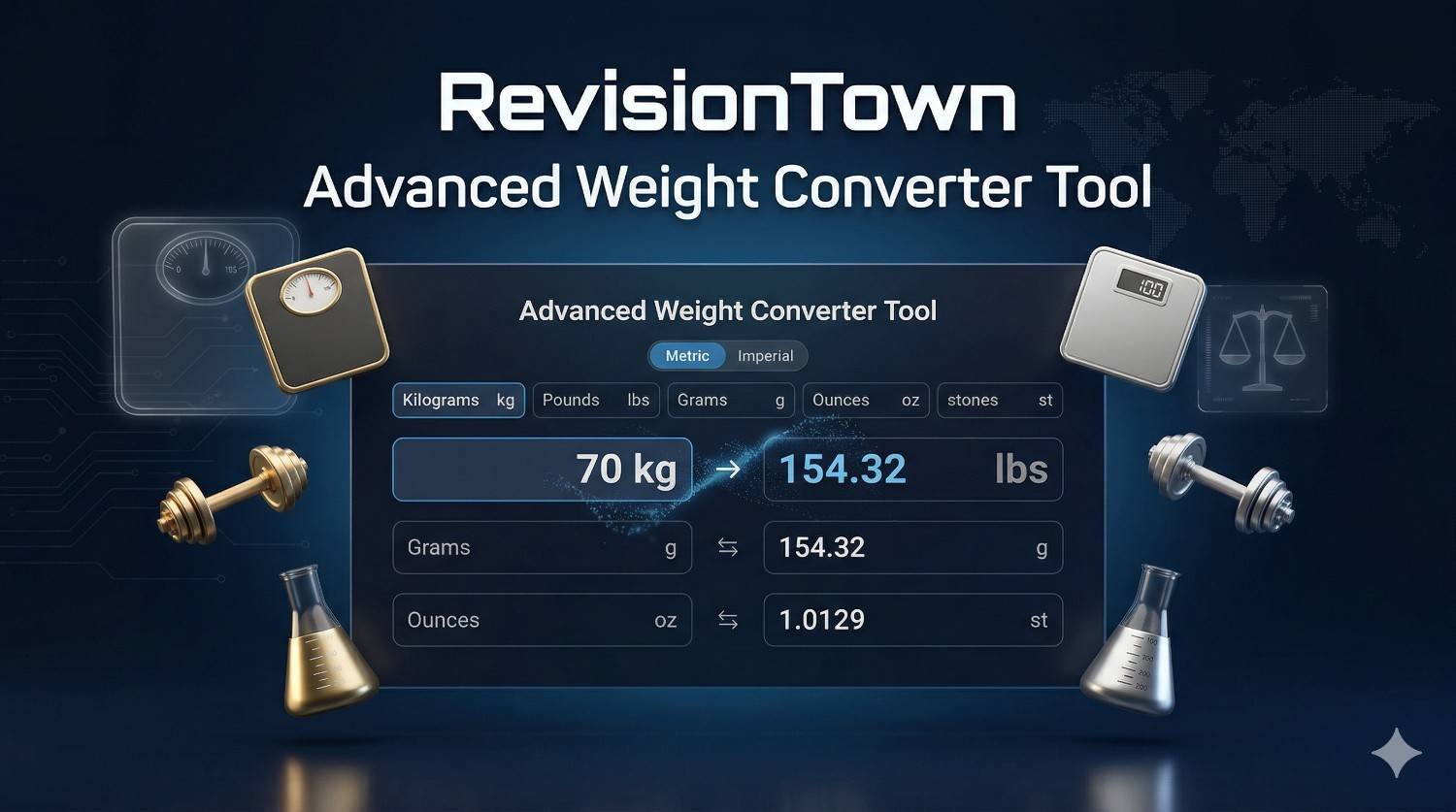
Convert kilograms, grams, pounds, ounces, stones, short tons, long tons, carats, grains, slugs and scientific mass units with one calculator.
Use this tool for everyday weight conversions and precise mass conversions. The calculator treats kilogram as the base unit, then converts to the selected target unit using verified metric, avoirdupois, troy, gem and scientific factors.
Weight Conversion Formula
For most school, science and practical uses, the safest way to convert weight or mass is to go through kilograms. If a unit has a factor of F, then 1 unit = F kg. Convert the input to kilograms first, then divide by the factor for the unit you want.
General formula
mass in kg = input value x source unit factor
converted value = mass in kg / target unit factor
Example: 150 lb to kg uses the exact international pound factor, so 150 x 0.45359237 = 68.0388555 kg.
Weight vs mass note
People often say weight when they mean mass. This calculator converts mass units such as kg, lb and oz. Physical weight as a force depends on local gravity and is usually measured in newtons.
Common Weight & Mass Conversion Table
The table below lists high-value conversions used in classrooms, kitchens, shipping, fitness, gemstones, engineering and physics. Exact relationships are used where the unit is legally defined by SI values.
| Conversion | Exact or standard value | Common use |
|---|---|---|
| 1 kilogram to pounds | 2.2046226218 lb | Body weight, gym loads, shipping labels |
| 1 pound to kilograms | 0.45359237 kg | International pound conversion |
| 1 ounce to grams | 28.349523125 g | Cooking, food labels, postal parcels |
| 1 stone to pounds | 14 lb | UK and Ireland body-weight notation |
| 1 short ton to kilograms | 907.18474 kg | US freight and material estimates |
| 1 long ton to kilograms | 1016.0469088 kg | UK imperial ton and maritime contexts |
| 1 metric tonne to kilograms | 1000 kg | Metric freight, materials, emissions |
| 1 grain to milligrams | 64.79891 mg | Ballistics, pharmacy history, precious metals |
| 1 carat to grams | 0.2 g | Gemstone and diamond mass |
| 1 troy ounce to grams | 31.1034768 g | Gold, silver and precious metals |
Worked Examples
Example 1: 70 kg to pounds
- Start with the kilogram value: 70 kg.
- Use 1 lb = 0.45359237 kg.
- 70 / 0.45359237 = 154.3235835 lb.
Answer: 70 kg is about 154.32 lb.
Example 2: 10 oz to grams
- Use 1 oz = 28.349523125 g.
- 10 x 28.349523125 = 283.49523125 g.
Answer: 10 oz is about 283.50 g.
Example 3: 3 stone to kilograms
- 1 stone = 14 lb.
- 3 stone = 42 lb.
- 42 x 0.45359237 = 19.05087954 kg.
Answer: 3 stone is about 19.05 kg.
Example 4: 2 troy oz gold to grams
- Use troy ounces, not everyday ounces.
- 2 x 31.1034768 = 62.2069536 g.
Answer: 2 troy oz is about 62.21 g.
Choosing the Right Weight Unit
Everyday and education
- Kilogram, gram and milligram: standard metric units for school science, food labels, medicine quantities and general measurement.
- Pound, ounce and stone: common imperial or US customary units for people, parcels, groceries and fitness weights.
- Metric tonne, short ton and long ton: large-mass units for freight, construction materials, agriculture and industrial reporting.
Specialist contexts
- Carat and point: gemstone mass. One metric carat is exactly 0.2 g and one point is 0.01 carat.
- Troy ounce and pennyweight: precious-metal units. Do not mix troy ounces with everyday avoirdupois ounces.
- Slug: engineering mass unit used with feet, pounds-force and seconds.
- Atomic mass unit, dalton and particle masses: molecular, atomic and physics-scale calculations.
Accuracy Notes
Several familiar units are defined exactly from SI units. The international pound is exactly 0.45359237 kg, the avoirdupois ounce is one-sixteenth of that pound, the grain is 64.79891 mg, and the metric carat is exactly 0.2 g. Scientific units such as atomic mass unit, electron mass, proton mass and Planck mass are constants with published uncertainty, so the calculator displays practical significant figures.
Data quality check: everyday conversion factors were checked against the NIST SI conversion-factor tables, and the atomic mass constant, electron mass, proton mass and Planck mass were checked against NIST CODATA constant values. For force-weight calculations, remember that newtons require a gravity value; mass-only kg/lb/oz conversions do not.
Related RevisionTown Tools
Use these internal resources when you need a narrower one-step converter or the broader converter category.
Weight Converter FAQ
It is a mass-unit converter for units people commonly call weight, such as kilograms, pounds, ounces and stones. True physical weight is a force and changes with gravity, while mass stays the same.
One international avoirdupois pound is exactly 0.45359237 kilograms. To convert pounds to kilograms, multiply pounds by 0.45359237.
Divide kilograms by 0.45359237, or multiply by about 2.2046226218. For example, 70 kg is about 154.32 lb.
No. An everyday avoirdupois ounce is 28.349523125 g, while a troy ounce is 31.1034768 g. Use troy ounces for precious metals and standard ounces for most food, postal and body-weight contexts.
One stone is exactly 14 pounds. In kilograms, one stone is 6.35029318 kg.
Choose metric tonne for 1000 kg, short ton for the US 2000 lb ton, and long ton for the UK 2240 lb ton. These are different units, so selecting the correct ton matters for freight and material calculations.