
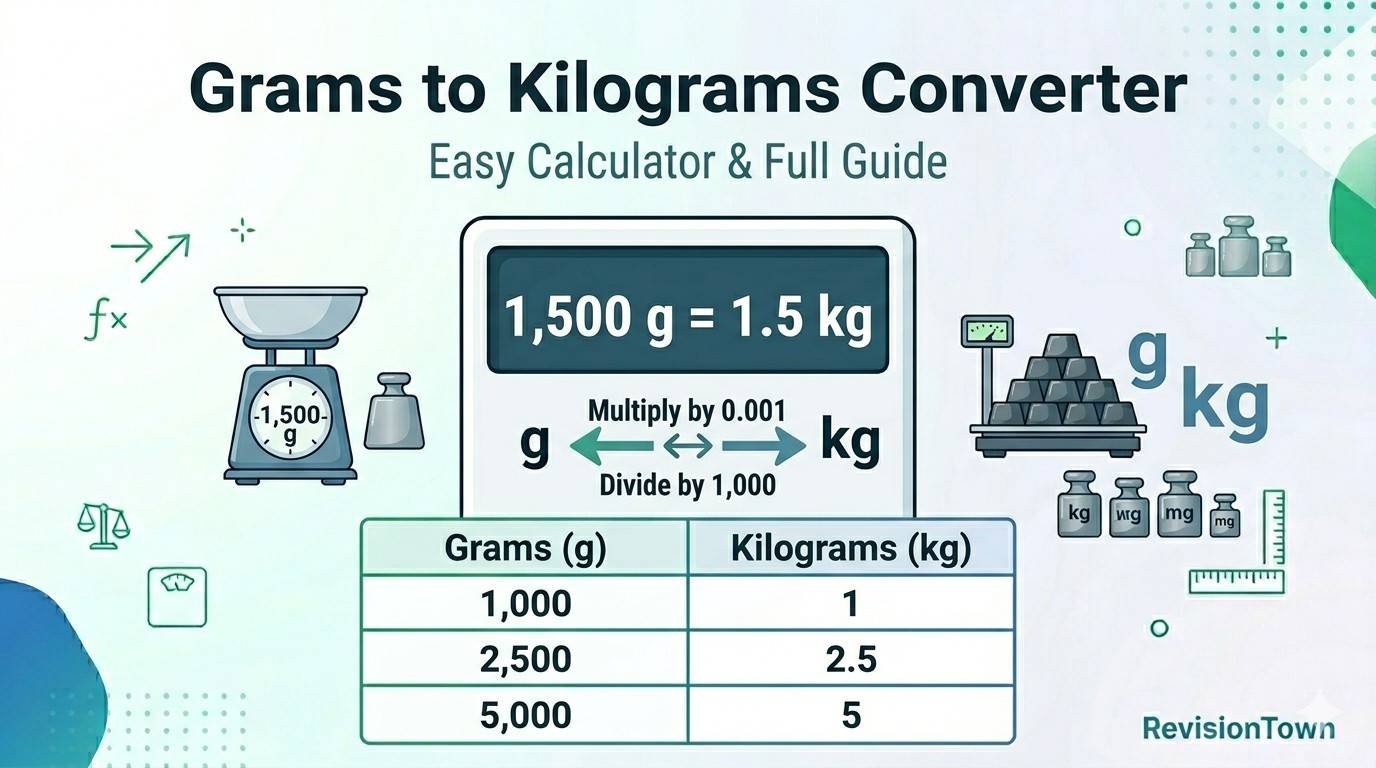
Grams to Kilograms Converter | g to kg Calculator Tool
Convert grams to kilograms instantly with a precise g to kg calculator, the exact metric formula, step-by-step examples, conversion tables, and practical guidance for science, cooking, shipping, schoolwork, and everyday measurements.
Quick answer: 1 kilogram = 1000 grams, so 1 gram = 0.001 kilograms. To convert grams to kilograms, divide the number of grams by 1000.
Online g to kg Calculator
Enter a whole number, decimal, or scientific notation value such as 250, 0.5, 1250, or 1.2e6.
Result
Grams to Kilograms Formula
The grams to kilograms conversion is a metric mass conversion. A kilogram is exactly 1000 grams, so one gram is one-thousandth of a kilogram. The formula is:
In words, divide the mass in grams by 1000 to get kilograms. The reverse formula converts kilograms back to grams:
The letter \(m\) represents mass. The subscript tells you which unit is being used. \(m_{\mathrm{g}}\) means the mass measured in grams, while \(m_{\mathrm{kg}}\) means the mass measured in kilograms. Keeping units visible in the formula is the easiest way to avoid moving the decimal point in the wrong direction.
How to Convert Grams to Kilograms Step by Step
Start with the value in grams. Because kilograms are larger than grams, the kilogram number should be smaller than the gram number. This size check helps you catch most mistakes before they affect a recipe, lab result, shipping label, or homework answer.
- Write the original mass in grams.
- Divide the gram value by 1000.
- Write the result with the unit kg.
- Check that the kilogram value is smaller than the gram value unless the original value is zero.
For example, convert 2500 grams to kilograms:
The answer is 2.5 kg. You can also think of this as moving the decimal point three places to the left. The value 2500 g becomes 2.500 kg, which is normally written as 2.5 kg.
Dimensional Analysis Method
For school and science work, dimensional analysis is often the cleanest method because it shows why the unit changes. Since \(1\ \mathrm{kg}=1000\ \mathrm{g}\), the conversion fraction can be written so the gram unit cancels:
The grams in the numerator and denominator cancel, leaving kilograms. This is more reliable than memorizing "move left" or "move right" because it works even when you are converting several units in one calculation.
Dimensional analysis also helps when the number is small. For \(45\ \mathrm{g}\), the setup is:
The kilogram result is less than 1 because 45 grams is much less than a full kilogram. If a calculation gives 45,000 kg from 45 g, the conversion direction has been reversed.
What Are Grams and Kilograms?
A gram, symbol g, is a metric unit of mass used for small and medium everyday quantities. Food servings, ingredients, supplements, laboratory samples, stationery, small packages, and school science measurements are often written in grams. A gram is small enough for precise kitchen and classroom work but large enough to be easy to read without long decimal strings.
A kilogram, symbol kg, is the SI base unit of mass. Although the prefix kilo means one thousand, the kilogram itself is the base SI unit used in formal science, engineering, medicine, logistics, and many regulations. Body mass, luggage mass, bulk ingredients, sports equipment, parcels, and industrial materials are commonly written in kilograms.
The relationship is exact:
Because the relationship is exact, rounding should come from the precision of the original measurement and the needs of the task, not from the conversion factor. If a scale reads 123.4 g, converting to 0.1234 kg preserves the measurement detail. If a recipe only needs one decimal place in kilograms, you may round later.
Quick Grams to Kilograms Conversion Table
Use this table for common gram values. The pattern is simple: divide by 1000, or move the decimal point three places left.
| Grams (g) | Kilograms (kg) | How to read it | Common context |
|---|---|---|---|
| 1 g | 0.001 kg | One-thousandth of a kilogram | Small sample or spice amount |
| 10 g | 0.01 kg | One-hundredth of a kilogram | Small ingredient |
| 50 g | 0.05 kg | Five-hundredths of a kilogram | Snack serving or lab sample |
| 100 g | 0.1 kg | One-tenth of a kilogram | Food serving |
| 250 g | 0.25 kg | One quarter kilogram | Butter, flour, or packaged food |
| 500 g | 0.5 kg | Half a kilogram | Produce, flour, or small parcel |
| 750 g | 0.75 kg | Three quarters kilogram | Food packaging |
| 1000 g | 1 kg | One kilogram | Base benchmark |
| 1250 g | 1.25 kg | One and one quarter kilograms | Shipping or groceries |
| 2500 g | 2.5 kg | Two and one half kilograms | Bulk ingredient or package |
| 5000 g | 5 kg | Five kilograms | Larger parcel or bag |
| 10000 g | 10 kg | Ten kilograms | Luggage, feed, or bulk supply |
Worked Examples
Example 1: Convert 850 g to kg
Divide 850 by 1000:
The answer is 0.85 kg. This is less than one kilogram because 850 grams is less than 1000 grams.
Example 2: Convert 1500 g to kg
Divide 1500 by 1000:
The answer is 1.5 kg. This value is more than one kilogram because 1500 grams is greater than 1000 grams.
Example 3: Convert 37.5 g to kg
Decimal gram values convert the same way:
The answer is 0.0375 kg. In a lab report, the decimal form is usually acceptable. In everyday language, you may leave such a small value in grams because 37.5 g is easier to read than 0.0375 kg.
Example 4: Convert 12,400 g to kg
Large gram values often become cleaner when converted to kilograms:
The answer is 12.4 kg. This is the type of conversion often used for luggage, shipping, animal feed, bulk groceries, and sports equipment.
Decimal Point Shortcut
Because 1000 has three zeros, converting grams to kilograms is the same as moving the decimal point three places to the left. This shortcut is useful for mental math, but it should be used with care. Always keep the units in mind.
| Starting value | Move decimal three places left | Result |
|---|---|---|
| 250 g | 250.0 becomes 0.250 | 0.25 kg |
| 1000 g | 1000.0 becomes 1.000 | 1 kg |
| 2750 g | 2750.0 becomes 2.750 | 2.75 kg |
| 8 g | 8.0 becomes 0.008 | 0.008 kg |
The shortcut can be summarized as \(g \rightarrow kg\): move left three places. The reverse conversion \(kg \rightarrow g\) moves right three places. If you are unsure, use the formula instead: kilograms equals grams divided by 1000.
Grams, Kilograms, Milligrams, and Metric Tons
Grams and kilograms are part of the metric mass system. The metric prefixes show powers of ten, which makes unit conversion predictable. A milligram is one-thousandth of a gram. A kilogram is one thousand grams. A metric ton, also called a tonne, is one thousand kilograms.
| Unit | Symbol | Relationship to grams | Best used for |
|---|---|---|---|
| Milligram | mg | \(1\ \mathrm{mg}=0.001\ \mathrm{g}\) | Medicine labels, chemistry, small samples |
| Gram | g | \(1\ \mathrm{g}\) | Food, school labs, small objects |
| Kilogram | kg | \(1\ \mathrm{kg}=1000\ \mathrm{g}\) | Body mass, parcels, bulk ingredients |
| Metric ton | t | \(1\ \mathrm{t}=1{,}000{,}000\ \mathrm{g}\) | Large shipments, agriculture, industry |
If your starting value is in milligrams rather than grams, the milligrams to kilograms conversion page is more direct. If you need the reverse of this calculator, use kilograms to grams conversion. For many mass units at once, the broader weight converter is a better fit.
Mass vs Weight: Why the Page Uses Kilograms
In everyday language, people often say "weight" when they mean mass. A kitchen scale may display grams, a bathroom scale may display kilograms, and a shipping form may ask for package weight in kilograms. In physics, however, mass and weight are not the same. Mass describes the amount of matter in an object. Weight is the gravitational force on that mass.
The gram and kilogram are units of mass. The SI unit of force is the newton. On Earth, a 1 kg mass has a weight of about 9.8 newtons, but its mass is still 1 kg. On the Moon, the same object has less weight because lunar gravity is weaker, but its mass remains the same. For most cooking, shipping, and everyday conversion tasks, the scale reading in grams or kilograms is treated as mass.
This distinction matters in science classes because formulas may require mass in kilograms even when the problem says "weight" casually. For example, Newton's second law uses mass in kilograms:
If a problem gives a mass of 250 g, convert it to \(0.25\ \mathrm{kg}\) before substituting into a formula that uses SI units. The conversion is small, but it changes the final force by a factor of 1000 if missed.
Using g to kg in Science and Schoolwork
Science problems frequently require kilograms because SI formulas are built around kilograms, meters, seconds, amperes, kelvins, moles, and candelas. If a lab balance gives a mass in grams, convert it to kilograms before using equations involving force, energy, momentum, density with SI units, or acceleration. This is one of the most common unit steps in physics and chemistry.
Suppose a classroom experiment measures a cart mass as 650 g. To calculate force from acceleration, first convert:
Then use \(F=ma\). If the acceleration is \(2\ \mathrm{m/s^2}\), the force is:
If the student accidentally uses 650 instead of 0.65, the force becomes 1300 N, which is not reasonable for a small cart. This is why the grams-to-kilograms step should be shown clearly in written work.
Using Grams to Kilograms in Cooking and Food Labels
Food packaging and recipes often move between grams and kilograms. A recipe might call for 250 g of flour, while a bulk ingredient bag is labeled 1 kg. A nutrition label may list serving mass in grams, while a shopping list may use kilograms for the total amount needed. The conversion helps scale recipes and compare package sizes.
For example, if a recipe uses 300 g of rice and you are preparing four batches, the total is:
Writing 1.2 kg makes more sense for shopping because rice is often sold by kilogram. On the other hand, for precise baking, grams are usually better than kilograms because the numbers are easier to measure accurately on a kitchen scale. Both units are useful; the best unit depends on the task.
When scaling a recipe, convert after calculating the total if the recipe is written entirely in grams. This avoids repeated rounding. Add all gram quantities first, then divide by 1000 when you need the total in kilograms.
Using Grams to Kilograms for Shipping and Logistics
Shipping systems often ask for package mass in kilograms even when a scale displays grams. A small parcel might weigh 850 g, but the shipping form may expect 0.85 kg. Larger parcels may be easier to enter directly in kilograms. Converting accurately matters because shipping fees, carrier limits, customs documents, and warehouse records may depend on the entered mass.
For a package weighing 2750 g, the conversion is:
If a carrier rounds up to the next 0.5 kg or next full kilogram, apply that business rule after converting. The mathematical conversion gives the actual mass. The shipping charge may use a rounded billing mass, and that is a separate policy decision.
For parcels measured in pounds or ounces, use the matching converter rather than forcing everything through grams mentally. RevisionTown has separate pages for pounds to kilograms conversion, ounces to kilograms conversion, and kilograms to pounds conversion.
Using Grams to Kilograms in Health, Fitness, and Nutrition
Body mass is usually written in kilograms in countries using the metric system, while food, supplements, and macronutrients are usually written in grams. This can create a practical need to move between units. For example, a nutrition plan might list protein in grams per kilogram of body mass. If a person has a body mass of 70 kg and a target of 1.6 g of protein per kg, the daily target is:
This is not a grams-to-kilograms conversion by itself, but it shows why unit labels matter. The body mass is in kilograms, while the nutrient amount is in grams. If a food package lists a serving size as 125 g, that serving mass is \(0.125\ \mathrm{kg}\), but nutrition targets are usually easier to read in grams.
For health calculations that use kilograms, check whether the input should be body mass, food mass, or ingredient mass. A unit conversion can make the number fit the form, but it cannot decide whether the number is the correct input for the health formula.
Significant Figures and Rounding
The conversion factor \(1000\ \mathrm{g}=1\ \mathrm{kg}\) is exact. This means the precision of the result depends on the measurement you start with, not on the conversion factor. If a scale reads 246 g to the nearest gram, the converted value is 0.246 kg. If the scale reads 246.0 g, the converted value is 0.2460 kg, preserving one additional decimal place of measurement precision.
For everyday tasks, practical rounding is acceptable. A grocery list can say 0.5 kg instead of 0.500 kg. A lab report may require more careful significant figures. A shipping form may have its own rounding rules. A recipe may prefer grams because a value like 0.037 kg is less friendly than 37 g.
Do not round too early when a calculation has multiple steps. If you are adding several ingredient masses, add the grams first and convert once at the end. If you convert each ingredient to kilograms and round each one, the final total can drift away from the true value.
Spreadsheet and Calculator Workflow
In a spreadsheet, the grams to kilograms formula is simple. If the gram value is in cell A2, use:
In spreadsheet notation, that is usually =A2/1000. Label the output column clearly as kilograms or kg. A column heading such as "mass" alone is not enough if the workbook includes both grams and kilograms.
For code, use variable names that include the unit. A variable called massGrams and a converted variable called massKilograms are safer than two variables both called mass. Unit-aware names reduce mistakes when the same value is passed into formulas, APIs, or reports.
If you are building a form, display both the result and the formula used. Users are more likely to trust the answer when they can see that the calculator divided by 1000 for grams to kilograms and multiplied by 1000 for kilograms to grams.
Common Mistakes to Avoid
Multiplying Instead of Dividing
To convert grams to kilograms, divide by 1000. Multiplying by 1000 is the reverse conversion from kilograms to grams.
Forgetting Decimal Zeros
Small gram values produce kilogram values with leading zeros. For example, 8 g is 0.008 kg, not 0.08 kg.
Mixing Mass and Force
Grams and kilograms are mass units. If a physics formula needs weight as a force, the unit is newtons, not kilograms.
Rounding Before Adding
Add several gram values first, then convert to kilograms. Early rounding can change totals in recipes, labs, and shipping records.
How to Check Your Answer
A reliable conversion should pass three quick checks. First, the kilogram value should be smaller than the gram value because a kilogram is a larger unit. Second, multiplying the kilogram answer by 1000 should return the original gram value. Third, benchmark values should look familiar: 500 g should be 0.5 kg, 1000 g should be 1 kg, and 2000 g should be 2 kg.
For example, if you convert 3450 g to 3.45 kg, the reverse check is:
The reverse check returns the starting value, so the conversion is correct. This habit is especially useful when the number has several decimal places or when the result will be used in another formula.
When to Keep Grams and When to Use Kilograms
Use grams when the mass is small, when precision matters, or when a scale reads directly in grams. Ingredients, medication-adjacent labels, small packages, classroom samples, and food servings are usually easier to read in grams. Use kilograms when the mass is larger, when a form requires SI mass, or when you are comparing values such as body mass, luggage mass, shipping mass, or bulk goods.
A value like 0.003 kg is mathematically correct, but 3 g is easier for most people to understand. A value like 4500 g is correct, but 4.5 kg is easier for a parcel or bag. The goal is not always to force every number into kilograms. The goal is to use the unit that makes the measurement accurate and readable for the situation.
If you need many related mass conversions, use a broader unit tool such as the unit converters page, the converters section, or the advanced weight converter tool. This page stays focused on the common grams-to-kilograms calculation.
Practice Problems
- Convert 120 g to kg.
- Convert 875 g to kg.
- Convert 2400 g to kg.
- Convert 0.75 g to kg.
- Convert 18,500 g to kg.
- Convert 3.2 kg to grams.
Answers
1. \(120\ \mathrm{g}=0.12\ \mathrm{kg}\). 2. \(875\ \mathrm{g}=0.875\ \mathrm{kg}\). 3. \(2400\ \mathrm{g}=2.4\ \mathrm{kg}\). 4. \(0.75\ \mathrm{g}=0.00075\ \mathrm{kg}\). 5. \(18{,}500\ \mathrm{g}=18.5\ \mathrm{kg}\). 6. \(3.2\ \mathrm{kg}=3200\ \mathrm{g}\).
The first five answers divide grams by 1000. The last answer uses the reverse relationship and multiplies kilograms by 1000.
Detailed Conversion Notes for Real Situations
Real-world measurements are often messier than textbook numbers. A kitchen scale may fluctuate between 499 g and 501 g. A parcel may include packaging material. A lab sample may need tare correction before conversion. The grams-to-kilograms formula does not change, but the quality of the input value affects the usefulness of the result.
For cooking, tare the container before measuring. If a bowl weighs 420 g and the bowl plus flour weighs 670 g, the flour mass is 250 g, not 670 g. Convert the ingredient mass after subtracting the container mass:
For shipping, include packaging if the carrier requires gross mass. A product may be 900 g, but if the box, padding, and label add 180 g, the shipping mass is 1080 g, or 1.08 kg. Entering only the product mass can understate the package mass.
For science, check whether the balance reading is net mass, gross mass, or mass after calibration. A conversion cannot fix a measurement that was taken from the wrong object or before the balance was zeroed. Convert only after the measured value represents the intended mass.
Grams to Kilograms in Word Problems
Word problems often hide the conversion step inside a larger task. Read the units before choosing a formula. If a problem gives mass in grams but asks for density in \(\mathrm{kg/m^3}\), convert grams to kilograms before calculating density. If a problem gives several ingredient masses in grams but asks for total mass in kilograms, add the grams first and then divide by 1000.
Example: A container holds 350 g of sand, 125 g of gravel, and 25 g of water. Find the total mass in kilograms.
The answer is 0.5 kg. The calculation is clearer when addition happens while all values share the same unit.
Another example: A box has 24 items, and each item has a mass of 75 g. Find the total mass in kilograms.
The answer is 1.8 kg. This is a common pattern in packing, inventory, classroom math, and recipe scaling.
Unit-Safe Checklist
- Confirm the starting value is in grams, not milligrams or kilograms.
- Use \(1\ \mathrm{kg}=1000\ \mathrm{g}\).
- Divide grams by 1000 to get kilograms.
- Move the decimal point three places left only if you are comfortable tracking zeros.
- Keep the kg unit beside the final answer.
- Reverse-check by multiplying the kilogram value by 1000.
- Round only after the required calculation is complete.
- Choose grams for small values and kilograms for larger or SI-based values.
More Real-World g to kg Examples
Many people understand the formula quickly but still hesitate when the number has zeros, decimals, or a real-world label attached to it. The examples below show the same conversion in several common situations. The arithmetic does not change: divide grams by 1000. What changes is the context and the way the answer should be written.
Food Package Example
A bag of almonds is labeled 750 g. To compare it with another bag labeled 1 kg, convert the 750 g package to kilograms:
The 750 g bag is 0.75 kg, so it contains three quarters of a kilogram. If the 1 kg bag costs only slightly more, the larger bag may be better value. The unit conversion makes the comparison fair because both packages are now written in kilograms.
Parcel Example
A parcel scale reads 1840 g after the item and packaging are placed on the scale. A shipping form asks for kilograms. Convert the scale reading:
The actual package mass is 1.84 kg. If the carrier bills by the next whole kilogram, the billing mass may become 2 kg, but the mathematical conversion remains 1.84 kg. Keep the actual value and the billing rule separate.
Laboratory Sample Example
A sample has a measured mass of 6.25 g. A formula later in the lab requires kilograms. Convert before substituting:
The converted mass is 0.00625 kg. This small number is easy to misread, so include the leading zero before the decimal point. Writing 0.00625 kg is clearer than .00625 kg.
Bulk Ingredient Example
A bakery uses 18,750 g of flour in a production batch. Convert the total to kilograms for ordering and inventory:
The batch uses 18.75 kg of flour. If flour is purchased in 25 kg sacks, one sack is enough for this batch, with 6.25 kg remaining before considering waste or reserve stock.
Converting Several Gram Values Into One Kilogram Total
When a task includes several gram values, the cleanest approach is usually to add the gram values first and convert the final total. This keeps the arithmetic simple and avoids repeated rounding. It is especially useful for recipes, bills of materials, inventory lists, and lab mixtures.
Suppose a recipe uses 250 g of flour, 125 g of sugar, 80 g of butter, and 45 g of cocoa powder. The total ingredient mass is:
Now convert the total to kilograms:
The total is 0.5 kg. If you converted each ingredient separately and rounded to two decimal places, 250 g would become 0.25 kg, 125 g would become 0.13 kg, 80 g would become 0.08 kg, and 45 g would become 0.05 kg. Adding those rounded values gives 0.51 kg, which is not the exact total. The difference is small here, but it shows why totals should normally be converted after addition.
The same idea applies to parcels. If an order contains items of 310 g, 480 g, and 625 g, add first:
The exact total is 1.415 kg before any carrier rounding. This method keeps item-level data in grams while producing a shipment-level kilogram total.
Grams to Kilograms in Density Calculations
Density is a common place where grams and kilograms can be mixed accidentally. Density compares mass and volume, but the units must match the system being used. In SI form, density is often written in kilograms per cubic meter, \(\mathrm{kg/m^3}\). If a measured mass is in grams, convert it to kilograms before using cubic meters for volume.
Example: A sample has a mass of 500 g and a volume of \(0.00025\ \mathrm{m^3}\). First convert mass:
Then calculate density:
If the mass had been entered as 500 kg instead of 0.5 kg, the density would be \(2{,}000{,}000\ \mathrm{kg/m^3}\), which is a factor of 1000 too large. This is why unit conversion is not a cosmetic step in science calculations. It changes the numerical result when the formula expects a particular unit.
Density may also be written in grams per cubic centimeter, \(\mathrm{g/cm^3}\). In that case, keeping mass in grams may be appropriate. The key is not that kilograms are always better. The key is that the mass unit must match the volume unit and the density unit required by the problem.
Grams to Kilograms in Force, Momentum, and Energy Problems
Many physics formulas require mass in kilograms because they are written in SI units. This is one reason students often need a grams-to-kilograms converter. A lab balance may measure a cart, block, ball, or hanging mass in grams, but formulas for force, momentum, and kinetic energy usually expect kilograms.
For momentum, the formula is:
If a ball has a mass of 150 g and a speed of \(12\ \mathrm{m/s}\), convert the mass first:
For kinetic energy, the formula is:
If the same 150 g ball is moving at \(12\ \mathrm{m/s}\), the kinetic energy is:
Using 150 instead of 0.15 would give a result 1000 times too large. The formula has not changed; the error would come from entering grams where kilograms were required.
Grams to Kilograms for Inventory and Procurement
Inventory records often contain mixed units because products are sold in different sizes. A store may sell 250 g packs, 500 g packs, 1 kg packs, and 5 kg sacks. To compare stock totals or reorder quantities, it helps to convert all masses to one unit. Kilograms are usually better for summary totals because large gram values become easier to read.
Imagine a shelf has eight 250 g packs, six 500 g packs, and three 1 kg packs. Convert or calculate each group:
The total stock is \(2+3+3=8\ \mathrm{kg}\). This is much clearer than writing 8000 g in a purchasing summary, although both values are correct.
For procurement, also distinguish net mass and gross mass. Net mass is the product itself. Gross mass includes packaging. A food product may have a net mass of 500 g, but a carton of many units may have a larger gross mass because of boxes, labels, liners, and pallets. Convert the quantity that matches the decision you are making.
Choosing the Right Number Format
The same converted value can be written in different ways. For example, 125 g is 0.125 kg. That can also be written as \(1.25\times10^{-1}\ \mathrm{kg}\), but scientific notation is usually unnecessary for ordinary grams-to-kilograms work. Plain decimals are easier for cooking, shipping, and classroom arithmetic.
Scientific notation becomes useful when the gram value is extremely small or extremely large. For example, \(0.0004\ \mathrm{g}\) is \(0.0000004\ \mathrm{kg}\), which can be written as \(4\times10^{-7}\ \mathrm{kg}\). A large industrial value such as \(12{,}000{,}000\ \mathrm{g}\) is 12,000 kg, or \(1.2\times10^4\ \mathrm{kg}\). Use the form that your audience can read without confusion.
For money, inventory, and shipping, avoid unnecessary trailing decimals unless the form requires them. Writing 2 kg is usually clearer than 2.000000 kg. For laboratory work, trailing zeros may communicate measurement precision, so 2.000 kg can be meaningful if the scale supports that precision. The conversion does not decide the formatting; the purpose of the measurement does.
Negative Values, Zero, and Invalid Inputs
A physical mass cannot be negative in ordinary measurement. However, calculators and spreadsheets may still receive negative numbers when a value represents a change, correction, or difference. For example, a stock adjustment of \(-250\ \mathrm{g}\) represents removing 250 g from inventory. Mathematically, the conversion is:
The negative sign is preserved because the value represents a direction of change, not a physical object with negative mass. For normal object mass, ingredient mass, body mass, or package mass, a negative input should be treated as invalid or as a data-entry error.
Zero converts cleanly. \(0\ \mathrm{g}=0\ \mathrm{kg}\). This is useful in forms where a missing item, empty container correction, or optional ingredient may be recorded as zero. Blank values are different from zero. A blank field means no value has been entered; zero means the measured value is zero.
Teaching the g to kg Conversion
For students, the most important concept is unit size. A kilogram is bigger than a gram. Therefore, the kilogram number must be smaller when representing the same mass. Before students learn shortcuts, this unit-size reasoning helps them choose multiplication or division. If the target unit is larger, the number becomes smaller. If the target unit is smaller, the number becomes larger.
A useful classroom progression is to start with benchmark conversions: 1000 g = 1 kg, 500 g = 0.5 kg, 250 g = 0.25 kg, and 100 g = 0.1 kg. These benchmarks are familiar from food packaging and help students estimate answers. After that, introduce the formula \(kg=g/1000\). Finally, use dimensional analysis for students who need a method that generalizes to compound units.
Visual number lines can also help. Mark 0 g, 250 g, 500 g, 750 g, and 1000 g. Under them, write 0 kg, 0.25 kg, 0.5 kg, 0.75 kg, and 1 kg. Students can see that gram numbers and kilogram numbers describe the same points on the mass scale. Only the labels change.
When checking work, ask students to explain whether the answer should be larger or smaller before calculating. This short explanation reduces blind decimal shifting and makes the conversion more reliable.
Printable-Style Reference List
The following list is useful when you need quick mental conversions. It is not a replacement for the calculator when precision matters, but it gives common anchors that make estimates faster.
- 1 g = 0.001 kg
- 5 g = 0.005 kg
- 10 g = 0.01 kg
- 25 g = 0.025 kg
- 50 g = 0.05 kg
- 100 g = 0.1 kg
- 200 g = 0.2 kg
- 250 g = 0.25 kg
- 500 g = 0.5 kg
- 750 g = 0.75 kg
- 1000 g = 1 kg
- 1500 g = 1.5 kg
- 2000 g = 2 kg
- 5000 g = 5 kg
When estimating, compare the gram value to 1000 g. Values below 1000 g are below 1 kg. Values above 1000 g are above 1 kg. Values around 500 g are around half a kilogram.
Final Review Before Using a Converted Value
Before you use a converted kilogram value in a form, report, worksheet, spreadsheet, recipe, or shipping system, review the input and the unit label. The most reliable conversion can still be wrong if the starting value was copied from the wrong line, included the container when it should not have, excluded packaging when it should have included it, or came from a scale set to a different unit. A grams-to-kilograms calculator solves the unit step, but it cannot verify the measurement context.
For recipes, check whether the ingredient amount is for one batch or several batches. A value of 300 g may be correct for one cake, but a production sheet for six cakes should use 1800 g, which converts to 1.8 kg. For shipping, confirm whether the number is product mass, package mass, or billable mass. A product mass of 950 g may become 1.15 kg after packaging, and the carrier may round the billable value differently. For science, confirm whether the balance was tared and whether the formula expects kilograms, grams, or another mass unit.
It is also worth checking readability. If the converted value is 0.004 kg, the equivalent 4 g may be easier for a human reader. If the value is 4500 g, the equivalent 4.5 kg is usually easier. Correct unit choice is partly mathematical and partly practical. The best presentation is the one that keeps the value accurate while making the scale obvious to the person using it.
A final reverse check takes only a moment. Multiply the kilogram result by 1000. If it returns the original gram value, the conversion is internally consistent. For example, \(0.875\ \mathrm{kg}\times1000=875\ \mathrm{g}\). This quick check is especially helpful when the value will affect a cost, grade, lab conclusion, shipment, or safety-related instruction.
Frequently Asked Questions
How do you convert grams to kilograms?
Divide the gram value by 1000. The formula is \(m_{\mathrm{kg}}=m_{\mathrm{g}}/1000\). For example, 2500 g is 2.5 kg.
How many grams are in 1 kilogram?
There are exactly 1000 grams in 1 kilogram. This means \(1\ \mathrm{kg}=1000\ \mathrm{g}\).
What is 500 grams in kilograms?
500 grams is 0.5 kilograms because \(500\div1000=0.5\).
What is 250 grams in kg?
250 grams is 0.25 kg. It is one quarter of a kilogram.
What is 100 grams in kg?
100 grams is 0.1 kg. Divide 100 by 1000 to get 0.1.
Is 1000 g equal to 1 kg?
Yes. 1000 g equals exactly 1 kg.
Do I multiply or divide for g to kg?
Divide by 1000 for grams to kilograms. Multiply by 1000 for kilograms to grams.
Why does the number get smaller when converting grams to kilograms?
The number gets smaller because kilograms are larger units. The same mass needs fewer kilograms than grams.
Can I convert decimal grams to kilograms?
Yes. Decimal gram values use the same formula. For example, \(2.5\ \mathrm{g}=0.0025\ \mathrm{kg}\).
Are grams and kilograms weight or mass?
Grams and kilograms are units of mass. In everyday language they are often used when people talk about weight, but in physics weight is a force measured in newtons.
Accuracy note: The metric relationship is exact: \(1\ \mathrm{kg}=1000\ \mathrm{g}\). The calculator result should be rounded according to your measurement precision, recipe needs, lab instructions, or shipping form requirements.