Percentage Calculator
Calculate Percentage of a Number, Increase, Decrease, Difference, Reverse Percentages and More
Published: November 15, 2025 | Updated: November 15, 2025
Published by: RevisionTown Team
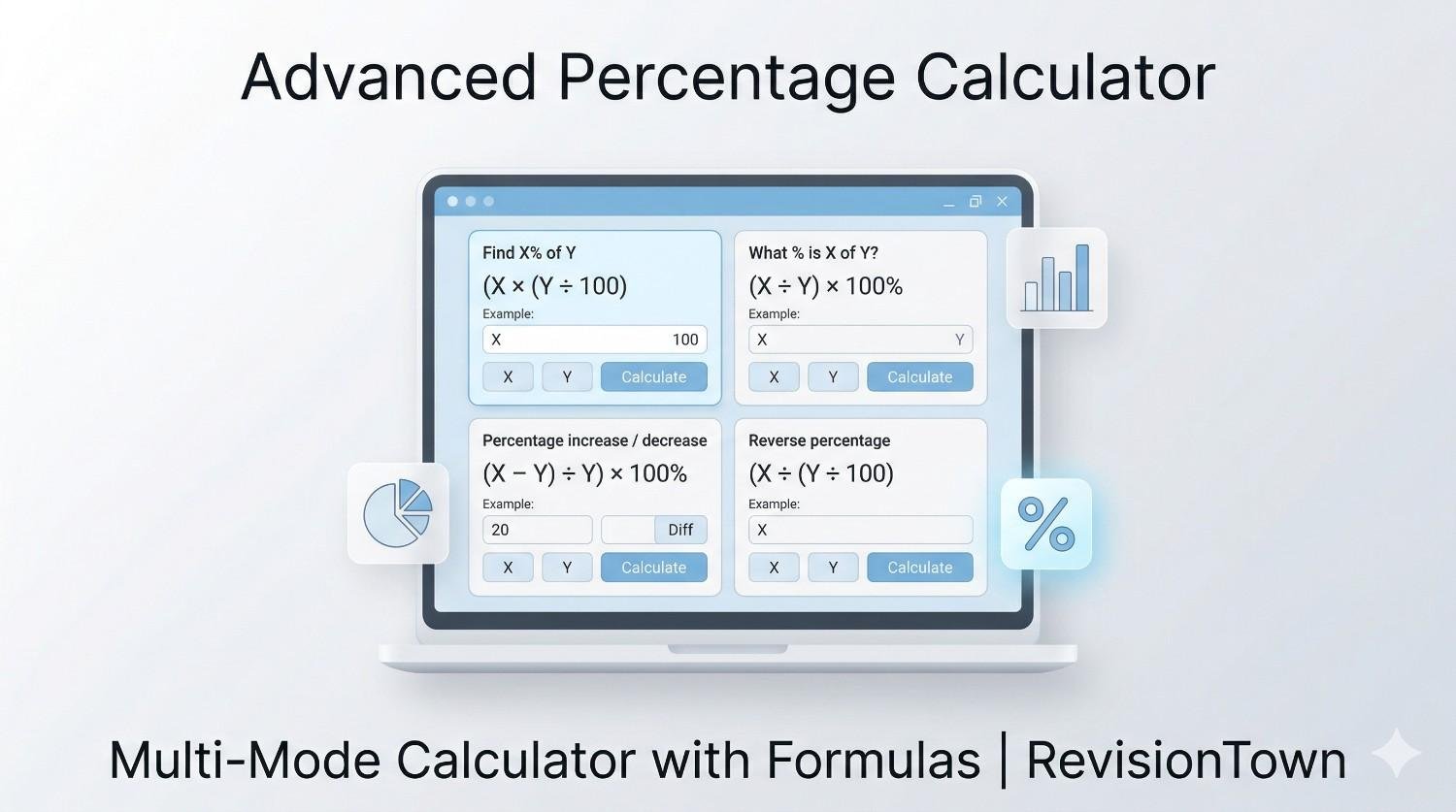
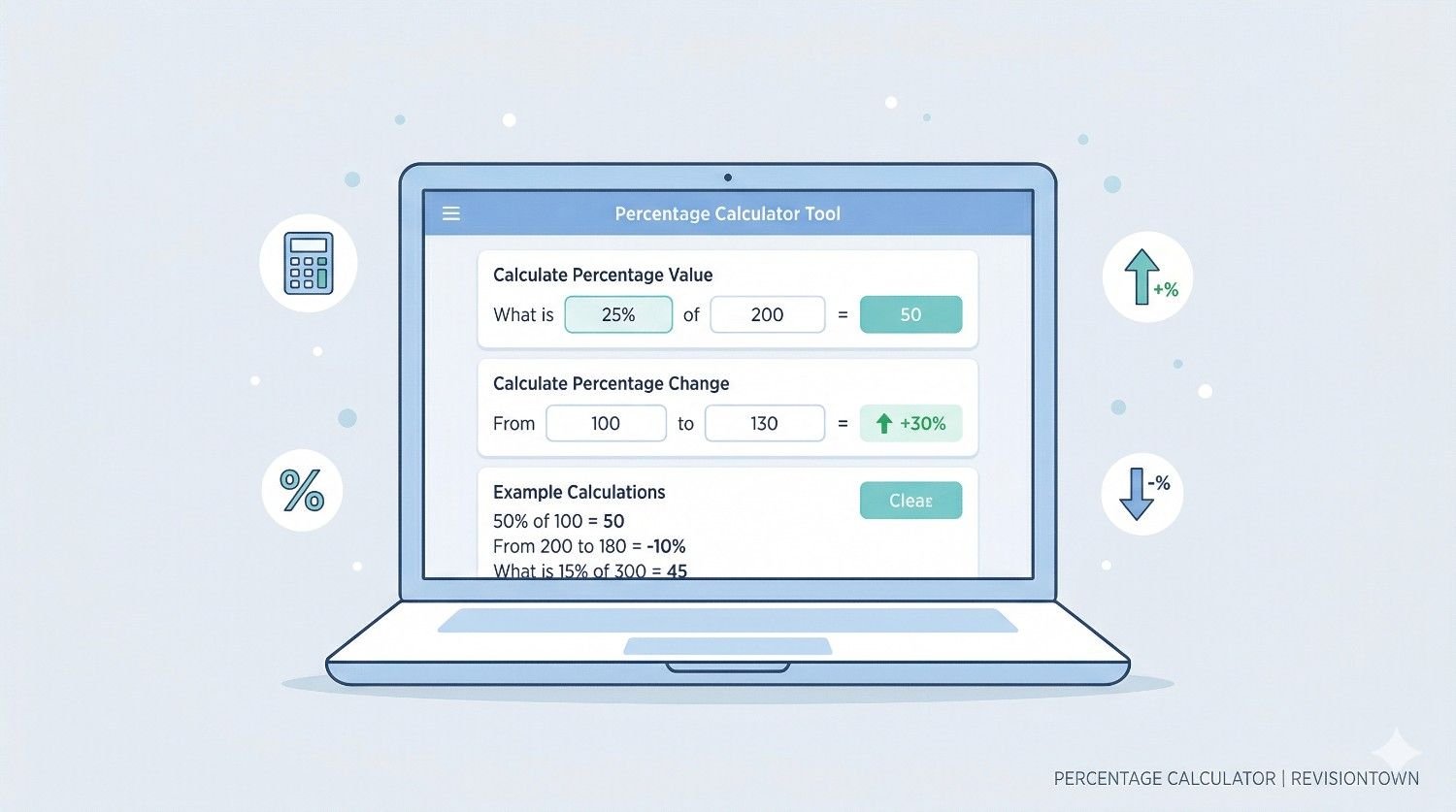
Percentage calculations are essential in everyday life, from calculating grades, discounts, and tips to analyzing financial data, tracking progress, and making informed decisions. This comprehensive calculator handles common percentage calculations including finding percentages of numbers, percentage increases and decreases, percentage differences, reverse percentages, and specialized conversions like GPA to percentage.
Whether you're a student calculating exam percentages, a professional analyzing business metrics, or a shopper comparing prices, this tool provides instant, accurate results with detailed formulas and step-by-step explanations.
Percentage Calculator
Result:
Percentage Formulas
1. Basic Percentage Formula
Calculate what percentage one number is of another:
Example: \(15\) out of \(60 = (15 \div 60) \times 100 = 25\%\)
2. Percentage of a Number
Find X% of Y:
Example: \(20\%\) of \(150 = (20 \div 100) \times 150 = 30\)
3. Percentage Increase
Calculate percentage increase from old to new value:
Example: from \(50\) to \(65 = \frac{65 - 50}{50} \times 100 = 30\%\) increase
4. Percentage Decrease
Calculate percentage decrease from old to new value:
Example: from \(80\) to \(60 = \frac{80 - 60}{80} \times 100 = 25\%\) decrease
5. Percentage Difference
Compare two values (no reference point):
Example: between \(40\) and \(60 = \frac{|40 - 60|}{50} \times 100 = 40\%\) difference
Percentage Calculation Examples
Calculate Grade Percentage
Problem: Scored 420 out of 500
Solution: \( (420 \div 500) \times 100 \)
\(= 84\%\)
Calculate Tip Amount
Problem: 15% tip on $80 bill
Solution: \( (15 \div 100) \times 80 \)
\(= \$12\) tip
Salary Increase
Problem: Salary rose from $50k to $57.5k
Solution: \( \frac{57.5 - 50}{50} \times 100 \)
\(= 15\%\) raise
Weight Loss Percentage
Problem: Lost weight from 200 lbs to 180 lbs
Solution: \( \frac{200 - 180}{200} \times 100 \)
\(= 10\%\) loss
Commission Calculation
Problem: 8% commission on $5,000 sales
Solution: \( (8 \div 100) \times 5000 \)
\(= \$400\)
GPA to Percentage
Problem: 3.6 GPA on 4.0 scale
Solution: \( (3.6 \div 4.0) \times 100 \)
\(= 90\%\)
How Percentages Work
A percentage is a way of writing a number as a share of 100. The word percent means "per hundred", so \(25\%\) means \(25\) per \(100\), or \(25/100\), or \(0.25\). Percentages are useful because they make comparisons easier. It is easier to compare a score of \(42\) out of \(50\) with a score of \(72\) out of \(90\) when both are converted to percentages: \(84\%\) and \(80\%\). The raw marks have different totals, but the percentage puts them on the same scale.
Every percentage calculation has three parts: the part, the whole, and the rate. The part is the amount being compared, the whole is the reference amount, and the rate is the percentage. In formula form, the relationship is:
If two of those values are known, the third can be found. If you know the whole and the percentage, you can calculate the part. If you know the part and the whole, you can calculate the percentage. If you know the part and the percentage, you can calculate the whole. This is why a single percentage calculator can support several modes: it is solving the same relationship from different directions.
For classroom review, the basic percentages learning resources are helpful when you want more practice with the concept before using a calculator. This page is designed for quick calculation and clear formula checking.
Choosing the Right Percentage Calculation
Before entering numbers, identify the question type. Many percentage mistakes happen because the wrong formula is chosen, not because the arithmetic is difficult. "What is \(20\%\) of \(80\)?" is not the same as "20 is what percent of 80?" and neither is the same as "80 is 20 percent of what number?" The words tell you which value is missing.
Find a part
Use "What is \(X\%\) of \(Y\)?" Example: \(15\%\) of \(200\). This returns an amount.
Find a rate
Use "\(X\) is what percent of \(Y\)?" Example: \(45\) is what percent of \(60\). This returns a percentage.
Find the whole
Use reverse percentage. Example: \(30\) is \(25\%\) of what total? This returns the original whole.
If the question involves an old value and a new value, use percentage change. If the new value is larger, the result is an increase. If the new value is smaller, the result is a decrease. If neither value is the clear reference point, use percentage difference instead. This distinction matters in science, business, and statistics because the denominator changes.
When the problem is specifically about an increase, the dedicated percentage increase calculator is a focused option. When you need the broader set of modes, stay on this percentage calculator.
Finding a Percentage of a Number
The most common percent question asks for a percentage of a number. Examples include \(10\%\) of a bill, \(40\%\) of a budget, \(75\%\) of a target, or \(12.5\%\) of a population. The formula is direct:
For example, \(18\%\) of \(250\) is \( \frac{18}{100} \times 250 = 45 \). This means \(45\) is the portion that represents \(18\%\) of the whole amount \(250\). If the context is money, the answer is money. If the context is marks, the answer is marks. If the context is people, units, grams, miles, or points, the answer keeps that unit.
A useful mental shortcut is to break the percent into familiar pieces. \(20\%\) is one fifth, \(25\%\) is one quarter, \(50\%\) is one half, and \(10\%\) is one tenth. So \(35\%\) of \(80\) can be seen as \(30\%\) of \(80\) plus \(5\%\) of \(80\). That is \(24 + 4 = 28\). The calculator gives the exact answer quickly, but the mental estimate tells you whether the result is reasonable.
If the percentage is part of a longer expression, use the scientific calculator to combine the percent calculation with powers, roots, logarithms, or trigonometric functions. For ordinary percentage of a number questions, this page is faster.
Finding What Percent One Number Is of Another
When the question says "\(X\) is what percent of \(Y\)?", you are comparing a part to a whole. The part goes on top, the whole goes on bottom, and the result is multiplied by \(100\):
If a student scores \(72\) out of \(90\), the percentage is \( \frac{72}{90} \times 100 = 80\% \). If a company sells \(480\) units out of a \(600\)-unit target, the completion rate is \( \frac{480}{600} \times 100 = 80\% \). The formula is the same in both cases because both compare a part with a reference total.
The whole must be the correct reference point. If a store sells \(30\) red shirts and \(70\) blue shirts, red shirts are \(30\%\) of all shirts sold because the whole is \(100\). But red shirts are not \(30\%\) of blue shirts; compared with blue shirts, the rate is \( \frac{30}{70} \times 100 \approx 42.86\% \). Always ask: "percent of what?" before choosing the denominator.
For exam marks specifically, the calculate percentage marks resource is a natural follow-up when you need a student-focused explanation of marks, totals, and grade interpretation.
Reverse Percentages: Finding the Original Whole
Reverse percentage problems ask for the original whole when a percentage and a part are known. The structure is: "If \(A\) is \(p\%\), what is \(100\%\)?" The formula is:
For example, if \(45\) is \(30\%\) of a number, the whole is \( \frac{45}{0.30} = 150 \). Reverse percentage is common in sales, tax, discounts, finance, and grade recovery questions. If a sale price is \(80\%\) of the original price, you can divide the sale price by \(0.80\) to estimate the original price before discount.
A common mistake is subtracting the percent from the final amount instead of reversing the percentage relationship. If an item costs \(\$80\) after a \(20\%\) discount, the original price is not \(\$100\) because \(80 + 20 = 100\). The correct reasoning is that the sale price is \(80\%\) of the original: \( \frac{80}{0.80} = 100 \). In this example the result happens to be \(\$100\), but the method matters. If an item costs \(\$72\) after \(20\%\) off, the original is \( \frac{72}{0.80} = 90 \), not \(72 + 20\).
For more practice with this topic, see the reverse percentages learning resources, which focus on identifying the original value from a final percentage result.
Percentage Increase, Decrease, and Change
Percentage change compares a new value with an old value. The old value is the reference point, so it belongs in the denominator. The general formula is:
If the result is positive, it is a percentage increase. If it is negative, it is a percentage decrease. For example, moving from \(120\) to \(150\) gives \( \frac{150 - 120}{120} \times 100 = 25\% \). Moving from \(150\) to \(120\) gives \( \frac{120 - 150}{150} \times 100 = -20\% \), which is a \(20\%\) decrease. Notice that a \(25\%\) increase followed by a \(20\%\) decrease returns to the original value. Percentage changes are not symmetrical because the denominator changes.
This matters in real decisions. If a price rises from \(\$100\) to \(\$125\), the increase is \(25\%\). If it later falls from \(\$125\) to \(\$100\), the decrease is \(20\%\), not \(25\%\). The dollar movement is the same, but the reference point is different. This is why the calculator asks for the original and new value separately.
For a focused explanation of increase scenarios, use calculating percentage increase or the percentage increase formulas page. For general old-to-new comparisons, the percentage change mode on this calculator is the right tool.
Percentage Difference vs Percentage Change
Percentage difference and percentage change are often confused. Percentage change is directional: it compares a new value with an old value. Percentage difference is non-directional: it compares two values relative to their average. Use percentage difference when neither value is clearly the original or reference value.
Suppose two labs measure a sample as \(48\) and \(52\). Neither result is necessarily the original value, so percentage difference is appropriate. The absolute difference is \(4\), the average is \(50\), and the percentage difference is \( \frac{4}{50} \times 100 = 8\% \). If instead a company's revenue changed from \(48\) to \(52\), percentage change is more appropriate because \(48\) is the old reference value.
A practical rule is this: use percentage change when the words "from" and "to" appear. Use percentage difference when the words "between" or "compare" appear and there is no original baseline. If you are comparing experimental and theoretical values, the denominator may be theoretical value, average value, or a field-specific reference depending on the convention. Read the problem carefully before choosing the calculator mode.
If you only need that specific comparison type, the percentage difference calculator is a dedicated option. If your task is old value to new value, use percentage change calculator logic instead.
Discounts, Sale Prices, Tax, and Tips
Percentages appear constantly in shopping, invoices, and service bills. A discount reduces a price by a percentage, a sales tax increases a price by a percentage, and a tip adds a percentage of the bill. The structure is the same, but the final operation changes depending on whether the percent is added or subtracted.
For a discount, first calculate the discount amount, then subtract it from the original price. If an item is \(\$120\) and the discount is \(25\%\), the discount amount is \(0.25 \times 120 = 30\). The sale price is \(120 - 30 = 90\). Equivalently, the sale price is \(75\%\) of the original, so \(0.75 \times 120 = 90\). Both methods are correct; the second method is faster when you are comfortable with complements.
For tax or tips, add the percentage amount. If a bill is \(\$80\) and the tip is \(18\%\), the tip is \(0.18 \times 80 = 14.40\), and the total is \(\$94.40\). If a product costs \(\$50\) and tax is \(7.5\%\), the tax is \(0.075 \times 50 = 3.75\), and the final price is \(\$53.75\). Always identify whether the percent is being added or subtracted before using the result.
For shopping scenarios where the main question is final price after a sale, the percent off calculator is more direct. Use this broader percentage calculator when you also need reverse percentages, percentage difference, GPA conversions, or fraction-to-percent work.
Academic Marks, Grades, GPA, and Percentages
Students often use percentages to understand exam marks and course grades. The calculation is usually straightforward: divide marks earned by total marks and multiply by \(100\). If a student earns \(46\) out of \(50\), the percentage is \( \frac{46}{50} \times 100 = 92\% \). If a test has sections with different point values, add all earned marks first, add all possible marks first, and then divide. Do not average section percentages unless each section carries the same weight.
Course grades may be weighted. For example, homework may count \(20\%\), quizzes \(30\%\), and the final exam \(50\%\). In that case, the course percentage is not simply the average of all scores. Each category percentage must be multiplied by its category weight. If homework is \(90\%\), quizzes are \(80\%\), and the final is \(84\%\), then the weighted result is \(0.20(90) + 0.30(80) + 0.50(84) = 84\%\). For grade-specific workflows, the grade calculator can handle student grade planning more directly.
GPA and percentage conversions are more sensitive because schools use different grading scales. A simple proportional conversion like \( \frac{\text{GPA}}{4.0} \times 100 \) is mathematically easy, but it may not match an institution's official conversion table. A 10-point scale may use a rule such as \( \text{Percentage} = \text{CGPA} \times 9.5 \), but that is not universal. Always follow the school's published conversion policy when submitting academic records.
If GPA is the main task, use the GPA calculator or the dedicated GPA to percentage page. This percentage calculator is useful for quick proportional conversions and explaining the arithmetic behind them.
Decimals, Fractions, and Percentages
Percentages are closely connected to decimals and fractions. To convert a percentage to a decimal, divide by \(100\). To convert a decimal to a percentage, multiply by \(100\). This gives the pair of rules:
For example, \(37\% = 0.37\), \(5\% = 0.05\), and \(125\% = 1.25\). A percentage above \(100\%\) means more than one whole. This is normal in growth, performance, comparisons, and ratios. If a team completes \(120\%\) of its target, it did \(20\%\) more than the target. If a price becomes \(150\%\) of its original value, it has increased by \(50\%\).
To convert a fraction to a percentage, divide the numerator by the denominator and multiply by \(100\). For example, \( \frac{3}{8} = 0.375 = 37.5\% \). To convert a percentage to a fraction, write it over \(100\) and simplify: \(25\% = \frac{25}{100} = \frac{1}{4}\). For fraction-specific simplification, the fraction calculator can help.
For dedicated conversion pages, use the decimal to percent converter, percent to decimal converter, fraction to percent converter, or percent to fraction converter.
Business, Finance, and Data Uses
Percentages are the language of comparison in business and finance. Revenue growth, profit margin, conversion rate, churn rate, commission, tax, discount, market share, budget variance, and return on investment are all percentage-based ideas. A raw increase from \(1000\) to \(1200\) is a gain of \(200\), but the percentage increase is \(20\%\). A raw increase from \(10000\) to \(10200\) is also a gain of \(200\), but the percentage increase is only \(2\%\). The same absolute movement can mean very different things depending on the base.
Margins and markups are especially easy to confuse. Profit margin usually compares profit with selling price: \( \text{Margin} = \frac{\text{Profit}}{\text{Selling Price}} \times 100 \). Markup compares profit with cost: \( \text{Markup} = \frac{\text{Profit}}{\text{Cost}} \times 100 \). If an item costs \(\$60\) and sells for \(\$100\), profit is \(\$40\). The margin is \(40\%\), but the markup is \(66.67\%\). Both are true, but they answer different questions.
In data analysis, percentages help normalize values across groups of different sizes. If \(12\) out of \(40\) students prefer one option and \(18\) out of \(90\) students prefer another, raw counts do not tell the whole story. The rates are \(30\%\) and \(20\%\). The smaller group has fewer people but a larger share. This is why reports often show both counts and percentages.
When working with business metrics, always label the denominator. A "conversion rate" can mean conversions divided by visitors, leads, clicks, signups, or qualified users depending on the report. A percentage is only meaningful when the reference group is clear.
Common Percentage Mistakes
The most common mistake is using the wrong denominator. In a percentage calculation, the denominator is the reference whole. If the reference changes, the percentage changes. A change from \(40\) to \(50\) is a \(25\%\) increase because \(10\) is \(25\%\) of \(40\). A change from \(50\) to \(40\) is a \(20\%\) decrease because \(10\) is \(20\%\) of \(50\). The same difference of \(10\) gives different percentages because the base is different.
Another mistake is confusing percentage points with percent change. If an interest rate rises from \(4\%\) to \(6\%\), it has increased by \(2\) percentage points. Relative to the original \(4\%\), it has increased by \(50\%\), because \( \frac{6 - 4}{4} \times 100 = 50\% \). News, finance, and exam questions often distinguish these ideas. "Percentage points" refers to direct subtraction of two percentages. "Percent increase" refers to relative change.
A third mistake is adding percentages that do not share the same base. A \(10\%\) increase followed by another \(10\%\) increase is not a \(20\%\) increase overall. Starting with \(100\), the first increase gives \(110\). The second increase is \(10\%\) of \(110\), giving \(121\). The total increase is \(21\%\). Percent changes compound because the base changes each time.
A fourth mistake is rounding too early. If a percentage is used in later calculations, keep extra decimal places until the final answer. Rounding \(33.333\%\) to \(33\%\) too early can create noticeable error in larger totals. Round for presentation at the end, not during the setup unless the instructions require it.
Rounding and Reporting Percentage Answers
A calculator may return many decimal places, but the final answer should match the context. Money is usually rounded to two decimal places. Exam percentages may be rounded to the nearest whole number, one decimal place, or two decimal places depending on the instructions. Scientific measurements may require significant figures. Business dashboards often use one decimal place for rates unless small changes are important.
Be careful when a small denominator creates a large percentage. If complaints rise from \(1\) to \(2\), the increase is \(100\%\), but the absolute increase is only one complaint. Both facts matter. When percentages are based on small counts, include the raw numbers so readers can judge the scale. A statement like "complaints doubled from 1 to 2" is clearer than only saying "complaints increased by 100 percent."
When comparing close values, too much rounding can hide meaningful differences. A conversion rate of \(4.44\%\) and a conversion rate of \(4.46\%\) both round to \(4.5\%\) at one decimal place. If the sample size is large, that small difference may matter. If the sample size is small, the difference may not be reliable. Percentages should be interpreted with the size and quality of the underlying data.
A good reporting habit is to write the formula once, show the input values, and then show the rounded answer. For example: \( \frac{37}{52} \times 100 = 71.1538\%\), so the reported answer is \(71.2\%\) to one decimal place.
How to Check a Percentage Result
A quick estimate prevents many errors. If you calculate \(15\%\) of \(200\), the result should be close to \(30\), because \(10\%\) is \(20\) and \(5\%\) is \(10\). If the calculator says \(300\), a decimal or percent entry is probably wrong. If you calculate \(80\%\) of \(50\), the answer should be less than \(50\), because \(80\%\) is less than a whole. If the answer is greater than \(50\), the input likely used \(80\) instead of \(0.80\) somewhere.
For "what percent" questions, compare the part to the whole. If the part is half the whole, the answer should be \(50\%\). If the part is larger than the whole, the answer should be more than \(100\%\). If the part is very small compared with the whole, the answer should be a small percentage. These rough checks are faster than recalculating the entire problem.
For percentage change, ask whether the direction makes sense. If the new value is larger than the old value, the result should be positive. If the new value is smaller, the result should be negative or labeled as a decrease. If the old value is zero, ordinary percentage change is undefined because division by zero is not allowed. In that case, report the absolute change instead or explain that a percent change cannot be calculated from a zero baseline.
For formula-heavy work, you can use the percentage formulas page as a formula reference while using this calculator for the arithmetic.
Step-by-Step Method for Word Problems
Percentage word problems become easier when you use a consistent method. First, identify the unknown. Are you finding the part, the whole, the percentage rate, the increase, the decrease, or the difference? Second, identify the reference whole. Third, write the formula before substituting values. Fourth, calculate. Fifth, check the result against the context.
For example: "A class has \(32\) students. \(12.5\%\) are absent. How many students are absent?" The unknown is a part. The whole is \(32\). The percent is \(12.5\%\). Use \( \text{Part} = \frac{12.5}{100} \times 32 = 4 \). The answer is \(4\) students. The check is sensible because \(12.5\%\) is one eighth, and one eighth of \(32\) is \(4\).
Another example: "A price after discount is \(\$68\). The discount was \(15\%\). What was the original price?" The sale price is \(85\%\) of the original because \(100\% - 15\% = 85\%\). Use \( \text{Original} = \frac{68}{0.85} = 80 \). The original price was \(\$80\). This is a reverse percentage problem, not a simple subtraction problem.
This method is slower than guessing, but it produces fewer errors. Once the setup is clear, the calculator handles the arithmetic quickly.
When a Percentage Can Be Misleading
Percentages are powerful, but they can mislead when the base is hidden. A \(200\%\) increase sounds large, but it may mean growth from \(1\) to \(3\). A \(2\%\) increase may sound small, but if it applies to a million-dollar budget, the amount is significant. Always consider the raw values behind a percentage.
Percentages can also mislead when groups have different sizes. If \(90\%\) of a small group supports an option and \(60\%\) of a much larger group supports another option, the larger group may still contain more supporters in total. Rates and counts answer different questions. A rate tells you the share within a group; a count tells you the scale.
Another issue is base switching. A report might say costs fell \(20\%\) one year and rose \(20\%\) the next year, implying a return to the original level. That is incorrect. Starting at \(100\), a \(20\%\) fall gives \(80\). A \(20\%\) rise from \(80\) gives \(96\), not \(100\). Equal percent increases and decreases do not cancel unless the base is the same.
A professional percentage statement should include the rate, the reference period or group, and the raw values when practical. "Revenue increased \(12\%\), from \(\$2.5\) million to \(\$2.8\) million" is more useful than "Revenue increased \(12\%\)" alone.
Percentage Points vs Percent Change
Percentage points are different from percent change. A percentage point is the direct difference between two percentages. Percent change measures the relative movement compared with the original percentage. This distinction appears in economics, survey results, election polling, interest rates, pass rates, and business dashboards.
Suppose a pass rate rises from \(70\%\) to \(75\%\). The increase is \(5\) percentage points because \(75 - 70 = 5\). But the percent change relative to the original \(70\%\) is \( \frac{75 - 70}{70} \times 100 \approx 7.14\% \). Both statements are mathematically correct, but they do not mean the same thing. Saying "the pass rate increased by 5 percent" is ambiguous; saying "the pass rate increased by 5 percentage points" is clear.
The same issue appears with interest rates. If a rate moves from \(3\%\) to \(4\%\), it has increased by \(1\) percentage point. Relative to \(3\%\), it has increased by \( \frac{1}{3} \times 100 = 33.33\% \). In finance and public reporting, confusing these phrases can make a change sound much smaller or much larger than it really is.
Use percentage points when subtracting two percentages. Use percent change when comparing a new value with an old reference value.
When writing answers, include the base value and the kind of change. "The rate rose from \(3\%\) to \(4\%\), a 1 percentage point increase" is precise. "The rate rose by \(33.33\%\) relative to its original level" is also precise, but it answers a different question.
Percent Error and Accuracy Questions
Percent error measures how far an experimental or estimated value is from an accepted or exact value. It is common in science labs, measurement work, quality control, forecasting, and data checking. A typical formula is:
For example, if a lab result gives \(9.6\) grams and the accepted value is \(10.0\) grams, the absolute error is \(0.4\) grams. The percent error is \( \frac{0.4}{10.0} \times 100 = 4\% \). The absolute value bars make the result positive, because percent error is usually reported as a size of error rather than a direction. If direction matters, use signed percentage change instead.
Percent error is not the same as percentage difference. Percent error uses a known accepted value as the denominator. Percentage difference uses the average of two values when neither is the accepted reference. In a lab report, the accepted value is usually the reference. In a comparison of two independent measurements with no accepted value, percentage difference may be more appropriate.
For lab-style calculations, the percentage error calculator is a dedicated option. Use this page when percent error is one of several percentage tasks you need to handle.
Compounding Percentage Changes
Percentage changes compound when they happen one after another. You cannot always add the percentages directly because each new change applies to the latest value, not always to the original value. If a value increases by \(10\%\) and then increases by another \(10\%\), the total increase is \(21\%\), not \(20\%\). Starting from \(100\), the first increase gives \(110\), and the second gives \(121\).
The multiplier method is the cleanest way to handle compounding. A \(10\%\) increase means multiply by \(1.10\). A \(15\%\) decrease means multiply by \(0.85\). A \(5\%\) increase means multiply by \(1.05\). If changes happen in sequence, multiply the multipliers:
For example, if a price of \(\$200\) rises by \(12\%\) and then falls by \(8\%\), the final value is \(200 \times 1.12 \times 0.92 = 206.08\). The overall change is \( \frac{206.08 - 200}{200} \times 100 = 3.04\% \). It is not \(12\% - 8\% = 4\%\), because the decrease was applied to the increased value.
This idea is important in finance, inflation, population growth, discounts, salary changes, performance metrics, and repeated grade weighting. When multiple percentage changes occur, convert each percentage into a multiplier before combining them.
Using Percentages in Tables and Reports
In reports, percentages should make information easier to compare. A good table often includes both the count and the percentage. For example, a survey table might show \(64\) responses and \(32\%\), not only \(32\%\). The count shows scale; the percentage shows share. Without the count, readers cannot tell whether \(32\%\) represents \(8\) people, \(80\) people, or \(8000\) people.
The totals in a percentage table should be clear. Column percentages answer "within this column, what share is each row?" Row percentages answer "within this row, what share is each column?" Overall percentages answer "within the entire table, what share is this cell?" These are different calculations. A table can show any of them, but the label must tell the reader which denominator was used.
Rounding can make totals look slightly off. A table with three categories of \(33.33\%\), \(33.33\%\), and \(33.33\%\) may display as \(33.3\%\), \(33.3\%\), and \(33.3\%\), adding to \(99.9\%\). That does not mean the data is wrong; it is a rounding effect. In formal reports, a note such as "percentages may not sum to 100 due to rounding" is often appropriate.
If you are teaching or revising, the converting fractions, decimals, and percentages resource connects the three representations that appear most often in percentage tables.
Practice Strategy for Learning Percentages
To become confident with percentages, practice by type. Start with simple percentage of a number questions, then move to "what percent" questions, then reverse percentages, then increase and decrease, then percentage difference. Mixing all types too early can make the topic feel harder than it is. Each type has a predictable structure once the reference value is clear.
A useful practice routine is to solve each question three ways: estimate mentally, calculate using the formula, and check with the calculator. The mental estimate catches large errors. The formula builds understanding. The calculator confirms arithmetic. For example, before calculating \(17.5\%\) of \(240\), estimate that \(10\%\) is \(24\), \(5\%\) is \(12\), and \(2.5\%\) is \(6\), so the answer should be around \(42\). The exact calculation is \(0.175 \times 240 = 42\).
When reviewing mistakes, do not only mark the answer wrong. Identify the error type. Was the denominator wrong? Was the percentage entered as \(25\) instead of \(0.25\)? Was the question reverse percentage rather than percentage of a number? Was the old value confused with the new value? Naming the error helps prevent it from repeating.
For broader topic practice, the percentages page can support revision beyond calculator use. Use the calculator here when you want fast answers with formulas and worked output.
Quick Reference: Which Formula Should You Use?
A percentage calculator is most useful when the wording of the question has been translated into the correct formula. Use this quick reference when you are unsure which mode to select. If the question asks for an amount, you are usually finding a part. If the question asks "what percent", you are usually finding a rate. If the question gives a percentage and asks for the original total, you are finding the whole.
Use "What is \(X\%\) of \(Y\)?" when the answer should be an amount.
Example: \(35\%\) of \(240\) gives \(84\). This could mean \(84\) marks, dollars, people, points, grams, or any other unit depending on the problem.
Use "\(X\) is what percent of \(Y\)?" when the answer should be a rate.
Example: \(84\) is what percent of \(240\) gives \(35\%\). This is useful for marks, completion rates, sales target progress, and survey shares.
Use reverse percentage when the whole is missing.
Example: \(84\) is \(35\%\) of what number gives \(240\). This appears in original price, pre-tax price, before-discount price, and original total questions.
Use percentage increase or decrease when the wording includes an old value and a new value. If the new value is higher, label the result as an increase. If the new value is lower, label it as a decrease. Use percentage difference when two values are being compared and neither is clearly the starting value. Use percent error when one value is experimental and the other is accepted or theoretical.
If you are solving a question manually, write the units beside each value before calculating. For example, in a discount problem, the original price, discount amount, and sale price are all money values, while the discount rate is a percentage. In a grade problem, marks earned and total marks are point values, while the grade percentage is a rate. Keeping units visible makes it easier to spot whether the answer should be a percent or an amount.
If the task is only "find the percent given a value", the percent given value calculator may be faster. If the task is "find the value given a percent", the value given percent calculator is a focused alternative. This page remains the best all-in-one option when you need several percentage modes in one place.
Final Checklist Before You Use the Result
Before copying a percentage result into homework, a spreadsheet, a report, or a financial decision, check five things. First, confirm that the denominator is the correct whole. Second, confirm that the result should be a percentage rather than an amount. Third, check whether the problem asks for change, difference, or error. Fourth, decide how many decimal places are appropriate. Fifth, attach the context, such as marks, dollars, respondents, units sold, or original price.
This final check takes only a few seconds, but it prevents the most common percentage errors. A result like \(18.18\%\) is not meaningful by itself unless the reader knows what was compared. A clear answer might say: "The two values differ by \(18.18\%\) relative to their average" or "The new price is \(18.18\%\) higher than the old price." Those statements use similar numbers but communicate different relationships.
For learning, keep the formula visible. For practical work, keep the reference value visible. A percentage is only as useful as the base it is measured against.
Frequently Asked Questions
How do you calculate percentage?
To calculate a percentage, divide the part by the whole and multiply by \(100\). Formula: \( \text{Percentage} = \frac{\text{Part}}{\text{Whole}} \times 100 \). Example: \(25\) out of \(100 = \frac{25}{100} \times 100 = 25\%\).
How to calculate percentage of a number?
To find what percentage one number is of another, use \( \frac{\text{Number}}{\text{Total}} \times 100 \). Example: \(15\) is \(25\%\) of \(60\). To find \(X\%\) of \(Y\), use \( \frac{X}{100} \times Y \). Example: \(20\%\) of \(50 = 10\).
How to calculate percentage increase?
Formula: \( \frac{\text{New Value} - \text{Old Value}}{\text{Old Value}} \times 100 \). Example: price increased from \(\$50\) to \(\$65\), so the increase is \(30\%\).
How to calculate percentage decrease?
Formula: \( \frac{\text{Old Value} - \text{New Value}}{\text{Old Value}} \times 100 \). Example: price decreased from \(\$80\) to \(\$60\), so the decrease is \(25\%\).
What is percentage difference?
Percentage difference compares two values relative to their average: \( \frac{|\text{Value 1} - \text{Value 2}|}{(\text{Value 1} + \text{Value 2})/2} \times 100 \). It is used when neither value is a clear reference point.
How to convert GPA to percentage?
For a simple 4.0 scale estimate, \( \text{Percentage} = \frac{\text{GPA}}{4.0} \times 100 \). For some 10.0 scale systems, a common estimate is \( \text{Percentage} = \text{GPA} \times 9.5 \). Always follow the official institution conversion rule.
Master Percentage Calculations
Understanding percentage calculations is a fundamental skill that applies to academics, finance, business, health, and everyday decision-making. This comprehensive calculator provides 10+ calculation modes to handle any percentage-related problem, from simple calculations like finding 20% of a number to complex scenarios like percentage difference and GPA conversions.
Whether you're calculating exam percentages, analyzing salary increases, determining profit margins, tracking weight loss progress, or converting academic scores, this tool delivers instant, accurate results with detailed formulas and step-by-step explanations. Use the various calculation modes to solve your specific percentage problems and understand the mathematical concepts behind each calculation.