Percent Off Calculator | Calculate Discount & Sale Price (10%, 20%, 30% Off)
Use this percent off calculator to find the discount amount, final sale price, and amount you pay after a percentage markdown. It is built for quick shopping math such as 10% off, 20% off, 30% off, 50% off, coupon stacking, sale comparisons, and checking whether a discount is worth it.
Calculate Percent Off
Percent Off Formula
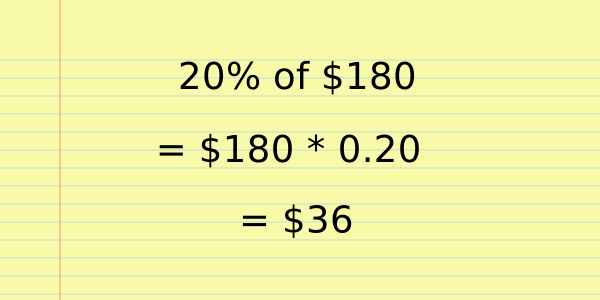
The discount amount is the original price multiplied by the discount percentage. The sale price is the original price minus the discount amount.
Example: \(20\%\) off $100 gives \(100\times0.20=20\) saved, so the sale price is \(100-20=80\).
What Is a Percent Off Calculator?
A percent off calculator finds the sale price after a discount. It starts with the original price, applies a discount percentage, calculates the money saved, and subtracts that savings from the original price. If a jacket is $120 and the store offers 25% off, the calculator shows the discount amount and the final sale price before any extra taxes, shipping, or fees.
This page is focused on one specific job: percentage markdowns such as 10% off, 20% off, 30% off, 50% off, and similar sale labels. For broader percentage questions such as percent change, percent difference, or "what percent of" calculations, use the percentage calculator. For a broader shopping workflow that includes multiple discount styles, the discount calculator can help. This page is designed for the common retail question: "What will I pay after this percent-off discount?"
Percent off is a reduction from the original price, not a dollar amount unless the original price makes it so. A 20% discount on $100 is $20. A 20% discount on $50 is $10. The percentage is the same, but the savings change because the base price is different.
How to Calculate Percent Off
To calculate percent off by hand, use three steps. First, turn the discount percentage into a decimal by dividing by 100. Second, multiply the original price by that decimal to find the discount amount. Third, subtract the discount amount from the original price.
So 20% off $150 means you save $30 and pay $120. The same process works for any original price and any discount percentage from 0% to 100%.
You can also calculate the sale price directly by multiplying the original price by the percentage you still pay. For 20% off, you pay 80% of the original price. For 30% off, you pay 70%. For 75% off, you pay 25%.
Percent Off Formulas
There are three formulas worth knowing: one for the discount amount, one for the sale price, and one for finding the discount percentage when the original and sale prices are known.
In these formulas, \(P\) is the original price and \(r\) is the discount rate as a percentage. If you know the original price and the sale price, the percentage off is:
For example, if a product was $80 and is now $60, the discount amount is $20. The percent off is \((20/80)\times100=25\%\).
Quick Methods for Common Discounts
Some discounts are easy to calculate mentally. These shortcuts are useful while shopping in a store, comparing online listings, or checking whether a checkout total makes sense.
| Discount | Fast savings method | Fast sale price method | Example |
|---|---|---|---|
| 10% off | Divide price by 10 | Pay 90% | $50 saves $5, pay $45 |
| 20% off | Divide price by 5 | Pay 80% | $100 saves $20, pay $80 |
| 25% off | Divide price by 4 | Pay 75% | $80 saves $20, pay $60 |
| 30% off | Multiply by 0.30 | Pay 70% | $90 saves $27, pay $63 |
| 40% off | Multiply by 0.40 | Pay 60% | $120 saves $48, pay $72 |
| 50% off | Divide price by 2 | Pay half | $80 saves $40, pay $40 |
| 75% off | Save three quarters | Pay one quarter | $120 saves $90, pay $30 |
Percent Off Quick Reference Table
The table below shows final sale prices before tax or extra charges.
| Original price | 10% off | 20% off | 30% off | 40% off | 50% off |
|---|---|---|---|---|---|
| $25 | $22.50 | $20.00 | $17.50 | $15.00 | $12.50 |
| $50 | $45.00 | $40.00 | $35.00 | $30.00 | $25.00 |
| $75 | $67.50 | $60.00 | $52.50 | $45.00 | $37.50 |
| $100 | $90.00 | $80.00 | $70.00 | $60.00 | $50.00 |
| $150 | $135.00 | $120.00 | $105.00 | $90.00 | $75.00 |
| $200 | $180.00 | $160.00 | $140.00 | $120.00 | $100.00 |
| $500 | $450.00 | $400.00 | $350.00 | $300.00 | $250.00 |
Worked Examples
Example 1: 20% off $150
You save $30 and pay $120 before tax or other charges.
Example 2: 30% off $90
The final sale price is $63, and the savings are $27.
Example 3: 50% off $84
At 50% off, you pay half. The sale price is $42.
Example 4: Find the percentage off
An item was $80 and is now $60. The savings are $20.
The item is 25% off.
10%, 20%, and 30% Off Explained
These are the most common sale labels, so it helps to understand them quickly. A 10% discount means you save one tenth of the original price. If the item costs $70, 10% is $7 and the sale price is $63.
A 20% discount means you save one fifth of the original price. If the item costs $70, 20% is $14 and the sale price is $56.
A 30% discount means you save three tenths and pay seven tenths. If the item costs $70, the sale price is $49.
The "pay percentage" method is often faster than calculating the savings first. For 10% off, pay 90%. For 20% off, pay 80%. For 30% off, pay 70%.
Percent Off vs Sale Price vs Discount Amount
Percent off, sale price, and discount amount are related but not identical. Percent off is the rate of the markdown, such as 30%. Discount amount is the money saved, such as $27. Sale price is the amount paid after the markdown, such as $63.
For example, on a $90 product with 30% off:
If your main question is "What is the sale price?", this page is the right fit. If your main question is how sale price relates to list price in a broader pricing context, the sale price calculator and list price calculator can support those related pricing tasks.
Multiple Discounts and Coupon Stacking
Multiple discounts are usually applied one after another, not added directly. A 20% discount followed by an extra 10% discount is not the same as 30% off. The second discount applies to the already-reduced price.
Example: an item costs $200. First apply 20% off:
Then apply an extra 10% off:
The final price is $144. The total savings are $56, so the effective discount is:
This is why "20% off plus 10% off" gives 28% total savings, not 30%. To combine sequential discounts, multiply the pay percentages:
where each discount rate is written as a decimal. For 20% and 10%, use \(0.80\times0.90=0.72\), meaning you pay 72% and save 28%.
Percent Off Before or After Tax?
Most retail discounts are applied before sales tax, but rules and checkout displays can vary by location, store, product type, and promotion. The basic percent-off calculator gives the pre-tax sale price. If tax applies, tax is usually calculated on the taxable sale price after the discount.
Example: $100 item, 20% off, then 8% sales tax.
If your main task is the final checkout total after tax, use the sales tax calculator or total price calculator after finding the discounted sale price here.
Discounts, Shipping, and Fees
A discount can make an item cheaper, but shipping and fees can change the final decision. A $50 item with 30% off costs $35 before shipping. If shipping is $9.95, the checkout cost becomes $44.95 before tax. Another store might sell the same item for $40 with free shipping. The smaller advertised discount may still be the better total deal.
When comparing offers, write all costs in one place. Include sale price, tax, shipping, service fees, delivery charges, protection plans, and any minimum-spend requirement for the coupon. A percent-off calculator answers the markdown part, but smart comparison uses the full out-of-pocket cost.
Unit Price and Value After Discount
For groceries, household goods, subscriptions, and bulk purchases, the lowest sale price is not always the best value. Compare unit price after discount. Unit price means cost per ounce, pound, item, month, serving, liter, or another useful unit.
Example: a 12-pack costs $18 with 20% off. The sale price is:
The unit price is:
If a 10-pack from another store costs $12.50 after discount, the unit price is $1.25. The first deal is better per item even though the package costs more overall.
Discount Percentage from Original and Sale Price
Sometimes a store shows the original price and sale price but not the percentage off. Use the reverse discount formula:
Example: original price $120, sale price $84.
The item is 30% off. This calculation is useful when retailers advertise "sale" without stating the markdown rate. It also helps you compare two sale labels that use different wording.
Finding the Original Price from a Sale Price
If you know the sale price and the discount percentage, you can work backward to find the original price. This is useful for checking receipts, reconstructing a list price, or solving classroom percentage problems.
Example: a product is $60 after 25% off.
The original price was $80. This is a reverse percentage problem. For broader reverse percentage work, the general percentage tools on RevisionTown are better; this section stays specific to sale prices and discounts.
Retail and Business Uses
Shoppers use percent-off calculations to compare deals, but retailers use the same math to plan promotions. A business may test whether 15% off, 20% off, or 30% off creates enough extra sales to justify the lower price. The sale price is simple to calculate, but the business decision also depends on cost, margin, inventory, customer behavior, and competitors.
If a retailer buys a product for $40 and sells it for $80, a 25% discount makes the sale price $60. The business still has $20 above cost before other expenses. If the retailer discounts the product by 50%, the sale price is $40, which may leave no gross profit before overhead. For margin-focused analysis, the margin calculator and profit margin calculator can support the next step after the discount math.
For sales teams and business classes, discounting should be connected to revenue, profit, and customer response. A larger discount can increase volume but reduce margin. A smaller discount can preserve margin but attract fewer buyers. The percent-off formula gives the price; strategy determines whether the promotion makes sense.
Discounts vs Markups
A discount reduces a price. A markup increases a cost to create a selling price. The formulas move in opposite directions, so they should not be mixed. A 25% discount on $100 gives $75. A 25% markup on $100 gives $125. They are not inverse operations in the way many people expect.
For a discount:
For a markup:
If you are working with business pricing rather than shopping discounts, use this percent-off calculator only for markdowns. Use a sales or pricing calculator for revenue, margin, markup, and sales planning. The sales calculator is a better fit for broader sales math.
Common Shopping Mistakes
How to Compare Two Discounted Items
When two similar items have different original prices and discounts, calculate the final sale price for each. Do not compare only the discount percentage. A higher percentage off does not automatically mean a lower final price.
Example: Item A is $120 with 30% off. Item B is $95 with 20% off.
Item A has the larger discount percentage, but Item B has the lower sale price. If the products are truly comparable, Item B is cheaper. If Item A is higher quality, larger, or includes more features, the decision may depend on value rather than price alone.
Receipt and Checkout Checks
Receipts can be confusing when discounts, coupons, loyalty points, taxes, and returns appear on separate lines. A percent-off calculation helps verify the first part: whether the item-level discount was applied correctly.
If the tag says $64.99 and the sale is 30% off, the pre-tax sale price is:
Rounded to cents, that is $45.49. The discount amount is $19.50 if rounded to cents. A receipt may round each item separately or apply a discount to a subtotal, so small one-cent differences can appear. For large differences, check whether the discount excluded certain items, required a coupon code, had a maximum discount, or applied before a bundle promotion.
Percent Off with Maximum Discount Caps
Some coupons say something like "30% off, up to $50." In that case, calculate the percentage discount first, then apply the cap if necessary.
Example: 30% off a $300 item, maximum discount $50.
The calculated discount is $90, but the coupon cap is $50. The actual sale price is:
Without the cap, the price would be $210. Discount caps are common in app coupons, marketplace offers, delivery promotions, and large-purchase campaigns. Always read the terms before assuming the full percentage applies.
Percent Off with Minimum Spend
Some offers require a minimum purchase, such as "20% off when you spend $100." The discount might apply only if the eligible subtotal reaches the threshold before tax and shipping. If your cart is $98, adding a small needed item may trigger the coupon, but adding an unnecessary item just to reach the threshold may not save money overall.
Example: your cart is $98 and the coupon is 20% off $100 or more. Adding a $5 item makes the eligible subtotal $103. The discount becomes:
The sale subtotal becomes $82.40. If the extra item is useful, the threshold helped. If the extra item is wasteful, compare against the original cart without the coupon. The best deal is the one that lowers the cost of items you actually need.
When a Discount Is Not a Good Deal
A discount reduces price, but it does not automatically create value. A product can still be overpriced after a discount. A sale can encourage buying something unnecessary. A large markdown can apply to old stock, limited sizes, short shelf life, or products with missing features. Percent off is only one part of the decision.
Use the calculator to remove the arithmetic uncertainty. Then evaluate quality, need, return policy, warranty, delivery time, and total cost. For expensive purchases, compare several sellers and check whether the same item has a normal market price below the advertised "original" price.
Rounding Percent-Off Results to Cents
Money is normally rounded to the nearest cent. The formula may produce more than two decimal places, especially when the price includes cents or the discount percentage is not a whole number. Calculate the discount accurately, then round the final money amounts according to the checkout system or the problem instructions.
Example: 15% off $19.99.
Rounded to cents, the discount is $3.00. The sale price is:
Some checkout systems calculate discounts per item and round each item. Others calculate the discount on the subtotal and round once. For a single item, the difference is usually small. For many items, rounding can create one-cent differences. If a receipt differs by a cent, rounding method may be the reason.
For classroom problems, show the unrounded calculation first and then state the rounded money answer. For shopping, focus on the checkout total. For business reporting, keep consistent rounding rules so discounts, revenue, and tax calculations reconcile cleanly.
Percent Off vs Dollar-Off Coupons
A percent-off coupon reduces price by a percentage. A dollar-off coupon reduces price by a fixed amount. The better coupon depends on the original price. A 20% coupon is better than a $10 coupon when the eligible price is above $50, because 20% of $50 is $10. Below $50, the $10 coupon saves more.
Use this break-even formula:
For a $15 coupon versus 25% off:
At $60, both coupons save $15. Above $60, 25% off saves more. Below $60, the $15 coupon saves more. This is useful when checkout offers multiple coupon choices and only one can be applied.
Also check restrictions. A dollar-off coupon may require a minimum spend. A percent-off coupon may exclude brands, sale items, clearance items, subscriptions, gift cards, or shipping. The math tells you the potential savings; the terms decide whether the savings actually apply.
Cashback vs Percent Off
Cashback is different from an immediate discount. A 10% discount reduces the price at checkout. A 10% cashback offer may charge the full price now and return value later as points, account credit, statement credit, store credit, or a rebate. The dollar value may be similar, but the timing and usability are different.
Example: $200 item with 10% off gives a checkout price of $180. A $200 item with 10% cashback still costs $200 at checkout, then may return $20 later if all terms are met. If the cashback is store credit, it is not the same as cash unless you already plan to use it.
When comparing cashback to percent off, ask these questions: Does the cashback post immediately? Can it expire? Is it cash, points, or store credit? Are returns deducted from cashback? Is there a maximum cashback amount? Does the offer stack with other coupons? These details affect the real value of the promotion.
Buy One Get One and Percent Off
Buy-one-get-one promotions can be converted into an effective percent off, but the result depends on what you buy and whether the items have the same price. "Buy one, get one free" on two identical items is effectively 50% off the pair because you pay for one item and receive two.
If two identical items are $40 each and one is free, the original total is $80 and the savings are $40:
But "buy one, get one 50% off" on two identical items is not 50% off the pair. You pay full price for the first item and half price for the second. For two $40 items, the total is $60 instead of $80, so the effective discount is 25% off the pair.
If the two items have different prices, many stores apply the discount to the lower-priced item. That can reduce the effective percentage. Always compare the final total, not only the headline wording.
Clearance Pricing and Deep Discounts
Clearance sales often use large discounts such as 60%, 70%, 75%, or 80% off. The quick method is to calculate what you still pay. At 70% off, you pay 30% of the original price. At 75% off, you pay 25%. At 80% off, you pay 20%.
Example: 70% off $150.
You pay $45. Example: 80% off $150.
You pay $30. Deep discounts can be excellent when the item is useful, but clearance items may have limited sizes, no returns, older packaging, short warranty windows, or discontinued accessories. The discount math should be combined with a practical check of condition and return policy.
Returns and Refunds After a Discount
If you return a discounted item, the refund is normally based on the price you actually paid, not the original price. If you bought a $100 item at 30% off, you paid $70 before tax. A return would normally refund the discounted purchase price, adjusted for taxes, fees, shipping, restocking fees, or store policy.
Complications happen when a coupon applies across multiple items. A $20 coupon on a cart with several products may be prorated across the items. If you return one item, the refund may subtract the prorated discount. This can make the refund lower than the line-item sale price you expected.
For expensive purchases, keep the receipt and review how the discount was applied. If a promotion is "final sale," "exchange only," or "store credit only," the largest percent off may not be worth the reduced flexibility.
Percent Off with Price Matching
Price matching can interact with discounts in several ways. Some stores match a competitor's lower price before applying a coupon. Others do not allow coupons on price-matched items. Some match only the final advertised price and exclude membership or coupon-only offers. The best method is to calculate each eligible scenario separately.
Example: Store A sells an item for $120 with 20% off. Store B sells it for $95 regular price.
Store B is still $1 cheaper before tax and shipping. If Store A allows price matching to $95 and then applies 20% off, the price becomes $76, but many stores do not allow that combination. The policy matters as much as the arithmetic.
Percent Off for Subscriptions and Monthly Prices
Subscription discounts may apply to the first month, the first year, or the full subscription term. A large discount on the first billing period may not reduce the long-term average cost as much as it appears. Always identify the time period that receives the discount.
Example: a service costs $20 per month, and the first 3 months are 50% off. You pay $10 per month for 3 months, then $20 per month for the remaining 9 months of the year.
The full-price annual cost would be \(12\times20=240\). The actual yearly savings are $30, or 12.5% of the annual cost, not 50% for the whole year.
Percent Off in Different Currencies
The percent-off formula works with any currency because the percentage is a ratio. A 20% discount on 100 dollars, euros, pounds, dirhams, or any other currency leaves 80 units of that currency before taxes and fees. The currency symbol changes, but the math does not.
When shopping internationally, exchange rates, import duties, VAT, shipping, and card fees may matter more than the advertised discount. Convert the sale price into your home currency only after applying the discount in the store currency, then add any extra international costs. The discount calculator handles the markdown; cross-border purchases require a total-cost check.
Percent Off for Budgets
A discount lowers the price, but it does not automatically make a purchase fit a budget. If your budget is $75 and an item costs $100 with 20% off, the sale price is $80. The discount is real, but the purchase is still over budget before tax. In that case, either wait for a deeper discount, use a better coupon, choose a different item, or increase the budget deliberately.
You can also work backward from a budget. If an item costs $100 and your maximum pre-tax budget is $75, the required discount is:
You need at least 25% off to reach $75 before tax. If tax or shipping applies, the required discount may be higher.
Practice Problems with Answers
Use these to check your understanding before relying on the calculator for fast shopping decisions.
| Problem | Answer | Check |
|---|---|---|
| 10% off $90 | Pay $81 | \(90\times0.90=81\) |
| 20% off $45 | Pay $36 | \(45\times0.80=36\) |
| 30% off $250 | Pay $175 | \(250\times0.70=175\) |
| 40% off $75 | Pay $45 | \(75\times0.60=45\) |
| 50% off $38 | Pay $19 | \(38\div2=19\) |
| 75% off $64 | Pay $16 | \(64\times0.25=16\) |
| $120 reduced to $96 | 20% off | \((120-96)/120\times100=20\%\) |
Percent Off for Students
Percent off is a practical application of percentage decrease. A discount rate tells you how much the original price decreases. The sale price is the original price after that decrease. This makes discount problems useful for learning proportions, decimals, and real-world arithmetic.
A student-friendly method is to write the "you pay" percentage. If a product is 35% off, you pay 65% of the original price:
This avoids a separate subtraction step and connects directly to multiplier methods used in percentage increase and decrease questions.
Black Friday, Holiday Sales, and Event Discounts
Large sale events often combine big percent-off claims with limited-time pressure. The calculator is useful because it turns the headline into a specific price. If a $240 item is advertised at 35% off, the sale price is:
You save $84 and pay $156 before tax and shipping. That is a clear number you can compare with other retailers, previous prices, and your budget.
For event sales, do not evaluate only the discount. Check whether the product is the same model, whether shipping changes during the event, whether the return window is shorter, whether the discount is tied to a membership, and whether the advertised "original" price reflects a real market price. Percent-off math gives clarity, but the final buying decision should include product quality and total cost.
Outlet, Clearance, and Final Sale Labels
Outlet and final-sale items often advertise large markdowns. A 65% discount means you pay 35% of the original price. A 90% discount means you pay 10%. These are easy to calculate, but final-sale terms can matter more than the discount.
Example: 65% off $180.
The sale price is $63. If the item cannot be returned, ask whether the lower price is worth the risk. For clothing, check size, fabric, and condition. For electronics, check model year, warranty, accessories, and compatibility. For furniture, check delivery fees and return pickup costs. A deep discount on the wrong product is still wasted money.
Member Discounts, Student Discounts, and Employee Discounts
Membership, student, military, teacher, employee, and loyalty discounts often use the same percent-off formula. If a store gives students 15% off a $64 item, the sale price is:
If the discount applies only to full-price items, it may not work on sale merchandise. If it applies after another markdown, it becomes a stacked discount. If it applies before tax, tax should usually be calculated after the discount. The order of operations matters.
For employee purchases, a discount can be treated as a benefit, but policies may limit resale, returns, gift purchases, or stacking with promotions. The arithmetic is simple; eligibility rules determine whether the discount is available.
Percent Off and Installment Payments
Buy-now-pay-later and installment offers can make a discounted price feel smaller because the cost is split into payments. Always calculate the discounted total first, then divide into payments. If a $300 item is 20% off, the sale price is $240. If the store splits that into four equal payments, each payment is:
The discount saves $60, but the total owed is still $240 before any tax, shipping, late fees, or financing charges. Installments change timing, not the discounted price. If interest or fees apply, the true cost may be higher than the sale price shown by the percent-off calculation.
Discounts on Subtotals vs Individual Items
Some coupons apply to a cart subtotal. Others apply only to one item. A 20% cart discount on $150 saves $30. A 20% single-item discount on one $80 item in a $150 cart saves only $16. The discount rate is the same, but the base amount is different.
Cart discount:
Single-item discount:
When a promotion says "one full-price item," "eligible items," "subtotal," or "entire order," identify the base price before calculating. The base price is the amount the percentage applies to. A percent without the correct base amount cannot give a reliable final price.
Percent Off with Gift Cards and Store Credit
Gift cards and store credit reduce what you pay out of pocket, but they are not the same as a percent-off discount. If a $100 item is 20% off, the sale price is $80. If you then use a $25 gift card, your out-of-pocket payment is $55, but the discount is still 20% off the item. The gift card is a payment method, not a markdown.
This distinction matters for returns and budgeting. A refund may go partly back to the gift card. A store credit may expire or be usable only at that retailer. Treat the percent discount, payment method, and refund rules as separate parts of the transaction.
Merchant Markdown Planning
For sellers, percent-off calculations help set promotional prices quickly. If a product normally sells for $48 and the merchant wants a 15% sale, the sale price is:
The seller may then decide whether to list the price as $40.80, $40.99, or $39.99. Promotional pricing often combines math with customer psychology, margin targets, inventory goals, and competitor prices.
Markdown planning should also consider cost. If the item costs the seller $30, a $40.80 sale price leaves $10.80 before overhead. If the discount is increased to 30%, the sale price becomes $33.60, leaving only $3.60 before overhead. A discount that looks attractive to customers may be too aggressive for the seller unless it clears inventory, attracts new customers, or supports a larger strategy.
How to Explain Percent Off in One Sentence
A simple explanation is: percent off tells what part of the original price is removed. If an item is 30% off, 30% is removed and 70% remains. That means the sale price is 70% of the original price.
This sentence helps students and shoppers avoid a common mistake: subtracting the discount number itself instead of the percentage of the original price. A 30% discount is not $30 off unless the original price is $100. A 30% discount on $60 is $18 off. A 30% discount on $200 is $60 off.
More Worked Discount Scenarios
| Scenario | Calculation | Result |
|---|---|---|
| $38 item at 15% off | \(38\times0.85\) | $32.30 sale price |
| $240 item at 35% off | \(240\times0.65\) | $156.00 sale price |
| $18.99 item at 40% off | \(18.99\times0.60\) | $11.39 sale price, rounded |
| $500 item at 12% off | \(500\times0.88\) | $440.00 sale price |
| $72 item reduced to $54 | \((72-54)/72\times100\) | 25% off |
| $45 after 10% off | \(45\div0.90\) | $50 original price |
How This Page Fits with Related Calculators
Use this page when the input is an original price and a percent-off discount. Use the general advanced percentage calculator when the question is not specifically a sale markdown. Use the discount formula guide when you want formula notes rather than an interactive calculator. Use the calculators directory for other math and finance tools.
The purpose of this page is narrow and practical: original price, percent off, savings, and sale price. That clear scope makes it faster for sale tags, shopping carts, receipts, classroom discount examples, and quick mental-math checks.
Effective Discount After Fixed Fees
A fixed fee can reduce the real value of a discount. Suppose an item is $100 with 20% off, but the order has a $6 handling fee. The sale price is $80, but the pre-tax checkout cost becomes $86. Compared with the original $100 item price, the effective savings are $14, not $20.
This does not mean the advertised 20% discount is mathematically wrong. It means the fee changes the practical savings. The same issue appears with delivery fees, service charges, small-order fees, and required add-ons. When fees are fixed, they matter more on low-priced orders. A $6 fee on a $20 order is large. A $6 fee on a $300 order is much smaller as a percentage of the purchase.
For the cleanest comparison between stores, calculate the percent-off sale price first, then add fixed fees and tax estimates. Compare final out-of-pocket totals only after every required cost is included. That final total is the number that should guide the buying decision, not the sale banner alone.
Final Checklist Before Buying
Before deciding that a sale is a good deal, check the sale price, not just the percent off. Add tax, shipping, or fees if they apply. Compare unit price for bulk items. Check whether stacked discounts are sequential. Look for maximum discount caps and minimum-spend rules. Confirm the product is something you actually need or would have bought at a fair price.
A clean final calculation looks like this:
That line tells you the starting price, the markdown, and the amount paid before tax. It is short enough for shopping and precise enough for a worksheet or receipt check.
Frequently Asked Questions
How do you calculate percent off?
Multiply the original price by the discount percentage divided by 100 to get the savings, then subtract the savings from the original price.
What is the formula for percent off?
The main formula is \(\text{Sale price}=P(1-r/100)\), where \(P\) is the original price and \(r\) is the discount percentage.
How do you calculate 20% off?
Multiply the price by 0.20 to find the discount, then subtract it. You can also multiply the price by 0.80 directly to get the sale price.
How much is 30% off $100?
30% off $100 saves $30 and leaves a sale price of $70.
How do you find the discount percentage from original and sale price?
Use \((\text{Original price}-\text{Sale price})/\text{Original price}\times100\). For example, $80 reduced to $60 is 25% off.
Do stacked discounts add together?
Usually no. They are applied one after another. A 20% discount followed by 10% off gives 28% total savings, not 30%.
Does this calculator include sales tax?
No. It calculates the pre-tax sale price and savings from the percent-off discount. Add tax after the discount if tax applies.