
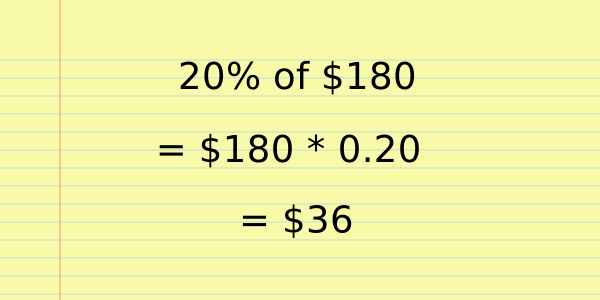
Sale price and savings calculator
Percent Off Calculator - Discount Calculator for Sales & Prices
Enter the original price and the percent off to calculate the discount amount, final sale price, percentage you pay, and checkout-ready savings. Use the examples and formulas below to understand every sale price before you buy.
Calculate Final Price After Percent Off
This calculator is built for sales and price tags: original price, percent off, amount saved, and final price. It keeps the focus on the retail discount calculation, separate from broader percentage change or general percentage problems.
Use the regular price before discount.
Enter the sale percentage, such as 10, 20, 30, 50, or 75.
Final sale price
$100.00 with 20% off saves $20.00, so the final price is $80.00.
Fast answer: percent off means subtracting a percentage of the original price. The discount amount is \(\text{Original Price}\times \text{Percent Off}/100\), and the final sale price is \(\text{Original Price}-\text{Discount Amount}\). A 20% discount means you pay 80% of the original price.
What This Percent Off Calculator Does
A percent off calculator answers a very practical sale question: if an item has a discount, what is the final price and how much money do you save? The calculation starts with the original price, applies the advertised discount percentage, and returns the discount amount and the sale price after the markdown. That makes it useful for retail shopping, online checkout, clearance tags, coupons, business pricing, classroom percentage practice, and comparing sale offers before paying.
This page is intentionally focused on final price and savings after a retail-style percentage discount. It is not trying to replace a broad percentage calculator for every kind of percentage question, and it is not a percentage change tool for comparing old and new values after the fact. If you need to find whether a price increased or decreased by a certain percentage between two known prices, use a percentage change calculator. If you need to compare two values without treating one as the original price, a percentage difference calculator is a better fit.
The calculator above keeps the retail workflow simple. Type the regular price into the original price field. Type the sale percentage into the percent off field. The result shows the amount saved, the final price, and the percent of the original price you still pay. A 30% discount means the discount is 30% of the original price and the final price is 70% of the original price. A 75% discount means the discount is three quarters of the original price and the final price is one quarter of the original price.
Knowing the formula matters because sale signs can be designed to feel larger than they are. "Save 25%" sounds appealing, but the actual dollar amount depends on the starting price. A 25% discount on a $20 item saves $5. A 25% discount on a $400 item saves $100. The same percentage can feel very different in money terms. This calculator shows both pieces: the percentage and the dollars saved.
The page also helps separate percent off from dollars off. A "$20 off" coupon subtracts a fixed amount. A "20% off" sale subtracts a percentage of the original price. On a $100 item, both save $20. On a $50 item, 20% off saves $10, while $20 off saves $20. On a $200 item, 20% off saves $40, while $20 off saves $20. The percent off formula changes with the item price, so calculating the final price prevents bad assumptions.
Percent Off Formulas
There are three useful formulas for percent off problems. They all describe the same discount, but each form is helpful in a different situation. The first formula finds savings. The second finds final sale price. The third uses a pay multiplier, which is usually the fastest method once you understand it.
Discount Amount
\[\text{Discount Amount}=\text{Original Price}\times\frac{\text{Percent Off}}{100}\]
This formula tells you how many dollars, pounds, euros, or other currency units you save. For example, on a $100 item with 20% off, the discount amount is \(100\times 20/100=20\). You save $20.
Final Sale Price
\[\text{Final Price}=\text{Original Price}-\text{Discount Amount}\]
After you know the discount amount, subtract it from the regular price. If the original price is $100 and the discount amount is $20, the final price is \(100-20=80\). The sale price is $80 before any tax, shipping, fees, or other checkout adjustments.
One-Step Final Price Formula
\[\text{Final Price}=\text{Original Price}\times\left(1-\frac{\text{Percent Off}}{100}\right)\]
This is the fastest formula for a final price. A 20% discount means you pay \(1-20/100=0.80\) of the original price. A 35% discount means you pay \(0.65\) of the original price. A 75% discount means you pay \(0.25\) of the original price.
Pay Percent and Savings Check
\[\text{Pay Percent}=100\%-\text{Percent Off}\]
\[\text{Original Price}=\text{Discount Amount}+\text{Final Price}\]
The pay percent helps you check the result. If an item is 30% off, you pay 70% of the original price. If the original price is $200, final price is \(200\times 0.70=140\), and savings are $60. The check is \(60+140=200\).
For a deeper formula-only explanation, RevisionTown also has a focused discount formula guide. This page keeps the formulas tied to a working calculator and sale price examples, so you can use the result immediately.
Common Percent Off Discount Table
The table below shows final prices for common sale percentages. It also shows the pay multiplier, which is often the fastest way to calculate the final price mentally. For example, 25% off means you pay 75%, so the multiplier is \(0.75\).
| Percent off | You pay | Multiplier | $50 item | $100 item | $200 item | Quick meaning |
|---|---|---|---|---|---|---|
| 5% off | 95% | 0.95 | $47.50 | $95.00 | $190.00 | Small sale or member discount |
| 10% off | 90% | 0.90 | $45.00 | $90.00 | $180.00 | Move one decimal place to estimate savings |
| 15% off | 85% | 0.85 | $42.50 | $85.00 | $170.00 | Common coupon discount |
| 20% off | 80% | 0.80 | $40.00 | $80.00 | $160.00 | One fifth off |
| 25% off | 75% | 0.75 | $37.50 | $75.00 | $150.00 | One quarter off |
| 30% off | 70% | 0.70 | $35.00 | $70.00 | $140.00 | Popular seasonal sale |
| 40% off | 60% | 0.60 | $30.00 | $60.00 | $120.00 | Large markdown |
| 50% off | 50% | 0.50 | $25.00 | $50.00 | $100.00 | Half price |
| 60% off | 40% | 0.40 | $20.00 | $40.00 | $80.00 | Deep clearance |
| 70% off | 30% | 0.30 | $15.00 | $30.00 | $60.00 | Major clearance |
| 75% off | 25% | 0.25 | $12.50 | $25.00 | $50.00 | You pay one quarter |
| 80% off | 20% | 0.20 | $10.00 | $20.00 | $40.00 | You pay one fifth |
If you want a separate calculator focused only on the final sale price result, the sale price calculator is a related option. If you want a broader tool for discount types, compare this with RevisionTown's discount calculator and discount calculator 2.
Worked Percent Off Examples
Worked examples are useful because they show the difference between the dollar savings and the final price. In each example, the same structure applies: find the discount amount, subtract it from the original price, and check that savings plus final price equals the original price.
Example 1: 10% Off $80
Find the discount amount:
\[\$80\times\frac{10}{100}=\$8\]
Subtract from the original price:
\[\$80-\$8=\$72\]
A 10% discount on $80 saves $8, so the final price is $72. The one-step method is \(80\times 0.90=72\).
Example 2: 15% Off $60
Find 15% of $60:
\[\$60\times 0.15=\$9\]
Final price:
\[\$60-\$9=\$51\]
A 15% discount on $60 saves $9 and gives a final sale price of $51. The pay multiplier is \(0.85\), so \(60\times 0.85=51\).
Example 3: 20% Off $100
20% off is one of the most common shopping discounts:
\[\$100\times\frac{20}{100}=\$20\]
\[\$100-\$20=\$80\]
So 20% off $100 saves $20 and the final price is $80. Since 20% off means paying 80%, you can also calculate \(100\times 0.80=80\).
Example 4: 25% Off $48
25% is one quarter. One quarter of $48 is $12:
\[\$48\times 0.25=\$12\]
\[\$48-\$12=\$36\]
The final price is $36. The direct multiplier method is \(48\times 0.75=36\), because a 25% discount means you pay 75%.
Example 5: 30% Off $200
Find the savings:
\[\$200\times 0.30=\$60\]
Subtract:
\[\$200-\$60=\$140\]
A 30% discount on $200 saves $60 and leaves a sale price of $140. You pay 70% of the original price.
Example 6: 40% Off $75
Calculate the discount:
\[\$75\times 0.40=\$30\]
Final sale price:
\[\$75-\$30=\$45\]
The sale saves $30. The final price is $45. A good check is \(75\times 0.60=45\), because 40% off means paying 60%.
Example 7: 50% Off $129.99
50% off is half price:
\[\$129.99\times 0.50=\$64.995\]
Rounded to cents, the discount is $65.00 and the final price is $64.99 or $65.00 depending on store rounding and register rules. Most checkout systems round line items to the nearest cent. For practical shopping, expect about $65.00 final price before tax.
Example 8: 70% Off $250
A 70% discount means you save 70% and pay 30%:
\[\$250\times 0.70=\$175\]
\[\$250-\$175=\$75\]
The final price is $75. The direct method is \(250\times 0.30=75\).
Example 9: 75% Off $96
A 75% discount means you pay 25%, or one quarter:
\[\$96\times 0.25=\$24\]
The final price is $24 and the savings are \(96-24=72\). This example is faster by thinking "pay one quarter" than by calculating the discount first.
Mental Math Shortcuts for Percent Off
The calculator is fastest for exact cents, but mental math helps you decide quickly whether a sale is worth it. The trick is to convert the percent off into either a familiar fraction or a pay multiplier. Once you know the relationship, many retail discounts can be estimated in seconds.
10% Off
Move the decimal one place left to find 10%. On $84, 10% is $8.40. Subtract it to get $75.60. The multiplier method is \(84\times 0.90=75.60\).
20% Off
20% is one fifth. Divide by 5 to estimate savings, or multiply by 0.80 to get final price. On $45, one fifth is $9, so the final price is $36. On $120, 20% is $24 and the final price is $96.
25% Off
25% is one quarter. If an item is $80, one quarter is $20, and the final price is $60. If an item is $36, one quarter is $9, and the final price is $27. The multiplier is 0.75.
30% Off
30% is three times 10%. On $90, 10% is $9, so 30% is $27. The final price is $63. The multiplier method is \(90\times 0.70=63\). For an estimate, find 10%, triple it, then subtract.
40% Off
40% is four times 10%, and it means paying 60%. On $150, 10% is $15, so 40% is $60. The final price is $90. The direct multiplier is \(0.60\).
50% Off
50% off is half price. Divide by 2. A $38 item becomes $19. A $240 item becomes $120. This is the easiest large discount to calculate mentally.
70% and 75% Off
For 70% off, think "pay 30%." For 75% off, think "pay 25%." On a $200 item, 70% off means paying $60. On a $200 item, 75% off means paying $50. High discount percentages are often easier to calculate by the pay percent than by the savings percent.
Practical shortcut: for the final price, use the amount you pay, not the amount you save. 35% off means pay 65%. 60% off means pay 40%. 85% off means pay 15%. This reduces one subtraction step.
Using Percent Off for Sales and Prices
Retail discounts are simple in theory, but real shopping situations introduce details such as tax, shipping, coupons, minimum purchase rules, clearance tags, price matching, loyalty rewards, and "up to" sale language. The calculator gives the base sale price. The sections below explain how to use that number carefully.
Sale Tag Check
Use the calculator to check whether a shelf tag or online sale price matches the advertised percent off. Enter the original price and the discount to verify the expected final price.
Coupon Planning
Use the final price before tax to decide whether a coupon meets a minimum spend rule. Pay attention to exclusions, item categories, and whether coupons apply before or after other discounts.
Budget Decisions
Use the savings and final price together. A large percentage off does not automatically make an item affordable if the original price is high.
Before Tax vs After Tax
Most percent off calculations are applied to the item price before sales tax, although exact rules can vary by location and transaction type. If a $100 item is 20% off, the pre-tax final price is $80. If the tax rate is 8%, then tax on $80 is \(80\times 0.08=6.40\), so the checkout total is $86.40. If tax were calculated on the original price in a special case, the total would differ. Always check the checkout line if taxes, fees, or shipping are involved.
Shipping and Fees
A discount may reduce the item price but not the shipping fee. For example, a $60 item at 25% off has a sale price of $45. If shipping is $8, the total before tax is $53. The sale saved $15 on the item, but the checkout total is not $45 unless shipping is free. This is why a final price calculator answers the item discount, while the final checkout cost may need one more step.
Clearance and Final Sale
Clearance tags often use large discount percentages such as 50%, 60%, 70%, or 75% off. The math is the same, but return rules may be different. A $180 jacket at 70% off has a final price of \(180\times 0.30=54\), saving $126. The sale is large, but the decision should still consider size, condition, return policy, and whether the item was actually worth the original price.
Comparing Two Sale Offers
If two stores sell the same product at different original prices and discounts, calculate the final price for each. A $120 item at 25% off is $90. A $110 item at 15% off is $93.50. The smaller percentage discount can be worse or better depending on the original price. Comparing final prices is more reliable than comparing percent signs.
Business Pricing and Markdown Planning
For a business, percent off is a pricing decision, not just a shopper calculation. A 30% markdown on a $50 product creates a sale price of $35 and a $15 discount. That affects revenue, margin, inventory clearance, and customer perception. This calculator gives the arithmetic, but business decisions should also consider cost, margin, stock age, competitor pricing, and demand.
Stacked Discounts: Why 20% Off Plus 10% Off Is Not 30% Off
One of the most common sale mistakes is adding stacked discounts as if they apply to the original price at the same time. In many stores, discounts are sequential. The first discount lowers the price, and the second discount applies to the lowered price. That makes the total discount slightly smaller than simply adding the percentages.
Sequential Discount Formula
If two discounts are applied one after another, use pay multipliers:
\[\text{Final Price}=\text{Original Price}\times(1-d_1)\times(1-d_2)\]
Here \(d_1\) and \(d_2\) are decimal discounts. For 20% off followed by 10% off, use \(0.20\) and \(0.10\):
\[\text{Final Price}=\text{Original Price}\times 0.80\times 0.90\]
The combined pay multiplier is \(0.72\), so you pay 72% of the original price. That means the total discount is 28%, not 30%.
Example: $100 With 20% Off and Then 10% Off
Start with $100. Apply 20% off:
\[\$100\times 0.80=\$80\]
Apply 10% off to the new $80 price:
\[\$80\times 0.90=\$72\]
The final price is $72. The savings are $28. That is a 28% effective discount from the original $100 price.
Coupon Order Matters
Some stores apply a percent discount before a fixed dollar coupon. Others apply a fixed coupon first, then the percentage discount. These two orders can produce different totals. For example, start with $100, apply 20% off, then apply a $10 coupon: $100 becomes $80, then $70. If the $10 coupon applies first, $100 becomes $90, then 20% off gives $72. The difference is $2. Read coupon terms before assuming the best order.
How This Page Handles Stacking
The calculator above handles a single percent off discount because that is the cleanest, most common sale-price problem. For stacked discounts, calculate one step at a time. Enter the original price and first discount, use the final price as the new original price, and apply the second discount. This keeps the arithmetic clear and avoids treating sequential discounts as additive.
Rounding, Cents, and Real Checkout Prices
Percent off math often produces more than two decimal places, but retail prices are usually rounded to cents. The calculator displays dollars and cents because that is how most shoppers see prices. Behind the scenes, formulas may produce values such as $64.995 or $18.666. The store register, payment processor, or ecommerce platform will round according to its rules.
Rounding to the Nearest Cent
Most everyday price calculations round to the nearest cent. A calculated final price of $12.345 becomes $12.35. A calculated final price of $12.344 becomes $12.34. If a line item and an order total are rounded at different stages, the last cent can sometimes differ. That does not mean the percentage formula is wrong; it means rounding happened at a different step.
Line-Item Rounding vs Cart Rounding
If you buy several items, a store might calculate and round the discount for each line item, or it might apply the discount to the cart subtotal and then round. These approaches can differ by a few cents. For personal budgeting, the difference is usually small. For accounting, invoicing, or business promotions, define the rounding method clearly.
Prices Ending in .99
Many retail prices end in .99. A 25% discount on $19.99 gives \(19.99\times 0.75=14.9925\), which rounds to $14.99. A 50% discount on $129.99 gives $64.995, which may round to $65.00 depending on the system. If you need exact checkout totals, use the calculator for the base result and then check the cart for final tax and rounding.
Why the Savings May Look Off by a Cent
If the final price is rounded, the displayed savings may also be rounded. For example, a calculated discount amount of $4.9975 may display as $5.00. When you add the displayed discount and displayed final price, the result should be very close to the original price, but there can be a one-cent rounding difference in some cases. That is normal in retail math.
Common Percent Off Mistakes to Avoid
Percent off calculations are simple once the relationship is clear, but sale wording can still cause confusion. These are the mistakes most likely to change the final amount a shopper expects to pay.
Using the Discount Percent as the Pay Percent
A 30% discount does not mean you pay 30%. It means you save 30% and pay 70%. A 70% discount does not mean you pay 70%. It means you save 70% and pay 30%. Always decide whether a percentage represents the savings or the amount paid.
Forgetting to Subtract the Discount
If you calculate \(100\times 0.20=20\), that $20 is the savings, not the final price. The final price is \(100-20=80\). The one-step multiplier avoids this mistake because \(100\times 0.80=80\) gives the final price directly.
Adding Sequential Discounts
As explained above, 20% off followed by 10% off is usually 28% off overall, not 30%. Add discounts only when the promotion explicitly says the total discount is the sum. When in doubt, apply them one at a time.
Ignoring Minimum Spend Rules
A coupon may require a minimum order value before the discount applies. If a cart is $98 and the coupon requires $100, the discount may not apply. Some stores calculate the threshold before coupons, some after certain exclusions, and some exclude sale items. Read the rule before counting the savings.
Assuming "Up To" Means Every Item
"Up to 70% off" means some items may be 70% off, but many may have smaller discounts. Use the actual product discount, not the headline maximum. A product at 25% off in a sale advertised as up to 70% off should be calculated with 25%, not 70%.
Comparing Savings Instead of Final Price
A bigger dollar savings can still leave a higher final price if the original price is much higher. A $200 item at 40% off saves $80 and costs $120. A $130 item at 20% off saves $26 and costs $104. The smaller discount is the better final price in this case.
How to Compare Sale Prices Correctly
Comparing discounts is one of the best uses of a percent off calculator. A sale sign tells you the size of the markdown, but it does not always tell you which option is the best deal. To compare offers fairly, calculate the final price for each option, then consider tax, shipping, quality, quantity, return rules, and whether the item is actually the same product.
Compare Final Price, Not Just Percent Off
Suppose Store A sells a jacket for $160 with 30% off. Store B sells a similar jacket for $145 with 20% off. The discount at Store A looks larger, but the final price decides the better deal. Store A: \(160\times 0.70=112\), so the sale price is $112. Store B: \(145\times 0.80=116\), so the sale price is $116. In this case, Store A is $4 cheaper even though the original price is higher. If Store B offered free shipping and Store A charged shipping, the better checkout total could change.
Compare Same Quantity or Unit Price
Discounts can be misleading when package sizes differ. A 30% discount on a 24-pack is not directly comparable to a 20% discount on a 12-pack unless you calculate the unit price. First find the final sale price, then divide by quantity. If a 24-pack was $18 and is 25% off, the final price is \(18\times 0.75=13.50\), so the unit price is \(13.50/24=0.5625\), or about 56 cents each. If a 12-pack was $10 and is 20% off, the final price is $8, so the unit price is \(8/12=0.6667\), or about 67 cents each. The larger pack is still cheaper per item.
Compare Discount With Shipping
Online shopping often adds shipping after the item discount. A $100 item at 30% off has a sale price of $70. If shipping is $12, the pre-tax checkout total is $82. Another store may sell the same item for $90 with 15% off and free shipping. The final item price is \(90\times 0.85=76.50\). With free shipping, the second store is $5.50 cheaper before tax, even though the discount percentage is smaller. This is why a discount calculator should be part of a full checkout comparison, not the only number considered.
Compare Discounts With Store Credit or Rewards
Rewards, store credit, and loyalty points are not always the same as an immediate discount. A $100 item at 20% off costs $80 before tax. A $100 item with a $20 future credit may still cost $100 today, and the $20 value only helps if you later buy something else you actually need. If you are comparing cash out of pocket, use the immediate final price. If you are comparing long-term value, include reward terms, expiration dates, excluded categories, and whether the reward can be combined with future sales.
Compare Sale Price With Return Policy
A lower final price may not be the best choice if the item is final sale, has restocking fees, or cannot be exchanged. For example, 70% off a $200 item creates a $60 final price. That is a large discount, but if it cannot be returned and the size or compatibility is uncertain, the risk may matter. The calculator gives the arithmetic answer; the buying decision should include policy and product fit.
Compare the Discount With Real Market Price
A percent off discount uses the seller's original price. If the original price was inflated, the discount can look better than it is. A $300 item at 50% off costs $150. If other stores regularly sell the same item for $140, the sale is not actually the best price. Calculate the final price, then compare it with current prices for the same model, size, condition, and warranty.
Reverse Percent Off: Finding the Original Price
Sometimes you know the sale price and the discount, but you want to recover the original price. This is a reverse percentage problem. It appears in shopping tags, receipts, homework questions, and business markdown analysis. The key is to divide by the pay percent, not by the discount percent.
Original Price From Sale Price
\[\text{Original Price}=\frac{\text{Sale Price}}{1-\text{Percent Off}/100}\]
For example, suppose a shirt costs $48 after 40% off. A 40% discount means you pay 60%, so the pay multiplier is \(0.60\). The original price is:
\[\frac{\$48}{0.60}=\$80\]
The original price was $80. The savings were \(80-48=32\), so the discount amount was $32.
Why You Do Not Divide by the Discount Percent
If a $48 sale price came after 40% off, the $48 is not 40% of the original price. It is 60% of the original price, because the shopper pays the part left after the discount. Dividing \(48\) by \(0.40\) would give $120, which is wrong for this situation. Always ask: "What percent of the original price am I paying?" Then divide by that pay percent.
Reverse Example: Sale Price $75 After 25% Off
A 25% discount means you pay 75%. The sale price is $75, so:
\[\frac{\$75}{0.75}=\$100\]
The original price was $100. The savings were $25. If you check forward, 25% off $100 gives a final price of $75.
When Reverse Percentages Are Useful
Reverse percent off is useful when a receipt shows the discounted price but not the original price, when a store tag says "now $39 after 35% off," or when a student problem gives the sale price and asks for the pre-sale price. For a broader lesson on this kind of problem, use RevisionTown's reverse percentages resource.
Checkout Examples: Discount, Tax, and Total Cost
The calculator focuses on the discount and final item price before tax. Real checkout totals may add sales tax, shipping, service fees, deposits, or other charges. The examples below show how to build from the sale price to a fuller estimate while keeping each step separate.
Example: 20% Off With Sales Tax
A $120 item is 20% off, and the sales tax rate is 8%. First calculate the discounted item price:
\[\$120\times 0.80=\$96\]
Then calculate tax on the discounted price:
\[\$96\times 0.08=\$7.68\]
The checkout total is \(96+7.68=103.68\). The discount reduced the item price by $24, but the final amount paid after tax is $103.68.
Example: 30% Off Plus Shipping
A $75 item is 30% off and shipping is $6.99. First find the sale price:
\[\$75\times 0.70=\$52.50\]
Add shipping:
\[\$52.50+\$6.99=\$59.49\]
If tax is charged on the item but not shipping, tax would be calculated on $52.50. If tax applies to shipping in your location, the tax base may be higher. The item discount is clear, but the checkout rules determine the final total.
Example: Fixed Coupon After Percent Off
A $90 item is 25% off, and you also have a $10 coupon applied after the percent discount. First apply the percent off:
\[\$90\times 0.75=\$67.50\]
Then subtract the coupon:
\[\$67.50-\$10=\$57.50\]
If the coupon were applied before the percent discount, the result would be \((90-10)\times 0.75=60\). The order changes the final price, so always follow the store's coupon order.
Example: Free Shipping Threshold
Suppose free shipping applies at $50 after discounts. Your cart is $60 before a 20% coupon. The discounted cart is \(60\times 0.80=48\), which may fall below the free shipping threshold if the store uses post-discount subtotal. If shipping is $7, the total becomes $55. Adding a small useful item may or may not be worth it, depending on the price of the item and whether you need it. A percent off calculator helps reveal these threshold effects.
Percent Off for Business Markdowns and Pricing
For shoppers, percent off is about finding the sale price. For a seller, percent off also affects revenue, gross margin, inventory turnover, and customer perception. A markdown can help clear old stock, but the discount must be understood in dollars, not just as an attractive percentage.
Markdown Amount
If a product has a regular price of $80 and a 30% markdown, the sale price is \(80\times 0.70=56\). The markdown amount is $24. If the product cost the business $42, the gross profit after markdown is \(56-42=14\). The item can still be profitable, but the margin is lower than at full price.
Markdown vs Margin
Markdown and margin are not the same thing. Markdown is the reduction from the selling price. Margin compares profit with the selling price. If a $100 product is discounted 20%, the sale price is $80. If the cost is $50, profit is $30 and margin is \(30/80=37.5\%\). The discount was 20%, but the margin after discount is 37.5%. Mixing these ideas can lead to poor pricing decisions.
Break-Even Sale Price
A business should know the lowest acceptable sale price before offering a discount. If a product costs $35 and the regular price is $50, a 30% discount gives a sale price of $35. That covers the product cost but leaves no gross profit before overhead. A 40% discount gives \(50\times 0.60=30\), which is below product cost. A calculator makes the markdown visible before the promotion is published.
Promotional Clarity
Customers trust clear discounts. If a sign says 25% off, the final price should match the formula unless exclusions, taxes, or fees are clearly stated. Businesses should display original price, percent off, sale price, and any limitations. This reduces confusion and helps shoppers make quick decisions.
Education and Practice
Percent off examples are also strong classroom practice because they connect percentage formulas to real choices. Students can calculate discounts, compare final prices, reverse original prices, and discuss whether a sale is actually better after shipping and tax. That makes discount math a practical bridge between arithmetic and financial literacy.
Related Percentage Skills for Discounts
Percent off is one practical use of percentages. If you are learning the underlying math or checking a different type of percentage problem, the right related resource depends on the question you are asking.
- Use percentage formulas when you want a formula reference for percent, part, whole, increase, decrease, and related problems.
- Use basic percentages when you need a student-friendly review of what a percent means.
- Use percentage increases and decreases when a price changes up or down and you need the percentage movement.
- Use reverse percentages when you know a sale price and need to recover the original price before the discount.
- Use percentage calculator tools when the question is not specifically about retail discounts and final sale prices.
Keeping these jobs separate helps each calculator answer its own search intent. This page is for "What is the final sale price after X% off?" Broader percentage resources are better for classroom formulas, percent change, reverse percentages, and non-retail percentage questions.
Percent Off Calculator FAQ
How do you calculate percent off?
Multiply the original price by the percent off divided by 100 to get the discount amount. Then subtract the discount amount from the original price. In formula form: \(\text{Final Price}=\text{Original Price}-(\text{Original Price}\times\text{Percent Off}/100)\).
What is the fastest way to calculate the final sale price?
Use the pay multiplier. Subtract the discount percentage from 100%, then multiply the original price by that percentage as a decimal. For 20% off, pay 80%, so multiply by \(0.80\). For 35% off, pay 65%, so multiply by \(0.65\).
How much is 20% off $100?
20% off $100 saves $20 and gives a final price of $80. The discount is \(100\times 0.20=20\), and the sale price is \(100-20=80\).
How much is 25% off?
25% off means one quarter off. You save 25% and pay 75%. For example, 25% off $80 saves $20 and gives a final price of $60.
Is 50% off the same as half off?
Yes. 50% off is half off. You save half the original price and pay the other half. A $120 item at 50% off costs $60 before tax and other fees.
How do I calculate 70% off?
For 70% off, you pay 30% of the original price. Multiply the original price by \(0.30\) for the final price. A $200 item at 70% off costs \(200\times 0.30=60\), so the final price is $60.
Do I calculate sales tax before or after the discount?
In many retail transactions, sales tax is calculated after the discount is applied to the taxable item price, but rules can vary by location and promotion type. This calculator gives the discounted item price before tax, shipping, and additional checkout fees.
What is the difference between percent off and percentage change?
Percent off starts with an original price and a discount percentage to find a sale price. Percentage change compares an old value and a new value to measure how much the value changed. Sale math and change math are related, but the questions are different.
Can I use this for stacked discounts?
Yes, but apply one discount at a time. Enter the original price and the first percent off, then use the resulting final price as the new original price for the next discount. Do not add stacked percentages unless the promotion explicitly says they are additive.
How do I find the original price from a sale price?
That is a reverse percentage problem. If you know the sale price and percent off, divide the sale price by the pay percent as a decimal. For example, if $80 is the price after 20% off, then the pay multiplier is 0.80 and the original price is \(80/0.80=100\).
About RevisionTown
RevisionTown builds calculator pages and study resources that make everyday math easier to apply. This percent off calculator focuses on retail sale prices, final price after discount, and amount saved, with formulas and examples that help shoppers, students, and small business users check discount math before making a decision.
For the most reliable result, use the calculator before adding tax, shipping, or fees, then treat those checkout amounts as separate steps. Keeping the discount step separate makes the sale price easier to verify and prevents coupon, tax, and shipping rules from hiding the true savings.
