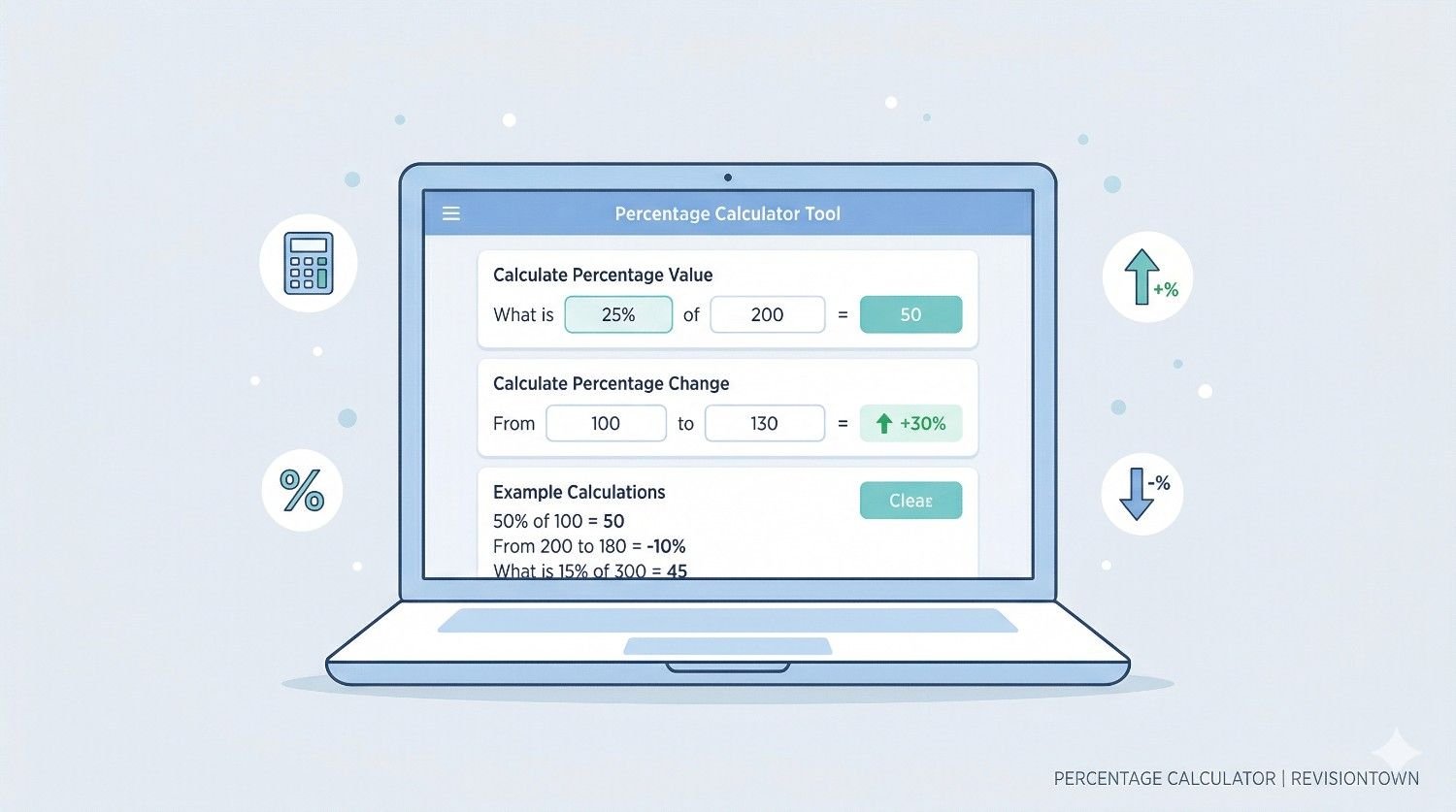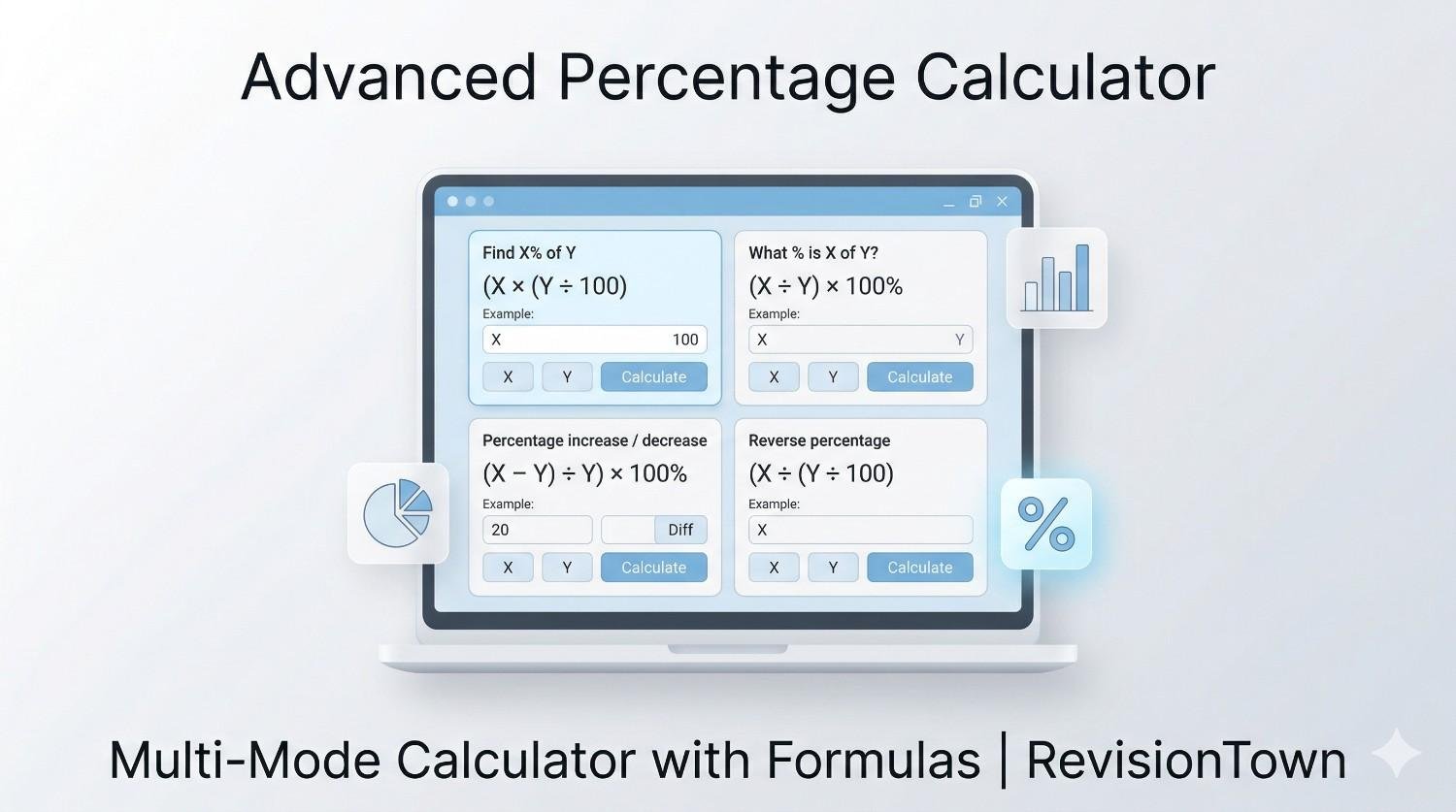
Multi-mode percentage calculator
Percentage Calculator % – Percent Change & Percent Difference Calculator
Use this percentage calculator to solve the everyday percentage questions that cause the most confusion: percent change from one value to another, increasing or decreasing a number by a percentage, finding what percent one number is of another, calculating a percentage of a value, finding the original base, and comparing two values with percent difference.
This page is focused on general percentage arithmetic and comparison. If your task is specifically a sale price, use a dedicated percent off calculator. If your task is only increase from an old value to a new value, the separate percentage increase calculator is narrower. This page stays broader: it explains percent change, percent difference, percent of a number, reverse percentages, and the formulas behind them.
Calculate Percentages
Choose the calculation type, enter your numbers, and get an instant result.
Which Percentage Formula Should You Use?
Percentages always compare a part, change, or difference to a base. The most important decision is choosing the correct base. Percent change uses the starting value. Percent difference uses the average of the two values. "X is what percent of Y?" uses \(Y\) as the base. "What is X percent of Y?" turns the percentage into a multiplier.
When you are unsure, read the wording carefully. "Of" usually identifies the whole. "From" usually identifies the starting value. "Between" often signals percent difference, where neither value is treated as the original.
What Is a Percentage?
A percentage is a ratio written out of 100. The word "percent" means "per hundred," so \(25\%\) means \(25\) out of every \(100\), or \(25/100\), or \(0.25\). Percentages are useful because they let you compare quantities with different sizes on a common scale. A score of 18 out of 20 and a score of 72 out of 80 look different, but both are \(90\%\). A price increase of 5 dollars is small on a 500-dollar item and large on a 10-dollar item; the percentage tells you the size of the change relative to the base.
The core percentage formula is:
Here, \(x\) is the part and \(y\) is the whole. If a class has 12 students absent out of 240 students, the absence percentage is \(12/240\times100=5\%\). If a shop sold 84 items from a stock of 120, the sale-through rate is \(84/120\times100=70\%\). If a student earns 42 marks out of 50, the percentage is \(42/50\times100=84\%\). The arithmetic is simple, but the wording matters because the denominator changes the meaning.
This calculator is designed for practical percentage questions rather than one narrow task. It supports percent change, percent difference, percentage increase or decrease, percent of a number, "what percent" questions, and reverse percentage questions. For a broader collection of tools, the main calculators page is useful. For general arithmetic beyond percentages, use the math calculator. This page stays focused on percentage reasoning so it can rank for its own intent without duplicating dedicated discount, finance, or grade calculators.
Percent Change: From X to Y
Percent change measures how much a value increases or decreases compared with its original value. It is the right formula when the wording includes "from" one value "to" another value, such as from 80 to 100, from 250 to 225, from last month's sales to this month's sales, or from an old price to a new price. The starting value is the base.
If the result is positive, the value increased. If the result is negative, the value decreased. For example, moving from 80 to 100 gives:
Moving from 100 to 80 gives:
Notice that a 25% increase from 80 to 100 is not reversed by a 25% decrease. To return from 100 to 80, the decrease is 20%. This is one of the most common percentage mistakes. Percentages are always tied to their base, and the base changed from 80 to 100.
Percent change is used in sales reports, exam scores, business growth, price movement, scientific measurements, population data, website traffic, and finance. If you only need increase from an old value to a new value, the dedicated percentage increase calculator can handle that narrower task. This page includes that calculation as one mode, but also explains percent difference and reverse percentages.
Percentage Increase and Percentage Decrease
Increasing or decreasing a value by a percentage is different from calculating the percent change between two known values. Here, you know the original value and the percentage, and you want the final value. The simplest method is to convert the percentage to a multiplier. For an increase of \(r\%\), use:
For a decrease of \(r\%\), use:
If a 60-dollar item increases by 15%, the final value is \(60\times1.15=69\). If it decreases by 15%, the final value is \(60\times0.85=51\). The multiplier method is more reliable than calculating the percentage amount separately because it reduces steps and helps with repeated changes.
For example, an increase of 8% followed by another increase of 8% is not a 16% increase overall. The multiplier is \(1.08\times1.08=1.1664\), which is a 16.64% total increase. A decrease of 20% followed by an increase of 20% does not return to the original value. The multiplier is \(0.80\times1.20=0.96\), so the result is still 4% below the original. This is why percentage increases and decreases should be treated as multiplicative changes.
X Is What Percent of Y?
The question "X is what percent of Y?" asks you to express \(X\) as a percentage of \(Y\). Here, \(Y\) is the denominator because it is the whole or reference value. The formula is:
If 18 is what percent of 60, the answer is \(18/60\times100=30\%\). If 45 marks are earned out of 50, the score is \(45/50\times100=90\%\). If a business gets 320 returning customers out of 800 total customers, returning customers are \(320/800\times100=40\%\) of the customer base.
This mode is useful for grade percentages, share of total, conversion rate, attendance, completion rate, revenue mix, and survey results. In education, it connects naturally to the grade calculator and GPA calculator, but those pages have their own purpose. This page is for the underlying percentage arithmetic.
What Is X Percent of Y?
The question "What is X percent of Y?" gives you the percentage and the base, then asks for the part. The formula is:
For example, 15% of 240 is \(0.15\times240=36\). 2.5% of 800 is \(0.025\times800=20\). 120% of 50 is \(1.20\times50=60\). Percentages can be greater than 100%, which simply means the part is larger than the original base. A result of 120% means \(1.2\) times the base.
This mode is useful when calculating tax, tips, commission, discounts, markups, survey samples, grade weights, and proportions. If the task is a sales discount, use a dedicated discount calculator or percent off calculator. If the task is VAT, the VAT calculator is more specific. This percentage calculator explains the general method behind all of them.
X Is Y Percent of What Number?
Reverse percentage questions ask for the original whole. The wording often looks like "24 is 30% of what number?" or "The discounted price is 80% of the original; what was the original?" The formula is:
If 24 is 30% of a number, then the number is \(24/0.30=80\). If 51 is 85% of an original value, the original is \(51/0.85=60\). Reverse percentages are common in price questions, grade-weight questions, tax-inclusive totals, and "before discount" calculations.
The most common mistake is subtracting the percentage from the final value instead of dividing by the remaining percentage. If an item costs 80 dollars after a 20% discount, the original price was not 100 dollars because \(80+20=100\). The final price is 80% of the original, so the original is \(80/0.80=100\). In this example the shortcut happens to match, but for other values it often fails. The reliable method is always to identify what percentage of the original remains and divide by that multiplier.
Percentage Difference Between Two Values
Percentage difference compares two values when neither value is clearly the original. It is different from percent change. Percent change is directional: from an original value to a new value. Percentage difference is symmetric: the difference between \(X\) and \(Y\) is the same as the difference between \(Y\) and \(X\). The formula is:
If two measurements are 40 and 50, the absolute difference is 10 and the average is 45. The percentage difference is \(10/45\times100\approx22.22\%\). This is not the same as the percent change from 40 to 50, which is 25%, or the percent change from 50 to 40, which is -20%. Percentage difference is best when comparing two measurements, estimates, model outputs, lab results, quotes, or values where neither one is the baseline.
Use percent change when there is time, direction, or a starting value. Use percentage difference when the two values are peers. If you compare last year to this year, percent change is usually correct. If you compare two laboratories' measurements of the same sample, percentage difference is often more appropriate.
| Question | Formula | Best use | Common mistake |
|---|---|---|---|
| Percent change from X to Y | \(\frac{Y-X}{|X|}\times100\) | Growth, decline, price changes, before/after comparisons | Using the new value as the base |
| Increase X by Y% | \(X(1+Y/100)\) | Raises, markups, population growth, projected totals | Adding the percent number directly |
| Decrease X by Y% | \(X(1-Y/100)\) | Discounts, losses, reductions, shrinkage | Confusing percentage decrease with percentage points |
| X is what percent of Y? | \(\frac{X}{Y}\times100\) | Scores, shares, completion rates, proportions | Putting the whole in the numerator |
| What is X% of Y? | \((X/100)Y\) | Tax, tips, commissions, weighted marks, sample sizes | Forgetting to divide the percent by 100 |
| X is Y% of what? | \(\frac{X}{Y/100}\) | Reverse discounts, original values, before-tax values | Subtracting instead of dividing by the multiplier |
Percent Change vs Percent Difference
Percent change and percent difference are often confused because both include a difference and a percentage. The difference is the denominator. Percent change uses the original value as the denominator because the question is directional. Percentage difference uses the average of the two values as the denominator because the question is a neutral comparison.
Suppose a value changes from 40 to 50. The percent change is:
The percentage difference is:
Both answers are valid in the right context. If the price increased from 40 dollars to 50 dollars, the percent change is 25%. If two instruments measured the same value as 40 and 50, the percentage difference is 22.22%. Choosing the wrong formula can make a report misleading even when the arithmetic is correct.
Percentage Points vs Percent
A percentage point is an absolute difference between two percentages. A percent change is a relative change. If a rate moves from 20% to 25%, the increase is 5 percentage points. The relative percent increase is:
So the rate increased by 5 percentage points, or by 25% relative to its original level. These statements are not interchangeable. News, business reports, statistics, and school data often mix them up. If a pass rate rises from 80% to 84%, that is a 4 percentage point increase, but a 5% relative increase because \(4/80\times100=5\%\).
This distinction matters in finance, public policy, grades, surveys, and science. Saying "unemployment rose by 2%" is very different from saying "unemployment rose by 2 percentage points." The first is relative to the original unemployment rate; the second is an absolute change in the rate itself. When explaining results, always state which one you mean.
Decimal, Fraction, and Ratio Forms
Percentages are closely related to decimals, fractions, and ratios. Converting between forms makes percentage calculations easier. To change a percentage to a decimal, divide by 100. To change a decimal to a percentage, multiply by 100. To change a fraction to a percentage, divide the numerator by the denominator and multiply by 100.
If you are working with fractions, the fraction calculator can help. If the question is more about proportional relationships than percentages, the ratio calculator may be more suitable. Percentages, fractions, decimals, and ratios are different ways to describe the same underlying comparison.
Worked Examples for Common Percentage Questions
Example 1: Percent change in sales
A store's weekly sales increased from 12,000 dollars to 14,400 dollars. The percent change is:
The store's weekly sales increased by 20%. The starting value is the base because the question compares a later value with an earlier value.
Example 2: Percentage decrease in cost
A monthly bill falls from 150 dollars to 126 dollars. The percent change is:
The bill decreased by 16%. Reporting this as a positive 16% decrease is clear. Reporting it as -16% change is mathematically correct. The wording depends on the context.
Example 3: What is 18% of 250?
Convert 18% to a decimal and multiply by 250:
So 18% of 250 is 45. This is the same calculation used for many tax, tip, and commission questions. For sales commission specifically, the commission calculator is a more dedicated tool.
Example 4: 36 is what percent of 90?
Use 90 as the whole:
So 36 is 40% of 90. If this were a test score, 36 marks out of 90 would be 40%.
Example 5: 64 is 80% of what?
Convert 80% to 0.80 and divide:
So 64 is 80% of 80. This is a reverse percentage problem, often used when working back from a reduced price or a remaining amount.
How to Use the Percentage Calculator Correctly
- Choose the mode that matches the wording. "From X to Y" means percent change. "Between X and Y" may mean percent difference. "X is what percent of Y" asks for a part-to-whole comparison.
- Identify the denominator before calculating. Most percentage errors come from choosing the wrong base.
- Enter values without the percent symbol. Type 15, not 0.15, when the field asks for 15%.
- Interpret the sign. A positive percent change is an increase; a negative percent change is a decrease.
- Round only at the end. Rounding during intermediate steps can create small errors, especially in finance and statistics.
Practical Uses for a Percentage Calculator
Percentages appear in school, shopping, finance, business, health, statistics, and everyday comparisons. The same formulas repeat, but the wording changes. In school, a percentage calculator converts marks to a score, compares improvement between tests, or checks weighted assignments. In shopping, percentages calculate discounts, price increases, VAT, and final prices. In finance, percentages describe interest rates, returns, fees, inflation, and growth. In business, percentages track conversion rate, margin, churn, growth rate, and share of total revenue.
For finance-heavy percentage work, the finance calculators, business growth calculator, and CAGR calculator can be useful. Those tools handle specific financial models. This percentage calculator explains the general arithmetic underneath them: part divided by whole, change divided by original, and difference divided by average.
Percentage Calculations in School and Exams
Students often use percentages to convert raw marks into a score. If you earn 72 marks out of 90, your percentage is \(72/90\times100=80\%\). If your score rises from 64% to 76%, the increase is 12 percentage points, but the relative increase is \(12/64\times100=18.75\%\). Both can be useful, but they answer different questions.
Weighted grades add another layer. A test worth 40% of a course and an assignment worth 60% of a course should not be averaged equally. The weighted score is:
If a student scores 80% on a test worth 40% and 90% on an assignment worth 60%, the course score is \(80\times0.40+90\times0.60=86\%\). For full grade planning, use a grade-specific tool. For the percentage arithmetic itself, this calculator is enough.
Percentage Calculations in Shopping, Discounts, and VAT
Shopping percentages usually involve discounts, tax, or price comparisons. A 30% discount means the customer pays 70% of the original price. If the original price is 120 dollars, the final price is \(120\times0.70=84\). A 12% tax added to a 50-dollar purchase gives \(50\times1.12=56\). A price rising from 80 dollars to 92 dollars gives a percent change of \((92-80)/80\times100=15\%\).
When the task is specifically sale price, the percent off calculator for final price and savings is more targeted. When the task is VAT, use the VAT calculator. This page is best when the question is not a specific tax or discount workflow but a general percentage comparison.
Percentage Calculations in Statistics
Statistics uses percentages for frequency, relative frequency, survey results, error rates, proportions, and comparisons. A percentage is often easier to understand than a raw count because it adjusts for sample size. If one survey has 40 positive responses out of 50 and another has 160 positive responses out of 250, the raw counts are not directly comparable. The percentages are \(80\%\) and \(64\%\), so the first survey has the higher positive response rate.
However, percentages can mislead when sample sizes are very small. A change from 1 out of 2 to 2 out of 2 is a jump from 50% to 100%, but the sample is too small for a strong conclusion. In statistics, always look at both the percentage and the count. For deeper statistical work, the statistics calculators and mean, median, and mode calculator can support more advanced analysis.
Common Percentage Mistakes
Advanced Notes: Negative Numbers, Zero, and Edge Cases
Percentages are easiest when all values are positive, but real data sometimes includes zero or negative values. Percent change from zero is undefined because the original value is the denominator. You cannot divide by zero. If a company goes from 0 customers to 50 customers, it is better to say it gained 50 customers, not that it had an infinite percent increase.
Negative bases require care. This calculator uses the absolute value of the original value in percent change so the size of the change is measured relative to the magnitude of the starting value. In accounting or scientific contexts, negative values may have special meaning, so always explain the interpretation. A change from -100 to -50 is a movement toward zero; whether that is an increase or improvement depends on the context.
Percentage difference also needs care when values are near zero. If both values are zero, the percentage difference is undefined. If the average of the magnitudes is very small, even a small absolute difference can produce a very large percentage difference. This is mathematically correct but may not be practically meaningful. In reports, combine percentage results with raw numbers when values are small.
How to Explain a Percentage Result Clearly
A good percentage result includes the number, the base, and the meaning. Instead of writing "25%" by itself, write "sales increased by 25% from the original 80 units to 100 units." Instead of writing "difference is 22.22%," write "the percentage difference between the two measurements, using their average as the base, is 22.22%." Clear wording prevents the reader from confusing percent change, percent difference, and percentage points.
When presenting percentages in schoolwork, business reports, or analysis, include enough context for the calculation to be checked. State the formula if the result affects a decision. For example, "The conversion rate is \(240/3000\times100=8\%\)" is clearer than "conversion rate is 8%." If a result is rounded, state the rounding. If a percentage is based on a small sample, include the sample size.
Choosing the Right Percentage Calculation: A Practical Decision Guide
The fastest way to avoid percentage errors is to decide what the question is really asking before you enter numbers. Many percentage questions use similar words but require different formulas. The phrase "from X to Y" usually means percent change. The phrase "what percent of" usually means part divided by whole. The phrase "between X and Y" may mean percentage difference if neither number is the original. The phrase "after a discount" often means reverse percentage if you are trying to recover the original price.
Ask four questions. First, is there an original value? If yes, percent change or increase/decrease is likely. Second, is one value clearly the whole? If yes, use part divided by whole. Third, are both values measurements of the same thing with no natural starting point? If yes, use percentage difference. Fourth, do you know the final value and the percent but need the starting value? If yes, use a reverse percentage formula.
For example, "revenue rose from 40,000 to 48,000" has an original value, so use percent change: \((48000-40000)/40000\times100=20\%\). "18 employees out of 72 completed training" has a part and a whole, so use \(18/72\times100=25\%\). "Two labs measured 98.2 and 101.4" has two peer measurements, so percentage difference is reasonable. "A discounted item costs 72 after a 20% discount" asks for the original, so divide by \(0.80\).
This decision process matters more than memorising a list of formulas. Formulas are easy to apply once the base is correct. Most wrong percentage answers come from choosing the wrong denominator, not from multiplying incorrectly. If you train yourself to identify the base first, the rest of the calculation becomes more reliable.
Rounding Percentages Without Changing the Meaning
Rounding is practical, but it can change meaning if done too early or without context. A result of \(12.496\%\) rounded to one decimal place is \(12.5\%\). Rounded to the nearest whole percent, it is \(12\%\). Neither is wrong, but the level of precision should match the situation. A school score may be reported to one decimal place. A financial report may use two decimal places. A public summary may use whole percentages for readability.
As a rule, keep full precision during the calculation and round only the final answer. If you round each intermediate step, small errors can build up. This matters in multi-step percentage problems such as compounding, VAT, weighted grades, and finance. For example, if a value is increased by 7.5% and then decreased by 3.2%, the multiplier is:
The net change is approximately \(4.06\%\). If you round the intermediate multipliers too aggressively, the result may drift. The same issue appears in weighted grades, growth projections, and repeated discounts.
When reporting a rounded percentage, be clear about the original data if the decision is important. "The rate is about 13%" may be enough in conversation. "The rate is 12.8% based on 64 out of 500 cases" is better in a report because it gives the reader the count and the denominator. A percentage without its base can hide whether the result is based on a large dataset or a tiny sample.
Percentages in Business: Margin, Markup, Growth, and Conversion Rate
Business percentages are especially easy to mix up because different terms use different denominators. Margin and markup are the classic example. Profit margin compares profit with selling price. Markup compares profit with cost. If an item costs 60 dollars and sells for 90 dollars, the profit is 30 dollars. The profit margin is:
The markup is:
Both figures describe the same transaction, but they answer different questions. Margin asks what share of selling price is profit. Markup asks how much was added to cost. A business report that confuses margin and markup can misstate profitability.
Growth rate is another common use. If monthly users increase from 8,000 to 10,400, the growth rate is \((10400-8000)/8000\times100=30\%\). If the same product then grows from 10,400 to 12,480, that second increase is 20%, not another 30%. A business can grow by a smaller percentage while still adding more users than before because the base has changed.
Conversion rate uses the part-over-whole formula. If 450 people sign up after 9,000 visits, conversion rate is \(450/9000\times100=5\%\). If an advertising campaign improves conversion rate from 5% to 6%, that is a 1 percentage point increase and a 20% relative increase. Both statements can be useful, but they are not the same. If the task involves ongoing growth modelling, the business growth calculator is a more specialised tool; this page explains the percentage arithmetic behind those business metrics.
Percentages in Finance: Returns, Interest, and Compounding
Finance uses percentages to express interest rates, investment returns, loan rates, inflation, fees, and portfolio allocation. A one-period return uses percent change. If an investment rises from 1,000 dollars to 1,080 dollars, the return is \(8\%\). If it falls from 1,080 dollars to 1,000 dollars, the return is \(-7.41\%\), not \(-8\%\), because the base is now 1,080. This is the same asymmetry seen in ordinary percent change.
Compounding means repeated percentage changes multiply. A 10% return followed by a 10% loss gives:
The result is a 1% loss overall. This surprises many people because they expect +10% and -10% to cancel. They do not cancel because the second percentage is applied to a different base. The same logic applies to inflation and salary adjustments. A 5% raise after a 5% price increase does not always preserve purchasing power if the timing, base, or compounding differs.
Annualised growth requires more than a simple percent change if the period is longer than one year. A total increase from 10,000 to 14,000 over three years is 40% total growth, but the annual compound growth rate is:
For that specialised calculation, use the CAGR calculator. For the simpler one-step percentage change, the calculator on this page is the right tool.
Percentages in Spreadsheets
Spreadsheet percentage formulas follow the same mathematics as this calculator. If cell A2 contains the original value and B2 contains the new value, percent change is:
In a spreadsheet, you would normally enter =(B2-A2)/A2 and format the cell as a percentage.
You should not multiply by 100 if the cell is already formatted as a percentage, because the formatting
handles the display. If you type a formula that returns \(0.25\) and format the cell as a percentage, it
displays as 25%.
For "X is what percent of Y?", enter =X/Y and format as a percentage. For "what is X% of
Y?", enter =X*Y if \(X\) is already stored as a percentage, or =(X/100)*Y if
\(X\) is stored as a number such as 15. For a reverse percentage, divide by the percentage in decimal
form. If 64 is 80% of the original, enter =64/80% or =64/0.8.
Spreadsheet errors often come from mixing display percentages with decimal percentages. A cell showing 15% usually stores \(0.15\). A cell containing the number 15 is not the same thing. If your spreadsheet answer is 100 times too large or too small, check whether you divided by 100 twice or forgot to divide by 100 at all.
Percentages in Data Reports and Dashboards
Dashboards often use percentages because they are compact and easy to scan. Conversion rate, completion rate, error rate, churn rate, retention rate, response rate, win rate, and utilisation rate are all percentages. The challenge is not calculating them; it is defining the numerator and denominator consistently. If a conversion rate uses visits as the denominator in one report and unique visitors in another, the results are not comparable.
Every percentage metric should have a definition. A completion rate might be \(\text{completed tasks}/\text{started tasks}\times100\), or it might be \(\text{completed tasks}/\text{assigned tasks}\times100\). Both are possible, but they answer different questions. A retention rate might measure customers active at the end of a period, customers who made a repeat purchase, or customers who did not cancel. The percentage only becomes useful when the base is clear.
When a percentage changes, show both the percentage point change and the relative percent change if the audience may confuse them. If retention moves from 60% to 66%, the change is 6 percentage points. The relative lift is \(6/60\times100=10\%\). A product manager, analyst, or teacher may need both values to understand the movement. If you only report "up 10%," some readers may think retention moved from 60% to 70%, which is not correct.
Percentages in Health, Fitness, and Everyday Life
Percentages also appear in everyday decisions: battery level, nutrition labels, body composition, hydration goals, time saved, progress toward a target, and household budgeting. A progress bar at 75% means three quarters of the task is complete. A food label may show a nutrient as a percentage of a daily value. A budget category may be 30% of monthly income. The same part-over-whole formula applies.
For health or fitness pages, percentages should be treated as estimates unless a professional measurement is involved. Body composition, calorie targets, and nutrition labels can all involve assumptions. A percentage calculator can handle arithmetic, but it cannot decide whether a target is appropriate. Use percentages as a way to understand proportions, not as a substitute for professional advice when health decisions are involved.
In household budgeting, percentages can make spending easier to compare. If rent is 1,500 dollars and monthly income is 5,000 dollars, rent is \(1500/5000\times100=30\%\) of income. If groceries rise from 600 to 690 dollars, the percent change is 15%. Combining percentages with actual currency amounts gives the clearest picture because a small percentage of a large category may be more money than a large percentage of a small category.
Building Mental Percentage Fluency
A calculator is useful, but mental percentage fluency saves time. Start with benchmark percentages. Ten percent is one tenth. Five percent is half of ten percent. One percent is one hundredth. Twenty-five percent is one quarter. Fifty percent is one half. Seventy-five percent is three quarters. These benchmarks let you estimate quickly before using the calculator.
For example, 15% of a number is 10% plus 5%. If the base is 240, then 10% is 24 and 5% is 12, so 15% is 36. To find 2.5%, find 5% and halve it. To find 12%, find 10% plus 2%. Estimation helps catch input mistakes. If the calculator says 15% of 240 is 360, you know something went wrong because 10% is only 24.
Another useful habit is converting percentages to multipliers. A 12% increase is a multiplier of 1.12. A 12% decrease is a multiplier of 0.88. A 250% value is a multiplier of 2.5. A 0.5% fee is a multiplier of 0.005 when calculating the fee itself, or 1.005 when adding it. Multipliers are especially helpful for repeated changes, finance, growth, and discounts.
How This Page Avoids Competing With Similar Percentage Tools
RevisionTown has several percentage-related pages because different users have different tasks. A general percentage calculator answers broad arithmetic questions. A percent-off calculator answers shopping and sale-price questions. A percentage increase calculator focuses on old-value to new-value growth. A VAT calculator handles tax-inclusive and tax-exclusive totals. A grade calculator handles academic weighting. Those pages should not all say the same thing.
This page is best for mixed percentage work: percent change, percent difference, percent of a number, reverse percentage, and choosing the correct formula. It links to specialised calculators only when the context naturally calls for them. That helps readers choose the right tool and keeps each page focused on a distinct search intent.
Percentage Problem Checklist Before You Calculate
Before using the calculator, run through a short checklist. First, write the two quantities with labels. A label might be "old price," "new price," "part," "whole," "discounted price," "original price," "measurement A," or "measurement B." Labels make the denominator obvious. Second, decide whether the question is directional. If it moves from one value to another, percent change is usually correct. If it compares two independent values, percentage difference may be correct. Third, decide whether the result should be positive, negative, or always positive. Percent change can be negative; percent difference is normally positive because it uses an absolute difference.
Fourth, estimate the answer before calculating. If a value doubles, the increase is 100%. If it halves, the decrease is 50%. If 25 is compared with 100, the answer should be around 25%. Estimation catches mistakes such as entering 0.15 when the calculator expects 15, or reversing the part and the whole. Fifth, write the result in a sentence. A sentence forces you to name the base: "The value increased by 18% from the original," "The part is 42% of the whole," or "The two measurements differ by 6.7% using their average as the reference." If the sentence sounds unclear, the calculation may not match the question.
For percent change, the checklist is: identify original value, identify new value, subtract original from new, divide by original, multiply by 100, and interpret the sign. For percent difference, the checklist is: find the absolute difference, find the average of the two values, divide the difference by the average, multiply by 100, and report the result as a comparison rather than an increase or decrease. For reverse percentage, the checklist is: identify the final known part, identify what percent that part is of the original, convert the percent to a decimal, and divide the part by that decimal.
More Real-World Percentage Examples
Website traffic: A page receives 18,000 visits this month compared with 15,000 visits last month. The percent change is \((18000-15000)/15000\times100=20\%\). Because last month is the original period, it is the denominator. If another page receives 600 visits instead of 500, it also has 20% growth, even though the absolute increase is much smaller. Percentages reveal proportional change; raw numbers reveal scale.
Survey response: A survey receives 240 positive responses out of 300 total responses. The positive response rate is \(240/300\times100=80\%\). If a second survey receives 80 positive responses out of 100, it also has an 80% positive response rate. The percentage is the same, but the sample sizes differ. A careful report should include both the percentage and the count.
Price comparison: One supplier quotes 460 dollars and another quotes 500 dollars for the same service. If you treat 460 as the base, the second quote is \((500-460)/460\times100=8.70\%\) higher. If you want a neutral comparison, the percentage difference is \(40/480\times100=8.33\%\). The first answer is directional; the second is symmetric. The better choice depends on whether one quote is the baseline or whether the two quotes are simply being compared.
Target progress: If your savings target is 5,000 dollars and you have saved 3,250 dollars, your progress is \(3250/5000\times100=65\%\). If your savings increase from 3,250 to 3,900, the progress becomes 78%, which is a 13 percentage point improvement toward the goal. The amount saved increased by \((3900-3250)/3250\times100=20\%\). Both statements are true, but they describe different things: progress toward the target and growth in the saved amount.
When to Use a Different Calculator
This page is intentionally broad, but some percentage tasks deserve dedicated tools. Use a discount or percent-off tool when you need final sale price and savings. Use a VAT tool when tax is included or excluded. Use a commission calculator when the percentage depends on sales tiers or splits. Use a grade calculator when percentages are weighted across assignments. Use finance calculators when interest, compounding, or investment periods are involved.
That separation is useful because each calculator can rank for its own purpose. This page should answer general percentage questions, percent change questions, and percent difference questions. It should not try to replace every specialised calculator on RevisionTown. If you need the full calculator directory, start from the RevisionTown calculators page.
Frequently Asked Questions
What is the easiest way to calculate a percentage?
Divide the part by the whole and multiply by 100. The formula is \(\text{percentage}=(\text{part}/\text{whole})\times100\). The key is choosing the correct whole.
What is the formula for percent change?
Percent change is \((\text{new}-\text{original})/|\text{original}|\times100\). A positive answer is an increase, while a negative answer is a decrease.
What is the difference between percent change and percent difference?
Percent change compares a new value with an original value. Percent difference compares two values using their average as the denominator, so it is not directional.
How do I increase a number by a percentage?
Use the multiplier \(1+r/100\), where \(r\) is the percentage increase. For example, increasing 200 by 12% gives \(200\times1.12=224\).
How do I decrease a number by a percentage?
Use the multiplier \(1-r/100\), where \(r\) is the percentage decrease. For example, decreasing 200 by 12% gives \(200\times0.88=176\).
Can a percentage be greater than 100%?
Yes. A percentage greater than 100% means the part is larger than the whole or the final value is more than the original. For example, 150% means 1.5 times the base.
Why can percent change from zero not be calculated?
Percent change divides by the original value. If the original value is zero, the denominator is zero, so the percentage change is undefined.