
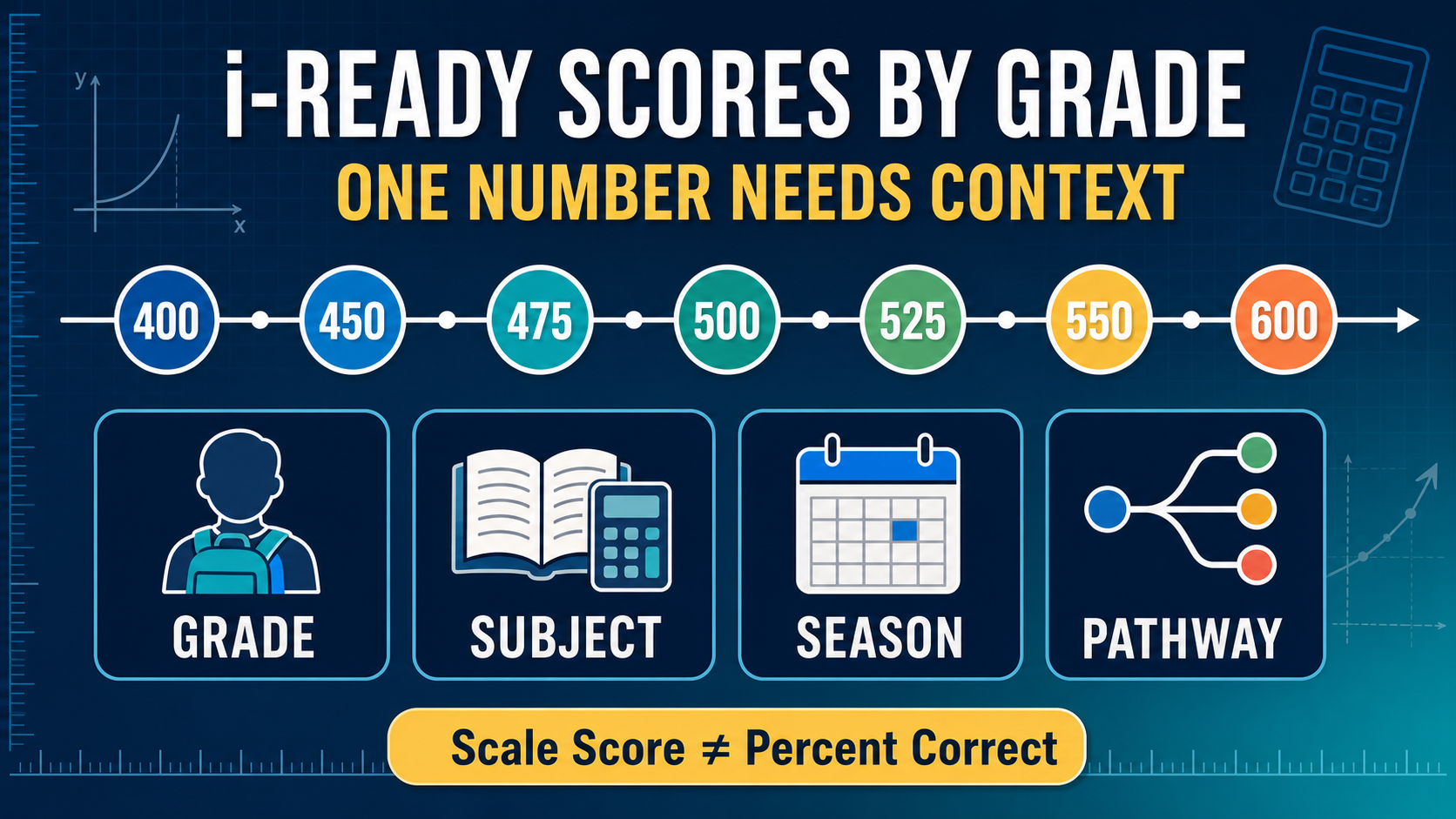
i-Ready Diagnostic scores must be interpreted using the student’s subject, chronological grade, and the correct placement table. A Mathematics scale score of 500 can be on grade level for one student, above grade level for a younger student, and below grade level for an older student. The number does not carry one universal grade label.
This guide uses the official 2026–2027 i-Ready Inform Mathematics Overall Placements and Integrated table for the requested examples: 400, 450, 475, 500, 525, 550, and 600. Beginning in 2026–2027, i-Ready Diagnostic is called i-Ready Inform. Many families and schools will continue to use “Diagnostic” during the transition.
The fastest way to interpret a score is to find the student’s rostered grade first, then locate the score in that row. Do not use a Mathematics table for Reading, an overall table for a domain score, or an Integrated high-school table when the school reports a Traditional mathematics pathway.
i-Ready Diagnostic scores by grade: quick answer
| Math scale score | Often on grade level for students rostered in… | Above grade level for… | Below grade level for… |
|---|---|---|---|
| 400 | Kindergarten | — | Grades 1–12 |
| 450 | Grades 1–3 | Kindergarten | Grades 4–12 |
| 475 | Grades 2–4 | Kindergarten–Grade 1 | Grades 5–12 |
| 500 | Grades 3–6 | Kindergarten–Grade 2 | Grades 7–12 |
| 525 | Grades 4–9 | Kindergarten–Grade 3 | Grades 10–12 |
| 550 | Grades 6–9 | Kindergarten–Grade 5 | Grades 10–12 |
| 600 | Grades 10–12 | Kindergarten–Grade 9 | — |
Important: “On grade level” in this summary includes Early, Mid, or Late On Grade Level. High-school entries use the official Integrated reporting table. Traditional Algebra 1, Geometry, and Algebra 2 pathways have separate tables. The official report—not this compact summary—should control an individual decision.
2026–2027 i-Ready Math on-grade-level score ranges
The following ranges combine Early, Mid, and Late On Grade Level for the Mathematics Overall/Integrated table. They are criterion-referenced placement ranges, not percentile averages or minimum “passing” scores.
| Rostered grade | On-grade-level Math range | Where the requested examples fit |
|---|---|---|
| Kindergarten | 362–448 | 400 is on grade; 450+ is above |
| Grade 1 | 402–472 | 450 is on grade |
| Grade 2 | 428–498 | 450 and 475 are on grade |
| Grade 3 | 449–516 | 450, 475, and 500 are on grade |
| Grade 4 | 465–526 | 475, 500, and 525 are on grade |
| Grade 5 | 480–540 | 500 and 525 are on grade |
| Grade 6 | 495–564 | 500, 525, and 550 are on grade |
| Grade 7 | 508–574 | 525 and 550 are on grade |
| Grade 8 | 518–585 | 525 and 550 are on grade |
| Grade 9, Integrated | 515–598 | 525 and 550 are on grade |
| Grade 10, Integrated | 556–610 | 600 is on grade |
| Grade 11, Integrated | 564–629 | 600 is on grade |
| Grade 12, Integrated | 572–800 | 600 is on grade |
These ranges show why “Is 500 a good score?” cannot be answered until the grade is known. A Grade 3 student with 500 is in Late Grade 3 placement. A Grade 6 student with the same score is in Early Grade 6 placement. A Grade 8 student with 500 is below the Grade 8 on-grade range.
What does an i-Ready scale score measure?
The i-Ready scale places performance on a common continuum. Mathematics scores in the official placement tables run from 100 to 800. Because the assessment is adaptive, students do not all receive the same questions. Correct and incorrect responses help the system select subsequent items and estimate the student’s location on the scale.
A scale score is useful for tracking change across administrations, but it is not a percentage correct. A score of 500 does not mean 50 percent, 500 questions, or “fifth-grade math.” It is a point on the assessment’s scale.
After the scale score is calculated, i-Ready uses grade-specific cut ranges to report placement. That is why two students with the same number can receive different absolute or relative placements. For more detail on how these measures differ, read our guide to i-Ready scale score versus percentile.
How to use the placement table correctly
- Confirm the subject. This article’s numbered examples are Mathematics Overall. Reading has different cut ranges.
- Confirm the score type. Use the overall score with the overall table. Algebra, Number and Operations, Geometry, and Measurement and Data domain scores have their own tables.
- Find the rostered grade. Start with the row for the grade in which the student is enrolled, not a guessed instructional grade.
- Locate the score inside that row. Read the column and color/label associated with the range.
- Check the high-school pathway. Grades 9–12 can be reported through Integrated or Traditional mathematics pathways.
- Read the domain pattern. The same overall score can hide different strengths and needs.
- Add percentile and growth information. Placement, national comparison, and progress answer different questions.
If you are looking at a family report, our step-by-step i-Ready report guide explains the scale score, placement, percentile, domains, growth measures, and Lexile or Quantile information.
What Does a 400 i-Ready Math Score Mean?
A 400 i-Ready Math score is within the 2026–2027 Kindergarten on-grade range of 362–448. It is below the on-grade starting point for Grade 1, which begins at 402. The same score therefore has different meanings by enrollment grade.
| Student’s rostered grade | Interpretation of 400 |
|---|---|
| Kindergarten | On grade level; the score falls in the middle Kindergarten band |
| Grade 1 | Kindergarten absolute placement, one grade level below |
| Grade 2 | Grade 1 absolute placement, one grade level below |
| Grade 3 | Grade 1 absolute placement, two grade levels below |
| Grade 4 and above | At least three grade levels below under the relative placement model |
For a young student, adults should avoid attaching a negative label to 400. Look at Number and Operations, Algebra and Algebraic Thinking, Measurement and Data, and Geometry. The child may be developing counting, quantity, comparison, composing numbers, operations concepts, shapes, or measurement language. Instruction should follow the actual domain recommendation.
For an older student, the gap between current performance and grade-level work is more substantial. The answer is not to abandon grade-level instruction. Teachers generally need a coordinated plan: preserve access to important grade-level ideas while explicitly rebuilding the prerequisite concepts that are preventing progress.
Check assessment engagement before making a high-impact decision. Rushing, fatigue, misunderstanding the interface, or missing accommodations can reduce the usefulness of the result. A low score is a reason to investigate and support, not a diagnosis.
What Does a 450 i-Ready Math Score Mean?
A 450 Math score is above the Kindergarten on-grade range, on grade level for students in Grades 1–3, and below grade level beginning in Grade 4. It provides one of the clearest examples of why chronological grade matters.
- Kindergarten: 450 falls into a Grade 1 absolute placement, so it is above grade level.
- Grade 1: 450 is in Late Grade 1, within the 402–472 on-grade span.
- Grade 2: 450 is in Mid Grade 2, within the 428–498 span.
- Grade 3: 450 is in Early Grade 3, within the 449–516 span.
- Grades 4–5: 450 is one grade level below in the current table.
- Grade 6: it is about two grade levels below.
- Grade 7 and above: it is generally three or more levels below.
“On grade level” does not mean the three students are ready for identical instruction. A Grade 1 student at 450 sits near the later part of the Grade 1 range, while a Grade 3 student at 450 is at the early end of the Grade 3 range. Their domain results and grade-level curriculum are different.
For Grades 1–3, use the report to identify whether the next priority is operations, place value, algebraic thinking, geometry, or measurement. For an older student, look for the highest-leverage prerequisites rather than assigning a broad collection of easier worksheets.
What Does a 475 i-Ready Math Score Mean?
A 475 i-Ready Math score is on grade level for students rostered in Grades 2–4. It is above grade level in Kindergarten and Grade 1, and it is below grade level beginning in Grade 5.
| Grade group | Meaning of 475 |
|---|---|
| Kindergarten–Grade 1 | Above grade level |
| Grade 2 | Late Grade 2 placement |
| Grade 3 | Mid Grade 3 placement |
| Grade 4 | Early Grade 4 placement |
| Grades 5–6 | Approximately one grade level below |
| Grade 7 | Approximately two grade levels below |
| Grade 8 and above | Generally three or more grade levels below |
For a Grade 4 student, 475 is not “almost 500” in a way that automatically predicts proficiency. What matters is that it falls in the Early Grade 4 range of 465–481 and that the student’s domain scores show what to teach next. A few points can cross a reporting boundary, but students on opposite sides of a cut score may have very similar instructional needs.
Parents should ask for the placement label and domain breakdown rather than interpreting 475 through an internet chart alone. Teachers can connect the result to current work samples, unit assessments, mathematical explanations, and error patterns.
What Does a 500 i-Ready Math Score Mean?
A 500 Mathematics score is on grade level for Grades 3–6 in the official 2026–2027 Overall/Integrated table. It is above grade level for Kindergarten through Grade 2 and below grade level for Grade 7 and above.
- Grade 3: 500 is in Late Grade 3.
- Grade 4: 500 is in Mid Grade 4.
- Grade 5: 500 is in Mid Grade 5.
- Grade 6: 500 is in Early Grade 6.
- Grades 7–8: it is approximately one grade level below.
- Grade 9: it is about two grade levels below.
- Grade 10 and above: it is generally three or more grade levels below.
For a Grade 5 student, 500 falls within the Mid Grade 5 range of 498–526. It may indicate that the overall result is aligned with grade-level expectations, but the domains can still vary. A student might be stronger in Number and Operations and need more support in Geometry, or the reverse.
A score of 500 should not be converted into a percentile without the student’s grade and testing season. Percentile ranks compare a student with same-grade peers who tested in the same season. The criterion-referenced placement shown here answers a different question: how performance aligns with grade-level expectations.
What Does a 525 i-Ready Math Score Mean?
A 525 Math score is on grade level across a relatively wide band: Grades 4–9 in the 2026–2027 Overall/Integrated table. It is above grade level for Kindergarten through Grade 3 and below grade level for Grades 10–12.
| Rostered grade | Placement detail for 525 |
|---|---|
| Grade 4 | Late Grade 4 |
| Grade 5 | Mid Grade 5 |
| Grade 6 | Mid Grade 6 |
| Grade 7 | Early Grade 7 |
| Grade 8 | Early Grade 8 |
| Grade 9, Integrated | Early Grade 9 |
| Grade 10, Integrated | Grade 9 absolute placement, one level below |
| Grade 11, Integrated | About two levels below |
| Grade 12, Integrated | About three levels below |
This does not mean a Grade 4 and Grade 9 student with 525 know the same curriculum. The assessment’s grade-specific test flow, placement rules, and instructional context matter. The same score can map to different absolute placements because cut ranges overlap across rostered grades.
If the student is a fifth grader, 525 is near the upper end of Mid Grade 5. For a more focused example, see our guide to what a 514 i-Ready Math score means for a fifth grader.
What Does a 550 i-Ready Math Score Mean?
A 550 Math score is on grade level for Grades 6–9, above grade level for Kindergarten through Grade 5, and below grade level for Grades 10–12.
- Grade 5: 550 falls into a Grade 6 absolute placement, above grade level.
- Grade 6: it is in Late Grade 6.
- Grade 7: it is in Mid Grade 7.
- Grade 8: it is in Mid Grade 8.
- Grade 9, Integrated: it is in Early Grade 9.
- Grade 10, Integrated: it maps to Grade 9, one level below.
- Grades 11–12, Integrated: it maps approximately one level below in the official table.
For a younger student, an Above Grade Level label is a signal to inspect readiness for deeper work, not a command to accelerate automatically. Enrichment can emphasize reasoning, multiple representations, complex applications, and unfinished domain skills. A high overall score does not guarantee that every domain is equally advanced.
For a Grade 10–12 student, use the school’s correct high-school pathway. A Traditional program separates Algebra 1, Geometry, and Algebra 2 placement tables, so the Integrated interpretation above may not match the report.
What Does a 600 i-Ready Math Score Mean?
A 600 i-Ready Math score is above grade level for students in Kindergarten through Grade 9 and on grade level for Grades 10–12 under the Integrated table. It does not mean “sixth-grade math.”
| Rostered grade | Meaning of 600 |
|---|---|
| Kindergarten–Grade 9 | Above Grade Level; absolute placement is capped by grade-specific reporting rules |
| Grade 10, Integrated | Late Grade 10 |
| Grade 11, Integrated | Mid Grade 11 |
| Grade 12, Integrated | Early Grade 12 |
For a Grade 8 student, 600 sits in the Grade 10 absolute range, so the relative report is Above Grade Level. For a Grade 9 student, it also maps to Grade 10. For Grade 10, the score is within the on-grade span of 556–610. Grade 11 has an on-grade span of 564–629, and Grade 12 begins its on-grade range at 572.
Scores near the upper end of the scale require careful interpretation because placement caps, available item content, and pathway rules affect reporting. Teachers should use classroom problem solving, course performance, domain evidence, and local policies before making acceleration or course-placement decisions.
Why the same score can mean different things
Placement is tied to chronological grade
The official table uses a separate row for every rostered grade. The cut ranges overlap. Curriculum Associates explains that this reflects differences in test content and grade-specific expectations. Therefore, adults should never locate a score in a column without first selecting the correct row.
Math and Reading use different tables
A 500 in Math is not interpreted through the Reading Overall table. Reading also includes domains such as Vocabulary and Comprehension, while Mathematics includes Algebra and Algebraic Thinking, Number and Operations, Geometry, and Measurement and Data.
Overall and domain scores are not interchangeable
An overall Math score of 525 and a Geometry score of 525 must be checked against different tables. The overall score summarizes evidence across the assessment; a domain score describes a narrower part of performance.
High-school pathways differ
The Integrated pathway organizes high-school mathematics differently from the Traditional sequence of Algebra 1, Geometry, and Algebra 2. The official PDF includes separate Traditional tables. Confirm which option the school uses before interpreting Grades 9–12.
Does fall, winter, or spring change the placement?
The official 2026–2027 placement table uses grade-specific criterion ranges; it does not provide a different placement cut for fall, winter, and spring. A scale score of 500 is located in the same grade row regardless of season.
Season still matters for percentile rank and growth. A percentile compares the student with nationally representative students in the same grade who tested at the same time of year. A score that is common in spring may be less common in fall. Growth measures also depend on the baseline and time available to learn.
That is why a family report should be read in layers:
- scale score for the student’s location on the scale;
- placement for performance against grade-level criteria;
- percentile for comparison with same-grade, same-season peers;
- domain scores for strengths and needs; and
- growth measures for progress from the baseline.
Our guide to i-Ready fall, winter, and spring scores explains these seasonal comparisons in more detail.
Placement level does not equal a student’s identity
A placement label describes evidence from one assessment administration. It does not define intelligence, motivation, future achievement, eligibility, or the highest work a student should ever see. A student can have uneven domains, an unusual testing day, or classroom strengths that a broad adaptive assessment does not fully capture.
Use neutral language. Say, “The current result suggests these skills need support,” instead of, “You are a fourth-grade math student.” The student remains enrolled in their chronological grade and should continue to access grade-level ideas with appropriate scaffolding.
What should parents do after receiving the score?
- Confirm the exact label. Ask whether the number is Math Overall or a domain score.
- Write down the grade and date. These are necessary for percentile and growth interpretation.
- Review testing conditions. Note illness, rushing, fatigue, interruptions, or missing approved supports.
- Read every domain. Look for a pattern rather than reacting to the overall number alone.
- Compare other evidence. Use unit tests, classwork, teacher observations, explanations, and prior scores.
- Ask for the instructional response. Find out what will be taught, how grade-level access will be maintained, and how progress will be checked.
- Set a skill goal, not a mystery number. Practice the concepts the report identifies instead of drilling guessed test questions.
What should teachers do with a below-grade placement?
Identify prerequisite skills that have the highest connection to current grade-level work. Use the domain results and instructional recommendations, then verify them with short diagnostic tasks and student explanations. Group flexibly around a specific concept rather than making the overall placement a permanent track.
A student several levels below may need intensive, systematic support, but should not spend the entire day only on earlier-grade worksheets. Connect foundational instruction to the language, representations, and problems in the grade-level curriculum. Monitor whether the support is improving independent performance.
What should teachers do with an above-grade placement?
Check whether performance is consistently advanced across domains and classroom work. Enrichment can increase depth, reasoning, modeling, proof, multiple strategies, and application before accelerating through content. If course placement or grade acceleration is being considered, follow local policy and use multiple measures.
Above Grade Level is not the same as “mastered all current and future mathematics.” The official tables cap some absolute placements, especially for younger students. Domain-level evidence is essential.
How much score change is meaningful?
Do not treat every one- or two-point difference as a major change. Assessment scores contain normal variation, and a placement boundary can make a small numerical difference look larger because the label changes. Review the amount of change, the testing interval, effort, growth targets, domain pattern, and classroom evidence.
Typical Growth and Stretch Growth are individualized measures based partly on the student’s baseline. They are not universal point targets for every grade. A student can make meaningful progress while remaining below grade level, and a student can stay on grade level without moving through identical point gains as a classmate.
Common interpretation mistakes
- Calling 500 a fifth-grade score. It is on grade level across Grades 3–6 in the current overall table.
- Using a Reading chart for Math. Subjects have different ranges.
- Using an overall chart for a domain. Domain placements require domain tables.
- Ignoring chronological grade. Placement ranges are grade-specific.
- Converting a score directly to percentile. Percentile also requires grade and season.
- Using an old table. Always check the school year printed on the source.
- Ignoring the high-school pathway. Integrated and Traditional reporting differ.
- Treating a cut score as a sharp learning boundary. Students just above and below a cut may have similar needs.
- Assuming “above” means no support is needed. Domains can be uneven.
- Using one score for a high-stakes decision. Confirm with multiple sources and local policy.
Frequently asked questions
Is 400 a good i-Ready Math score?
It is on grade level for Kindergarten in the 2026–2027 table. It is below grade level for Grade 1 and above. “Good” should be replaced with the more precise question: Where does 400 fall for this student’s grade, and what skills come next?
Is 450 a third-grade score?
For a Grade 3 student, 450 is Early Grade 3. The same 450 is Late Grade 1 for a first grader and Mid Grade 2 for a second grader.
Is 500 a fifth-grade score?
Not exclusively. It is within the on-grade range for Grades 3, 4, 5, and 6. Grade-specific cut ranges overlap.
Is 525 good for Grade 5?
Yes, in the precise sense that 525 is within Mid Grade 5 placement. Review the domain scores before deciding what enrichment or support is appropriate.
Is 550 above grade level for Grade 5?
Yes. The Grade 5 on-grade range ends at 540, and 550 maps to a Grade 6 absolute placement for a fifth grader.
Is 600 a high score?
It is Above Grade Level for Kindergarten through Grade 9 and on grade level for Grades 10–12 in the Integrated table. Course pathway and domain evidence remain important.
Do these Math numbers apply to Reading?
No. Reading has a separate overall placement table and separate domain tables.
Does the testing season change the on-grade cut range?
The official placement table does not use separate seasonal cut ranges. Season affects percentile interpretation and the context for growth.
What if the score does not match classroom performance?
Review assessment engagement, conditions, accommodations, prior scores, domains, and classroom evidence. Ask the school whether the administration is valid before using it for a major decision.
Should a student retest to cross a boundary?
No. Retesting should be considered only when the school has reason to question validity and should follow authorized procedures. It should not be used to chase a preferred label.
Why does the report now say i-Ready Inform?
Curriculum Associates renamed i-Ready Diagnostic as i-Ready Inform beginning in the 2026–2027 school year. The purpose remains to provide actionable information for instruction.
Bottom line
An i-Ready Math score has meaning only after you attach the correct context. Confirm Mathematics versus Reading, overall versus domain, rostered grade, high-school pathway, testing season, and assessment validity. Then read the placement, percentile, domains, and growth measures together.
For the official 2026–2027 Overall/Integrated Math table, 400 is on grade level for Kindergarten; 450 for Grades 1–3; 475 for Grades 2–4; 500 for Grades 3–6; 525 for Grades 4–9; 550 for Grades 6–9; and 600 for Grades 10–12. Those summaries are useful orientation, but the student’s actual report and current official table should guide instruction.
Official sources
- Curriculum Associates: i-Ready Inform resources, scores, placement tables, and norms
- Curriculum Associates: 2026–2027 i-Ready Inform Grades K–12 Scale Score Placement Tables
- Curriculum Associates: i-Ready Inform adaptive assessment overview
- Curriculum Associates: i-Ready Inform name change and 2026–2027 update


