Arctan(x) Calculator | Inverse tangent calculator
Use this Arctan(x) Calculator to find the inverse tangent of any real number \(x\). The result is shown as the principal angle in radians and degrees, with a tangent check, a reference triangle interpretation, and a general solution for equations of the form \(\tan(\theta)=x\).
The inverse tangent function answers a simple but important question: what angle has tangent equal to this value? If \(\tan(\theta)=x\), then \(\theta=\arctan(x)\) for the principal angle. Because tangent repeats every \(\pi\) radians, the full equation solution is \(\theta=\arctan(x)+k\pi\), where \(k\) is any integer.
Arctan(x) Calculator
Enter any real value for \(x\). The calculator returns \(\arctan(x)\), also written \(\tan^{-1}(x)\), as a principal value in radians and degrees. It also shows the tangent check and the general solution for \(\tan(\theta)=x\).
Use the calculator for numerical answers. Use the guide below when you need to understand the principal value, convert between radians and degrees, solve a tangent equation, or explain the result in a trigonometry assignment.
What Is Arctan(x)?
The function \(\arctan(x)\) is the inverse tangent function. It returns the angle whose tangent is \(x\). In notation:
The expression \(\tan^{-1}(x)\) is often used for the same function, but it should be read carefully. In trigonometry, \(\tan^{-1}(x)\) usually means inverse tangent, not \(1/\tan(x)\). The reciprocal of tangent is cotangent:
Because the tangent function is periodic, many angles can have the same tangent. For example, \(\tan(45^\circ)=1\), but \(\tan(225^\circ)=1\) as well. To make an inverse function, arctan returns only one principal value. The principal value range is:
In degrees, that range is:
The endpoints are not included because tangent does not take finite values at \(\pm90^\circ\). As \(x\) becomes very large, \(\arctan(x)\) gets closer to \(90^\circ\), but it never equals \(90^\circ\). As \(x\) becomes very negative, \(\arctan(x)\) gets closer to \(-90^\circ\), but it never equals \(-90^\circ\).
If you are reviewing inverse trig functions as a group, the related Arcsin(x) Calculator and Arccos(x) Calculator are useful because their ranges are different from arctan's range.
Arctan Formula and General Solution
The calculator's main operation is:
This returns the principal angle \(\theta\) in the interval \(\left(-\frac{\pi}{2},\frac{\pi}{2}\right)\). If the problem is only asking for \(\arctan(x)\), the principal value is the answer. If the problem asks you to solve the trigonometric equation \(\tan(\theta)=x\), then every angle with the same tangent must be included.
The general solution is:
In degrees, the same solution is:
This works because tangent has period \(\pi\):
The calculator shows the principal value and the equation-solution pattern separately because they answer different questions. A single inverse-function value is not the same as the full set of angles that solve a periodic trigonometric equation.
Important: \(\arctan(x)\) itself has one principal output for each real \(x\). The expression \(\theta=\arctan(x)+k\pi\) is the general solution for \(\tan(\theta)=x\), not a statement that the inverse function returns infinitely many values.
Radians and Degrees
Arctan results are often needed in both radians and degrees. Radians are the standard unit in higher mathematics, calculus, and most scientific calculators. Degrees are common in geometry, surveying, construction, introductory trigonometry and everyday angle measurement.
To convert radians to degrees:
To convert degrees to radians:
For example, \(\arctan(1)=\frac{\pi}{4}\). In degrees:
If you need standalone unit conversion, use the Radians to Degrees Converter or the Degrees to Radians Converter. Use this arctan calculator when the angle itself must be found from a tangent value.
How to Calculate Arctan(x) Step by Step
For most non-special values, arctan is calculated numerically using a calculator or software. But the reasoning behind the calculation is still straightforward. Suppose you want \(\arctan(0.75)\).
- Recognize that the question asks for an angle, not a ratio.
- Write \(y=\arctan(0.75)\).
- Use the inverse relationship \(\tan(y)=0.75\).
- Evaluate the inverse tangent function.
- Report the principal value in radians or degrees.
- If solving \(\tan(\theta)=0.75\), add \(k\pi\) to describe all solutions.
Numerically:
The tangent check is:
This check is useful because it confirms the direction of the inverse operation. Arctan takes a tangent ratio and returns an angle. Tangent takes an angle and returns a ratio.
Worked Examples
Example 1: Find \(\arctan(1)\)
The tangent of \(45^\circ\) is \(1\), so the inverse tangent of \(1\) is \(45^\circ\):
If the equation is \(\tan(\theta)=1\), then the general solution is:
In degrees:
Example 2: Find \(\arctan(-1)\)
Because arctan is an odd function, \(\arctan(-x)=-\arctan(x)\). Therefore:
For the equation \(\tan(\theta)=-1\), the general solution is:
Example 3: Find \(\arctan(\sqrt{3})\)
From the special angle values, \(\tan(60^\circ)=\sqrt{3}\). Therefore:
This value is in the principal range, so it is the arctan output. The full tangent-equation solution is:
Example 4: Find \(\arctan(0)\)
The tangent of \(0\) is \(0\), so:
For the equation \(\tan(\theta)=0\), every integer multiple of \(\pi\) is a solution:
Common Arctan Values
Some inverse tangent values are exact because they come from special right triangles. These are worth memorizing because they appear frequently in trigonometry, calculus, vectors and coordinate geometry.
| \(x\) | \(\arctan(x)\) in radians | \(\arctan(x)\) in degrees | Tangent check |
|---|---|---|---|
| \(-\sqrt{3}\) | \(-\frac{\pi}{3}\) | \(-60^\circ\) | \(\tan(-60^\circ)=-\sqrt{3}\) |
| \(-1\) | \(-\frac{\pi}{4}\) | \(-45^\circ\) | \(\tan(-45^\circ)=-1\) |
| \(-\frac{1}{\sqrt{3}}\) | \(-\frac{\pi}{6}\) | \(-30^\circ\) | \(\tan(-30^\circ)=-\frac{1}{\sqrt{3}}\) |
| \(0\) | \(0\) | \(0^\circ\) | \(\tan(0)=0\) |
| \(\frac{1}{\sqrt{3}}\) | \(\frac{\pi}{6}\) | \(30^\circ\) | \(\tan(30^\circ)=\frac{1}{\sqrt{3}}\) |
| \(1\) | \(\frac{\pi}{4}\) | \(45^\circ\) | \(\tan(45^\circ)=1\) |
| \(\sqrt{3}\) | \(\frac{\pi}{3}\) | \(60^\circ\) | \(\tan(60^\circ)=\sqrt{3}\) |
Most decimal values do not simplify to a familiar exact angle. For those, use the calculator and round according to the question. If an answer is used in a later calculation, keep more digits during the working and round the final result.
Arctan and Right Triangles
In a right triangle, tangent is the ratio of the opposite side to the adjacent side:
Therefore arctan can find the angle when the opposite and adjacent sides are known:
For example, if the opposite side is \(5\) and the adjacent side is \(12\), then:
This is a common use in slope, elevation, surveying, navigation, coordinate geometry and physics. The ratio \(5/12\) gives the tangent of the angle, and the inverse tangent returns the angle itself.
Arctan is especially useful when a problem gives a rise and a run. If a road rises \(8\) meters over a horizontal distance of \(100\) meters, then the angle of inclination is:
For broader right-triangle review, see Right Triangle Trigonometry and Basic Trigonometry.
Principal Value vs Equation Solution
The phrase "find \(\arctan(x)\)" and the phrase "solve \(\tan(\theta)=x\)" are related, but they are not identical. The inverse tangent function gives one principal value. The trigonometric equation has infinitely many solutions because tangent repeats every \(180^\circ\).
For example:
But the equation \(\tan(\theta)=1\) has solutions:
So \(45^\circ\), \(225^\circ\), \(405^\circ\), and \(-135^\circ\) are all equation solutions, but only \(45^\circ\) is the principal arctan output.
This distinction matters in exams. If the question asks for \(\tan^{-1}(1)\), give the principal value. If it asks for all solutions to \(\tan(\theta)=1\) over a specified interval, use the principal value as a starting point, then add or subtract multiples of \(180^\circ\) until all solutions in the interval are found. For more on solving periodic trig equations, use the Trigonometric Equations guide.
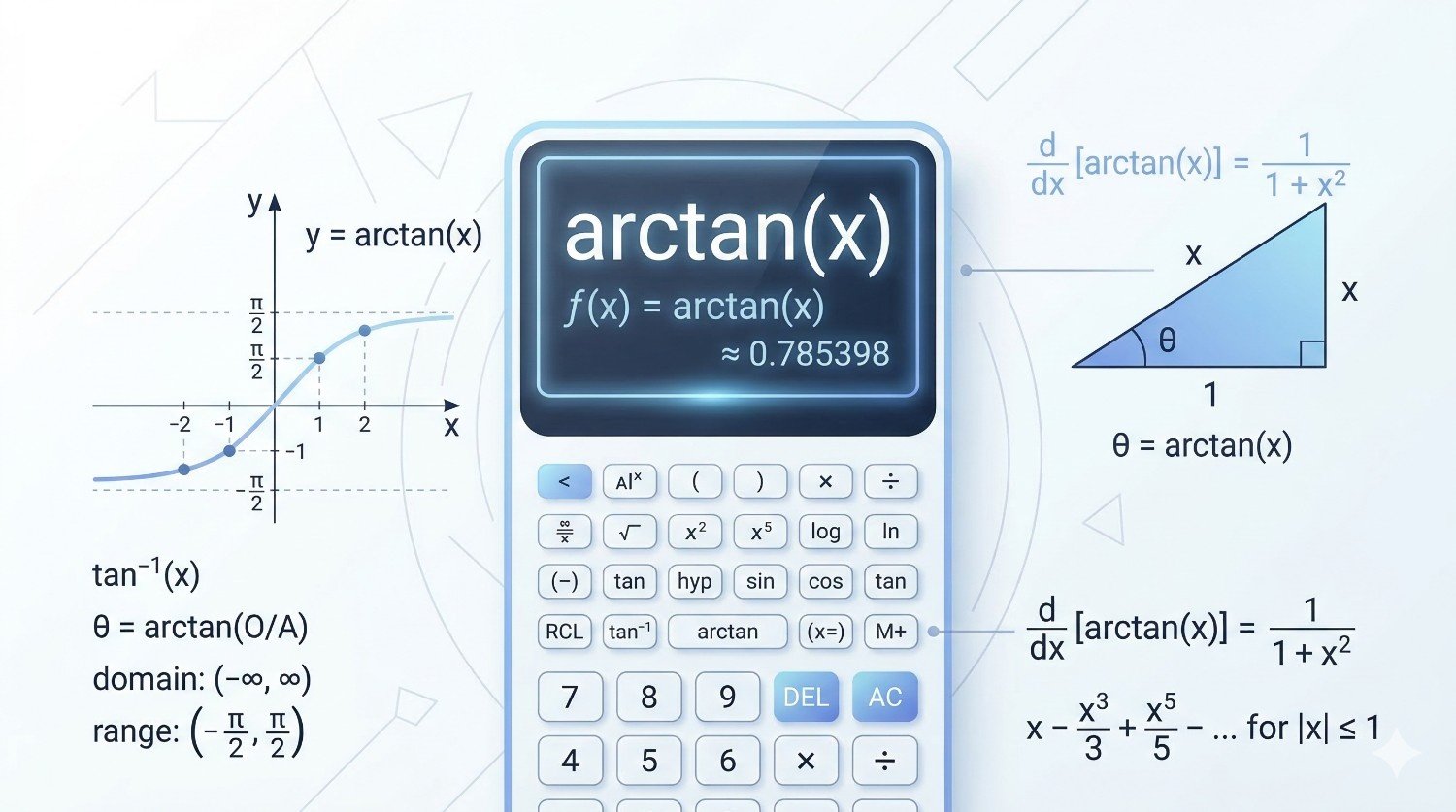
Arctan Graph, Domain and Range
The domain of \(\arctan(x)\) is all real numbers:
The range is:
The graph is increasing for all \(x\). It passes through \((0,0)\), approaches \(\frac{\pi}{2}\) as \(x\to\infty\), and approaches \(-\frac{\pi}{2}\) as \(x\to-\infty\). These horizontal approach lines are asymptotes, not output values.
The function is odd:
This symmetry helps with mental checks. If \(\arctan(2)\approx63.434949^\circ\), then \(\arctan(-2)\approx-63.434949^\circ\). The magnitudes match, but the signs are opposite.
For a broader view of trigonometric function behavior, use Trigonometric Functions or the Trigonometry and Circular Functions topic guide.
Arctan in Coordinate Geometry
In coordinate geometry, arctan is often used to find the angle of a line from its slope. If a line has slope \(m\), then:
For example, a line with slope \(2\) makes an angle of:
A line with slope \(-0.5\) has principal inclination:
In some coordinate-geometry contexts, the angle of inclination is reported between \(0^\circ\) and \(180^\circ\), so a negative principal arctan value may need adjustment. For a negative slope, the line may be described as having inclination \(180^\circ-26.565051^\circ=153.434949^\circ\). The arctan calculator gives the principal value; the problem context decides whether another coterminal or supplementary angle is preferred.
When both \(x\)- and \(y\)-coordinates are involved, many programming languages use an \(atan2(y,x)\) function rather than simple arctan. The \(atan2\) function accounts for the quadrant by looking at the signs of both coordinates. Simple \(\arctan(y/x)\) gives the ratio angle but can lose quadrant information if used carelessly.
Arctan in Calculus
Arctan appears often in calculus because its derivative and integral relationships are simple and important. The derivative is:
This means that:
Arctan also appears in integrals involving quadratic denominators. For example:
This is why inverse tangent is not only a right-triangle tool. It is also a core function in integration, differential equations, signal processing, geometry and physics. If you are studying calculus, the Derivatives of Inverse Trigonometric Functions page and Derivatives of Trigonometric Functions page connect this calculator to differentiation rules.
Arctan, Arcsin and Arccos Compared
Inverse trigonometric functions all return angles, but they have different inputs, ranges and geometric meanings. Arctan accepts any real number because tangent can produce every real value. Arcsin and arccos accept only values from \(-1\) to \(1\), because sine and cosine outputs are limited to that interval.
| Function | Meaning | Input domain | Principal range |
|---|---|---|---|
| \(\arctan(x)\) | Angle whose tangent is \(x\) | All real numbers | \(\left(-\frac{\pi}{2},\frac{\pi}{2}\right)\) |
| \(\arcsin(x)\) | Angle whose sine is \(x\) | \([-1,1]\) | \(\left[-\frac{\pi}{2},\frac{\pi}{2}\right]\) |
| \(\arccos(x)\) | Angle whose cosine is \(x\) | \([-1,1]\) | \([0,\pi]\) |
These range choices are not arbitrary. They are selected so each inverse function gives exactly one output for each valid input. If inverse trig functions returned every possible angle, they would not behave as functions in the usual sense.
Use arctan when you know opposite divided by adjacent, slope, rise over run, or a tangent ratio. Use arcsin when you know opposite divided by hypotenuse. Use arccos when you know adjacent divided by hypotenuse.
Calculator Mode and Rounding Advice
Scientific calculators often have degree and radian modes. If the calculator is in radian mode, inverse tangent results display radians. If it is in degree mode, results display degrees. This page displays both to remove that ambiguity, but you should still know which unit your assignment expects.
For exact special values, use exact forms such as \(\frac{\pi}{4}\) rather than rounded decimals when possible. For non-special values, use enough decimal places for the context. A construction angle may be rounded to one or two decimal places. A calculus or physics calculation may keep more digits until the final answer.
Rounding too early can create noticeable error in later steps. If \(\arctan(0.75)\) is used inside another formula, keep \(0.643501\) radians or more during the calculation, then round at the end. If the problem asks for degrees only, convert after finding the radian value and then round the degree answer.
The Scientific Calculator and Easy Scientific Calculator are useful for broader numerical work, while this page focuses specifically on inverse tangent.
Common Mistakes With Arctan
The first common mistake is reading \(\tan^{-1}(x)\) as the reciprocal of tangent. In inverse-trig context, \(\tan^{-1}(x)\) means \(\arctan(x)\). The reciprocal function is \(\cot(x)\), not inverse tangent.
The second mistake is confusing a principal value with all solutions. \(\arctan(1)=45^\circ\), but \(\tan(\theta)=1\) has infinitely many solutions. If the task asks for all solutions in an interval, use the periodicity of tangent.
The third mistake is forgetting radians. In calculus, angles are almost always in radians. A derivative or integral formula involving trigonometric functions assumes radian measure. Degrees are useful for geometry, but radians are the natural unit for advanced mathematics.
The fourth mistake is losing quadrant information. If you only know a ratio \(y/x\), the arctan value tells you a principal angle, but not always the full quadrant of a point \((x,y)\). For coordinate direction problems, check the signs of both coordinates.
The fifth mistake is rounding the angle before using it in another calculation. If a problem has several steps, keep extra digits in the intermediate arctan result and round the final answer only.
Using Arctan to Find an Angle From Rise and Run
One of the most practical uses of arctan is finding an angle from a vertical change and a horizontal change. In a right triangle, the tangent of an angle is the ratio of the opposite side to the adjacent side. If a diagram gives a rise and a run, the angle of inclination is found with inverse tangent.
For example, suppose a ramp rises \(1.2\) meters over a horizontal distance of \(6.5\) meters. The tangent ratio is:
The angle is:
This angle is small because the rise is much smaller than the horizontal run. If the rise were equal to the run, the angle would be \(45^\circ\), because \(\arctan(1)=45^\circ\). If the rise were larger than the run, the angle would be greater than \(45^\circ\) but still less than \(90^\circ\) for a positive finite ratio.
The same method works for roof pitch, slope angle, line inclination, hill gradient, camera angle, pipe fall, stair geometry and many physics diagrams. In each case, the ratio tells you the tangent of the angle, and arctan returns the angle itself. The units of rise and run must match before taking the ratio. A rise in centimeters and run in meters should not be divided directly until one unit is converted.
Percent grade is closely related. A grade of \(8\%\) means the rise is \(8\) units for every \(100\) horizontal units, so the tangent ratio is \(0.08\). The angle is:
This shows why percent grade and angle in degrees are not the same number. A grade of \(100\%\) corresponds to a tangent ratio of \(1\), which is \(45^\circ\), not \(100^\circ\). Arctan is the conversion bridge between a slope ratio and an actual angle.
Quadrants, Signs and the atan2 Issue
Simple arctan works perfectly when the input is only a tangent ratio and the desired answer is the principal angle. However, coordinate direction problems need quadrant awareness. The ratio \(y/x\) can be the same for points in opposite quadrants, so \(\arctan(y/x)\) alone may not identify the correct direction from the origin.
For example, the points \((1,1)\) and \((-1,-1)\) both have \(y/x=1\). Simple arctan gives:
That is correct for \((1,1)\), which is in Quadrant I. But \((-1,-1)\) is in Quadrant III, where the direction angle is \(225^\circ\) if measured counterclockwise from the positive \(x\)-axis. The tangent ratio is the same because both coordinates are negative, but the actual direction differs by \(180^\circ\).
This is why many programming languages and graphing tools include an \(atan2(y,x)\) function. It uses the signs of both \(x\) and \(y\), not only their ratio. In plain trigonometry, you handle this by checking the quadrant after calculating the reference angle.
| Point signs | Quadrant | What simple arctan gives | Direction adjustment |
|---|---|---|---|
| \(x>0,\ y>0\) | I | Positive principal angle | No adjustment usually needed |
| \(x<0,\ y>0\) | II | Negative ratio angle | Add \(180^\circ\) |
| \(x<0,\ y<0\) | III | Positive ratio angle | Add \(180^\circ\) |
| \(x>0,\ y<0\) | IV | Negative principal angle | Use as negative angle or add \(360^\circ\) |
For example, the point \((-3,4)\) has ratio \(4/(-3)=-1.333...\). The principal arctan value is about \(-53.13^\circ\). But the point is in Quadrant II, so the direction angle from the positive \(x\)-axis is:
The arctan calculator gives the principal angle. If the problem involves a coordinate point, vector direction, bearing or polar coordinate angle, check the quadrant separately.
Solving Tangent Equations Over an Interval
When solving a tangent equation, start with arctan to get a principal angle or reference angle, then use the period of tangent to find every solution in the requested interval. Tangent repeats every \(\pi\) radians, or \(180^\circ\), so solutions are spaced by \(180^\circ\).
Suppose the problem asks for all solutions of \(\tan(\theta)=2\) for \(0^\circ\le\theta<360^\circ\). First find the principal value:
Now add \(180^\circ\) to find the next solution in the interval:
There are two solutions in \(0^\circ\le\theta<360^\circ\):
If the problem uses radians, follow the same method with \(\pi\). For \(\tan(\theta)=2\) on \(0\le\theta<2\pi\):
For a negative tangent value, the principal arctan output is negative. If the interval is \(0^\circ\le\theta<360^\circ\), add \(180^\circ\) until the values fall inside the interval. For \(\tan(\theta)=-0.5\):
Add \(180^\circ\) to get \(153.435^\circ\), and add another \(180^\circ\) to get \(333.435^\circ\). So the solutions in one full revolution are:
A common error is to stop at the principal value even when the problem asks for all solutions in an interval. Another common error is to use a \(360^\circ\) period. Sine and cosine have period \(360^\circ\), but tangent has period \(180^\circ\).
Arctan Identities and Useful Properties
Arctan has several properties that are useful for checking answers and simplifying expressions. The most basic is the inverse relationship:
This is true for every real \(x\). The reverse composition also works when the angle is inside the principal arctan range:
If \(\theta\) is outside that range, \(\arctan(\tan(\theta))\) returns the coterminal principal value, not necessarily the original angle. For example:
This happens because \(225^\circ\) and \(45^\circ\) have the same tangent, and \(45^\circ\) is the principal arctan value.
Arctan is an odd function:
This is helpful for negative inputs. If you know \(\arctan(3)\), then \(\arctan(-3)\) is the negative of that angle.
Another useful relationship for positive \(x\) is:
For example, \(\arctan(2)+\arctan(0.5)=90^\circ\). This is consistent with complementary angles in a right triangle, where the tangent ratio for one acute angle is the reciprocal tangent ratio for the other acute angle.
There are also addition identities involving arctan, but they require attention to branches and quadrants. A common form is:
This identity needs quadrant correction when \(ab\ge1\) or when the resulting angle crosses the principal range. For calculator work, it is usually safer to evaluate arctan values directly unless the problem specifically asks for an exact simplification.
Numerical Behavior and Estimation
Arctan grows quickly near \(x=0\), then levels off as \(x\) becomes large. This shape reflects the horizontal asymptotes at \(\pm\frac{\pi}{2}\). Doubling \(x\) does not double \(\arctan(x)\). For example, \(\arctan(1)=45^\circ\), but \(\arctan(2)\approx63.435^\circ\), not \(90^\circ\).
For small values of \(x\), arctan is close to \(x\) when measured in radians:
This approximation is useful in physics and engineering for small angles. For example, \(\arctan(0.01)\approx0.00999967\) radians, which is very close to \(0.01\) radians. In degrees, that is about \(0.573^\circ\).
A more detailed series expansion is:
Students usually do not need this series for basic calculator use, but it explains how inverse tangent can be approximated without a calculator. It also appears in calculus and numerical methods.
For large positive \(x\), arctan is close to \(90^\circ\). For example:
For large negative \(x\), arctan is close to \(-90^\circ\):
The value never reaches the endpoint for finite \(x\). This is why the range uses open endpoints.
Arctan in Physics, Vectors and Practical Measurement
Arctan appears in physics whenever a direction angle is found from perpendicular components. If a vector has horizontal component \(v_x\) and vertical component \(v_y\), then a basic angle relative to the horizontal can be found from:
This is common in projectile motion, forces, displacement, velocity, electric fields and resultant vectors. The ratio gives the tangent of the direction angle. As with coordinate geometry, the signs of \(v_x\) and \(v_y\) determine the quadrant, so the principal arctan value may need adjustment.
In a force problem, suppose a resultant force has horizontal component \(40\text{ N}\) and vertical component \(30\text{ N}\). The direction angle above the horizontal is:
In navigation or bearing problems, the angle convention may be different. Some bearings are measured clockwise from north rather than counterclockwise from the positive \(x\)-axis. Arctan still gives a ratio angle, but the final interpretation must match the bearing convention used in the problem.
In measurement work, arctan is used to convert a slope, deflection or offset into an angle. A camera tilt, sensor angle, ramp incline, roof pitch or line-of-sight angle can often be modeled by a right triangle. The opposite-over-adjacent ratio is measured first, then inverse tangent gives the angle.
Exact Answers vs Decimal Answers
Some arctan values are exact and should be written exactly when the problem expects exact trigonometry. For example, \(\arctan(1)=\frac{\pi}{4}\), not merely \(0.785398\). Exact answers preserve mathematical structure and avoid rounding error.
Other inputs do not have a simple exact angle in standard special-angle form. For example, \(\arctan(0.7)\) is usually reported as a decimal approximation. In radians:
In degrees:
If a problem uses exact radicals such as \(\sqrt{3}\), \(\frac{1}{\sqrt{3}}\), \(1\), or \(0\), check the special-angle table before reaching for a decimal answer. If the input is a measurement, slope, coordinate ratio or decimal, a rounded numerical answer is usually appropriate.
When both exact and decimal forms are useful, write both. For example:
This communicates the exact mathematical value and the familiar degree measure at the same time.
How to Present Arctan Work Clearly
A clear arctan solution should identify the ratio, state the inverse tangent expression, give the angle in the requested unit, and include the general solution if the task is an equation. This structure is short, but it prevents common ambiguity.
For a right-triangle problem, a good solution might read:
This clearly shows that arctan is being used to find an angle from a tangent ratio. If the problem asks for all solutions to a tangent equation, add the period:
If the problem asks for solutions in a specific interval, list only the values in that interval. If it asks for a principal inverse value, do not list extra coterminal angles. The wording of the question decides how much of the solution set is needed.
When using a calculator, state whether the answer is in degrees or radians. A number like \(0.785398\) and a number like \(45\) can both describe the same angle in different units. Without the unit, the answer is incomplete.
More Worked Arctan Examples
The examples below show how the same inverse tangent idea appears in different problem types. Each example begins by identifying the tangent ratio, then uses arctan to recover the angle.
Example 5: Angle between two points
Find the angle of the line from \(A(2,3)\) to \(B(10,7)\) relative to the positive horizontal direction. First calculate the changes:
The tangent ratio is:
Therefore:
Because both \(\Delta x\) and \(\Delta y\) are positive, the direction is in Quadrant I, so the principal arctan value is already the correct direction angle.
Example 6: Direction of a vector in Quadrant II
A vector has components \((-6,8)\). The ratio is:
The principal arctan value is:
But the vector is in Quadrant II because the horizontal component is negative and the vertical component is positive. The direction angle measured counterclockwise from the positive \(x\)-axis is:
This example shows why a direction problem needs a quadrant check after using arctan.
Example 7: Solve a tangent equation in radians
Solve \(\tan(\theta)=0.25\) for \(0\le\theta<2\pi\). First find the principal arctan value:
Since tangent has period \(\pi\), add \(\pi\) to find the second solution in the interval:
The solutions are:
Example 8: Find an elevation angle
An observer stands \(120\) meters from the base of a tower. The top of the tower is \(45\) meters above the observer's eye level. The angle of elevation is:
The angle is reasonable because the height is less than half the horizontal distance, so the angle should be well below \(45^\circ\).
Example 9: Find a depression angle
A drone is \(80\) meters above the ground and the horizontal distance to a target is \(150\) meters. The angle of depression from the horizontal is:
If the problem asks for an angle below the horizontal, the answer may be described as \(28.072^\circ\) below the horizontal, or as a signed angle of \(-28.072^\circ\) depending on convention.
Example 10: Find the angle from a percent grade
A road has a \(12\%\) grade. This means the rise-run ratio is \(0.12\). Therefore:
The degree angle is much smaller than \(12^\circ\). Percent grade is a tangent ratio expressed as a percentage, not an angle measure.
Arctan in Polar Form and Complex Numbers
Arctan also appears when converting rectangular coordinates into polar form. A point \((x,y)\) can be written using a distance \(r\) and an angle \(\theta\). The distance is found with the Pythagorean theorem, and the angle is related to arctan:
As with vector direction, quadrant correction is important. The ratio \(y/x\) alone does not always determine the correct polar angle. If \(x<0\), the angle often needs adjustment by \(\pi\) radians or \(180^\circ\), depending on the quadrant and the desired interval.
For example, the point \((3,4)\) has:
So a polar form is \((5,53.130^\circ)\). The point \((-3,-4)\) has the same absolute ratio, but it is in Quadrant III. The principal arctan of \(4/3\) is \(53.130^\circ\), while the direction angle for \((-3,-4)\) is:
In complex numbers, a complex number \(z=a+bi\) can be written in polar form \(z=r(\cos\theta+i\sin\theta)\). The argument \(\theta\) is found from the same direction idea:
For \(z=3+4i\), \(\theta=\arctan(4/3)\). For \(z=-3+4i\), the ratio is negative, but the complex number lies in Quadrant II, so the final argument is adjusted. This is a higher-level use of the same inverse tangent principle.
Arctan in Calculators and Programming
Most calculators and programming languages include an arctan function. It may be labeled \(\tan^{-1}\), \(atan\), or arctan. The output unit depends on the environment. Scientific calculators may use degree mode or radian mode. Programming languages almost always return radians.
For example, in many programming environments:
This is \(\frac{\pi}{4}\) radians, which is \(45^\circ\). If degrees are needed, multiply by \(180/\pi\):
When using coordinates, programming environments often provide both \(atan(x)\) and \(atan2(y,x)\). The ordinary \(atan\) function takes one ratio. The \(atan2\) function takes two components and returns an angle with the correct quadrant. If your problem involves a point, vector or direction from coordinates, \(atan2\)-style reasoning is often safer.
For student calculator work, check mode before entering inverse tangent. If a calculator is in radian mode and you expected degrees, \(\tan^{-1}(1)\) will show about \(0.785398\) instead of \(45\). Both are correct values in different units. The calculator on this page displays both so the unit difference is visible.
Study Checklist for Inverse Tangent
Use this checklist when reviewing arctan for homework, exams or calculator-based work.
- Know that \(\arctan(x)\) returns an angle whose tangent is \(x\).
- Remember the principal value range: \(-90^\circ<\arctan(x)<90^\circ\).
- Use radians for calculus unless the question explicitly asks for degrees.
- Do not confuse \(\tan^{-1}(x)\) with \(\frac{1}{\tan(x)}\).
- For \(\tan(\theta)=x\), write \(\theta=\arctan(x)+k\pi\) for the general solution.
- When solving over a limited interval, list only the solutions that fall in that interval.
- For coordinate directions, check the quadrant after using arctan.
- For right triangles, use \(\arctan\left(\frac{\text{opposite}}{\text{adjacent}}\right)\).
- For slope problems, use \(\theta=\arctan(m)\), then interpret the sign and context.
- Use exact values for \(0\), \(\pm1\), \(\pm\sqrt{3}\), and \(\pm\frac{1}{\sqrt{3}}\) when possible.
If you can explain each item in this list, you understand the main calculator output and the most common ways arctan appears in trigonometry.
Teacher and Tutor Notes for Explaining Arctan
A good way to introduce arctan is to begin with tangent as a machine. Tangent takes an angle and gives a ratio. Arctan reverses that process: it takes a ratio and gives an angle. Students often understand inverse tangent more easily when they see the two directions side by side.
The next teaching step is range restriction. Tangent is not one-to-one over all real angles, so the inverse tangent function must choose a principal interval. Showing the graph of tangent on \(\left(-\frac{\pi}{2},\frac{\pi}{2}\right)\) helps students see why every real tangent value has exactly one angle in that interval.
After that, distinguish inverse-function questions from equation-solving questions. The question "What is \(\arctan(1)\)?" has one principal answer. The question "Solve \(\tan(\theta)=1\)" has a repeating family of answers. This distinction prevents a large share of mistakes in later trigonometric equations.
Finally, use context problems. Slope, ramp angle, vector direction and elevation angle examples make arctan feel practical rather than abstract. A student who can connect rise over run to a visible angle is less likely to treat inverse tangent as a button without meaning.
Word Problem Patterns That Use Arctan
Many arctan word problems use different language but the same mathematical structure. The question gives two perpendicular measurements, asks for an angle, and expects the ratio \(\frac{\text{opposite}}{\text{adjacent}}\). Recognizing the pattern is usually more important than memorizing a special formula for each situation.
Angle of elevation: If an observer looks upward at an object, the vertical height difference is the opposite side and the horizontal distance is the adjacent side. The formula is:
Angle of depression: If an observer looks downward from a height, the same tangent ratio is used. The angle may be described as below the horizontal, so the answer can be given as a positive depression angle or as a negative signed angle depending on the convention.
Slope angle: If a line, road, ramp or roof has a rise and run, use:
Vector direction: If a vector has vertical component \(y\) and horizontal component \(x\), a basic direction angle is found from \(\arctan(y/x)\). Then the quadrant must be checked.
Coordinate line angle: If a line passes through two points, calculate \(\Delta y\) and \(\Delta x\), then use:
Percent grade: If a grade is given as a percent, convert it to a decimal tangent ratio first. For example, \(15\%\) grade means \(0.15\), so the angle is \(\arctan(0.15)\), not \(15^\circ\).
These patterns all rely on the same idea: tangent gives a ratio from an angle, and arctan gives an angle from a ratio. When a word problem gives a vertical and horizontal comparison, arctan is often the correct inverse trig function.
Interval Answers and Angle Conventions
Trigonometry problems often specify an interval for the answer. The interval controls which angle values should be listed. If the problem asks for a principal arctan value, use the arctan range only. If the problem asks for all solutions to \(\tan(\theta)=x\) over an interval, use the repeating tangent period and keep only solutions inside that interval.
For example, if \(\tan(\theta)=3\), the principal angle is:
For \(0^\circ\le\theta<360^\circ\), tangent is positive in Quadrants I and III, so the solutions are:
For \(-180^\circ<\theta\le180^\circ\), the solutions are instead:
Both answer sets describe angles with tangent \(3\). They differ because the requested interval is different. This is why writing the interval next to your solution is good practice.
Angle conventions can also change the final wording. A signed math angle may be negative, while a navigation or construction angle may be described as a positive angle below a reference line. For instance, \(-20^\circ\) can mean \(20^\circ\) below the horizontal. In a bearing system, the same direction may be written using a clockwise-from-north convention. Arctan supplies the ratio angle, but the context supplies the final convention.
If your answer seems different from a textbook or calculator, check whether one answer is in radians, whether the interval is different, and whether a coterminal angle has been used. Many apparent contradictions are simply different valid representations of the same tangent direction.
How to Check an Arctan Answer
The easiest check is to apply tangent to the answer. If the original question was \(\arctan(0.6)\), then the answer should be an angle whose tangent is \(0.6\). If the calculator gives \(\theta\approx30.964^\circ\), check:
The second check is the sign. A positive input should give a positive principal arctan value. A negative input should give a negative principal arctan value. Zero should give zero. If the signs do not match, check whether you accidentally changed the ratio or used a non-principal equation solution.
The third check is the size. If \(x=1\), the angle is \(45^\circ\). If \(0
The fourth check is the unit. If your answer is about \(0.785\), it is probably radians. If your answer is \(45\), it is probably degrees. Both describe the same angle for \(\arctan(1)\), but they are not interchangeable without a unit conversion.
The fifth check is the context. A coordinate direction may require quadrant adjustment. A tangent equation may require more than one solution in the interval. A right triangle angle may need to be reported as an acute angle. The calculator output is accurate for the principal inverse tangent, but the final interpretation still belongs to the problem.
Choosing Arctan Instead of Arcsin or Arccos
Inverse trigonometry questions often become easier once you identify which two sides or quantities are being compared. Use arctan when the known ratio is opposite over adjacent, rise over run, vertical change over horizontal change, or \(y\)-component over \(x\)-component. Use arcsin when the known ratio is opposite over hypotenuse. Use arccos when the known ratio is adjacent over hypotenuse.
For example, if a right triangle gives a height of \(9\) and a horizontal distance of \(12\), arctan is the natural choice because the ratio is \(9/12\), opposite over adjacent. If the same problem gives a height of \(9\) and a line-of-sight distance of \(15\), arcsin may be more direct because the ratio is \(9/15\), opposite over hypotenuse. If it gives horizontal distance \(12\) and line-of-sight distance \(15\), arccos may be more direct because the ratio is \(12/15\), adjacent over hypotenuse.
Choosing the inverse function from the available information reduces unnecessary work. You can often solve the same triangle in more than one way, but the cleanest solution uses the ratio already provided by the problem. For slope, direction, gradient, elevation from horizontal distance, and vector components, arctan is usually the most direct inverse trig function. Label the angle unit clearly. Check whether the answer needs a principal value or every valid angle, especially in timed exams.
Practice Questions
Try each question before opening the answer. For exact values, give both radians and degrees when possible.
Question 1
Find \(\arctan\left(\frac{1}{\sqrt{3}}\right)\).
\[\tan\left(\frac{\pi}{6}\right)=\frac{1}{\sqrt{3}}\]
Answer: \(\arctan\left(\frac{1}{\sqrt{3}}\right)=\frac{\pi}{6}=30^\circ\).
Question 2
Find the principal value of \(\arctan(-\sqrt{3})\).
\[\tan\left(-\frac{\pi}{3}\right)=-\sqrt{3}\]
Answer: \(-\frac{\pi}{3}=-60^\circ\).
Question 3
Find the angle of a line with slope \(0.25\).
\[\theta=\arctan(0.25)\approx0.244979\text{ radians}\]
\[\theta\approx14.036243^\circ\]
Answer: about \(14.04^\circ\).
Question 4
Solve \(\tan(\theta)=1\) for \(0^\circ\le \theta<360^\circ\).
The principal value is \(45^\circ\). Tangent repeats every \(180^\circ\).
Answer: \(\theta=45^\circ,225^\circ\).
Related Trigonometry Resources
Use these related pages when the problem moves beyond inverse tangent into broader trigonometry, angle conversion, equations or formula review.
Arctan(x) FAQ
What does \(\arctan(x)\) calculate?
It calculates the angle whose tangent is \(x\). If \(y=\arctan(x)\), then \(\tan(y)=x\). The calculator returns the principal angle in radians and degrees.
What is the range of arctan?
The principal range is \(\left(-\frac{\pi}{2},\frac{\pi}{2}\right)\), or \((-90^\circ,90^\circ)\). The endpoints are not included because tangent is undefined at those angles.
Is \(\tan^{-1}(x)\) the same as \(\frac{1}{\tan(x)}\)?
No. In inverse-trigonometry notation, \(\tan^{-1}(x)\) means \(\arctan(x)\). The reciprocal of tangent is cotangent, written \(\cot(x)\).
What is \(\arctan(1)\)?
\(\arctan(1)=\frac{\pi}{4}=45^\circ\), because \(\tan(45^\circ)=1\).
What is \(\arctan(0)\)?
\(\arctan(0)=0\), because \(\tan(0)=0\).
Can arctan accept any real number?
Yes. The domain of arctan is all real numbers. Very large positive inputs produce angles close to \(90^\circ\), and very large negative inputs produce angles close to \(-90^\circ\).
Why does the calculator show a general solution?
The principal arctan output is one angle. The general solution is for equations of the form \(\tan(\theta)=x\). Since tangent has period \(\pi\), all equation solutions are \(\theta=\arctan(x)+k\pi\).
Should I use radians or degrees?
Use the unit requested by the problem. Geometry and practical angle problems often use degrees. Calculus, higher mathematics and many scientific formulas usually use radians.