Mathematics Fundamentals
Algebra: What Is Algebra? Basic Definition, Meaning and Examples
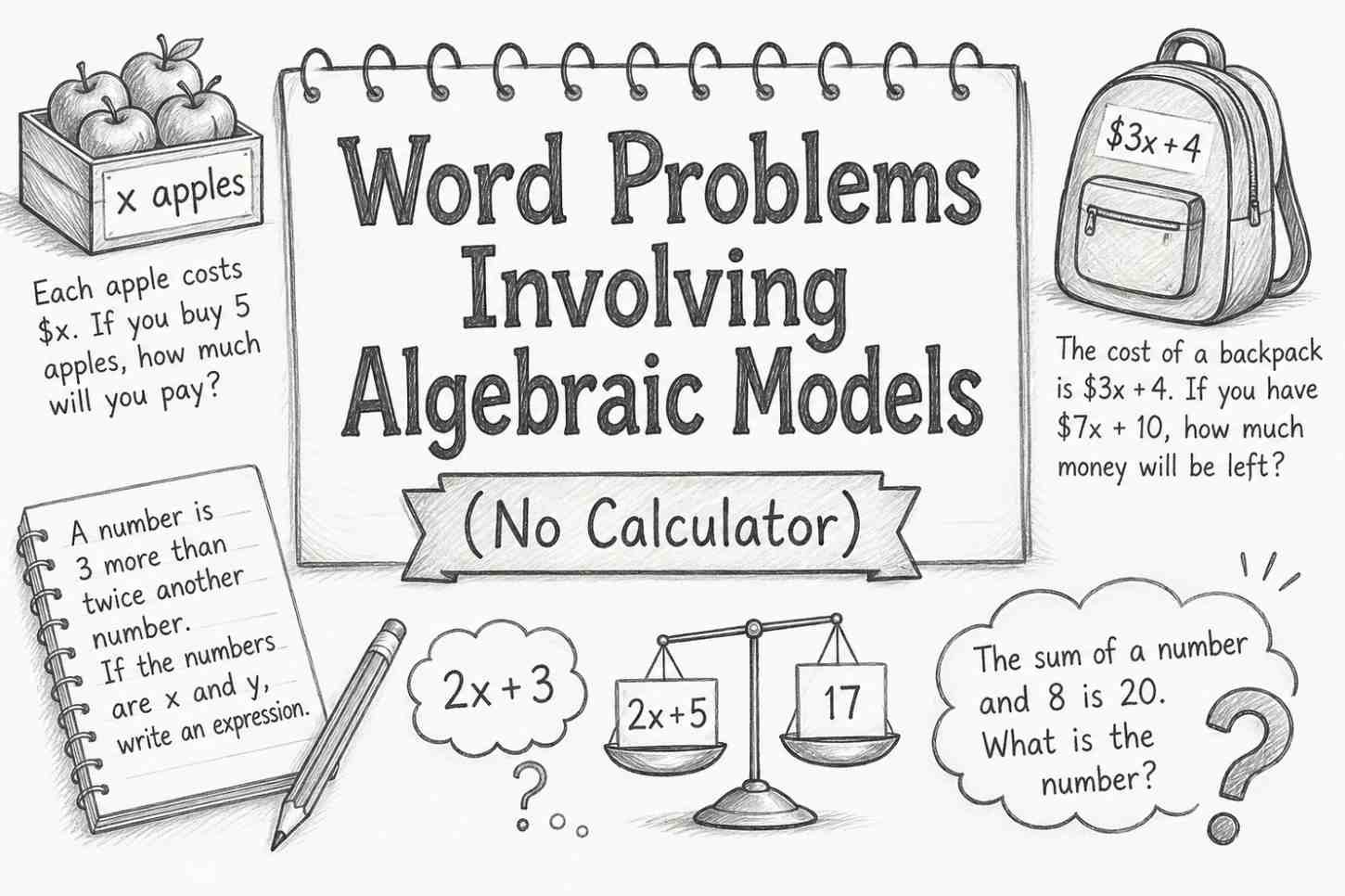
Algebra is the language of mathematical relationships. It uses numbers, symbols, and rules to describe quantities that are unknown, changing, or connected to one another. Instead of solving only one arithmetic calculation, algebra lets us write a general statement, test a pattern, and find values that make a relationship true.
For example, arithmetic can tell you that (7 + 5 = 12). Algebra can express the same kind of relationship more generally: if (x + 5 = 12), then (x = 7). The letter is not a mystery or a decoration. It represents a quantity whose value can be discovered, changed, compared, or used to describe a rule.
This detailed guide explains what algebra means, why it matters, the vocabulary you need, and the techniques that make problems manageable. It also includes fully rendered MathJax examples, common mistakes, practical applications, and a learning sequence for students building confidence from the basics upward.
What is algebra?
Algebra is a branch of mathematics in which letters and other symbols stand for numbers, quantities, or mathematical objects. The symbols allow us to represent a situation before every value is known. They also allow one rule to apply to many cases.
Suppose a cinema ticket costs (p) dollars. The cost of (n) tickets is (pn). If the price is (12) dollars and a family buys (4) tickets, substitution gives
\[pn = 12 \times 4 = 48.\]
The expression (pn) is more useful than the single answer (48) because it works for any ticket price and any number of tickets. If the price changes or the family buys a different number, the relationship stays intact. That ability to describe a whole family of situations is the central power of algebra.
At an introductory level, algebra usually involves numbers and variables. As mathematics advances, algebra also studies structures such as vectors, matrices, polynomials, groups, rings, and fields. The underlying habit remains the same: identify a relationship, represent it precisely, and reason according to agreed rules.
Algebra is sometimes introduced as “solving for (x),” but that phrase is too narrow. Solving equations is important, yet algebra also includes simplifying expressions, recognizing patterns, building formulas, interpreting graphs, comparing rates of change, and proving that two forms are equivalent. A student who sees only isolated answer-finding may miss the bigger idea: algebra is a toolkit for thinking about quantities and relationships.
Algebra and arithmetic: related but different
Arithmetic focuses mainly on known numbers and calculations. You add, subtract, multiply, divide, estimate, and compare specific values. Algebra extends arithmetic by allowing unknown or variable values. Arithmetic asks, “What is (18\div3)?” Algebra asks, “What number (x) makes (3x = 18)?”
Both use the same number rules. In fact, good algebra depends on secure arithmetic. The difference is abstraction. When you know that (a(b+c)=ab+ac), you are not checking one numerical fact; you are stating a rule that holds whenever the quantities are defined. Try (a=3), (b=2), and (c=5):
\[3(2+5)=3\cdot7=21 \qquad\text{and}\qquad 3\cdot2+3\cdot5=6+15=21.\]
The numbers verify one example, but algebra explains why the structure works in every comparable example. This is why algebra is often called generalized arithmetic.
Why is algebra important?
Algebra matters because the world is full of relationships. Prices depend on quantity. Travel time depends on distance and speed. A savings balance depends on deposits, withdrawals, and interest. A graph records how one quantity changes as another changes. Algebra gives us a concise way to model these relationships and make predictions from them.
It is also the gateway to much of later mathematics. Geometry uses formulas for area, volume, and coordinates. Statistics uses formulas to summarize data and quantify variation. Physics uses equations to describe motion, forces, energy, and electricity. Chemistry uses ratios and symbolic relationships. Economics and business use algebra to analyze revenue, cost, profit, demand, and risk. Computer science relies on symbolic logic, variables, functions, and algorithms.
More quietly, algebra develops useful habits of mind. It teaches students to define quantities clearly, make each step reversible when possible, separate a claim from its evidence, and check whether an answer fits the original condition. These are reasoning skills, not just classroom techniques.
Consider a simple budget. If you earn (w) dollars per hour for (h) hours, gross pay can be modeled as
\[P = wh.\]
If you need to earn (600) dollars at a rate of (15) dollars per hour, the equation (15h = 600) gives
\[h = \frac{600}{15} = 40.\]
Algebra turns a verbal question into a relationship you can solve and check. The same pattern appears in loan calculations, recipes, construction plans, cell-phone data comparisons, and scientific experiments.
Algebra is not only for students headed toward technical careers. It helps anyone interpret claims that use numbers. A sale advertisement, a news graph, a utility bill, a financing offer, or a dosage instruction often contains an implicit algebraic relationship. Understanding the relationship makes it easier to decide whether a claim is reasonable.
Core algebra vocabulary you need to know
Algebra becomes much easier when the language is clear. The following terms appear in almost every introductory course.
Variables
A variable is a symbol, usually a letter, that represents a number or quantity. In (5x+2), the variable is (x). A variable may represent an unknown value, such as the answer to an equation, or a changing value, such as time in a motion formula.
The meaning of a variable comes from context. In the formula (A=lw), (A) may be area, (l) length, and (w) width. In a graph (y=2x+1), (x) is usually the input and (y) the output. Letters do not have fixed meanings outside a stated context.
Constants, coefficients, and terms
A constant is a fixed number. In (4x-9), the constant is (-9). A coefficient is the numerical factor attached to a variable; (4) is the coefficient of (x). A term is a part of an expression separated by addition or subtraction. The expression (4x-9) has two terms: (4x) and (-9).
In (3a^2-2a+7), the terms are (3a^2), (-2a), and (7). The coefficient of (a^2) is (3), the coefficient of (a) is (-2), and (7) is the constant term.
Factors and products
Factors are quantities multiplied together. In (6x), (6) and (x) are factors; (6x) is their product. In ((x+3)(x-2)), the two binomials are factors. Recognizing factors is essential for simplifying, expanding, and solving equations.
Like terms
Like terms have exactly the same variable part, including the same exponents. Thus (3x) and (-7x) are like terms, as are (2a^2b) and (9a^2b). But (x) and (x^2) are not like terms, and neither are (ab) and (a+b).
You can combine like terms by adding or subtracting their coefficients:
\[3x - 7x + 5 = (3-7)x+5 = -4x+5.\]
For extra practice identifying and simplifying these building blocks, see RevisionTown’s verified guide to variables and expressions.
Expressions, equations, identities, and formulas
An expression is a mathematical phrase with numbers, variables, and operations but no equality claim, such as (2x^2-3x+1). An equation states that two expressions are equal, such as (2x^2-3x+1=0). An identity is an equation true for every allowed value of the variables, such as ((a+b)^2=a^2+2ab+b^2). A formula is an equation that describes a relationship among quantities, such as (d=rt).
Keeping these categories separate prevents many errors. You simplify an expression, solve an equation, verify an identity, and use or rearrange a formula.
Algebraic expressions and the order of operations
An algebraic expression combines variables, constants, and operations. Examples include (7x-4), (\frac{a+b}{2}), and (3m^2n). Expressions do not assert that anything equals anything else, so they do not have a single “answer” until values are substituted or the expression is simplified.
Evaluating an expression
To evaluate an expression, replace each variable with a given value and calculate using the order of operations. If (x=4), evaluate (2x^2-3x+5):
\[ 2x^2-3x+5 = 2(4)^2-3(4)+5 = 2\cdot16-12+5 = 25. \]
Parentheses around a substituted negative number are especially important. If (x=-3), then
\[x^2=(-3)^2=9,\]
whereas
\[-3^2=-(3^2)=-9.\]
The exponent is applied before the leading negative sign unless parentheses make the negative part of the base. This small detail causes many avoidable errors.
Order of operations
When an expression contains several operations, mathematical convention establishes a shared order: grouping symbols first, then exponents and roots, then multiplication and division from left to right, then addition and subtraction from left to right. In many classrooms this is remembered as BIDMAS or BODMAS. The letters are a memory aid; the crucial rule is that multiplication and division have equal priority, as do addition and subtraction.
For example,
\[ 18 \div 3 \times 2 = 6 \times 2 = 12, \]
not (18\div6=3). Work from left to right when operations have the same priority. RevisionTown’s BIDMAS and BODMAS order-of-operations guide explains this convention with further examples.
Simplifying expressions
To simplify means to rewrite an expression in an equivalent form that is easier to read or use. You may combine like terms, remove parentheses by distributing, reduce fractions, or apply exponent rules. You must not change the value of the expression.
For instance, simplify (4(2x-3)+5x-1):
\[ 4(2x-3)+5x-1 = 8x-12+5x-1 = 13x-13. \]
Every step preserves equality between the old and new expressions. The distributive property justifies the first rewrite, and combining like terms justifies the second.
The distributive property
The distributive property says that multiplication distributes across addition or subtraction:
\[ a(b+c)=ab+ac \qquad\text{and}\qquad a(b-c)=ab-ac. \]
It is one of the most useful rules in elementary algebra. It allows you to expand parentheses, factor common terms, and solve equations. For example, (5(x-2)=5x-10). In reverse, (5x-10=5(x-2)). The two forms are equivalent, but one may be more helpful depending on the problem.
Equations: the balance principle and solving for an unknown
An equation says that two expressions have equal value. The equals sign, (=), is not an instruction to “write the answer next.” It is a relationship: the quantity on the left is the same as the quantity on the right. In
\[3x+4=19,\]
the goal is to find every value of (x) that makes the equality true. Such a value is called a solution.
The balance principle
Think of an equation as a balanced scale. If you add, subtract, multiply, or divide both sides by the same nonzero quantity, the scale remains balanced. This principle explains the legal moves used to solve equations.
To solve (3x+4=19), undo the operations around (x) in reverse order:
\[ \begin{aligned} 3x+4&=19\\ 3x&=15 &&\text{subtract }4\text{ from both sides}\\ x&=5 &&\text{divide both sides by }3. \end{aligned} \]
Check the result in the original equation:
\[3(5)+4=15+4=19.\]
The check is not optional busywork. It catches arithmetic slips and confirms that the answer actually satisfies the original relationship.
Equations with variables on both sides
When a variable appears on both sides, collect the variable terms on one side and constants on the other. Solve
\[5x-7=2x+11.\]
Subtract (2x) from both sides, then add (7):
\[ \begin{aligned} 5x-7&=2x+11\\ 3x-7&=11\\ 3x&=18\\ x&=6. \end{aligned} \]
It is not a rule that variables “move across” an equals sign and change sign by magic. What actually happens is that the same operation is performed to both sides. Saying the real operation out loud makes later algebra much less confusing.
Equations with fractions
Fractions often become easier if you multiply every term by the least common denominator. Solve
\[\frac{x}{3}+\frac{x}{4}=7.\]
The least common denominator is (12). Multiply both sides by (12):
\[ 12\left(\frac{x}{3}\right)+12\left(\frac{x}{4}\right)=12(7), \]
so
\[4x+3x=84,\qquad 7x=84,\qquad x=12.\]
Substitution confirms that (\frac{12}{3}+\frac{12}{4}=4+3=7).
For a focused progression of practice, use RevisionTown’s pages on equations and linear equations. A linear equation has variables only to the first power and usually graphs as a straight line.
Special outcomes: one, none, or infinitely many solutions
Not every equation leads to one answer. Consider
\[2(x+3)=2x+6.\]
Expanding produces (2x+6=2x+6), which is always true. Every real value of (x) is a solution, so the equation has infinitely many solutions. By contrast,
\[2(x+3)=2x+9\]
becomes (2x+6=2x+9), then (6=9), which is never true. There is no solution. Recognizing these cases prevents you from forcing an answer where none exists.
Inequalities: comparing quantities rather than matching them
An inequality compares two quantities that are not necessarily equal. The main symbols are (<) for “less than,” (>) for “greater than,” (\leq) for “less than or equal to,” and (\geq) for “greater than or equal to.” Instead of finding one exact value, you often find a set or interval of values.
For example, solve
\[3x-5\leq 10.\]
Add (5), then divide by (3):
\[ 3x\leq15,\qquad x\leq5. \]
The solution includes every number at most (5). On a number line, it is represented with a closed point at (5) and shading to the left. In interval notation, the solution is
\[(-\infty,5].\]
The sign-change rule
There is one vital difference between solving equations and inequalities: when you multiply or divide both sides by a negative number, reverse the inequality sign. If
\[-2x>8,\]
then dividing by (-2) gives
\[x<-4.\]
Why? Multiplication by a negative reverses order on the number line. Since (2<5), multiplying both values by (-1) gives (-2>-5). Reversing the sign preserves a true statement.
Inequalities model limits and conditions: a budget may require spending no more than a set amount, a bridge may have a maximum load, or a product may be safe only within a temperature range. RevisionTown’s inequalities resource can extend this introduction with additional notation and exercises.
Functions, graphs, and the language of change
A function is a relationship in which each permitted input has exactly one output. Functions are central to algebra because they describe how one quantity depends on another. We often write
\[y=f(x),\]
which is read as “(y) equals (f) of (x).” The notation does not mean (f\times x). It names a rule called (f) that takes an input (x) and returns an output.
If (f(x)=2x+3), then
\[f(4)=2(4)+3=11.\]
The input (4) is mapped to the output (11). The set of permitted inputs is the domain; the outputs produced are the range. A function can be represented by a formula, table, graph, verbal rule, or mapping diagram. These are different views of the same relationship.
Linear functions
A linear function has the form
\[y=mx+b,\]
where (m) is the slope and (b) is the (y)-intercept. The slope tells how much (y) changes when (x) increases by one. In (y=3x-2), the slope is (3): every one-unit increase in (x) raises (y) by three. The intercept is (-2): the line crosses the vertical axis at ((0,-2)).
Linear models are useful when a quantity changes at a constant rate. A taxi fare with a base charge of (4) dollars plus (2.50) dollars per mile can be written as
\[C=2.50m+4.\]
The coefficient (2.50) is the rate per mile; (4) is the starting charge. A graph makes this structure visible and lets you estimate values or compare plans.
Nonlinear functions
Not every relationship has a constant rate. Quadratic functions include a squared variable, such as
\[y=x^2-4x+3.\]
Their graphs are parabolas. Exponential functions have a variable exponent, such as (y=2^x), and can model repeated percentage growth or decay. Rational functions include variables in denominators. Knowing the type of function helps you predict its graph, possible restrictions, and suitable solution methods.
For a deeper foundation, RevisionTown’s guide to understanding functions explains how inputs, outputs, and representations fit together.
The properties that make algebra work
Algebra is not a collection of arbitrary moves. Each valid transformation rests on properties of numbers and operations. Learning the names is useful, but understanding the meaning is more important: the properties tell you which rewrites preserve value and therefore which solution steps are legitimate.
Commutative and associative properties
The commutative property says that order does not change the result of addition or multiplication:
\[ a+b=b+a,\qquad ab=ba. \]
Thus (3+8=8+3) and (4x=x\cdot4). The property does not apply to subtraction or division. In general, (a-b\ne b-a), and \(\frac{a}{b}\ne\frac{b}{a}\). Remembering this prevents the mistaken belief that terms may always be rearranged freely.
The associative property says that grouping does not change the result of addition or multiplication:
\[ (a+b)+c=a+(b+c),\qquad (ab)c=a(bc). \]
For example, (2x+7x+3x) may be regrouped as ((2x+7x)+3x), making it easy to combine like terms. Again, subtraction and division do not generally associate. For instance, ((20-5)-3=12), while (20-(5-3)=18).
Identity and inverse properties
An identity element leaves a number unchanged. Additive identity is (0), because
\[a+0=a.\]
Multiplicative identity is (1), because
\[a\cdot1=a.\]
An inverse undoes an operation. The additive inverse of (a) is (-a), since (a+(-a)=0). For nonzero (a), the multiplicative inverse is (\frac{1}{a}), since
\[a\left(\frac{1}{a}\right)=1.\]
These ideas explain equation solving. When you subtract (4) from both sides of (x+4=9), you are adding the inverse (-4). When you divide both sides of (3x=18) by (3), you are multiplying by the inverse \(\frac13\). The process is logical rather than a list of commands.
Equality properties
Equality has its own set of rules. It is reflexive, meaning (a=a); symmetric, meaning if (a=b), then (b=a); and transitive, meaning if (a=b) and (b=c), then (a=c). Most important in elementary solving are the addition, subtraction, multiplication, and division properties of equality:
\[ \begin{aligned} &\text{If }a=b,\text{ then }a+c=b+c.\\ &\text{If }a=b,\text{ then }a-c=b-c.\\ &\text{If }a=b,\text{ then }ac=bc.\\ &\text{If }a=b\text{ and }c\ne0,\text{ then }\frac{a}{c}=\frac{b}{c}. \end{aligned} \]
These properties justify doing the same thing to both sides. They also show why division by zero is forbidden: zero has no multiplicative inverse, so there is no legal operation “divide by zero.”
Factoring and the zero-product property
Factoring is the reverse of distribution. It helps reveal a product, and products are especially useful in equations because of the zero-product property:
\[ab=0\quad\Rightarrow\quad a=0\text{ or }b=0.\]
For example, solve (x^2-9x=0). First factor out the greatest common factor:
\[x^2-9x=x(x-9).\]
Then apply the zero-product property:
\[x=0\quad\text{or}\quad x-9=0,\]
so (x=0) or (x=9). This method is not a trick; it uses the fact that real-number multiplication can produce zero only when one factor is zero.
Rearranging formulas
Algebra is often used to isolate a different variable in a formula. The goal is the same as solving an equation, but the answer is an expression rather than a single number. Starting with (A=lw), solve for (w). Divide both sides by (l), provided (l\ne0):
\[w=\frac{A}{l}.\]
Starting with the slope formula
\[m=\frac{y_2-y_1}{x_2-x_1},\]
solve for (y_2). Multiply by (x_2-x_1), then add (y_1):
\[ m(x_2-x_1)=y_2-y_1, \qquad y_2=m(x_2-x_1)+y_1. \]
Write every operation clearly, especially when fractions or several variables are involved. RevisionTown’s rearranging functions resource provides further practice with this transferable skill.
Worked algebra examples: from simple to multi-step
Worked examples are valuable when they show reasoning, not merely a chain of answers. In each example below, notice what is being preserved, which property is used, and how the final result is checked.
Example 1: simplify an expression
Simplify (6a-4+3a+9). Group the like terms and constants:
\[ 6a+3a-4+9=9a+5. \]
The result is (9a+5). We did not combine (9a) and (5) because they are unlike terms.
Example 2: expand and simplify
Simplify (3(2x-5)-4(x+1)). Distribute each factor before combining terms:
\[ \begin{aligned} 3(2x-5)-4(x+1)&=6x-15-4x-4\\ &=2x-19. \end{aligned} \]
A common error is to write (-4x+4) for (-4(x+1)). The negative factor multiplies both terms, so the correct expansion is (-4x-4).
Example 3: solve a two-step equation
Solve (\frac{x}{5}-3=7). Add (3) to both sides, then multiply by (5):
\[ \begin{aligned} \frac{x}{5}-3&=7\\ \frac{x}{5}&=10\\ x&=50. \end{aligned} \]
Check: \(\frac{50}{5}-3=10-3=7\). The solution is (x=50).
Example 4: solve an equation with parentheses
Solve (4(x-2)+3=2x+11). Expand before isolating (x):
\[ \begin{aligned} 4x-8+3&=2x+11\\ 4x-5&=2x+11\\ 2x-5&=11\\ 2x&=16\\ x&=8. \end{aligned} \]
Substitution verifies the answer: (4(8-2)+3=27) and (2(8)+11=27).
Example 5: factor and solve a quadratic
Solve (x^2-x-12=0). Find two numbers whose product is (-12) and whose sum is (-1): (-4) and (3). Therefore,
\[ x^2-x-12=(x-4)(x+3). \]
Set each factor equal to zero:
\[ x-4=0\quad\text{or}\quad x+3=0, \]
so the solutions are (x=4) and (x=-3). Checking one value, (4^2-4-12=16-4-12=0); the other works as well.
Example 6: solve a system by substitution
Find the intersection of (y=2x+1) and (x+y=10). Substitute (2x+1) for (y) in the second equation:
\[ \begin{aligned} x+(2x+1)&=10\\ 3x+1&=10\\ 3x&=9\\ x&=3. \end{aligned} \]
Now find (y): (y=2(3)+1=7). The lines meet at ((3,7)). Always check in both original equations: (3+7=10) and (7=2(3)+1).
Example 7: turn a percentage problem into algebra
After a (20\%) discount, a jacket costs (56) dollars. Find its original price (p). A (20\%) discount leaves (80\%) of the original price:
\[0.80p=56.\]
Divide by (0.80):
\[p=\frac{56}{0.80}=70.\]
The original price was (70) dollars. Check: (20\%) of (70) is (14), and (70-14=56).
These examples show a pattern: translate accurately, choose a justified operation, keep the work organized, and check. As questions become more advanced, this pattern remains dependable.
Major areas of algebra
“Algebra” covers a progression of related topics. The basic ideas recur as the mathematics becomes more sophisticated.
Linear algebra and systems of equations
Elementary linear algebra begins with lines and equations of the first degree. A system of equations contains two or more equations with shared variables. For example,
\[ \begin{cases} x+y=10\\ x-y=2 \end{cases} \]
has the solution (x=6), (y=4). Adding the equations gives (2x=12), so (x=6); then (y=4). Graphically, the solution is the point where the two lines intersect. Systems can have one solution, no solution when parallel lines never meet, or infinitely many solutions when equations describe the same line. See RevisionTown’s verified systems of equations guide for more methods and interpretations.
Polynomials
A polynomial is an expression made from variables, constants, addition, subtraction, and nonnegative integer powers. Examples are (5x-1), (x^2+3x+2), and (2a^3-a+7). Polynomials are classified by degree, the highest exponent of the variable. A first-degree polynomial is linear; a second-degree polynomial is quadratic; a third-degree polynomial is cubic.
Students learn to add, subtract, multiply, factor, and solve polynomials. Factoring reverses expansion. For example,
\[x^2+5x+6=(x+2)(x+3).\]
The factorized form helps solve (x^2+5x+6=0), because a product is zero only if at least one factor is zero. Thus (x=-2) or (x=-3). RevisionTown’s polynomials guide provides a useful next step after basic expressions.
Quadratic equations
A quadratic equation has degree two and can often be written as
\[ax^2+bx+c=0,\qquad a\ne0.\]
Common solution methods are factoring, completing the square, graphing, and the quadratic formula:
\[x=\frac{-b\pm\sqrt{b^2-4ac}}{2a}.\]
The quantity (b^2-4ac), called the discriminant, helps predict the number and type of real solutions. A positive discriminant gives two distinct real solutions; zero gives one repeated real solution; a negative discriminant gives no real solutions. For focused support, use RevisionTown’s quadratic equations page.
Exponents, radicals, and logarithms
Exponents compact repeated multiplication: (x^4=x\cdot x\cdot x\cdot x). They follow rules such as
\[x^m\cdot x^n=x^{m+n},\qquad \frac{x^m}{x^n}=x^{m-n}\ (x\ne0),\qquad (x^m)^n=x^{mn}.\]
Radicals undo powers, so (\sqrt{x}) is the principal nonnegative number whose square is (x), when (x\geq0) in the real-number system. Logarithms undo exponentiation: (\log_b(a)=c) means (b^c=a). These ideas appear in growth models, scientific notation, and advanced equations. RevisionTown’s exponents and logarithms resource is a suitable continuation.
Abstract algebra
At a more advanced level, abstract algebra studies the rules governing operations themselves. Instead of focusing only on real numbers, it examines systems such as groups, rings, and fields. This may sound distant from beginner algebra, but it grows from familiar questions: Which operations are allowed? Is there an identity element? Does every element have an inverse? When does order matter? The subject provides a rigorous language for symmetry, cryptography, coding theory, and modern mathematics.
Real-world examples of algebra
Algebra is useful whenever you can identify quantities and describe how they relate. The model is not the real world itself; it is a simplified representation that helps answer a question. A good model states its assumptions and is checked against actual information.
Shopping and discounts
Suppose an item has original price (p) and a discount of (r\%). The sale price is
\[S=p\left(1-\frac{r}{100}\right).\]
For a (25\%) discount on an (80)-dollar item,
\[S=80\left(1-\frac{25}{100}\right)=80(0.75)=60.\]
The model makes clear that a (25\%) discount means paying (75\%) of the original price, not subtracting (25) dollars unless the original price happens to make that true.
Travel and rate problems
The distance formula
\[d=rt\]
relates distance (d), rate (r), and time (t). If a car travels (180) miles at (60) miles per hour, then (t=d/r=180/60=3) hours. Units act as a check: miles divided by miles per hour leaves hours.
Business revenue and profit
If a business sells (q) units at a price of (p) each, revenue is (R=pq). If cost is (C(q)), profit is
\[\Pi(q)=R(q)-C(q).\]
For instance, suppose notebooks sell for (8) dollars, fixed costs are (300) dollars, and each notebook costs (3) dollars to produce. Then
\[R(q)=8q,\qquad C(q)=300+3q,\qquad \Pi(q)=8q-(300+3q)=5q-300.\]
The break-even point occurs where profit is zero:
\[5q-300=0,\qquad q=60.\]
The business must sell (60) notebooks to cover the stated costs. Algebra does not decide whether the assumptions are realistic, but it shows what follows from them.
Geometry and design
Formulas turn measurements into usable results. The area of a rectangle is (A=lw). If the perimeter is fixed at (40) meters and the length is (x), then the width is (20-x), because (2l+2w=40). The area becomes
\[A=x(20-x)=20x-x^2.\]
That quadratic expression can be analyzed to find which dimensions maximize area. Architects, engineers, designers, and builders use algebraic relationships constantly, even when software performs the calculations.
Science and technology
Scientific formulas use algebra to connect measurable quantities. A temperature conversion, for example, can be modeled as
\[F=\frac{9}{5}C+32.\]
To convert (68^\circ\mathrm{F}) to Celsius, rearrange:
\[C=\frac{5}{9}(F-32)=\frac{5}{9}(68-32)=20.\]
Programming also depends on algebraic thinking. A variable stores a value; an expression calculates a result; a function takes inputs and returns outputs; a condition compares quantities. The syntax differs from school notation, but the logical structure is familiar.
A reliable method for solving algebra problems
Strong algebra is less about memorizing isolated tricks and more about using a dependable process. The following method works for many exercises and word problems.
- Read for the relationship. Identify what is known, what is unknown, and what is being asked. Do not begin calculating before you understand the situation.
- Define variables clearly. Write what each letter represents, including units when relevant. For example, let (m) be the number of miles traveled.
- Translate words into mathematics. “Total” often suggests addition; “per” may suggest division or a rate; “is” often indicates equality. Use the context, not keyword guessing alone.
- Choose a form that exposes the structure. Draw a table, graph, diagram, or equation when it helps. Different representations can reveal different mistakes.
- Perform legal, justified operations. Maintain equality by doing the same operation to both sides. Use parentheses carefully and simplify one step at a time.
- Check the result. Substitute it into the original equation or compare it with the real-world conditions. Ask whether the sign, size, and units make sense.
- State the answer in context. A bare number may be incomplete. “The trip takes (3) hours” is clearer than writing only (3).
Consider a word problem: A streaming service charges (9) dollars per month plus a one-time setup fee of (15) dollars. How many months of service cost (69) dollars?
Let (m) be the number of months. The total-cost equation is
\[9m+15=69.\]
Subtract (15), then divide by (9):
\[9m=54,\qquad m=6.\]
Check: (9(6)+15=54+15=69). The answer is six months. Notice how defining the variable and writing the relationship removes the need to guess.
When a problem feels difficult, begin with a simpler numerical case. If a formula describes (n) identical items, try (n=1) or (n=2) to see whether the relationship behaves as expected. This does not replace proof, but it is a powerful way to find a modeling or arithmetic error early.
Common algebra mistakes and how to avoid them
Combining unlike terms
You may combine (3x+5x) to get (8x), but you may not combine (3x+5) into (8x). The terms have different variable parts. A useful check is to imagine (x=2): (3x+5=11), while (8x=16), so they cannot be equivalent.
Distributing incompletely
In (3(x+4)), the (3) multiplies every term inside the parentheses: (3x+12), not (3x+4). With subtraction, preserve signs carefully:
\[-2(x-5)=-2x+10.\]
Canceling across addition
Cancellation is valid only for common factors, not for pieces of a sum. For example,
\[\frac{x+3}{x}\]
does not simplify to (3) because (x) is not a factor of the whole numerator. By contrast,
\[\frac{x(x+3)}{x}=x+3\]
when (x\ne0), because (x) is a factor of the complete numerator and denominator.
Forgetting restrictions
Some expressions are undefined for certain values. A denominator cannot be zero, so (\frac{1}{x-4}) requires (x\ne4). An even root in the real numbers requires a nonnegative radicand, so (\sqrt{x-1}) requires (x\geq1). State these restrictions when they matter; they protect you from accepting invalid results.
Changing an inequality sign at the wrong time
Reverse an inequality only when multiplying or dividing by a negative quantity. Do not reverse it merely because you subtract a number or move a term. Write the actual operation on both sides to reduce confusion.
Skipping the check
An answer can look neat and still be wrong. Substitute it into the original equation, especially after clearing fractions, squaring both sides, or using a formula. These operations can introduce extraneous solutions in some problems.
How to learn algebra with confidence
Algebra rewards steady practice more than last-minute memorization. Start by strengthening number sense: signed numbers, fractions, decimals, percentages, factors, and order of operations. Many apparent algebra weaknesses are really arithmetic fluency gaps.
Next, learn each new idea in several forms. If you study linear equations, solve symbolic examples, create a table of values, graph the line, and explain what the slope and intercept mean in words. Moving among representations builds understanding that survives unfamiliar questions.
Keep a short error log. After a missed problem, do not record only the correct answer. Name the cause: sign error, distribution error, rushed arithmetic, wrong formula, misunderstood wording, or incomplete check. Patterns in mistakes reveal exactly what to practice.
Practice retrieval, not just recognition. Cover worked steps and try to reconstruct them. Explain why an operation is valid. Create a similar problem and solve it. Teaching a method aloud is one of the fastest ways to discover whether you truly understand it.
Finally, use reference material as a bridge rather than a substitute for thinking. Formula sheets and calculators can be useful, but first decide what relationship the problem requires. For structured topic review, RevisionTown’s algebra cheatsheet table of contents can help you move from fundamentals to more focused practice.
Frequently asked questions about algebra
Who invented algebra?
Algebra developed over many centuries across several civilizations. Ancient Egyptian, Babylonian, Greek, Indian, Chinese, Islamic, and European mathematicians all contributed methods and notation. The word “algebra” comes from the Arabic al-jabr, associated with a ninth-century work by Muhammad ibn Musa al-Khwarizmi on solving equations. Modern algebra is the result of a long shared mathematical tradition, not a single invention.
What is the easiest way to start algebra?
Begin with variables, simple expressions, and one-step equations. Make sure you can work accurately with negative numbers and fractions. Then progress to multi-step equations, inequalities, graphs, functions, and polynomials. Small daily practice sessions with immediate checking are more effective than occasionally attempting only difficult problems.
Why does (x) often mean the unknown?
It is a convention, not a rule. Any symbol can represent an unknown or variable. Letters near the end of the alphabet, especially (x), (y), and (z), became common for unknowns, while early letters such as (a), (b), and (c) often represent known constants. Context always determines the meaning.
Is (2x) the same as (2+x)?
No. (2x) means (2\times x), while (2+x) means add (2) and (x). If (x=3), then (2x=6) but (2+x=5). In algebra, placing a number next to a variable indicates multiplication.
When should I use a calculator in algebra?
Use one when the task calls for numerical approximation, lengthy arithmetic, graphing, or data analysis. But understand the symbolic setup first. A calculator can evaluate (\sqrt{173}), but it cannot decide on its own whether a square root is the appropriate operation or whether an answer is reasonable.
Algebra is a practical language for relationships
Algebra begins with a simple but powerful move: represent a quantity with a symbol. From there, you can write expressions, solve equations, compare values with inequalities, describe functions, analyze patterns, and model real situations. The symbols may look abstract, but their purpose is practical—to make relationships visible and solvable.
The most important question in any algebra problem is not “Which trick should I use?” but “What relationship does this notation describe?” Once you can answer that question, procedures become easier to choose and remember. You can decide whether to simplify, solve, graph, factor, substitute, or rearrange because you understand the structure of the task.
Confidence in algebra comes from understanding rather than shortcut hunting. Define your quantities, use the order of operations, preserve balance in equations, justify each transformation, and check the result in context. With those habits in place, algebra becomes less like a collection of rules to memorize and more like a reliable way to reason.