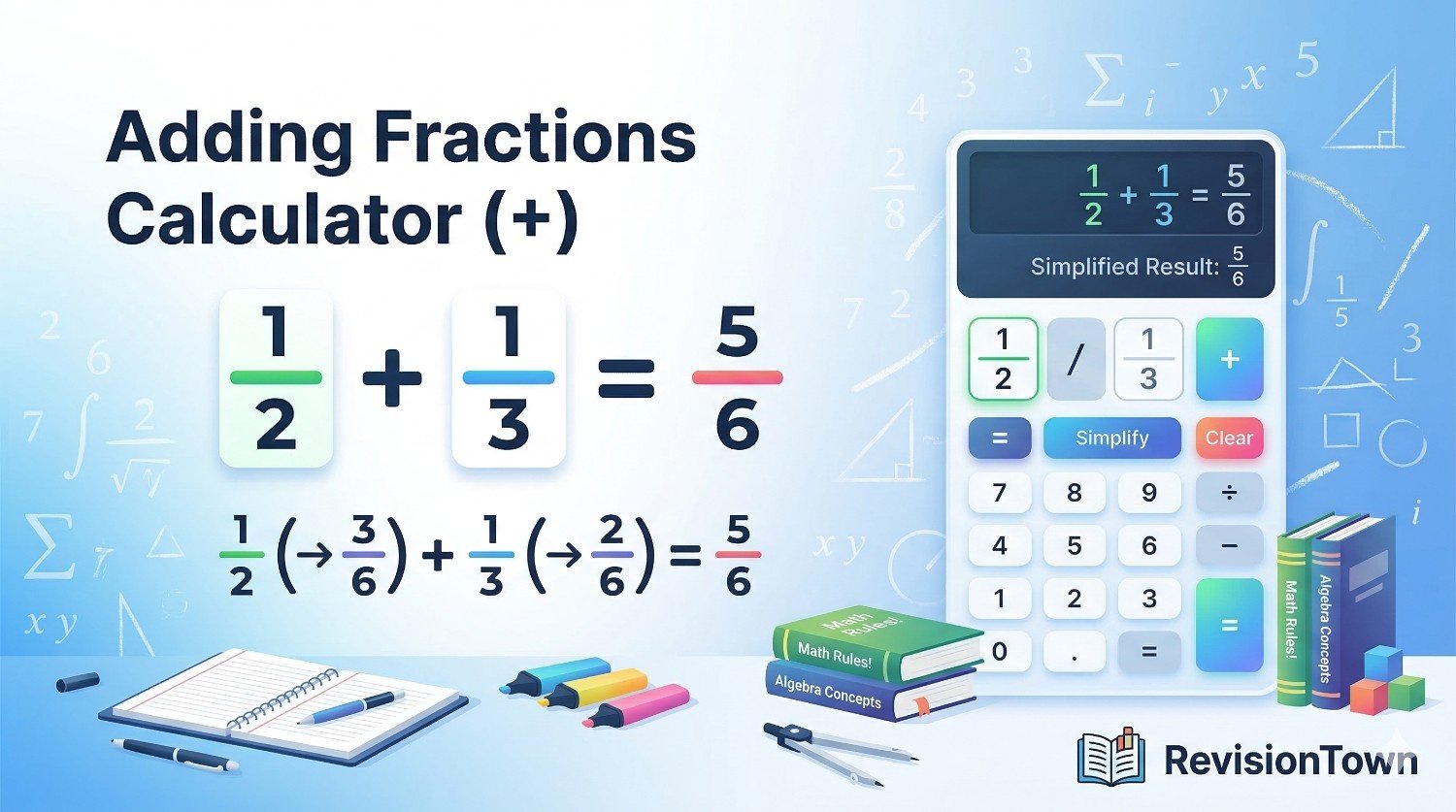
Adding Fractions Calculator
Add fractions with the same or different denominators, including mixed numbers and negative values. Get a simplified answer, decimal, percentage, and a clear explanation of every important step.
Need to add fractions quickly? Enter the two fractions below. The calculator finds a suitable common denominator, combines the numerators, reduces the result, and shows equivalent forms. It is designed to help you check homework, understand the method, and compare your own working with a complete solution.
This page concentrates on fraction addition. If you need a separate calculation involving subtraction, multiplication, or division, you can use the broader fractions calculator as a companion. The explanations below focus on why the addition rule works, not just on producing a final number.
Add fractions with steps
Use whole-number numerators and denominators. A negative sign is allowed, but a denominator cannot be zero.
First fraction
Second fraction
What does it mean to add fractions?
Adding fractions means combining parts that are measured using the same whole. A fraction such as 14 describes one part when a whole has been divided into four equal parts. A fraction such as 34 describes three of those same-sized parts. Because the pieces have the same size, it is natural to combine the numerators: 14 + 34 = 44 = 1.
The difficulty appears when the denominators are different. The pieces in 12 and 13 do not have the same size: a half is larger than a third. Adding 1 to 1 would ignore that difference. Before the numerators can be combined, both fractions must be rewritten using equal-sized parts. That rewritten denominator is called a common denominator.
For example, one half can be renamed as three sixths, while one third can be renamed as two sixths. Now both fractions describe sixths, so the addition is clear: 36 + 26 = 56. The value has not changed when a fraction is renamed this way. Multiplying the numerator and denominator by the same non-zero number creates an equivalent fraction because it scales the number of parts and the size of each part together.
This is the central idea behind every reliable fraction addition method. The calculator may find the common denominator in a second, but the reasoning is still the same: make the unit parts match, add the matching parts, and simplify the result if possible.
In the formula, a and c are the numerators, while b and d are the denominators. The formula works because the first fraction is multiplied by dd and the second by bb. Both denominators then become bd. When you are working by hand, you may choose a smaller least common denominator instead of the product bd; the smaller denominator often makes the arithmetic easier and the final answer less cluttered.
How to use this adding fractions calculator
The calculator is useful for a quick check and for learning the sequence of operations. Enter each fraction as two whole numbers: the top field is the numerator and the bottom field is the denominator. For the starting example, the calculator uses one half plus one third. You can replace any number and the result updates when you choose Calculate or when you edit a field.
- Enter the first numerator. This is the number of selected parts in the first fraction. For 58, enter 5 in the first top field.
- Enter the first denominator. This tells the calculator the size of the parts. For 58, enter 8 in the first bottom field.
- Enter the second fraction in the same way. A denominator may be negative mathematically, although the calculator will rewrite the final result with a positive denominator for a conventional display.
- Leave Add selected when you are solving an addition problem. The other operation buttons are available for quick related checks, but the explanations on this page are built around addition.
- Read the result and steps. The result panel shows the original expression, the simplified fraction, a decimal approximation, a percentage, and a mixed-number form when one is appropriate.
A denominator of zero is not allowed because it would ask how many equal parts a whole has been divided into when there are no parts. The calculator will show an error instead of treating zero as a valid denominator. It also rejects non-integer input so that the tool stays focused on fractions written as whole-number ratios. If you have a decimal that needs to be written as a fraction first, use the decimal-to-fraction converter and then bring the resulting numerator and denominator back here.
For best learning value, try to predict the common denominator before pressing Calculate. After the result appears, compare your prediction with the working. If the answer differs, check the denominator conversion before checking the final addition; most fraction errors happen while renaming the fractions rather than while adding the final numerators.
Fraction vocabulary: numerator, denominator, and equivalent fractions
A fraction has two numbers separated by a fraction bar. The numerator is above the bar and counts how many parts are being considered. The denominator is below the bar and tells how many equal parts make one whole. In 710, 7 is the numerator and 10 is the denominator. The denominator controls the unit size; the numerator controls how many units are present.
A proper fraction has an absolute numerator smaller than its denominator, such as 38. Its value lies between zero and one when it is positive. An improper fraction has an absolute numerator at least as large as its denominator, such as 118. It can be rewritten as a mixed number, 118 = 138. A mixed number has a whole-number part and a proper fraction part.
Equivalent fractions have different numerators and denominators but the same value. For example, 23, 46, and 1015 are equivalent. You create an equivalent fraction by multiplying or dividing the numerator and denominator by the same non-zero number. That rule is what permits a denominator to be changed without changing the amount represented.
A common denominator is a number that is a multiple of each denominator in the problem. For denominators 4 and 6, 12 is a common denominator because 12 is divisible by both 4 and 6. The least common denominator, often shortened to LCD, is the smallest positive common multiple. In that example the LCD is 12. The LCD and the least common multiple, or LCM, are the same number when you are comparing positive denominators.
These words matter because they describe different jobs. The denominator establishes equal-sized units. Equivalent fractions rename those units. The common denominator provides a shared unit. The numerator is the part that is added after the units match. Keeping those roles separate makes the method much easier to remember than trying to memorize a collection of symbols.
How to add fractions with the same denominator
When two fractions already have the same denominator, adding them is direct. Keep the denominator unchanged and add the numerators. The reason is that both numerators count the same type of part. If a recipe uses 25 of a cup of one ingredient and 15 of a cup of another measurement, the total is five-sized parts: 25 + 15 = 35.
Notice what does not happen: you do not add the denominators. Adding 2 and 1 gives 3 selected fifths, not thirds. If you added the denominators as well, you would be changing the size of the unit while counting it, which would describe a different quantity. A useful sentence to remember is: same denominator, add the numerators; keep the denominator.
Example: adding like denominators
- Check that both denominators are 7.
- Add the numerators: 3 + 2 = 5.
- Keep the denominator 7.
- Check whether 57 can be reduced. It cannot because 5 and 7 have no common factor greater than 1.
The same process works for improper results. For example, 79 + 89 = 159. The fraction is correct as an intermediate answer, but it is not in simplest form. Dividing the numerator and denominator by 3 gives 53, which may also be written as 123. Simplifying is a separate final step; it does not change the addition rule.
Same-denominator questions are a useful first check of your understanding. If you can explain why the denominator stays fixed, you already understand the key idea behind more difficult problems. When denominators differ, the extra work is only the process of finding equivalent fractions with a shared denominator.
How to add fractions with different denominators
To add fractions with different denominators, first create equivalent fractions with a common denominator. There are several valid routes. The clearest hand method is usually to find a common multiple, convert each fraction, add the new numerators, and simplify. The calculator follows this logic and displays the conversion factors so you can see exactly what changed.
A dependable four-step method
- Find a common denominator. List multiples of each denominator or use the LCM method. Choose a positive common multiple that both denominators divide evenly.
- Rename each fraction. Divide the common denominator by the original denominator. Multiply the corresponding numerator by that factor.
- Add the numerators. Once the denominator is shared, add only the top numbers and keep the common denominator.
- Simplify. Divide the numerator and denominator by their greatest common divisor. If the numerator is larger than the denominator, decide whether a mixed-number form would make the result easier to read.
Consider 23 + 14. The denominators are 3 and 4. Their smallest common multiple is 12. Since 12 ÷ 3 = 4, multiply the first numerator and denominator by 4: 23 = 812. Since 12 ÷ 4 = 3, multiply the second fraction by 3: 14 = 312. The addition is now 812 + 312 = 1112.
The conversion factor for each fraction is important. You cannot simply replace the denominator 3 with 12 and leave the numerator as 2, because 23 and 212 have different values. When the denominator is multiplied by 4, the numerator must also be multiplied by 4. The number of parts changes, but the total amount stays constant.
Sometimes the product of the denominators is an easy common denominator. For 58 + 310, multiplying 8 by 10 gives 80, so you can use 80 immediately. However, the least common denominator is 40, since both 8 and 10 divide into 40. Using 40 gives 2540 + 1240 = 3740. Using 80 would also produce a correct answer, but it would create larger intermediate numbers: 5080 + 2480 = 7480, which then has to be reduced by 2. A smaller common denominator is generally more efficient.
For additional practice with the underlying addition and subtraction ideas, the adding and subtracting learning page can help you connect fraction addition to integer and decimal addition. The same habit applies in every representation: align the units before combining the amounts.
Finding the least common denominator with the LCM method
The least common denominator, or LCD, is the least common multiple of the denominators. It is often the neatest denominator to use because it avoids unnecessary expansion. To find it, write the first few positive multiples of each denominator and identify the first number that appears in both lists.
| Denominators | Multiples of the first | Multiples of the second | LCD |
|---|---|---|---|
| 3 and 5 | 3, 6, 9, 12, 15 | 5, 10, 15 | 15 |
| 4 and 6 | 4, 8, 12 | 6, 12 | 12 |
| 8 and 12 | 8, 16, 24 | 12, 24 | 24 |
Prime factorisation gives a faster method when denominators are larger. Break each denominator into prime factors, then take every prime factor at the highest power that appears in any denominator. For 12 and 18, the factorisations are 12 = 2 × 2 × 3 and 18 = 2 × 3 × 3. The LCD uses two 2s and two 3s, so LCD = 2 × 2 × 3 × 3 = 36. This method prevents you from accidentally leaving out a factor that one denominator needs.
The formula uses the greatest common divisor, or gcd, to remove the overlap between the denominators. If denominators are 8 and 12, their product is 96, but they share a gcd of 4. Dividing 96 by 4 gives an LCM of 24. In practical work you do not always need to calculate the gcd separately; a short list of multiples is often quicker for small denominators.
After you have the LCD, find each conversion factor by dividing the LCD by the original denominator. Suppose you are adding 712 and 518. The LCD is 36. The first conversion factor is 36 ÷ 12 = 3, so 712 becomes 2136. The second factor is 36 ÷ 18 = 2, so 518 becomes 1036. Then 2136 + 1036 = 3136. Since 31 is prime and does not divide 36, the answer is already simplified.
One useful check is that every conversion factor should be a whole number. If the LCD divided by an original denominator gives a decimal, the proposed common denominator is not actually a multiple of that denominator. Choose a different common multiple before continuing. This check catches many errors early, before they affect the numerators.
Adding fractions by cross-multiplication
Cross-multiplication provides a compact method when you do not want to list multiples. For ab + cd, multiply the first numerator by the second denominator and the second numerator by the first denominator. Add those cross-products. Multiply the denominators to form the new denominator.
For example, 38 + 512 gives a numerator of 3 × 12 + 5 × 8 = 36 + 40 = 76 and a denominator of 8 × 12 = 96. The intermediate result is 7696, which simplifies by 4 to 1924.
Cross-multiplication is always valid, but it may create larger numbers than the LCD method. The denominator 96 is a common denominator, while the smaller LCD is 24. If you are working under exam time pressure, choose the method that reduces mental load. If the denominators are small and unrelated, cross-multiplication is quick. If they share factors, the LCD method often keeps the arithmetic cleaner and makes simplification easier to see.
How to add mixed numbers
A mixed number combines a whole number and a proper fraction, such as 213. You can add mixed numbers in two main ways. The first is to add the whole parts and fractional parts separately, then regroup if the fractional total reaches one. The second is to convert each mixed number to an improper fraction, add the improper fractions, and convert the answer back to a mixed number. Both methods are equivalent when each step is carried out carefully.
Method 1: add whole parts and fractional parts
Suppose you need to add 214 and 324. Add the whole numbers: 2 + 3 = 5. Add the fractional parts: 14 + 24 = 34. Combine them to obtain 534. Because the fractional part is less than one, no regrouping is needed.
Now consider 135 + 245. The whole parts total 3. The fractions total 75, which is 125. The extra whole must be carried into the whole-number part, giving 425. A fractional total greater than or equal to one is a signal to regroup.
Method 2: convert to improper fractions first
To convert a mixed number to an improper fraction, multiply the whole number by the denominator, add the numerator, and keep the denominator. For 213, multiply 2 × 3 = 6, add 1 to get 7, and write 73. In symbols, the conversion is:
Here w is the whole number, r is the remainder numerator, and d is the denominator. For 325, the improper numerator is 3 × 5 + 2 = 17, so the fraction is 175. Once both mixed numbers are converted, use the ordinary unlike-denominator method.
Example: adding unlike mixed numbers
Add 212 and 123.
- Convert the first mixed number: 2 × 2 + 1 = 5, so 212 = 52.
- Convert the second mixed number: 1 × 3 + 2 = 5, so 123 = 53.
- Use an LCD of 6: 52 = 156 and 53 = 106.
- Add: 156 + 106 = 256.
- Convert back: 25 ÷ 6 gives whole part 4 and remainder 1, so the answer is 416.
For positive mixed numbers, the separate-parts method is often fastest when the denominators already match. The improper-fraction method is more systematic when denominators differ, when there are several terms, or when you want to use a calculator that accepts numerator and denominator fields. Whichever route you choose, keep the final fraction improper until the arithmetic is finished, then convert it once. Repeatedly switching between forms creates extra opportunities for transcription errors.
Adding improper fractions and whole numbers
Improper fractions are not wrong fractions; they simply represent one or more complete wholes together with a remainder. When an addition produces an improper fraction, you can leave it in that form if the question asks for a fraction, or convert it to a mixed number if that form communicates the size more naturally.
A whole number can be rewritten with any denominator by multiplying it by a fraction equal to one. For example, 4 can be written as 41, 82, or 205. This is useful when adding a whole number to a fraction. If you need to add 4 and 37, write 4 as 287, then add: 287 + 37 = 317 = 437.
When there are several fractions, add them in a planned order. First combine terms with the same denominator, then handle the remaining denominators. For example, in 16 + 46 + 13, combine the first two to get 56. Rewrite one third as two sixths, then 56 + 26 = 76 = 116. Combining compatible terms can reduce the amount of common-denominator work.
Adding negative fractions, zero, and signs
Negative fractions follow the same denominator rules as positive fractions. The sign tells you the direction or side of zero; the numerator and denominator still describe the size of the fractional unit. It is conventional to place the negative sign in front of the fraction, so −35 and −35 mean the same value. A negative denominator can also be moved to the numerator: 3−5 = −35.
If the fractions have the same denominator, add the signed numerators. For example, −27 + 57 = 37. The result is positive because the positive numerator has the larger absolute value. Conversely, 27 + −57 = −37.
With unlike denominators, normalize the signs first, find a common denominator, and then combine signed numerators. For −14 + 16, the LCD is 12. The equivalent fractions are −312 and 212. Their sum is −112. The negative sign belongs to the final numerator because the negative amount is larger in magnitude.
Zero is represented by any fraction with a zero numerator and a non-zero denominator. Thus 08 equals zero, and 0 plus any fraction leaves that fraction unchanged. When simplifying, reduce 08 to 0 rather than trying to divide by zero. The denominator 0 is never valid, whether the numerator is positive, negative, or zero.
How to simplify a fraction after adding
Simplifying a fraction means writing the same value with no common factor greater than 1 in the numerator and denominator. The simplest form is also called lowest terms. Simplification is not an optional decoration: it makes the answer easier to compare, interpret, and use in a later calculation.
To simplify, find the greatest common divisor of the absolute numerator and denominator. Then divide both by that same number. For 1824, the greatest common divisor is 6. Dividing both parts by 6 gives 34. Because 3 and 4 share no factor greater than 1, the fraction is in lowest terms.
You can also simplify by cancelling known factors in stages. If the result is 4256, divide both parts by 2 to get 2128, then divide both by 7 to get 34. Using the gcd in one step is usually quicker, but staged cancellation can be helpful when you recognise small factors immediately.
Do not cancel across an addition sign before the addition has been completed. In an expression such as 12 + 14, there is no legal cancellation between a numerator in one term and a denominator in another term. Cancellation applies to factors that are multiplied, not to terms that are being added. First find the common denominator or use the cross-multiplication formula; simplify the resulting fraction afterward.
The calculator reports when the raw result was reduced. That message can help you see the difference between the arithmetic result and the conventional final answer. For instance, the raw sum might be 1012, while the simplified answer is 56. Both represent the same amount, but 56 is the form normally expected in a final response.
Worked examples of adding fractions
The examples in this section cover the situations that cause the most confusion: common denominators, unlike denominators, results greater than one, negative values, and numbers that reduce after the addition. When you use the calculator, compare its steps with the same structure.
Example 1: same denominator
Add 411 and 511.
The denominator is already shared, so add 4 and 5. The answer is 911. It is less than one because the numerator 9 is smaller than the denominator 11, and it cannot be reduced because 9 and 11 have no common factor.
Example 2: unlike denominators with a small LCD
Add 56 and 78.
- The LCD of 6 and 8 is 24.
- Convert 56 using a factor of 4: 56 = 2024.
- Convert 78 using a factor of 3: 78 = 2124.
- Add the matching parts: 2024 + 2124 = 4124.
- Convert the improper result if useful: 4124 = 11724.
The result is a little more than one, which also makes sense because each original fraction is close to one. This kind of size check is valuable before you accept the exact fraction.
Example 3: an answer that simplifies
Add 310 and 915.
The LCD of 10 and 15 is 30. Convert the fractions: 310 = 930 and 915 = 1830. Add to get 2730. The gcd of 27 and 30 is 3, so divide both by 3: 2730 = 910. The simplified answer is nine tenths.
Example 4: using cross-multiplication
Add 29 and 47.
Cross-products are 2 × 7 = 14 and 4 × 9 = 36. Add them to obtain 50. The denominator is 9 × 7 = 63. Therefore 29 + 47 = 5063. Since 50 and 63 share no common factor, this is already simplified. The decimal value is about 0.79365, which is sensible because two ninths plus four sevenths should be less than one.
Example 5: a negative result
Add −512 and 18.
The LCD of 12 and 8 is 24. The first fraction becomes −1024; the second becomes 324. Add signed numerators: −10 + 3 = −7. The result is −724. Its magnitude is less than one half, and the negative sign is expected because the negative term is larger in magnitude than the positive term.
Example 6: adding a whole number
Add 3 and 710. Rewrite 3 as 3010. Then 3010 + 710 = 3710 = 3710. The whole number has not changed the denominator; it has simply been expressed in the same tenths unit as the fraction.
Example 7: adding three fractions
Add 14, 23, and 512. The LCD of 4, 3, and 12 is 12. Convert the first two fractions: 14 = 312 and 23 = 812. Now add 312 + 812 + 512 = 1612 = 43 = 113.
Example 8: zero as a useful check
Add 718 and −718. The denominators match and the signed numerators cancel: 7 + (−7) = 0. The result is 018, which simplifies to 0. If your calculator gives a non-zero result for a fraction and its additive opposite, check the signs before checking the denominator.
Using fraction addition in word problems
Fraction word problems often hide the operation inside everyday language. Words such as total, altogether, combined, in all, and more of the same quantity often indicate addition, but the context still matters. Before calculating, identify what one fraction measures and make sure both fractions refer to compatible units. Adding three fifths of a metre to two fifths of a metre makes sense; adding three fifths of a metre to two fifths of a kilogram does not.
Recipe quantities
Suppose a recipe uses 112 cups of flour in one bowl and 34 cup in a second mixture. The total is 112 + 34. Convert the mixed number: 112 = 32. The LCD of 2 and 4 is 4, so 32 = 64. Add 64 + 34 = 94 = 214 cups. The result is a little more than two cups, which is a practical reasonableness check.
Distance and time
If someone walks 56 of a kilometre in the morning and 34 of a kilometre later, the total distance is found by adding like units. The LCD of 6 and 4 is 12. The distances become 1012 and 912, giving 1912 kilometres, or 1712 kilometres. Keep the unit in the final sentence so the result is not mistaken for a pure number.
Progress toward a goal
Suppose a student completes 25 of a study plan on Monday and 14 on Tuesday. The completed portion is 25 + 14. With an LCD of 20, the total is 820 + 520 = 1320. The remaining portion is a different question that would use subtraction, so do not automatically subtract unless the wording asks for what is left.
In a word problem, write a short plan before the equation: name the quantities, identify the operation, choose a common unit, then calculate. If the two fractions use different units, convert units first. A fraction addition calculator can verify the arithmetic, but it cannot decide whether the story describes addition or whether the quantities belong together. That modelling decision is part of the mathematics.
Converting a fraction sum to a decimal or percentage
A fraction, decimal, and percentage are three ways of describing the same value. Once a fraction has been added and simplified, divide the numerator by the denominator to obtain a decimal. Multiply that decimal by 100 to obtain a percentage. The calculator displays both forms so you can interpret the result in the format a question requires.
For example, 58 becomes 5 ÷ 8 = 0.625. As a percentage, it is 0.625 × 100% = 62.5%. If you add 18 and 38, the result is 48 = 12 = 0.5 = 50%. Simplifying before converting makes the fraction easier to read, although the decimal value is the same either way.
Some fractions produce terminating decimals. Denominators made only from factors of 2 and 5, after simplification, can be written exactly with a finite number of decimal places. Examples include tenths, quarters, eighths, and twentieths. Other fractions produce repeating decimals, such as 13 = 0.333…. A calculator must round a repeating decimal for display, so the displayed decimal may be an approximation while the fraction remains exact.
Do not confuse a percentage with a decimal. A value of 0.35 is the same as 35%, not 0.35%. To convert a decimal to a percentage, multiply by 100 and attach the percent sign. To convert a percentage to a decimal, divide by 100. When a fraction addition result is greater than one, its percentage is greater than 100%; that is not automatically an error. For example, 54 equals 1.25 and 125%.
If you need to compare percentages or calculate a percentage change after finding a fraction total, the percentage calculator is a useful next step. If the starting information is a decimal rather than a fraction, convert it first with the decimal-to-fraction converter so the exact ratio is visible before you add.
How to estimate and check a fraction answer
Exact arithmetic is important, but an estimate can tell you whether an answer is plausible. Before adding, compare each fraction with familiar benchmark values such as 0, 12, and 1. If both positive fractions are less than one, their sum should be positive and less than two. If one fraction is close to one and the other is close to one half, a result near 1.5 is more believable than a result near 0.15.
For example, 78 is close to 1 and 25 is close to 12, so their sum should be around 1.5. The exact result is 3540 + 1640 = 5140 = 11140, which is 1.275. That is somewhat below 1.5 because two fifths is below one half, but it is still in the expected range.
Use an equivalent-decimal check when the denominators are familiar. If you add 14 and 15, the decimals are 0.25 and 0.2, so the result should be 0.45. The exact fraction is 920, which equals 0.45. This check is especially useful when a denominator conversion feels error-prone.
- Check the sign of the result.
- Check whether the size is within a sensible range.
- Check that both converted fractions keep their value.
- Check the final fraction for a common factor.
For rounded decimal or percentage answers, decide the required precision before rounding. Keep the fraction exact in your working, then round only the final decimal. Rounding each fraction before adding can introduce a small error that would not exist in the exact calculation. If a question asks for a specific number of significant figures, use the site’s rounding and significant figures guidance after you have completed the fraction addition.
Common mistakes when adding fractions
Most incorrect fraction answers come from a short list of repeatable mistakes. Recognising the pattern is more useful than memorising that a particular exercise was wrong. Use the explanations below as a checklist when your answer does not match the calculator.
Adding the denominators
The most common error is writing a + cb + d for ab + cd. This is not the fraction addition rule. If denominators match, the denominator stays the same. If they do not match, first create equivalent fractions. The denominator describes the unit size, so adding it changes the unit instead of combining equal units.
Changing a denominator without changing the numerator
Turning 13 into 112 does not preserve the value. The correct equivalent fraction is 412, because both numerator and denominator were multiplied by 4. Whenever you change a denominator, write the conversion factor beside the fraction and apply it to both numbers.
Using a number that is not a common denominator
A denominator such as 10 is not suitable for fractions with denominators 4 and 6 because 10 is not divisible by either one. A common denominator must be a multiple of every original denominator. If you are unsure, divide the proposed denominator by each original denominator. Whole-number quotients confirm that the choice works.
Forgetting to simplify
A raw fraction such as 1218 is equal to 23, but a worksheet or exam may ask for simplest form. Always inspect the numerator and denominator after the addition. If both are even, divide by 2; if both end in 0 or 5, check for a factor of 5; then look for other common factors.
Converting a mixed number incorrectly
For 214, the improper numerator is 2 × 4 + 1 = 9, not 6 or 3. The whole number must be multiplied by the denominator before the remainder numerator is added. After the conversion, keep the denominator unchanged.
Dropping a negative sign
When a negative fraction is converted to an equivalent fraction, the sign must remain attached. For example, −14 becomes −312, not 312. A sign error can make a result positive when it should be negative or can change the size of a subtraction-like calculation.
Rounding too early
Replacing 13 with 0.33 before adding introduces an approximation. Keep exact fractions while you combine them. Convert to a decimal at the end and round the final display as requested. This is especially important when several fractions are being added.
Confusing addition with a ratio
A fraction can describe a part of a whole, a quotient, or a ratio depending on context. Adding two fractions is not the same as combining the terms of a ratio. If a question asks how two quantities compare rather than how much they total, a ratio method may be appropriate. The ratio calculator can help with ratio-specific questions, while this page is for adding numerical fraction values.
Practice questions for adding fractions
Use the questions below without the calculator first, then enter each one to check your method. Write the common denominator and the conversion factors, not only the final answer. The purpose of practice is to make the sequence automatic while keeping the reasoning visible.
| # | Problem | Answer in simplest form | Useful check |
|---|---|---|---|
| 1 | 29 + 49 | 23 | Like denominators |
| 2 | 14 + 16 | 512 | LCD 12 |
| 3 | 58 + 112 | 1724 | LCD 24 |
| 4 | 710 + 35 | 1310 = 1310 | Rewrite fifths as tenths |
| 5 | −13 + 19 | −29 | Carry the sign |
| 6 | 112 + 234 | 414 | Convert mixed numbers |
For more number-focused revision, you can continue with the site’s number practice sheets or broader mathematics practice sheets. If you want fresh exercises rather than a fixed list, the math worksheet generator can provide another way to practise the same skills.
Adding fractions calculator FAQs
How do I add fractions with different denominators?
Find a common denominator, preferably the least common denominator. Rewrite each fraction as an equivalent fraction with that denominator, add the numerators, and simplify. For example, to add 13 and 14, use an LCD of 12. The fractions become 412 and 312, so the answer is 712.
Do I add the denominators when adding fractions?
No. When denominators are already equal, keep that denominator and add only the numerators. When denominators differ, change them to a common denominator first. Adding denominators would change the size of the fractional units and generally gives the wrong value.
What is the least common denominator?
The least common denominator is the smallest positive number that is a multiple of every denominator in the problem. For denominators 6 and 8, the least common denominator is 24. It is also the least common multiple of the denominators. Using it usually keeps the equivalent fractions and intermediate arithmetic as small as possible.
Can I add improper fractions?
Yes. Improper fractions are valid numbers. Add them using the same denominator method, then simplify. If the result is easier to interpret as a mixed number, divide the numerator by the denominator and write the quotient and remainder as a whole number plus a proper fraction.
How do I add mixed numbers?
You can add the whole-number and fractional parts separately, regrouping if the fractional sum is at least one. Alternatively, convert each mixed number to an improper fraction, add the fractions, and convert the final improper fraction back. The second method is often more systematic when denominators differ.
Can this calculator handle negative fractions?
Yes. Enter the negative sign in the numerator or use a negative denominator. The calculator normalizes the result so the denominator is positive. It keeps the sign in the numerator, which is the conventional form for a negative fraction.
Why must a denominator not be zero?
A denominator represents the number of equal parts in one whole. Zero parts cannot form a valid partition, and division by zero is undefined. A zero numerator is allowed when the denominator is non-zero; a zero denominator is never allowed.
Why is my answer different from the calculator even though the fractions look equivalent?
Compare the values, not only the appearance. Your answer may be equivalent but not simplified, such as 68 instead of 34. If the values are genuinely different, check the common-denominator conversion and make sure you multiplied the numerator by the same factor as the denominator.
Can I use the calculator with decimals?
This tool is set up for whole-number numerators and denominators so that the result remains an exact fraction. Convert a decimal to a fraction first, then enter the numerator and denominator. For instance, 0.75 becomes 34 after simplification.
How do I turn an answer into a percentage?
Divide the numerator by the denominator to get a decimal, then multiply by 100. For example, 38 = 0.375 = 37.5%. The calculator displays this percentage automatically, with a rounded decimal for readability.
Should I simplify before or after adding fractions?
Either approach can be valid when the cancellation is legal, but the clearest general method is to find the common denominator, add, and simplify the final result. You may simplify individual fractions before adding if you are reducing an equivalent input, but never cancel across an addition sign as if the terms were factors.
What is the difference between this page and a general fractions calculator?
This page is built around addition and gives detailed guidance on common denominators, equivalent fractions, mixed numbers, signs, and checking an addition result. The general fractions calculator is better when you want one compact tool for addition, subtraction, multiplication, and division.
What should I do if the result is larger than one?
Nothing is wrong. Adding two positive fractions can produce an improper fraction. For example, 34 + 23 is greater than one. Leave the answer improper if that is the requested form, or convert it to a mixed number by dividing the numerator by the denominator.
Choosing the right fraction form for your next step
The best form of a result depends on what you are doing next. A simplified fraction is usually the most exact form and is ideal for further algebra. A mixed number is often easiest to understand when the value describes a measurement greater than one, such as a distance or quantity of material. A decimal is convenient for measurement, comparison, and calculator entry. A percentage is natural when the fraction represents a share of a total.
If you are comparing two parts of a whole, keep the denominator visible so the relationship remains clear. If you are combining rates or converting a proportion into a percent, a decimal or percentage may be more useful. For a broader review of number relationships, the site’s number learning resources provide a natural place to continue. If your course uses a formula sheet, the relevant number and algebra formulae reference can also help you connect fraction work with later topics.
The essential habit is to preserve exact values until the final representation is chosen. Add fractions as fractions, simplify, and only then convert or round. That order protects accuracy and leaves a clear trail that another reader can follow.
A final checklist for adding fractions
Before submitting an answer, run through this short routine:
- Are the two quantities measured in compatible units?
- Are the denominators equal, or did you find a common denominator?
- Did every denominator change use the same factor on its numerator?
- Did you add only the numerators after the units matched?
- Did you simplify the final fraction and normalize its sign?
- Does the decimal or estimate have a sensible size?
Use the calculator for confirmation, but keep your own working when the goal is learning. A correct answer tells you what the value is; a correct sequence of steps tells you why it is that value. Once the common-denominator idea is secure, adding fractions with like denominators, unlike denominators, mixed numbers, whole numbers, and negative values becomes one consistent process.