
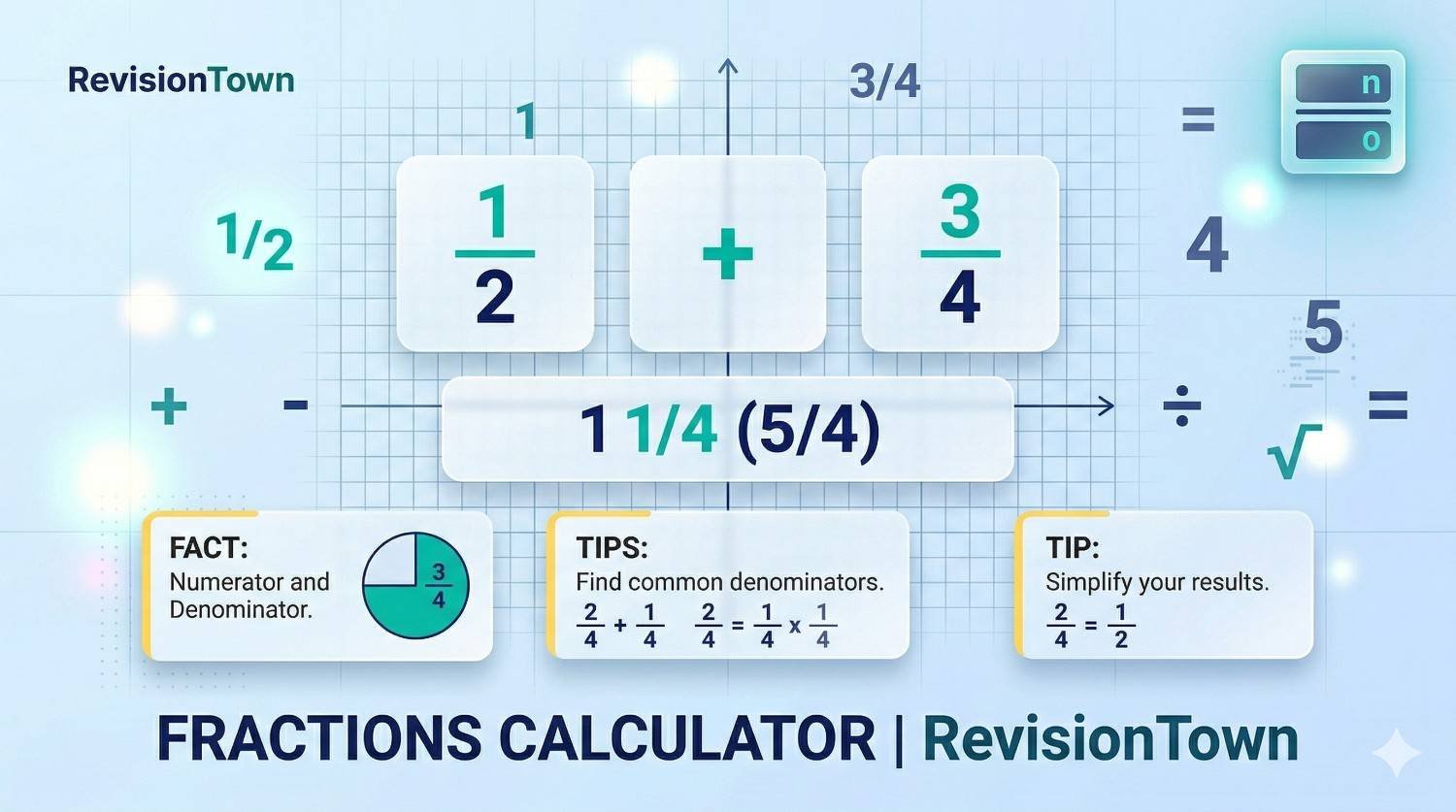
Add, subtract, multiply, divide, simplify, convert and compare fractions or mixed numbers with step-by-step working.
Use this calculator for homework checks, recipe scaling, classroom examples and exam revision. It keeps exact fractional answers first, then shows the mixed number, decimal and percentage forms where useful.
Recent Calculations
- Results you calculate in this session will appear here.
Fraction Rules and Formulas
Fractions are ratios of two integers. The numerator counts the selected parts, and the denominator names the equal parts in one whole. A fraction is in simplest form when the numerator and denominator share no common factor greater than 1.
| Task | Rule | Example |
|---|---|---|
| Add fractions | a/b + c/d = (ad + bc) / bd, then simplify. For easier arithmetic, use the least common denominator. | 1/2 + 3/4 = 2/4 + 3/4 = 5/4 |
| Subtract fractions | a/b - c/d = (ad - bc) / bd, then simplify. | 5/6 - 1/4 = 10/12 - 3/12 = 7/12 |
| Multiply fractions | a/b x c/d = ac / bd. Simplify before or after multiplying. | 2/3 x 9/10 = 18/30 = 3/5 |
| Divide fractions | a/b / c/d = a/b x d/c. Multiply by the reciprocal of the second fraction. | 3/5 / 2/7 = 3/5 x 7/2 = 21/10 |
| Simplify | Divide numerator and denominator by their greatest common divisor. | 24/36, GCD 12, becomes 2/3 |
| Compare | For positive denominators, compare a x d with c x b. | 5/8 vs 3/5: 25 > 24, so 5/8 > 3/5 |
Common Fraction Equivalents
These benchmark fractions are useful for mental math, cooking, measurement, money problems, percentage questions and quick answer checks.
| Fraction | Decimal | Percentage | Useful note |
|---|---|---|---|
| 1/2 | 0.5 | 50% | Half of a whole |
| 1/3 | 0.333333... | 33.333333...% | Recurring decimal |
| 2/3 | 0.666666... | 66.666666...% | Twice one third |
| 1/4 | 0.25 | 25% | One quarter |
| 3/4 | 0.75 | 75% | Three quarters |
| 1/5 | 0.2 | 20% | Fifths convert cleanly to tenths |
| 1/8 | 0.125 | 12.5% | Common in rulers and recipes |
| 3/8 | 0.375 | 37.5% | Three eighths |
| 5/8 | 0.625 | 62.5% | Five eighths |
| 7/8 | 0.875 | 87.5% | One eighth less than 1 |
Worked Examples
Example 1: Add 1/2 + 3/4
- The least common denominator of 2 and 4 is 4.
- Convert 1/2 to 2/4.
- Add: 2/4 + 3/4 = 5/4.
- As a mixed number, 5/4 = 1 1/4.
Answer: 5/4 or 1 1/4.
Example 2: Multiply 2 1/3 x 3/5
- Convert 2 1/3 to 7/3.
- Multiply: 7/3 x 3/5 = 21/15.
- Simplify by 3 to get 7/5.
- As a mixed number, 7/5 = 1 2/5.
Answer: 7/5 or 1 2/5.
Example 3: Simplify 24/36
- The greatest common divisor of 24 and 36 is 12.
- Divide both terms by 12.
- 24/36 = 2/3.
Answer: 2/3.
Example 4: Convert 3/8 to a percentage
- Divide numerator by denominator: 3 / 8 = 0.375.
- Multiply by 100 to convert to percent.
- 0.375 x 100 = 37.5%.
Answer: 37.5%.
Common Fraction Mistakes to Avoid
Calculation checks
- Do not add denominators when adding fractions. Find a common denominator and add only the numerators.
- For division, multiply by the reciprocal of the second fraction, not the first.
- Simplify the final answer unless the question asks for an unsimplified form.
- Keep denominator signs positive. Move any negative sign to the numerator or in front of the whole fraction.
Mixed number checks
- Convert mixed numbers to improper fractions before operating.
- For a negative mixed number such as -2 1/3, treat the whole value as negative: -7/3.
- When converting improper fractions back to mixed numbers, divide the numerator by the denominator and keep the remainder over the denominator.
- Use decimals for estimates, but keep fractions for exact answers.
Data quality note: the calculator uses integer arithmetic for exact fraction operations wherever possible, then derives decimal and percentage previews from the simplified exact result. Educational explanations cover fraction rules commonly taught in middle school, GCSE, IGCSE, SAT, ACT and early algebra courses.
Related RevisionTown Tools
Use these pages when you need a narrower calculator, extra practice, or adjacent math tools.
Fractions Calculator FAQ
Find a common denominator, rewrite each fraction with that denominator, add the numerators, then simplify the result. For example, 1/2 + 3/4 becomes 2/4 + 3/4 = 5/4.
Divide the numerator and denominator by their greatest common divisor. For 24/36, the greatest common divisor is 12, so 24/36 simplifies to 2/3.
Multiply the numerators together and multiply the denominators together, then simplify. For example, 2/3 x 9/10 = 18/30 = 3/5.
Multiply the first fraction by the reciprocal of the second fraction. For example, 3/5 divided by 2/7 becomes 3/5 x 7/2 = 21/10.
Yes. Enter the whole number, numerator and denominator. The calculator converts mixed numbers to improper fractions for calculation, then shows the simplified mixed-number result.
Write the decimal over a power of 10, then simplify. For example, 0.375 = 375/1000 = 3/8.