Body composition calculator
Body Fat Calculator
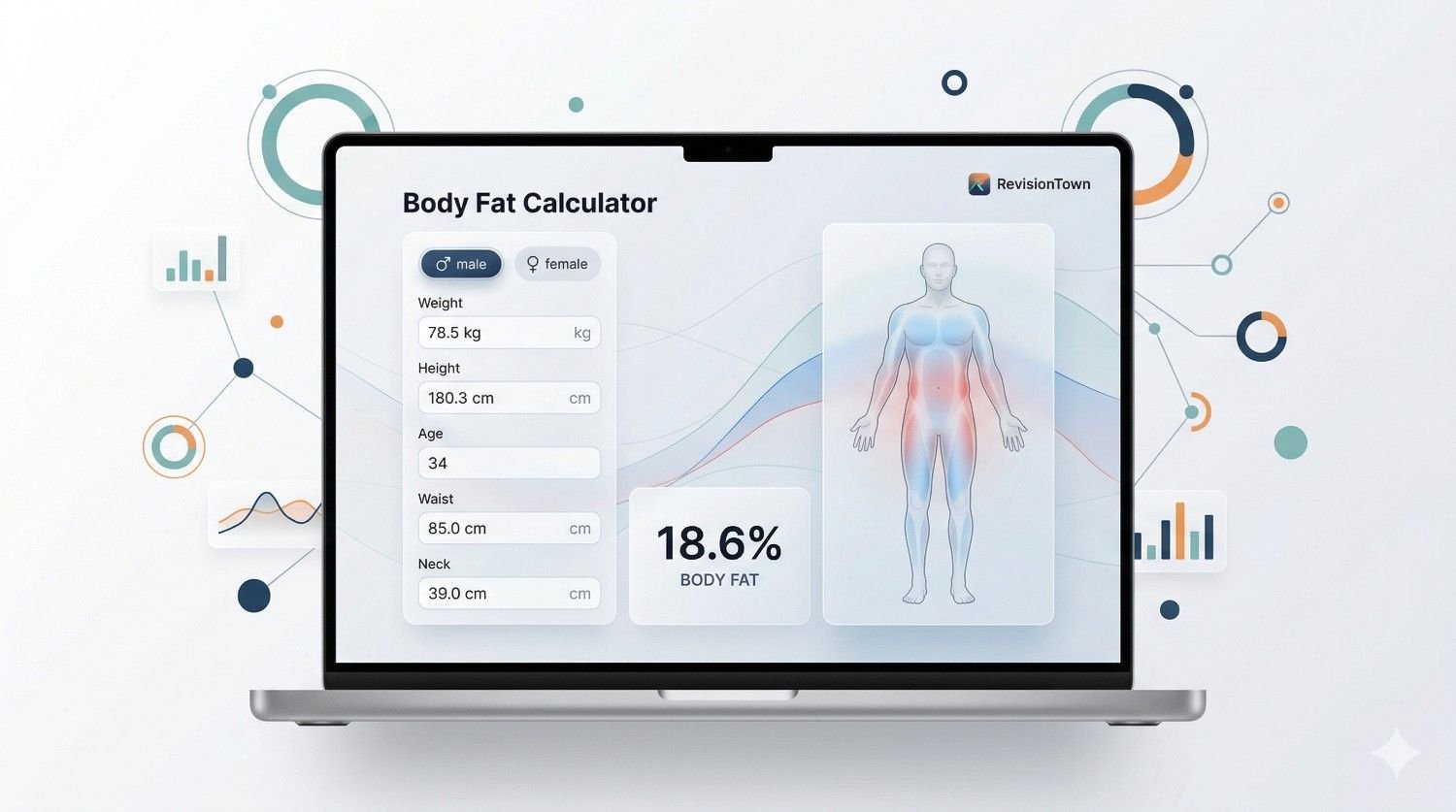
Estimate body fat percentage with the tape-measure Navy method, compare it with a BMI-based adult estimate, calculate fat mass and lean body mass, and plan a realistic target body fat range. This page focuses on practical body composition interpretation, not just a single number on the scale.
Calculate Body Fat Percentage, Fat Mass, and Lean Mass
Choose the method you want to emphasize, enter your measurements, and review the results. Metric entries are converted internally where a formula uses inch-based circumference values.
What This Body Fat Calculator Does
The Body Fat Calculator estimates the percentage of body weight that is fat mass, then translates that estimate into fat mass, lean body mass, and a target-weight scenario. It is built for people who want more context than body weight alone can provide. Scale weight treats muscle, bone, organs, water, and fat as one total number. Body fat percentage separates that total into estimated fat and non-fat components, which can be more useful for fitness planning, body recomposition, and progress tracking.
This page keeps the focus on body fat estimation and interpretation. If you only need a quick percentage tool, the body fat percentage calculator is a narrower option. If you want a broader body-composition workflow with additional assumptions, compare this page with the advanced body fat calculator or the highly advanced body fat calculator. For planning calories after estimating body composition, the highly advanced BMR calculator, advanced TDEE calculator, and highly advanced calorie calculator are more appropriate next steps.
The calculator uses three practical outputs. First, it estimates body fat percentage using circumference measurements or a BMI-based adult formula. Second, it calculates estimated fat mass and lean body mass. Third, it estimates a target body weight for a selected target body fat percentage, assuming lean mass is maintained. That last assumption matters. If lean mass changes, the target weight changes too.
Body Fat Percentage Explained
Body fat percentage is the proportion of total body weight made up of fat tissue. If a person weighs 80 kilograms and has an estimated body fat percentage of 20%, the estimated fat mass is 16 kilograms and the estimated lean body mass is 64 kilograms. Lean body mass includes muscle, bone, organs, connective tissue, water, and other non-fat tissues. It is not the same thing as muscle mass, but it is often a useful proxy when planning fat loss or muscle gain.
Body fat percentage can explain why two people with the same height and weight may look, perform, and respond to training very differently. One person may carry more lean mass and less fat mass; another may carry less lean mass and more fat mass. Their scale weights are identical, but their body composition is not. This is one reason body fat estimates are often used alongside waist circumference, strength trends, photos, performance markers, and health markers instead of relying on weight alone.
Body fat also has essential functions. It supports hormone production, helps absorb fat-soluble vitamins, contributes to insulation, protects organs, and stores energy. The goal is not to remove all fat. The goal is to understand whether current body composition supports health, performance, and personal goals. Extremely low and very high levels can both create concerns, but a calculator cannot diagnose risk for an individual.
Formulas Used by the Calculator
The circumference method in this calculator uses the common U.S. Navy-style equations. These equations use base-10 logarithms of circumference measurements relative to height. The inch-based versions are shown below. When you enter metric values, the calculator converts centimeters to inches before applying the equations.
Men, using inches:
\[ \text{BF\%}=86.010\log_{10}(\text{waist}-\text{neck})-70.041\log_{10}(\text{height})+36.76 \]Women, using inches:
\[ \text{BF\%}=163.205\log_{10}(\text{waist}+\text{hip}-\text{neck})-97.684\log_{10}(\text{height})-78.387 \]The BMI-based estimate uses the adult Deurenberg equation. It is useful when no tape measure is available, but it is less individualized than circumference methods because it does not directly measure waist, neck, hip, or body shape.
In this formula, sex is 1 for male and 0 for female.
These are estimation equations. They are not a direct measurement of tissue. For many users, the value of the calculator is not that it gives a perfect number. The value is that it turns body measurements into a consistent estimate that can be tracked over time under similar conditions.
How to Measure for the Navy Method
Measurement technique matters. A small change in tape position or tightness can move the estimate by several percentage points. Use a flexible, non-stretch tape measure. Keep the tape level, snug, and in contact with the skin without compressing soft tissue. Take measurements in the same conditions each time, preferably in the morning before a large meal and after using the bathroom.
| Measurement | How to take it | Common error |
|---|---|---|
| Height | Stand tall without shoes. Use centimeters or feet and inches accurately. | Entering 5 feet 10 inches as 5.10 feet instead of 70 total inches. |
| Neck | Measure just below the larynx, with shoulders relaxed and head facing forward. | Angling the tape or including shoulder muscles. |
| Waist or abdomen | For a Navy-style estimate, measure around the abdomen at navel level after a relaxed exhale. | Pulling the stomach in, holding the breath, or compressing the tape. |
| Hip | For the female equation, measure the hips at the widest point. | Using a narrow upper-hip point instead of the widest circumference. |
Take each circumference more than once. If two measurements are close, average them or use the most consistent reading. If they differ widely, pause and repeat the measurement carefully. The goal is not to force a better result; the goal is to make the measurement repeatable. A repeatable estimate is more useful for progress tracking than an optimistic estimate.
Navy Method vs BMI-Based Estimate
The Navy method and BMI-based estimate answer similar questions with different inputs. The Navy method uses circumferences and height. It can reflect abdominal size and body shape more directly than BMI. The BMI method uses height, weight, age, and sex. It is easier to complete, but it cannot distinguish a muscular body from a body carrying more fat at the same height and weight.
| Method | Inputs | Best use | Main limitation |
|---|---|---|---|
| Navy circumference method | Height, waist or abdomen, neck, and hip for the female equation. | Home body fat estimate when a tape measure is available. | Sensitive to tape placement, posture, and formula assumptions. |
| BMI-based estimate | Height, weight, age, and sex. | Quick screening estimate when circumference measurements are unavailable. | Less accurate for muscular people, older adults with low lean mass, and unusual body proportions. |
| Target planner | Weight, current body fat percentage, and target body fat percentage. | Planning a realistic body-composition target. | Assumes lean body mass stays constant, which may not happen. |
If the Navy and BMI estimates are close, you have a reasonable starting range. If they are far apart, review your measurements and your body type. A strength-trained person may have a BMI-based estimate that is too high. A person with low muscle mass may have a BMI-based estimate that is too low. The circumference method may also be affected by where fat is stored and how the tape is used.
General Body Fat Categories
Body fat categories are broad reference ranges, not diagnoses. They vary by source, population, age, sex, athletic context, and measurement method. The calculator uses general adult fitness categories to make results easier to interpret, but the category should not replace medical evaluation or individualized coaching.
| Category | Men | Women | Practical interpretation |
|---|---|---|---|
| Essential fat | 2% to 5% | 10% to 13% | Minimum fat needed for basic physiological function; not a casual target. |
| Athlete range | 6% to 13% | 14% to 20% | Often seen in highly trained people, but sustainability varies. |
| Fitness range | 14% to 17% | 21% to 24% | Common target range for many recreational fitness goals. |
| Average range | 18% to 24% | 25% to 31% | May be appropriate for many adults depending on health context. |
| Higher range | 25% and above | 32% and above | May be associated with higher health risk, especially with larger waist circumference. |
Do not treat the boundary between categories as a sharp biological line. A result of 24.9% and 25.1% is practically the same estimate, especially when measurement error may be several percentage points. Categories are useful for orientation. Trends, health markers, performance, waist circumference, and professional advice provide the deeper context.
Worked Example: Navy Method
Suppose a male user enters a height of 180 centimeters, a weight of 80 kilograms, a waist circumference of 85 centimeters, and a neck circumference of 38 centimeters. The calculator first converts the circumference and height measurements from centimeters to inches because the displayed Navy equation uses inch-based constants.
The male circumference value is waist minus neck:
The estimate is about 16.2% body fat. Fat mass and lean body mass are then calculated from body weight:
The result is an estimate, not a lab measurement. If the same user measures the waist at a different point or pulls the tape tighter, the answer changes. That is why measurement consistency matters more than chasing a single decimal place.
Worked Example: BMI-Based Method
Suppose a 30-year-old female user is 165 centimeters tall and weighs 65 kilograms. First calculate BMI:
For the adult Deurenberg formula, sex is 0 for female:
Estimated fat mass is:
Estimated lean body mass is:
This method is convenient, but it should be interpreted cautiously. BMI-based body fat formulas are population equations. They can be useful for a quick estimate, but they are not the best choice for people with unusually high muscle mass, low muscle mass, or atypical fat distribution.
Target Body Fat and Target Weight
The target planner estimates the body weight that would correspond to a selected body fat percentage if lean body mass stayed the same. This is a planning model, not a guarantee. During fat loss, some lean mass may be lost if the deficit is too aggressive, protein is too low, resistance training is absent, or recovery is poor. During muscle gain, lean mass may increase, which changes the target-weight math.
For example, a person who weighs 90 kilograms at 30% body fat has estimated lean body mass of 63 kilograms:
If the target is 20% body fat and lean mass is maintained, target weight is:
The estimated change is 11.25 kilograms. In real life, the final number may differ because lean mass, water, glycogen, and measurement error change. The target is best used as a rough planning range, not a rigid endpoint.
Lean Body Mass, Fat Mass, and Why They Matter
Fat mass is the estimated mass of fat tissue. Lean body mass is everything else. Many fitness goals are better described in terms of both values instead of scale weight alone. A person who loses 8 kilograms with most of the change coming from fat mass has made a different type of progress than a person who loses 8 kilograms while also losing substantial lean mass.
The lean body mass calculator can help isolate that part of the calculation. Lean mass matters because it is connected with strength, function, training performance, resting energy expenditure, and long-term weight maintenance. It is also one reason resistance training is commonly paired with fat loss. The goal is usually not just to become lighter; the goal is to improve the ratio of lean tissue to fat tissue in a sustainable way.
For calorie planning, lean body mass also helps interpret metabolic estimates. The BMR calculator can estimate resting energy needs, and some equations use lean body mass directly. After energy needs are estimated, the advanced macro calculator, advanced protein calculator, and advanced fat intake calculator can help translate calorie targets into practical nutrition ranges.
Body Fat Percentage vs BMI
BMI is a height-to-weight index. It is easy to calculate and widely used in population screening, but it does not directly measure body fat. Body fat percentage attempts to estimate composition. Both values can be useful, but they should not be confused. BMI can identify broad weight-status patterns, while body fat percentage gives more detail about fat mass and lean mass.
The BMI calculator is useful when you want a simple height-and-weight reference. The body fat calculator is more useful when you want to estimate composition. A muscular person may have a high BMI but a moderate body fat percentage. An older sedentary person may have a normal BMI but a higher body fat percentage because lean mass is lower. That situation is one reason body composition can add context to BMI.
Neither BMI nor body fat percentage replaces medical assessment. Blood pressure, blood lipids, glucose control, waist circumference, medication history, family history, sleep, fitness, and symptoms can all matter. A single calculator result should not be treated as a complete health profile.
Waist Circumference and Fat Distribution
Body fat percentage estimates total fat relative to weight, but it does not fully describe where fat is stored. Fat stored around the abdomen can carry different health implications than fat stored around the hips and thighs. This is why waist circumference can be useful alongside body fat percentage. A person with the same body fat percentage as another person may have a different waist measurement and a different risk profile.
Abdominal fat includes both subcutaneous fat under the skin and visceral fat around internal organs. External tape measurements cannot precisely separate those tissues, but waist circumference can still provide useful context. If body fat percentage decreases while waist circumference decreases, that usually supports the conclusion that fat loss is occurring. If scale weight decreases but waist does not change and strength falls, lean mass loss may be part of the change.
For tracking, measure waist at the same landmark each time. The Navy-style male equation uses abdomen at navel level. Other health guidelines may use a different anatomical point. The exact landmark should stay consistent for your own trend. Mixing landmarks makes comparisons unreliable.
Tracking Progress Without Overreacting
Body composition changes slowly. A one-week change in estimated body fat percentage may reflect measurement noise more than actual tissue change. Tape tension, hydration, sodium, digestion, skin temperature, posture, and where the tape sits can all influence measurements. This is why monthly or biweekly comparisons often make more sense than daily body fat calculations.
Use multiple indicators. Track body weight trend, waist measurement, strength, training performance, clothing fit, energy, appetite, sleep, and photos under similar lighting. If body weight is stable but waist decreases and strength increases, recomposition may be happening. If body weight falls quickly but strength, energy, and mood collapse, the plan may be too aggressive. If body fat estimate changes sharply overnight, measurement error is more likely than true fat loss or gain.
Consistency is the main skill. Use the same tape, same measurement points, same time of day, and same calculation method. Do not switch between Navy method, BIA scale, skinfolds, and BMI formula every week and expect a clean trend. Different methods can produce different absolute values. Pick one method for trend tracking and use other methods only as additional context.
Using Body Fat Results for Fat Loss
For fat loss, body fat percentage can help turn a vague weight-loss goal into a body-composition goal. Instead of saying "I want to lose 10 kilograms," a person can estimate current fat mass and lean body mass, choose a realistic target body fat range, and plan a pace that protects lean mass. The calorie target still comes from energy balance, but the body fat estimate helps define what kind of weight loss is desired.
A practical fat-loss workflow is to estimate body fat percentage, calculate fat mass and lean body mass, estimate maintenance calories, choose a moderate deficit, set protein intake, train with resistance, and monitor trends. The maintenance calorie calculator can help compare maintenance estimates, while the protein calculator can support lean mass preservation planning.
Aggressive deficits may create quick scale changes but can increase the risk of lean mass loss, fatigue, poor training, rebound hunger, and poor adherence. A slower plan may produce better body composition because it gives the user more room to train, recover, and maintain daily movement. The best pace depends on body size, health status, training history, schedule, and professional guidance when needed.
Using Body Fat Results for Muscle Gain
During muscle gain phases, body fat percentage helps monitor whether weight gain is mostly productive. A small calorie surplus, progressive resistance training, adequate protein, and enough recovery can support lean mass gain. However, if body weight rises quickly and body fat estimate rises quickly, the surplus may be larger than needed. If weight does not rise and strength stalls, the surplus may be too small or recovery may be insufficient.
The goal is not to keep body fat unchanged forever. Some fat gain may occur during a muscle gain phase. The question is whether the tradeoff supports the goal. A person gaining 0.2 to 0.5 kilograms per week with improving performance may be in a reasonable range. A person gaining much faster without corresponding strength or muscle changes may want to review calorie intake. The calorie calculator and TDEE calculator can help adjust energy targets.
For people focused on recomposition, body fat percentage may improve while scale weight changes little. Beginners, returning lifters, and people with higher starting body fat may be more likely to gain muscle and lose fat in the same phase. In that case, the most useful signs are improved strength, reduced waist measurement, stable or improved energy, and a slow change in estimated body fat.
Accuracy and Limitations
Every practical body fat calculator has error. The Navy method is accessible, but it estimates body density from circumference relationships. It may not fit every body type. The BMI method is even more general because it uses only height, weight, age, and sex. Neither method can directly measure visceral fat, muscle mass, bone density, hydration, or regional composition.
Laboratory methods such as DEXA, air displacement plethysmography, hydrostatic weighing, and multi-compartment models can provide more detailed estimates, but even they have assumptions and measurement conditions. Home bioelectrical impedance devices are convenient, but hydration status can strongly affect readings. Skinfold calipers can be useful with a trained technician, but site selection and technique matter.
The best use of this calculator is consistent trend tracking and practical planning. If you need a clinical assessment, athletic testing standard, medical monitoring, or evaluation of a health condition, use qualified professional assessment. If you are pregnant, postpartum, under 18, recovering from an eating disorder, managing a chronic disease, or experiencing unexplained weight change, do not rely on this calculator as the main decision tool.
Common Body Fat Calculator Mistakes
- Using the wrong unit system. Inch-based formulas require inches. This calculator converts metric inputs internally, but the values entered must match the selected unit system.
- Measuring the waist at different points. A navel-level abdomen measurement and a narrowest-waist measurement can produce different results.
- Pulling the tape too tight. Compressing tissue can artificially lower circumference values.
- Entering goal weight as current weight. The calculator estimates current body composition from current data.
- Expecting daily precision. Body fat changes slowly, and measurements contain noise.
- Comparing different methods as if they are interchangeable. Navy, BMI, BIA, DEXA, and skinfolds may all produce different absolute values.
- Ignoring lean mass. Fat loss is more useful when lean mass is preserved as much as possible.
- Treating a category as a diagnosis. Categories are broad guides, not medical conclusions.
How to Interpret a Single Body Fat Result
A single body fat result is best understood as an estimate with a range around it. If the calculator returns 24.0%, the practical interpretation is not that the person has exactly 24.0% body fat. A more realistic interpretation is that the person may be near that value if the measurements were taken accurately and if the equation fits that person's body proportions reasonably well. This distinction matters because many users become distracted by tiny changes that are smaller than the likely measurement error.
The first question is whether the result is plausible. A circumference estimate that is dramatically different from visual appearance, previous measurements, or other methods should be reviewed before it is used for planning. Check the unit system, height entry, tape placement, and whether the circumference value was measured at the correct landmark. For the male Navy-style equation, waist minus neck must be positive and large enough to make sense. For the female equation, waist plus hip minus neck must be positive and realistic. If the calculator rejects the value or shows an unusual result, the measurement relationship is probably outside a practical range.
The second question is whether the result matches the goal context. A recreational exerciser trying to improve health does not need the same body fat target as a physique athlete preparing for a short-term event. A person returning from injury may care more about rebuilding strength and restoring activity than reaching a very lean category. Someone with a medical condition may need individualized guidance where body fat percentage is only one small part of the assessment.
The third question is whether the result is actionable. A good estimate should help decide the next step. If body fat is higher than desired and waist circumference is also high, the next step may be a moderate calorie deficit, more activity, strength training, and a plan that protects lean mass. If body fat is already low and energy, sleep, or hormones are affected, the next step may be maintenance, recovery, or professional advice rather than further fat loss. If body fat is in a reasonable range but performance is poor, nutrition quality, sleep, training structure, and stress may matter more than lowering the percentage.
Interpretation should also include time. A result is more useful when compared with previous results taken under similar conditions. A person who moves from 34% to 30% over several months while strength improves is likely making useful progress. A person who moves from 18% to 17.5% in one week may simply be seeing tape or hydration variation. The longer trend is more meaningful than the short-term fluctuation.
How to Compare Body Fat Estimates From Different Methods
It is common for different methods to disagree. A Navy circumference estimate might say 19%, a smart scale might say 23%, a BMI formula might say 25%, and a DEXA scan might show a regional breakdown that does not match any home device exactly. This can feel frustrating, but it is normal. Each method uses different assumptions. The useful question is not always "Which number is perfect?" The useful question is "Which method can I repeat consistently, and what trend does it show?"
When methods differ, separate absolute value from trend value. A home method may not give the exact true value, but it may still show direction if performed consistently. For example, if a person uses the same tape method every month and waist circumference decreases while the estimated body fat percentage decreases, the trend is useful even if the exact percentage is not perfect. A body composition scan may provide a more detailed snapshot, but if it is only performed once a year, it may not guide week-to-week decisions.
Do not average every method automatically. If one method is clearly inappropriate for the person, averaging can make the result worse. A BMI-based formula may overestimate body fat for a muscular strength athlete. A consumer impedance scale may swing with hydration. A tape method may be unreliable if the user cannot find the same waist landmark. In those cases, choose the method that is most repeatable and most relevant to the goal, then use the others as secondary context.
For most home users, the strongest low-cost approach is a combination of body weight trend, waist circumference, progress photos, training performance, and one consistent body fat estimate. If those indicators point in the same direction, confidence increases. If they conflict, slow down and review the data. For example, if body weight drops but waist stays the same and strength falls, the weight loss may not be the kind of progress the user wanted. If weight is stable but waist drops and strength rises, recomposition may be occurring even when the scale is quiet.
Different methods are also affected by different preparation rules. Impedance devices often ask for consistent hydration and timing. Tape methods require consistent landmarks and posture. Skinfolds require trained technique. Scans require controlled conditions and proper interpretation. When comparing methods, note the conditions under which each measurement was taken. A number without context can mislead.
Body Fat, Lean Mass, and Energy Planning
Body fat percentage becomes more useful when it connects to energy planning. A calorie deficit that reduces body weight but also reduces lean mass may not be ideal. A calorie surplus that increases body weight rapidly but mostly increases fat mass may not be ideal either. Estimating fat mass and lean body mass helps clarify what kind of change is happening.
For fat loss, the aim is usually to reduce fat mass while preserving as much lean mass as practical. This requires enough protein, resistance training, a sustainable deficit, and recovery. If a user loses weight rapidly while strength drops and measurements do not improve as expected, the deficit may be too aggressive or training may be insufficient. If weight loss is slow but waist, photos, and performance improve, progress may be better than the scale suggests.
For muscle gain, the aim is usually to increase lean mass while keeping fat gain controlled. A surplus that is too small may not support training adaptation. A surplus that is too large may increase fat mass faster than needed. Body fat tracking can help decide when to continue a gain phase, slow the surplus, return to maintenance, or start a fat-loss phase. The calculator does not make that decision automatically, but it provides numbers that make the tradeoff clearer.
For maintenance, body fat percentage can show whether weight stability is truly stable body composition. Some people maintain the same scale weight while gradually gaining fat and losing muscle because activity and training decline. Others maintain scale weight while improving body composition through resistance training and better nutrition. A stable scale is useful, but it is not the whole story.
Energy planning should be reviewed in blocks, not every day. A reasonable block might be four to eight weeks. During that period, keep the method consistent, review weekly averages, and adjust only when the trend is clear. Constant daily changes can create confusion and make it impossible to know what worked.
Measurement Schedule and Data Review
A structured measurement schedule makes body fat tracking more useful. For many people, body weight can be tracked several times per week if it does not create stress, waist measurement can be taken weekly or every two weeks, and body fat percentage can be estimated every two to four weeks. More frequent body fat measurements are rarely more informative because circumference changes are small and measurement noise can be large.
Use a simple log. Record date, body weight, waist, neck, hip if used, estimated body fat percentage, training notes, sleep quality, and any unusual factors such as travel, illness, soreness, or a large restaurant meal. These notes prevent overreaction. If a measurement is unexpectedly high after poor sleep and high sodium intake, it may be water and digestion rather than fat gain. If the trend remains high for several weeks, it deserves more attention.
Review data in patterns. A single measurement answers "What did the calculator estimate today?" A pattern answers "What is changing?" A useful review might ask: Is waist moving in the expected direction? Is strength stable or improving? Is body weight trend matching the goal? Is hunger manageable? Is sleep acceptable? Are measurements being taken consistently? If the answer to several of these questions is no, the plan needs adjustment even if the calculator result looks favorable.
When measuring, avoid changing many variables at once. If you start a new training program, change calorie intake, increase steps, and change meal timing all in one week, the next measurement may be hard to interpret. Sometimes that is unavoidable, but when possible, make controlled changes. Body composition tracking is more informative when the process is stable enough for cause and effect to be visible.
Do not let the measurement schedule become the goal. The goal is better health, performance, confidence, function, or body composition. The calculator is a tool. If repeated measuring causes anxiety or obsessive behavior, reduce the frequency or work with a qualified professional.
Special Cases and When Estimates Need Extra Caution
Some situations require extra caution because standard adult body fat equations may fit poorly. Very muscular individuals may receive BMI-based estimates that are too high. Older adults with reduced muscle mass may receive estimates that look acceptable even when function and strength need attention. People with unusual limb proportions, very high or very low body weight, or atypical fat distribution may not match the assumptions behind circumference equations.
Pregnancy and the postpartum period require individualized care. Body composition, fluid balance, hormones, recovery, and nutritional needs are changing, and standard body fat targets may be inappropriate. Children and adolescents should not use adult body fat calculators for decision-making because growth, puberty, and development require specialized interpretation. People with edema, lymphedema, recent surgery, or conditions affecting fluid balance may also get misleading circumference or impedance results.
Eating disorder history is another important case. Body fat calculations, calorie targets, and frequent measurements can be triggering or harmful for some people. In that situation, the safest approach is not a more detailed calculator; it is support from qualified professionals. Health includes physical, mental, and behavioral well-being, and a number cannot capture all of that.
Athletes in sports with weight classes, appearance standards, or endurance demands should also be careful. Lower body fat is not always better. Performance can decline if energy availability is too low, recovery suffers, or hormonal function is disrupted. A body fat target should support the sport, training phase, and long-term health. Short-term event preparation is different from year-round living.
If a body fat estimate leads to extreme decisions, it is being used incorrectly. The purpose of the calculator is to support informed planning, not to pressure users toward unsafe targets. When in doubt, use the result as a conversation starter with a qualified professional rather than as a final answer.
Choosing a Realistic Target Body Fat Percentage
A realistic target is specific, safe, and connected to the user's actual goal. For many people, the best first target is not an athlete-range number. It may be a modest reduction in waist circumference, a 3 to 5 percentage point change in estimated body fat, or a maintenance phase that improves strength while body fat stays stable. Smaller targets are easier to evaluate and adjust.
Start with the current estimate and category, then choose a direction. If the current estimate is in a higher range and waist circumference is also high, a first target might be moving toward the average range while improving activity and nutrition habits. If the current estimate is already in the fitness range, a lower target may require more sacrifice and may not improve health or performance. If the current estimate is below the essential range, the target should usually move upward, not downward, and professional guidance may be important.
Use target-weight math carefully. The formula assumes lean mass is preserved. If the current lean mass estimate is 60 kilograms and the target is 20% body fat, the target weight estimate is 75 kilograms. If lean mass increases to 62 kilograms, the target weight at the same body fat percentage becomes 77.5 kilograms. If lean mass decreases to 58 kilograms, the target weight becomes 72.5 kilograms. The body is not a spreadsheet with fixed cells. Lean mass, water, glycogen, and digestive contents all change.
The best targets also include behaviors. A target might be: estimate body fat monthly, strength train three times per week, average a moderate calorie deficit, reach a protein range, walk daily, and review the trend after six weeks. That plan is more actionable than simply saying "reach 15%." Outcomes follow behaviors, and behaviors are easier to adjust.
Finally, choose a target that can be maintained. A result achieved through dehydration, crash dieting, or unsustainable restriction may disappear quickly and may harm health. A slightly higher body fat percentage that supports sleep, performance, mood, hormones, and daily life may be a better long-term outcome than a lower number that cannot be sustained.
How to Build a Complete Fitness Planning Workflow
Body fat percentage is only one part of a useful plan. Start by estimating body composition. Then estimate calorie needs, choose a goal pace, set protein and macro ranges, and monitor progress. If the goal is fat loss, use body fat percentage to define the desired composition change. If the goal is muscle gain, use body fat percentage to check whether weight gain is controlled. If the goal is maintenance, use it to confirm that body composition is stable over time.
A practical sequence is:
- Use this calculator to estimate body fat percentage, fat mass, and lean body mass.
- Use the highly advanced BMR calculator to estimate resting energy expenditure.
- Use the advanced TDEE calculator or maintenance calorie calculator to estimate daily energy needs.
- Use the advanced macro calculator, advanced carbohydrate calculator, and protein tools to plan nutrition distribution.
- Review related tools through the health and fitness calculators hub when you need a broader calculator set.
The workflow should remain flexible. If the trend is not matching the estimate, adjust slowly. If training performance is worsening, recovery is poor, or hunger is extreme, the plan may need revision. If health concerns are present, professional guidance should take priority over calculator output.
Practice Problems
Problem 1: Calculate fat mass
A person weighs 72 kilograms and has an estimated body fat percentage of 25%. Fat mass is:
Lean body mass is:
Problem 2: Calculate target weight
A person has 60 kilograms of lean body mass and wants to estimate body weight at 20% body fat, assuming lean mass is maintained:
Problem 3: Compare two methods
If the Navy method estimates 21% and the BMI method estimates 27%, the spread is 6 percentage points. That does not automatically mean one method is useless. It means the user should review circumference technique, body type, and whether BMI is likely to overestimate or underestimate for that individual.
Problem 4: Interpret a trend
A user's body weight drops from 90 kilograms to 86 kilograms over eight weeks, waist circumference decreases, and strength is mostly maintained. Even if the body fat calculator estimate moves only gradually, the combined trend suggests useful fat-loss progress. If strength falls sharply and waist barely changes, the plan should be reviewed.
Important Use Notes
This calculator provides educational estimates only. It is not medical advice, a diagnosis, or a replacement for a physician, registered dietitian, physical therapist, or qualified fitness professional. Body fat equations can be inaccurate for individuals, and body composition targets should be adapted to age, sex, health status, training background, medical history, and personal needs.
Do not use the calculator to justify extreme dieting, dehydration, unsafe weight cutting, or very low body fat targets. If you have a medical condition, symptoms, pregnancy or postpartum concerns, a history of disordered eating, or unexplained weight change, get individualized professional care.
Frequently Asked Questions
Body fat percentage estimates how much of total body weight is fat mass. The rest is lean body mass, including muscle, bone, organs, water, and other non-fat tissue.
It can be useful for home tracking, but it is still an estimate. Accuracy depends on body proportions, measurement technique, tape placement, and the population assumptions behind the equation.
BMI-based formulas use height, weight, age, and sex, but they do not directly measure body shape or lean mass. Muscular people and people with low lean mass can receive less reliable BMI-based estimates.
For most people, weekly, biweekly, or monthly tracking is more useful than daily body fat calculations. Use the same method, measurement points, and conditions each time.
No. The calculator is designed for adult estimation. Children and adolescents need growth-aware assessment from qualified healthcare professionals.
Use the result as a starting point. Pair it with waist measurement, weight trend, training performance, nutrition planning, recovery, and professional guidance when needed.