Perpendicular is a geometry word with a very precise meaning. It describes a right-angle relationship between straight lines, line segments, rays or surfaces. Once you learn to look for the small square that marks a right angle, the symbol ⊥ and the 90° measurement, the idea becomes easy to recognize in diagrams, shapes, graphs and everyday objects.
Direct answer: Perpendicular means “meeting at a right angle.” Two straight lines are perpendicular when the angle between them is exactly 90 degrees. We write this relationship with the symbol ⊥.
What does perpendicular mean in math?
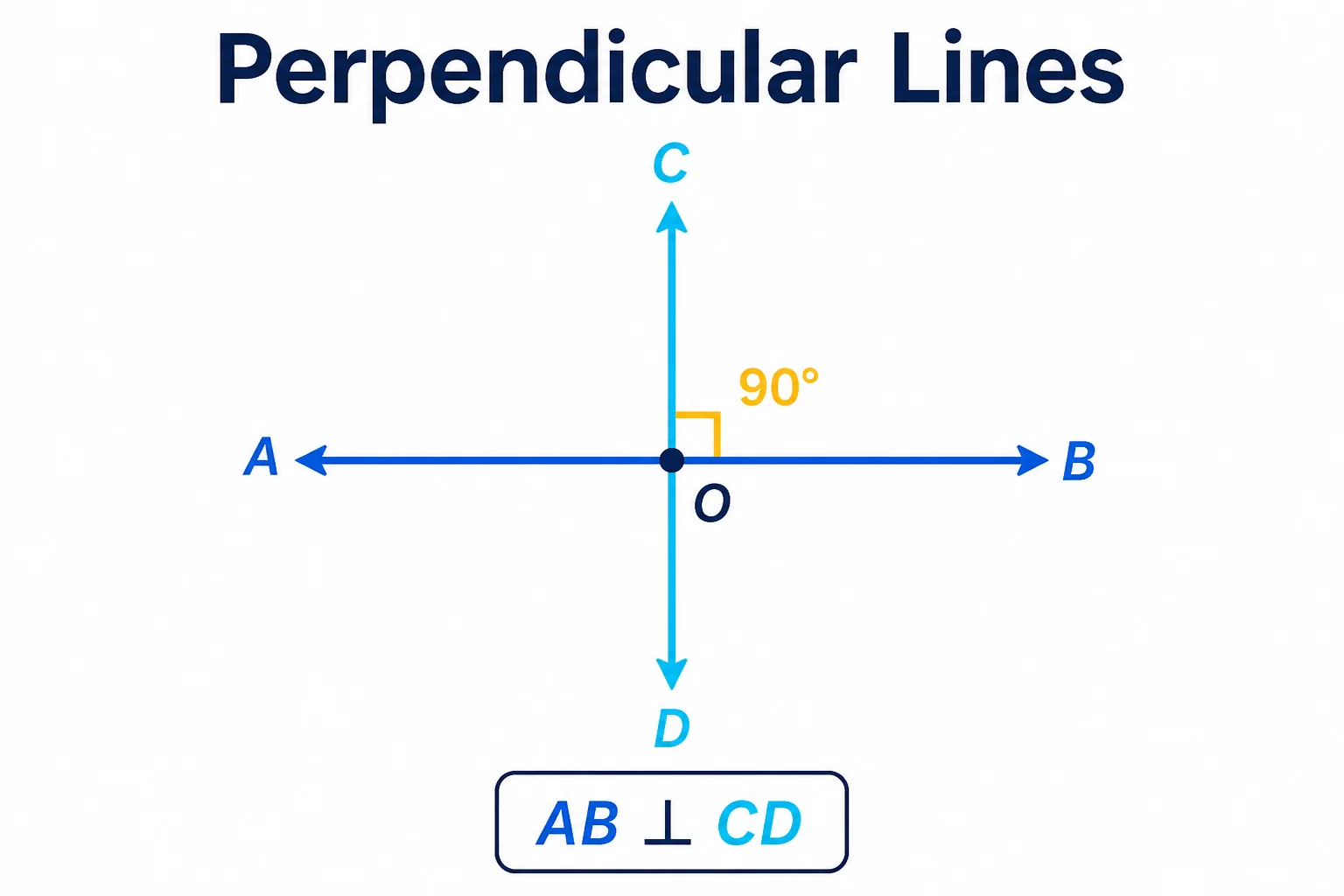
In elementary geometry, perpendicular usually describes two straight lines. Imagine a horizontal line and a vertical line crossing like a plus sign. If the crossing makes a square corner, the lines are perpendicular. Their direction on the page does not matter: you can rotate the whole drawing and the lines remain perpendicular because the angle between them stays 90°.
The lines do not have to look horizontal and vertical. One may slope upward while the other slopes downward. The only test that matters is the angle where they meet. If that angle is a right angle, the relationship is perpendicular.
The perpendicular symbol
The symbol for perpendicular is ⊥, which looks like an upside-down capital T. If line AB and line CD are perpendicular, we write:
The order can be reversed: CD ⊥ AB says the same thing. In a diagram, a tiny square placed inside an angle is another way to show that the angle measures 90°. A diagram drawn roughly may not look exact, so the square marker or written measurement is stronger evidence than appearance alone.
Lines, segments and rays
A line extends forever in both directions, a line segment has two endpoints, and a ray has one endpoint. Any of them can form a perpendicular relationship when their supporting straight paths meet at 90°. Two short segments may not physically touch in the visible drawing, but if extending them would make a right angle, the underlying lines are perpendicular.
Fast recognition rule: Ask one question: “Would these straight paths meet at exactly 90°?” If yes, they are perpendicular. If no, they are not.
Properties of perpendicular lines
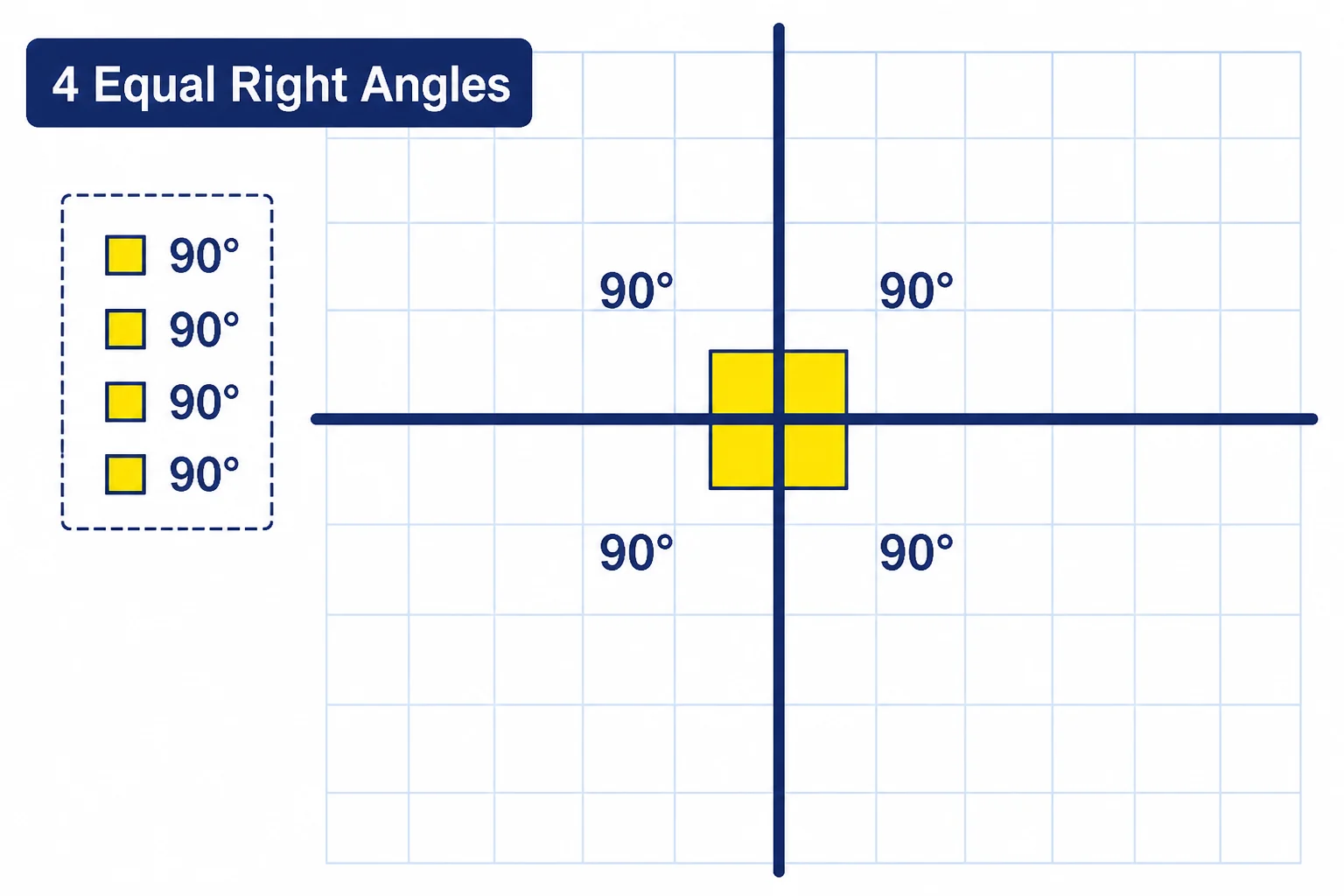
- They form a right angle. This is the defining property. The angle between the lines is exactly 90°.
- Two full lines form four right angles. When straight lines cross, vertically opposite angles are equal and adjacent angles add to 180°. If one angle is 90°, all four are 90°.
- They meet at one point in a plane. That point is called the point of intersection.
- The relationship survives rotation and reflection. Turning or flipping the diagram does not change the 90° angle.
- Exactly one perpendicular can pass through a chosen point. In ordinary Euclidean geometry, there is one unique line through a given point that is perpendicular to a given line.
- Several different lines can be perpendicular to the same line. For example, many vertical fence posts can each be perpendicular to one horizontal rail. Those posts are parallel to one another.
This idea explains why rectangles stay square at their corners and why a perpendicular height gives the shortest distance from a point to a line. It also supports area formulas: the height in a triangle or parallelogram must be measured at a right angle to the base. See the RevisionTown area and perimeter guide for examples using perpendicular height.
Perpendicular, parallel and intersecting lines compared
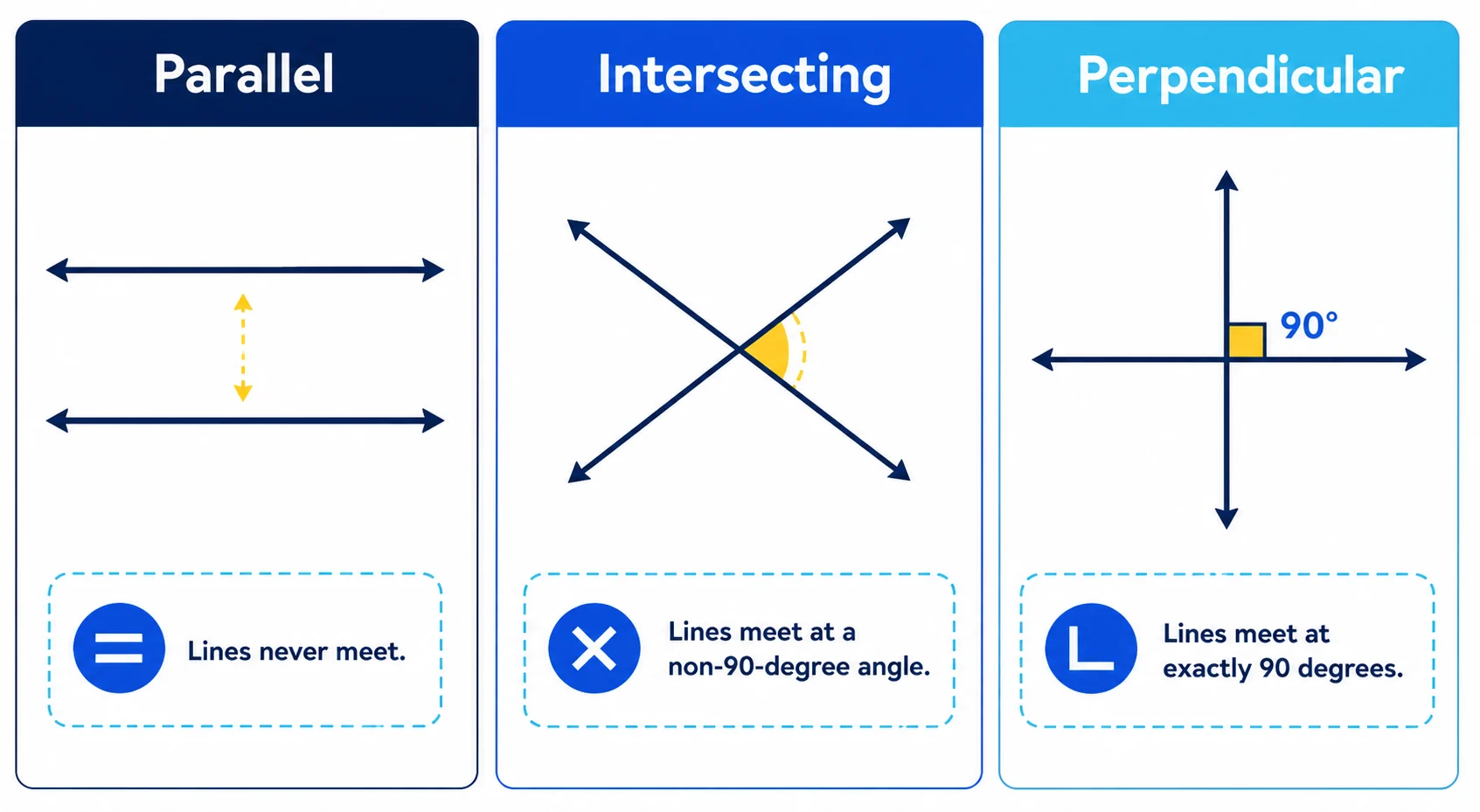
| Relationship | Do the lines meet? | Angle condition | Common symbol |
|---|---|---|---|
| Perpendicular | Yes, if extended | Exactly 90° | ⊥ |
| Parallel | No | No intersection angle | ∥ |
| Intersecting but not perpendicular | Yes | Not 90° | No special universal symbol |
| Coincident | They are the same line | No separate crossing angle | Often written as equal line equations |
What are not perpendicular lines?
Parallel lines are not perpendicular because they never meet. Two diagonal lines that cross at an acute angle, such as 40°, are intersecting but not perpendicular. The neighboring angle may be 140°, but neither value is 90°. Curves also need careful language: introductory geometry normally reserves “perpendicular lines” for straight lines. In later mathematics, two curves may be described as orthogonal when their tangent lines meet at 90°.
Do not trust the page orientation. A vertical-looking line and a horizontal-looking line are often perpendicular, but the drawing may be distorted. Look for a right-angle square, a 90° label, measured evidence or a valid slope calculation.
How to draw perpendicular lines step by step
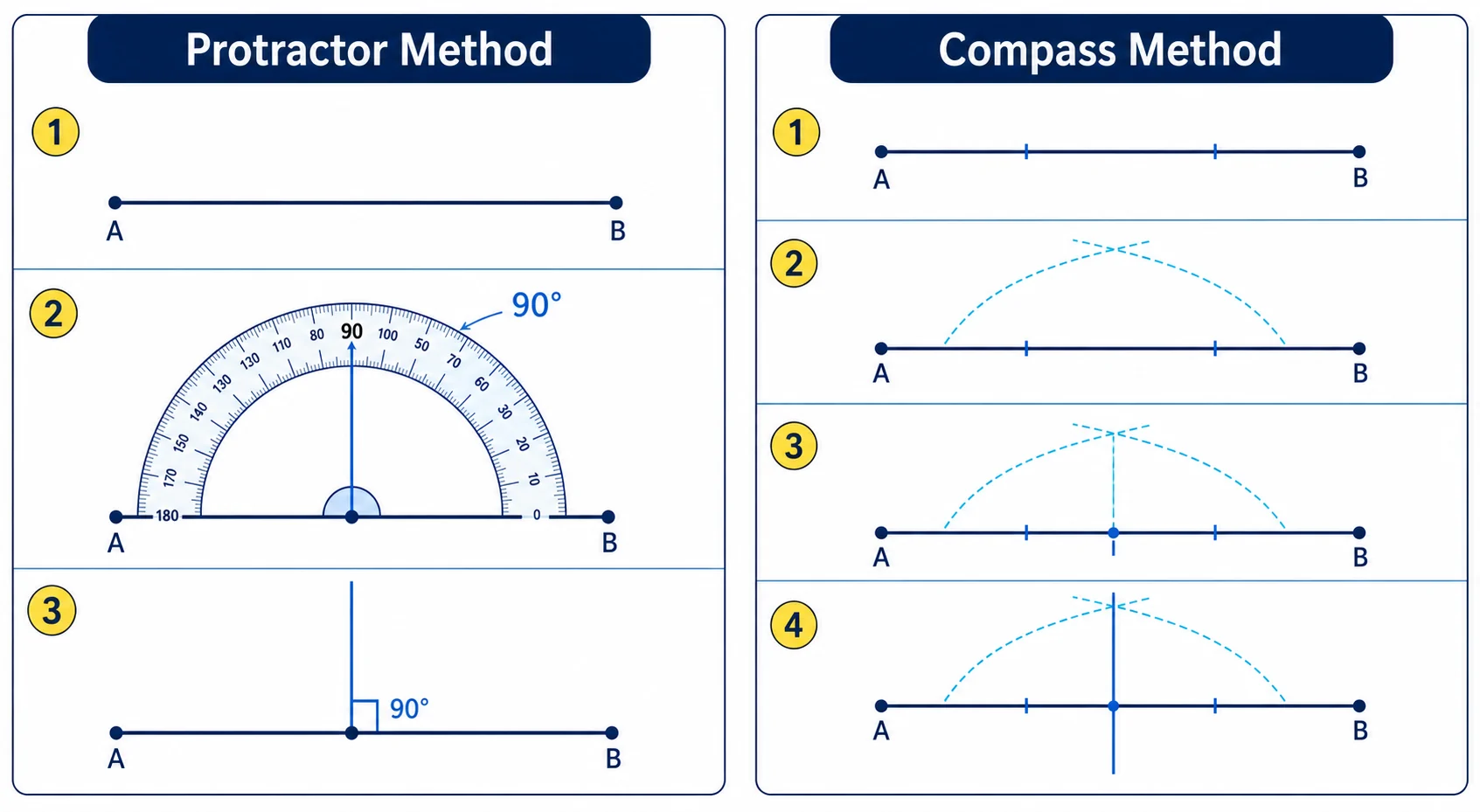
Method 1: Use a protractor
- Draw a straight baseline and choose the point where the new line should meet it. Label the point A.
- Place the protractor’s center mark exactly on A. Align its zero-degree baseline with the line.
- Find the 90° mark and place a small dot there. Label the dot B.
- Use a ruler to draw the straight line through A and B.
- Add a right-angle square at A and write the perpendicular symbol if the lines have names.
The most common error is aligning the bottom edge of the plastic rather than the printed baseline. Check both the protractor center and the zero-degree line before marking 90°.
Method 2: Use a compass and straightedge
- Draw line ℓ and mark point A on it.
- With the compass centered at A, draw arcs that cut the line at points C and D on opposite sides of A. AC and AD are now equal.
- Open the compass wider than AC. From C, draw an arc above the line. Without changing the width, draw another arc from D so the two arcs cross at B.
- Draw the straight line through A and B. Equal-radius arcs make B equally distant from C and D, so AB is the perpendicular bisector of CD.
- Verify the construction with a protractor or set square if available.
A set square offers a third fast method. Place one edge along the given line and draw along the edge that meets it at the tool’s right-angle corner. This is practical for classroom diagrams, technical drawing and construction layouts.
How perpendicular lines work on a coordinate plane
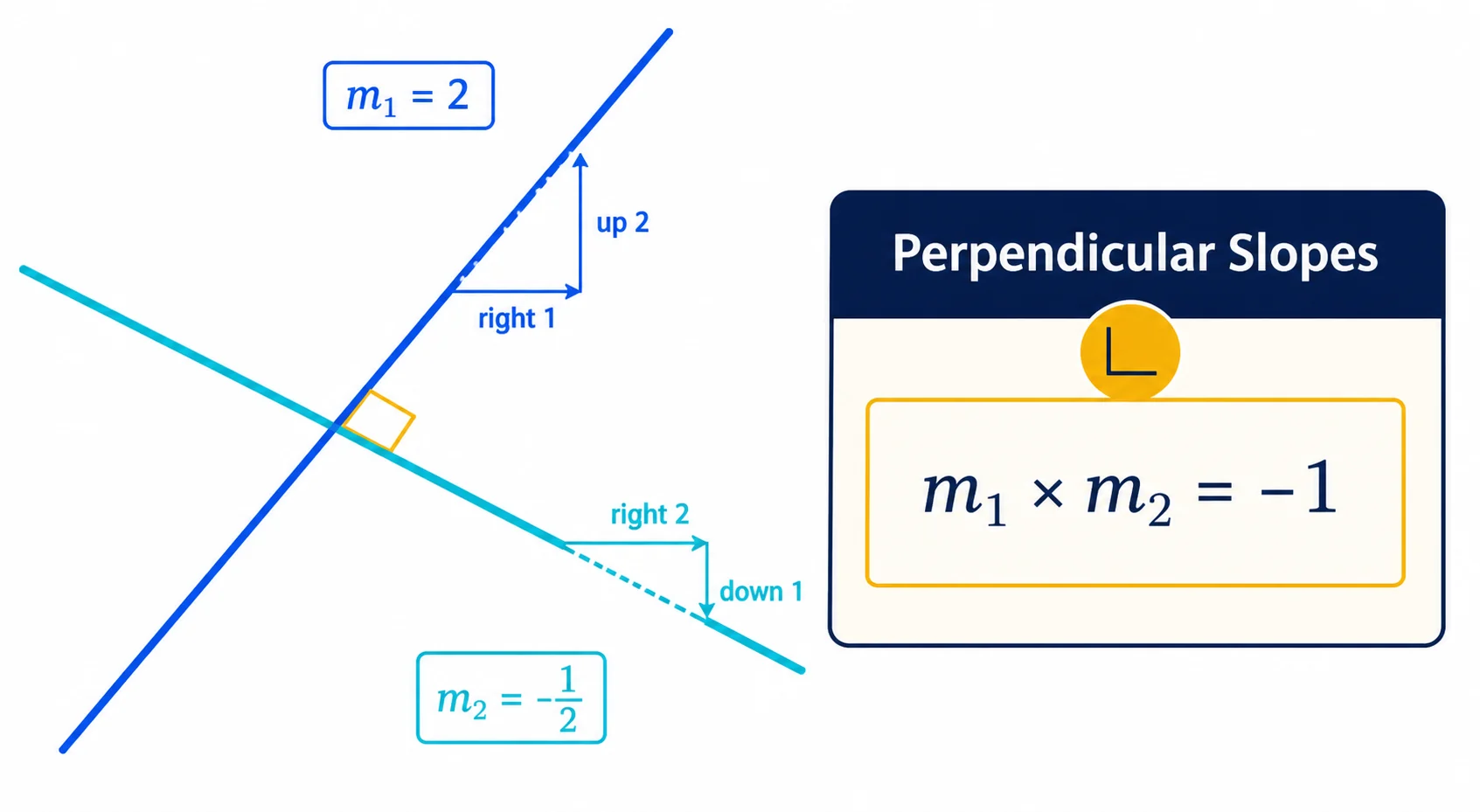
On a graph, slope describes a line’s rise divided by its run. If two nonvertical lines are perpendicular, one slope is the negative reciprocal of the other. “Reciprocal” means flip the fraction, and “negative” means change its sign.
If one line has slope 2, write it as 2/1. Flip it to 1/2 and change the sign, giving −1/2. Therefore slopes 2 and −1/2 are perpendicular. If a line has slope −3/4, its perpendicular slope is 4/3.
| First slope | Negative reciprocal | Product | Perpendicular? |
|---|---|---|---|
| 2 | −1/2 | −1 | Yes |
| −3/4 | 4/3 | −1 | Yes |
| 5 | 1/5 | 1 | No; the sign was not changed |
| 1 | −1 | −1 | Yes |
The horizontal-and-vertical exception
A horizontal line has slope 0. A vertical line has undefined slope, so multiplying their slopes is not possible. Nevertheless, horizontal and vertical lines are perpendicular because they meet at 90°. Treat this as a special geometric case rather than forcing it into the product rule.
To review rise, run, positive slopes, negative slopes and undefined slope, use RevisionTown’s complete guide to slope.
Finding the equation of a perpendicular line
Suppose a line has equation y = 3x + 4, and you need a perpendicular line through the point (2, 1). The original slope is 3, so the perpendicular slope is −1/3. Use point-slope form:
You can leave the answer in point-slope form or simplify it to the form requested. A quick check is to multiply 3 by −1/3. The result is −1, confirming the slopes are perpendicular.
Perpendicular lines in shapes and everyday life

Perpendicular lines are especially common in objects designed to be level, square or easy to align. A window’s vertical frame is perpendicular to its sill. Adjacent edges of a rectangular book cover meet at right angles. Two straight roads crossing in a plus-shaped intersection are perpendicular. On an analog clock, the hands are perpendicular at 3:00 and 9:00.
They also appear in sports-court markings, floor tiles, table corners, coordinate axes, graph paper, door frames, shelves and building plans. Engineers and builders use right-angle checks to prevent frames from leaning and to make rectangular parts fit together.
Which shapes contain perpendicular sides?
- Square: every pair of adjacent sides is perpendicular, creating four right angles.
- Rectangle: every corner is a right angle, so adjacent sides are perpendicular.
- Right triangle: the two legs that form its right angle are perpendicular.
- Right trapezoid or right-angled trapezium: one leg is perpendicular to the parallel bases, creating two right angles.
- Some kites and rhombuses: their diagonals may be perpendicular even when their sides are not.
A general parallelogram does not need right-angle corners. A rhombus does not need right-angle corners either; a square is the special rhombus that does. A regular hexagon has equal sides but its interior angles are 120°, so adjacent sides are not perpendicular. Explore these classifications in the complete RevisionTown guide to geometric shapes.
Perpendicular in three dimensions
In solid geometry, a line can be perpendicular to a plane, and two planes can be perpendicular. A vertical pole standing straight on level ground illustrates a line perpendicular to a plane. The floor and a straight wall illustrate perpendicular planes. In both cases, a right-angle relationship is still the central idea, but the objects occupy three-dimensional space.
Worked examples and common mistakes
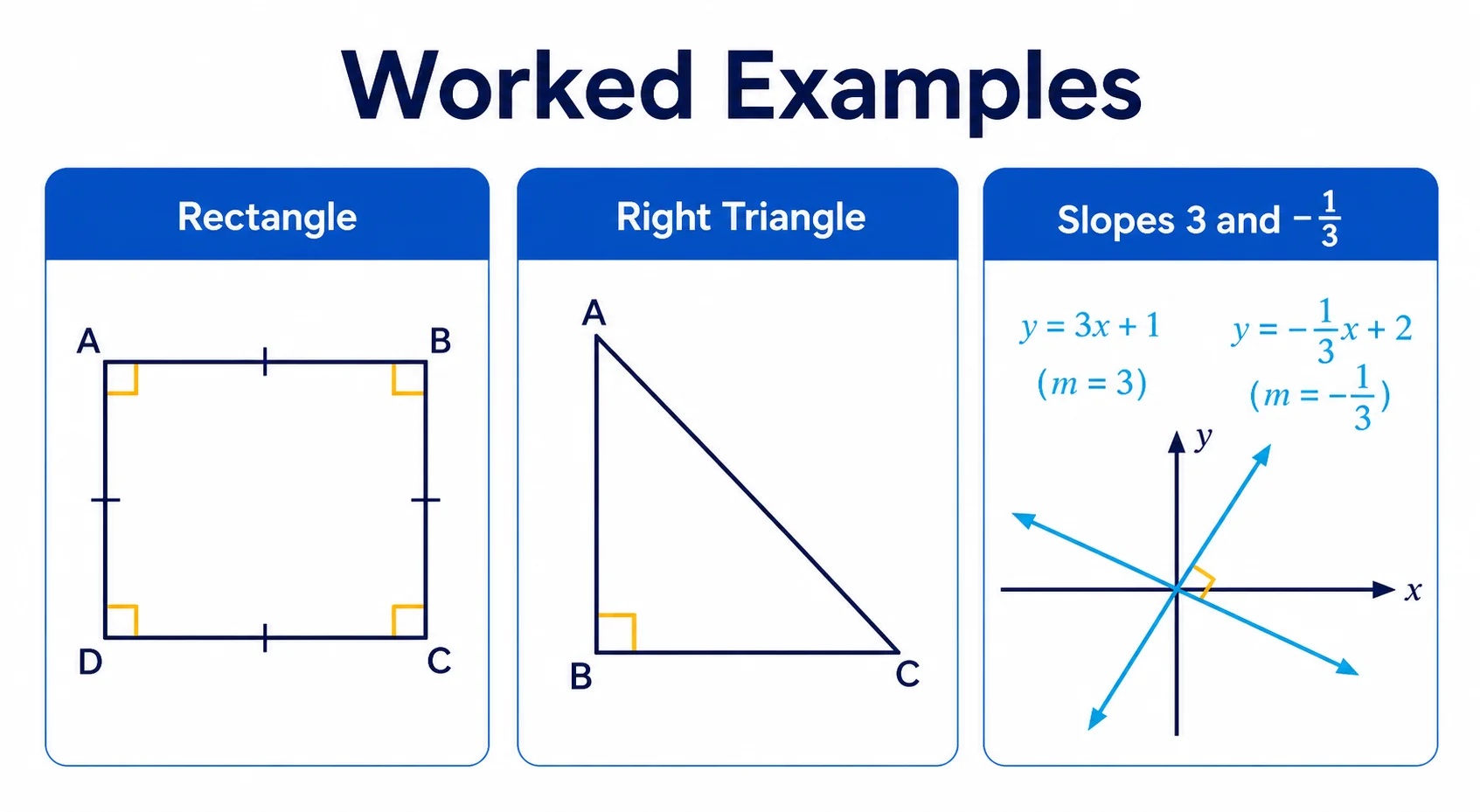
Example 1: Identify perpendicular sides in a rectangle
Rectangle ABCD has vertices named in order. Its four corners are right angles, so AB ⊥ BC, BC ⊥ CD, CD ⊥ DA and DA ⊥ AB. Opposite sides are parallel, not perpendicular: AB ∥ CD and BC ∥ AD.
Example 2: Use an angle measure
Lines p and q meet, and one angle is labeled 90°. Therefore p ⊥ q. Because the paths are full straight lines, the other three angles at the intersection are also 90°.
Example 3: Check two equations
Line r has slope 3 and line s has slope −1/3. Their product is 3 × (−1/3) = −1. Therefore the lines are perpendicular. Their intercepts do not affect the angle between them.
Example 4: Build a perpendicular equation
A line has slope −2/5. A perpendicular line must have slope 5/2. If it must pass through (4, −1), point-slope form gives y + 1 = (5/2)(x − 4). Checking the product, (−2/5)(5/2) = −1.
Five mistakes to avoid
- Assuming every intersection is perpendicular. Measure or prove that the angle is 90°.
- Confusing perpendicular with parallel. Parallel lines point in the same direction and never meet; perpendicular lines meet at a right angle.
- Taking only the reciprocal of a slope. You must also reverse the sign.
- Applying the slope-product rule to a vertical line. A vertical slope is undefined; use the horizontal–vertical special case.
- Judging an unscaled sketch by eye. Mathematical markings and stated facts are more reliable than appearance.
Quick practice quiz: test your understanding

- Which single measurement proves that two intersecting lines are perpendicular?
- Write the symbol used to mean “is perpendicular to.”
- Are slopes 4 and −1/4 perpendicular?
- Are slopes −2 and −1/2 perpendicular?
- A horizontal line is crossed by a vertical line. Are they perpendicular even though one slope is undefined?
- Name two shapes that always have perpendicular adjacent sides.
- How many right angles are made when two full perpendicular lines intersect?
- A line has slope 3/7. What is the slope of a perpendicular nonvertical line?
Show the answers
- 90°.
- ⊥.
- Yes, because 4 × (−1/4) = −1.
- No. Their product is 1, not −1. The negative reciprocal of −2 is 1/2.
- Yes. A horizontal and a vertical line meet at 90°.
- A square and a rectangle. A right triangle is another valid example.
- Four right angles.
- −7/3.
Frequently asked questions about perpendicular lines
What does perpendicular mean in simple words?
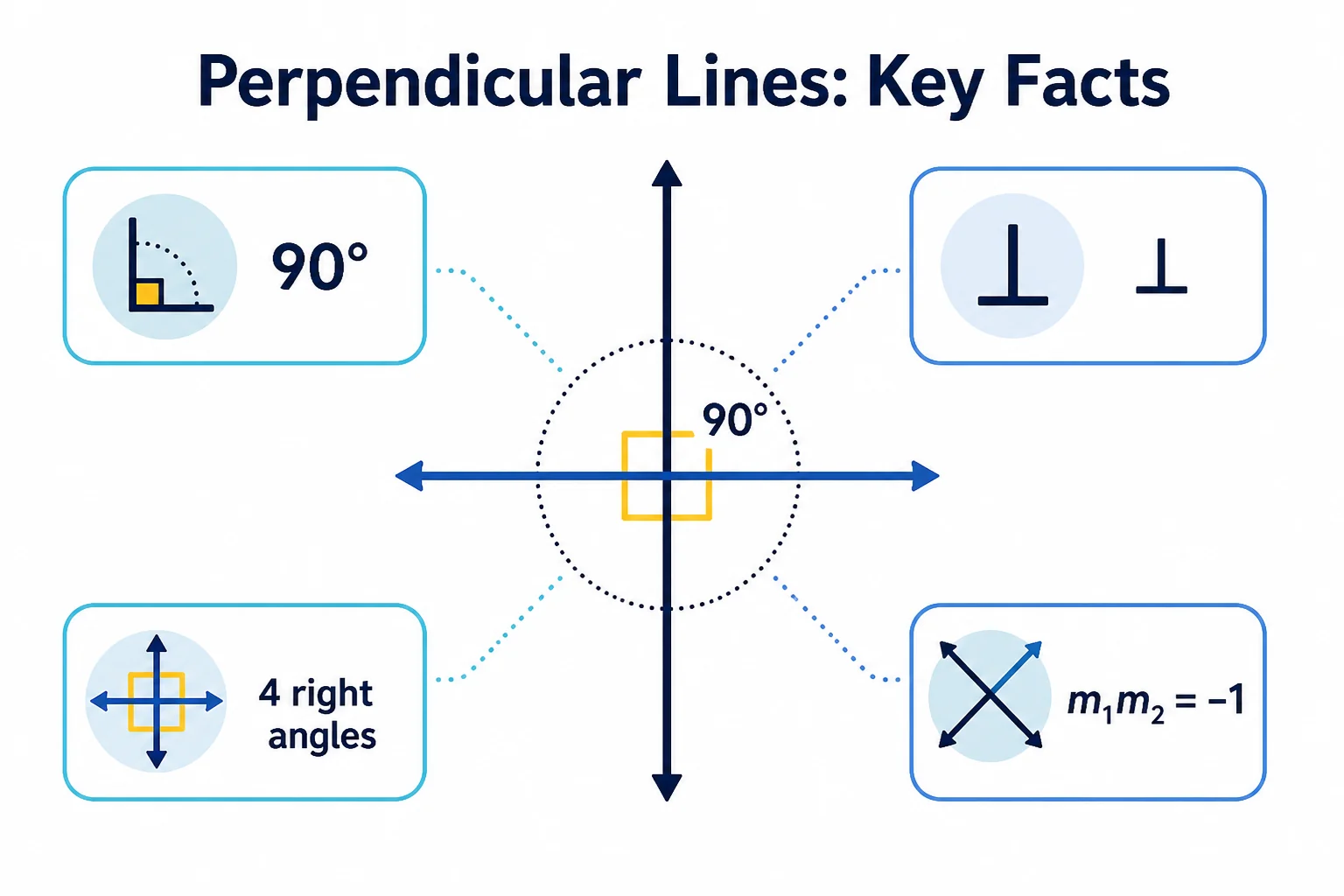
Perpendicular means meeting at a right angle. If two straight lines make a perfect square corner, the angle between them is 90°, so they are perpendicular.
What is the symbol for perpendicular?
The symbol is ⊥. For example, AB ⊥ CD means that line AB is perpendicular to line CD.
Are all intersecting lines perpendicular?
No. All perpendicular lines intersect, but not all intersecting lines are perpendicular. An intersection qualifies only when the angle is exactly 90°.
Can two lines be both parallel and perpendicular?
The same pair of distinct lines cannot be both. Parallel lines do not meet, while perpendicular lines meet at a right angle. However, two parallel lines can each be perpendicular to a third line.
How many perpendicular lines can pass through one point?
Relative to a chosen line, exactly one perpendicular line can pass through a particular point in Euclidean geometry. The point may lie on the given line or away from it.
Can three lines all be perpendicular to the same line?
Yes. They must meet the original line at different points, and they will be parallel to one another. They cannot all be distinct perpendiculars through the same single point.
Do perpendicular lines have to be vertical and horizontal?
No. A perpendicular pair can be rotated to any orientation. Their position changes, but their 90° angle does not.
At what grade do students learn perpendicular lines?
Curricula vary, but students are commonly introduced to parallel and perpendicular lines in upper elementary geometry. They use the concepts more formally in middle school and later connect perpendicular lines to slope, equations, proofs, constructions and three-dimensional geometry.
What is the difference between perpendicular and orthogonal?
In school geometry, perpendicular usually describes lines, segments or planes meeting at 90°. Orthogonal is a broader term used in advanced mathematics for objects with a right-angle or zero-dot-product relationship. For ordinary straight lines in a plane, the ideas agree.
Remember the one test that matters
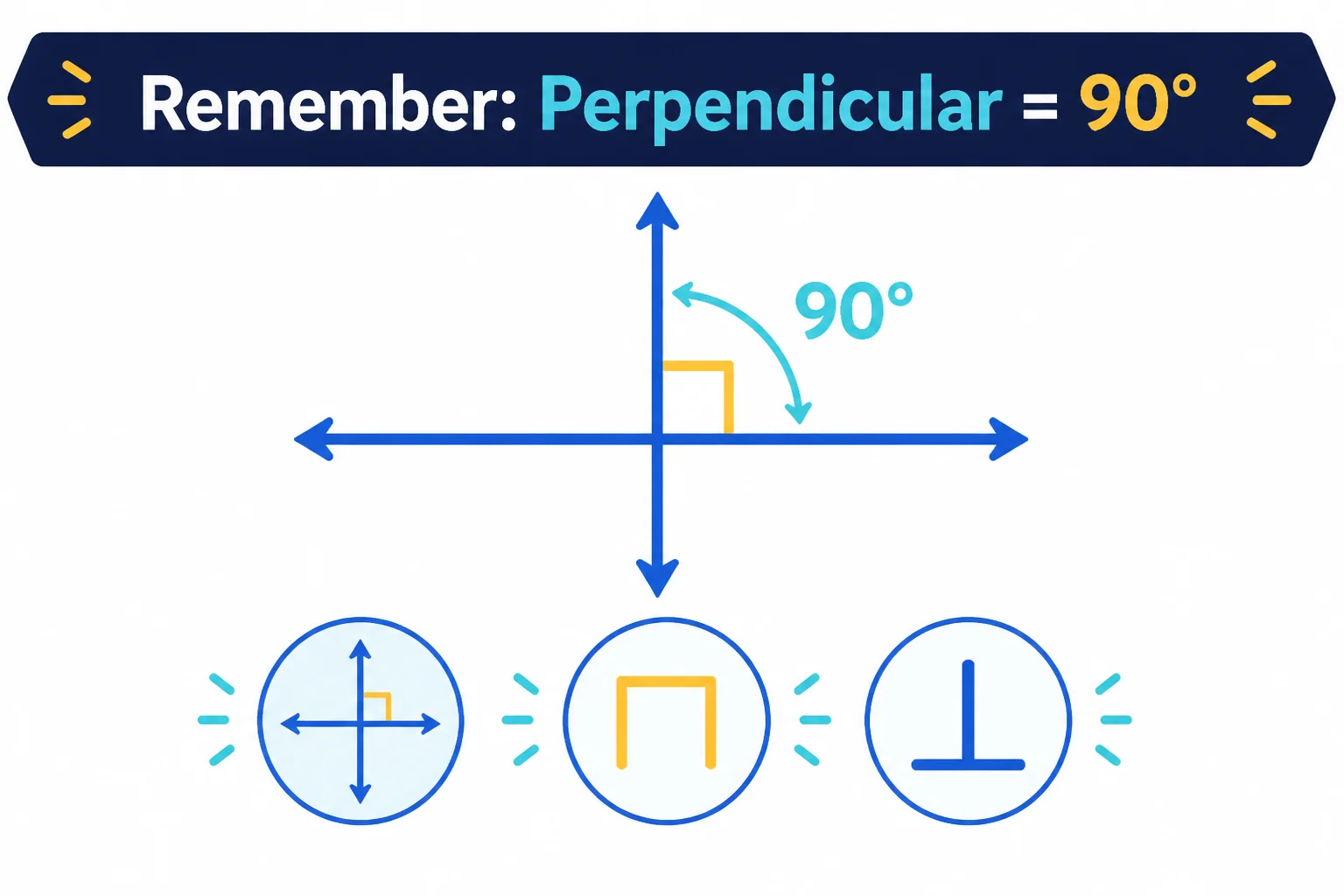
A pair of lines is perpendicular when it forms an exact right angle. Look for 90°, a small square angle marker, the symbol ⊥, or a valid coordinate proof using negative reciprocal slopes. Do not rely on the direction of the page or a rough sketch alone.
For more practice with the surrounding ideas, continue with RevisionTown’s guides to geometric shapes, slope, area and perimeter, and types of triangles.