Learn all major geometric shapes with properties, formulas, diagrams in words, examples, 2D and 3D classifications, area, perimeter, surface area and volume.3
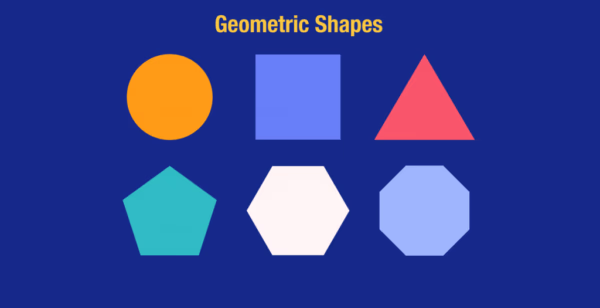
Colorful geometric shapes arranged neatly for a math revision lesson on RevisionTown. Ideal for learning circle, square, triangle, rectangle, hexagon and more.
Geometry Guide
Geometric Shapes: Complete Guide to 2D and 3D Shapes
Geometric shapes are the building blocks of geometry. They describe the structure of objects, diagrams,
surfaces, spaces, patterns and measurements. This guide explains the major kinds of geometric shapes, how they
are classified, the formulas students need, and how shape properties connect to area, perimeter, surface area,
volume, coordinate geometry and transformations.
If you want a shorter overview after this full guide, RevisionTown also has focused notes on
shapes in geometry,
geometry basics
and the wider geometry topic page. This article is the
broader reference page for learning shape families and comparing their properties.
Quick Answer: What Are Geometric Shapes?
A geometric shape is a figure defined by mathematical properties such as points, lines, curves, angles,
side lengths, surfaces, faces, vertices and dimensions. Some shapes are flat, such as triangles, rectangles,
circles and polygons. These are called two-dimensional or 2D shapes because they have length and width but no
depth. Other shapes occupy space, such as cubes, prisms, pyramids, cylinders, cones and spheres. These are
called three-dimensional or 3D shapes because they have length, width and height or depth.
In school mathematics, geometric shapes are not learned only as names. Students need to recognize properties,
compare categories, calculate measures and use shapes in real problems. A rectangle is not just "a long box";
it is a quadrilateral with four right angles and opposite sides equal. A sphere is not just "a ball"; it is the
set of all points in 3D space that are a fixed distance from a center. These definitions matter because they
determine which formulas and theorems apply.
\[
\text{2D shapes are measured with perimeter and area.}
\]
\[
\text{3D shapes are measured with surface area and volume.}
\]
Most geometry questions become easier when you ask four questions: What dimension is the shape? Are its sides
straight or curved? What properties are fixed? Which measurement is required? For example, a question about a
circle may ask for circumference, area, radius, diameter, arc length or sector area. A question about a cylinder
may ask for volume, curved surface area, total surface area or capacity. The shape name is only the starting
point; the property being measured controls the method.
Geometry Foundations: Points, Lines, Planes and Angles
Before studying complex shapes, it helps to understand the simple objects from which geometry is built. A
point marks an exact position. It has no length, width or height. A line extends infinitely in both directions.
A line segment has two endpoints and a measurable length. A ray has one endpoint and extends infinitely in one
direction. A plane is a flat surface that extends indefinitely in two dimensions. These basic ideas explain why
many shape definitions use words such as side, vertex, edge, face and angle.
Angles are formed when two rays meet at a common endpoint. They are central to shape classification. A triangle
may be acute, right or obtuse depending on its angles. A rectangle is a quadrilateral with four right angles.
A regular polygon has equal sides and equal angles. In circle geometry, angles also describe arcs, sectors and
chords. For more practice with angle vocabulary, see RevisionTown's guide to
types of angles in geometry.
Foundation term
Meaning
How it appears in shapes
Point
An exact location with no size.
Vertices of polygons and endpoints of segments.
Line
A straight path extending infinitely in both directions.
Used to define parallel, perpendicular and intersecting relationships.
Line segment
A part of a line with two endpoints.
Sides of polygons and edges of many solids.
Ray
A part of a line with one endpoint extending in one direction.
Forms angles and helps describe rotations.
Plane
A flat two-dimensional surface.
The surface on which 2D shapes lie; faces of many 3D solids are planar.
Angle
The turn between two rays or line segments.
Used to classify triangles, quadrilaterals, polygons and rotations.
A vertex is a point where two or more sides or edges meet. A side is a line segment forming part of a 2D
boundary. An edge is a line segment where two faces of a 3D solid meet. A face is a flat or curved surface on a
3D shape. A base is a chosen reference face or side, often used to calculate area or volume. A height is a
perpendicular distance from a base to an opposite point, side, face or surface. Confusing height with slanted
length is one of the most common mistakes in geometry.
How Geometric Shapes Are Classified
Shapes are classified in several ways. The most important classification is by dimension. Zero-dimensional
objects, such as points, have position but no measurable length. One-dimensional objects, such as line segments,
have length only. Two-dimensional shapes have length and width, so they have area. Three-dimensional shapes have
length, width and height, so they have volume. Higher-dimensional geometry exists in advanced mathematics, but
school geometry usually focuses on 2D and 3D shapes.
Shapes can also be classified by boundaries. A polygon is a closed 2D shape made only of straight line
segments. A circle is a closed curved shape. An ellipse is another closed curved shape, but it has two focal
points rather than one center-based radius. A solid such as a cube has flat polygonal faces, while a sphere has
one continuous curved surface. Some shapes, such as cylinders and cones, combine flat circular faces with curved
surfaces.
Every interior angle is less than \(180^\circ\), and no part caves inward.
Square, regular hexagon, acute triangle.
Concave shape
At least one interior angle is greater than \(180^\circ\).
Dart, arrowhead polygon, concave pentagon.
Composite shape
A shape made from two or more simpler shapes.
L-shaped floor plan, semicircle on a rectangle, prism with a cut-out.
Another important distinction is congruence versus similarity. Congruent shapes have the same size and shape.
Similar shapes have the same shape but may be different sizes. Similarity is essential for scale drawings,
maps, model making, indirect measurement and trigonometry. RevisionTown's lesson on
congruence and similarity in geometry
is useful when you want to move beyond naming shapes into proving relationships between them.
Two-Dimensional Geometric Shapes
Two-dimensional shapes are flat figures. They have length and width, but no thickness in mathematical terms.
The two main measurements are perimeter and area. Perimeter is the distance around the boundary of a shape. Area
is the amount of surface inside the boundary. For a broader formula-focused lesson, use RevisionTown's pages on
area and perimeter,
perimeter and
area formulas.
The most common 2D shape families are triangles, quadrilaterals, polygons and curved shapes. Triangles have
three sides. Quadrilaterals have four sides. Polygons have any number of straight sides as long as the figure is
closed. Circles and ellipses are not polygons because their boundaries are curved. A sector, semicircle, annulus
and circular segment are curved shapes related to circles.
2D shape
Main properties
Common measurement
Triangle
3 sides, 3 vertices, interior angles sum to \(180^\circ\).
Area, perimeter, angles, height, side lengths.
Square
4 equal sides and 4 right angles.
Area, perimeter, diagonal.
Rectangle
Opposite sides equal and 4 right angles.
Area, perimeter, diagonal.
Parallelogram
Opposite sides parallel and equal; opposite angles equal.
Area using base and perpendicular height.
Rhombus
4 equal sides; opposite angles equal.
Area using base and height or diagonals.
Trapezoid or trapezium
At least one pair of parallel sides, depending on local convention.
A triangle is a polygon with three sides, three vertices and three interior angles. The interior angles of every
Euclidean triangle add to \(180^\circ\). Triangles are important because many complex shapes can be split into
triangles. They also connect directly to congruence, similarity, trigonometry, coordinate geometry and proofs.
RevisionTown has focused triangle lessons at
triangles explained,
types of triangles
and triangle area formulas.
Triangles can be classified by side length. An equilateral triangle has three equal sides and three equal angles,
each measuring \(60^\circ\). An isosceles triangle has at least two equal sides and two equal base angles. A
scalene triangle has no equal sides. Triangles can also be classified by angle. An acute triangle has three
acute angles. A right triangle has one \(90^\circ\) angle. An obtuse triangle has one angle greater than
\(90^\circ\).
The area formula \(A=\frac{1}{2}bh\) uses the perpendicular height, not the slanted side unless the slanted side
is perpendicular to the base. In right triangles, the Pythagorean theorem connects the two shorter sides
\(a\) and \(b\) with the hypotenuse \(c\). Trigonometry then uses ratios such as sine, cosine and tangent to
connect angles with side lengths. This is why triangle understanding is essential before studying
right triangle trigonometry.
Triangle type
Definition
Useful property
Equilateral
All sides equal.
All angles are \(60^\circ\); it is a regular polygon.
Isosceles
At least two equal sides.
Base angles opposite the equal sides are equal.
Scalene
No equal sides.
All angles are usually different.
Right
One angle equals \(90^\circ\).
Pythagorean theorem applies.
Acute
All angles are less than \(90^\circ\).
Often appears in congruence and similarity problems.
Obtuse
One angle is greater than \(90^\circ\).
The longest side is opposite the obtuse angle.
Quadrilaterals: Four-Sided Geometric Shapes
A quadrilateral is any polygon with four sides. The interior angles of a quadrilateral add to \(360^\circ\).
Quadrilaterals include squares, rectangles, parallelograms, rhombi, trapezoids or trapezia, kites and irregular
four-sided shapes. The names matter because each family has different properties. A square is also a rectangle,
a rhombus and a parallelogram, but a general rectangle is not necessarily a square. A rhombus has four equal
sides, but it does not need four right angles.
The quadrilateral family is where many students first learn that shape categories can overlap. In everyday
language people may treat square and rectangle as separate, but mathematically a square satisfies the definition
of a rectangle because it has four right angles and opposite sides equal. This classification logic becomes
important later when proving properties and using formulas. For a focused lesson, use RevisionTown's pages on
quadrilaterals
and types of quadrilaterals.
Quadrilateral
Key properties
Area formula
Square
4 equal sides; 4 right angles; diagonals equal and perpendicular.
\(A=s^2\)
Rectangle
Opposite sides equal; 4 right angles; diagonals equal.
Has a pair of parallel sides in many school conventions.
\(A=\frac{1}{2}(a+b)h\)
Kite
Two pairs of adjacent equal sides; one pair of opposite angles may be equal.
\(A=\frac{1}{2}d_1d_2\)
Quadrilateral questions often require students to identify parallel sides, equal sides, right angles, diagonals
and symmetry. A square has four lines of symmetry. A rectangle has two. A general parallelogram usually has no
line symmetry, but it has rotational symmetry of order 2. A kite usually has one line of symmetry. A rhombus has
diagonals that bisect each other at right angles, which is useful in area and proof problems.
Polygons: Shapes Made From Straight Sides
A polygon is a closed 2D shape made only from straight line segments. The word includes triangles and
quadrilaterals, but it is often used for shapes with five or more sides. Polygons can be regular or irregular,
convex or concave, simple or complex. A simple polygon has sides that do not cross. A complex polygon has sides
that intersect. A regular polygon has equal sides and equal angles. A star polygon is a special complex or
self-intersecting form made by connecting vertices in a repeating pattern.
For school geometry, the most common polygon names are pentagon, hexagon, heptagon, octagon, nonagon, decagon
and dodecagon. Polygons appear in tiling, architecture, computer graphics, engineering diagrams, road signs,
design patterns and coordinate geometry. RevisionTown's
polygons page is useful for early revision, while
polygons in tenth grade is a stronger follow-up
for angle and proof work.
\[
\text{Interior angle sum of an }n\text{-gon} = (n-2)180^\circ
\]
\[
\text{Each exterior angle of a regular }n\text{-gon} = \frac{360^\circ}{n}
\]
\[
\text{Each interior angle of a regular }n\text{-gon} = \frac{(n-2)180^\circ}{n}
\]
Number of sides
Polygon name
Interior angle sum
3
Triangle
\(180^\circ\)
4
Quadrilateral
\(360^\circ\)
5
Pentagon
\(540^\circ\)
6
Hexagon
\(720^\circ\)
7
Heptagon
\(900^\circ\)
8
Octagon
\(1080^\circ\)
9
Nonagon
\(1260^\circ\)
10
Decagon
\(1440^\circ\)
12
Dodecagon
\(1800^\circ\)
Regular polygons have a useful area formula involving apothem. The apothem is the perpendicular distance from
the center of a regular polygon to a side. If \(P\) is perimeter and \(a\) is apothem, then:
\[
A_{\text{regular polygon}} = \frac{1}{2}aP
\]
This formula works because a regular polygon can be split into congruent isosceles triangles. Each triangle has
base equal to a side of the polygon and height equal to the apothem. Adding the triangle areas produces
\(\frac{1}{2}aP\). This is a good example of a major geometry strategy: divide a complicated shape into simpler
known shapes, calculate each part, then combine results.
Circles, Ellipses and Other Curved Geometric Shapes
Curved shapes are not polygons because their boundaries are not made entirely from straight line segments. The
most important curved shape is the circle. A circle is the set of all points in a plane at a fixed distance,
called the radius, from a fixed center. The diameter is twice the radius. Circumference is the distance around
the circle. Area is the surface inside the circle. RevisionTown has focused pages on
circumference,
circle area formulas and
area of a circle.
\[
d=2r
\]
\[
C=2\pi r=\pi d
\]
\[
A=\pi r^2
\]
A semicircle is half of a circle. A quadrant is one quarter of a circle. A sector is a slice of a circle formed
by two radii and an arc. A segment is a region between a chord and an arc. An annulus is the ring-shaped region
between two concentric circles. These shapes are common in design, engineering, landscaping, mechanical parts,
exam diagrams and real measurement problems.
An ellipse looks like a stretched circle. It has a semi-major axis \(a\) and a semi-minor axis \(b\). Its area
is \(A=\pi ab\). A parabola is a U-shaped curve, often written as \(y=ax^2+bx+c\). A hyperbola has two branches
and appears in advanced coordinate geometry and conic sections. These curves are important because they connect
geometry with algebra and functions. A circle, ellipse, parabola and hyperbola are all conic sections because
each can be produced by slicing a cone in a particular way.
Curved shape
Description
Common formula or equation
Circle
All points are a fixed distance from a center.
\(x^2+y^2=r^2\)
Ellipse
A stretched circle with two axes.
\(\frac{x^2}{a^2}+\frac{y^2}{b^2}=1\)
Parabola
A curve defined by equal distance from a focus and directrix.
\(y=ax^2+bx+c\)
Hyperbola
A two-branch conic with a difference-of-distances property.
\(\frac{x^2}{a^2}-\frac{y^2}{b^2}=1\)
Annulus
A ring between two circles with the same center.
\(A=\pi(R^2-r^2)\)
Sector
A slice of a circle bounded by two radii and an arc.
\(A=\frac{\theta}{360^\circ}\pi r^2\)
Three-Dimensional Geometric Shapes
Three-dimensional shapes, also called solids, occupy space. They have volume and surface area. Volume measures
the amount of space inside a solid. Surface area measures the total area of the outside surfaces. 3D shapes can
have flat faces, curved surfaces or both. Cubes, cuboids, prisms and pyramids are polyhedra because their
surfaces are made from polygons. Cylinders, cones and spheres include curved surfaces, so they are not
polyhedra.
The most practical 3D shape groups are prisms, pyramids, cylinders, cones, spheres and composite solids. A prism
has two congruent parallel bases connected by rectangular or parallelogram faces. A pyramid has a polygonal base
and triangular faces meeting at an apex. A cylinder has two congruent circular bases and one curved surface. A
cone has one circular base and an apex. A sphere is perfectly round in 3D space. RevisionTown's pages on
3D geometry,
surface area and
volume
are useful follow-up lessons.
3D shape
Main properties
Volume formula
Cube
6 square faces, 12 equal edges, 8 vertices.
\(V=s^3\)
Cuboid or rectangular prism
6 rectangular faces; opposite faces equal.
\(V=lwh\)
Prism
Constant cross-section along its length.
\(V=Ah\), where \(A\) is base area.
Pyramid
Polygonal base and triangular faces meeting at an apex.
\(V=\frac{1}{3}Ah\)
Cylinder
Two circular bases and one curved surface.
\(V=\pi r^2h\)
Cone
One circular base and an apex.
\(V=\frac{1}{3}\pi r^2h\)
Sphere
All points on the surface are distance \(r\) from the center.
\(V=\frac{4}{3}\pi r^3\)
Ellipsoid
Stretched sphere with three semi-axes.
\(V=\frac{4}{3}\pi abc\)
Frustum
A cone or pyramid cut parallel to its base.
Depends on top and bottom areas plus height.
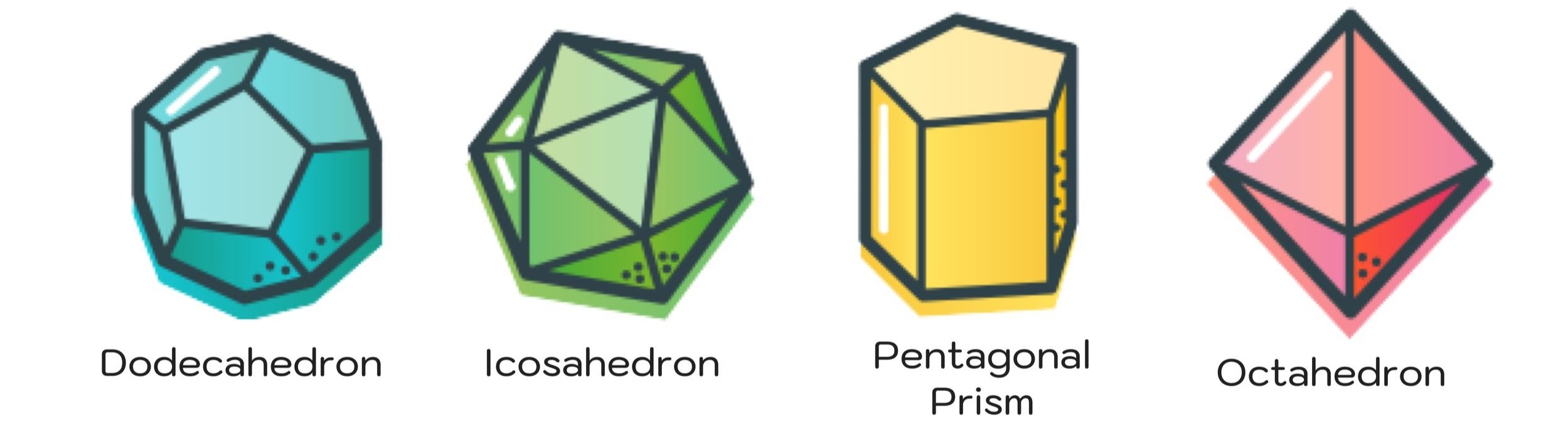
Polyhedra are 3D solids with flat polygonal faces. The five Platonic solids are the tetrahedron, cube, octahedron,
dodecahedron and icosahedron. Each has identical regular polygon faces and the same number of faces meeting at
every vertex. A tetrahedron has 4 triangular faces. A cube has 6 square faces. An octahedron has 8 triangular
faces. A dodecahedron has 12 pentagonal faces. An icosahedron has 20 triangular faces. These solids are important
in geometry because they show extreme symmetry and connect to Euler's formula:
\[
V-E+F=2
\]
where \(V\) is vertices, \(E\) is edges and \(F\) is faces for a convex polyhedron.
Curved 3D shapes include spheres, hemispheres, ellipsoids, cylinders, cones, capsules, tori and frustums. A
hemisphere is half a sphere. A capsule is a cylinder with two hemispherical ends. A torus is a doughnut-shaped
surface created by rotating a circle around an axis outside the circle. These shapes are less common in early
school work but appear in design, architecture, engineering, 3D modelling, medical imaging and physics.
Nets, Cross-Sections and Composite Geometric Shapes
A net is a 2D pattern that can be folded to form a 3D solid. Nets help students understand surface area because
they reveal every face of the solid. A cube net contains six squares. A rectangular prism net contains three
pairs of congruent rectangles. A cylinder net contains two circles and one rectangle, where the rectangle's
length is the circumference of the base. A cone net contains a circle and a sector. When surface area feels
difficult, sketching or imagining the net usually makes the problem clearer.
A cross-section is the shape made when a solid is sliced by a plane. A cylinder sliced parallel to its base has
a circular cross-section. Sliced vertically through the center, it has a rectangular cross-section. A cone sliced
parallel to its base has a circular cross-section, while angled slices can produce conic sections. Cross-sections
link 3D geometry with 2D shapes because the slice is flat even though the original object is solid.
Composite shapes are made from simpler shapes. A floor plan may combine rectangles, triangles and semicircles.
A logo may combine circles, polygons and arcs. A 3D object may combine a cylinder and cone, or a cuboid and
hemisphere. To solve composite-shape questions, split the figure into known pieces, calculate each part and add
or subtract. If a shape has a hole, subtract the area or volume of the missing part. If a solid is built from
two pieces, add volumes but be careful with surface area because touching faces may not be exposed.
Practical method: For any composite shape, write the plan before calculating. Identify the
component shapes, label the required lengths, decide whether to add or subtract, then apply the correct area,
perimeter, surface area or volume formula.
Geometric Shapes in Coordinate Geometry and Transformations
Coordinate geometry places shapes on a grid so their properties can be studied using algebra. Points are written
as ordered pairs \((x,y)\) in 2D or ordered triples \((x,y,z)\) in 3D. Lines can be described using equations.
Circles, parabolas and other curves can also be described algebraically. This creates a bridge between geometry
and algebra, allowing students to calculate lengths, midpoints, gradients, areas and intersections.
\[
\text{Distance between }(x_1,y_1)\text{ and }(x_2,y_2)
=\sqrt{(x_2-x_1)^2+(y_2-y_1)^2}
\]
\[
\text{Midpoint}=\left(\frac{x_1+x_2}{2},\frac{y_1+y_2}{2}\right)
\]
\[
\text{Gradient}=\frac{y_2-y_1}{x_2-x_1}
\]
Coordinate geometry helps prove whether a quadrilateral is a rectangle, parallelogram or rhombus. If opposite
sides have equal gradients, they are parallel. If slopes multiply to \(-1\), non-vertical lines are
perpendicular. If side lengths are equal, distance formula can prove congruent sides. RevisionTown's pages on
the coordinate plane and
lines in the coordinate plane
support this part of shape study.
Transformations move or change shapes while preserving or altering certain properties. A translation slides a
shape without rotating or resizing it. A reflection flips a shape across a line. A rotation turns a shape about
a point. A dilation enlarges or reduces a shape by a scale factor. Translations, reflections and rotations
preserve size and shape, so the image is congruent to the original. Dilations preserve shape but change size, so
the image is similar to the original if the scale factor is not \(1\). For more detail, use RevisionTown's
transformations in geometry
and transformations pages.
Transformation
What it does
Effect on shape
Translation
Moves every point the same distance and direction.
Congruent image; orientation unchanged.
Reflection
Flips a shape across a mirror line.
Congruent image; orientation reversed.
Rotation
Turns a shape around a center by an angle.
Congruent image; orientation changes.
Dilation
Enlarges or reduces distances from a center by a scale factor.
Similar image; size changes unless scale factor is \(1\).
Special and Advanced Shape Families Students Should Recognize
A complete guide to geometric shapes should not stop at the most common school examples. Many diagrams use
special shape families that are built from familiar ideas but have their own vocabulary. These include arcs,
lenses, lunes, annuli, spirals, stars, tessellating shapes, fractals, polyominoes, nets and irregular composite
figures. You may not need every name for every exam, but recognizing the family helps you choose a strategy.
If a figure is made from circle parts, use radius, diameter, sector and arc formulas. If it is built from
repeated polygons, look for symmetry and tessellation. If it repeats at smaller scales, it may be fractal-like.
A lens is a shape formed by the overlap of two circles or arcs. It appears in Venn diagrams, optics, design
patterns and area-between-curves problems. A lune is a crescent-shaped region bounded by two circular arcs. An
annulus is a ring, formed when a smaller circle is removed from a larger circle with the same center. These
shapes are not solved by memorizing one universal formula. Instead, they are usually solved by decomposing them
into sectors, triangles and circle areas. For example, the area of an annulus is simple because it is the large
circle minus the small circle:
Star shapes are another important family. Some stars are simple concave polygons, while others are complex
polygons whose sides cross. A five-point star can be studied through triangles, pentagons, symmetry and angle
relationships. In early geometry, students usually identify stars as concave or complex shapes. In advanced
geometry, star polygons can be described by how vertices are connected. This shows an important point:
geometric shapes can be classified at different levels depending on the course. A young student may call a
shape a star. An older student may describe it as a self-intersecting polygon with rotational symmetry.
Fractals are shapes or patterns that repeat detail at different scales. A perfect mathematical fractal has
self-similarity, meaning a smaller part resembles the whole. Famous examples include the Sierpinski triangle,
Koch snowflake and Mandelbrot set. Fractals appear in nature through coastlines, snowflakes, fern leaves,
branching trees, lightning, blood vessels and some crystal patterns. They are useful because they show that
not every geometric figure is best described by straight sides, smooth curves or simple formulas. RevisionTown's
guide to fractal geometry
is a strong next step for students who want to connect shapes with patterns, nature and technology.
Tessellations are arrangements of shapes that cover a plane without gaps or overlaps. Squares, equilateral
triangles and regular hexagons tessellate by themselves. Regular pentagons do not tessellate by themselves in
the same simple regular way. Tessellations appear in floor tiles, mosaics, wallpapers, textiles, Islamic
geometric design, honeycomb structures, computer graphics and game maps. A tessellation question may ask which
shapes fit around a point. Since a full turn around a point is \(360^\circ\), the interior angles meeting at a
vertex must add to \(360^\circ\).
\[
\text{Angles around a point}=360^\circ
\]
\[
\text{A regular polygon tessellates by itself when its interior angle divides }360^\circ
\]
Polyominoes are shapes made by joining equal squares edge to edge. A domino uses two squares, a tromino uses
three, a tetromino uses four and a pentomino uses five. These shapes are useful in puzzles, tiling, spatial
reasoning and computer science. They also teach students that two shapes may have the same area but different
perimeter. For example, five joined unit squares always have area \(5\) square units, but their perimeter
depends on how the squares are arranged.
In 3D geometry, polycubes are the solid equivalent of polyominoes. They are made by joining equal cubes face to
face. Polycubes appear in building blocks, packing problems, volume puzzles and 3D modelling. They are a useful
bridge between simple volume and more complex spatial reasoning because total volume may be easy to calculate
while surface area requires careful attention to hidden touching faces.
Symmetry, Shape Hierarchy and Geometry Systems
Symmetry is one of the most important ways to understand geometric shapes. A line of symmetry divides a 2D shape
into two matching halves. Rotational symmetry means a shape can be turned around a center and match its original
position before a full \(360^\circ\) turn. A square has four lines of symmetry and rotational symmetry of order
4. A rectangle has two lines of symmetry and rotational symmetry of order 2. A regular pentagon has five lines
of symmetry and rotational symmetry of order 5. A circle has infinitely many lines of symmetry and rotational
symmetry through any angle.
Symmetry helps students identify shapes quickly, but it also supports proof, design and construction. If a
triangle is isosceles, a line from the top vertex to the midpoint of the base may be a line of symmetry. If a
regular polygon has \(n\) sides, it has rotational symmetry of order \(n\). If a solid is highly symmetrical,
it may be easier to calculate surface area or volume because repeated faces or sections are congruent.
Shape
Line symmetry
Rotational symmetry
Scalene triangle
Usually none
Order 1
Isosceles triangle
Usually 1
Order 1, unless equilateral
Equilateral triangle
3
Order 3
Rectangle
2
Order 2
Square
4
Order 4
Regular hexagon
6
Order 6
Circle
Infinitely many
Any angle
Shape hierarchy is the idea that some shape categories contain others. This is especially important for
quadrilaterals. A square is a rectangle because it has four right angles. It is also a rhombus because it has
four equal sides. It is also a parallelogram because both pairs of opposite sides are parallel. A rectangle is a
parallelogram, but it is not always a square. A rhombus is a parallelogram, but it is not always a square. This
hierarchy prevents false statements such as "a square is not a rectangle" or "a rhombus cannot be a square".
Geometry also depends on the system being used. Most school geometry is Euclidean geometry, which studies flat
space and includes familiar results such as the angle sum of a triangle being \(180^\circ\). In non-Euclidean
geometry, surfaces or spaces may be curved, so familiar rules can change. For example, a triangle drawn on a
sphere using great-circle arcs can have an angle sum greater than \(180^\circ\). Students do not need advanced
non-Euclidean methods for basic shape work, but it is useful to know that "shape" can mean different things in
flat, curved and higher-dimensional settings. RevisionTown has separate introductions to
Euclidean geometry
and non-Euclidean geometry
for this extension.
The unit circle is another advanced shape idea that becomes essential in trigonometry. It is a circle with
radius \(1\) centered at the origin. Points on the unit circle connect angles to sine and cosine values. This
means the circle is not only a measurement shape; it becomes a coordinate and function tool. Students moving
from geometry into trigonometry should review RevisionTown's
unit circle
lesson after they are confident with radius, diameter, circumference and coordinate points.
A mature understanding of geometric shapes combines classification, measurement and reasoning. A beginner sees
a square and remembers \(A=s^2\). A stronger student sees a square as a regular quadrilateral, a rectangle, a
rhombus, a parallelogram, a polygon with four lines of symmetry, a shape that tessellates, and a face that can
form part of a cube. That layered understanding is what makes geometry powerful.
Essential Geometric Shape Formula Tables
Formula memorization is useful, but formulas are safer when you understand what each variable means. In
geometry, \(l\) usually means length, \(w\) width, \(b\) base, \(h\) perpendicular height, \(r\) radius,
\(d\) diameter, \(s\) side length and \(A\) area. For 3D shapes, \(V\) is volume and surface area may be written
as \(SA\). When a formula uses height, check whether the height must be perpendicular. In most area and volume
formulas, it does.
2D shape
Area
Perimeter or boundary
Square
\(A=s^2\)
\(P=4s\)
Rectangle
\(A=lw\)
\(P=2(l+w)\)
Triangle
\(A=\frac{1}{2}bh\)
\(P=a+b+c\)
Parallelogram
\(A=bh\)
\(P=2(a+b)\)
Trapezoid or trapezium
\(A=\frac{1}{2}(a+b)h\)
Sum of all sides
Rhombus or kite
\(A=\frac{1}{2}d_1d_2\)
Sum of all sides
Circle
\(A=\pi r^2\)
\(C=2\pi r\)
Ellipse
\(A=\pi ab\)
No simple exact elementary formula
Regular polygon
\(A=\frac{1}{2}aP\)
\(P=ns\)
3D shape
Volume
Surface area
Cube
\(V=s^3\)
\(SA=6s^2\)
Rectangular prism
\(V=lwh\)
\(SA=2(lw+lh+wh)\)
General prism
\(V=Ah\)
Area of all faces
Pyramid
\(V=\frac{1}{3}Ah\)
Base area plus triangular face areas
Cylinder
\(V=\pi r^2h\)
\(SA=2\pi r^2+2\pi rh\)
Cone
\(V=\frac{1}{3}\pi r^2h\)
\(SA=\pi r^2+\pi rl\)
Sphere
\(V=\frac{4}{3}\pi r^3\)
\(SA=4\pi r^2\)
Hemisphere
\(V=\frac{2}{3}\pi r^3\)
Curved \(SA=2\pi r^2\); total \(SA=3\pi r^2\)
Ellipsoid
\(V=\frac{4}{3}\pi abc\)
Approximation usually required
Calculators can help check answers, but they should not replace understanding. RevisionTown has useful tools
and formula pages for individual shapes, including the
area calculator,
volume calculator,
circle calculator and
geometry formulas. Use them after you have identified
the correct shape and selected the correct measurement.
Where Geometric Shapes Appear in Real Life
Geometric shapes appear everywhere because physical objects have form, size and position. Architecture uses
rectangles, triangles, arches, circles, cylinders, prisms and domes. Engineering uses triangles for strength,
circles for wheels and gears, cylinders for pipes and tanks, and prisms for beams and packaging. Graphic design
uses symmetry, circles, polygons and grids to build icons, logos, interfaces and layouts. Science uses spheres
for planets and droplets, ellipses for orbits, cylinders for containers and cones for light beams or sound
patterns.
In measurement problems, the shape determines the method. To tile a rectangular floor, calculate area. To fence
a garden, calculate perimeter. To paint a cylinder, calculate surface area. To fill a tank, calculate volume.
To enlarge a photo, use similarity and scale factor. To rotate a design, use transformations. To draw a map,
use coordinates. The same shape can produce different questions depending on whether the task involves boundary,
surface, space, angle, symmetry or position.
Architecture: rectangles, arches, cylinders, prisms, domes, triangles and polygons.
Engineering: beams, trusses, gears, pipes, tanks, cones, spheres and cross-sections.
Design: grids, circles, squares, polygons, symmetry, curves and transformations.
Science: spheres, ellipses, parabolas, waves, crystals and molecular shapes.
Navigation: coordinates, angles, bearings, vectors, scale drawings and maps.
Everyday measurement: flooring, fencing, packaging, storage, painting and construction.
How to Study Geometric Shapes Effectively
The best way to learn geometric shapes is to connect names, properties, diagrams and formulas. Do not memorize
a formula without knowing the shape it belongs to. Do not recognize a shape visually without knowing its
properties. A strong geometry student can describe a shape in words, sketch it, label it, classify it, calculate
measurements and explain why the formula works.
Start with classification. Ask whether the shape is 2D or 3D. If it is 2D, ask whether it is a polygon or a
curved shape. If it is a polygon, count the sides and check whether it is regular, irregular, convex or concave.
If it is 3D, ask whether it is a prism, pyramid, curved solid or composite solid. Then identify the required
measurement. Perimeter, area, surface area and volume are not interchangeable.
Study task
What to do
Why it helps
Build a shape table
List each shape, properties, formula and common mistakes.
Connects names with usable information.
Draw from memory
Sketch triangles, quadrilaterals, polygons, circles and solids without looking.
Improves recognition and diagram confidence.
Label diagrams
Mark radius, diameter, base, height, slant height, faces, edges and vertices.
Prevents formula substitution errors.
Compare similar shapes
Explain square vs rectangle, prism vs pyramid, circle vs sphere.
Builds accurate definitions.
Use mixed practice
Solve questions where the required formula is not announced.
Trains decision-making, not just recall.
Common mistakes include using diameter instead of radius, using slant height instead of perpendicular height,
forgetting units squared for area, forgetting units cubed for volume, adding hidden internal faces in composite
surface-area problems, treating every quadrilateral as a rectangle, assuming diagrams are drawn to scale and
confusing similar with congruent. Most mistakes are avoidable if you pause before calculating and identify the
exact shape and measurement.
Geometric Shapes FAQs
What are the main types of geometric shapes?
The main types are points, lines, angles, 2D shapes and 3D shapes. 2D shapes include triangles, quadrilaterals,
polygons, circles, ellipses, sectors and composite figures. 3D shapes include cubes, cuboids, prisms, pyramids,
cylinders, cones, spheres, hemispheres, ellipsoids, frustums, tori and composite solids.
Is a circle a polygon?
No. A polygon must be a closed 2D shape made only from straight line segments. A circle is closed and 2D, but
its boundary is curved, so it is not a polygon.
Is a square a rectangle?
Yes, mathematically a square is a special rectangle because it has four right angles and opposite sides equal.
It also has four equal sides, which makes it more specific than a general rectangle.
What is the difference between a prism and a pyramid?
A prism has two congruent parallel bases and a constant cross-section. A pyramid has one base and triangular
faces that meet at an apex. A prism volume is \(V=Ah\), while a pyramid volume is \(V=\frac{1}{3}Ah\).
What is the difference between area and surface area?
Area measures the inside region of a 2D shape. Surface area measures the total area of all exposed surfaces of
a 3D solid. Both use square units, but they apply to different kinds of figures.
How do I know which formula to use?
Identify the shape, identify the required measurement and label the known values. If the question asks for a
boundary, use perimeter or circumference. If it asks for flat space, use area. If it asks for outside covering
of a solid, use surface area. If it asks for capacity or space inside, use volume.
Final Takeaway
Geometric shapes are more than drawings. They are mathematical objects with definitions, properties and
measurable relationships. The strongest way to study them is to learn each shape family by dimension, boundary,
sides, angles, symmetry, formulas and real use. Start with points, lines and angles, then build up to triangles,
quadrilaterals, polygons, circles, curves, solids, coordinate shapes and transformations.
A good geometry answer does three things: it identifies the shape accurately, chooses the correct property or
formula, and explains the result with the right units and context. Once those habits are secure, shapes become
one of the most reliable parts of mathematics because the same definitions and formulas can be used in many
different problems.
What are Geometric Shapes?
A geometrical shape is a structure that has a definitive shape comprised of curves, lines, and/or points.
You are probably already familiar with many common 2D geometric shapes like circles, ovals, squares, and rectangles, in addition to common 3D geometric shapes such as cubes, spheres, and cylinders.
The main concept behind understanding geometric shapes is that every shape has unique properties and features that distinguish them from other shapes. Each geometric shape has a unique name (ex. rectangle, square, oval, etc) and geometrical shapes can be easily identified by looking at an image and seeing the shape’s characteristics, such as number of sides, angles, curves, or points.
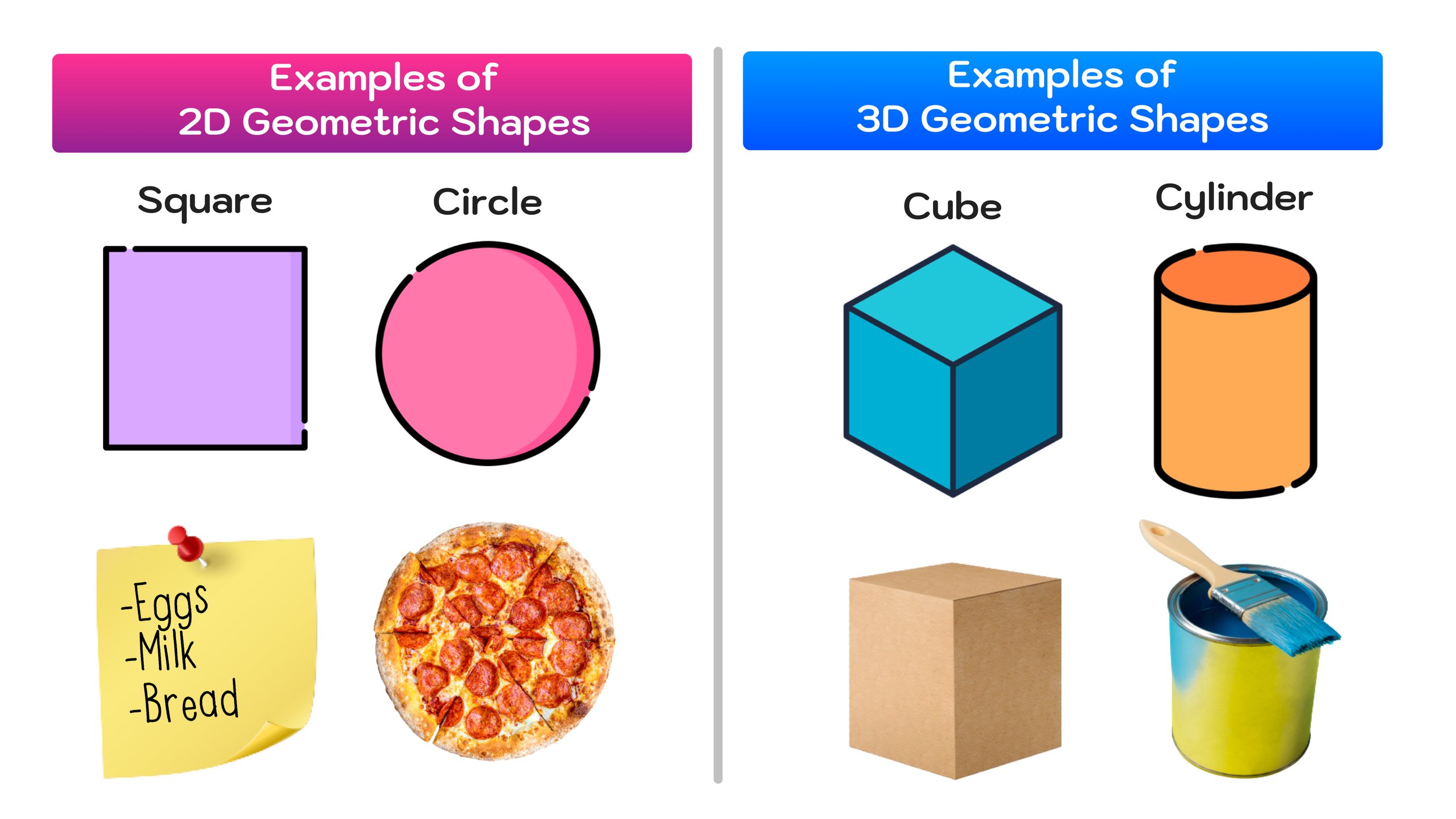
In fact, geometric shapes are all around you all of the time. Figure 01 below shows examples of common 2D geometric shapes and 3D geometric shapes and how they relate to objects in the real world. Later in this guide, we will take a look at geometric shapes art and design examples.
Figure 01: Example of 2D Geometric Shapes and 3D Geometric Shapes and how they relate to items in the real world.
2D Geometric Shapes Complete List
Circle
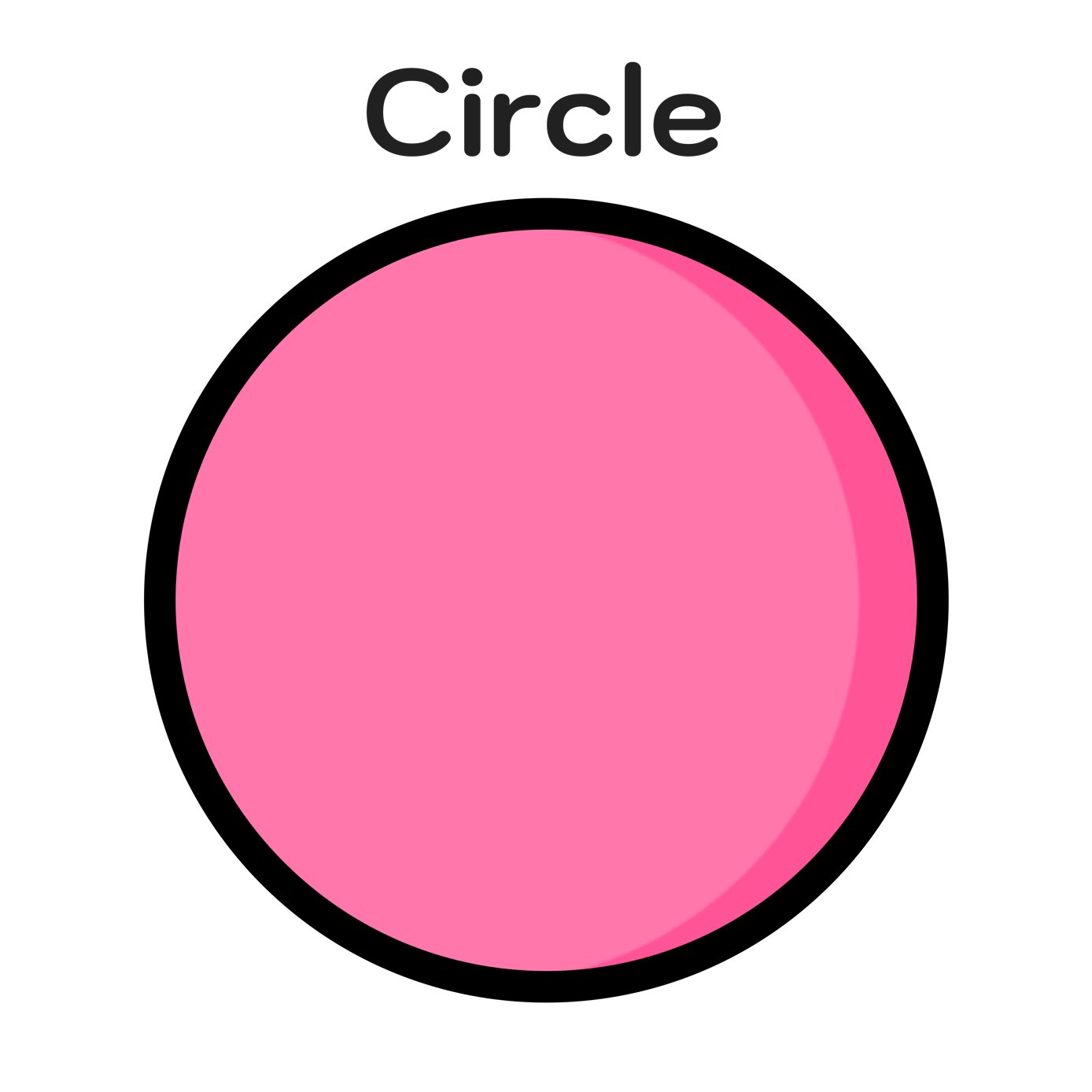
A circle is a 2D geometric shape consisting of all points that are at an equal distance from a central point called the center. This distance is known as the radius of the circle.
Semicircle
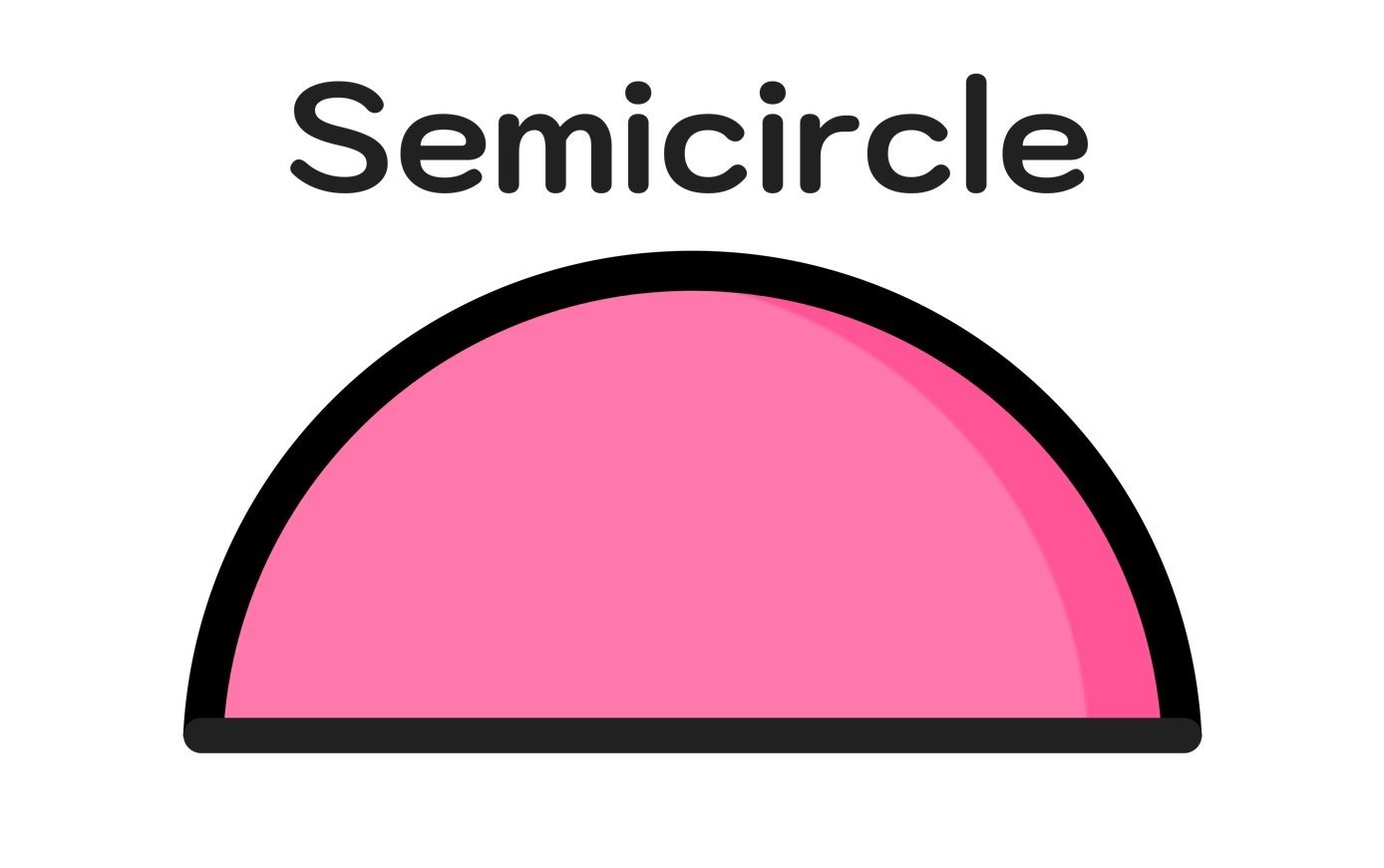
A semicircle is half of a circle, which is formed by cutting a circle along its diameter and removing one of the resulting halves.
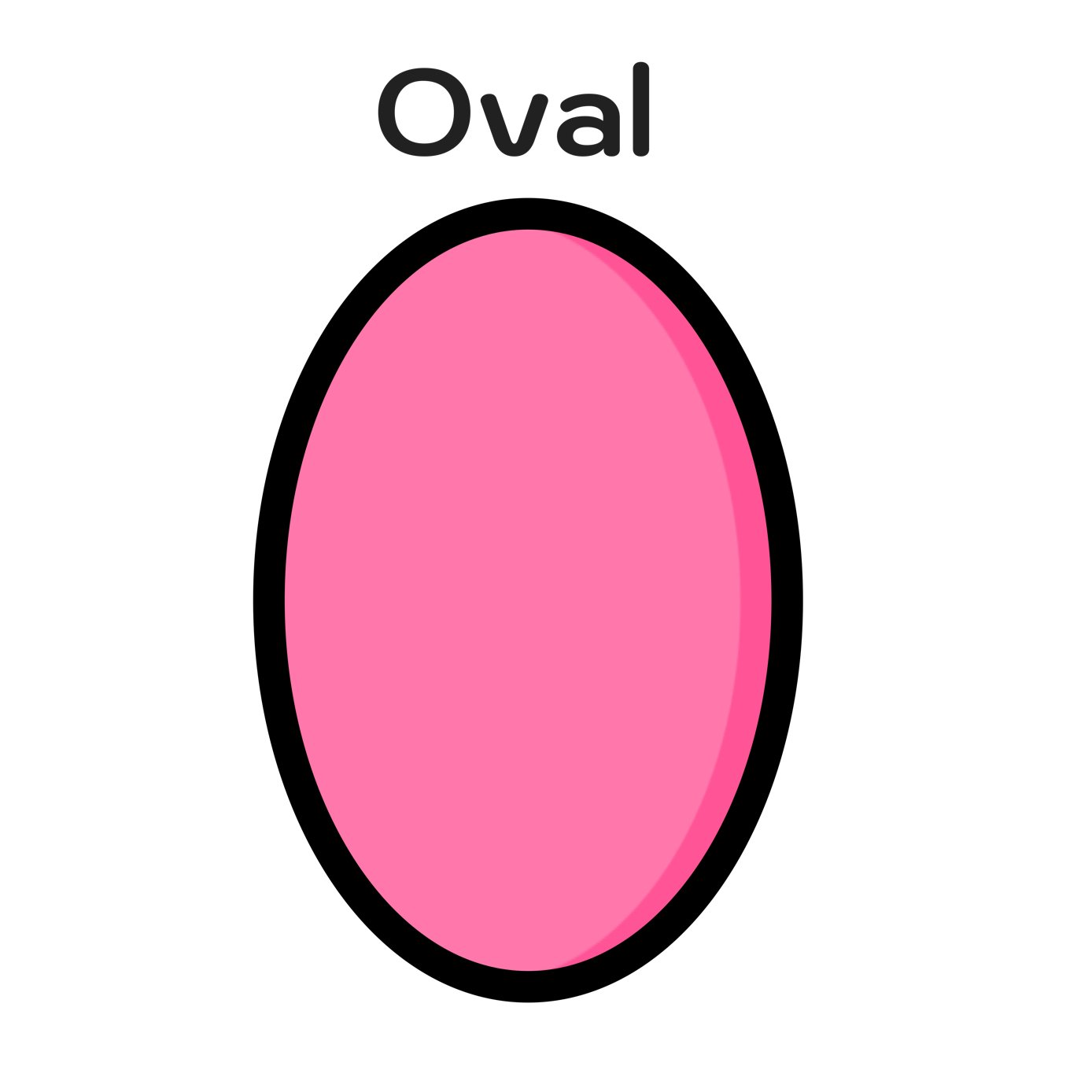
Oval
An oval is a closed, elongated shape with no straight lines, resembling an egg or an ellipse.
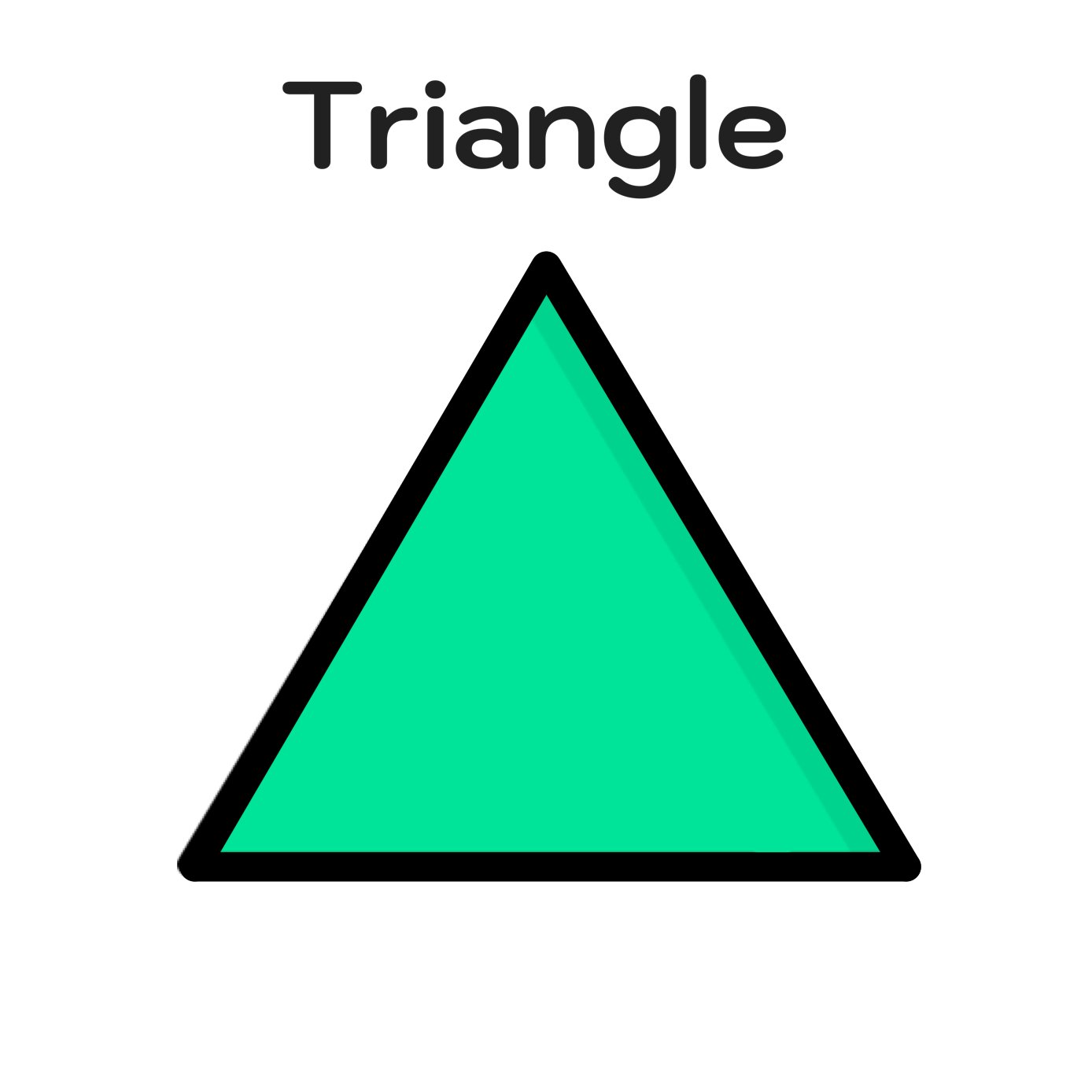
Triangle
A triangle is a 2D geometric shape that is a plane figure with three straight sides and three angles.
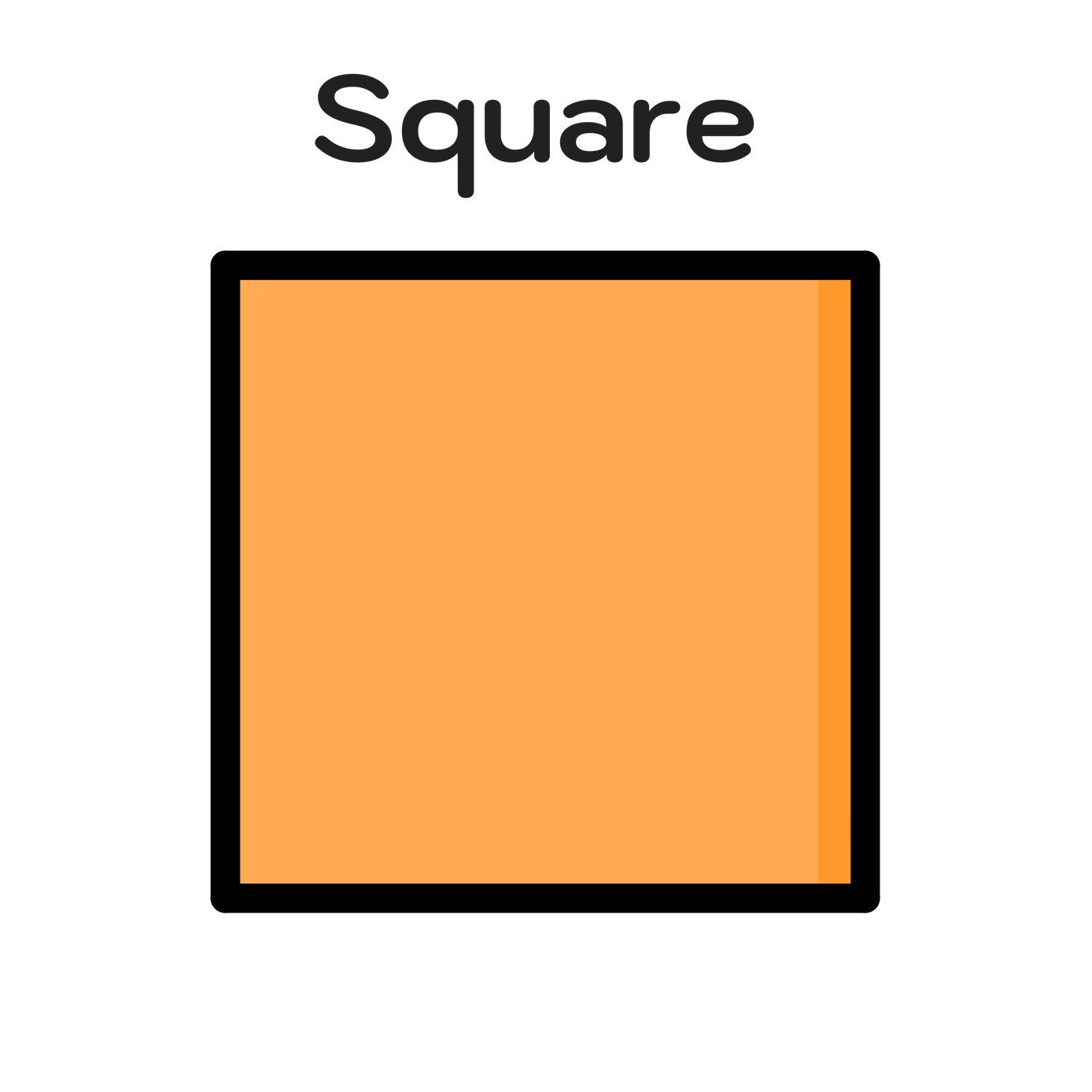
Square
A square is a four-sided polygon with all sides equal in length with all four angles being right (i.e. they equal 90 degrees).
Is a square also a rectangle?
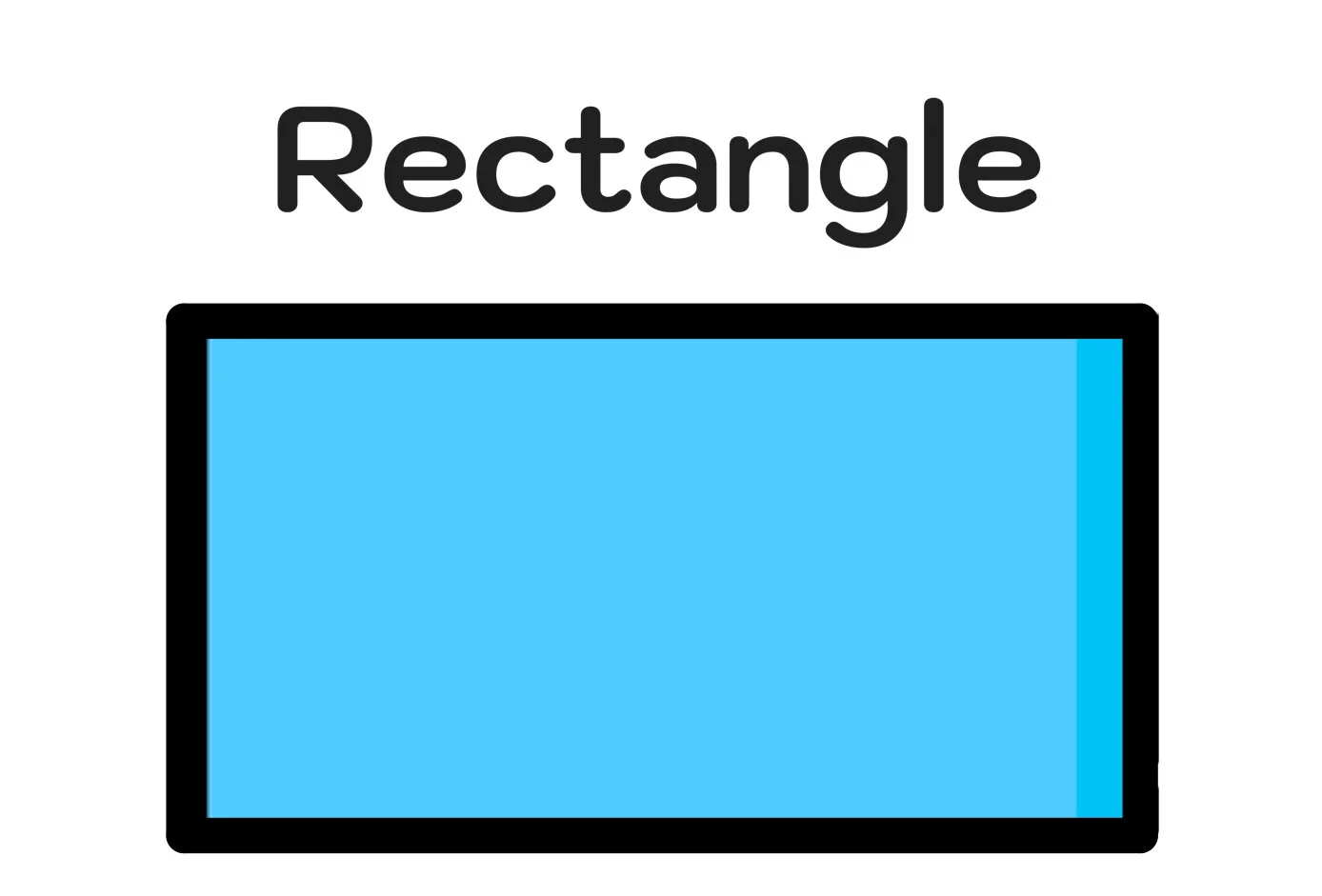
Rectangle
A rectangle is a four-sided polygon with opposite sides that are parallel to each other and equal in length. All four interior angles of a rectangle are equal to 90 degrees.
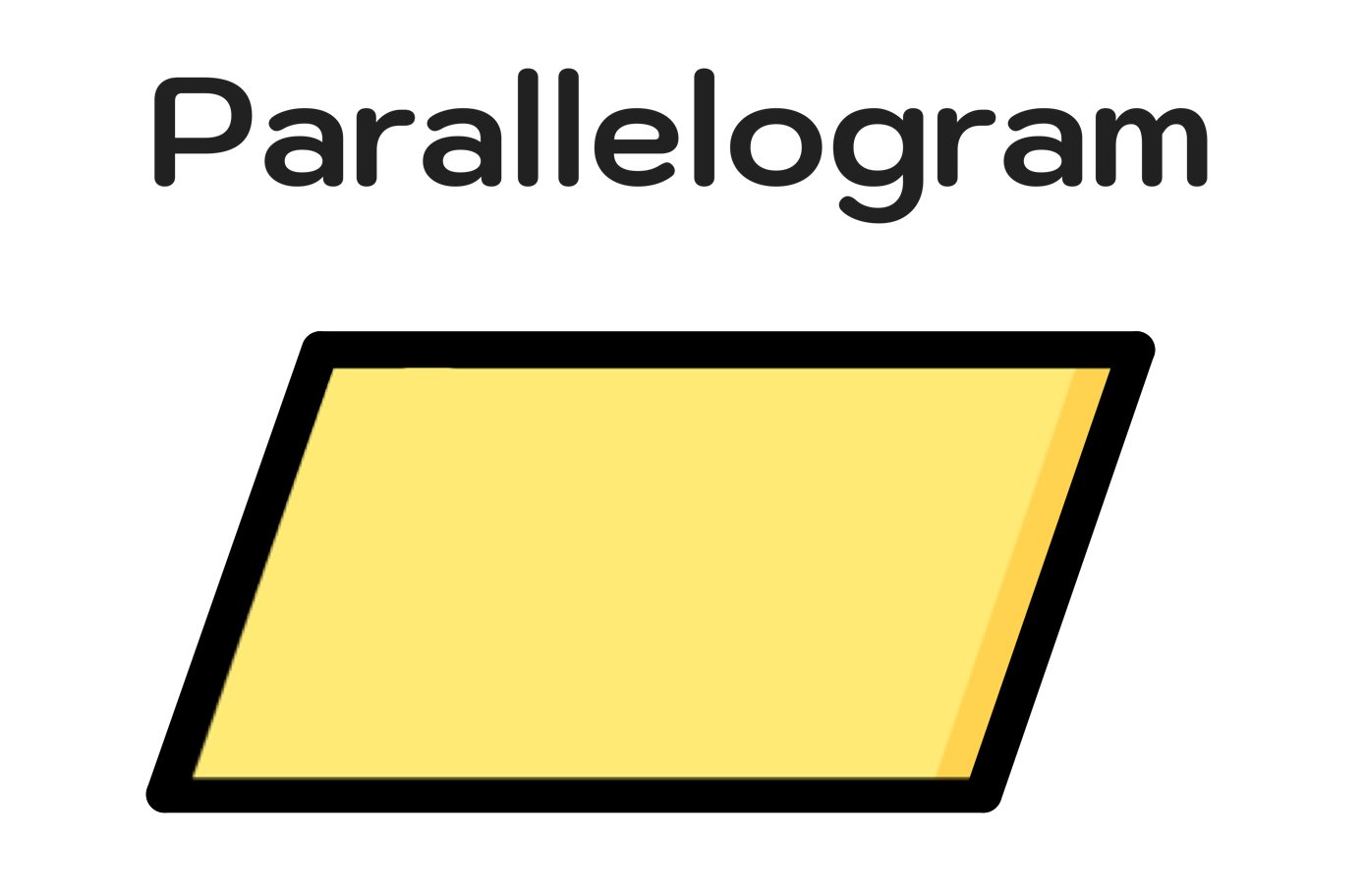
Parallelogram
A parallelogram is a 2D geometric shape that is a four-sided polygon that has parallel opposite sides that are equal in length.
Parallelogram lines of symmetry explained
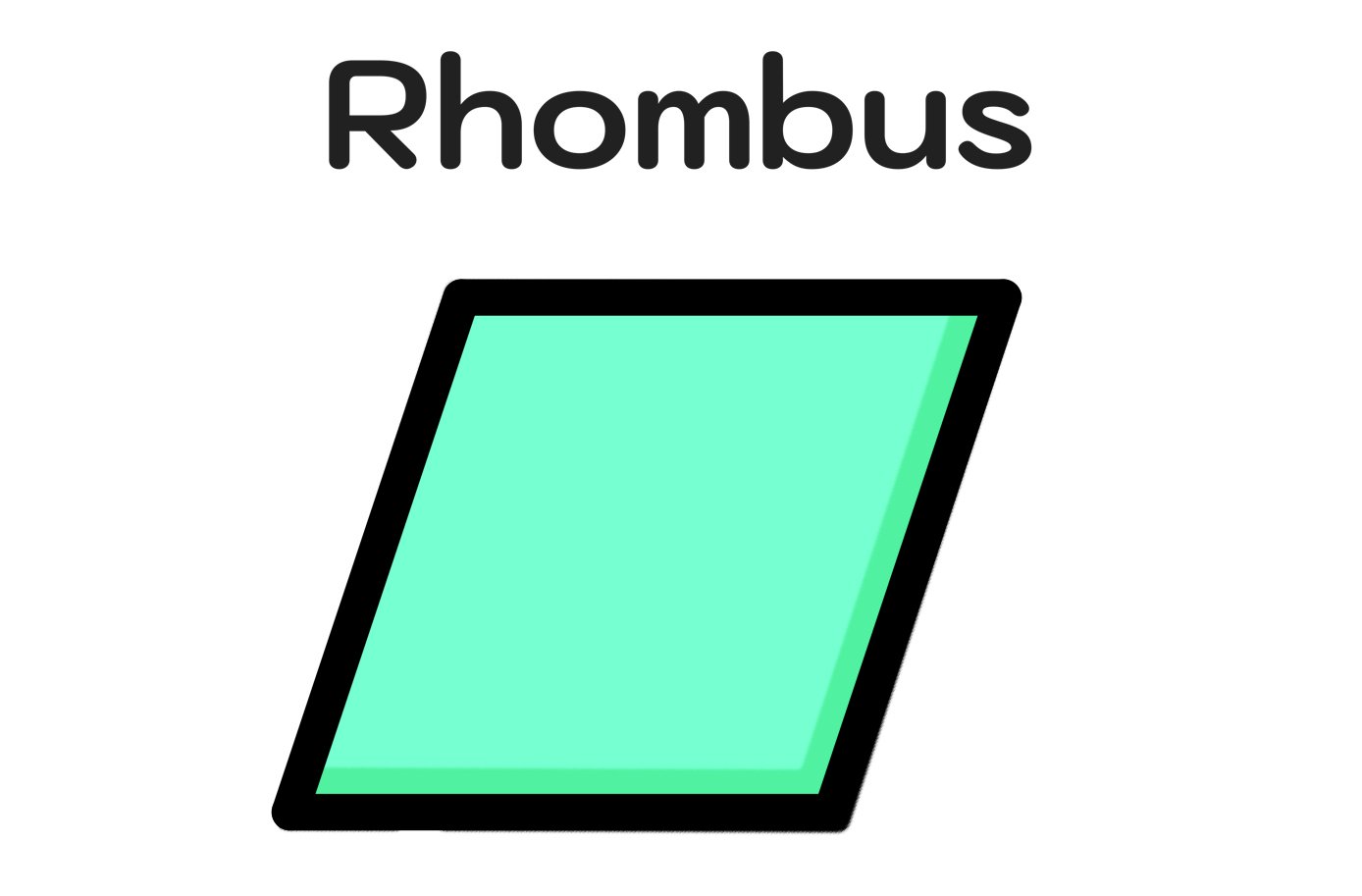
Rhombus
A rhombus is a four-sided polygon where all four sides are equal in length and opposite angles are equal in measure.
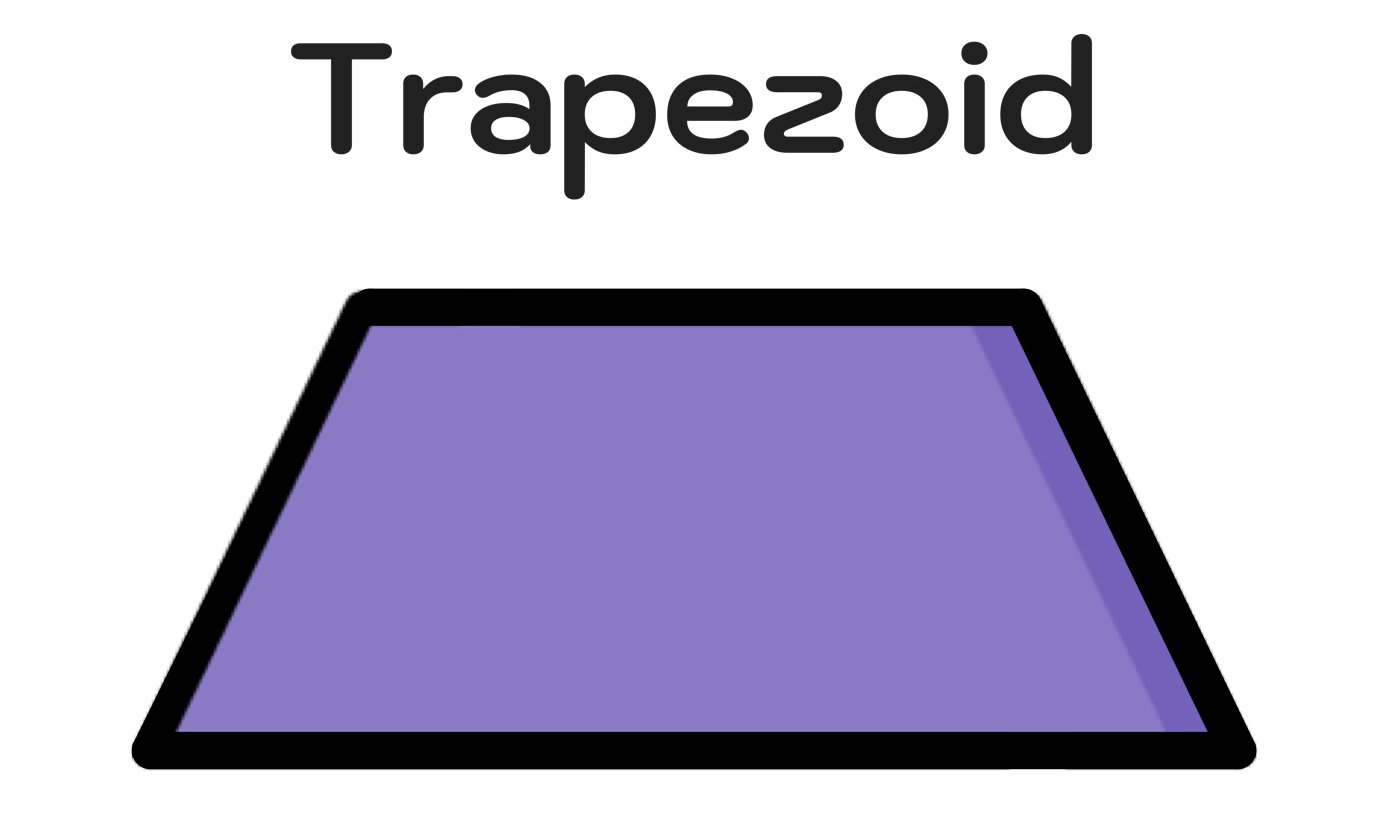
Trapezoid
A trapezoid is a 2D geometric shape that is a quadrilateral with at least one pair of parallel sides
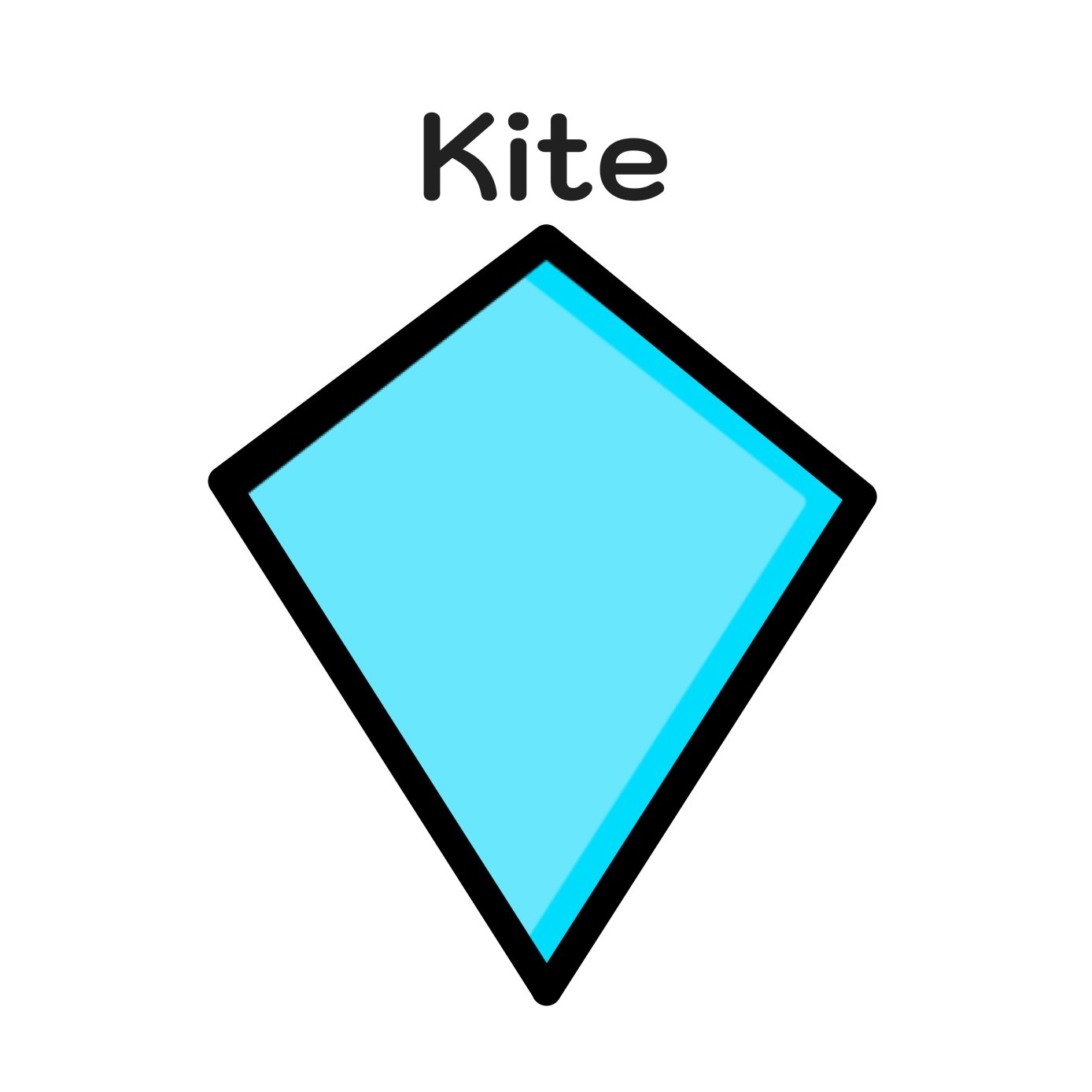
Kite
A kite is a four-sided polygon with two pairs of adjacent sides of equal length.
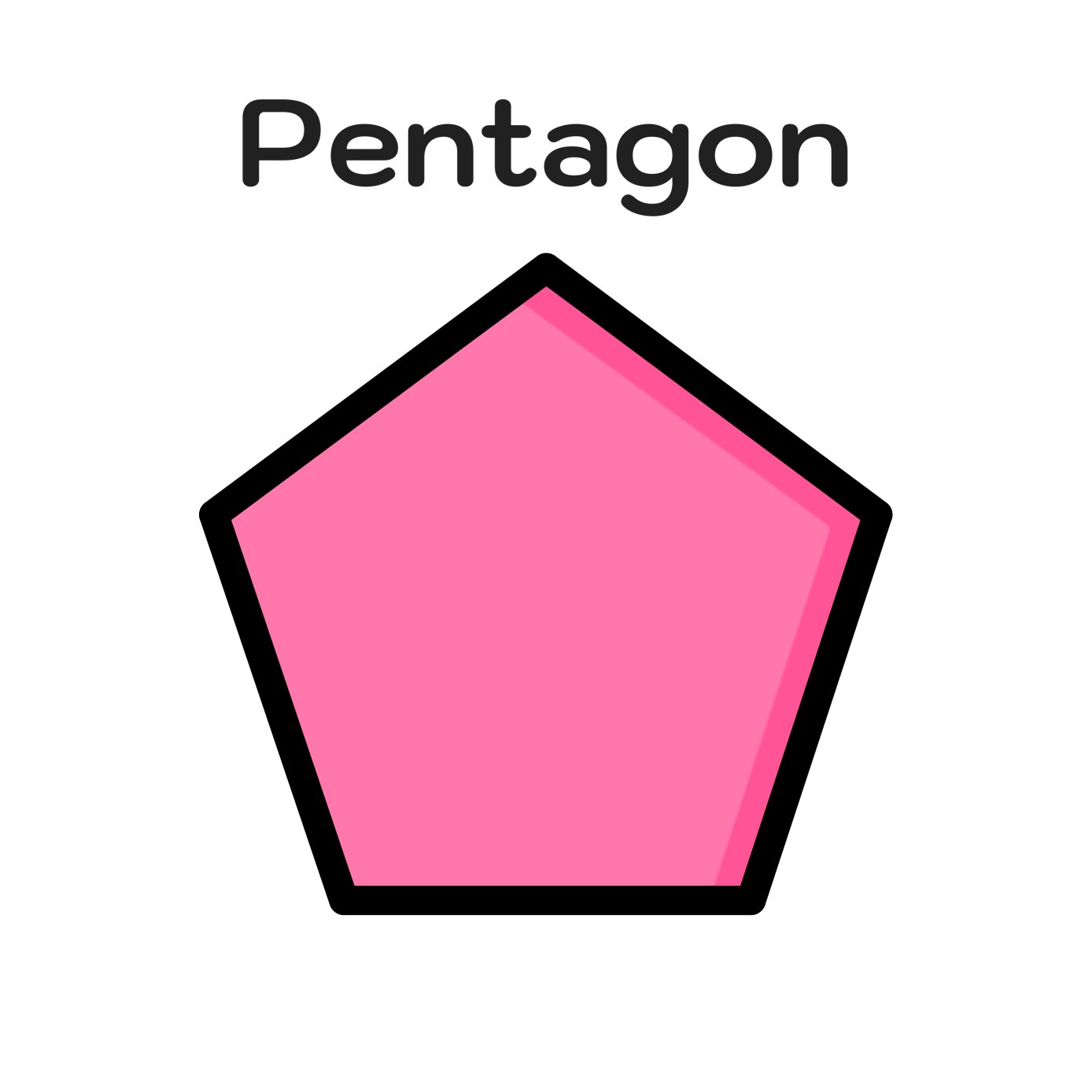
Pentagon
The 2D geometric shape known as a regular pentagon is a five-sided polygon where all of the sides and all of the angles are equal in measure.
Pentagon = 5 Sides
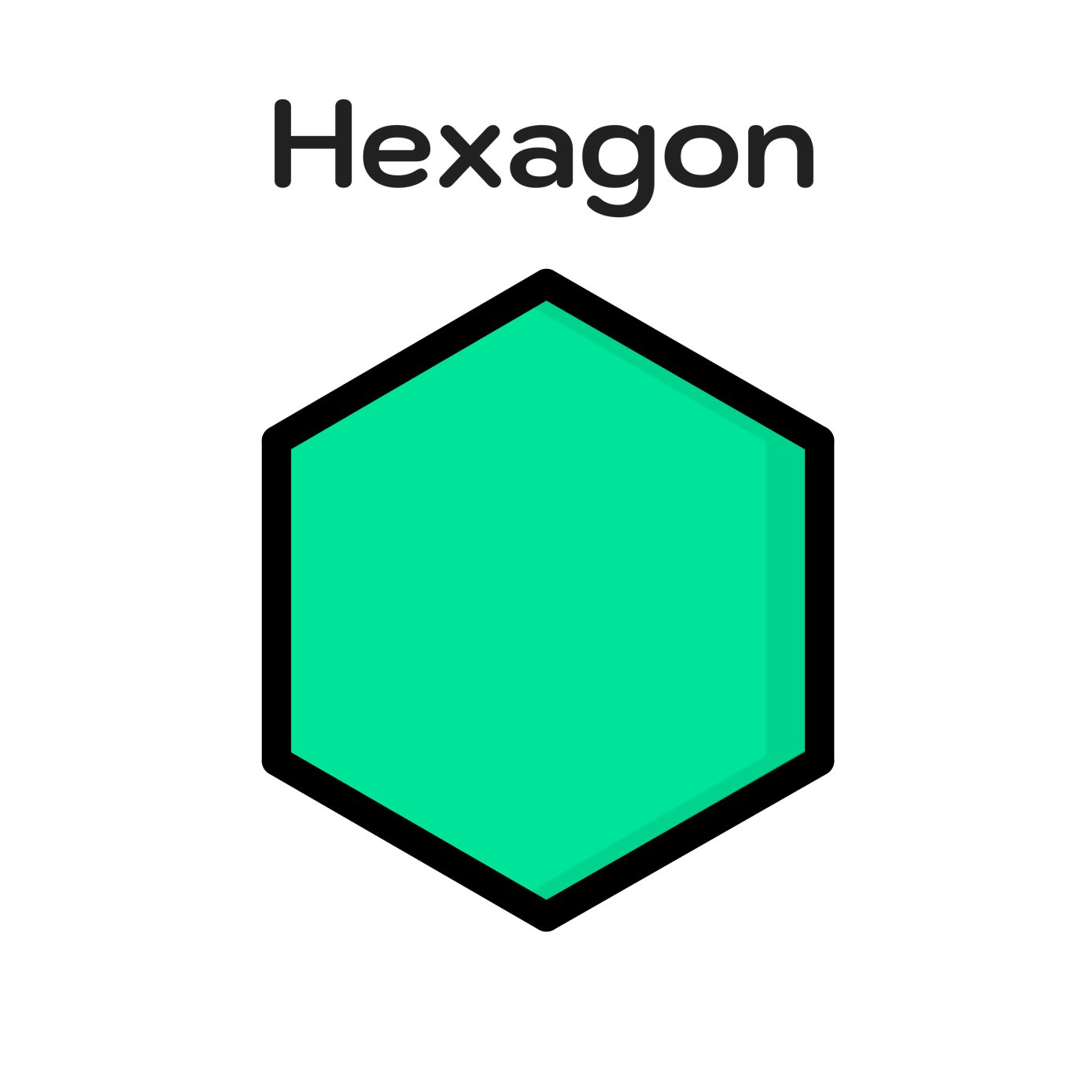
Hexagon
The 2D geometric shape known as a regular hexagon is a six-sided polygon where all of the sides and all of the angles are equal in measure.
Hexagon = 6 Sides
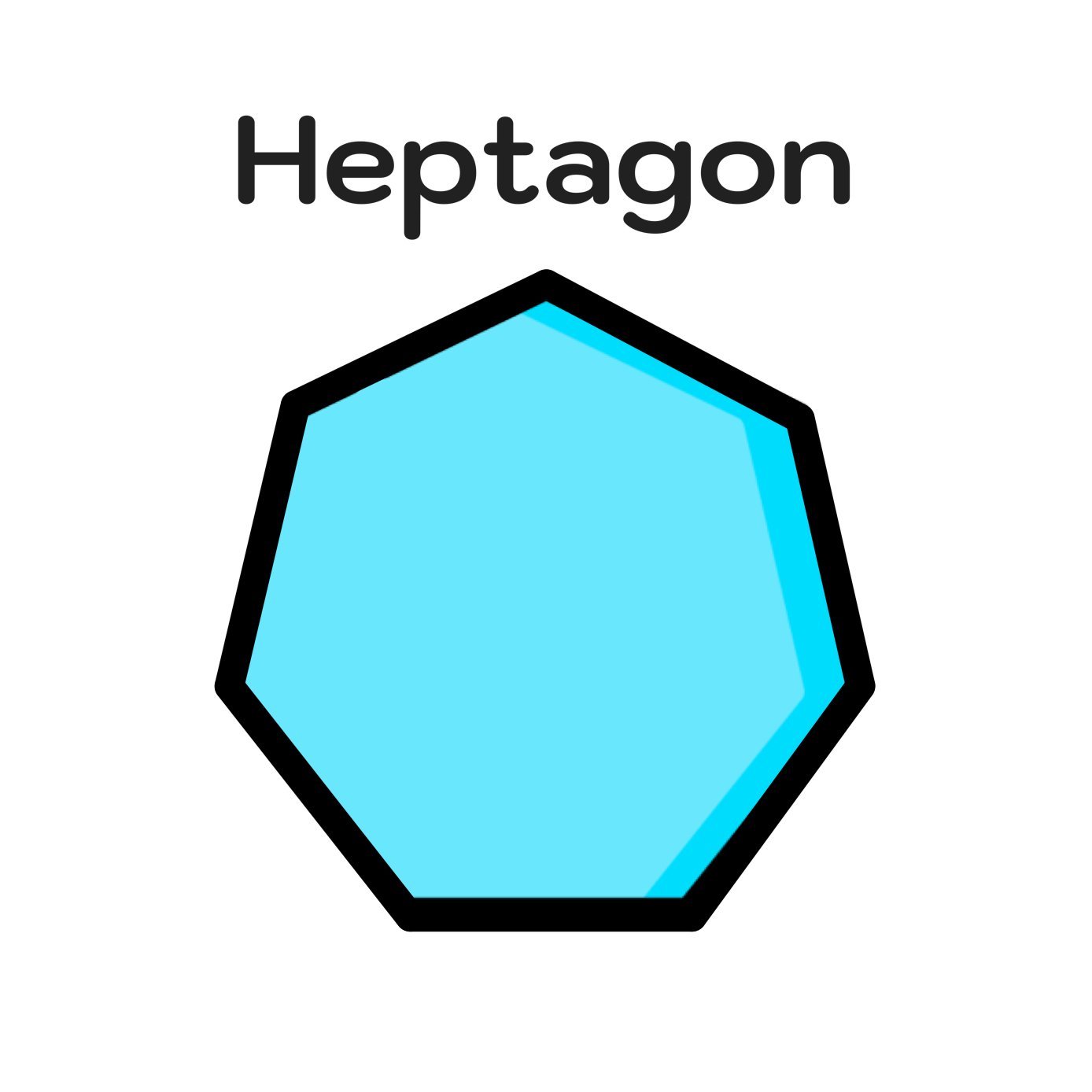
Heptagon
The 2D geometric shape known as a regular heptagon is a seven-sided polygon where all of the sides and all of the angles are equal in measure.
Heptagon = 7 Sides
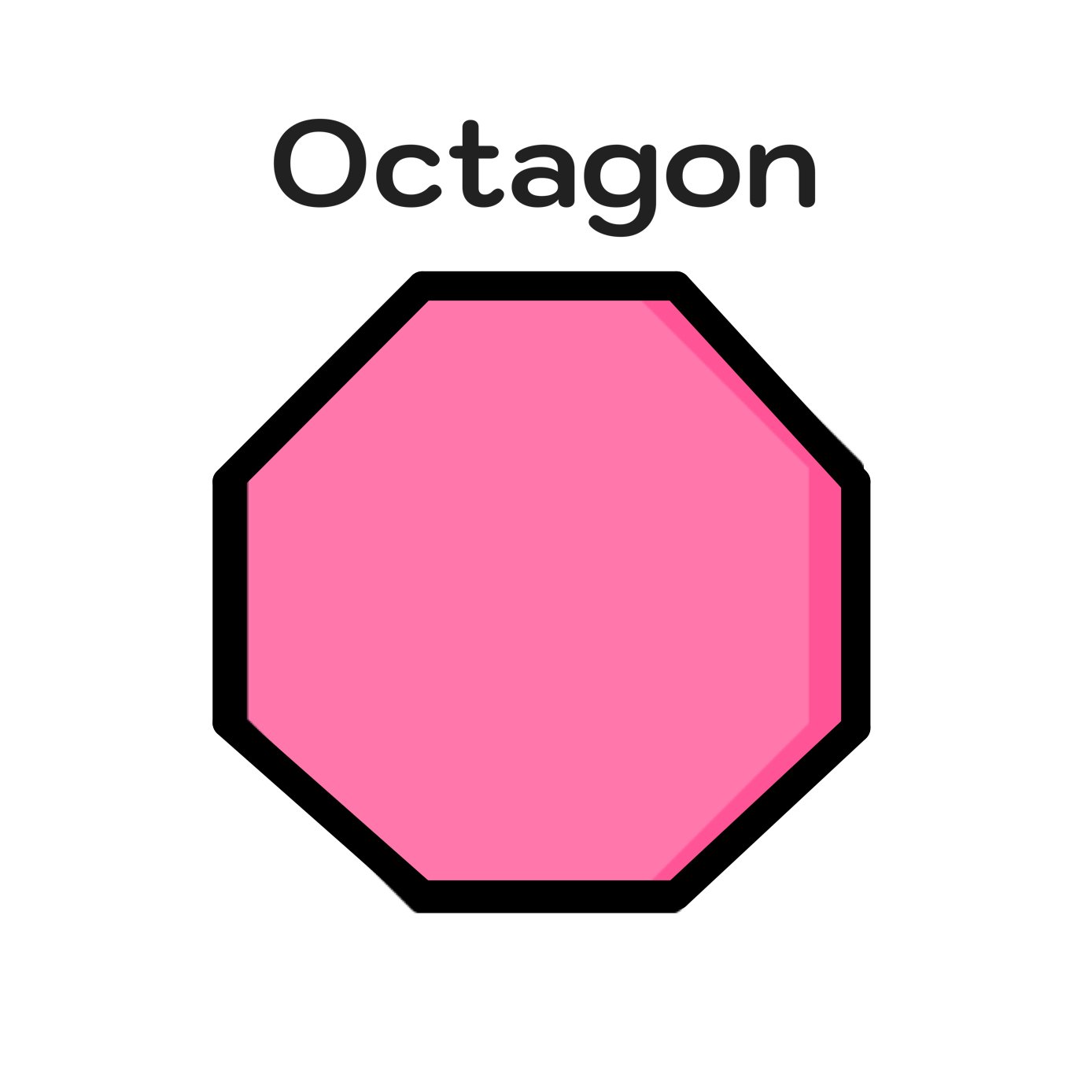
Octagon
The 2D geometric shape known as a regular octagon is an eight-sided polygon where all of the sides and all of the angles are equal in measure.
Octagon = 8 Sides
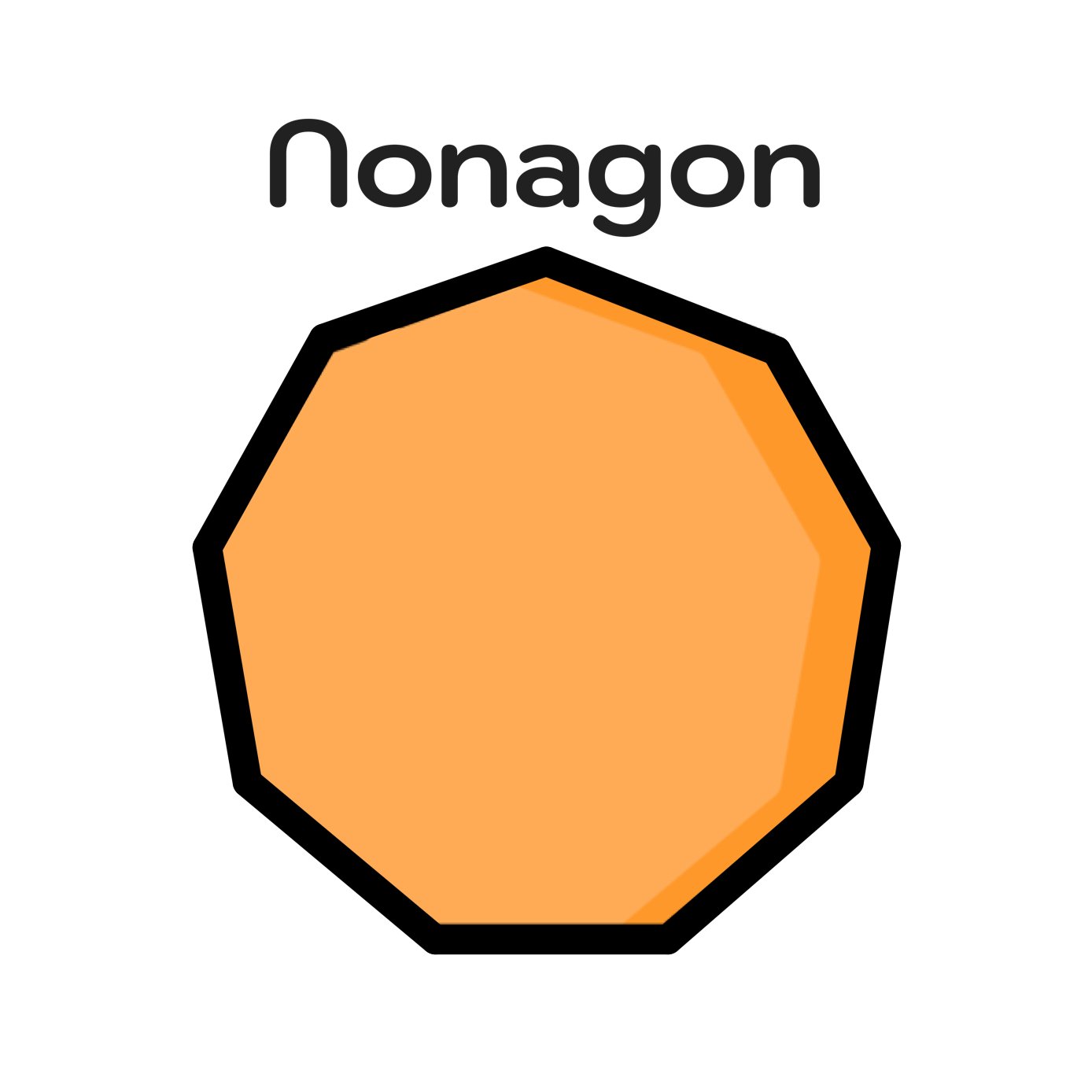
Nonagon
The 2D geometric shape known as a regular nonagon is a nine-sided polygon where all of the sides and all of the angles are equal in measure.
Nonagon = 9 Sides
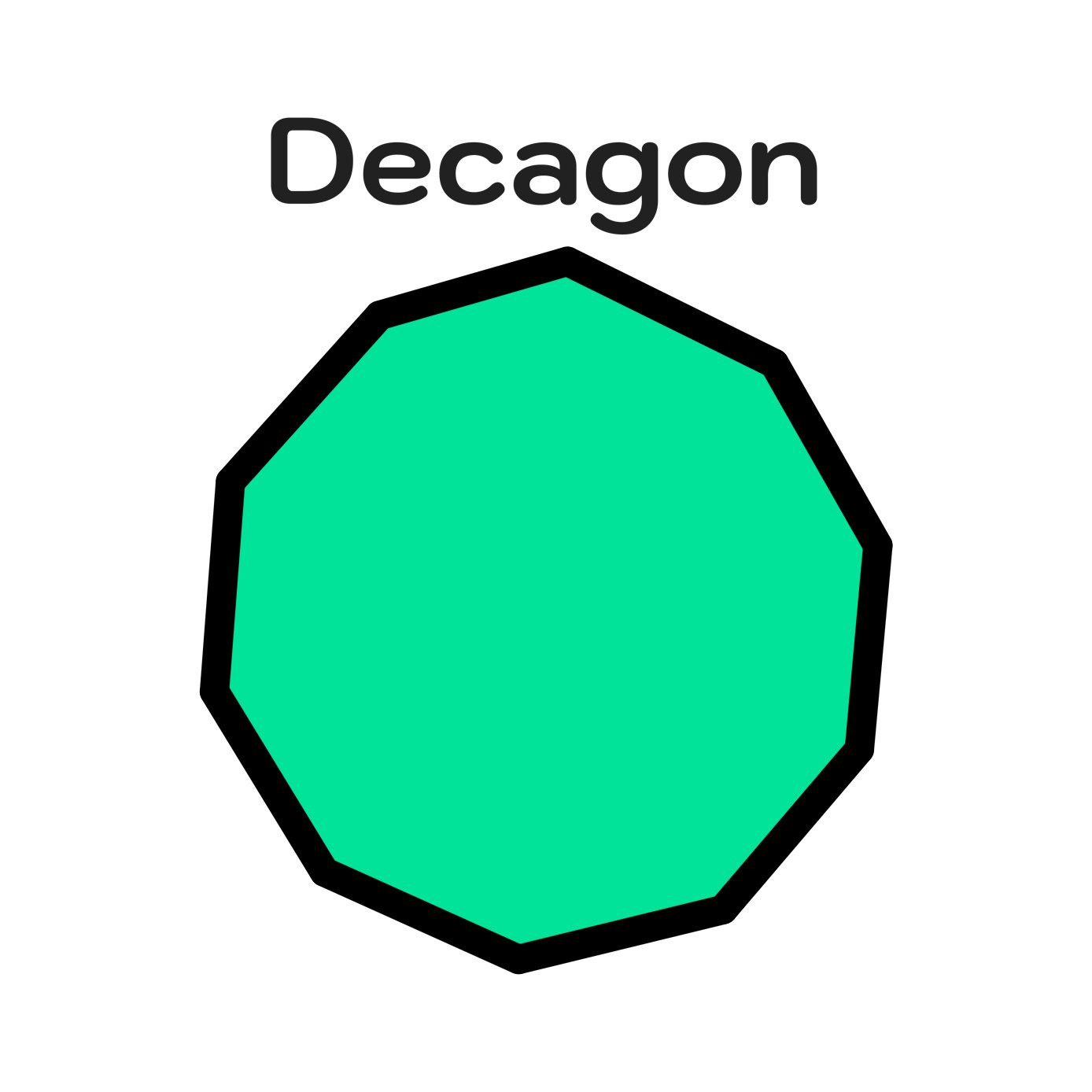
Decagon
The 2D geometric shape known as a regular decagon is a ten-sided polygon where all of the sides and all of the angles are equal in measure.
Decagon = 10 Sides
3D Geometric Shapes Complete List
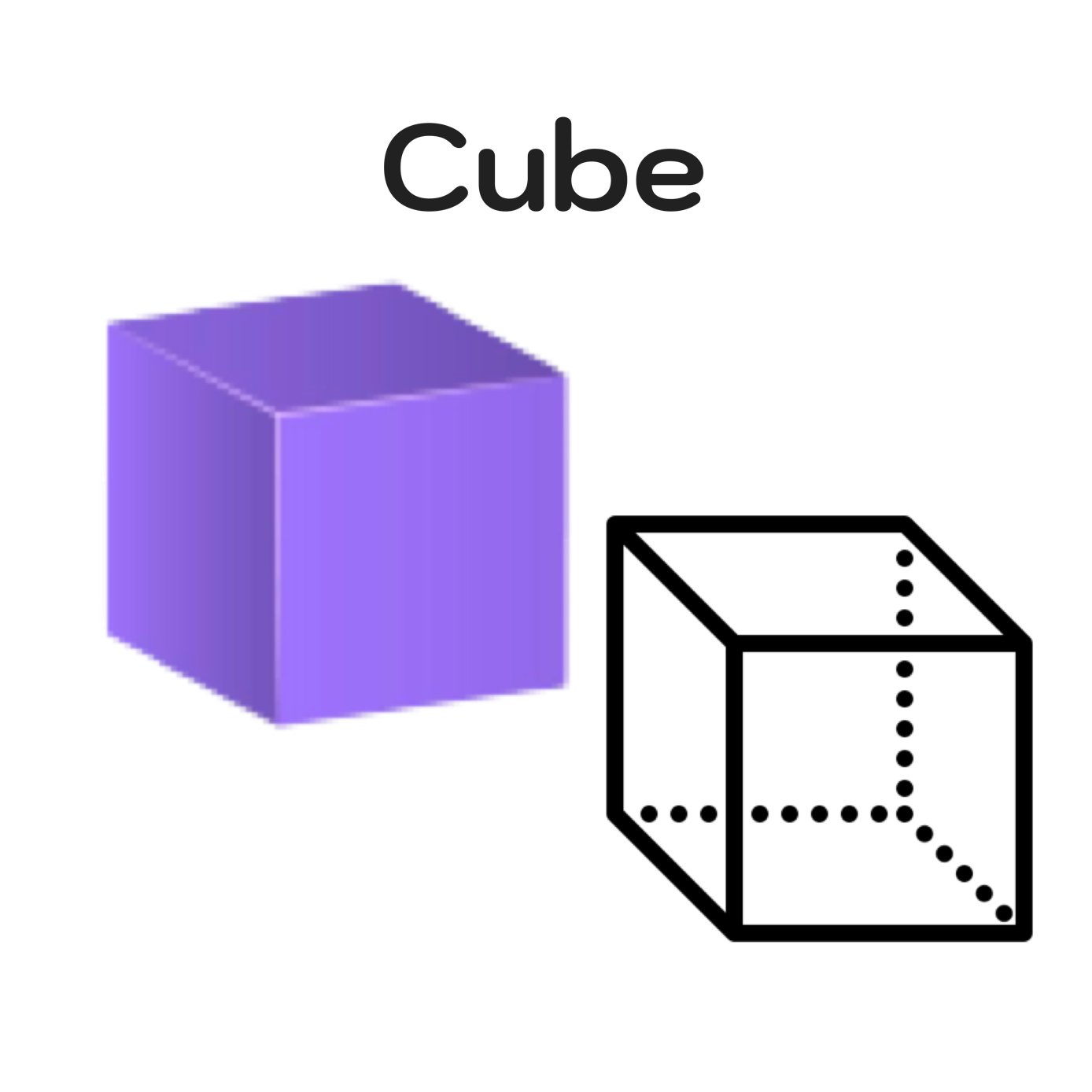
Cube
A cube is a 3D geometrical shape with six square faces that are all equal in size and all interior angles equal 90 degrees.
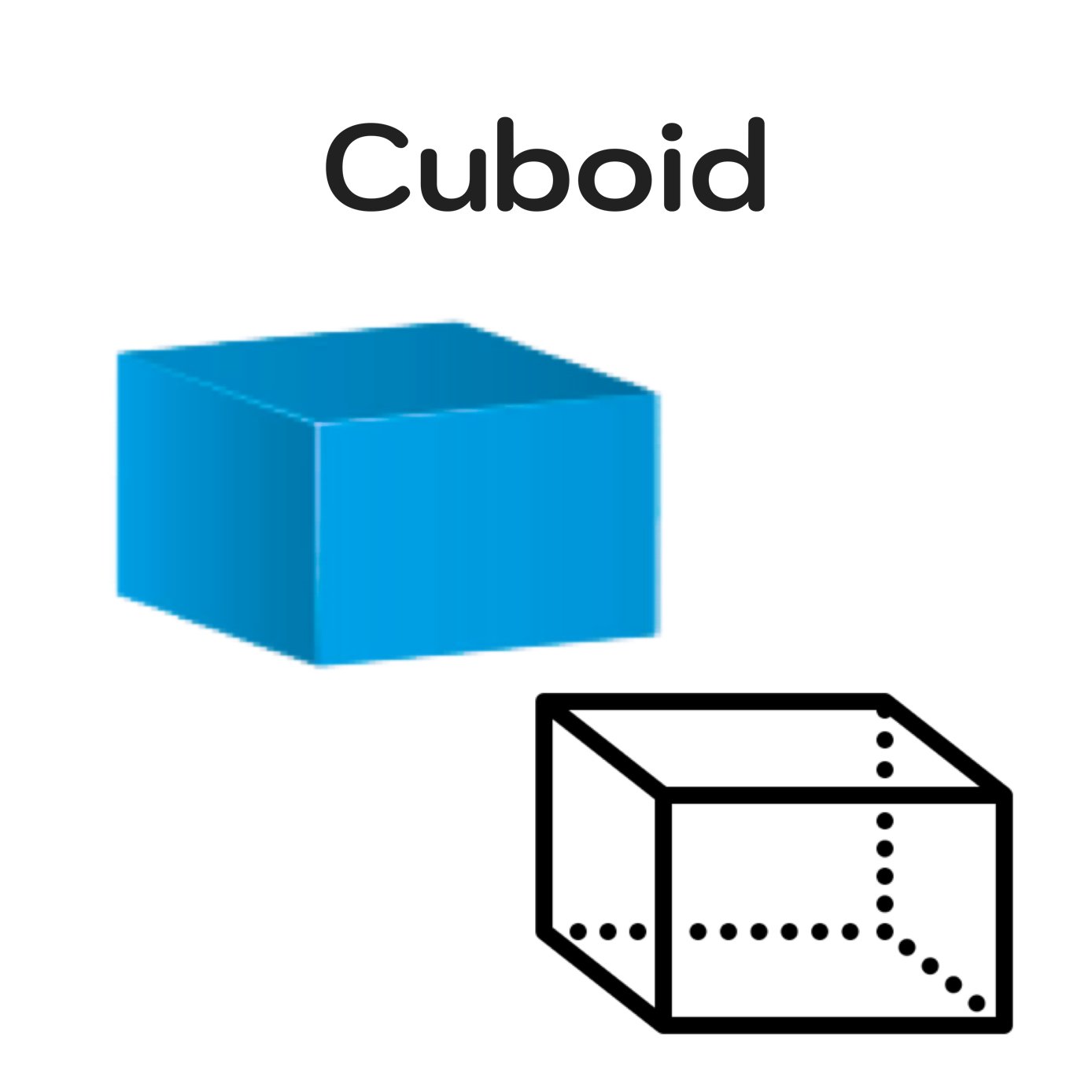
Cuboid
A cuboid, also referred to as a rectangular prism, is a 3D geometrical shape with six square faces where opposite faces are equal in size and all interior angles equal 90 degrees.
Cone
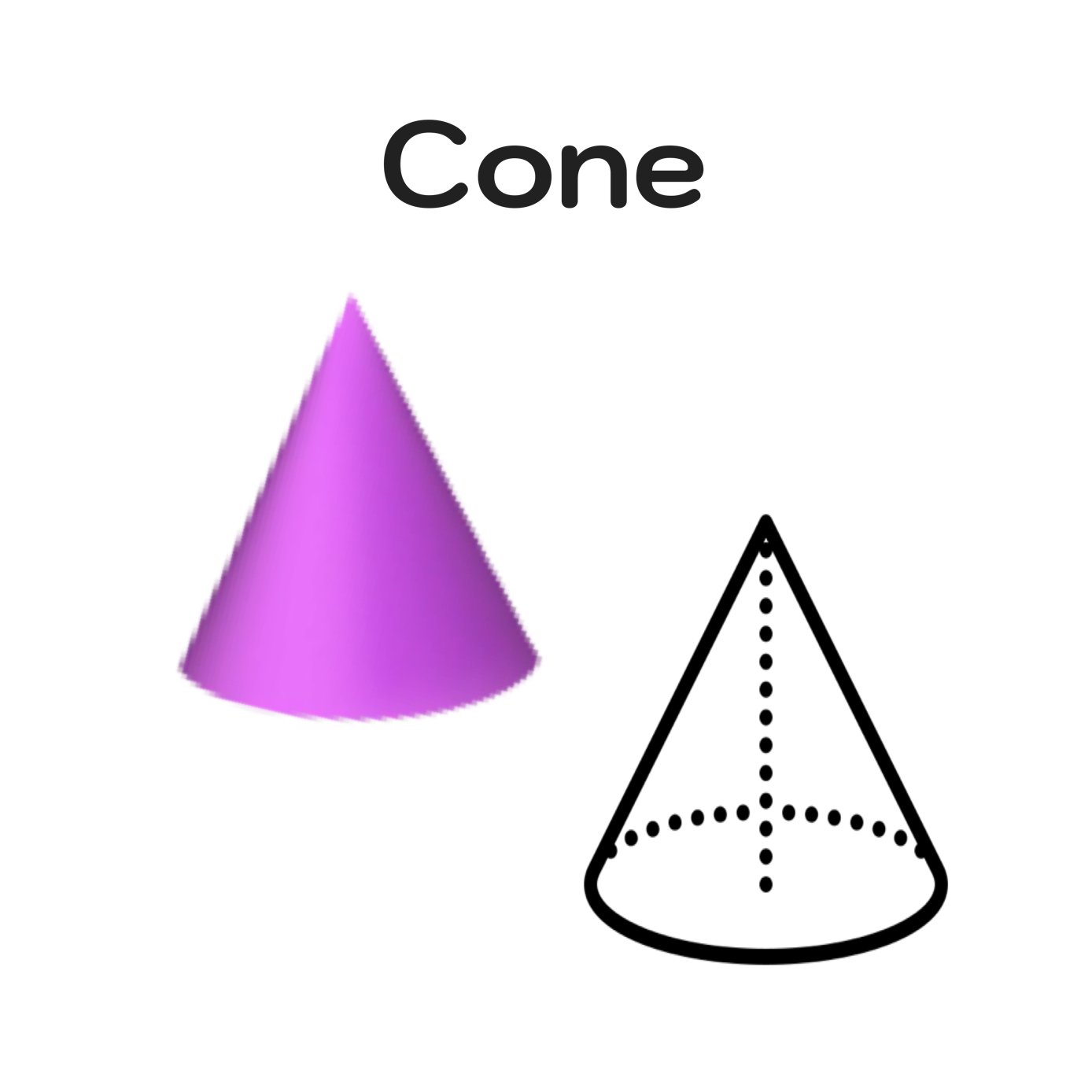
A cone is a 3D geometric shape with a circular base that slants to a point called an apex.
Cylinder
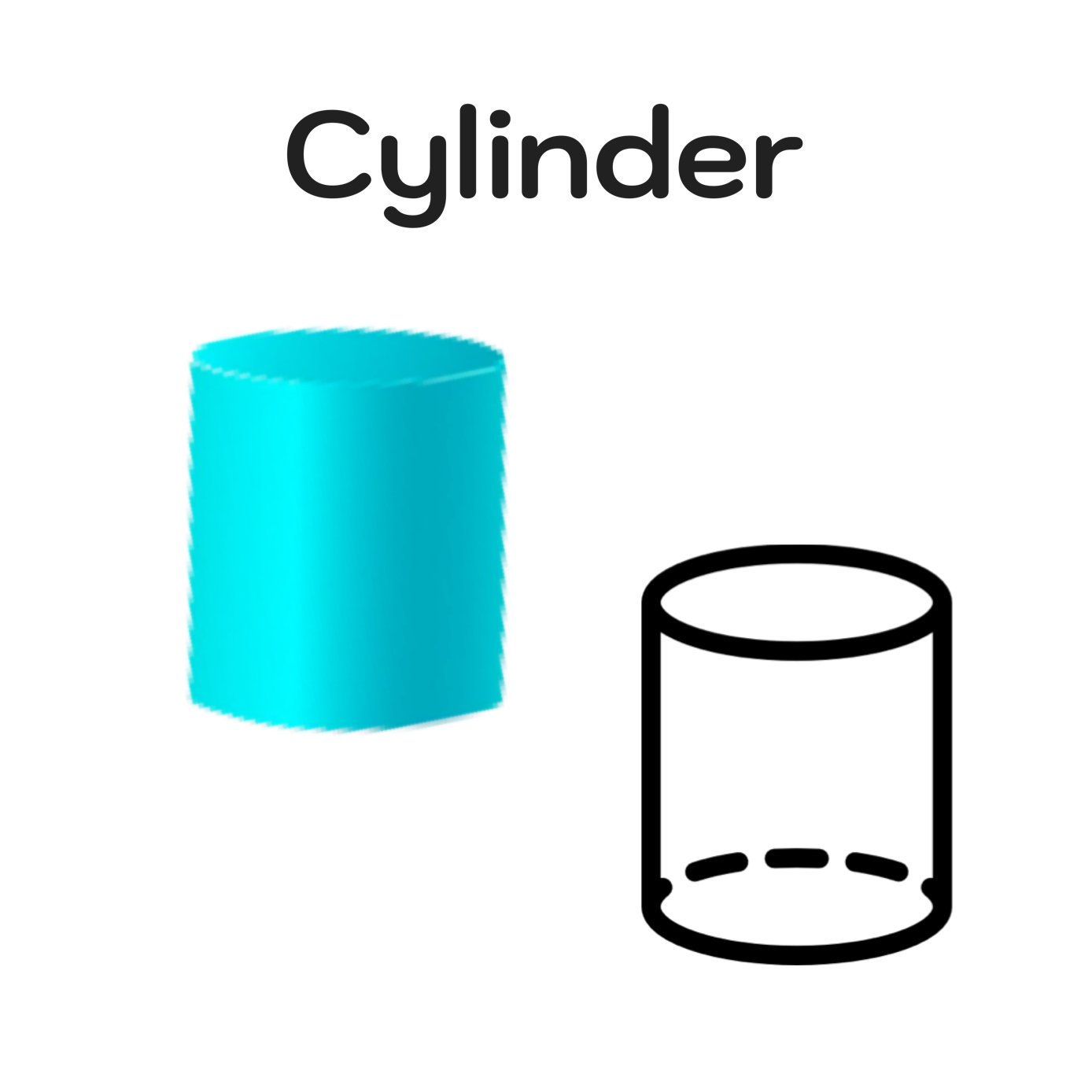
A cylinder is a is a 3D geometric shape made of two parallel and equal circular bases of connected by a curved surface.
Sphere
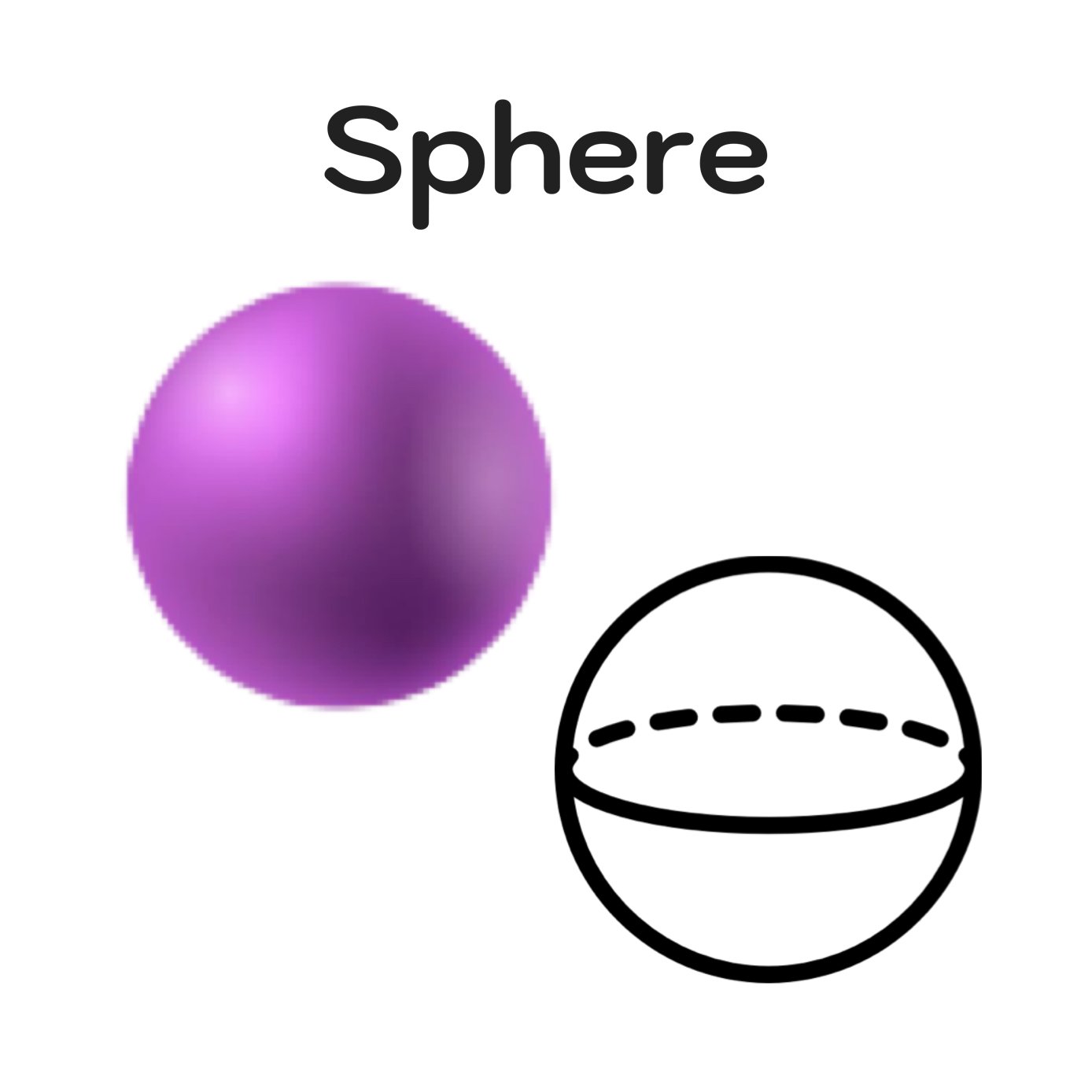
A sphere is a 3D geometric shape that resembles a ball and is perfectly round, where all surface points are equidistant from the center point.
Pyramid
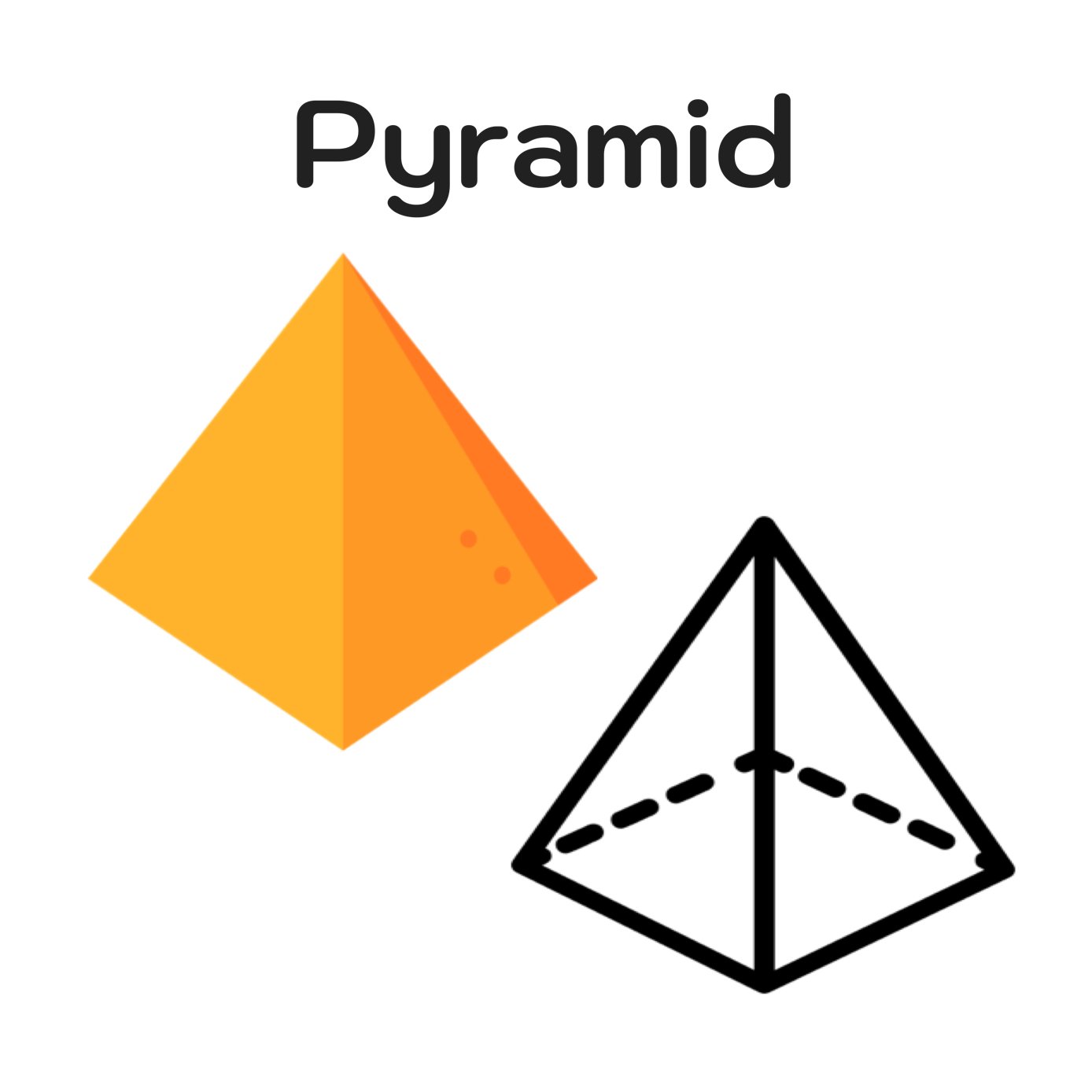
A pyramid is a 3D geometric shape with a polygonal base and triangular faces that slant up to a single point called an apex.
Platonic Solids and Other Shapes
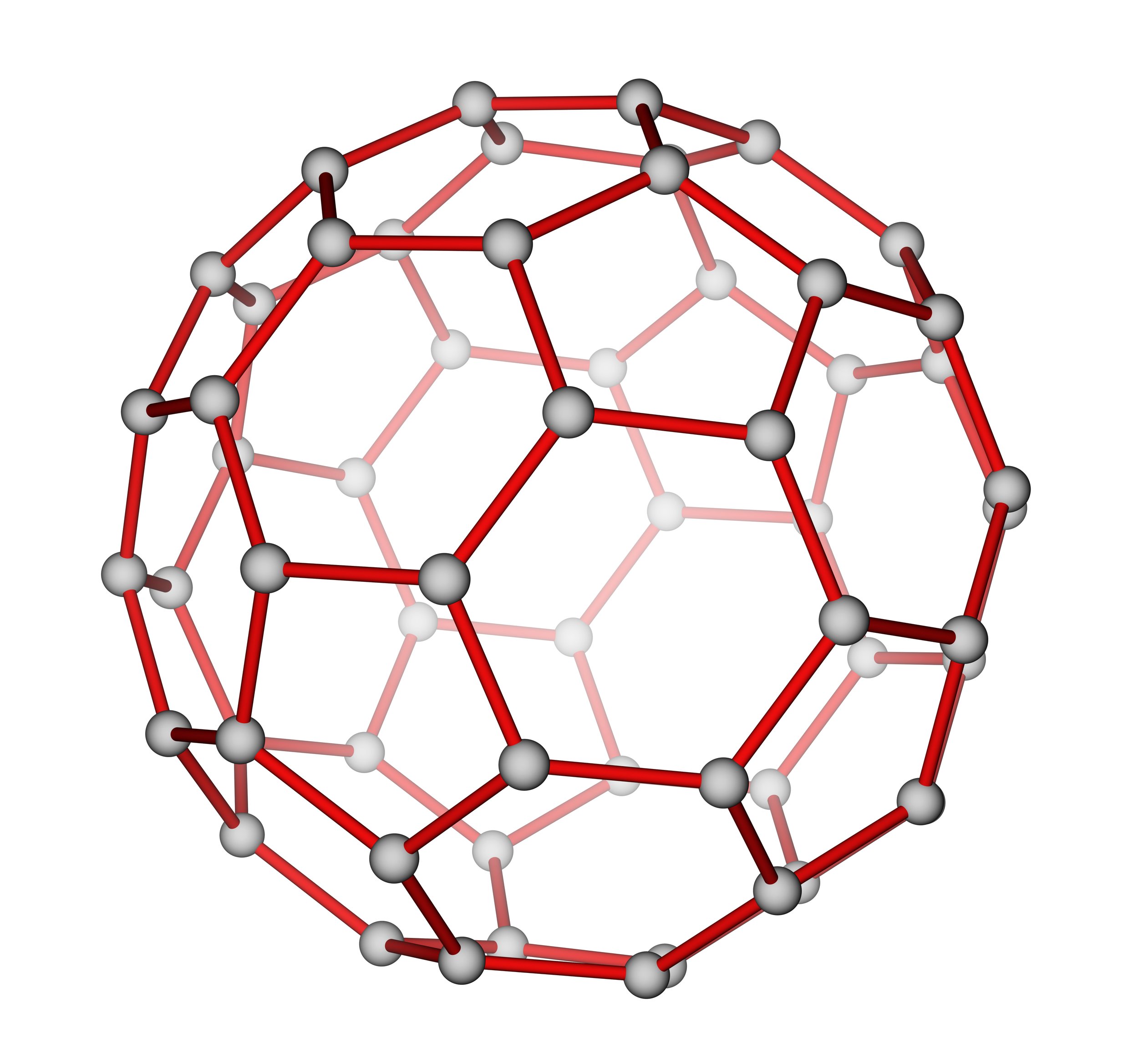
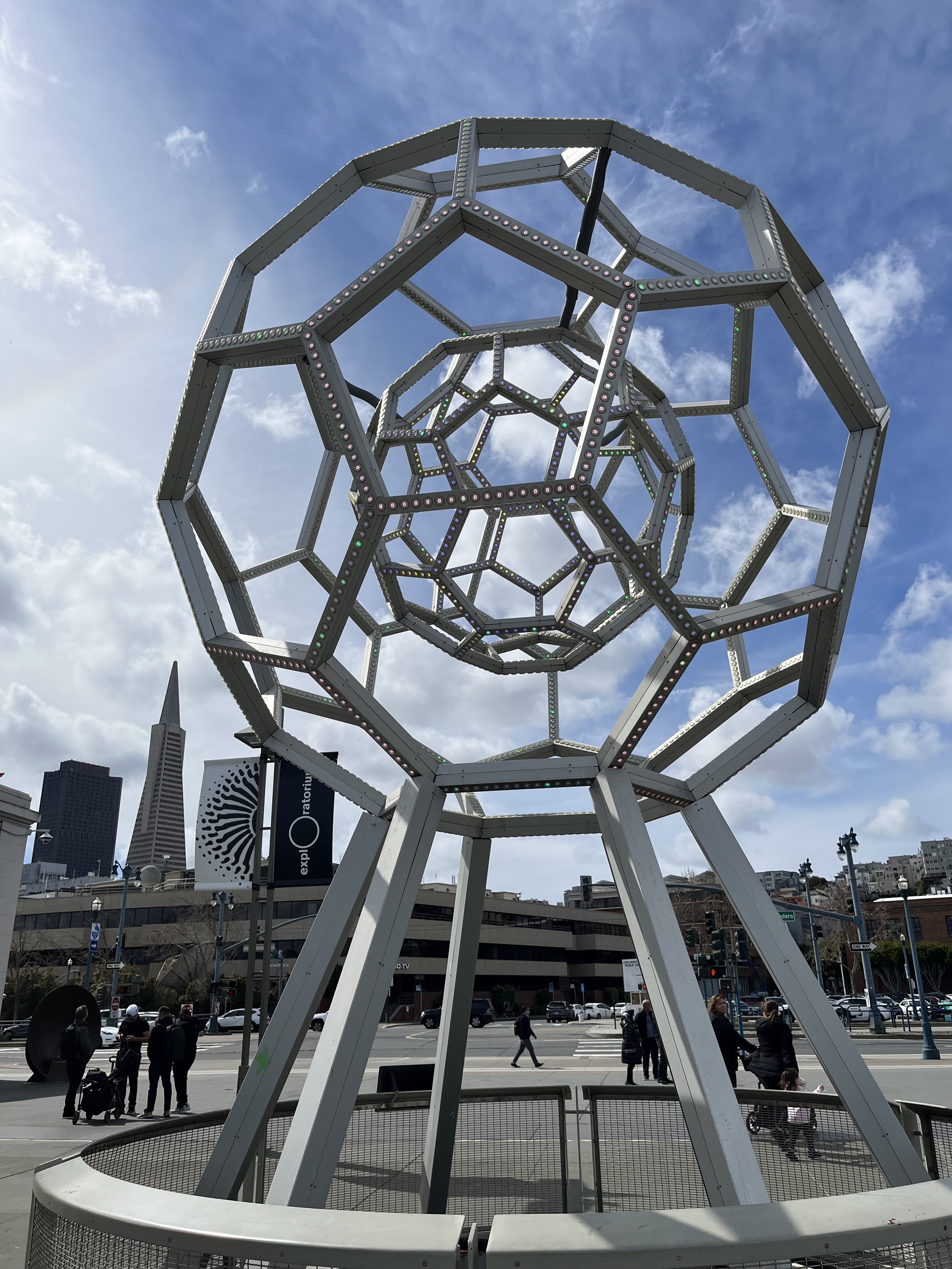
In addition to the 3D-shapes previously shown, there are several extremely interesting three-dimension shapes such as the platonic solids and another extremely fascinating three-dimensional shape called a Buckyball—a spherical molecule composed of 60 carbon atoms arranged in a pattern resembling a soccer ball. It has unique physical and chemical properties that make it useful in a wide range of applications, including materials science, nanotechnology, and medicine.
Buckyball
The famous 25-foot tall Buckyball sculpture located at the Pier 15 Exploratorium in San Francisco, California.
Tetrahedron: 4 faces, 4 points, 6 edges
Hexahedron: 6 faces, 8 points, 12 edges (like a cube)
Octahedron: 6 faces, 6 points, 12 edges
Icosahedron: 20 faces, 12 points, 30 edges
Dodecahedron: 12 faces, 20 points, 30 edges
What is the difference between 2D geometric shapes and 3D geometric shapes?
The key difference between 2D geometric shapes and 3D geometric shapes is the quantity of dimensions—namely that 2D geometric shapes have two dimensions (length and width) and 3D geometric shapes have three dimensions (length, width, and height).
By looking at each 2D geometric shape in the list above, you can see that each geometrical shape is flat. Such shapes can be drawn on flat surfaces including a sheet of paper or on a screen. Conversely, 3D geometric shapes have what is called depth. These kinds of shapes are referred to as solids and they are not flat. You can construct 3D geometrical shapes using physical materials such as cardboard, plastic, or clay.
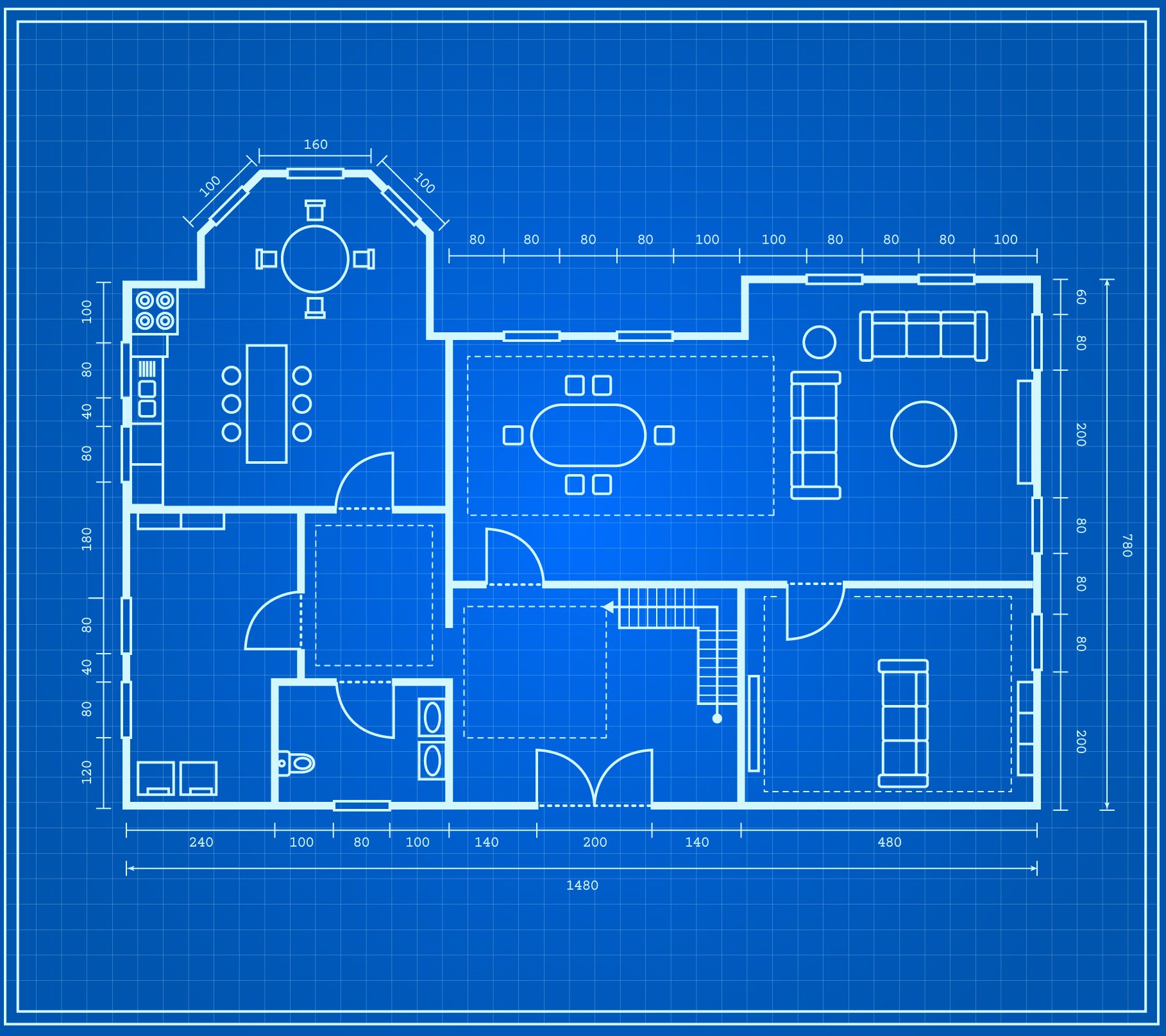
As far as real world applications go, 2D geometric shapes are used for things like making blueprints or graphic designs, while 3D geometric shapes are used for things like building objects out of wood, designing video game levels, and construction.
Notice that the blueprint design of a house is two-dimensional (flat) and is comprised of only 2D geometric shapes.
On the other hand, an actual house has depth and is made of 3D geometric shapes.
Geometric Shapes Art
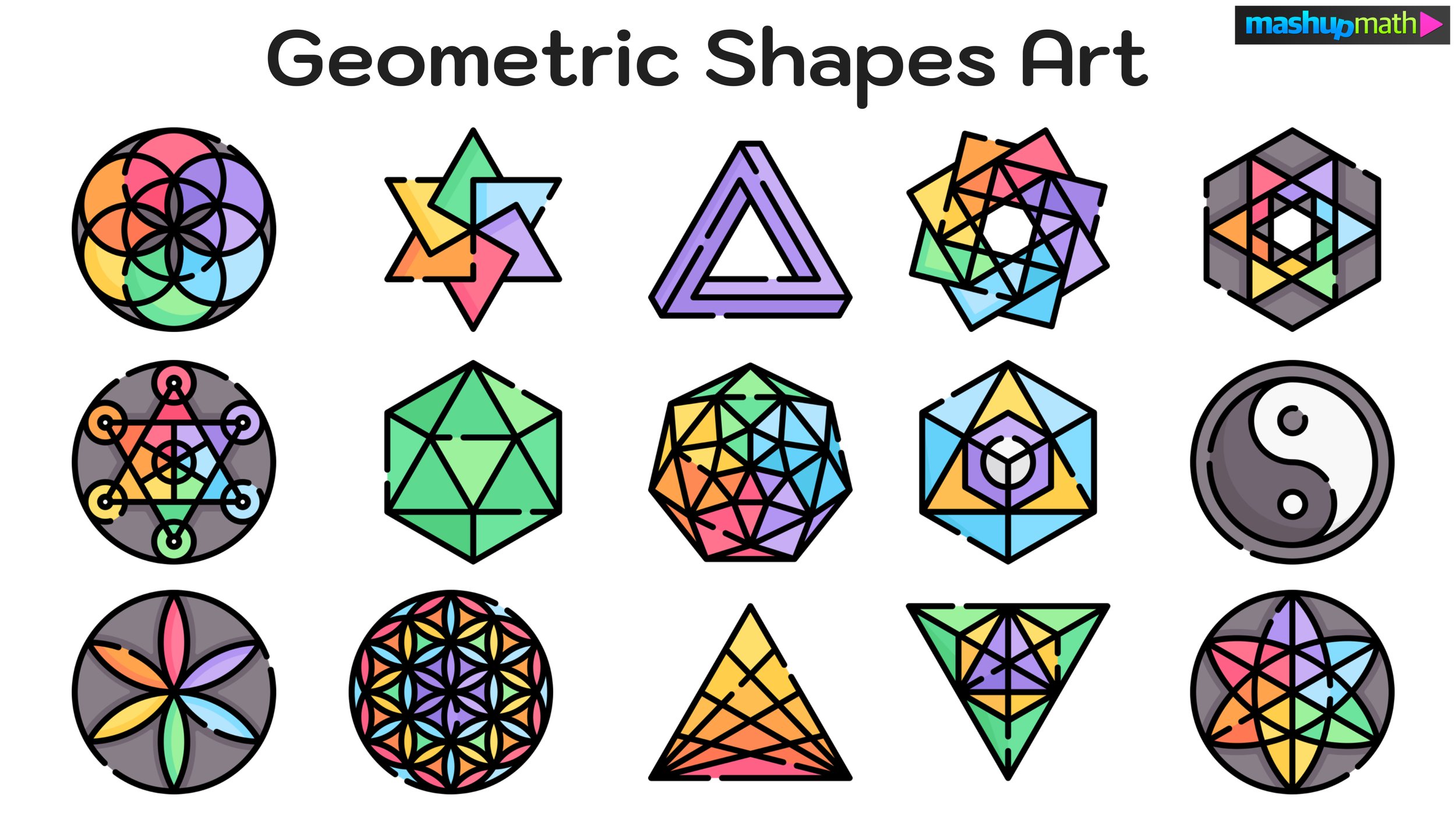
What is geometric shapes art? The answer to this question is that almost all forms of art rely on 2D and 3D geometric shapes—including graphic design, painting, sculpting, tessellations, and even architecture. Without geometric shapes, artists would not be able to instill elements like patterns, balance, movement, harmony, or structure into a work.
All of these geometric shapes art designs were created using the 2D and 3D geometric shapes from the lists above.
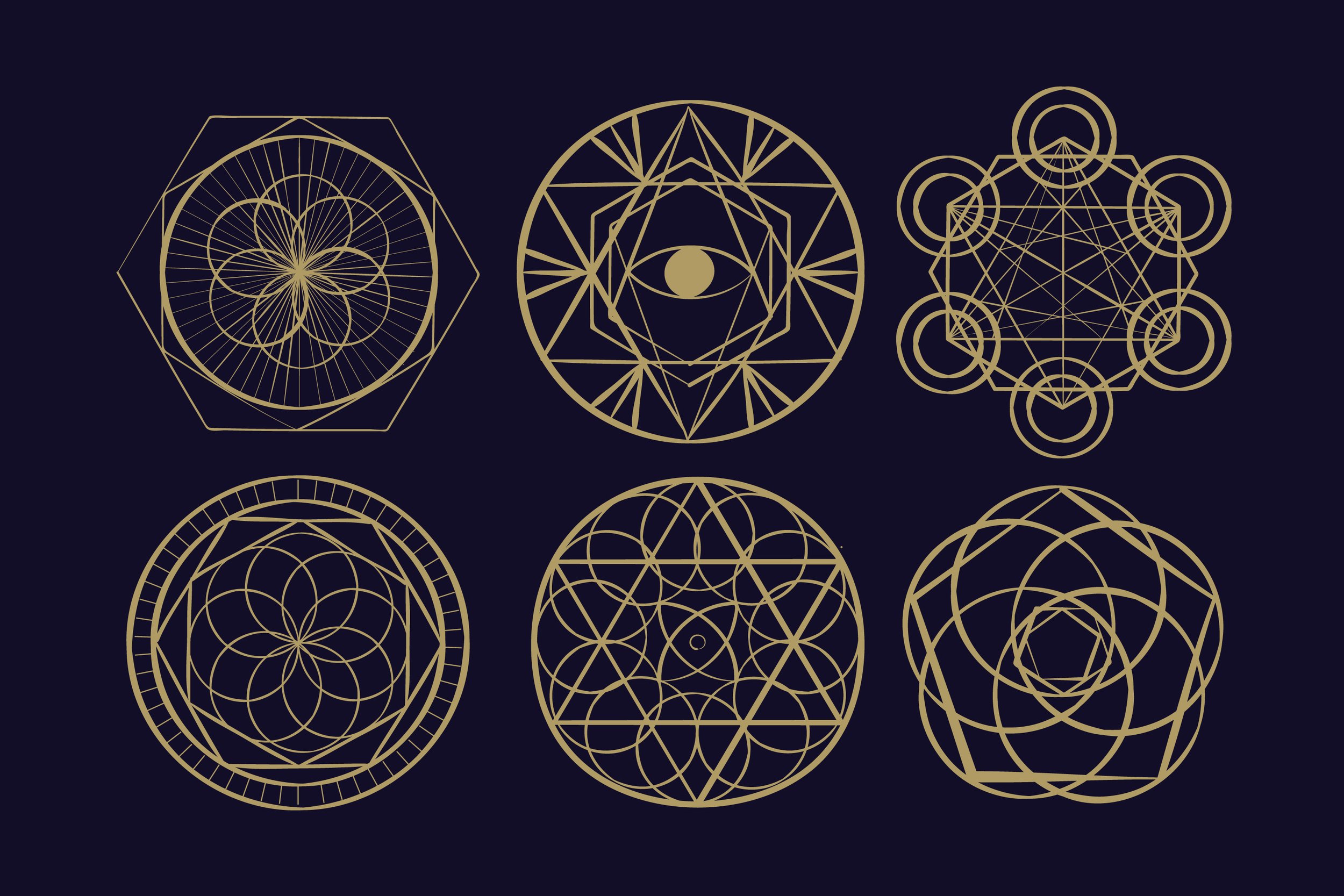
Many think of abstract paintings or even sacred geometry images when they think of geometric shapes art, but the concepts also extend to areas like sculpture (geometrical shapes are used to create depth and portray themes such as balance or movement.
Furthermore, geometrical shapes are often used in a range of graphic design projects including the creation of logos for companies, wallpaper designs, murals, and even 3D-printing!
Geometrical shapes are, in essence, the foundation of any aspect of art, since all designs, 2D or 3D, are comprised on geometrical shapes in some form.
Below are a few more examples of geometric shapes artworks:
Geometric Shapes Art: Wall Murals
Geometric Shapes Art: Sacred Geometry
Geometric Shapes Art: 3D-Printing
Free Printable Geometric Shape Chart
Now that you are familiar with all of the geometric shapes and geometric shapes names, you can begin to study them all and learn to memorize each geometric shape, what it looks like, and what its unique properties and characteristics are.
To help you study, you can use the link below to download a free printable Geometric Shapes Chart PDF file that you can use as a reference guide whenever you are dealing with geometrical shapes.