
Area, cost and material estimating
Triangle Footage Cost Calculator
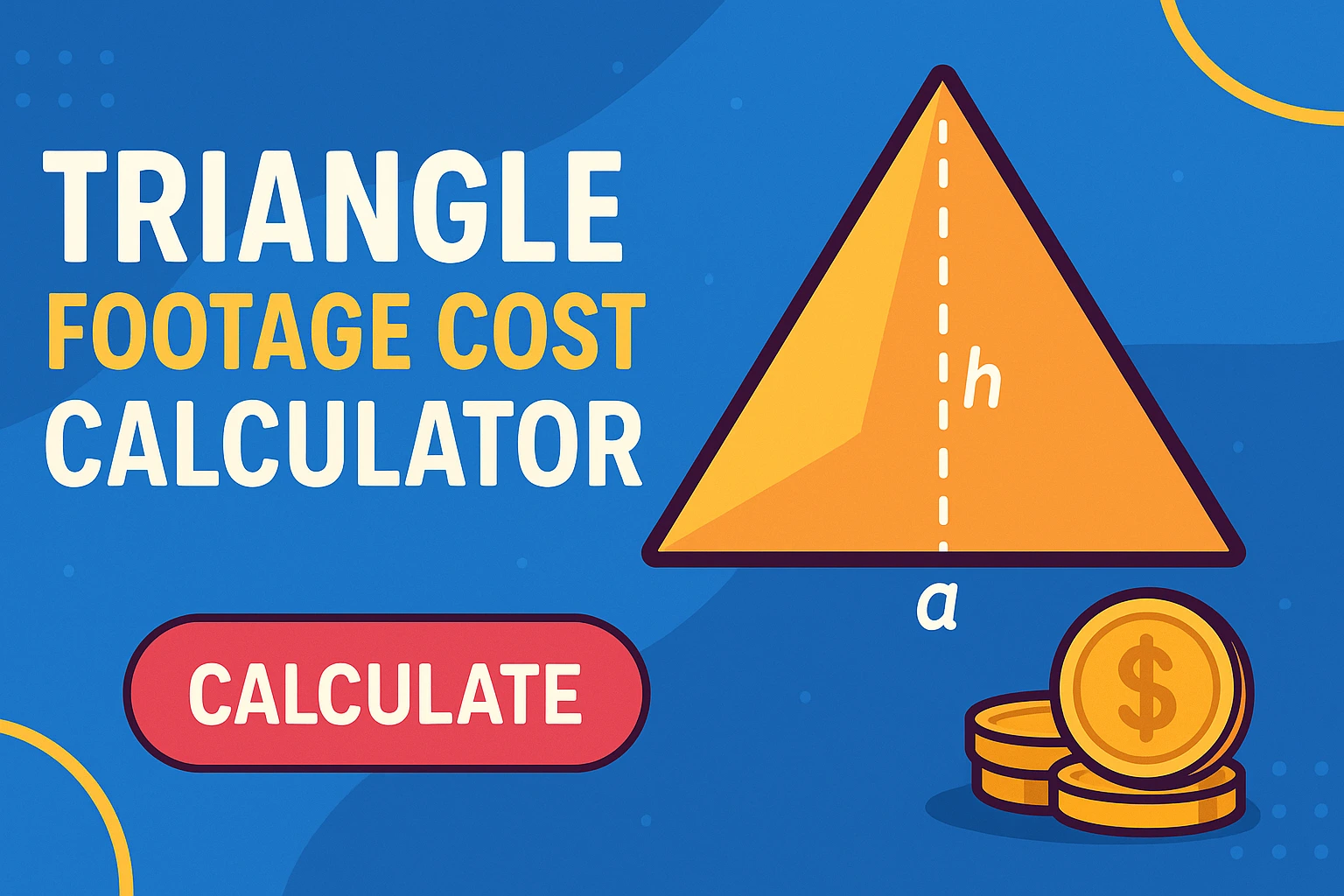
Use this triangle footage cost calculator to estimate the area and material cost of a triangular space from three side lengths. It is built for flooring cuts, triangular patios, gable panels, landscape beds, tile layouts, shade fabric, turf, roofing sections and other projects where a triangle has to be priced by square foot, square yard or square metre. Enter the three sides, choose the units, add the number of matching triangular pieces, set your price per area unit and include a waste allowance for cuts, trimming and mistakes.
Calculate triangular area and project cost
Enter all three triangle sides. The calculator converts mixed side units to metres, checks that the measurements can form a valid triangle, applies Heron’s formula, converts the result into your selected area unit and then calculates the material cost.
What the Triangle Footage Cost Calculator Does
A triangular area is easy to underestimate because the shape rarely fits neatly into a rectangular pricing habit. Many people measure a triangle as if it were a rectangle, multiply two side lengths and then wonder why the material order is far too large. Others remember that a triangle uses half of a rectangle, but they accidentally use a slanted side as the height. The purpose of this calculator is to remove those common errors. It lets you enter the three sides of the triangle, even when they are measured in different units, and it computes the true triangular area before applying the cost per square unit.
The tool is useful when you already know the three edge lengths of the triangular section. That is common in real projects: you may be measuring the three borders of a triangular garden bed, the three sides of a gable cladding panel, the sides of a triangular paving section or the edges of a triangular fabric panel. The calculator uses Heron’s formula, which is designed for exactly this situation. You do not have to know the height of the triangle, and you do not have to identify the interior angles. As long as the three side lengths form a possible triangle, the formula gives a reliable area.
Cost estimating then builds on the area. Materials are normally priced by square foot, square yard, square metre or another area unit. After the calculator finds the triangle’s area, it converts that area into the selected unit and multiplies by the price per unit. A waste percentage is included because triangular projects often require cutting. The exact triangle may occupy 83 square feet, but the usable order may need to be higher because boards, sheets, rolls, tiles and panels are not sold as perfect triangles. The final cost is therefore an estimate for the practical quantity to buy, not just a mathematical area.
For broader measurement work, use this triangle estimator alongside the square footage calculator when the space includes rectangular rooms, halls or regular floor sections. If you are only trying to learn the geometric area before adding price, the triangle area calculator and the triangle area formulas guide are good companions. This page stays focused on area plus cost, so it fits estimating tasks such as material budgeting, order planning and comparing quotes.
Triangle Area and Cost Formulas
The calculator is based on standard triangle geometry and practical estimating arithmetic. If you understand the formulas, you can check the result, explain it to a customer, show your working in a classroom task or compare it with a contractor’s quote. The most important point is that a triangle is measured by area, not by perimeter. The perimeter helps you price edging, trim, border stone or tape, but it does not tell you how much tile, turf, fabric, paint, cladding or paving surface is required.
Triangle inequality check
\[a+b>c,\quad a+c>b,\quad b+c>a\]
A triangle is possible only when each pair of sides adds up to more than the remaining side. If the measurements fail this test, the three lengths cannot close into a triangle.
Semi-perimeter
\[s=\frac{a+b+c}{2}\]
The semi-perimeter \(s\) is half the perimeter. Heron’s formula uses \(s\) to calculate area from three sides.
Heron’s formula
\[A=\sqrt{s(s-a)(s-b)(s-c)}\]
Here \(A\) is the triangle area and \(a\), \(b\), \(c\) are the three side lengths in the same linear unit. The calculator converts all sides to a common unit before applying the formula.
Base-height formula
\[A=\frac{1}{2}bh\]
If you know a true base \(b\) and a perpendicular height \(h\), the base-height formula is usually quicker. The height must meet the base at a right angle. A sloping side is not the height unless it is perpendicular to the selected base.
Area cost
\[\text{base cost}=\text{total area}\times \text{price per area unit}\]
If 92 ft² of material costs $4.50 per ft², the base material cost is \(92\times4.50=\$414.00\).
Waste allowance
\[\text{order area}=\text{measured area}\times\left(1+\frac{\text{waste percent}}{100}\right)\]
For 92 ft² with 10% overage, the estimated order area is \(92\times1.10=101.2\) ft². The calculator applies this same allowance to the cost estimate.
These formulas also show why unit handling matters. If the sides are measured in feet, the area is in square feet. If sides are measured in metres, the area is in square metres. When a project has mixed side units, such as 12 feet, 10 feet and 96 inches, the inches must be converted to feet or the feet must be converted to metres before calculating. The calculator performs that conversion automatically, then converts the final area into the display unit selected by the user.
| Formula | Use it when | Important caution |
|---|---|---|
| \(A=\frac{1}{2}bh\) | You know the base and the perpendicular height. | Do not use a diagonal side as height unless it is perpendicular to the base. |
| \(A=\sqrt{s(s-a)(s-b)(s-c)}\) | You know all three sides but not the height. | All side lengths must be in the same unit before the formula is applied. |
| \(\text{cost}=A\times \text{price}\) | You have area and a price per square unit. | The price unit must match the area unit or be converted correctly. |
| \(\text{final cost}=\text{base cost}\times(1+w/100)+f\) | You want to include waste percentage \(w\) and fixed cost \(f\). | Fixed charges such as delivery or tool hire are not affected by the waste percentage unless the supplier prices them that way. |
How to Measure a Triangular Area Correctly
Accurate measurement is the difference between a useful estimate and a misleading one. For a triangle, measure along the actual edges of the area you want to cover. If the area is a garden bed, measure the three border lines. If it is a wall panel, measure the three cut edges. If it is flooring, measure the visible boundary of the triangular section after excluding walls, cabinets, columns or fixed features that do not need material. Write down every side with its unit immediately, because a side recorded as “84” can mean 84 inches, 84 centimetres or 84 feet depending on the project context.
When the three sides are accessible, Heron’s formula is usually the most convenient method. Measure side \(a\), side \(b\) and side \(c\). Confirm that the tape measure follows the straight edge of the triangle, not a curved path around obstacles. If a side is not straight, the space is not a true triangle and should be broken into smaller shapes. A curved garden edge, for example, may need a rectangle plus a triangle plus a curved segment rather than one triangle estimate. If you need a general shape toolkit, the area calculator can help compare several common area formulas.
If the triangle has one clear base and a measurable perpendicular height, you can also use \(A=\frac{1}{2}bh\). The base can be any side, but the height must be measured at 90° to that side. A common mistake is to measure from one corner to the opposite side along a slanted line and call it the height. That is only valid if the line is perpendicular. For construction and landscaping, a framing square, laser level, set square or carefully measured right angle can help locate the true height. For classroom work, the perpendicular height is usually drawn with a right-angle mark.
Right triangles are simpler because the two legs that meet at 90° can act as base and height. If a triangular floor corner measures 9 feet along one wall and 6 feet along the perpendicular wall, the area is \(0.5\times9\times6=27\) ft². The hypotenuse is useful for border trim, but it is not needed for area when the perpendicular legs are known. If you have only the three sides, the calculator still handles the right triangle through Heron’s formula.
For larger projects, measure more than once. Long outdoor sides can shift because the tape is not held straight, ground is uneven or one point is not the real corner. Mark the corners first, then measure each side from point to point. For flooring and sheet goods, measure at the finished surface level rather than along a wall that is bowed or covered with trim. For roof and gable calculations, be clear whether you are measuring the actual sloped surface or a flat elevation. Sloped surfaces can have larger areas than their flat projection.
Complex rooms and outdoor areas rarely consist of one perfect triangle. A patio may include a rectangle with a triangular corner. A garden may include a triangular bed beside a rectangular path. A tiled wall may have several triangular cuts at the top under a sloped ceiling. In those cases, split the layout into simple shapes, calculate each part separately and add the areas. The rectangle footage cost calculator, square footage cost calculator and circle footage cost calculator are useful when a project mixes several geometric shapes.
When Triangle Footage Cost Estimates Are Useful
A triangle footage cost estimate is useful whenever the surface to be covered or supplied is triangular and the material is priced by area. That may sound narrow, but triangular pieces appear constantly in building, landscaping, interiors, crafts, signage and education. The same geometry applies whether you are pricing turf for a corner lawn, tile for a triangular insert, fabric for a shade sail, mulch for a bed, panels for a gable, metal for a bracket, paint for a decorative wall section or laminate for a diagonal room feature.
Flooring, tile and paving
Triangular sections are common where rooms meet angled walls, bay windows, stair edges, diagonal transitions and corners. If a flooring installer prices by square foot, the triangular area has to be included in the total material quantity. The exact area can be calculated from the three sides, but the order quantity usually needs waste because flooring pieces have grain direction, plank length, tile pattern or installation constraints. For tile projects, the tile calculator can help with tile counts after the triangular area has been measured, especially when grout spacing and tile size matter.
Landscaping and garden beds
Triangular garden beds are often formed by fences, driveways, paths or property boundaries. Soil, mulch, landscape fabric, gravel, pavers, turf and edging can all be estimated from triangular area. For mulch, remember that volume also depends on depth. Area tells you the surface footprint, but mulch quantity requires \(V=A\times d\), where \(d\) is depth. RevisionTown’s mulch triangle calculator is a closer fit when you are converting triangular area and mulch depth into volume.
Roofing, gables and cladding
Many roof faces, dormer sides and gable ends contain triangular surfaces. If the surface is truly triangular and you know the three edges, this calculator can estimate the square footage for shingles, siding, underlayment, sheathing or cladding. Be careful with roof pitch. A triangular gable viewed from the front is not always the same area as a sloped roof face. If material is installed on a slope, measure or calculate the sloped surface. For wider building work, a general construction calculator can help organize related estimates, but the triangle cost formula remains the same.
Fabric, shade sails and banners
Triangular fabric items are often priced by material area, binding length and hardware. The area estimate helps calculate fabric cost, while the perimeter helps estimate seam, hem, tape or edge binding. A triangular shade sail with sides of 15 ft, 18 ft and 20 ft needs a different amount of fabric than a rectangular shade panel with the same longest side. It also needs a different waste allowance because fabric rolls have fixed widths, pattern direction and seam constraints. The calculator gives a mathematical starting point; the final order should account for the manufacturer’s cutting layout.
Education and technical practice
For students, triangle cost problems are practical applications of area, unit conversion and proportional reasoning. They require more than substituting numbers into a formula. The student has to decide what is being measured, whether the dimensions form a valid triangle, what the area unit will be, how to convert price and whether to include waste. For a broader formula reference, the geometry formulas page is a useful companion because it places triangle formulas beside other two-dimensional and three-dimensional formulas.
How Waste Percentage Changes the Cost
Waste percentage is not a mathematical afterthought. It is one of the most important practical adjustments in a triangle cost estimate. A perfect triangle area tells you the exact surface size, but materials are rarely supplied in perfect triangular pieces. Tiles are sold in boxes, boards are sold by length, turf is sold in rolls, fabric is sold by width, sheet goods are sold by panel size and mulch is sold by volume. Triangles create offcuts, and some offcuts cannot be reused elsewhere in the same project.
A low waste percentage may be reasonable when the material is flexible, easy to cut and sold in small increments. Paint, liquid coatings and some bulk landscape materials may have lower geometric waste, although spillage and coverage variation still matter. A medium waste allowance may be more realistic for tile, vinyl plank, laminate, turf and fabric. A high waste allowance may be needed for patterned tile, fragile stone, large-format panels, diagonal plank layouts, expensive veneer, roof shingles near valleys or materials that must align visually.
For a triangular space, waste is often higher than for a rectangle of similar area. Rectangles can be filled efficiently with straight rows. Triangles narrow toward one point, so each row may need custom cutting. If the design has a directional grain or pattern, the leftover piece from one side of the triangle may not be usable on the other side. This is why a 10% default is a starting point, not a rule. Some projects are fine with 5%, while others need 15% to 25% or supplier-specific rounding.
| Project type | Typical starting allowance | Why it may change |
|---|---|---|
| Paint or coating on a triangular wall section | 5% to 10% | Surface texture, number of coats, primer need and container rounding affect final quantity. |
| Mulch, gravel or soil surface coverage | 5% to 15% | Depth variation, settling, uneven ground and delivery minimums can increase quantity. |
| Tile or stone on a triangular floor area | 10% to 20% | Cut edges, breakage, tile size, diagonal layouts and pattern matching can raise waste. |
| Sheet goods, panels, cladding or plywood | 15% to 25% | Panel dimensions, seam locations, grain direction and offcut usability matter more than exact surface area. |
| Fabric, shade cloth or membrane | 10% to 25% | Roll width, hems, overlaps, seams and orientation can require more material than the geometric triangle. |
Always compare the calculator’s final estimate with how the supplier sells the material. If the calculated order area is 101.2 ft² but the tile comes in boxes covering 14.5 ft², you cannot buy exactly 101.2 ft². You need \(\lceil 101.2/14.5\rceil=7\) boxes, which covers 101.5 ft². If the material is sold in full sheets, rolls or bags, round up to the next purchasable unit. This protects you from running short and avoids mismatched batches later.
Unit Conversion for Triangle Footage
Area units are squared units, so linear conversion and area conversion are not the same thing. One foot is 12 inches, but one square foot is 144 square inches because \(12\times12=144\). One yard is 3 feet, but one square yard is 9 square feet because \(3\times3=9\). This is a frequent source of cost errors. If a material is priced by square yard and the area is calculated in square feet, the price cannot be multiplied directly until the area or price unit is converted.
The calculator avoids that mistake by converting all side lengths to metres internally, calculating area in square metres and then converting the output into the selected area unit. If the material price is entered per ft², per yd² or per m², the calculator also converts that price to a comparable internal unit before calculating cost. This is especially useful when the sides are measured in feet but the supplier price is per square yard, or when an international specification uses metres but a local contractor quotes in square feet.
| Conversion | Exact or common value | Use in estimating |
|---|---|---|
| 1 ft | 12 in = 0.3048 m | Convert side lengths before area formulas. |
| 1 yd | 3 ft = 0.9144 m | Useful for carpet, turf and fabric roll estimates. |
| 1 ft² | 144 in² = 0.09290304 m² | Common area unit for flooring, roofing and renovation estimates. |
| 1 yd² | 9 ft² = 0.83612736 m² | Common for carpet, turf, fabric and landscaping materials. |
| 1 m² | 10.7639 ft² | Useful when comparing metric quotes with imperial measurements. |
If a project requires more unit conversions than the calculator provides, use the area converter to convert square feet, square metres, square yards and other square units. The key rule is simple: convert lengths before using a length formula, and convert areas before using an area price. Do not mix feet with inches inside Heron’s formula, and do not multiply square feet by a price quoted per square yard.
Worked Examples
The examples below show how the calculation changes when the triangle is used for flooring, landscaping, fabric or multiple repeated pieces. They also show how the same area formula supports practical decisions such as overage, fixed costs and unit selection.
Example 1: Three-sided triangular patio in square feet
A triangular patio has side lengths of 12 ft, 10 ft and 8 ft. Pavers cost $6.25 per ft², and the installer wants a 12% waste allowance for cuts and breakage.
\[s=\frac{12+10+8}{2}=15\]
\[A=\sqrt{15(15-12)(15-10)(15-8)}=\sqrt{1575}\approx39.69\text{ ft}^2\]
\[\text{base cost}=39.69\times6.25\approx\$248.06\]
\[\text{cost with 12\% waste}=248.06\times1.12\approx\$277.83\]
The exact patio area is about 39.69 ft². The estimated paver cost with 12% waste is about $277.83 before any delivery, edging, base material or labour.
Example 2: Right triangle flooring corner
A triangular floor insert is a right triangle with perpendicular sides of 9 ft and 6 ft. The material costs $4.80 per ft², and the customer wants 10% overage. Since the base and height are known, use the base-height formula.
\[A=\frac{1}{2}\times9\times6=27\text{ ft}^2\]
\[\text{base cost}=27\times4.80=\$129.60\]
\[\text{cost with 10\% overage}=129.60\times1.10=\$142.56\]
This kind of calculation is common around angled cabinets, stairs, hearths and triangular room sections. If the triangular insert is part of a larger floor plan, add its area to the rectangular area before rounding to full boxes.
Example 3: Triangular garden bed priced by square yard
A triangular landscape bed has sides of 16 ft, 18 ft and 22 ft. A landscape fabric supplier prices fabric at $3.40 per yd². The project includes 8% overage. First calculate the area in square feet, then convert to square yards.
\[s=\frac{16+18+22}{2}=28\]
\[A=\sqrt{28(12)(10)(6)}=\sqrt{20160}\approx141.99\text{ ft}^2\]
\[141.99\text{ ft}^2\div9\approx15.78\text{ yd}^2\]
\[\text{base cost}=15.78\times3.40\approx\$53.65\]
\[\text{cost with 8\% overage}=53.65\times1.08\approx\$57.94\]
The area is about 142 ft², which is about 15.78 yd². With 8% overage, the fabric estimate is about $57.94. If the fabric roll has a fixed width, check whether the triangular shape fits the roll layout efficiently before ordering.
Example 4: Multiple triangular panels
A sign shop needs four identical triangular acrylic panels. Each triangle has sides of 32 in, 28 in and 24 in. The acrylic sheet cost is $0.18 per in², and the shop adds 15% waste for cutting and handling.
\[s=\frac{32+28+24}{2}=42\]
\[A=\sqrt{42(10)(14)(18)}=\sqrt{105840}\approx325.33\text{ in}^2\]
\[\text{total area}=325.33\times4\approx1301.32\text{ in}^2\]
\[\text{base cost}=1301.32\times0.18\approx\$234.24\]
\[\text{cost with 15\% waste}=234.24\times1.15\approx\$269.38\]
Repeating the same triangular piece changes total area but not area per piece. The calculator’s quantity input is designed for this situation. It is useful for panels, repeated tile insets, triangular brackets, identical fabric flags and multiple landscape features.
Example 5: Checking an invalid measurement
Suppose someone records a triangle with sides 4 ft, 5 ft and 12 ft. The calculator rejects it because \(4+5=9\), and 9 is not greater than 12. The three lengths cannot close into a triangle. In a real project, this usually means one side was measured incorrectly, the area is not a triangle or the intended points were not marked consistently.
Triangle Cost Estimating Workflow
A reliable triangle estimate is a short process. You do not need complicated software, but you do need consistent measurement, a suitable formula and realistic purchasing assumptions. Use the workflow below when you want the calculator result to support a real quote or material order.
- Define the actual triangular surface. Mark the three corners and confirm that the area is a straight-edged triangle. If the boundary is curved or stepped, split it into smaller shapes.
- Measure the three sides or the base and height. Use the same level of precision for each measurement. For small panels, measure to the nearest millimetre or one-sixteenth of an inch. For outdoor landscape beds, the nearest inch or centimetre may be enough.
- Record units immediately. Write 8 ft, 96 in, 2.4 m or 240 cm, not just 8, 96 or 240. Unit mistakes compound because area is squared.
- Run the triangle inequality check. If the three sides do not form a valid triangle, fix the measurement before estimating cost.
- Calculate area. Use Heron’s formula for three sides or \(A=\frac{1}{2}bh\) for base and perpendicular height.
- Convert area to the supplier’s pricing unit. A price per square yard needs square yards, not square feet. A price per square metre needs square metres.
- Add waste or overage. Match the percentage to the material and layout. Triangles often need more trimming than rectangles.
- Round to purchasable units. Full boxes, sheets, rolls, bags and delivery minimums may change the final quantity.
- Add fixed costs separately. Delivery, adhesive, underlayment, fasteners, rental tools, edging and labour may not scale exactly with area.
- Keep the calculation with the project file. A written area and cost trail makes later revisions easier when a dimension, price or material changes.
This workflow is especially useful when comparing two materials. A triangular floor insert might cost less in vinyl than stone, but stone may have higher waste, higher installation cost and higher delivery charges. A triangular landscape bed might be cheaper in mulch than decorative stone, but stone lasts longer. The calculator gives a consistent area and material-cost baseline so those comparisons can be made clearly.
Choosing the Right Price Unit
Material prices are not always quoted in the same unit used for measuring the space. Flooring in the United States is often priced per ft². Carpet, turf and some fabric can be priced per yd². International building products may be priced per m². Sheet goods may have a per-sheet price instead of a per-area price. Bulk landscaping material may be priced by volume, not area. A triangle footage calculator is most direct when the material has a clear price per area unit, but it can still support other estimates by finding the footprint first.
If a supplier provides a price per sheet or roll, convert it into an effective price per area unit only if the sheet or roll can be used efficiently. For example, a 4 ft by 8 ft sheet has 32 ft² of material. If it costs $64, the simple area price is $2 per ft². But a triangular panel may not nest efficiently on the sheet, and the offcut may or may not be usable. The effective cost could be higher if each triangle requires most of a sheet. For exact fabrication, draw a cutting layout before relying on the average per-square-foot cost.
If a material is priced by volume, first calculate area and then multiply by depth. Mulch, concrete, gravel, soil and some insulation are common examples. A triangular bed with area 80 ft² and mulch depth 3 in has volume \(80\times\frac{3}{12}=20\) ft³. Since one cubic yard is 27 ft³, that is \(20/27\approx0.74\) yd³ before overage. Area alone is not enough for those materials, but it is the necessary first step.
Common Mistakes to Avoid
Most triangle cost errors are not caused by difficult mathematics. They come from using the wrong measurement, skipping unit conversion or misunderstanding what the price covers. The list below covers the mistakes that appear most often in renovation, landscaping, roofing, classroom and fabrication calculations.
Using a slanted side as the height
The height of a triangle must be perpendicular to the base. If you use a slanted side as the height, the calculated area is usually too large. This is why Heron’s formula is useful when the true height is hard to measure. It avoids the need to choose a height at all, as long as the three side lengths are correct.
Forgetting the factor of one half
A triangle with base 10 ft and height 8 ft has area \(40\) ft², not \(80\) ft². The formula is \(A=\frac{1}{2}bh\). Forgetting the one-half factor doubles the area and doubles the material estimate.
Mixing feet, inches and yards
If one side is recorded in inches and another in feet, convert before calculating. A side of 96 inches is 8 feet. Entering 96 as feet would make the triangle enormous and the cost estimate meaningless. The calculator accepts mixed units so each side can be entered as measured.
Multiplying by the wrong price unit
If the area is 90 ft² and the price is $18 per yd², the cost is not \(90\times18\). Since 90 ft² is 10 yd², the cost is \(10\times18=\$180\). Matching area units to price units is essential.
Ignoring package rounding
The calculator can estimate the cost from a price per unit, but suppliers often sell full boxes, rolls, sheets or bags. A result of 101.2 ft² may require 7 boxes, not 6.98 boxes. Always round up to the supplier’s purchasable unit.
Leaving out edge and perimeter costs
Area prices cover surface material. They may not cover edging, trim, borders, tape, flashing, seam allowance or fasteners. A triangular area can have a long perimeter relative to its area, so edge costs can be significant. If a material also needs border pricing, calculate perimeter separately.
Treating a curved or irregular space as one triangle
Some spaces look roughly triangular but have curved, bowed or stepped boundaries. A single triangle estimate may be too high or too low. Split the space into simpler shapes, or approximate the irregular edge with several smaller triangles and rectangles. When in doubt, sketch the layout and label every dimension.
Forgetting labour and preparation
Material area is only part of project cost. Surface preparation, cutting labour, disposal, adhesive, base layers, underlayment, primer, sealant, delivery and tool hire may exceed the material cost. The optional fixed cost field can include simple extras, but professional quotes should itemize major labour and preparation costs separately.
Comparing Triangle, Rectangle and Square Footage Costs
Triangle, rectangle and square cost estimates all start with area, but the geometry and waste behavior differ. Rectangles and squares are easier to measure because length and width meet at right angles. A rectangle uses \(A=lw\), while a square uses \(A=s^2\). Triangles use either \(A=\frac{1}{2}bh\) or Heron’s formula. For the same bounding rectangle, a triangle may cover exactly half the area if it spans the full rectangle diagonally, but many real triangles do not sit neatly inside a rectangle with known dimensions.
Waste also behaves differently. Rectangular rooms usually allow repeated rows of material. Square rooms can be especially efficient. Triangular spaces narrow, so the material cuts change across the layout. This matters for tile, planks, panels and fabric. When estimating a mixed project, calculate each shape separately, then add the totals and apply a waste percentage that reflects the whole installation pattern. If a rectangular room has one triangular corner, it may be more accurate to estimate the rectangle with the rectangle footage cost calculator and the triangular corner with this calculator, then combine the two results.
For a single irregular project, you can create a shape schedule. List every shape, its area, the unit used, the material price, the waste allowance and the final quantity. This is especially helpful when a contractor, student or property owner needs to explain the estimate. A schedule prevents hidden double-counting and makes it easier to update one part of the project if a dimension changes.
Triangle Types and Cost Planning
The calculator works for equilateral, isosceles, scalene, acute, obtuse and right triangles as long as the three sides form a valid triangle. The type of triangle can still affect measurement and installation. An equilateral triangle has three equal sides and a balanced shape. An isosceles triangle has two equal sides, which can simplify layout if the material pattern is symmetrical. A scalene triangle has three unequal sides and usually needs more careful labeling. A right triangle has two perpendicular sides, which often makes measuring easier.
For cost planning, the important distinction is not only the mathematical type but also the installation pattern. A long narrow triangle may have a small area but a lot of edge length, which can raise trim and labour. An obtuse triangle may create awkward cuts at one corner. A wide shallow triangle may waste more sheet material because the usable shape is spread out. A right triangle may be efficient when it fits naturally into a rectangular sheet or tile grid. These practical details explain why two triangles with similar area can have different final costs.
If you are studying triangles, it helps to separate geometry facts from estimating decisions. Geometry gives the exact area. Estimating asks how much material must be purchased, how much is wasted during cutting, how the supplier packages it and which extra costs attach to the job. A good estimate respects both sides: the mathematical area and the real purchasing method.
Practical Checklist Before Ordering Materials
Before placing an order, check the following points. They apply whether you are buying flooring, stone, mulch, fabric, cladding, turf, paint, panels or another surface material.
- Confirm the three corners of the triangle and measure the actual surface, not a rough visual outline.
- Check the triangle inequality. If the sides cannot form a triangle, remeasure before estimating cost.
- Decide whether Heron’s formula or the base-height formula is the best method for your measurements.
- Convert all sides into one unit before doing any manual calculation.
- Use the area unit that matches the supplier’s quote, or convert the area correctly.
- Choose a waste percentage based on the material, pattern, cut difficulty and packaging.
- Round up to full boxes, bags, rolls, sheets or delivery quantities.
- Add fixed costs such as delivery, adhesive, underlayment, edging, fasteners, disposal or tool hire.
- Keep a sketch with side labels so another person can understand and verify the estimate.
- For expensive materials, ask the supplier or installer to review the cutting layout before purchase.
Use the calculator as a reliable starting point for area and material cost. For structural, safety-critical or high-value work, confirm measurements and ordering quantities with a qualified contractor, fabricator, surveyor or supplier.
Practice Questions
Use these questions to test the formulas and estimating logic. Expand each answer after trying the calculation yourself.
A triangular tile insert has sides of 7 ft, 8 ft and 9 ft. What is the approximate area?
The semi-perimeter is \(s=(7+8+9)/2=12\). Heron’s formula gives \(A=\sqrt{12(5)(4)(3)}=\sqrt{720}\approx26.83\) ft².
A right triangle has perpendicular legs of 4 m and 3 m. What is its area?
Use \(A=\frac{1}{2}bh\). The area is \(0.5\times4\times3=6\) m².
A triangular area is 45 ft². Material costs $5.20 per ft². What is the base material cost?
The base cost is \(45\times5.20=\$234.00\).
The same 45 ft² area needs 12% waste. What area should be allowed before package rounding?
The order allowance is \(45\times1.12=50.4\) ft² before rounding to boxes, rolls or sheets.
Can sides of 6 ft, 7 ft and 15 ft form a triangle?
No. Since \(6+7=13\), and 13 is not greater than 15, the side lengths fail the triangle inequality.
A material costs $27 per yd². The triangular area is 72 ft². What is the base cost?
Convert 72 ft² to square yards: \(72/9=8\) yd². The base cost is \(8\times27=\$216\).
Triangle Footage Cost Calculator FAQ
How do I calculate the square footage of a triangle?
If you know the base and the perpendicular height, use \(A=\frac{1}{2}bh\). If you know all three sides, use Heron’s formula: first calculate \(s=\frac{a+b+c}{2}\), then calculate \(A=\sqrt{s(s-a)(s-b)(s-c)}\). The result is in square units based on the side-length unit used.
Can I use this calculator if my side measurements use different units?
Yes. Enter each side with its own unit. The calculator converts all three sides to a common internal unit before applying Heron’s formula. This prevents errors such as treating inches as feet or multiplying square feet by a square-yard price.
What does the waste percentage mean?
Waste percentage is an allowance for cuts, trimming, breakage, pattern matching, overlaps and unusable offcuts. A perfect mathematical triangle might have an area of 80 ft², but a tile, flooring or sheet-goods project may require more than 80 ft² of purchased material.
Why does the calculator reject some side lengths?
The three sides must satisfy the triangle inequality: \(a+b>c\), \(a+c>b\) and \(b+c>a\). If one side is too long compared with the other two, the sides cannot close into a triangle. Remeasure or check that the space is actually triangular.
Does triangle square footage include labour?
No. The calculator estimates material area and area-based material cost. Labour, delivery, adhesive, base preparation, edging, disposal, permits and tool rental should be added separately. The optional fixed cost field can include simple extras, but a professional quote should itemize major project costs.
Is a triangle always half of a rectangle?
A triangle is half of a rectangle only when it shares the rectangle’s full base and perpendicular height, such as a diagonal split of a rectangle. Many real triangles do not have obvious rectangular bounds, so using Heron’s formula or a true base-height measurement is safer.
Should I round the final material amount up?
Yes. After area and waste are calculated, round up to the supplier’s purchasable unit. Materials may be sold by full boxes, sheets, rolls, bags or delivery batches. Ordering the exact calculated area is often impossible and can leave you short.
What if the project is not one triangle?
Split the project into simpler shapes. Calculate triangular sections with this calculator, rectangular sections with a rectangle or square footage tool, and circular sections with a circle area or cost tool. Add the areas and then apply a realistic waste allowance for the whole installation.