Area Converter
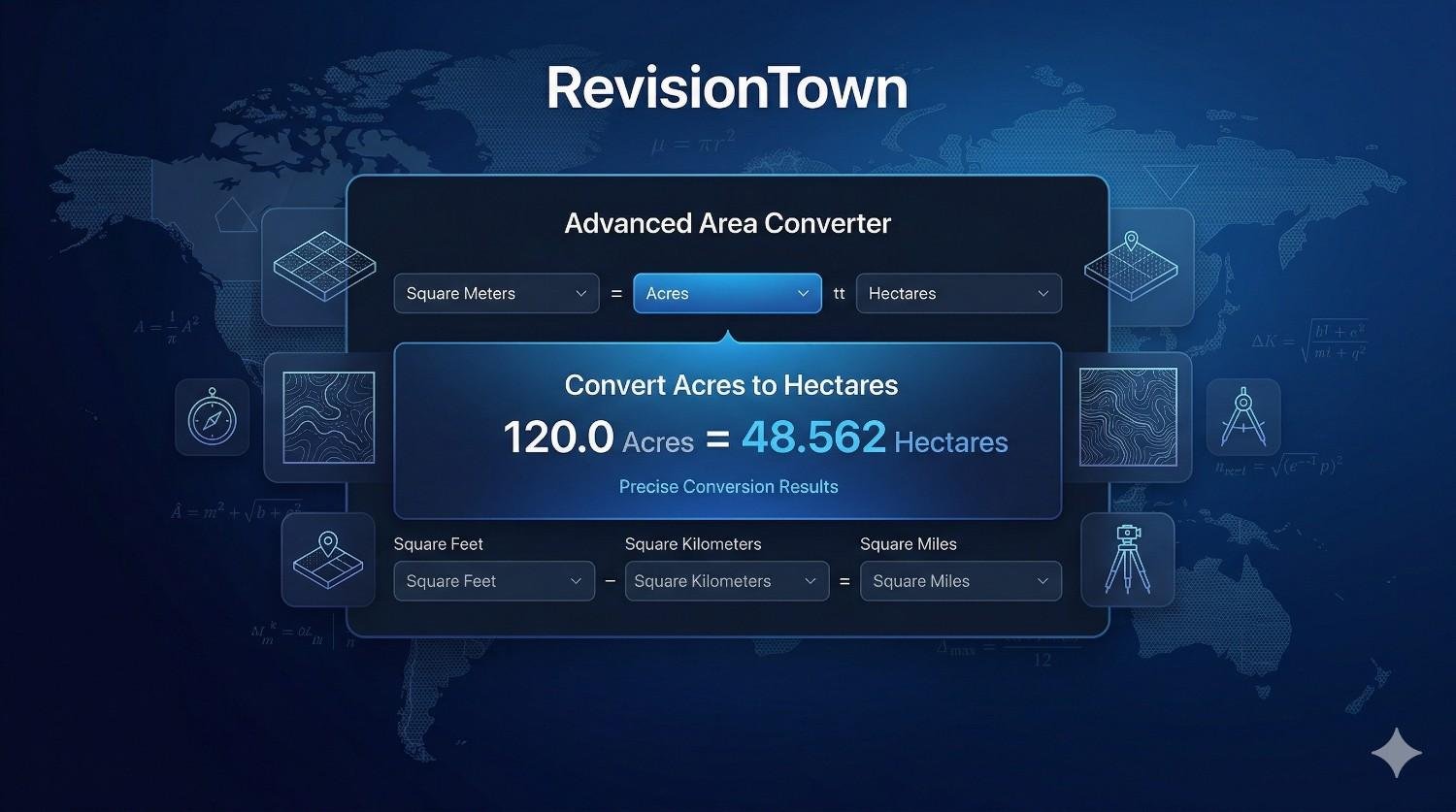
Welcome to the comprehensive area conversion calculator designed for converting between square meters, square feet, acres, hectares, and all major area units. Whether you're working on real estate measurements, land surveying, construction projects, gardening, interior design, or international property transactions, our calculator provides instant, accurate conversions with detailed formulas and explanations.
Universal Area Converter
Convert Any Area Unit
Enter an area, select the source and destination units, and the result updates instantly.
Enter a non-negative area value. The conversion updates as you type.
Quick Conversions
Common Area Conversions
1 Square Meter
1 Acre
1 Hectare
1 Square Mile
Area Conversion Formulas
Square Meters to Square Feet
\[ \text{Square Feet} = \text{Square Meters} \times 10.7639 \]
Example: 100 m² = 100 × 10.7639 = 1,076.39 ft²
Acres to Hectares
\[ \text{Hectares} = \text{Acres} \times 0.404686 \]
Example: 5 acres = 5 × 0.404686 = 2.023 ha
General Area Conversion Formula
\[ A_{\text{new}} = A_{\text{original}} \times \left(\frac{L_{\text{new}}}{L_{\text{original}}}\right)^2 \]
Where L represents the length conversion factor between units
Understanding Area Units
Square Meter (m²)
The square meter is the SI unit of area, defined as the area of a square with sides of one meter. It's the standard unit for measuring floor space, land area, and surface areas in most countries worldwide. One square meter equals approximately 10.764 square feet.
Square Foot (ft²)
The square foot is the imperial unit of area, defined as the area of a square with sides of one foot. Commonly used in the United States, United Kingdom, and Canada for real estate, construction, and interior spaces. One square foot equals approximately 0.0929 square meters.
Acre
An acre is a unit of area commonly used in the United States and United Kingdom for measuring land. Historically defined as the area one could plow in a day with a yoke of oxen, it now equals exactly 43,560 square feet or approximately 4,047 square meters. One acre is about 90% of an American football field.
Hectare (ha)
The hectare is a metric unit of area equal to 10,000 square meters or 100 ares. It's widely used for measuring land, particularly agricultural land, forests, and large properties. One hectare equals approximately 2.471 acres and represents a square with 100-meter sides.
Square Kilometer (km²)
A square kilometer is a unit of area equal to one million square meters. It's used for measuring large land areas such as cities, countries, lakes, and forests. One square kilometer equals approximately 0.386 square miles or 247 acres.
Square Mile (mi²)
The square mile is an imperial unit of area used primarily in the United States and United Kingdom for measuring large land areas. One square mile equals exactly 640 acres or approximately 2.59 square kilometers.
Comprehensive Conversion Tables
Metric Area Units Conversion
| Unit | Square Meters (m²) | Square Feet (ft²) | Acres |
|---|---|---|---|
| 1 Square Meter | 1 m² | 10.764 ft² | 0.000247 acres |
| 1 Square Kilometer | 1,000,000 m² | 10,763,910 ft² | 247.105 acres |
| 1 Hectare | 10,000 m² | 107,639 ft² | 2.471 acres |
| 1 Square Centimeter | 0.0001 m² | 0.00108 ft² | 2.47×10⁻⁸ acres |
Imperial Area Units Conversion
| Unit | Square Feet (ft²) | Square Meters (m²) | Acres |
|---|---|---|---|
| 1 Square Foot | 1 ft² | 0.0929 m² | 0.0000229 acres |
| 1 Square Yard | 9 ft² | 0.836 m² | 0.000206 acres |
| 1 Square Mile | 27,878,400 ft² | 2,589,988 m² | 640 acres |
| 1 Acre | 43,560 ft² | 4,046.86 m² | 1 acre |
Quick Reference: Common Area Conversions
| From | To | Multiply By | Example |
|---|---|---|---|
| m² to ft² | Square Feet | 10.7639 | 50 m² = 538.20 ft² |
| ft² to m² | Square Meters | 0.092903 | 1,000 ft² = 92.90 m² |
| Acres to m² | Square Meters | 4,046.86 | 2 acres = 8,093.71 m² |
| Hectares to Acres | Acres | 2.47105 | 5 ha = 12.36 acres |
| km² to mi² | Square Miles | 0.386102 | 10 km² = 3.86 mi² |
| mi² to km² | Square Kilometers | 2.58999 | 5 mi² = 12.95 km² |
Practical Conversion Examples
Example 1: Converting a House Floor Plan
A house has 150 square meters of floor space. Convert to square feet.
\[ 150 \text{ m}^2 \times 10.7639 = 1,614.59 \text{ ft}^2 \]
Result: 150 m² = 1,614.59 square feet
Example 2: Converting Agricultural Land
A farm measures 25 acres. Convert to hectares.
\[ 25 \text{ acres} \times 0.404686 = 10.117 \text{ hectares} \]
Result: 25 acres = 10.12 hectares
Example 3: Converting a City's Area
A city covers 500 square kilometers. Convert to square miles.
\[ 500 \text{ km}^2 \times 0.386102 = 193.051 \text{ mi}^2 \]
Result: 500 km² = 193.05 square miles
Applications of Area Conversion
- Real Estate: Converting property sizes for international listings, comparing prices per square foot/meter
- Construction: Calculating material requirements, floor areas, and site measurements
- Agriculture: Measuring farmland, crop areas, and irrigation zones across different systems
- Interior Design: Planning floor coverings, paint quantities, and furniture placement
- Land Surveying: Professional land measurements for property boundaries and development
- Urban Planning: City development, zoning regulations, and infrastructure planning
- Environmental Science: Forest coverage, habitat areas, and conservation measurements
- Education: Teaching students about measurement systems and geometric calculations
Tips for Accurate Area Conversions
- Remember It's Squared: Area conversions require squaring the length conversion factor (e.g., 1 m = 3.28 ft, so 1 m² = 10.76 ft²)
- Use Exact Factors: For professional work, use precise conversion factors: 1 m² = 10.763910417 ft² exactly
- Check Your Units: Always verify whether you're working with linear or area measurements
- Consider Context: Real estate often rounds to whole numbers; surveying requires precision
- Visualize the Scale: Know common references like a tennis court (≈260 m²) or football field (≈5,350 m²)
- Double-Check Large Conversions: Verify conversions between acres/hectares and square meters carefully
- Use Appropriate Precision: Round based on application—construction needs precision, estimates can be approximate
Common Area Measurement Questions
How many square feet in a square meter?
There are approximately 10.764 square feet in one square meter. This means one square meter is slightly larger than 10 square feet. For quick mental math, you can use 10.8 as an approximation.
How many acres in a hectare?
There are approximately 2.471 acres in one hectare. A hectare is larger than an acre—specifically about 2.5 times larger. One hectare equals exactly 10,000 square meters.
How do I calculate square footage?
To calculate square footage of a rectangular area, multiply length by width (both in feet). For example, a room 12 feet long and 10 feet wide has 120 square feet. For irregular shapes, divide into rectangles and sum the areas.
What's the difference between linear and area measurements?
Linear measurements are one-dimensional (length, width, height) measured in feet, meters, etc. Area measurements are two-dimensional (length × width) measured in square feet, square meters, etc. When converting area units, you must square the length conversion factor.
How Area Conversion Works
An area conversion changes the unit used to describe the same two-dimensional space. The floor, field, wall, parcel, or map region does not become larger or smaller; only the numerical label changes. A room described as 20 square meters is the same room described as about 215.28 square feet. The conversion is useful when the unit matches the decision being made: a contractor may price flooring by square feet, an international listing may state usable space in square meters, and a farm report may use hectares or acres.
The reliable method is to convert through one base unit. This calculator uses square meters as that base. It first multiplies the entered value by the source unit's number of square meters, then divides by the target unit's number of square meters. If \(A_s\) is an area in a source unit, \(f_s\) is the source unit's value in square meters, and \(f_t\) is the target unit's value in square meters, then:
\[A_t=A_s\times\frac{f_s}{f_t}\]
Convert to the base unit first, then convert from the base unit to the destination unit.
This approach avoids the most common mistake in area work: using a length conversion factor only once. One meter is 3.28084 feet. A one-meter by one-meter square has sides that are each 3.28084 feet long, so its area is \(3.28084\times3.28084\), not merely 3.28084 square feet. That difference matters immediately in property, material, and land calculations.
Why the conversion factor must be squared
Suppose a rectangle is \(L\) units long and \(W\) units wide. Its area is \(A=L\times W\). If one source length unit equals \(k\) target length units, then the converted dimensions are \(kL\) and \(kW\). The converted area is:
\[A_{\text{target}}=(kL)(kW)=k^2LW=k^2A_{\text{source}}\]
For meters to feet, \(k=3.28084\), so \(k^2\approx10.7639\). That is why 1 square meter equals approximately 10.7639 square feet. In reverse, divide by 10.7639 or multiply by 0.09290304. The same reasoning applies to centimeters and inches, yards and meters, miles and kilometers, and every other squared-unit conversion.
This is also why a result can look surprisingly large or small. A 10% change in each side of a square produces approximately a 21% change in area because \(1.1^2=1.21\). In design and estimating, small errors in length measurements can create larger errors in material area. Measure both dimensions carefully before converting.
Choose the Right Area Unit
There is no universally best area unit. The correct choice depends on scale, local convention, and the purpose of the calculation. Square millimeters and square centimeters suit small surfaces and technical drawings. Square feet and square meters are practical for rooms, apartments, walls, roofs, and work surfaces. Acres and hectares suit land. Square kilometers and square miles suit cities, parks, watersheds, districts, and geographic regions.
| Typical use | Helpful units | Why they fit |
|---|---|---|
| Tiles, paper, small panels, drawings | mm², cm², in² | They keep small values readable without long decimals. |
| Rooms, homes, offices, flooring, paint | m², ft², yd² | They match building and real-estate conventions. |
| Gardens, farms, woodland, property lots | acres, hectares, m² | They describe medium and large parcels efficiently. |
| Municipal, environmental, and map areas | km², mi² | They avoid very large strings of square meters or feet. |
Use the unit that a contract, plan, regulation, or supplier requires. Converting for comparison is useful; replacing an official unit in a legal boundary description is not. A property listing may show both square feet and square meters, but deeds, surveys, zoning documents, and construction drawings should retain their specified units and stated precision.
Area Units in Practical Terms
Square meters and square feet
Square meters and square feet are the daily units of interior-space conversion. A square meter is the area of a square one meter on each side. A square foot is the area of a square one foot on each side. The exact international relationship is \(1\text{ foot}=0.3048\text{ meter}\). Squaring it gives \(1\text{ ft}^2=0.09290304\text{ m}^2\), and its reciprocal gives \(1\text{ m}^2\approx10.763910417\text{ ft}^2\).
For a home, do not assume that advertised floor area always means the same thing. Gross floor area, net internal area, usable area, rentable area, balcony area, and common-area allocations can follow different local rules. The converter changes units accurately, but it cannot resolve what was included in the original measurement. Before comparing two properties, confirm the measurement standard first and the unit second.
Acres and hectares
Acres and hectares both describe land, but they arise from different systems. A hectare is exactly 10,000 square meters, often pictured as a 100-meter by 100-meter square. An acre is exactly 43,560 square feet and equals 4,046.8564224 square meters. One hectare is about 2.47105 acres, while one acre is about 0.404686 hectares.
These units are common in agricultural, environmental, and land-development work because square feet or square meters become cumbersome for larger parcels. A quoted 10-acre parcel does not tell you its shape, frontage, easements, slope, access, or buildable portion. Area is an important quantity, not a complete description of a property.
Square yards, square inches, and square kilometers
Square yards are useful for carpet, turf, concrete, and fabric specifications in some markets. One square yard is nine square feet. Square inches and square centimeters suit labels, photographs, parts, material samples, and technical diagrams. Square kilometers and square miles suit large geographic areas; one square mile equals 640 acres and about 2.589988 square kilometers. Choose a unit that makes the magnitude easy to understand without hiding the precision that the work requires.
Area Converter for Rooms and Real Estate
For a rectangular room, measure inside wall to inside wall unless a specification says otherwise. Calculate in the measurement system used on site, then convert the finished area. A room that is 4.2 meters by 3.6 meters has an area of:
\[A=4.2\text{ m}\times3.6\text{ m}=15.12\text{ m}^2\]
\[15.12\text{ m}^2\times10.763910417\approx162.75\text{ ft}^2\]
For an L-shaped room, divide the outline into rectangles, calculate each rectangle, and add them. For a circular room or curved bay, use the appropriate geometric formula rather than estimating from the longest and shortest measurements. The area calculator is useful when the shape must be calculated before the result is converted. Once the area is known, return here to express it in the unit a supplier, listing, or plan needs.
Flooring estimates usually need a waste allowance for cuts, breakage, pattern matching, and awkward edges. The allowance depends on the product and layout; it is not part of a unit conversion. Calculate the net floor area first, add the required allowance separately, and then convert. If a 40 m² floor needs 10% additional material, order for \(40\times1.10=44\) m² before converting to square feet or square yards. This sequence keeps the calculation auditable.
Land, Gardens, and Agricultural Areas
Land conversion often begins with a map, survey, or local listing. If the source uses acres but a planting plan uses square meters, convert the entire parcel first and then separate usable zones: buildings, driveways, drainage areas, paths, setbacks, and planting beds. A one-acre parcel is large in residential terms but may have much less usable growing area after exclusions.
A garden plan benefits from working in square meters or square feet because beds, mulch, seed, turf, and irrigation are often specified per small area. A farm plan may use hectares or acres for field totals and square meters for structures, hoop houses, and protected growing zones. Keep a record of the original measure alongside the converted value; this makes it easier to reconcile orders with a site plan.
When estimating seed, fertilizer, herbicide, or irrigation, read the product label carefully. A rate stated per hectare cannot be applied directly to acres. Convert the land area into the label's unit before multiplying by the application rate. If a product is labeled at \(r\) kilograms per hectare and the field area is \(H\) hectares, the material estimate is \(rH\) kilograms. Do not convert the product mass using an area factor; convert the field area only.
Boundary and title work require a different level of caution. Land surveys can specify bearings, coordinates, monuments, easements, and descriptions that cannot be reproduced from a simple area figure. Use this tool to compare area units, not to establish a legal boundary or determine whether a parcel is buildable. For those decisions, use the recorded survey and qualified local professionals.
Construction, Materials, and Cost Estimates
Construction estimates frequently combine area calculations with coverage rates. Paint, tiles, drywall, roofing, insulation, concrete finishing, and landscaping materials are sold against a stated coverage per container, pack, or batch. The safe workflow is: calculate the actual shape; subtract openings only when the specification says to; add waste or overlap where necessary; convert to the supplier's area unit; then divide by the stated coverage.
If one tile box covers 18 square feet and the net floor is 150 square feet with 10% waste, the required order area is \(150\times1.10=165\) square feet. The initial box count is \(165/18\approx9.17\), so nine boxes are insufficient; round up to 10 boxes. If the plans are metric, convert the final required area rather than converting every dimension independently. For material pricing by square foot, the square footage cost calculator can extend the area result into a cost estimate.
Roofs and sloped surfaces require extra care. A plan-view footprint is not the same as the actual sloped surface area. A roof's pitch increases its surface area; wall openings may reduce paint area; a circular tank wall is a lateral surface, not a floor area. Choose the correct geometric measurement before converting units. If the task asks for volume, such as concrete in a slab or soil in a raised bed, use a volume calculation instead. The volume converter handles cubic units, which are fundamentally different from square units.
Calculate an Area Before You Convert It
An area converter assumes an area already exists. When you have dimensions instead, calculate the shape first. The most common formulas are straightforward, but the choice of formula matters. Keep every length in the same unit while calculating. Then convert the final area once.
| Shape | Area formula | Common use |
|---|---|---|
| Rectangle | \(A=lw\) | Rooms, plots, panels, walls |
| Triangle | \(A=\frac12bh\) | Gables, wedges, triangular lots |
| Circle | \(A=\pi r^2\) | Round beds, tanks, tables, discs |
| Trapezoid | \(A=\frac12(a+b)h\) | Irregular plots and tapered spaces |
| Parallelogram | \(A=bh\) | Slanted lots and repeated panels |
For irregular outlines, break the shape into familiar pieces. A garden may become two rectangles and a semicircle; a room may become a rectangle minus a closet notch; a lot may require coordinates or a survey-based method. Add areas that belong to the shape and subtract excluded areas. Draw the decomposition before entering numbers. This often catches a missing dimension or a mistaken overlap.
Do not confuse perimeter with area. Perimeter is the distance around a boundary and uses linear units. A 10-foot by 10-foot square has a perimeter of 40 feet and an area of 100 square feet. Fencing, trim, and edging usually depend on perimeter; flooring, turf, and paint coverage usually depend on area. The area and perimeter guide is useful when both quantities are involved in the same problem.
Precision, Rounding, and Significant Digits
The calculator retains more digits internally than a quick mental estimate, but the displayed result should be rounded for the task. A real-estate listing may use a whole square foot. A landscape plan may use the nearest tenth of a square meter. A fabrication drawing may require much finer precision. Reporting 215.278208 square feet for a small room can suggest a level of certainty that the tape measurement never had.
Round only at the end of a multi-step calculation. Early rounding can compound when you add several sections, convert units, include waste, and divide by a coverage rate. Keep the working value in the calculator or a spreadsheet, then apply the final rounding rule. For purchases, round quantities up when partial packages cannot be bought. For legal, financial, engineering, and scientific work, follow the governing standard or professional specification.
Be especially careful with commas and decimal points. Some locales write 1,500.5, while others write 1.500,5. Confirm how a source document formats numbers before copying a value into a calculator. Also check the exponent in scientific notation. \(2.5\times10^6\) square millimeters is 2.5 square meters, not 2,500 square meters.
Worked Area Conversion Workflows
Convert an apartment from square meters to square feet
Suppose an apartment is listed as 72 m². Select square meters as the source, square feet as the destination, and enter 72. The calculation is \(72\times10.763910417\approx775.00\) ft². Use the converted number to communicate with a buyer or compare listings, but also ask whether the listed 72 m² is net, gross, interior, or includes a terrace. The unit conversion is exact relative to the stated measurement; the meaning of the stated measurement still needs verification.
Convert a 3.5-acre site to hectares
Enter 3.5 acres and choose hectares. The calculation is \(3.5\times0.40468564224\approx1.4164\) hectares. If a planting recommendation is stated in kilograms per hectare, use 1.4164 hectares in the next step. If the recommendation is stated in pounds per acre, keep the original 3.5-acre value instead. Convert only when the downstream rate requires it.
Convert a square-yard carpet quote to square meters
A supplier quotes 80 square yards. Since 1 square yard is 0.83612736 m², the result is \(80\times0.83612736=66.8901888\) m². If the room net area is smaller, determine whether the quote includes waste, cuts, underlay, or installation before concluding that the excess is an error. Material quotes often include allowances that a simple room-area calculation does not show.
Convert a mapped region from square miles to square kilometers
A park covers 14 square miles. Multiply by 2.589988110336 to obtain approximately 36.2598 km². Do not use the ordinary mile-to-kilometer factor of 1.609344 without squaring it. The correct area factor is \(1.609344^2\approx2.589988\).
Common Area Conversion Errors
- Using a linear factor once: Area requires the square of the length relationship.
- Mixing units in a shape formula: Convert dimensions to one length unit before multiplying length by width.
- Confusing area with perimeter: A boundary distance is not a floor, wall, or land area.
- Ignoring the measurement definition: Net area and gross area are not interchangeable even when both use square meters.
- Rounding too early: Preserve working precision until the purchasing or reporting step.
- Using area for a volume job: Slab, tank, soil, and storage calculations require a third dimension.
- Assuming a legal boundary from a converted estimate: Use recorded surveys and local rules for property decisions.
Area Conversion in Education and Everyday Work
Students often meet area conversion after learning rectangle and triangle formulas. The important conceptual shift is that units carry algebraic meaning. If length is measured in meters, multiplying length by width gives meters times meters, or square meters. This unit analysis provides a quick check: a flooring answer in meters alone is incomplete, and a paint-coverage answer in cubic meters is likely using the wrong quantity.
In professional settings, consistency matters as much as arithmetic. A spreadsheet that mixes square feet, square meters, acres, and hectares without clear headings can produce expensive mistakes. Label every column, keep source values, record conversion factors, and note rounding rules. For a broader reference when several kinds of units appear in one project, the unit conversion chart can help keep length, area, volume, mass, and temperature conversions separate.
When a problem begins with dimensions rather than an area, use a length tool first only if the dimensions are expressed in different systems. For example, convert a 12-foot width and a 3-meter length into one common length unit, calculate the area, then use this converter for the final presentation unit. The length converter is the right companion for that first step.
Area Converter Questions
How many square feet are in 100 square meters?
Multiply 100 by 10.763910417. The result is approximately 1,076.39 square feet. For a general property comparison, 1,076 square feet may be an appropriate rounded display; for a specification, retain the precision required by the document.
How many square meters are in an acre?
One acre equals exactly 4,046.8564224 square meters. This is often rounded to 4,047 m² for general communication.
How many acres are in a square mile?
There are exactly 640 acres in one square mile. This relationship is useful for large land and map conversions in U.S. customary units.
How do I convert square feet to square yards?
Divide square feet by 9 because one square yard contains 9 square feet. For example, 180 square feet is 20 square yards.
Can I use this tool for wall area?
Yes. Calculate the wall's height times width, subtract doors or windows only when your estimate calls for it, then convert the result. For paint, follow the product's stated coverage and number of coats.
Does an acre equal a hectare?
No. A hectare is larger. One hectare is approximately 2.47105 acres, and one acre is approximately 0.404686 hectares.
Why does my result have many decimal places?
Most conversion factors do not produce a whole number. The calculator displays precision for checking; choose a sensible rounded value for reporting, purchasing, or design work.
Can I convert volume with an area converter?
No. Area uses square units and volume uses cubic units. A room's floor area can help begin a volume calculation, but height or depth must be included separately.
What is the best unit for a garden?
For a small garden, square meters or square feet are convenient. For a large plot, hectares or acres are clearer. Use the unit required by local regulations, plans, or product labels.
Is the converter suitable for a legal land survey?
It is suitable for general comparison and checking unit arithmetic. It is not a replacement for a survey, recorded plat, official boundary description, or professional advice.
A Reliable Area Measurement Workflow
A conversion is only as useful as the measurement that enters it. Before using an area figure for a purchase, estimate, report, or design decision, establish a clear workflow. First, identify the object being measured. Is it a floor, a wall face, a roof slope, a parcel boundary, a planted zone, a building footprint, or a usable interior space? Second, identify the stated measurement convention. Third, calculate or verify the geometric area. Fourth, apply the unit conversion. Finally, round and label the result for its intended use.
This order separates questions that are often accidentally combined. Geometry answers "what is the area?" Unit conversion answers "how is that same area expressed?" Estimating answers "how much material or money is needed?" A legal survey answers "where is the boundary?" Treating all four as one calculation creates avoidable errors. A calculator can make arithmetic fast, but it cannot decide whether a balcony belongs in the quoted floor area or whether a field boundary follows the fence line or recorded coordinates.
Step 1: Measure or obtain a documented value
Use the most reliable source available. For a room, a measured plan or field measurement is usually better than a rounded online listing. For land, the survey or official parcel record may be more useful than an advertisement. For a construction surface, a scaled drawing can be a starting point, but actual site conditions can require a field check. Record the source, date, and unit. A note saying "48" is not useful later; "48.0 m² net internal area from plan dated March" is far more defensible.
When measuring manually, check whether the shape is truly rectangular. Many rooms have alcoves, columns, bay windows, built-in cabinets, or angled walls. A field may have irregular edges. Measure each component rather than forcing the entire shape into an oversized rectangle. For a rectangle, take length and width at the relevant finished surfaces. For a repeated set of rooms, use the same convention throughout.
Step 2: Put dimensions in one length unit
Never multiply 12 feet by 3 meters and call the result an area without first converting one dimension. Convert either both dimensions to feet or both to meters. Then calculate the area. This is the point where a length converter is helpful. Once the area has been calculated in one squared unit, this Area Converter can express the result in acres, hectares, square feet, square meters, or another area unit.
As a quick check, the units themselves should multiply correctly. Feet times feet becomes square feet; meters times meters becomes square meters. Feet times meters is not a standard area unit for most purposes and is a sign that the calculation should be normalized before continuing.
Step 3: Apply the appropriate formula
Use direct formulas for familiar shapes and decomposition for irregular ones. A rectangular wall may be height times width, then openings are subtracted if the specification permits. A circular lawn may use \(\pi r^2\). A trapezoidal lot may use \(\frac12(a+b)h\) only when the parallel sides and perpendicular height are known. For an outline on a survey or map, coordinate-based area or specialized software may be required. Do not replace a complex boundary with a rectangle simply because it is easier to calculate.
Step 4: Convert and verify the direction
Ask whether the result should become numerically larger or smaller. Converting a moderate area from square meters to square feet should make the number larger because a square foot is smaller than a square meter. Converting acres to hectares should make the number smaller because a hectare is larger than an acre. This sanity check catches a reversed factor before it affects an order or report.
Use a reverse conversion as a second check for important work. If 1,500 ft² converts to approximately 139.35 m², converting 139.35 m² back should return close to 1,500 ft², allowing for displayed rounding. If it does not, review the input unit, output unit, decimal point, and whether a linear rather than area factor was used.
Step 5: Report a meaningful result
Report both the value and the unit, and include the measurement definition when it could matter. "1.42 hectares" is clear for a land estimate. "1.42 hectares of gross site area" is clearer when roads or buffers are included. "1,076 ft²" may be useful for a listing, while "1,076.39 ft² calculated from 100.00 m²" is more useful in a design record. The number of decimal places should reflect both the source precision and the decision being made.
Interpreting Area in Property and Land Decisions
Area is often treated as a simple ranking metric: more square feet, more square meters, more acres, or more hectares. In practice, value and usefulness depend on layout, condition, access, zoning, topography, and permitted use. A 100 m² apartment with a functional layout may be more useful than a larger one with long corridors. A five-acre parcel with road access and usable terrain may be more valuable for a given purpose than a larger steep or restricted parcel.
For property listings, compare like with like. A gross building area can include walls, service shafts, or common circulation that a net usable area excludes. A terrace, garage, storage unit, basement, or shared amenity may be shown separately or combined depending on local practice. Converting the stated number from square meters to square feet does not make two listing standards comparable. Ask what is included and use the same standard before calculating price per unit area.
For land, distinguish total parcel area from buildable area, cultivable area, irrigated area, and conserved area. A zoning setback, road easement, wetland, or slope can reduce the usable portion. A conversion may accurately show that a parcel is 6.07 hectares, but an engineering or planning review is needed to identify the part available for a particular project.
For construction budgets, separate horizontal and vertical surfaces. A 200 m² building footprint does not equal 200 m² of roof material once pitch, overhangs, and multiple levels are considered. Nor does it equal the total paintable wall area. Build a small schedule with each relevant surface, its formula, its unit, its waste allowance, and its supplier coverage rate. This makes revisions easier when a dimension changes.
Reference Relationships Worth Remembering
You do not need to memorize every factor, but a small set of relationships makes it easier to notice implausible results. One square meter is a little more than 10.75 square feet. One square foot is a little less than 0.1 square meter. One hectare is 10,000 square meters and about 2.47 acres. One acre is 43,560 square feet. One square mile is 640 acres. One square yard is 9 square feet. These benchmarks are enough to audit many everyday conversions before relying on a final precise value.
When you need a fast comparison but not a final specification, estimate first and calculate second. For example, 80 m² is roughly 860 ft² because \(80\times10.75\approx860\). The converter will give the more precise result. An estimate catches misplaced decimal points: 8 m² should not become 860 ft², and 800 m² should not become 86 ft².
Keep an Area Conversion Record
For any project that will be reviewed later, keep a short conversion record. Write the original measurement, its stated unit, the source of the measurement, the conversion factor or calculator used, the converted result, and the rounding rule. This can be a note in a plan, an estimate worksheet, or a spreadsheet column. It prevents a common problem: someone sees a number months later but cannot tell whether it was measured, converted, rounded, or estimated.
A useful record might read: "Floor area: 86.4 m² from architectural drawing; converted to 930.00 ft² using 1 m² = 10.763910417 ft²; material order calculated from 10% waste allowance." This wording keeps the distinct steps visible. If the plan changes to 88.0 m² or the supplier changes its coverage rate, the calculation can be updated without guessing what the earlier total included.
For collaborative work, use one designated unit for calculations and add display conversions only at reporting points. For example, a project team can maintain all geometry in square meters, while a sales sheet shows square feet beside it. This reduces the risk of alternating between factors or accidentally adding square meters to square feet. The same principle applies to land: maintain survey values as provided, use a working unit for estimates, and show comparison units clearly labeled.
Why Choose RevisionTown for Conversion Tools?
RevisionTown specializes in creating accurate, user-friendly calculators and educational resources for students, professionals, and anyone needing reliable measurement conversions. Our area conversion calculator is designed by expert educators who understand both the mathematics and practical applications across multiple fields.
Whether you're a student learning about measurement systems in IB, AP, GCSE, IGCSE curricula, a real estate professional comparing international properties, an engineer working on construction projects, or anyone needing accurate area conversions, our calculator provides instant results with clear explanations.
Our commitment to educational excellence extends beyond simple conversion—we provide context, formulas, comprehensive tables, and practical understanding. The area converter exemplifies our approach: support for all major area units, clear mathematical formulas, extensive reference tables, real-world examples, and tools that serve genuine needs in education, business, and daily life.
About the Author
Adam
Co-Founder at RevisionTown
Math Expert specializing in various curricula including IB, AP, GCSE, IGCSE, and more
Adam brings extensive experience in mathematics education, measurement systems, and practical applications of mathematical concepts. His expertise spans international curricula, standardized testing, and real-world problem-solving including geometry, spatial reasoning, and measurement conversions. With deep understanding of how area calculations apply across construction, real estate, agriculture, and science, Adam designs calculators and educational content that serve students, educators, professionals, and individuals worldwide. His work at RevisionTown reflects a commitment to accuracy, clarity, and making conversions accessible and practical for everyone.
Disclaimer: This area conversion calculator is provided for educational and general purposes. While we strive for maximum accuracy using internationally standardized conversion factors, results should be verified for critical applications such as legal property boundaries, construction specifications, or official land surveys. Different rounding conventions may produce slight variations. For legal, engineering, or safety-critical applications, consult professional surveyors and verify all conversions. Conversion factors used: 1 m² = 10.7639104167 ft² exactly, 1 acre = 4,046.8564224 m² exactly, 1 hectare = 10,000 m² exactly.