Volume Converter
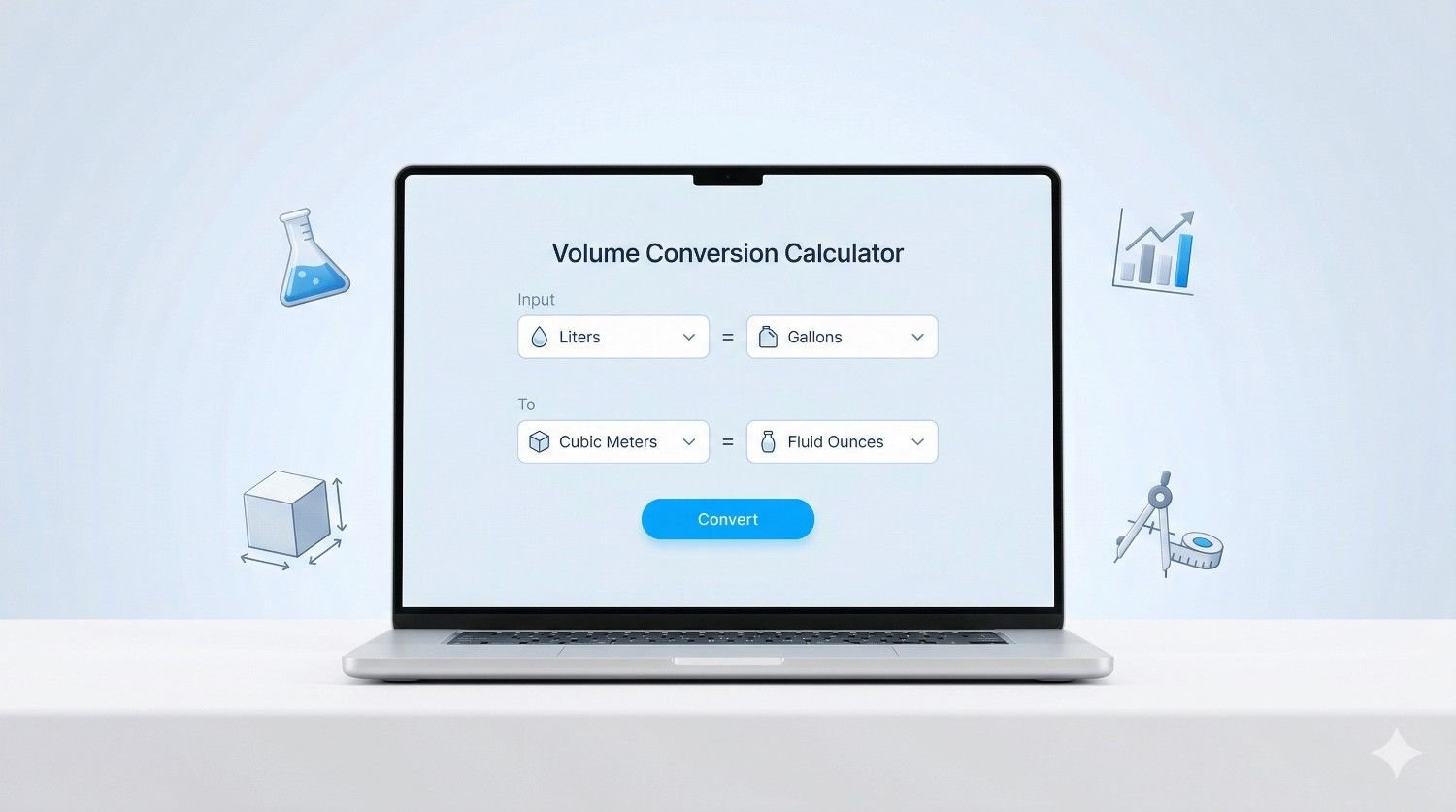
Welcome to the comprehensive volume converter designed for converting between liters, gallons, cubic meters, fluid ounces, cups, pints, quarts, and all major volume units. Perfect for cooking, chemistry, engineering, international trade, and anyone needing accurate volume measurements across metric and imperial systems.
Universal Volume Converter
Convert Any Volume Unit Instantly
Select your units and enter a value to convert between all major volume measurements.
Conversion Result
Quick Conversions
Common Volume Conversions
1 Liter
1 US Gallon
1 Liter
1 Cup
Volume Conversion Formulas
Liters to US Gallons
\[ \text{US Gallons} = \text{Liters} \times 0.264172 \]
Example: 10 L = 10 × 0.264172 = 2.64 gal
US Gallons to Liters
\[ \text{Liters} = \text{US Gallons} \times 3.78541 \]
Example: 5 gal = 5 × 3.78541 = 18.93 L
Cubic Meters to Liters
\[ \text{Liters} = \text{Cubic Meters} \times 1,000 \]
Example: 2 m³ = 2 × 1,000 = 2,000 L
Understanding Volume Units
Liter (L)
The liter is the standard metric unit of volume, equal to one cubic decimeter (1 dm³). Widely used worldwide for beverages, liquids, and general volume measurements. One liter equals 1,000 milliliters or approximately 0.264 US gallons. The liter is particularly convenient for everyday measurements and is used on product labels globally.
US Gallon
The US gallon is the standard liquid volume unit in the United States, equal to exactly 231 cubic inches or approximately 3.785 liters. Used primarily for fuel, milk, and other beverages in the US. Note that the US gallon differs from the UK (imperial) gallon, which is larger at 4.546 liters.
Milliliter (mL)
A milliliter is one-thousandth of a liter, equivalent to one cubic centimeter (1 cm³). Commonly used in cooking, medicine dosing, and laboratory measurements. Milliliters provide precise measurements for small volumes and are standard in metric recipes and medical prescriptions.
Fluid Ounce (fl oz)
Fluid ounces measure liquid volume in the imperial and US customary systems. The US fluid ounce (29.574 mL) differs slightly from the UK fluid ounce (28.413 mL). Used extensively in cooking, beverage serving sizes, and product labeling in the United States.
Cubic Meter (m³)
The cubic meter is the SI unit of volume, representing a cube with sides of one meter. Primarily used for large-scale measurements like room capacity, swimming pools, shipping containers, and industrial applications. One cubic meter equals 1,000 liters.
Comprehensive Conversion Tables
Metric Volume Conversions
| Unit | Liters | Milliliters | Cubic Meters |
|---|---|---|---|
| 1 Liter | 1 L | 1,000 mL | 0.001 m³ |
| 1 Milliliter | 0.001 L | 1 mL | 0.000001 m³ |
| 1 Cubic Meter | 1,000 L | 1,000,000 mL | 1 m³ |
| 1 Cubic Centimeter | 0.001 L | 1 mL | 0.000001 m³ |
US Volume Conversions
| Unit | US Gallons | Liters | Fluid Ounces |
|---|---|---|---|
| 1 US Gallon | 1 gal | 3.785 L | 128 fl oz |
| 1 US Quart | 0.25 gal | 0.946 L | 32 fl oz |
| 1 US Pint | 0.125 gal | 0.473 L | 16 fl oz |
| 1 US Cup | 0.0625 gal | 0.237 L | 8 fl oz |
| 1 US Fluid Ounce | 0.0078 gal | 0.0296 L | 1 fl oz |
Quick Reference: Cooking Measurements
| Measurement | Milliliters | Fluid Ounces | Cups |
|---|---|---|---|
| 1 Teaspoon | 4.93 mL | 0.167 fl oz | 0.021 cups |
| 1 Tablespoon | 14.79 mL | 0.5 fl oz | 0.063 cups |
| 1/4 Cup | 59.15 mL | 2 fl oz | 0.25 cups |
| 1/2 Cup | 118.3 mL | 4 fl oz | 0.5 cups |
| 1 Cup | 236.6 mL | 8 fl oz | 1 cup |
Practical Conversion Examples
Example 1: Converting Recipe Measurements
A recipe calls for 500 mL of milk. Convert to US cups.
\[ 500 \text{ mL} \div 236.588 = 2.113 \text{ cups} \]
Result: 500 mL ≈ 2.1 cups
Example 2: Fuel Consumption
A car's fuel tank holds 15 US gallons. Convert to liters.
\[ 15 \text{ gal} \times 3.78541 = 56.781 \text{ L} \]
Result: 15 gallons = 56.78 liters
Example 3: Swimming Pool Volume
A pool measures 50 cubic meters. Convert to liters.
\[ 50 \text{ m}^3 \times 1,000 = 50,000 \text{ L} \]
Result: 50 m³ = 50,000 liters
Applications of Volume Conversion
- Cooking and Baking: Converting recipe measurements between metric and US/UK systems
- International Trade: Product packaging and labeling for different markets
- Chemistry and Pharmacy: Precise liquid measurements for experiments and medications
- Fuel and Energy: Gasoline, diesel, and other fuel calculations across countries
- Construction: Concrete mixing, paint quantities, and material volume calculations
- Beverage Industry: Bottle sizes, serving measurements, production volumes
- Swimming Pools and Aquariums: Water volume for chemical dosing and capacity
- Science Education: Teaching volume concepts in various measurement systems
Conversion Tips and Best Practices
- Know the Difference: US and UK gallons are different—UK gallon is about 20% larger
- Cooking Precision: For baking, use weight measurements when possible for best accuracy
- Memorize Key Conversions: 1 liter ≈ 0.26 US gallons, 1 cup ≈ 237 mL
- Consider Temperature: Volume can change with temperature, especially for gases
- Use Proper Tools: Measuring cups and graduated cylinders for accurate measurements
- Double-Check Units: Always verify whether measurements are US or UK imperial
- Round Appropriately: Cooking allows rounding; chemistry requires precision
Common Volume Questions
How many liters in a gallon?
A US gallon contains approximately 3.785 liters, while a UK (imperial) gallon contains about 4.546 liters. The difference stems from historical definitions—the US gallon is based on wine gallons, while the UK gallon is based on ale gallons.
How many mL in a cup?
A US cup contains approximately 236.588 milliliters. The metric cup (used in some countries) equals exactly 250 mL. When following recipes, check which measurement system is being used.
What's the difference between volume and capacity?
Volume refers to the three-dimensional space an object occupies, while capacity typically refers to how much a container can hold. In practice, the terms are often used interchangeably when discussing liquids.
Why Choose RevisionTown for Conversion Tools?
RevisionTown specializes in creating accurate, user-friendly calculators and educational resources for students, professionals, and anyone needing reliable measurement conversions. Our volume converter is designed by expert educators who understand both the mathematics and practical applications across multiple fields.
Whether you're a student learning about measurement systems in IB, AP, GCSE, IGCSE curricula, a chef converting international recipes, a scientist conducting experiments, or anyone needing accurate volume conversions, our calculator provides instant results with clear explanations.
Our commitment to educational excellence extends beyond simple conversion—we provide context, formulas, comprehensive tables, and practical understanding. The volume converter exemplifies our approach: support for all major volume units including metric, US, and UK systems, clear mathematical formulas, extensive reference tables including cooking measurements, and tools that serve genuine needs in education, cooking, science, and daily life.
About the Author
Adam
Co-Founder at RevisionTown
Math Expert specializing in various curricula including IB, AP, GCSE, IGCSE, and more
Adam brings extensive experience in mathematics education, measurement systems, and practical applications of mathematical concepts. His expertise spans international curricula, standardized testing, and real-world problem-solving including geometry, spatial reasoning, and unit conversions. With deep understanding of how volume measurements apply across cooking, chemistry, engineering, and everyday life, Adam designs calculators and educational content that serve students, educators, professionals, and individuals worldwide. His work at RevisionTown reflects a commitment to accuracy, clarity, and making conversions accessible and practical for everyone.
Disclaimer: This volume converter is provided for educational and general purposes. While we strive for maximum accuracy using internationally standardized conversion factors, results should be verified for critical applications such as medical dosing, chemical formulations, or commercial transactions. Different measurement standards exist (US vs UK imperial), and precision may vary. For medical, pharmaceutical, or safety-critical applications, consult professional references. Conversion factors used: 1 US gallon = 3.785411784 L exactly, 1 liter = 1,000 mL exactly, 1 US cup = 236.588 mL.