
Measurement, area, volume and unit conversion foundations
Squared & Cubic Units | Free Learning Resources
Learn why square units measure area, why cubic units measure volume, and why conversion factors must be squared or cubed when a measurement changes dimension. This guide explains the idea visually, algebraically, and practically, with examples for metric and customary units, common mistakes, and classroom-ready practice.
What Are Squared and Cubic Units?
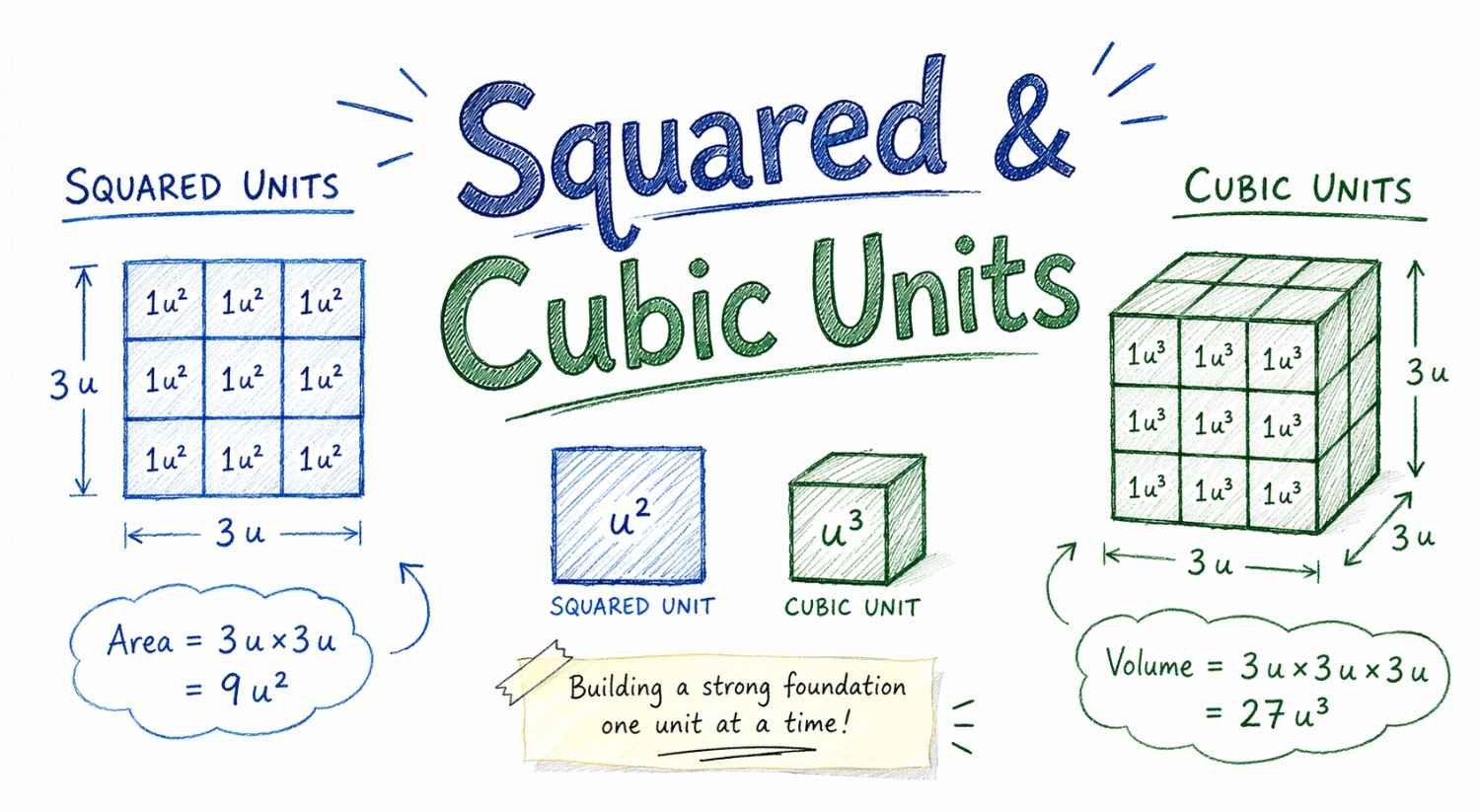
Squared and cubic units are measurement units used when a quantity has two or three dimensions. A line segment is measured in ordinary linear units such as centimeters, meters, inches, feet, or kilometers. A flat region is measured in square units such as square centimeters \(\text{cm}^2\), square meters \(\text{m}^2\), or square feet \(\text{ft}^2\). A three-dimensional space is measured in cubic units such as cubic centimeters \(\text{cm}^3\), cubic meters \(\text{m}^3\), or cubic feet \(\text{ft}^3\).
The exponent attached to the unit tells you how many length directions are being multiplied. In \(\text{m}^2\), the unit meter is multiplied by itself twice because area is length times width. In \(\text{m}^3\), the unit meter is multiplied by itself three times because volume is length times width times height. The exponent is not decoration. It is part of the measurement and changes how conversions work.
This distinction becomes especially important when students move from simple length conversions into geometry, science, construction, design, and data interpretation. Converting \(1\text{ m}\) to centimeters is straightforward: \(1\text{ m}=100\text{ cm}\). Converting \(1\text{ m}^2\) to square centimeters is different: \(1\text{ m}^2=10,000\text{ cm}^2\), because the conversion factor \(100\) applies in two directions. Converting \(1\text{ m}^3\) to cubic centimeters is larger again: \(1\text{ m}^3=1,000,000\text{ cm}^3\), because the factor applies in three directions.
If you need a direct tool for checking a unit after learning the method, RevisionTown has a Unit Converters hub, an Area Converter, and a Volume Converter. This page focuses on the learning process: what the units mean, why the powers matter, and how to reason through conversions without memorizing isolated facts.
The Big Idea: Dimension Changes the Conversion Factor
The safest rule is to convert the unit in every direction being measured. A length has one direction, so the conversion factor is used once. An area has two directions, so the conversion factor is used twice. A volume has three directions, so the conversion factor is used three times.
For example, if \(1\text{ m}=100\text{ cm}\), then the linear factor from meters to centimeters is \(100\). For area, the factor is \(100^2=10,000\). For volume, the factor is \(100^3=1,000,000\). This is why a small-looking unit change can produce a very large area or volume conversion.
The reason is geometric. A square that is \(1\text{ m}\) by \(1\text{ m}\) has area \(1\text{ m}^2\). The same square is \(100\text{ cm}\) by \(100\text{ cm}\), so its area is \(100\times100=10,000\text{ cm}^2\). A cube that is \(1\text{ m}\) by \(1\text{ m}\) by \(1\text{ m}\) is \(100\text{ cm}\) by \(100\text{ cm}\) by \(100\text{ cm}\), so its volume is \(100\times100\times100=1,000,000\text{ cm}^3\).
Linear Units: The Starting Point
Linear units measure one-dimensional quantities: length, distance, height, width, thickness, radius, diameter, perimeter, and circumference. A linear measurement answers the question "How far?" or "How long?" Examples include \(5\text{ m}\), \(12\text{ cm}\), \(8\text{ ft}\), and \(2.4\text{ km}\). Linear units are the foundation because area and volume are built from length measurements.
When converting a linear measurement, the conversion factor is used once. If \(1\text{ m}=100\text{ cm}\), then \(3\text{ m}=300\text{ cm}\). If \(1\text{ km}=1000\text{ m}\), then \(2.5\text{ km}=2500\text{ m}\). If \(1\text{ ft}=12\text{ in}\), then \(4\text{ ft}=48\text{ in}\). The number changes because the unit size changes, but the measurement is still one-dimensional.
Length conversions often appear before students meet square and cubic units. That sequence makes sense, but it can also create a habit of using the linear factor for every problem. A common error is to say \(1\text{ m}^2=100\text{ cm}^2\) simply because \(1\text{ m}=100\text{ cm}\). The missing idea is that \(\text{m}^2\) has two meter directions, not one.
When a problem involves only one length, a direct length tool such as the Length Converter or the Meters and Centimeters Calculator can be useful. When a problem involves a surface or a solid, pause before converting. Ask whether the unit is raised to the power \(2\) or \(3\). That power tells you how many times to apply the conversion factor.
Square Units for Area
Area measures the amount of flat surface inside a boundary. A classroom floor, a rectangle, a triangle, a circle, a wall, a garden bed, a sheet of paper, and a map region all use square units. The word "square" is not limited to square-shaped objects. A triangle can have an area of \(24\text{ cm}^2\), a circle can have an area of \(50\text{ m}^2\), and a rectangle can have an area of \(12\text{ ft}^2\). The unit is square because the measurement counts how many unit squares cover the region.
A unit square is a square with side length \(1\) unit. One square centimeter is a square that is \(1\text{ cm}\) by \(1\text{ cm}\). One square meter is a square that is \(1\text{ m}\) by \(1\text{ m}\). One square foot is a square that is \(1\text{ ft}\) by \(1\text{ ft}\). When you report area, you are counting how many of those unit squares fit inside the shape.
Many area formulas show the same idea. A rectangle uses:
If \(l\) is measured in meters and \(w\) is measured in meters, then the unit is \(\text{m}\times\text{m}=\text{m}^2\). A triangle uses:
If the base \(b\) and height \(h\) are both in centimeters, the unit is square centimeters. A circle uses:
The radius is squared, so the unit is also squared. For more formula-specific practice, use the Rectangle Area Formulas, Triangle Area Formulas, and Circle Area Formulas pages after you understand why the units are squared.
Cubic Units for Volume
Volume measures the amount of three-dimensional space inside a solid or container. A box, tank, cube, cylinder, room, swimming pool, bottle, and storage container all use cubic units or related capacity units. The word "cubic" means the unit is built from a unit cube: \(1\) unit long, \(1\) unit wide, and \(1\) unit high.
One cubic centimeter, written \(\text{cm}^3\), is a cube measuring \(1\text{ cm}\times1\text{ cm}\times1\text{ cm}\). One cubic meter, written \(\text{m}^3\), is a cube measuring \(1\text{ m}\times1\text{ m}\times1\text{ m}\). One cubic foot, written \(\text{ft}^3\), is a cube measuring \(1\text{ ft}\times1\text{ ft}\times1\text{ ft}\).
A rectangular prism uses:
If all three lengths are measured in meters, the volume unit is \(\text{m}\times\text{m}\times\text{m}=\text{m}^3\). A cylinder uses:
The circular base contributes square units through \(r^2\), and the height adds the third length direction. That is why the final unit is cubic. For formula review, the Volume Formulas page and the Cylinder Volume Formula resource are useful companions to this unit lesson. If you need a calculation tool after setting up a shape problem, the Volume Calculator can help check numerical results.
Why \(1\text{ m}^2\) Is Not \(100\text{ cm}^2\)
This is one of the most common mistakes in measurement. Since \(1\text{ m}=100\text{ cm}\), many students initially think \(1\text{ m}^2=100\text{ cm}^2\). The problem is that a square meter is not a line segment. It is a full square. A square with side length \(1\text{ m}\) has two side directions: length and width.
Write the square meter as a product:
Now convert each meter:
The conversion factor is squared because there are two directions. A square meter contains \(100\) centimeters along one side and \(100\) centimeters along the other side. That creates \(100\times100=10,000\) square centimeter tiles.
The same reasoning works for any area conversion. If \(1\text{ ft}=12\text{ in}\), then \(1\text{ ft}^2=144\text{ in}^2\), not \(12\text{ in}^2\). If \(1\text{ km}=1000\text{ m}\), then \(1\text{ km}^2=1,000,000\text{ m}^2\), not \(1000\text{ m}^2\). The power on the unit controls the power on the conversion factor.
Why \(1\text{ m}^3\) Is \(1,000,000\text{ cm}^3\)
A cubic meter is a cube, not a line segment. It has length, width, and height. Each of those directions changes from meters to centimeters. Since \(1\text{ m}=100\text{ cm}\), a cube that is \(1\text{ m}\) on each edge is \(100\text{ cm}\) on each edge.
The number is large because volume grows in three directions. This is why cubic conversions can feel surprising. A student may understand that \(1\text{ m}\) is \(100\text{ cm}\), but the cube contains \(100\) layers in one direction, \(100\) rows in another direction, and \(100\) columns in the third direction.
A helpful visual is to imagine a cube made of tiny centimeter cubes. Along the front edge there are \(100\) small cubes. Across the depth there are another \(100\) cubes. Up the height there are another \(100\) cubes. The total number is \(100^3\), so the cube contains one million cubic centimeters.
Metric Square and Cubic Unit Conversions
Metric conversions are especially useful because the base-ten structure makes patterns clear. The common length relationships include \(1\text{ km}=1000\text{ m}\), \(1\text{ m}=100\text{ cm}\), \(1\text{ m}=1000\text{ mm}\), and \(1\text{ cm}=10\text{ mm}\). For squared and cubic units, square or cube the linear factor.
| Linear relationship | Area relationship | Volume relationship |
|---|---|---|
| \(1\text{ m}=100\text{ cm}\) | \(1\text{ m}^2=10,000\text{ cm}^2\) | \(1\text{ m}^3=1,000,000\text{ cm}^3\) |
| \(1\text{ m}=1000\text{ mm}\) | \(1\text{ m}^2=1,000,000\text{ mm}^2\) | \(1\text{ m}^3=1,000,000,000\text{ mm}^3\) |
| \(1\text{ cm}=10\text{ mm}\) | \(1\text{ cm}^2=100\text{ mm}^2\) | \(1\text{ cm}^3=1000\text{ mm}^3\) |
| \(1\text{ km}=1000\text{ m}\) | \(1\text{ km}^2=1,000,000\text{ m}^2\) | \(1\text{ km}^3=1,000,000,000\text{ m}^3\) |
To convert from a larger unit to a smaller unit, multiply by the squared or cubed factor. To convert from a smaller unit to a larger unit, divide by the squared or cubed factor. For example:
Students often study these ideas in elementary and middle school measurement units, then return to them in algebra, geometry, physics, chemistry, and calculus applications. RevisionTown's Metric Units of Measurement resource is a useful starting point for younger learners, while this page extends the idea into powers of units.
Customary Square and Cubic Unit Conversions
Customary unit conversions use the same logic even though the factors are not powers of ten. The most common relationships are \(1\text{ ft}=12\text{ in}\), \(1\text{ yd}=3\text{ ft}\), and \(1\text{ mi}=5280\text{ ft}\). For area, square the factor. For volume, cube the factor.
| Linear relationship | Area relationship | Volume relationship |
|---|---|---|
| \(1\text{ ft}=12\text{ in}\) | \(1\text{ ft}^2=144\text{ in}^2\) | \(1\text{ ft}^3=1728\text{ in}^3\) |
| \(1\text{ yd}=3\text{ ft}\) | \(1\text{ yd}^2=9\text{ ft}^2\) | \(1\text{ yd}^3=27\text{ ft}^3\) |
| \(1\text{ mi}=5280\text{ ft}\) | \(1\text{ mi}^2=27,878,400\text{ ft}^2\) | \(1\text{ mi}^3=147,197,952,000\text{ ft}^3\) |
The customary system is a good test of understanding because the factors are less friendly. If you understand the structure, you do not need to memorize every squared or cubic conversion. You can derive them. For example, since \(1\text{ yd}=3\text{ ft}\), one square yard is \(3\text{ ft}\times3\text{ ft}=9\text{ ft}^2\), and one cubic yard is \(3\text{ ft}\times3\text{ ft}\times3\text{ ft}=27\text{ ft}^3\).
For early review of customary measurement, the Customary Units of Measurement page can support students who need the base length relationships before moving into squared and cubic units.
Area Formulas and Square Units
Area formulas create square units because they multiply two length measurements. Sometimes the formula hides the multiplication inside a constant, but the unit still comes from two dimensions. For a rectangle, \(A=lw\). For a parallelogram, \(A=bh\). For a triangle, \(A=\frac{1}{2}bh\). For a circle, \(A=\pi r^2\). In each case, the final unit is squared.
Suppose a rectangle is \(8\text{ cm}\) long and \(5\text{ cm}\) wide. Its area is:
If the same dimensions were written as \(0.08\text{ m}\) and \(0.05\text{ m}\), the area would be:
These are the same area because \(0.004\text{ m}^2=40\text{ cm}^2\). The equality works because \(1\text{ m}^2=10,000\text{ cm}^2\), so \(0.004\times10,000=40\).
When solving an area problem, it is usually safest to make all length units the same before applying the formula. If one side is in meters and another side is in centimeters, convert one of them first. After the formula is complete, convert the final square unit only if the answer requires a different unit. For practice with area concepts, see Area 5th Grade Math, the Area Calculator, and the broader Geometry Formulas resource.
Volume Formulas and Cubic Units
Volume formulas create cubic units because they multiply three length dimensions or combine an area with a height. A rectangular prism uses \(V=lwh\). A cube uses \(V=s^3\). A cylinder uses \(V=\pi r^2h\). A prism uses \(V=Bh\), where \(B\) is the area of the base. Since the base area is already measured in square units, multiplying by height produces cubic units.
Suppose a box is \(4\text{ m}\) long, \(3\text{ m}\) wide, and \(2\text{ m}\) high. Its volume is:
If the answer is needed in cubic centimeters, convert using \(1\text{ m}^3=1,000,000\text{ cm}^3\):
Do not multiply by \(100\) or \(10,000\) here. The measurement is volume, so the linear meter-to-centimeter factor \(100\) must be cubed. This is one reason volume problems can produce very large or very small numbers. Scientific notation can help keep those values readable:
For students reviewing solid geometry, the Volume 5th Grade Math, Volume Formulas, and Geometry Calculators pages can support formula practice after the unit reasoning is clear.
Capacity Units and Cubic Units
Capacity units such as liters and milliliters are closely related to cubic units. In the metric system, \(1\text{ mL}=1\text{ cm}^3\). A milliliter is the same volume as one cubic centimeter. A liter is \(1000\text{ mL}\), so:
Since \(1000\text{ cm}^3\) is the same as a cube \(10\text{ cm}\) by \(10\text{ cm}\) by \(10\text{ cm}\), one liter can be pictured as a \(10\text{ cm}\) cube. That visual helps connect container capacity with volume formulas.
This connection also explains why some science problems move between \(\text{cm}^3\), \(\text{mL}\), and \(\text{L}\). In chemistry, biology, and physics, volume may be written as a cubic length unit or as a capacity unit depending on the context. A lab cylinder may read milliliters, while a formula may use cubic centimeters. The conversion \(1\text{ mL}=1\text{ cm}^3\) is often the bridge.
Worked Examples
Example 1: Convert \(6\text{ m}^2\) to \(\text{cm}^2\)
Since \(1\text{ m}=100\text{ cm}\), the area conversion factor is \(100^2=10,000\). Therefore:
Example 2: Convert \(45,000\text{ mm}^2\) to \(\text{cm}^2\)
Since \(1\text{ cm}=10\text{ mm}\), \(1\text{ cm}^2=100\text{ mm}^2\). To convert from smaller square units to larger square units, divide:
Example 3: Convert \(0.8\text{ m}^3\) to \(\text{cm}^3\)
Since \(1\text{ m}=100\text{ cm}\), \(1\text{ m}^3=100^3=1,000,000\text{ cm}^3\). Therefore:
Example 4: Convert \(54\text{ ft}^3\) to \(\text{yd}^3\)
Since \(1\text{ yd}=3\text{ ft}\), \(1\text{ yd}^3=27\text{ ft}^3\). Convert from smaller cubic feet to larger cubic yards by dividing:
Common Mistakes with Squared and Cubic Units
- Using the linear factor for area: If \(1\text{ m}=100\text{ cm}\), then \(1\text{ m}^2=10,000\text{ cm}^2\), not \(100\text{ cm}^2\).
- Using the area factor for volume: If \(1\text{ m}=100\text{ cm}\), then \(1\text{ m}^3=1,000,000\text{ cm}^3\), not \(10,000\text{ cm}^3\).
- Converting after mixing units in a formula: Do not multiply meters by centimeters unless the problem intentionally uses mixed units. Convert lengths first.
- Dropping the unit exponent: Writing \(40\text{ cm}\) for an area answer is incorrect. The correct unit might be \(40\text{ cm}^2\).
- Confusing perimeter with area: Perimeter is linear; area is squared. A rectangle can have perimeter in centimeters and area in square centimeters.
- Confusing surface area with volume: Surface area is squared; volume is cubed. A box can have surface area in \(\text{m}^2\) and volume in \(\text{m}^3\).
- Assuming bigger units always mean bigger numbers: The physical size is the same, but the numerical value changes. Smaller units produce larger numbers.
How to Check Whether Your Unit Makes Sense
A good answer includes both the correct number and the correct unit. Before finalizing a solution, ask what kind of quantity the problem requested. If it asked for a length, the unit should be linear. If it asked for a surface, the unit should be squared. If it asked for space inside a solid, the unit should be cubed.
Then check the direction of the conversion. When converting from a larger unit to a smaller unit, the number usually becomes larger. For example, \(2\text{ m}^2\) becomes \(20,000\text{ cm}^2\). When converting from a smaller unit to a larger unit, the number usually becomes smaller. For example, \(20,000\text{ cm}^2\) becomes \(2\text{ m}^2\). If your result moves in the opposite direction, review whether you multiplied or divided correctly.
Finally, estimate. If \(1\text{ m}^2\) is \(10,000\text{ cm}^2\), then \(3\text{ m}^2\) should be about \(30,000\text{ cm}^2\). If your answer is \(300\text{ cm}^2\), it is too small by a factor of \(100\). Estimation is often the fastest way to catch a unit-power error.
Teaching Strategy: From Tiles to Formulas
Students often learn squared and cubic units best when they begin with physical or visual models. For area, draw a square grid and count unit squares. A \(4\) by \(3\) rectangle contains \(12\) unit squares. Then connect the count to multiplication: \(4\times3=12\). After that, attach the unit: if each grid square is \(1\text{ cm}\) by \(1\text{ cm}\), the area is \(12\text{ cm}^2\).
For volume, use cubes or a drawing of stacked layers. A box that is \(4\) cubes long, \(3\) cubes wide, and \(2\) cubes high has \(4\times3=12\) cubes in each layer and \(2\) layers. The total is \(24\) cubes. Then connect the model to the formula \(V=lwh\) and the unit \(\text{unit}^3\).
Once the model is clear, conversions become more intuitive. If every side of a square is divided into \(10\) smaller parts, the number of tiny squares is \(10^2=100\). If every edge of a cube is divided into \(10\) smaller parts, the number of tiny cubes is \(10^3=1000\). This visual explanation is more durable than memorizing a list of conversions.
Squared and Cubic Units in Real Life
Square units appear whenever people measure surfaces. Flooring is often sold by square foot or square meter. Paint coverage is described in square feet or square meters per container. Land area may be measured in square meters, square kilometers, acres, or square miles. Fabric, roofing, tiling, carpeting, posters, screens, and walls all involve area.
Cubic units appear whenever people measure space or capacity. Concrete, mulch, soil, shipping boxes, storage rooms, aquariums, pools, air volume, and tanks all involve volume. A contractor estimating concrete for a slab must use cubic units. A gardener ordering mulch must consider how area and depth combine to make volume. A student solving a science problem may need to connect milliliters, cubic centimeters, and liters.
Real-life problems often combine dimensions. A room may be \(12\text{ ft}\) by \(10\text{ ft}\), giving floor area in square feet. If the room is \(8\text{ ft}\) high, its air volume is \(12\times10\times8=960\text{ ft}^3\). The same physical room has both area and volume, depending on what you are measuring.
Dimensional Analysis with Squared and Cubic Units
Dimensional analysis is a method for checking that units cancel correctly. It is useful because it turns a conversion into a chain of fractions rather than a memory test. The main rule is simple: multiply by a fraction equal to \(1\), arranged so the unit you do not want cancels and the unit you do want remains.
For length, converting meters to centimeters can be written as:
The meter unit cancels once because the measurement is linear. For area, the meter unit must cancel twice:
For volume, the unit must cancel three times:
This notation is powerful because it explains both the number and the unit. If the final unit is not what the question asks for, the conversion setup is wrong. If a square unit is still in the denominator or a cubic unit has disappeared, the fractions need to be rearranged. Dimensional analysis is especially helpful in science problems where area, volume, density, pressure, speed, and concentration may appear together.
A useful habit is to write the unit powers before calculating the number. For example, before converting \(0.06\text{ km}^2\) to square meters, write \(\left(\frac{1000\text{ m}}{1\text{ km}}\right)^2\). Seeing the exponent \(2\) beside the conversion fraction reminds you that the factor is one million, not one thousand.
Scale Factors: Why Enlarged Shapes Change Area and Volume Differently
Squared and cubic units are closely connected to scale factors. If every length in a shape is multiplied by the same scale factor \(k\), the area is multiplied by \(k^2\), and the volume is multiplied by \(k^3\). This is the same idea as unit conversion, but it appears in similarity, models, maps, architecture, art, and engineering.
Suppose a rectangle is enlarged by a scale factor of \(3\). Its length becomes \(3\) times as large and its width becomes \(3\) times as large. The area becomes \(3\times3=9\) times as large. If a solid is enlarged by the same scale factor of \(3\), its length, width, and height all triple. The volume becomes \(3\times3\times3=27\) times as large.
This explains why doubling the side length of a cube does not double the volume. If the side length is doubled, the volume increases by \(2^3=8\). A cube with side \(4\text{ cm}\) has volume \(64\text{ cm}^3\). A cube with side \(8\text{ cm}\) has volume \(512\text{ cm}^3\). The side length doubled, but the volume became eight times as large.
Scale-factor reasoning is a good way to check unit conversions. Changing from meters to centimeters is like rescaling each length by \(100\). Area then changes by \(100^2\), and volume changes by \(100^3\). This connection helps students see that unit conversions are not arbitrary rules; they follow the same geometry as enlarged shapes.
Surface Area vs Volume
Surface area and volume are often confused because both describe three-dimensional objects. Surface area measures the outside covering of a solid, so it uses square units. Volume measures the space inside the solid, so it uses cubic units. A box can have surface area in \(\text{cm}^2\) and volume in \(\text{cm}^3\) at the same time.
Consider a rectangular box with length \(l\), width \(w\), and height \(h\). Its volume is:
Its surface area is:
Each term in the surface area formula multiplies two lengths, so each term has square units. The volume formula multiplies three lengths, so it has cubic units. If the dimensions are \(5\text{ cm}\), \(4\text{ cm}\), and \(3\text{ cm}\), the volume is \(60\text{ cm}^3\), while the surface area is:
Notice that the two numbers, \(60\) and \(94\), are not directly comparable because they measure different quantities. Saying \(94\text{ cm}^2\) is "more" than \(60\text{ cm}^3\) is not meaningful. One counts unit squares on the outside; the other counts unit cubes inside.
This distinction matters in applications. Paint needed for a box depends on surface area. Storage capacity depends on volume. Wrapping paper depends on surface area. Water held by a tank depends on volume. Insulation may involve surface area, while air capacity involves volume. Choosing the correct unit is part of choosing the correct formula.
Squared and Cubic Units in Rates
Units can appear inside rates, not only as final answers. A rate compares one quantity with another. If the quantity involves area or volume, its unit may be squared or cubed. Examples include rainfall in millimeters over square meters, paint coverage in square meters per liter, density in grams per cubic centimeter, flow rate in cubic meters per second, and pressure in newtons per square meter.
Paint coverage is a practical area rate. If one can of paint covers \(35\text{ m}^2\), the unit tells you that the paint is spread over a surface. If a wall has area \(70\text{ m}^2\), you need about:
Density is a practical volume rate. If a material has density \(2.7\text{ g}/\text{cm}^3\), each cubic centimeter has mass \(2.7\) grams. A sample with volume \(10\text{ cm}^3\) has mass:
Flow rate uses volume per time. If water flows at \(0.4\text{ m}^3/\text{s}\), then in \(10\) seconds the volume is:
The same unit-canceling logic applies. If the squared or cubic unit cancels correctly, the final unit should match the question. If the question asks for mass but the final unit is still \(\text{cm}^3\), the setup is incomplete.
Scientific Notation for Large Cubic Conversions
Cubic conversions can produce very large numbers. Since \(1\text{ m}^3=1,000,000\text{ cm}^3\), even modest cubic-meter values become large in cubic centimeters. Scientific notation helps make these numbers readable and reduces copying errors.
For example:
Converting cubic millimeters can create even larger values:
Scientific notation also helps with small values when converting from smaller cubic units to larger cubic units. For example:
If the numbers become awkward, keep the power structure visible. Write the conversion as \(100^3\), \(1000^2\), or \(10^3\) before simplifying. This reduces the chance of losing a zero. If a problem allows technology, a general Math Calculator can help with arithmetic, but the unit exponent still has to be chosen by reasoning.
Problem-Solving Workflow
A reliable workflow prevents most mistakes with squared and cubic units. Start by identifying what is being measured. Is the problem asking for a length, a surface, or a space? Then choose the unit type: linear, square, or cubic. Next, make all measurements compatible before applying formulas. Finally, convert the finished result only if the answer requires a different unit.
- Read the question: Look for words such as length, distance, perimeter, area, surface area, volume, capacity, cover, fill, or hold.
- Choose the dimension: Use exponent \(1\) for length, exponent \(2\) for area, and exponent \(3\) for volume.
- Convert input lengths if needed: A formula should usually use one consistent length unit.
- Apply the formula: Multiply the measurements and carry the units through the calculation.
- Convert the final unit if required: Square or cube the conversion factor based on the unit exponent.
- Estimate the result: Check whether the number became larger or smaller in the expected direction.
- Write the unit clearly: Do not leave an area answer with a linear unit or a volume answer with a square unit.
This workflow is useful from early measurement topics through advanced applications. In exam questions, marks are often lost not because the formula is unknown, but because units are mixed or converted with the wrong power. A clear unit workflow makes the arithmetic easier to trust.
Comparing Two Methods: Convert First or Convert Last
Many problems can be solved in two correct ways. You can convert all dimensions first and then calculate, or calculate first and then convert the final squared or cubic unit. Both methods give the same answer if the unit powers are handled correctly.
Suppose a rectangle measures \(2\text{ m}\) by \(30\text{ cm}\), and the answer is needed in square centimeters. Method 1 converts first:
Method 2 calculates in square meters after converting \(30\text{ cm}\) to \(0.3\text{ m}\):
The methods agree. The danger comes from mixing units inside the formula without tracking them. Writing \(2\times30=60\) and then guessing the unit is not valid because \(2\text{ m}\) and \(30\text{ cm}\) are not expressed in the same unit. Convert first when the problem is simple. Convert last when the formula naturally produces a standard unit and you are confident with square or cubic conversion factors.
Map Scale, Plans, and Models
Maps, floor plans, and scale models often use squared and cubic reasoning. If a floor plan uses a scale of \(1\text{ cm}:1\text{ m}\), then a \(1\text{ cm}\) length on the plan represents \(1\text{ m}\) in real life. But a \(1\text{ cm}^2\) area on the plan does not represent \(1\text{ m}\) of real length. It represents \(1\text{ m}^2\) of real area because both plan directions scale.
If the linear scale factor is \(50\), then the area scale factor is \(50^2=2500\). A drawing area of \(8\text{ cm}^2\) represents:
square units in the real measurement system. For three-dimensional models, the volume scale factor is even more dramatic. A model built at a \(1:20\) scale has lengths \(20\) times smaller than the real object, areas \(20^2=400\) times smaller, and volumes \(20^3=8000\) times smaller.
This is why models can be misleading if only one dimension is considered. A toy car half as long as a real car is not half the volume; if all dimensions scale by \(\frac{1}{2}\), the volume is \(\left(\frac{1}{2}\right)^3=\frac{1}{8}\) of the original. Scale-factor problems are another way of practicing the same powers that appear in squared and cubic unit conversions.
Classroom and Independent Study Activities
A strong lesson on squared and cubic units should include counting, measuring, converting, and explaining. Start with grid paper. Draw several rectangles and count the unit squares. Then calculate the same areas using multiplication. Ask students to explain why the unit is squared. Next, repeat the idea with centimeter cubes or drawn layers to show cubic units.
A useful activity is the "unit change challenge." Give students a \(1\text{ m}\) by \(1\text{ m}\) square drawn on the board or floor. Ask how many centimeter squares fit across one side, then how many fit across the whole area. Then ask the same question for a \(1\text{ m}\) cube imagined as centimeter cubes. This activity makes \(10,000\) and \(1,000,000\) feel less mysterious.
For independent study, keep a three-column notebook page: linear units, square units, and cubic units. Each time you learn a length conversion, derive the matching area and volume conversions. For example, from \(1\text{ ft}=12\text{ in}\), derive \(1\text{ ft}^2=144\text{ in}^2\) and \(1\text{ ft}^3=1728\text{ in}^3\). This builds a connected system instead of isolated facts.
Students can also create their own examples using familiar spaces. Measure a desk length and width to estimate surface area. Measure a box to estimate volume. Convert the result into another unit and explain why the conversion factor was squared or cubed. Explaining the unit choice in words is just as important as computing the number.
Notation Guide: Writing Units Clearly
Clear notation prevents many wrong answers. The exponent belongs to the unit as well as to the measurement idea. Writing \(\text{cm}^2\) means square centimeters, not centimeters multiplied by the number \(2\). Writing \(\text{m}^3\) means cubic meters, not meters multiplied by \(3\). The exponent describes the dimension of the unit.
In handwritten work, make the exponent visibly smaller and higher than the unit. In typed work, use \(\text{cm}^2\), \(\text{m}^2\), \(\text{ft}^2\), \(\text{cm}^3\), \(\text{m}^3\), and \(\text{ft}^3\). In plain text, use cm^2 or cm² if your editor supports superscripts. Avoid writing "sq cm" in formal solutions unless the context accepts abbreviations, because \(\text{cm}^2\) is clearer in algebraic work.
Parentheses matter when converting units. The expression \((100\text{ cm})^2\) means \(100^2\text{ cm}^2\), which is \(10,000\text{ cm}^2\). Without parentheses, a student may accidentally square only the unit or only the number. A clean conversion setup should show both:
The same is true for cubic units:
When writing final answers, include enough context for the unit to be understood. If a question asks for the area of a garden, an answer such as \(24\) is incomplete. Write \(24\text{ m}^2\) or \(24\) square meters. If a question asks for the volume of a tank, write \(24\text{ m}^3\) or \(24\) cubic meters. A correct number with the wrong unit can describe a completely different quantity.
It also helps to read units aloud while checking work. Say "square centimeters" when you see \(\text{cm}^2\) and "cubic centimeters" when you see \(\text{cm}^3\). This simple habit makes it easier to notice when a formula or conversion does not match the problem. If the problem describes covering a floor and you hear yourself saying "cubic meters," something has gone wrong. If it describes filling a box and you hear "square feet," the answer is probably surface area rather than volume.
Final Answer Checklist for Tests and Homework
Before submitting an answer, check the unit as carefully as the number. First, underline the quantity requested in the question. If it asks for distance, perimeter, radius, or height, the final unit should be linear. If it asks for area, coverage, surface area, or land size, the final unit should be squared. If it asks for volume, capacity, filling, storage, or space inside a solid, the final unit should be cubed or written as an equivalent capacity unit.
Second, check whether every length in a formula used the same unit. If one side of a rectangle is in meters and the other is in centimeters, convert before multiplying. Third, check the conversion direction. Larger units to smaller units usually make the number larger; smaller units to larger units usually make the number smaller. Fourth, check the exponent on the conversion factor. Use \(k\) for length, \(k^2\) for area, and \(k^3\) for volume.
Finally, write the answer in a complete form. An answer such as \(1200\) may be mathematically incomplete because it does not say whether the value is \(1200\text{ cm}\), \(1200\text{ cm}^2\), or \(1200\text{ cm}^3\). The unit tells the reader what was measured.
Practice Questions
- Convert \(3\text{ m}^2\) to \(\text{cm}^2\).
- Convert \(75,000\text{ cm}^2\) to \(\text{m}^2\).
- Convert \(2\text{ ft}^2\) to \(\text{in}^2\).
- Convert \(5\text{ yd}^3\) to \(\text{ft}^3\).
- Convert \(0.25\text{ m}^3\) to \(\text{cm}^3\).
- A rectangle is \(6\text{ m}\) by \(4\text{ m}\). Find its area in \(\text{m}^2\), then convert to \(\text{cm}^2\).
- A cube has side length \(30\text{ cm}\). Find its volume in \(\text{cm}^3\), then convert to liters.
- Explain why \(1\text{ yd}^2=9\text{ ft}^2\) but \(1\text{ yd}^3=27\text{ ft}^3\).
Show answers
- \(3\text{ m}^2=30,000\text{ cm}^2\).
- \(75,000\text{ cm}^2=7.5\text{ m}^2\).
- \(2\text{ ft}^2=288\text{ in}^2\).
- \(5\text{ yd}^3=135\text{ ft}^3\).
- \(0.25\text{ m}^3=250,000\text{ cm}^3\).
- \(A=24\text{ m}^2=240,000\text{ cm}^2\).
- \(V=27,000\text{ cm}^3=27\text{ L}\).
- A yard has \(3\) feet in each direction. Area uses \(3^2=9\); volume uses \(3^3=27\).
Quick Reference: Choosing the Correct Unit
If you need calculation support after identifying the correct unit type, use a focused resource. The Area Calculator is for finding areas from dimensions, while the Volume Calculator is for three-dimensional solids. This learning page explains how the units behave so those tools are easier to use correctly.
Squared and Cubic Units FAQ
What is a squared unit?
A squared unit is a unit used for area. It is written with exponent \(2\), such as \(\text{cm}^2\), \(\text{m}^2\), or \(\text{ft}^2\). It represents the number of unit squares needed to cover a flat region.
What is a cubic unit?
A cubic unit is a unit used for volume. It is written with exponent \(3\), such as \(\text{cm}^3\), \(\text{m}^3\), or \(\text{ft}^3\). It represents the number of unit cubes needed to fill a three-dimensional space.
Why do I square the conversion factor for area?
Area has two length directions. If each direction changes by a factor of \(k\), the area changes by \(k\times k=k^2\).
Why do I cube the conversion factor for volume?
Volume has three length directions. If each direction changes by a factor of \(k\), the volume changes by \(k\times k\times k=k^3\).
Is \(1\text{ mL}\) the same as \(1\text{ cm}^3\)?
Yes. One milliliter is equal to one cubic centimeter. This connection is often used in science and capacity problems.
Should I convert before or after using a formula?
It is usually safest to convert all length measurements to the same unit before using an area or volume formula. After solving, convert the final square or cubic unit only if the problem asks for a different unit.