Weight and mass converter
Pounds+Ounces to Kilograms Conversion
Use this pounds+ounces to kilograms converter to change a mixed Imperial weight such as 7 lb 8 oz into kilograms, convert kilograms back to lb oz, or process several mixed weights at once. It is built for baby weight records, body-weight tracking, kitchen measurements, shipping notes, school work, and any situation where pounds and ounces need to be read in metric form.
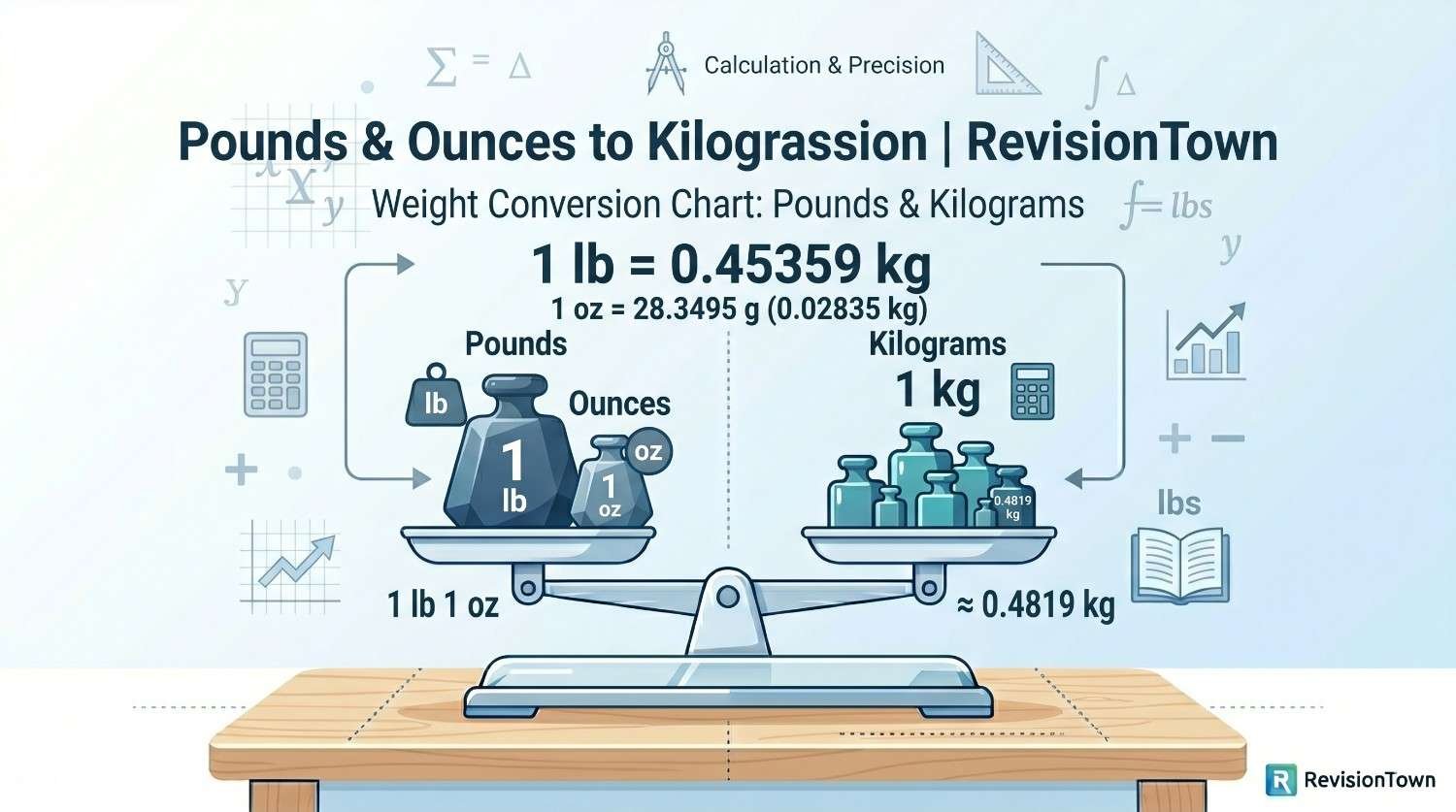
The exact conversion factors are \(1\text{ lb}=0.45359237\text{ kg}\), \(1\text{ oz}=0.028349523125\text{ kg}\), and \(1\text{ lb}=16\text{ oz}\). The calculator uses those constants directly so that the result is consistent whether you convert pounds and ounces separately or first change the ounces into decimal pounds.
Pounds+Ounces to Kilograms Calculator
Choose a conversion mode, enter the weight, and the result will appear with the calculation steps. The pounds+ounces tab accepts mixed weights such as 7 pounds and 8 ounces. If you enter 18 ounces, the calculator still converts the full weight correctly and also shows the normalized mixed form as 1 extra pound and 2 ounces.
Convert Pounds and Ounces to Kilograms
Formula used: \(\text{kg}=(\text{lb}\times 0.45359237)+(\text{oz}\times 0.028349523125)\)
Convert Kilograms to Pounds and Ounces
Formula used: \(\text{total lb}=\frac{\text{kg}}{0.45359237}\), then \(\text{oz}=16(\text{decimal lb})\)
Bulk Convert lb oz Values to kg
Enter values such as 7lb 8oz, 10 lb 12 oz, 5lb 4oz. Separate each value with a comma or a new line.
Pounds+Ounces to Kilograms Formula
Pounds and ounces are often used together because one pound is divided into 16 ounces. A mixed weight such as 7 lb 8 oz means 7 whole pounds plus 8 additional ounces. Kilograms are metric units. To convert the mixed value, you can either convert each part to kilograms and add them, or convert ounces into decimal pounds first and then convert the total pounds.
\[ 1\text{ lb}=0.45359237\text{ kg} \]
\[ 1\text{ oz}=0.028349523125\text{ kg} \]
\[ \text{kg}=(\text{lb}\times 0.45359237)+(\text{oz}\times 0.028349523125) \]
The same conversion can be written by changing ounces into a fraction of a pound:
\[ \text{total pounds}=\text{lb}+\frac{\text{oz}}{16} \]
\[ \text{kg}=\left(\text{lb}+\frac{\text{oz}}{16}\right)\times 0.45359237 \]
Both methods give the same result because \(0.45359237\div 16=0.028349523125\). The first method is easier to audit because it shows the kilogram value of the pounds and the kilogram value of the ounces separately. The second method is often faster for mental checking because it turns a mixed measurement into one decimal-pound number.
If the value is already only in pounds, use the dedicated pounds to kilograms conversion. If the value is only in ounces, use the ounces to kilograms conversion. This page is intentionally focused on the mixed form because it is common in baby weights, body weights, and some kitchen and shipping contexts.
Why Mixed Pounds and Ounces Need a Separate Converter
A mixed Imperial weight is not the same as a decimal number written with a point. The expression 7 lb 8 oz is not 7.8 lb. It is 7 pounds plus 8 ounces, and 8 ounces is half a pound because \(8\div 16=0.5\). Therefore, 7 lb 8 oz equals 7.5 lb, not 7.8 lb. This is the most common mistake when people type mixed weights into spreadsheets, forms, health apps, or recipe notes.
The same issue appears in reverse. A result such as 7.5 lb should be written as 7 lb 8 oz if you need mixed pounds and ounces. The decimal part \(0.5\) is multiplied by 16 to get 8 ounces. A decimal pound value of 7.75 lb becomes 7 lb 12 oz, because \(0.75\times 16=12\). The calculator handles these conversions directly so you do not need to remember every fractional ounce relationship.
Mixed pounds and ounces are still widely used in the United States and in some UK contexts because they feel precise while remaining familiar. Kilograms are used in most scientific, medical, international, and metric contexts. A tool that understands the mixed format avoids two problems at once: ignoring the ounces and treating ounces as decimal digits.
Step-by-Step Conversion Examples
Example 1: Convert 7 lb 8 oz to kg
Step 1: Convert pounds to kilograms.
\[ 7\times 0.45359237=3.17514659\text{ kg} \]
Step 2: Convert ounces to kilograms.
\[ 8\times 0.028349523125=0.226796185\text{ kg} \]
Step 3: Add the two parts.
\[ 3.17514659+0.226796185=3.401942775\text{ kg} \]
Answer: \(7\text{ lb }8\text{ oz}=3.401942775\text{ kg}\), commonly rounded to \(3.402\text{ kg}\) or \(3.40\text{ kg}\).
Example 2: Convert 10 lb 12 oz to kg
Step 1: Use the direct formula.
\[ \text{kg}=(10\times 0.45359237)+(12\times 0.028349523125) \]
\[ \text{kg}=4.5359237+0.3401942775=4.8761179775 \]
Answer: \(10\text{ lb }12\text{ oz}\approx 4.876\text{ kg}\). For a quick everyday reading, this may be written as \(4.88\text{ kg}\).
Example 3: Convert 3.5 kg to lb oz
Step 1: Convert kilograms to total pounds.
\[ \text{total lb}=\frac{3.5}{0.45359237}=7.716179\ldots \]
Step 2: Keep the whole pounds and convert the decimal part to ounces.
\[ 0.716179\ldots \times 16=11.4589\ldots\text{ oz} \]
Answer: \(3.5\text{ kg}\approx 7\text{ lb }11.5\text{ oz}\). If whole ounces are required, it is usually rounded to 7 lb 11 oz or 7 lb 12 oz depending on the rounding rule used.
Baby Weight and Pediatric Contexts
Baby weights are one of the most common reasons people need pounds+ounces to kilograms conversion. In everyday conversation, parents may say a baby weighs 7 lb 8 oz. In many charts, records, and international settings, the same weight is written in kilograms. A mixed-unit converter is useful because an ounce is a meaningful amount for an infant, and ignoring the ounces can noticeably change the result.
For example, 7 lb 0 oz is about 3.175 kg, while 7 lb 8 oz is about 3.402 kg. The difference is about 0.227 kg, or 227 grams. That difference is large enough to matter when tracking growth trends, but this calculator should not be used by itself to diagnose growth concerns or set treatment decisions. For medical records, medication calculations, or clinical decisions, use the official measurement taken by the healthcare team and follow their instructions.
When a family receives a weight in kilograms but wants to understand it in familiar lb oz language, the reverse converter is useful. For example, 3.4 kg is approximately 7 lb 7.9 oz. Rounded to the nearest ounce, that is about 7 lb 8 oz. The calculator shows the exact total and the mixed form so that the result is easy to communicate.
| Mixed weight | Kilograms | Decimal pounds | Useful reading |
|---|---|---|---|
| 5 lb 8 oz | 2.4948 kg | 5.5 lb | Commonly discussed in newborn-weight contexts |
| 6 lb 0 oz | 2.7216 kg | 6.0 lb | Simple whole-pound example |
| 6 lb 12 oz | 3.0617 kg | 6.75 lb | Three-quarter-pound mixed value |
| 7 lb 8 oz | 3.4019 kg | 7.5 lb | Half-pound mixed value |
| 8 lb 0 oz | 3.6287 kg | 8.0 lb | Whole-pound reference |
| 8 lb 13 oz | 3.9973 kg | 8.8125 lb | Near 4 kg reference |
| 10 lb 0 oz | 4.5359 kg | 10.0 lb | Whole-pound reference |
Body Weight, Fitness, and Health Records
Adult body weight is often recorded in whole pounds, but some scales and medical notes show pounds and ounces. A scale might display 150 lb 8 oz, while an app, form, or international document asks for kilograms. The conversion is the same as for any other mixed weight: \(150\text{ lb }8\text{ oz}=150.5\text{ lb}\), and \(150.5\times 0.45359237\approx 68.266\text{ kg}\).
For fitness tracking, consistency matters more than switching units every week. If your scale shows lb oz and your app uses kg, convert using the same method each time. Rounding to 0.1 kg is usually enough for personal trend tracking because daily hydration, food intake, clothing, and scale variation can exceed the difference between very small decimal places. For clinical use, follow the precision required by the healthcare setting.
When body weight is used in a calculation, kilograms often make formulas easier. For example, BMI uses weight in kilograms and height in meters. Some training, nutrition, and sports contexts also use kilogram-based ratios. If you only need plain pounds without ounces, the kilograms to pounds page and lbs to kg converter may be faster. If the value is mixed as lb oz, this page avoids the decimal-pound mistake.
Cooking, Baking, and Recipe Conversion
Recipes may list meat, produce, cheese, butter, flour, or bulk ingredients in pounds and ounces. International recipes and nutrition tools often use kilograms or grams. A mixed converter helps keep ingredient weights clear when adapting a recipe. For instance, 2 lb 4 oz is not 2.4 lb. It is 2.25 lb because 4 ounces is one quarter of a pound. In kilograms, 2 lb 4 oz is about 1.021 kg.
Professional baking usually benefits from grams rather than kilograms because ingredient quantities are smaller and precision matters. If the converted value is less than 1 kg, multiplying by 1000 gives grams. For example, 1 lb 8 oz is \(1.5\text{ lb}\), which is about \(0.6804\text{ kg}\), or \(680.4\text{ g}\). The kilograms to grams conversion can help after you have the metric kilogram value, while the grams to kilograms conversion is useful when moving in the opposite direction.
When scaling a recipe, convert once, then scale in the same unit. If a recipe calls for 3 lb 8 oz of an ingredient, that is 3.5 lb or about 1.588 kg. To double the recipe, use 3.176 kg rather than reworking the mixed Imperial value by hand. This reduces mistakes, especially when several ingredients have different ounce amounts.
Shipping, Postal, and Package Weights
Package scales frequently display pounds and ounces because many shipping labels and postal forms use that mixed format. International carriers, customs documents, and product specifications may ask for kilograms. A package weighing 4 lb 10 oz equals \(4+\frac{10}{16}=4.625\text{ lb}\), which is about 2.098 kg. If a weight limit is stated in kilograms, converting accurately helps avoid rejected labels, underpaid postage, or overweight packages.
For shipping, it is usually wise to round upward according to the carrier's rules. A calculator can give 2.098 kg, but a label system may require 2.10 kg, 2.1 kg, or a rounded billing weight. Dimensional weight, packaging, and carrier-specific thresholds can also matter. This converter gives the mass conversion; shipping cost decisions should also follow the carrier's current policy and measurement method.
If you need a broad tool for many unit types, use RevisionTown's unit converters page or the unit conversion calculator chart. Those pages are helpful for comparing length, area, volume, temperature, and other measurements, while this page stays focused on mixed pounds and ounces to kilograms.
How to Convert Ounces Greater Than 15
Traditional mixed notation writes ounces from 0 up to less than 16 because 16 ounces make 1 pound. However, people sometimes enter a value such as 3 lb 18 oz because they are adding measurements or reading from notes. Mathematically, the conversion still works: 3 lb 18 oz equals 4 lb 2 oz because 18 ounces is 1 pound and 2 ounces.
\[ \text{extra pounds}=\left\lfloor\frac{\text{oz}}{16}\right\rfloor \]
\[ \text{remaining oz}=\text{oz}-16(\text{extra pounds}) \]
The calculator converts the total weight exactly and shows the normalized mixed value. This is useful for bulk calculations and for checking arithmetic. For formal writing, though, the normalized form is clearer. Write 4 lb 2 oz rather than 3 lb 18 oz.
Precision, Rounding, and Significant Digits
The exact pound-to-kilogram definition uses \(0.45359237\). The exact ounce-to-kilogram value follows from dividing that by 16. The calculator can show several decimal places, but the correct number of decimals depends on the purpose. A kitchen note may only need 0.1 kg or grams rounded to the nearest 5 g. A personal body-weight log may use 0.1 kg. A record that came from a precise scale may justify 0.01 kg or more.
Rounding should normally happen at the end, not halfway through the calculation. If you convert 7 lb to 3.18 kg and 8 oz to 0.23 kg, adding those rounded pieces gives 3.41 kg. The exact result rounded to two decimals is 3.40 kg. The difference is small, but it shows why intermediate rounding can change the final digit. The calculator keeps the full precision internally and rounds only for display.
For medical, scientific, legal, or safety-critical uses, do not rely on a casual rounded value from memory. Use exact conversion factors, confirm the original measurement, and follow the official system or professional instructions for rounding. This page explains the arithmetic and provides a convenient converter, but it does not replace clinical judgment, laboratory procedures, or regulated documentation requirements.
Common Conversion Mistakes
Mistake 1: treating ounces as decimal digits. 7 lb 8 oz is 7.5 lb, not 7.8 lb. The ounce part must be divided by 16 before becoming decimal pounds.
Mistake 2: ignoring the ounces. Converting only the pounds in 7 lb 8 oz gives about 3.175 kg, but the correct value is about 3.402 kg.
Mistake 3: using the wrong factor. Pounds use 0.45359237 kg per pound. Ounces use 0.028349523125 kg per ounce.
Mistake 4: rounding too early. Keep enough precision during calculation and round only the final result.
Mistake 5: mixing grams and kilograms without converting. \(1\text{ kg}=1000\text{ g}\). If a recipe wants grams, convert kilograms to grams after the lb oz conversion.
Reference Table: Pounds+Ounces to Kilograms
| Pounds+Ounces | Decimal Pounds | Kilograms | Rounded kg |
|---|---|---|---|
| 1 lb 0 oz | 1.0000 lb | 0.45359237 kg | 0.454 kg |
| 1 lb 8 oz | 1.5000 lb | 0.680388555 kg | 0.680 kg |
| 2 lb 4 oz | 2.2500 lb | 1.020582833 kg | 1.021 kg |
| 3 lb 8 oz | 3.5000 lb | 1.587573295 kg | 1.588 kg |
| 5 lb 0 oz | 5.0000 lb | 2.267961850 kg | 2.268 kg |
| 7 lb 8 oz | 7.5000 lb | 3.401942775 kg | 3.402 kg |
| 10 lb 12 oz | 10.7500 lb | 4.876117978 kg | 4.876 kg |
| 20 lb 0 oz | 20.0000 lb | 9.071847400 kg | 9.072 kg |
Reverse Conversion: Kilograms to lb oz
To convert kilograms back to pounds and ounces, start by converting kilograms into total pounds. Then split the total into whole pounds and a decimal remainder. Finally, multiply the decimal remainder by 16 to get ounces.
\[ \text{total pounds}=\frac{\text{kg}}{0.45359237} \]
\[ \text{whole pounds}=\lfloor \text{total pounds}\rfloor \]
\[ \text{ounces}=16(\text{total pounds}-\text{whole pounds}) \]
If the ounce result rounds to 16.0, carry one pound and set ounces to 0. The calculator handles this edge case. For example, a value near 4.5359 kg may round to exactly 10 lb 0 oz rather than 9 lb 16 oz. That makes the mixed result easier to read and consistent with standard notation.
For single-unit reverse conversions, you may also find the kilograms to ounces conversion helpful when the result should be all ounces, or the kg to lbs converter when decimal pounds are enough. This page is best when you specifically need the mixed pounds+ounces format.
Understanding lb, lbs, oz, kg, and g
The abbreviation lb comes from the Latin word libra and is used for pound. The plural is commonly written as lbs in everyday English, although lb is also used as a unit symbol for both singular and plural values. The abbreviation oz means ounce. The abbreviation kg means kilogram, and g means gram. In metric notation, \(1\text{ kg}=1000\text{ g}\).
In everyday language, people often say "weight" for pounds and kilograms. In strict physics, kilograms measure mass, while weight is a force. For ordinary body, kitchen, and package measurements near Earth's surface, people use these terms interchangeably. This converter follows everyday usage and focuses on practical unit conversion rather than physics terminology.
If you are comparing many weight units, the weight converter, easy weight converter, and advanced weight converter tool can help with broader unit sets. This page remains narrower so that it can explain the mixed lb oz format in depth.
Practical Workflows
For Baby Weight Notes
Enter the pounds and ounces exactly as written on the scale or record. Use the kilogram result for forms that require metric weight, but follow healthcare instructions for official documentation and rounding. If a professional gives a different recorded value, use the professional record.
For Recipes
Convert the mixed weight to kilograms, then multiply by 1000 if the recipe or kitchen scale uses grams. Convert all ingredients before scaling the recipe so that one consistent unit is used for the final calculation.
For Fitness Logs
Use the same unit and rounding rule every time. If a scale shows 154 lb 6 oz, convert it once to kilograms and record the rounded result consistently, such as 70.0 kg or 70.03 kg depending on the precision you track.
For Shipping
Convert the package weight, then round according to the carrier's current instructions. The conversion gives physical weight only; billing weight may also include package dimensions or minimum charge rules.
For Spreadsheets
Store pounds and ounces in separate columns if possible. That prevents 7 lb 8 oz from being typed as 7.8 lb. A spreadsheet formula can then use the same conversion expression as this page.
For School Work
Show the conversion factor, substitute values, and keep units attached. If the problem asks for a rounded answer, round only after the final kilogram value is calculated.
Spreadsheet Formula for lb oz to kg
If pounds are in cell A2 and ounces are in cell B2, the spreadsheet formula is:
\[ \text{kg}=A2\times 0.45359237+B2\times 0.028349523125 \]
In a spreadsheet cell, this is usually typed as:
=A2*0.45359237+B2*0.028349523125
If you want to normalize ounces first, you can convert the whole value to decimal pounds:
=((A2)+(B2/16))*0.45359237
Both formulas are equivalent. Separate columns are recommended because they make the source measurement unambiguous. A single cell like "7 lb 8 oz" is easier for humans to read but harder for formulas to process consistently unless you use text parsing.
Practice Problems
Practice 1
Question: Convert 2 lb 8 oz to kilograms.
Answer: 8 oz is 0.5 lb, so the total is 2.5 lb. \(2.5\times 0.45359237=1.133980925\text{ kg}\). Rounded to three decimals, the answer is 1.134 kg.
Practice 2
Question: Convert 12 lb 3 oz to kilograms.
Answer: \((12\times 0.45359237)+(3\times 0.028349523125)=5.528154\text{ kg}\) approximately.
Practice 3
Question: Convert 4 kg to pounds and ounces.
Answer: \(4\div 0.45359237=8.81849\text{ lb}\). Whole pounds are 8. The decimal part \(0.81849\times 16=13.10\text{ oz}\). So 4 kg is about 8 lb 13.1 oz.
Practice 4
Question: A recipe lists 1 lb 12 oz of an ingredient. What is that in kilograms and grams?
Answer: 12 oz is 0.75 lb, so the total is 1.75 lb. \(1.75\times 0.45359237=0.7937866475\text{ kg}\), which is about 793.8 g.
Choosing the Right Related Converter
Use this page when the source value is in mixed pounds and ounces. Use pounds to ounces conversion when you want to turn pounds into total ounces, or ounces to pounds conversion when the source is all ounces and you need decimal pounds. Use oz to kg conversion for a pure ounce value and pounds to ounces when the final answer should remain Imperial.
If your work includes pounds, kilograms, stones, ounces, grams, and other units together, the weight converter for kg, lbs, pounds, and stone gives a broader interface. The mixed lb oz calculator on this page is more detailed for the specific case where pounds and ounces appear together.
Decimal Pounds Versus Mixed Pounds and Ounces
A major source of conversion errors is the difference between decimal pounds and mixed pounds+ounces. Decimal pounds use base 10 after the decimal point. Mixed pounds+ounces use 16 ounces per pound. Because these systems divide a pound differently, the digits after a decimal point are not ounces. For example, 7.25 lb means 7 pounds plus one quarter of a pound, and one quarter of a pound is 4 ounces. Therefore, 7.25 lb equals 7 lb 4 oz. It does not equal 7 lb 25 oz.
The conversion is straightforward once the distinction is clear. To change mixed lb oz into decimal pounds, divide the ounces by 16 and add the result to the pounds. To change decimal pounds into mixed lb oz, keep the whole-number pounds and multiply the decimal part by 16. This is the same idea used in time conversion: 1.5 hours is 1 hour 30 minutes, not 1 hour 5 minutes, because an hour has 60 minutes rather than 10 minutes. A pound has 16 ounces rather than 10 ounces, so the same care is needed.
| Mixed lb oz | Decimal pounds | Why | Kilograms |
|---|---|---|---|
| 7 lb 1 oz | 7.0625 lb | \(1\div 16=0.0625\) | 3.203 kg |
| 7 lb 4 oz | 7.25 lb | \(4\div 16=0.25\) | 3.289 kg |
| 7 lb 8 oz | 7.5 lb | \(8\div 16=0.5\) | 3.402 kg |
| 7 lb 12 oz | 7.75 lb | \(12\div 16=0.75\) | 3.515 kg |
| 7 lb 15 oz | 7.9375 lb | \(15\div 16=0.9375\) | 3.600 kg |
This table also explains why entering "7.8 lb" for 7 lb 8 oz gives the wrong result. The number 7.8 lb actually means 7 lb plus 0.8 of a pound. Since \(0.8\times 16=12.8\), 7.8 lb is 7 lb 12.8 oz. If a spreadsheet or app asks for decimal pounds, 7 lb 8 oz should be entered as 7.5, not 7.8.
Manual Conversion Without a Calculator
When you do not have a converter available, use the decimal-pound method for a fast manual check. First convert ounces into a fraction of a pound. Common fractions are easy to remember: 4 oz is 0.25 lb, 8 oz is 0.5 lb, and 12 oz is 0.75 lb. Then multiply the decimal pounds by 0.4536 for a close kilogram estimate. The exact factor is 0.45359237, but 0.4536 is usually enough for a quick check.
For example, 9 lb 8 oz is 9.5 lb. A quick estimate is \(9.5\times 0.4536\approx 4.3092\text{ kg}\). The exact result using the full factor is \(4.309127515\text{ kg}\). The estimate is close because the rounded factor only changes the last few digits. For casual understanding, this is fine. For official or high-precision use, use the exact factor and do not round until the end.
If the ounce amount is not a familiar fraction, divide by 16. For 11 oz, \(11\div 16=0.6875\). Therefore, 6 lb 11 oz is 6.6875 lb. Multiply by 0.45359237 to get about 3.033 kg. This method is especially useful when checking whether a calculator result is reasonable. If the quick estimate is far from the calculator output, recheck whether the value was entered as mixed lb oz or decimal pounds.
Bulk Conversion Tips
The bulk converter is useful when you have several weights from notes, a class exercise, recipe ingredients, shipping packages, or repeated baby-weight records. Use a consistent format such as "7 lb 8 oz, 8 lb 1 oz, 9 lb 3 oz" or place one weight on each line. Consistency makes it easier to spot typing errors before you use the results. If one entry is missing ounces, write 0 oz so the pattern stays clear.
For records, avoid mixing decimal pounds and mixed pounds in the same bulk list. A list such as "7 lb 8 oz, 7.5 lb, 8 lb 2 oz" may be understandable to a person, but it is more likely to cause mistakes when copied into a tool, spreadsheet, or form. Convert all values to one source format first. If the source is mixed, use lb oz. If the source is decimal pounds, use a decimal-pound converter rather than this mixed-format page.
After bulk conversion, review the largest and smallest values. They should make sense relative to the source list. If 6 lb 0 oz converts to about 2.72 kg and 12 lb 0 oz converts to about 5.44 kg, then values between them should fall within that range. This kind of quick reasonableness check is helpful when copying many values from handwritten notes or printed records.
Rounding Examples by Use Case
Different tasks call for different rounding. A cooking estimate, a fitness log, and a clinical record should not automatically use the same number of decimal places. The arithmetic may be exact, but the displayed result should match the decision being made. Too many decimals can imply false precision, while too few decimals can hide a meaningful difference.
| Use case | Typical display | Example with 7 lb 8 oz | Reason |
|---|---|---|---|
| Quick everyday reading | 1 decimal place | 3.4 kg | Easy to read and remember |
| Body-weight log | 1 or 2 decimal places | 3.40 kg | Consistent tracking across entries |
| Recipe conversion | kg or grams | 3.402 kg or 3402 g | Depends on ingredient size and scale display |
| School calculation | As requested | 3.402 kg | Follows the problem's rounding instruction |
| Official record | Required by the form | 3.401942775 kg before final rounding | Use the mandated precision and method |
When in doubt, keep the unrounded value in your working notes and round only the final value for display. For example, a spreadsheet can store 3.401942775 while showing 3.40. That way, later calculations still use the precise value even though the visible cell is tidy.
Converting Fractions of an Ounce
Some kitchen scales, postal scales, and older records show fractional ounces, such as 7 lb 8.5 oz or 2 lb 3.25 oz. The formula is the same. You do not need a special method because ounces can be decimal values. The weight 7 lb 8.5 oz is \(7+\frac{8.5}{16}=7.53125\text{ lb}\), which is about \(3.4161\text{ kg}\).
Fractional ounces are common when measuring small differences. Half an ounce is about 14.17 grams, and one quarter ounce is about 7.09 grams. For some cooking tasks, these differences matter. For casual package or body-weight estimates, they may not. The calculator accepts decimal ounces so that the source measurement can be entered as it appears.
If you need a clean mixed value after converting from kilograms, decide whether to show ounces to the nearest tenth, nearest quarter, nearest half, or nearest whole ounce. A result of 11.46 oz may be written as 11.5 oz to the nearest tenth, 11.5 oz to the nearest half ounce, or 11 oz to the nearest whole ounce if using standard rounding down is not required. Always use the rounding convention expected by the form or context.
Quality Checks for Important Records
When a conversion will be copied into a record, report, spreadsheet, shipping label, or health document, take a moment to verify the source measurement and the unit. A surprisingly common issue is that the same value is written in two different ways, such as 7 lb 8 oz in one place and 7.8 lb in another. These are not equivalent. If the original source is ambiguous, clarify it before converting.
Check whether the scale was set to lb oz, decimal pounds, ounces, kilograms, or grams. Digital scales may switch modes with a small button, and a display reading of 7:08, 7.8, and 7 lb 8 oz can mean different things depending on the device. For consistent records, include the unit symbol next to every value. Write "7 lb 8 oz" rather than just "7 8". Write "3.402 kg" rather than just "3.402".
For official or safety-sensitive contexts, use a fresh measurement when possible rather than converting an old rounded value. For example, converting a value already rounded to the nearest pound cannot recover the missing ounces. A measurement of 8 lb could represent anything from about 7 lb 8 oz to 8 lb 7 oz depending on the rounding method. The precision of the converted kilogram value cannot be better than the precision of the original measurement.
Understanding the Exact Conversion Factor
The pound used in everyday US customary and Imperial weight contexts is the international avoirdupois pound. It is defined as exactly 0.45359237 kilograms. Because a pound has exactly 16 ounces, one ounce is exactly \(0.45359237\div 16=0.028349523125\) kilograms. These exact relationships are why the calculator can use fixed constants rather than approximate lookup values.
For mental math, people often use \(1\text{ lb}\approx 0.45\text{ kg}\) and \(1\text{ kg}\approx 2.2\text{ lb}\). These approximations are useful for quick sense-checks, but they are not the same as exact conversion. For example, 10 lb is exactly 4.5359237 kg, while the rough estimate \(10\times 0.45\) gives 4.5 kg. That is close, but not identical. The more precise your use case, the more important the exact factor becomes.
The ounce factor can also be approximated as 0.02835 kg or about 28.35 grams. This is helpful in cooking because small ounce amounts are often easier to understand in grams. For example, 4 oz is about 113.4 g, 8 oz is about 226.8 g, and 12 oz is about 340.2 g. When a recipe uses pounds and ounces together, convert the total weight rather than converting each line from memory.
More Worked Examples for Everyday Values
Example: 6 lb 5 oz
First convert ounces to decimal pounds: \(5\div 16=0.3125\). The total is 6.3125 lb. Multiply by 0.45359237 to get \(2.862177\text{ kg}\), which rounds to 2.862 kg. This example is useful because 5 ounces is not one of the easiest quarter-pound fractions.
Example: 14 lb 14 oz
The ounce value is close to a full pound, so the total is \(14+\frac{14}{16}=14.875\text{ lb}\). Multiplying by 0.45359237 gives \(6.747436\text{ kg}\). A rough mental check is 15 lb times 0.45, which is about 6.75 kg, so the precise result is reasonable.
Example: 0 lb 12 oz
A value can be entered with zero pounds if the source is less than one pound. Since 12 oz is three quarters of a pound, the decimal value is 0.75 lb. The kilogram value is \(0.75\times 0.45359237=0.3401942775\text{ kg}\), or about 340.2 g.
Example: 22 lb 6 oz
Six ounces is \(6\div 16=0.375\) lb, so the total is 22.375 lb. The kilogram value is \(22.375\times 0.45359237=10.149628\text{ kg}\). This kind of value appears in pet weights, luggage checks, shipping, and larger infant or toddler records.
When to Convert to Grams Instead of Kilograms
Kilograms are the standard metric unit for body weight and larger package weights, but grams are often more practical for small items. If the result is less than 1 kg, it may be easier to read as grams. For example, 12 oz equals about 0.340 kg, but in a recipe it is usually clearer to write 340 g. The relationship is simple: multiply kilograms by 1000 to get grams.
\[ \text{grams}=\text{kilograms}\times 1000 \]
For example, 2 lb 2 oz is \(2.125\text{ lb}\), which is \(0.96388378625\text{ kg}\). In grams, that is about 963.9 g. If a kitchen scale displays grams, entering 964 g may be more useful than entering 0.964 kg. For body-weight records, kilograms remain more readable because the numbers are larger.
Keep the final audience in mind. A parent may understand lb oz more easily, a clinician or international form may expect kg, and a baker may prefer grams. The same underlying conversion supports all three forms, but the best display unit changes with the task.
Checklist Before You Use the Result
- Confirm whether the source is mixed lb oz or decimal pounds.
- Remember that \(1\text{ lb}=16\text{ oz}\).
- Convert both the pound part and the ounce part.
- Keep enough decimal places until the final answer.
- Use kg for metric records and g for smaller recipe quantities when needed.
- For official medical, legal, shipping, or regulated documents, follow the required rounding rule.
- When entering multiple values, keep each value in a clear format such as 7 lb 8 oz.
Key Takeaways
The most important rule is that pounds and ounces are mixed units, not decimal notation. A value such as 7 lb 8 oz should be converted as \(7+\frac{8}{16}=7.5\) total pounds, then multiplied by 0.45359237, or by converting each component separately and adding the kilogram values. The exact formula is \(\text{kg}=(\text{lb}\times 0.45359237)+(\text{oz}\times 0.028349523125)\).
This calculator is built for the common mixed-format use case: baby weights, body-weight notes, recipes, package weights, and forms that ask for kilograms. It also converts kilograms back to pounds and ounces and supports bulk lb oz entries. For single-unit conversions, use the related RevisionTown converters linked above; for mixed pounds+ounces, this page gives the most direct workflow.
Frequently Asked Questions
How do you convert pounds and ounces to kilograms?
Use \(\text{kg}=(\text{lb}\times 0.45359237)+(\text{oz}\times 0.028349523125)\). For example, 7 lb 8 oz equals \((7\times 0.45359237)+(8\times 0.028349523125)=3.401942775\text{ kg}\).
Is 7 lb 8 oz the same as 7.8 pounds?
No. 7 lb 8 oz is 7.5 pounds because 8 ounces is half a pound. The value 7.8 pounds would be 7 lb 12.8 oz.
What is 1 pound 8 ounces in kilograms?
1 lb 8 oz is 1.5 lb. Multiply by 0.45359237 to get \(0.680388555\text{ kg}\), usually rounded to 0.680 kg or 0.68 kg.
How many ounces are in a pound?
There are 16 ounces in 1 pound. This is why ounces are divided by 16 when converting a mixed lb oz value into decimal pounds.
How do you convert kilograms back to pounds and ounces?
Divide kilograms by 0.45359237 to get total pounds. Keep the whole pounds, then multiply the decimal part by 16 to get ounces.
How many kilograms is 10 lb 12 oz?
10 lb 12 oz equals \(4.8761179775\text{ kg}\). Rounded to three decimal places, it is 4.876 kg.
Should I round to two or three decimals?
It depends on the use. For everyday body weight, 0.1 kg may be enough. For recipes, grams may be more useful. For official records, use the required precision and rounding rule for that context.
Can I enter ounces greater than 15?
Yes. The calculator converts the total weight and shows the normalized mixed form. For formal writing, convert 18 oz into 1 lb 2 oz, because standard mixed notation keeps ounces below 16.