
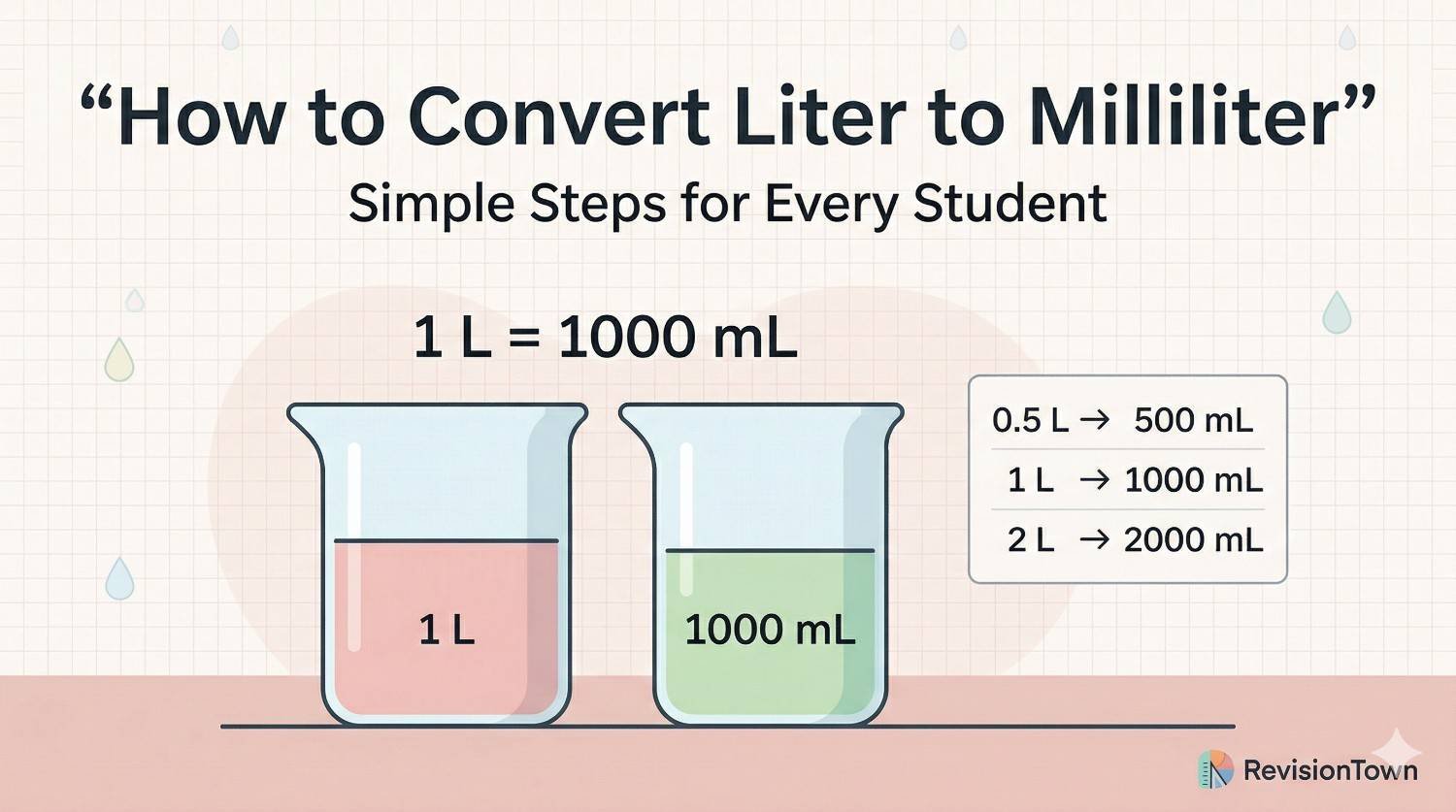
How to Convert Liter to Milliliter
Convert liters to milliliters instantly with the exact metric formula, a step-by-step explanation, worked examples, conversion table, practical measurement notes, and a focused calculator for \(L\) to \(mL\).
Quick answer: \(1\,\text{L}=1{,}000\,\text{mL}\). To convert liters to milliliters, multiply the number of liters by \(1{,}000\).
Liter to Milliliter Calculator
Enter a value in liters. The calculator multiplies by \(1{,}000\) and shows the equivalent in milliliters, cubic centimeters, and the reverse-check value in liters.
Use decimals such as 0.25, 1.5, or 2.75.
Result
1,500 mL
1.5 L × 1,000 = 1,500 mL
What Does Liter to Milliliter Mean?
A liter to milliliter conversion changes a volume written in liters into the same volume written in milliliters. Nothing about the actual amount changes. Only the unit changes. If a bottle contains \(2\,\text{L}\) of water, it also contains \(2{,}000\,\text{mL}\) of water. The volume is identical; milliliters simply use a smaller unit, so the number becomes larger.
The liter is commonly used for larger everyday liquid volumes, such as water bottles, fuel, milk, juice, aquarium capacity, tank volume, and chemistry solutions. The milliliter is commonly used for smaller volumes, such as medicine cups, lab samples, recipe ingredients, essential oils, syringes, measuring spoons, and small containers. Because both units belong to the metric volume system, the conversion is exact and simple.
This page is focused specifically on converting liters to milliliters. If your starting value is already in milliliters and you need liters, use RevisionTown's milliliter to liter conversion page. If you need to compare many volume units at once, the broader volume converter or advanced volume converter is a better fit. Keeping this page focused helps it answer the exact liter-to-milliliter question without competing with broader tools.
Liter to Milliliter Formula
The exact conversion factor is:
Therefore, the formula for converting liters to milliliters is:
In symbols:
Here, \(V_{\text{mL}}\) means volume in milliliters and \(V_{\text{L}}\) means volume in liters. The multiplier \(1{,}000\) comes from the metric prefix "milli," which means one-thousandth. A milliliter is one-thousandth of a liter, so one liter contains one thousand milliliters.
For example, to convert \(3.25\,\text{L}\) to milliliters:
The answer is \(3{,}250\,\text{mL}\). The decimal moves three places to the right because multiplying by \(1{,}000\) is the same as moving the decimal point three positions right.
Step-by-Step: How to Convert Liter to Milliliter
The conversion is easy, but writing it step by step helps avoid decimal-place mistakes. Use this process whenever you are solving homework, checking a recipe, preparing a lab solution, or building a table of metric volume values.
- Write the volume in liters.
- Use the conversion factor \(1\,\text{L}=1{,}000\,\text{mL}\).
- Multiply the liter value by \(1{,}000\).
- Write the answer with the unit \(mL\).
- Check by dividing the milliliter answer by \(1{,}000\) to return to liters.
Example with \(0.75\,\text{L}\):
So \(0.75\,\text{L}=750\,\text{mL}\). A reverse check confirms it:
This reverse check is useful because many liter and milliliter mistakes are decimal mistakes. If the reverse calculation does not return the starting liter value, the conversion needs to be reviewed.
Why Multiply by 1,000?
The metric system is built around powers of ten. The prefix "milli" means \(1/1{,}000\) of the base unit. In volume, one milliliter is one-thousandth of a liter:
That means it takes \(1{,}000\) milliliters to make \(1\) liter:
When converting from a larger unit to a smaller unit, the number gets larger. Liters are larger than milliliters. Therefore, a liter value becomes a larger milliliter number. This is why \(2\,\text{L}\) becomes \(2{,}000\,\text{mL}\), \(5\,\text{L}\) becomes \(5{,}000\,\text{mL}\), and \(0.25\,\text{L}\) becomes \(250\,\text{mL}\).
If you convert in the opposite direction, from milliliters to liters, you divide by \(1{,}000\). That reverse relationship is:
Remembering the direction is the key. Liter to milliliter uses multiplication. Milliliter to liter uses division.
Liter to Milliliter Conversion Table
Use this table for common liter values. It includes small decimal liter amounts, everyday bottle sizes, and larger volumes that often appear in recipes, science, and household measurements.
| Liters (L) | Milliliters (mL) | Calculation |
|---|---|---|
| \(0.001\,\text{L}\) | \(1\,\text{mL}\) | \(0.001\times1{,}000=1\) |
| \(0.01\,\text{L}\) | \(10\,\text{mL}\) | \(0.01\times1{,}000=10\) |
| \(0.05\,\text{L}\) | \(50\,\text{mL}\) | \(0.05\times1{,}000=50\) |
| \(0.1\,\text{L}\) | \(100\,\text{mL}\) | \(0.1\times1{,}000=100\) |
| \(0.25\,\text{L}\) | \(250\,\text{mL}\) | \(0.25\times1{,}000=250\) |
| \(0.5\,\text{L}\) | \(500\,\text{mL}\) | \(0.5\times1{,}000=500\) |
| \(0.75\,\text{L}\) | \(750\,\text{mL}\) | \(0.75\times1{,}000=750\) |
| \(1\,\text{L}\) | \(1{,}000\,\text{mL}\) | \(1\times1{,}000=1{,}000\) |
| \(1.5\,\text{L}\) | \(1{,}500\,\text{mL}\) | \(1.5\times1{,}000=1{,}500\) |
| \(2\,\text{L}\) | \(2{,}000\,\text{mL}\) | \(2\times1{,}000=2{,}000\) |
| \(2.5\,\text{L}\) | \(2{,}500\,\text{mL}\) | \(2.5\times1{,}000=2{,}500\) |
| \(5\,\text{L}\) | \(5{,}000\,\text{mL}\) | \(5\times1{,}000=5{,}000\) |
Worked Examples
Example 1: Convert \(2\,\text{L}\) to mL
Start with the formula:
Substitute \(2\) for the liter value:
So \(2\,\text{L}=2{,}000\,\text{mL}\).
Example 2: Convert \(0.35\,\text{L}\) to mL
So \(0.35\,\text{L}=350\,\text{mL}\). This type of value often appears on drink bottles, measuring cups, and recipe amounts.
Example 3: Convert \(1.25\,\text{L}\) to mL
So \(1.25\,\text{L}=1{,}250\,\text{mL}\).
Example 4: Convert \(0.005\,\text{L}\) to mL
So \(0.005\,\text{L}=5\,\text{mL}\). This example is important because small liter decimals can look unfamiliar. A small decimal in liters can be a normal amount in milliliters.
Example 5: Convert \(12.75\,\text{L}\) to mL
So \(12.75\,\text{L}=12{,}750\,\text{mL}\). For larger values, commas help keep the milliliter result readable.
Moving the Decimal Point
Because \(1{,}000=10^3\), converting liters to milliliters is the same as moving the decimal point three places to the right. This shortcut is useful for mental math, but it should still be understood as multiplication by \(1{,}000\).
If there are not enough digits after the decimal point, add zeros. For example, \(0.07\,\text{L}\) becomes \(70\,\text{mL}\), not \(7\,\text{mL}\), because \(0.07\times1{,}000=70\). Similarly, \(0.007\,\text{L}=7\,\text{mL}\). The number of decimal places matters.
Decimal movement can be checked with the size of the units. Milliliters are smaller than liters, so the milliliter number should be larger. If \(0.75\,\text{L}\) becomes \(0.00075\,\text{mL}\), the decimal moved in the wrong direction. A normal bottle of \(0.75\,\text{L}\) is \(750\,\text{mL}\), not a fraction of one milliliter.
Liter, L, l, Milliliter, and mL Notation
The liter is written with the symbol \(L\) or sometimes \(l\). The uppercase \(L\) is widely used because the lowercase \(l\) can be confused with the number \(1\). The milliliter is written as \(mL\) or sometimes \(ml\), but \(mL\) is clearer because the uppercase \(L\) makes the liter part easier to recognize.
In precise work, write units consistently. A clear answer looks like \(250\,\text{mL}\), \(1{,}000\,\text{mL}\), or \(2.5\,\text{L}\). Avoid writing only "250" without a unit, because the number alone does not tell the reader whether the amount is liters, milliliters, cups, gallons, or another volume unit.
For schoolwork and reports, use a space between the number and the unit: \(500\,\text{mL}\), not \(500mL\). In labels and forms, both are readable, but the spaced format is clearer in formal writing. In code or spreadsheet column names, use practical labels such as volume_liters and volume_ml.
Liters, Milliliters, and Cubic Centimeters
A milliliter is also equal to a cubic centimeter:
This means a liter also equals \(1{,}000\,\text{cm}^3\):
This relationship is useful in science, medicine, engineering, and geometry. If a container has a volume of \(250\,\text{cm}^3\), it also has a volume of \(250\,\text{mL}\). If a bottle contains \(1.5\,\text{L}\), that is \(1{,}500\,\text{mL}\) and \(1{,}500\,\text{cm}^3\).
Another useful relationship is between liters and cubic decimeters:
A cube measuring \(10\,\text{cm}\) by \(10\,\text{cm}\) by \(10\,\text{cm}\) has a volume of \(1{,}000\,\text{cm}^3\), which is \(1{,}000\,\text{mL}\), which is \(1\,\text{L}\). This is one reason metric volume conversions are so convenient: length, volume, and capacity units connect cleanly through powers of ten.
Everyday Uses for Liter to Milliliter Conversion
Liter to milliliter conversion appears in many everyday situations. A \(1.5\,\text{L}\) water bottle is \(1{,}500\,\text{mL}\). A \(2\,\text{L}\) soda bottle is \(2{,}000\,\text{mL}\). A \(0.5\,\text{L}\) bottle is \(500\,\text{mL}\). These labels are equivalent, but different countries and product types may prefer one unit over the other.
In cooking, a recipe may list liquid ingredients in liters while a measuring cup is marked in milliliters. If a soup recipe needs \(1.2\,\text{L}\) of stock, measure \(1{,}200\,\text{mL}\). If a sauce needs \(0.25\,\text{L}\), measure \(250\,\text{mL}\). For kitchen conversions involving cups, tablespoons, and teaspoons, RevisionTown's cooking measurement converter and cooking ingredient converter can help when the recipe uses mixed measurement systems.
In classrooms and labs, liter-to-milliliter conversion is used for beakers, graduated cylinders, solution preparation, dilution, and sample handling. A chemistry instruction may ask for \(0.1\,\text{L}\) of solution, while the measuring cylinder is marked in milliliters. The conversion is \(0.1\times1{,}000=100\,\text{mL}\).
In product packaging, milliliters often appear on smaller bottles, and liters appear on larger bottles. A container labeled \(0.75\,\text{L}\) is the same as \(750\,\text{mL}\). A container labeled \(3\,\text{L}\) is \(3{,}000\,\text{mL}\). Understanding the conversion makes it easier to compare prices, serving sizes, storage needs, and dosage-related container sizes. For medical dosing, always follow a qualified professional's instructions and the product label; this page only converts units.
Liter to Milliliter in Science and Chemistry
Science often uses liters and milliliters together because experiments can involve both large prepared solutions and small measured samples. A stock solution may be made in liters, while individual aliquots are measured in milliliters. The conversion keeps the units consistent across calculations.
For example, if a lab needs \(0.2\,\text{L}\) of buffer, the equivalent volume is:
If five groups each need \(150\,\text{mL}\), the total volume is \(750\,\text{mL}\), which is \(0.75\,\text{L}\). Since this page focuses on liter to milliliter, the forward conversion would be \(0.75\,\text{L}=750\,\text{mL}\).
Concentration calculations often depend on matching volume units. If concentration is written in grams per liter, and a measured sample is in milliliters, the volume may need to be converted before substitution into a formula. For chemistry-specific workflows, RevisionTown also has a chemistry conversion page. For concentration-style conversions involving milligrams per liter, the ppm to mg/L conversion page may be useful.
When recording lab results, include the original measurement and the converted value if both are useful. For example: "Prepared \(0.5\,\text{L}\) (\(500\,\text{mL}\)) of solution." This makes the note readable to someone using a liter-based protocol and someone using milliliter-marked equipment.
Liter to Milliliter in Cooking and Nutrition Labels
Recipes often mix metric and household measurements. A carton may be labeled \(1\,\text{L}\), a measuring jug may show \(1{,}000\,\text{mL}\), and a recipe may ask for \(250\,\text{mL}\). Knowing that \(1\,\text{L}=1{,}000\,\text{mL}\) makes it easy to scale recipes and compare ingredient amounts.
Common cooking amounts include:
- \(0.25\,\text{L}=250\,\text{mL}\)
- \(0.5\,\text{L}=500\,\text{mL}\)
- \(0.75\,\text{L}=750\,\text{mL}\)
- \(1\,\text{L}=1{,}000\,\text{mL}\)
- \(1.5\,\text{L}=1{,}500\,\text{mL}\)
If a recipe needs \(0.6\,\text{L}\) of milk, that is \(600\,\text{mL}\). If you are dividing a \(1\,\text{L}\) bottle into four equal portions, each portion is \(250\,\text{mL}\). If a nutrition label lists a serving as \(250\,\text{mL}\), then a \(1\,\text{L}\) carton contains \(4\) such servings because \(1{,}000\div250=4\).
Cup conversions are not always identical across regions because cup sizes can vary. If the task is specifically cup to milliliter, use the cup to milliliter converter. If the task is only liter to milliliter, the conversion is exact and does not depend on the type of cup.
Liter to Milliliter for Bottles, Tanks, and Containers
Container sizes often use liters, while smaller marks on the container use milliliters. A \(1\,\text{L}\) measuring jug may have markings every \(100\,\text{mL}\). A \(5\,\text{L}\) container may be described in liters for storage but filled in milliliter increments for dosing or mixing.
For bottles:
For tanks and larger containers, milliliters can become large numbers. A \(10\,\text{L}\) container equals \(10{,}000\,\text{mL}\). A \(25\,\text{L}\) tank equals \(25{,}000\,\text{mL}\). In those cases, liters are usually easier to read, but milliliters may still be useful for precise additions, chemical dosing, or comparison with smaller measuring devices.
If you are working with gallons, quarts, or other non-metric volume units, use the more specific pages such as liters to gallons, gallons to liters, or liters to quarts. Those conversions use different factors and should not be treated as the same as liter to milliliter.
Accuracy, Rounding, and Significant Figures
The conversion factor \(1\,\text{L}=1{,}000\,\text{mL}\) is exact. Any uncertainty usually comes from the measured volume, not from the conversion factor. If a bottle is labeled \(1.5\,\text{L}\), the converted value is \(1{,}500\,\text{mL}\). If a measured liquid volume is \(1.48\,\text{L}\), the converted value is \(1{,}480\,\text{mL}\).
Rounding should match the purpose. In everyday use, whole milliliters are often enough. In lab work, one or two decimal places may matter for small volumes. For example:
Rounding this to \(3\,\text{mL}\) may be acceptable for a rough household estimate but not for a precise lab procedure. The calculator lets you choose decimal places, but the correct precision depends on the measurement tool and the context.
Do not add precision that was not present in the original measurement. If a container is labeled \(2\,\text{L}\), writing \(2{,}000.000\,\text{mL}\) suggests a level of precision that may not be true. A clear, practical answer is \(2{,}000\,\text{mL}\). If the input is \(2.000\,\text{L}\), then \(2{,}000.000\,\text{mL}\) may be appropriate in a technical context.
How to Check Your Liter to Milliliter Answer
A correct liter-to-milliliter answer should be \(1{,}000\) times the liter value. The milliliter number should be larger than the liter number unless the input is zero. Use these quick anchor values:
- \(0.001\,\text{L}=1\,\text{mL}\)
- \(0.01\,\text{L}=10\,\text{mL}\)
- \(0.1\,\text{L}=100\,\text{mL}\)
- \(1\,\text{L}=1{,}000\,\text{mL}\)
- \(10\,\text{L}=10{,}000\,\text{mL}\)
Then perform a reverse check:
If your answer is \(2{,}750\,\text{mL}\), divide by \(1{,}000\):
If the original value was \(2.75\,\text{L}\), the conversion is consistent. If the reverse check gives a different liter value, look for a misplaced decimal or a wrong multiplication/division direction.
Common Mistakes to Avoid
Liter to milliliter uses multiplication by \(1{,}000\). Dividing by \(1{,}000\) is for milliliter to liter.
For L to mL, move the decimal three places to the right. \(0.25\,\text{L}\) is \(250\,\text{mL}\), not \(0.00025\,\text{mL}\).
\(2\,\text{L}\) is \(2{,}000\,\text{mL}\). Missing one zero gives \(200\,\text{mL}\), which is ten times too small.
\(500\,\text{mL}\) is \(0.5\,\text{L}\). It is not \(500\,\text{L}\).
Liter to milliliter is exact. Gallons, quarts, cups, and fluid ounces use different conversion factors.
Keep enough digits during the calculation and round only the final milliliter result when precision matters.
Liter to Milliliter in Spreadsheets and Code
In a spreadsheet, if cell A2 contains a liter value, the milliliter formula is:
If the spreadsheet uses plain formulas, you can write =A2*1000. Label the column clearly as "milliliters" or "volume_ml." Do not label it only as "volume" unless the unit is shown elsewhere.
In JavaScript, the calculation is:
A practical variable name is milliliters = liters * 1000. For code that handles user input, validate that the input is numeric. Depending on the application, zero may be valid, while negative volume usually is not valid for a physical container.
For data tables, keep the original liter value and the converted milliliter value in separate fields. This avoids confusion when data is exported, filtered, or reused. A safe table might use volume_l and volume_ml as separate columns.
Scaling Liter Amounts Up or Down
Many practical liter-to-milliliter tasks are not single conversions. You may need to double a recipe, split a container into equal servings, prepare several bottles, or scale a classroom experiment for a different group size. The cleanest approach is to do the volume scaling first, then convert the final liter amount to milliliters.
For example, suppose one batch needs \(0.75\,\text{L}\) of liquid and you need \(4\) batches. First multiply the liter amount by \(4\):
Then convert to milliliters:
You can also combine the steps:
Both methods are correct. The two-step method is often easier to read because it keeps the scaling step separate from the unit conversion step. This is useful when someone else needs to check the work.
For splitting a volume, divide before or after converting as long as the units remain consistent. If a \(2\,\text{L}\) container is split into \(8\) equal portions, each portion is:
Or convert first:
Both routes give \(250\,\text{mL}\). The important point is not to divide one value in liters and compare it directly with another value in milliliters without converting.
Liter to Milliliter for Ratios and Mixtures
Ratios and mixtures often combine liter and milliliter values. A cleaning solution, lab mixture, fertilizer mix, beverage concentrate, or classroom activity may describe a large liquid volume in liters and smaller additive amounts in milliliters. Converting the liter value to milliliters makes the ratio easier to compare.
Suppose a mixture uses \(1.5\,\text{L}\) of water and \(30\,\text{mL}\) of concentrate. Convert the water volume first:
The ratio of concentrate to water is then:
Simplify by dividing both numbers by \(30\):
So the mixture uses \(1\) part concentrate for every \(50\) parts water. This would be harder to see if the water remained written as \(1.5\,\text{L}\) while the concentrate was written as \(30\,\text{mL}\).
Another example: a recipe uses \(0.4\,\text{L}\) of liquid and \(100\,\text{mL}\) of another ingredient. Convert \(0.4\,\text{L}\):
The ratio is \(400:100\), which simplifies to \(4:1\). The conversion makes the relationship clear.
For any mixture, convert all volume values into the same unit before comparing, adding, subtracting, or simplifying. Liters and milliliters are easy to combine once they are expressed in one unit. If a mixture has \(2\,\text{L}\), \(250\,\text{mL}\), and \(0.75\,\text{L}\), convert the liter values to milliliters:
The total is:
That is \(3\,\text{L}\) in total, but the milliliter form makes the addition straightforward.
Adding and Subtracting Volumes in L and mL
When volumes use different units, convert them before adding or subtracting. Do not add the numbers directly unless the units match. For example, \(1\,\text{L}+250\,\text{mL}\) is not \(251\,\text{mL}\) and it is not \(251\,\text{L}\). Convert \(1\,\text{L}\) to \(1{,}000\,\text{mL}\), then add:
For subtraction, use the same idea. If a \(2\,\text{L}\) bottle has \(600\,\text{mL}\) removed, convert the bottle volume first:
If you want the remaining amount in liters, divide by \(1{,}000\):
Mixed-unit addition is common in recipe scaling, classroom experiments, water intake tracking, aquarium treatment, and container filling. The safest rule is simple: convert all volumes into the same unit, perform the arithmetic, then convert back only if needed.
For totals smaller than \(1\,\text{L}\), milliliters are usually easier to read. For totals larger than a few liters, liters may be easier to read. Both forms can be included when clarity matters: \(1.4\,\text{L}\) (\(1{,}400\,\text{mL}\)).
Using Measuring Cups, Jugs, Syringes, and Cylinders
The best unit depends on the measuring tool. A kitchen jug may show marks at \(100\,\text{mL}\), \(250\,\text{mL}\), \(500\,\text{mL}\), and \(1\,\text{L}\). A small syringe may show \(1\,\text{mL}\), \(2\,\text{mL}\), or \(5\,\text{mL}\). A lab cylinder may show many milliliter marks. A large container may be labeled in liters.
If the tool is marked in milliliters, convert the liter value to milliliters before measuring. For example, \(0.125\,\text{L}\) is \(125\,\text{mL}\). That is much easier to measure on a milliliter-marked jug than trying to estimate \(0.125\,\text{L}\) directly.
If the tool is marked in liters, the liter value may be more convenient. For example, \(2.5\,\text{L}\) is easier to read as \(2.5\,\text{L}\) on a large container than as \(2{,}500\,\text{mL}\). The conversion is still exact, but the best display unit is the one that matches the tool.
For small volumes, milliliters are usually safer because the numbers are easier to handle. \(0.003\,\text{L}\) is correct, but \(3\,\text{mL}\) is more practical for a small measuring device. For large volumes, liters are usually safer because \(25\,\text{L}\) is easier to scan than \(25{,}000\,\text{mL}\). A good calculator should allow both forms to be checked.
Measurement accuracy also depends on the tool. A large jug may not measure \(5\,\text{mL}\) accurately. A syringe may not be suitable for measuring \(1\,\text{L}\). The unit conversion is exact, but the real-world measurement still depends on the tool scale, markings, and procedure.
Liter to Milliliter for Students
For students, the liter-to-milliliter conversion is a key example of metric prefixes. The most important idea is that "milli" means one-thousandth. A millimeter is one-thousandth of a meter, a milligram is one-thousandth of a gram, and a milliliter is one-thousandth of a liter. That pattern helps you remember the conversion without memorizing it as an isolated fact.
A simple way to write the relationship is:
So:
And therefore:
In exams or homework, show the formula and the substitution. For example, if the question asks for \(3.6\,\text{L}\) in milliliters, write:
Then include the unit in the final answer. Unitless answers are incomplete because \(3{,}600\) could mean many different things. The correct final answer is \(3{,}600\,\text{mL}\).
If you are asked to explain the conversion in words, say: "A milliliter is one-thousandth of a liter, so multiply liters by \(1{,}000\) to get milliliters." That explanation gives both the reason and the calculation.
Batch Conversion Table for Common Decimals
Decimal liter values often appear in small-volume work. This table shows patterns that make mental conversion faster.
| Pattern | Examples | Milliliter results |
|---|---|---|
| Thousandths of a liter | \(0.001\,\text{L}\), \(0.002\,\text{L}\), \(0.005\,\text{L}\) | \(1\,\text{mL}\), \(2\,\text{mL}\), \(5\,\text{mL}\) |
| Hundredths of a liter | \(0.01\,\text{L}\), \(0.02\,\text{L}\), \(0.05\,\text{L}\) | \(10\,\text{mL}\), \(20\,\text{mL}\), \(50\,\text{mL}\) |
| Tenths of a liter | \(0.1\,\text{L}\), \(0.2\,\text{L}\), \(0.9\,\text{L}\) | \(100\,\text{mL}\), \(200\,\text{mL}\), \(900\,\text{mL}\) |
| One and a decimal | \(1.1\,\text{L}\), \(1.25\,\text{L}\), \(1.75\,\text{L}\) | \(1{,}100\,\text{mL}\), \(1{,}250\,\text{mL}\), \(1{,}750\,\text{mL}\) |
| Whole liters | \(2\,\text{L}\), \(5\,\text{L}\), \(10\,\text{L}\) | \(2{,}000\,\text{mL}\), \(5{,}000\,\text{mL}\), \(10{,}000\,\text{mL}\) |
The pattern is consistent: multiply by \(1{,}000\). Once you know the anchor values, you can estimate quickly and then use the calculator for exact formatting.
Converting Ranges and Tolerances
Sometimes a volume is written as a range, such as \(0.5\,\text{L}\) to \(2\,\text{L}\), or with a tolerance, such as \(1.00\pm0.02\,\text{L}\). Convert each part of the range or tolerance using the same factor.
For a range:
So \(0.5\,\text{L}\) to \(2\,\text{L}\) is \(500\,\text{mL}\) to \(2{,}000\,\text{mL}\).
For a tolerance:
So \(1.00\pm0.02\,\text{L}\) becomes \(1{,}000\pm20\,\text{mL}\). This preserves the measurement uncertainty instead of converting only the central value.
Ranges and tolerances matter in lab work, manufacturing, product filling, agriculture, aquariums, and cooking at scale. The conversion factor is exact, but the allowable range or uncertainty should be carried through the calculation.
Troubleshooting Unusual Results
If a liter-to-milliliter result looks unusual, check the order of magnitude first. A value less than \(1\,\text{L}\) can absolutely become hundreds of milliliters. For example, \(0.4\,\text{L}=400\,\text{mL}\). A value greater than \(1\,\text{L}\) should become more than \(1{,}000\,\text{mL}\). For example, \(4.2\,\text{L}=4{,}200\,\text{mL}\).
If the answer is too small, you may have divided by \(1{,}000\) instead of multiplying. If the answer is ten times too small or ten times too large, you may have moved the decimal two or four places instead of three. If the answer has no unit, add \(mL\) before considering it complete.
Check the original value too. Some labels use commas and decimal points differently depending on country. In some places, \(1,5\,\text{L}\) means \(1.5\,\text{L}\). In others, a comma separates thousands. When entering numbers into a calculator, use the decimal format accepted by the input field, usually a period for decimals.
Finally, check whether the task really asks for milliliters. If it asks for gallons, quarts, cups, or cubic meters, the liter-to-milliliter formula is not enough. Use the correct volume conversion page for the target unit.
Choosing the Right Volume Conversion Tool
Use this page when the source value is in liters and the target value is milliliters. It is intentionally focused on the \(L\) to \(mL\) direction, with direct examples and practical checks. If the source value is in milliliters, use the mL to L page instead.
If you need a broader volume workflow with liters, gallons, quarts, cups, cubic meters, cubic centimeters, and other units, use the volume converter. If you want a longer list of volume units, use the advanced volume converter. For general unit tools, RevisionTown's converters page collects conversion calculators across different measurement types.
Choosing the correct page matters for search and for user experience. A focused liter-to-milliliter page should answer the exact formula, table, examples, and calculator need. A broad converter should help when the user is comparing several units. A cooking converter should help when recipe units are mixed. Each page can rank for its own intent when the content stays specific.
Practice Problems
Try these before using the calculator. The answer should always be the liter value multiplied by \(1{,}000\).
| Problem | Setup | Answer |
|---|---|---|
| Convert \(0.004\,\text{L}\) to mL | \(0.004\times1{,}000\) | \(4\,\text{mL}\) |
| Convert \(0.08\,\text{L}\) to mL | \(0.08\times1{,}000\) | \(80\,\text{mL}\) |
| Convert \(0.125\,\text{L}\) to mL | \(0.125\times1{,}000\) | \(125\,\text{mL}\) |
| Convert \(0.6\,\text{L}\) to mL | \(0.6\times1{,}000\) | \(600\,\text{mL}\) |
| Convert \(1.75\,\text{L}\) to mL | \(1.75\times1{,}000\) | \(1{,}750\,\text{mL}\) |
| Convert \(8.2\,\text{L}\) to mL | \(8.2\times1{,}000\) | \(8{,}200\,\text{mL}\) |
For each answer, divide by \(1{,}000\) to check. For example, \(1{,}750\,\text{mL}\div1{,}000=1.75\,\text{L}\). That confirms the conversion.
Liter to Milliliter Word Problems
Word problems test whether you can identify the starting unit, choose the correct direction, and keep the final unit clear. The calculation is still simple, but the wording can hide the conversion step. Look for the volume written in liters, then multiply by \(1{,}000\).
Problem 1: Water bottle servings
A bottle contains \(1.2\,\text{L}\) of water. Each serving is \(200\,\text{mL}\). How many servings are in the bottle?
First convert the bottle volume:
Then divide by the serving size:
The bottle contains \(6\) servings. The key step is converting \(1.2\,\text{L}\) to \(1{,}200\,\text{mL}\) before comparing it with a milliliter serving size.
Problem 2: Filling small containers
A jug contains \(2.5\,\text{L}\) of juice. You want to fill \(250\,\text{mL}\) cups. How many full cups can you fill?
You can fill \(10\) full cups. This example also shows why milliliters are useful for portioning a larger liter container into smaller amounts.
Problem 3: Comparing two containers
One container has \(0.75\,\text{L}\) and another has \(600\,\text{mL}\). Which container has more liquid?
Since \(750\,\text{mL}\) is greater than \(600\,\text{mL}\), the \(0.75\,\text{L}\) container has more liquid. Comparing the original numbers directly, \(0.75\) and \(600\), would be misleading because the units are different.
Problem 4: Remaining volume
A \(3\,\text{L}\) container has \(850\,\text{mL}\) removed. How much remains in milliliters?
The remaining volume is \(2{,}150\,\text{mL}\). If needed, that can also be written as \(2.15\,\text{L}\).
How to Write Liter to Milliliter Answers Clearly
A clear answer includes the original value, the conversion operation, and the final unit. For example, write "\(0.6\,\text{L}\times1{,}000=600\,\text{mL}\)" rather than only writing "\(600\)." The equation shows how the answer was obtained, and the unit tells the reader what the number means.
For schoolwork, put the final answer on its own line or sentence: "\(0.6\,\text{L}=600\,\text{mL}\)." For lab notes, keep the original and converted values together: "Measured volume: \(0.6\,\text{L}\) (\(600\,\text{mL}\))." For spreadsheets, use unit-specific column headers so values are not separated from their units.
If the converted value is used later in a calculation, keep extra precision until the final step. For example, \(0.333\,\text{L}=333\,\text{mL}\), while \(0.3333\,\text{L}=333.3\,\text{mL}\). Rounding to \(333\,\text{mL}\) may be fine for everyday use, but the extra \(0.3\,\text{mL}\) may matter in a precise lab or dosing context. The conversion factor is exact, so the appropriate rounding depends on the original measurement and the measuring instrument.
When communicating with other people, choose the unit they can act on. If someone is filling a measuring cup marked in milliliters, give the result in milliliters. If someone is choosing a large storage container, liters may be easier. Both are correct when the conversion is stated clearly.
Summary of the Conversion
The liter-to-milliliter conversion is one of the simplest metric volume conversions because it uses an exact factor of \(1{,}000\). The only operation needed is multiplication:
Use this formula for any nonnegative liter value. For decimals, move the decimal point three places to the right. For whole numbers, add three zeros. For mixed practical work, keep the original liter value and the converted milliliter value visible so the measurement is clear.
The most important checks are direction and scale. Liter to milliliter should produce a larger number. Milliliter to liter should produce a smaller number. If you remember that \(1\,\text{L}=1{,}000\,\text{mL}\), you can build nearly every other liter-to-milliliter conversion from that anchor.
FAQ
How do you convert liters to milliliters?
Multiply liters by \(1{,}000\). The formula is \(\text{mL}=\text{L}\times1{,}000\).
How many milliliters are in one liter?
There are \(1{,}000\,\text{mL}\) in \(1\,\text{L}\).
What is \(0.5\,\text{L}\) in milliliters?
\(0.5\,\text{L}=500\,\text{mL}\), because \(0.5\times1{,}000=500\).
What is \(2\,\text{L}\) in milliliters?
\(2\,\text{L}=2{,}000\,\text{mL}\), because \(2\times1{,}000=2{,}000\).
Is \(1\,\text{mL}\) the same as \(0.001\,\text{L}\)?
Yes. \(1\,\text{mL}=0.001\,\text{L}\). That is the reverse form of \(1\,\text{L}=1{,}000\,\text{mL}\).
Do I multiply or divide to convert liters to milliliters?
Multiply by \(1{,}000\). Divide by \(1{,}000\) only when converting milliliters to liters.
Is \(1\,\text{mL}\) equal to \(1\,\text{cm}^3\)?
Yes. \(1\,\text{mL}=1\,\text{cm}^3\), so \(1\,\text{L}=1{,}000\,\text{mL}=1{,}000\,\text{cm}^3\).
What is the best symbol for milliliter?
The symbol \(mL\) is clear and widely used. The uppercase \(L\) helps avoid confusion with the number \(1\).
Can I convert negative liters to milliliters?
Mathematically, multiplying a negative number by \(1{,}000\) is possible, but physical volume is normally nonnegative. This calculator accepts nonnegative values for practical measurement work.
When should I use a broader volume converter?
Use a broader converter when you need units beyond liters and milliliters, such as gallons, quarts, cups, cubic meters, or cubic centimeters. Use this page for the focused liter-to-milliliter calculation.