
Volume conversion guide
Convert liters to gallons
Use this liters to gallons converter to change a metric volume into US liquid gallons or imperial gallons. The guide explains the formulas, the difference between gallon systems, rounding choices, quick reference tables and practical examples for recipes, fuel, tanks, lab work and everyday volume measurements.
Liters to gallons calculator
Enter a liter value, choose the gallon system, and get the converted gallon result instantly.
How to convert liters to gallons
To convert liters to gallons, multiply the liter value by the correct gallon conversion factor. The most important detail is the type of gallon. A US liquid gallon and an imperial gallon are not the same size. In most US fuel, aquarium, household and product-volume contexts, "gallon" usually means US liquid gallon. In many UK and Commonwealth contexts, "gallon" may refer to the imperial gallon. The calculator above lets you choose either system so the result matches the measurement context.
For US liquid gallons, the conversion is:
For imperial gallons, the conversion is:
The inverse formulas are also useful. A US liquid gallon equals \(3.785411784\) liters, while an imperial gallon equals \(4.54609\) liters. If you need to go the other direction, RevisionTown's gallons to liters converter handles that reverse conversion directly. Keeping the direction clear prevents one of the most common volume-conversion mistakes: dividing when you should multiply, or using the wrong gallon size.
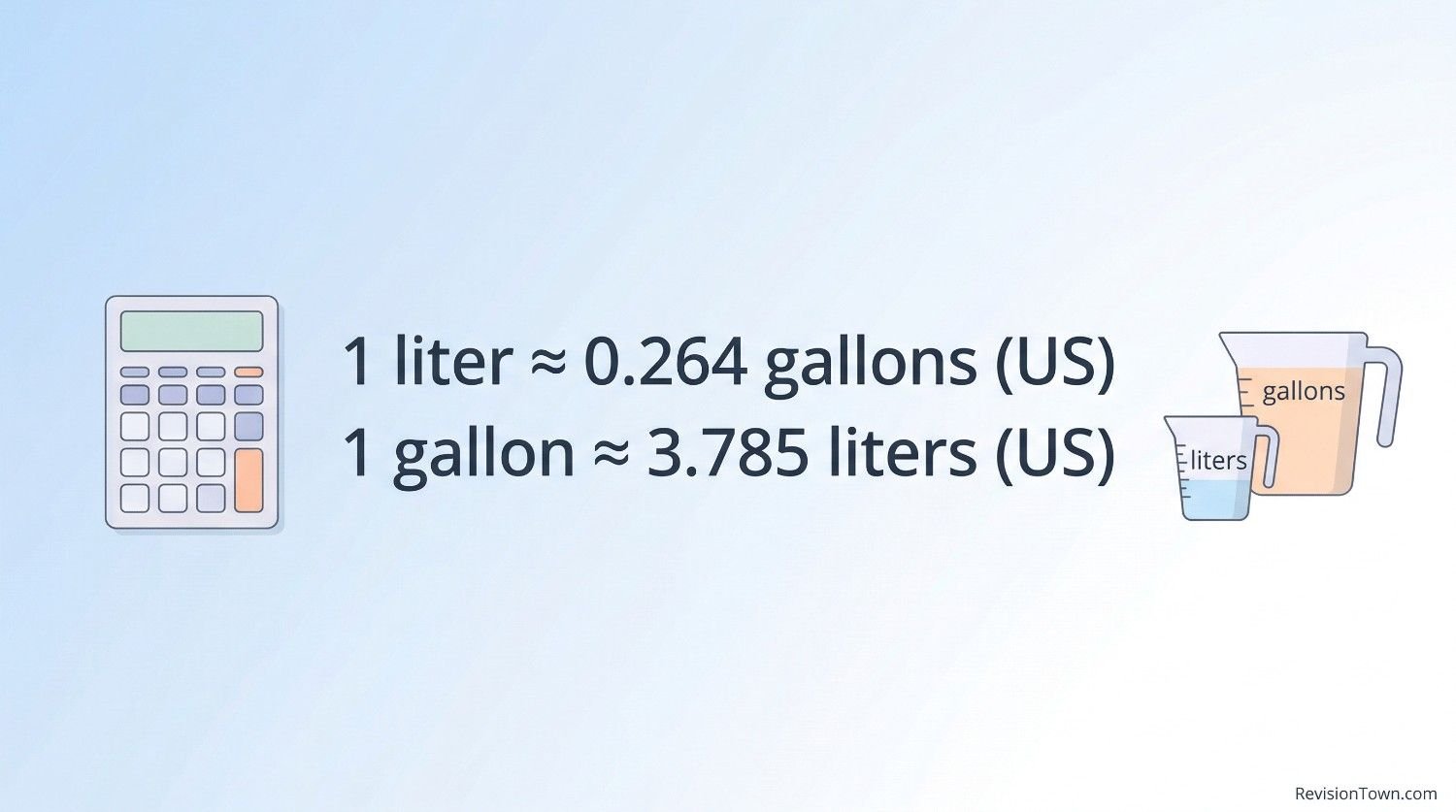
For quick mental estimates, you can remember that \(1\) liter is about \(0.264\) US gallons, so \(4\) liters is a little more than \(1\) US gallon. For imperial gallons, \(1\) liter is about \(0.220\) imperial gallons, so \(4.5\) liters is close to \(1\) imperial gallon. These estimates are useful for checking whether a result is reasonable, but exact work should use the full factor or the calculator.
Quick answer: liters to US gallons
If the gallon type is not specified and the context is US-based, use US liquid gallons. The fast conversion rule is:
So if you want to convert \(x\) liters to US gallons, calculate:
For example, \(10\) liters is:
Rounded to four decimal places, \(10\) liters is \(2.6417\) US gallons. Rounded to two decimal places, it is \(2.64\) US gallons. For everyday use, two decimal places is often enough. For technical, scientific or inventory work, keep more digits until the final reporting step.
Practical shortcut: To estimate liters to US gallons in your head, divide liters by \(3.8\). This gives a close approximation because \(1\) US gallon is about \(3.785\) liters. For exact conversion, use the factor \(0.2641720524\).
US gallon versus imperial gallon
The word gallon is not universal. A US liquid gallon and an imperial gallon are both volume units, but the imperial gallon is larger. This means the same liter amount converts to fewer imperial gallons than US gallons. For example, \(20\) liters is about \(5.2834\) US gallons, but only about \(4.3994\) imperial gallons. If you are reading a fuel economy figure, product label, recipe, tank capacity, or shipping specification, the gallon system matters.
| Unit | Liters per gallon | Gallons per liter | Common context |
|---|---|---|---|
| US liquid gallon | \(1\text{ US gal}=3.785411784\text{ L}\) | \(1\text{ L}=0.2641720524\text{ US gal}\) | US fuel, aquariums, household containers, many product labels |
| Imperial gallon | \(1\text{ imp gal}=4.54609\text{ L}\) | \(1\text{ L}=0.2199692483\text{ imp gal}\) | UK historical volume, some Commonwealth references, older fuel figures |
When a problem or document says only "gallons", look for clues. If the source is a US website, a US fuel label, or a US-made container, US liquid gallons are usually intended. If the source is UK-based or uses terms such as imperial mpg, imperial gallons may be intended. If the measurement has financial, safety, engineering or laboratory consequences, do not guess. Confirm the unit system before converting.
Liters to gallons conversion table
The table below gives common liter values converted to both US liquid gallons and imperial gallons. Values are rounded to four decimal places for readability. If you need more precision, use the calculator above and keep extra digits until your final answer.
| Liters | US liquid gallons | Imperial gallons |
|---|---|---|
| 0.5 L | 0.1321 US gal | 0.1100 imp gal |
| 1 L | 0.2642 US gal | 0.2200 imp gal |
| 2 L | 0.5283 US gal | 0.4399 imp gal |
| 3 L | 0.7925 US gal | 0.6599 imp gal |
| 4 L | 1.0567 US gal | 0.8799 imp gal |
| 5 L | 1.3209 US gal | 1.0998 imp gal |
| 10 L | 2.6417 US gal | 2.1997 imp gal |
| 15 L | 3.9626 US gal | 3.2995 imp gal |
| 20 L | 5.2834 US gal | 4.3994 imp gal |
| 25 L | 6.6043 US gal | 5.4992 imp gal |
| 50 L | 13.2086 US gal | 10.9985 imp gal |
| 100 L | 26.4172 US gal | 21.9969 imp gal |
If you are working with kitchen or small-container measurements, you may also need cups, teaspoons, milliliters or quarts. RevisionTown has separate pages for milliliters to cups, cups to milliliters, teaspoons to milliliters, milliliters to teaspoons, and liters to quarts. Use those specific converters when the final unit is not gallons.
Worked examples
Example 1: Convert 2 liters to US gallons
Use the US gallon factor:
So \(2\) liters is approximately \(0.5283\) US gallons. This is a little more than half a US gallon.
Example 2: Convert 5 liters to US gallons
So \(5\) liters is approximately \(1.3209\) US gallons. A 5-liter container is therefore larger than 1 US gallon.
Example 3: Convert 20 liters to imperial gallons
For imperial gallons, use the imperial factor:
So \(20\) liters is approximately \(4.3994\) imperial gallons. The same \(20\) liters would be \(5.2834\) US gallons, which shows why the gallon type matters.
Example 4: Convert 60 liters of fuel to US gallons
A 60-liter fuel tank holds about \(15.85\) US gallons. If you are using this value in a miles-per-gallon calculation, keep the units consistent. The gas mileage calculator is useful when you need a full fuel economy calculation after converting the fuel volume.
Why liters and gallons are easy to mix up
Liters belong to the metric system. Gallons belong to customary or imperial measurement systems. A liter is used widely in science, medicine, cooking, packaging, transport and everyday international measurement. A gallon is used in several countries for fuel, milk, water, paint, chemicals and other liquid quantities. Because the units come from different systems, the conversion factor is not a neat whole number.
The biggest confusion is not the arithmetic itself. It is choosing the correct gallon. The US liquid gallon is about \(3.785\) liters. The imperial gallon is about \(4.546\) liters. If you accidentally use an imperial factor for a US volume, your result will be noticeably different. For small household values, the difference may only be inconvenient. For fuel, tanks, chemicals, irrigation or inventory, the difference can matter.
Another common source of confusion is rounding too early. If you convert \(1\) liter as \(0.26\) gallons and then multiply that rounded factor by a large volume, the error grows. For quick estimates, \(0.26\) may be acceptable. For a 500-liter tank, the better factor \(0.2641720524\) gives \(132.086\) US gallons, while \(0.26\) gives \(130\) gallons. That difference is more than 2 gallons. Use the full factor when accuracy matters.
Rounding liters to gallons
Rounding depends on purpose. For a recipe, one or two decimal places may be enough because measuring tools are rarely more precise than that. For a fuel tank, two decimal places may be fine for a dashboard estimate, but inventory reporting may need three or more. For a lab, industrial process, or purchasing document, follow the precision required by the procedure or specification.
A useful rule is to keep extra digits during the calculation and round only at the end. The exact calculation for \(10\) liters to US gallons is \(2.641720524\) US gallons. If you round to four decimals, you get \(2.6417\). If you round to two decimals, you get \(2.64\). If you round to one decimal, you get \(2.6\). Each answer is correct for a different precision level, but the final use determines which is appropriate.
When reporting conversions, include the unit name. Writing \(2.64\) alone is incomplete. Write \(2.64\) US gallons, \(2.64\) gal (US), or \(2.64\) imperial gallons as appropriate. Clear unit labels prevent mistakes when data moves between worksheets, labels, orders, recipes or technical notes.
Do not round the conversion factor too aggressively for large quantities. For small cooking values, \(1\text{ L}\approx0.264\text{ US gal}\) is usually fine. For large tanks, deliveries or inventories, use \(0.2641720524\) for US gallons or \(0.2199692483\) for imperial gallons.
Liters to gallons in cooking and recipes
Recipes usually work better with milliliters, cups, tablespoons or teaspoons than gallons. Gallons are large for most kitchen quantities. Still, liters to gallons can be useful for bulk cooking, beverage preparation, brewing, catering, soup batches, stock pots or food-service containers. If a recipe or container capacity is listed in liters and your equipment is labeled in gallons, convert the volume before scaling ingredients.
For cooking, the exact gallon system depends on the source. US recipes usually use US cups, US fluid ounces and US gallons. Older UK or Commonwealth sources may use imperial measures. If you are converting a recipe from metric to US kitchen units, it is often more useful to convert liters to cups rather than gallons. RevisionTown's cooking measurement converter, cooking ingredient converter, and cooking calculators can support those related conversions.
For example, a 4-liter soup batch is about \(1.0567\) US gallons. That tells you the batch is slightly more than one gallon, which may help when choosing a storage container. But if you are dividing the soup into servings, cups or milliliters are often more convenient. The best unit is the one that matches the tool you will actually use.
Liters to gallons for fuel and vehicles
Fuel is one of the most common reasons to convert liters to gallons. Many countries sell fuel in liters, while US fuel economy is often discussed in miles per gallon. If you buy \(45\) liters of fuel and want to know the US-gallon equivalent, multiply by \(0.2641720524\):
So \(45\) liters is about \(11.89\) US gallons. This value can be used with miles driven to estimate miles per gallon:
Make sure the fuel economy unit is consistent. US miles per gallon and imperial miles per gallon are different because the gallon sizes are different. A car can appear to get a higher mpg number when imperial gallons are used because an imperial gallon contains more liters. If you compare fuel economy values internationally, check whether the source uses US mpg, imperial mpg or liters per 100 kilometers.
Liters to gallons for aquariums, tanks and containers
Aquarium and tank capacities are often listed in liters internationally and gallons in US contexts. Converting liters to gallons helps compare equipment, filters, pumps, water treatments and storage containers. For example, a 100-liter aquarium is about \(26.42\) US gallons or \(22.00\) imperial gallons. If a filter is rated for a 30-gallon tank, check whether the manufacturer means US gallons and whether the aquarium's actual water volume differs from its nominal tank volume.
For tanks and containers, capacity may not equal usable volume. A container might be labeled as 20 liters, but safe fill level may be lower. A tank might have shape irregularities, displacement from equipment, or a recommended air gap. The conversion gives the unit equivalent, not a guarantee of safe operating volume. For geometry-based tank problems, a volume calculator or the volume formulas page can help calculate the original liter value before converting it to gallons.
When water treatment instructions use gallons, be careful with dose scaling. If a treatment says one cap per 10 US gallons, and your tank is 40 liters, first convert \(40\) liters to US gallons: \(40\times0.2641720524=10.5669\) US gallons. The dose is therefore slightly more than the 10-gallon amount, not exactly one cap unless the product instructions allow approximate dosing.
Liters, milliliters, quarts and other volume units
Liters and gallons are not the only volume units you may need. In metric measurement, \(1\) liter equals \(1000\) milliliters. If a value is given in milliliters, convert it to liters before using the liters-to-gallons formula, or use a direct milliliter converter. RevisionTown has dedicated guides for liter to milliliter and milliliter to liter conversions.
In US customary measurement, gallons connect to quarts, pints, cups and fluid ounces. One US gallon equals 4 US quarts. Therefore, converting liters to quarts can sometimes be more useful than converting to gallons. A liter is about \(1.05669\) US quarts, which is why a 1-liter bottle is a little larger than 1 US quart. If your final target is quarts, use the liters to quarts page instead of rounding through gallons.
For broad unit work, use a dedicated advanced volume converter or volume converter. For general categories beyond volume, RevisionTown's unit converters, conversion resources, and converters hub help route you to the right tool.
Dimensional analysis method
Dimensional analysis is a reliable way to set up unit conversions. The idea is to multiply by a fraction equal to \(1\), arranged so the unwanted unit cancels. To convert liters to US gallons, use the relationship \(1\text{ US gal}=3.785411784\text{ L}\). Place liters in the denominator so liters cancel:
This is equivalent to multiplying by \(0.2641720524\), but the unit-canceling setup makes the direction clear. If you accidentally write \(\frac{3.785411784\text{ L}}{1\text{ US gal}}\), liters will not cancel correctly when starting from liters. The units themselves tell you whether the setup is right.
For imperial gallons, use \(1\text{ imp gal}=4.54609\text{ L}\):
Dimensional analysis is especially helpful when conversions have several steps. For example, milliliters to gallons can be set up as milliliters to liters, then liters to gallons. The units cancel in sequence, reducing the chance of choosing the wrong operation.
Common mistakes when converting liters to gallons
The first common mistake is using the wrong gallon system. A US gallon and an imperial gallon are different. If your result will be used in the United States, use US liquid gallons unless the source clearly says otherwise. If your source is UK-based or uses imperial mpg, check whether imperial gallons are expected.
The second mistake is dividing by \(0.2641720524\) instead of multiplying by it. Starting from liters and converting to US gallons, multiply liters by \(0.2641720524\). Dividing by that factor would convert in the wrong direction and produce a result that is much too large.
The third mistake is rounding too soon. Keep the conversion factor and intermediate values precise until the final result. This matters for large quantities such as tanks, delivery volumes, fuel records, chemical mixes or inventory calculations.
The fourth mistake is leaving off the unit label. A value such as \(5.28\) should be labeled as \(5.28\) US gallons or \(5.28\) imperial gallons. Without the label, another person may assume the wrong system.
The fifth mistake is converting a container's stated capacity without considering usable volume. If a tank has a safety margin or a container cannot be filled to the top, the converted full capacity may not match the safe working volume.
Choosing the right precision
Precision should match the job. For a rough estimate, \(1\text{ L}\approx0.26\text{ US gal}\) may be enough. For a classroom answer, \(0.2642\) is often a good rounded factor. For technical use, use \(0.2641720524\). For very large volumes, keep enough digits to avoid a significant accumulated rounding error.
The number of significant figures in the input also matters. If a bottle is labeled \(2\) liters, the label may not imply more than one or two significant figures. If a lab measurement is \(2.000\) liters, the trailing zeros communicate higher precision. A converted answer should not claim more meaningful precision than the original measurement supports.
For example, converting \(2\) liters to \(0.5283441048\) US gallons is mathematically correct, but writing \(0.53\) US gallons may be more appropriate for a consumer label or kitchen estimate. In contrast, a technical worksheet may keep \(0.5283\) or more decimal places. Use the calculator output as a precise base, then round according to the context.
Practical conversion scenarios
Fuel
Convert liters filled into US gallons before calculating miles per gallon. Keep the gallon system consistent with the mpg standard you are using.
Recipes
Use gallons for large batches, but convert to cups or milliliters when the measuring tools are smaller and more practical.
Aquariums
Convert tank capacity from liters to gallons when comparing US-rated filters, pumps, heaters or treatment instructions.
Storage
Convert container volume to choose drums, jugs, buckets or tanks, but remember that safe fill volume may be less than maximum capacity.
These scenarios show why conversion is more than arithmetic. The correct factor is essential, but so is the context. A kitchen conversion may tolerate rounding. A fuel-economy comparison must use the right gallon system. A tank calculation may require a margin. A chemical or lab measurement may require stricter precision and unit labeling.
Where the liters to gallons constants come from
The conversion constants are based on the definitions of the units. A liter is a metric unit of volume equal to \(1000\) cubic centimeters. A US liquid gallon is defined as \(231\) cubic inches. Because the inch is exactly \(2.54\) centimeters, the US liquid gallon can be expressed exactly in liters. That relationship produces the familiar value \(1\text{ US gal}=3.785411784\text{ L}\). Dividing \(1\) by that number gives the gallons-per-liter factor \(0.2641720524\).
The imperial gallon is defined differently. It equals \(4.54609\) liters, so its reciprocal is \(0.2199692483\) imperial gallons per liter. Since the imperial gallon is larger, a fixed liter amount becomes a smaller number of imperial gallons than US gallons. This is why the same 100-liter volume is \(26.4172\) US gallons but \(21.9969\) imperial gallons.
You do not need to memorize the historical background to use the converter, but it helps explain why the conversion is not a clean decimal such as \(0.25\) or \(0.2\). The units were defined in different measurement systems, so their relationship is exact but not simple. When accuracy matters, use the full constant instead of a rounded classroom shortcut.
US liquid gallons, US dry gallons and why the distinction matters
This page converts liters to US liquid gallons and imperial gallons. The US liquid gallon is the gallon used for most liquid-volume contexts in the United States: fuel, milk, water, liquid chemicals, aquariums, paint and many household containers. There is also a US dry gallon, used historically for some dry-volume measurements, but it is not the standard gallon meant by most modern liquid conversions. If a problem says liters to gallons and discusses liquids, the US liquid gallon is normally the relevant US unit.
The word "gallon" by itself can therefore hide several possibilities. A liter-to-gallon conversion for gasoline should not use a dry gallon. A recipe written in a US context should not use an imperial gallon unless the source specifically says so. A historical document, agricultural reference or older measurement table may require extra care. The safest approach is to write the unit explicitly as US liquid gallons, imperial gallons or another specific gallon type.
This page avoids the dry-gallon issue by focusing on the two gallon systems most users encounter in everyday volume conversions. If you are working with specialized dry-volume data, confirm the exact unit before using a liquid-volume conversion. Unit names that look familiar can still represent different quantities when they come from different measurement traditions.
Converting decimal liters and fractional liters
Decimal liter values convert the same way as whole liters. Multiply by the correct factor. For example, \(0.75\) liters to US gallons is:
So \(0.75\) liters is about \(0.1981\) US gallons. This is less than one quarter of a US gallon, which makes sense because \(1\) US gallon is about \(3.785\) liters.
Fractional liters can be converted by first writing the fraction as a decimal or by multiplying the fraction directly. For example, \(\frac{3}{2}\) liters is \(1.5\) liters. To convert to US gallons:
So \(1.5\) liters is about \(0.3963\) US gallons. If you are working on a math worksheet, leave the setup visible so the conversion factor and units are clear. If you are working in a practical setting, the decimal result is usually easier to read.
Very small liter values can also be converted directly, but milliliters may be more intuitive. For instance, \(0.1\) liters is \(100\) milliliters. In US gallons it is:
That number is correct, but for kitchen or medicine-style quantities, milliliters, teaspoons or cups may communicate the amount better than gallons.
How to convert liters to gallons in a spreadsheet
Spreadsheet formulas are useful when you have many values to convert. If column A contains liter values and you want US gallons in column B, enter this formula in cell B2:
For imperial gallons, use:
Then fill the formula down the column. Add a header such as "US gallons" or "imperial gallons" so the result is not ambiguous. If you are sharing the spreadsheet, include a note with the factor used. This is especially helpful when gallon values are used for fuel, inventory, shipping, tank capacity or purchasing.
For rounded outputs, use spreadsheet rounding functions after the multiplication. For example, to round a US gallon result to two decimals:
Use rounding for display, but consider keeping an unrounded column for calculation. If you calculate costs, rates or totals from a rounded gallon value, small errors can accumulate. A clean spreadsheet often has one hidden or working column with full precision and one visible column rounded for readers.
Common container sizes in liters and gallons
Many containers are sold in metric sizes but compared with gallon-based products. The following examples give useful reference points. A \(1\)-liter bottle is about \(0.2642\) US gallons. A \(2\)-liter bottle is about \(0.5283\) US gallons. A \(5\)-liter container is about \(1.3209\) US gallons. A \(10\)-liter container is about \(2.6417\) US gallons. A \(20\)-liter jerry can is about \(5.2834\) US gallons.
These comparisons help with quick decisions. If you need a container that holds at least 1 US gallon, a 4-liter container is enough because it holds about \(1.0567\) US gallons. If you need at least 5 US gallons, a 20-liter container is enough because it holds about \(5.2834\) US gallons. If you need exactly 5 US gallons, the equivalent in liters is about \(18.9271\) liters, so a 20-liter container gives extra headroom.
For aquariums and tanks, marketed capacity may be rounded. A tank sold as \(75\) liters is about \(19.8129\) US gallons, often described informally as around 20 gallons. This kind of rounding is acceptable for general comparison, but dosing, flow rates and equipment ratings may need a more careful usable-volume estimate.
Price comparison: cost per liter and cost per gallon
Converting liters to gallons can help compare prices when one product is priced per liter and another is priced per gallon. To compare fairly, convert the unit price to the same unit. If a liquid costs \(\$1.20\) per liter, the approximate price per US gallon is:
So the cost is about \(\$4.54\) per US gallon. Notice that price-per-liter to price-per-gallon uses liters per gallon, not gallons per liter. This is a different direction from volume conversion. When converting a price rate, think about what one gallon contains. One US gallon contains \(3.785411784\) liters, so the gallon price is the liter price multiplied by \(3.785411784\).
If a product costs \(\$4.00\) per US gallon and you want the price per liter, divide by \(3.785411784\):
That is about \(\$1.06\) per liter. Rate conversions can be more confusing than plain volume conversions because the unit appears in the denominator. Write the units carefully and check whether you are converting an amount of liquid or a price per unit.
Fuel economy: liters, gallons and distance units
Fuel economy adds another layer because it combines volume and distance. In the United States, fuel economy is often expressed as miles per US gallon. In many other countries, it is expressed as liters per 100 kilometers. To compare values, you must convert both the volume unit and the distance unit or use a dedicated fuel economy conversion formula.
If you have liters of fuel used and miles driven, first convert liters to US gallons, then divide miles by gallons. Suppose a car drives \(350\) miles and uses \(42\) liters of fuel. Convert the fuel:
Then calculate miles per gallon:
So the fuel economy is about \(31.5\) miles per US gallon. If imperial gallons were used instead, the mpg value would be higher because each imperial gallon contains more fuel. That is why fuel economy comparisons must specify US mpg or imperial mpg.
Tank filling and partial volume examples
Liters-to-gallons conversion is often needed for partial fills. Suppose a storage tank currently contains \(30\) liters and has a maximum safe fill of \(75\) liters. The current volume in US gallons is:
The safe-fill volume is:
The remaining safe fill is \(75-30=45\) liters, which is \(11.88774236\) US gallons. This is more useful than only converting the total capacity because it tells you how much additional liquid can be added under the safe-fill rule.
For irregular tanks, you may need to calculate volume from dimensions first. Once the volume is known in liters, convert to gallons. If dimensions are in centimeters, calculate cubic centimeters, divide by \(1000\) to get liters, then multiply by the gallons-per-liter factor. For example, \(50000\text{ cm}^3\) is \(50\) liters, and \(50\) liters is \(13.2086\) US gallons.
Estimating liters to gallons without a calculator
For quick US estimates, divide liters by \(4\) to get a low estimate in gallons, because \(1\) US gallon is a little less than \(4\) liters. Since \(4\) liters is \(1.0567\) US gallons, the divide-by-4 method slightly underestimates the gallon value. A more accurate mental estimate is to divide by \(3.8\), but dividing by \(4\) is easier and often useful for a quick check.
For example, \(20\) liters divided by \(4\) gives \(5\) gallons. The accurate US value is \(5.2834\) gallons. The estimate is close enough to show that a 20-liter container is slightly more than 5 US gallons. For \(100\) liters, dividing by \(4\) gives \(25\) gallons, while the accurate value is \(26.4172\) US gallons. The difference is larger, so use the calculator for final work.
For imperial gallons, divide liters by about \(4.5\). Since \(1\) imperial gallon is \(4.54609\) liters, this gives a good mental estimate. A \(20\)-liter container is about \(4.4\) imperial gallons. A \(100\)-liter tank is about \(22\) imperial gallons. Again, use the exact factor for final values.
Classroom word problems
Liters-to-gallons problems often appear as unit conversion, proportional reasoning or dimensional analysis exercises. A typical problem might say: "A container holds \(18\) liters of water. How many US gallons is this?" The setup is:
The answer is about \(4.7551\) US gallons. A complete classroom answer should include the unit and a sensible rounded value, such as \(4.76\) US gallons.
Another problem might reverse the logic inside a comparison: "A 5-gallon US container and a 20-liter container are available. Which holds more?" Convert \(5\) US gallons to liters or \(20\) liters to US gallons. Since \(5\) US gallons is about \(18.9271\) liters, the \(20\)-liter container holds more. If using liters to gallons, \(20\) liters is \(5.2834\) US gallons, which is more than \(5\) US gallons.
A third problem might include two steps: "A tank is filled with \(2500\) milliliters of liquid. How many US gallons is that?" First convert milliliters to liters:
Then convert liters to US gallons:
So \(2500\) milliliters is about \(0.6604\) US gallons. Showing both steps makes the unit movement clear.
When gallons are not the best final unit
Sometimes gallons are technically correct but not practical. A small medicine dose of \(0.005\) liters converts to \(0.00132086\) US gallons, but nobody wants to measure that in gallons. Since \(0.005\) liters is \(5\) milliliters, milliliters are the better final unit. Similarly, a recipe ingredient of \(0.25\) liters is \(250\) milliliters or a little more than 1 US cup, which is more useful in a kitchen than \(0.0660\) gallons.
Choose gallons when the amount is large enough for gallons to communicate the size well: fuel tanks, buckets, drums, aquariums, water storage, paint, cleaning liquid or bulk recipes. Choose milliliters, cups, tablespoons or teaspoons for smaller kitchen and household quantities. Choose cubic meters or liters for many scientific and engineering quantities. Good measurement work is not just about converting; it is about selecting a unit that readers can understand and use.
Practice problems
Practice 1: Convert 8 liters to US gallons
\(8\times0.2641720524=2.113376419\). So \(8\) liters is about \(2.1134\) US gallons.
Practice 2: Convert 8 liters to imperial gallons
\(8\times0.2199692483=1.759753986\). So \(8\) liters is about \(1.7598\) imperial gallons.
Practice 3: Convert 3.5 liters to US gallons
\(3.5\times0.2641720524=0.9246021833\). So \(3.5\) liters is about \(0.9246\) US gallons.
Practice 4: A tank has 120 liters. How many US gallons is that?
\(120\times0.2641720524=31.70064628\). The tank holds about \(31.70\) US gallons.
Practice 5: Which is larger, 10 US gallons or 35 liters?
\(10\) US gallons is \(37.85411784\) liters. Since \(37.8541\) liters is greater than \(35\) liters, 10 US gallons is larger.
Troubleshooting your conversion result
If your answer looks unreasonable, start with a size check. Since \(1\) US gallon is about \(3.785\) liters, the gallon number should be smaller than the liter number for any positive value greater than \(1\). If you convert \(10\) liters and get \(37.85\) gallons, the operation went the wrong direction. \(37.85\) liters is close to \(10\) US gallons, not the other way around. A correct \(10\)-liter conversion gives \(2.6417\) US gallons.
Next, check whether the result is a US gallon or an imperial gallon result. If two sources disagree by about \(20\%\), there is a good chance they are using different gallon systems. For example, \(100\) liters is \(26.4172\) US gallons but \(21.9969\) imperial gallons. Both answers can be correct if the unit labels are different. The mistake is not the arithmetic; the mistake is comparing values without checking which gallon is being used.
Then check rounding. A result shown as \(2.64\) US gallons and a result shown as \(2.6417\) US gallons are not meaningfully different for most everyday uses. They are the same conversion rounded to different precision levels. A result shown as \(2.20\) gallons for \(10\) liters is likely an imperial-gallon result. A result shown as \(2.5\) gallons may be a rough estimate. Before deciding an answer is wrong, compare the factor and rounding policy.
Finally, check the original unit. Sometimes a value is given in milliliters, cubic centimeters, cubic meters or fluid ounces rather than liters. If the input is \(2500\) milliliters, the liter value is \(2.5\), not \(2500\). If the input is \(0.25\) cubic meters, the liter value is \(250\), because \(1\text{ m}^3=1000\text{ L}\). Unit conversions are reliable only when the starting unit is identified correctly.
Large-volume planning table
Large-volume conversions appear in water storage, fuel delivery, irrigation, aquariums, pools, chemical containers and industrial supplies. In those settings, the difference between US and imperial gallons is large enough to affect orders and capacity planning. The following reference values are rounded to two decimal places because large-volume planning usually begins with approximate container sizes, then moves to exact specifications when purchasing or filling.
| Liters | US liquid gallons | Imperial gallons | Typical use |
|---|---|---|---|
| 150 L | 39.63 US gal | 33.00 imp gal | Medium aquarium, water barrel, cleaning supply |
| 200 L | 52.83 US gal | 43.99 imp gal | Drum, water storage, fuel transfer |
| 500 L | 132.09 US gal | 109.98 imp gal | Small tank, irrigation, bulk liquid |
| 1000 L | 264.17 US gal | 219.97 imp gal | IBC tote, water tank, industrial container |
| 5000 L | 1320.86 US gal | 1099.85 imp gal | Large storage tank or process volume |
For large containers, it is often better to keep liters as the primary measurement if the manufacturer specifies liters. Convert to gallons for comparison, but do not erase the original unit. If a 1000-liter tote is described as about 264 US gallons, that rounded gallon value should not replace the exact liter specification in a technical record. Keep both values visible when ordering, labeling or documenting capacity.
Writing a clear conversion answer
A clear conversion answer includes the starting value, the factor, the calculation and the final unit. For example: "\(18\) liters \(\times0.2641720524=4.7551\) US gallons, so \(18\) liters is about \(4.76\) US gallons." This format is short, but it includes everything another reader needs to verify the result. It is better than simply writing "\(4.76\)" because the unit system is visible.
For imperial gallons, name the unit explicitly: "\(18\) liters \(\times0.2199692483=3.9594\) imperial gallons." Do not write only "gallons" when the context could be mixed. A reader in one country may assume US gallons while another may assume imperial gallons. The extra word prevents a measurement error.
If you are solving a word problem, add a reasonableness sentence. For \(18\) liters, a US-gallon answer near \(5\) is reasonable because \(20\) liters is a little more than \(5\) US gallons. For \(18\) liters, an answer near \(68\) gallons is not reasonable because gallons are larger than liters. This quick check catches wrong-direction calculations before they become final answers.
Liters to gallons answer templates
Use this template for US gallons: "To convert liters to US gallons, multiply by \(0.2641720524\). Therefore, \(V\) liters equals \(V\times0.2641720524\) US gallons." Replace \(V\) with the liter value and round the result as needed.
Use this template for imperial gallons: "To convert liters to imperial gallons, multiply by \(0.2199692483\). Therefore, \(V\) liters equals \(V\times0.2199692483\) imperial gallons." This template is especially useful in worksheets, technical notes and conversion explanations because it shows the selected gallon system.
Use this template for multi-step problems: "First convert the starting unit to liters. Then multiply liters by the appropriate gallons-per-liter factor. Finally, label the answer as US gallons or imperial gallons." This keeps milliliters, cubic centimeters and other units from being treated as liters by mistake.
Frequently asked questions
How many US gallons are in 1 liter?
There are \(0.2641720524\) US liquid gallons in \(1\) liter. Rounded to four decimal places, \(1\) liter is \(0.2642\) US gallons.
How many imperial gallons are in 1 liter?
There are \(0.2199692483\) imperial gallons in \(1\) liter. Rounded to four decimal places, \(1\) liter is \(0.2200\) imperial gallons.
Is 4 liters equal to 1 gallon?
Four liters is close to one US gallon but not exactly equal. \(4\) liters equals about \(1.0567\) US gallons and about \(0.8799\) imperial gallons.
How do I convert liters to gallons quickly?
For US gallons, multiply liters by \(0.2641720524\). For a quick estimate, divide liters by \(3.8\). For imperial gallons, multiply liters by \(0.2199692483\).
Why are US and imperial gallon results different?
The imperial gallon is larger than the US liquid gallon. A US gallon is \(3.785411784\) liters, while an imperial gallon is \(4.54609\) liters. The same liter amount therefore converts to fewer imperial gallons.
Should I use US gallons or imperial gallons?
Use US liquid gallons for US fuel, US containers and US customary measurements. Use imperial gallons only when the source or context clearly calls for the imperial system.
Can I convert milliliters to gallons with this formula?
Yes, but first convert milliliters to liters by dividing by \(1000\). Then multiply by the appropriate gallons-per-liter factor.
What is 10 liters in gallons?
\(10\) liters equals \(2.6417\) US gallons or \(2.1997\) imperial gallons, rounded to four decimal places.
Final conversion checklist
- Decide whether the target is US liquid gallons or imperial gallons.
- Use \(0.2641720524\) for liters to US gallons.
- Use \(0.2199692483\) for liters to imperial gallons.
- Keep extra digits during calculation and round only at the final step.
- Label the result clearly as US gallons or imperial gallons.
- Use a specialized converter if the final unit is cups, quarts, teaspoons or milliliters.
Converting liters to gallons is straightforward once the gallon system is clear. Multiply by the correct factor, keep the units visible, and round the final answer according to the job. For everyday US use, the most common formula is \(\text{US gallons}=\text{liters}\times0.2641720524\). For imperial contexts, use \(\text{imperial gallons}=\text{liters}\times0.2199692483\). With those two formulas and careful labeling, you can convert fuel, recipe, tank, container and volume measurements confidently.