
Regular hexagon area, footage and material estimating
Hexagon Footage Cost Calculator
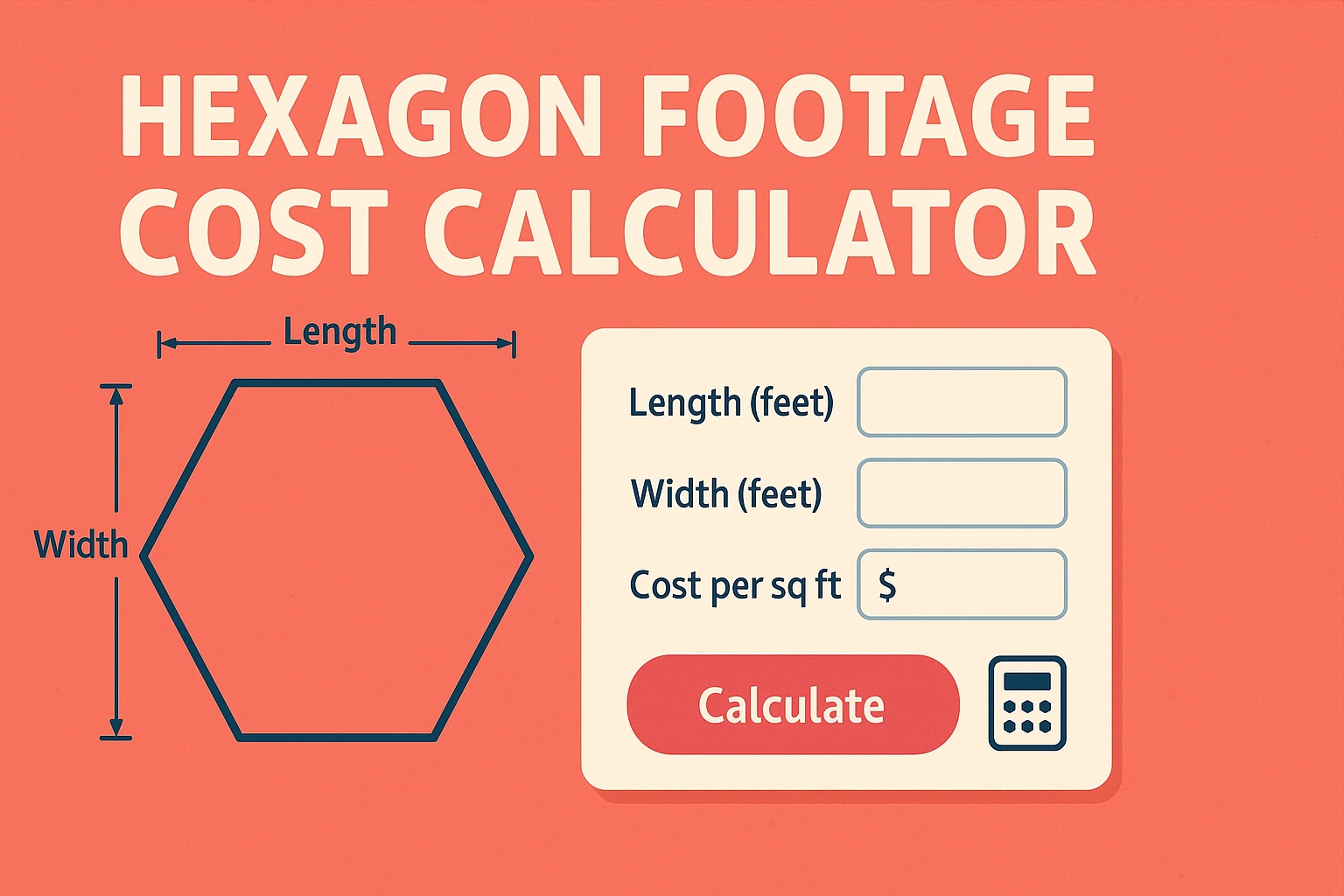
Use this hexagon footage cost calculator to estimate the area, perimeter, order quantity and material cost of a regular six-sided shape. It is designed for hexagonal tiles, paver patios, honeycomb-style flooring, garden beds, wall panels, table tops, signs, mats, turf sections, decorative platforms and classroom geometry problems where a regular hexagon is priced by square foot, square yard or square metre. Enter the measurement you know, choose the unit, add quantity and price, then include a waste allowance for cuts, trimming, pattern matching and package rounding.
Calculate regular hexagon area and cost
Choose the hexagon measurement you have, enter its value and unit, then set the material price. The calculator converts the measurement, derives the side length, calculates area and perimeter, applies quantity and estimates cost before and after overage.
What the Hexagon Footage Cost Calculator Does
A hexagon is a six-sided polygon. This calculator is built for a regular hexagon, meaning all six sides have the same length and all six interior angles are equal. That distinction matters because a regular hexagon has a predictable area formula, while an irregular six-sided shape does not. When your project is a true regular hexagon, one known measurement can define the whole shape, allowing the calculator to estimate area, perimeter, order area and material cost.
Regular hexagons are practical because they tile efficiently. Unlike many decorative polygons, regular hexagons can fit together without gaps, which is why they appear in honeycomb patterns, floor tile, paving, mosaics, modular mats, acoustic panels, wall features, garden layouts and game boards. A hexagon can also look more organic than a square while still using straight edges. For material estimating, this shape is valuable because it can cover a surface with repeated units and relatively predictable edge geometry.
The calculator is intended for real project planning, not only geometry homework. A mathematical hexagon area tells you the finished surface size, but the purchase quantity may be larger. Hexagonal tile may be sold in boxes. Pavers may break during cutting. Sheet goods may need a rectangular blank. Carpet, rubber, turf or fabric may be affected by roll width and direction. The waste field lets you add a practical allowance for trimming, offcuts, pattern matching, spare pieces and supplier packaging.
If your layout is not a regular hexagon, use a more suitable method rather than forcing the regular formula. For rectangular sections, use the rectangle footage cost calculator or square footage cost calculator. For triangular inserts, use the triangle footage cost calculator. For circular features, use the circle footage cost calculator. This page stays focused on regular hexagonal material estimates so the tool answers a specific estimating need.
Regular Hexagon Area and Cost Formulas
A regular hexagon has six equal sides and can be divided into six congruent equilateral triangles. That is why the side-length formula is compact. Let \(a\) be the side length, \(P\) the perimeter, \(r\) the apothem or inradius, \(R\) the circumradius and \(A\) the area. In a regular hexagon, the circumradius equals the side length, which makes this polygon especially convenient compared with many other regular shapes.
Perimeter from side length
\[P=6a\]
A regular hexagon has six equal sides, so the perimeter is six times the side length. Perimeter is useful for edge strips, border pavers, trim, tape, frames and formwork.
Area from side length
\[A=\frac{3\sqrt{3}}{2}a^2\]
Since \(\frac{3\sqrt{3}}{2}\approx2.598076211\), the area is approximately \(2.598076211a^2\) when the side length is \(a\).
Area from perimeter and apothem
\[A=\frac{1}{2}Pr\]
This regular polygon formula works because the hexagon can be divided into triangles whose combined bases equal the perimeter and whose height is the apothem.
Apothem from side length
\[r=\frac{\sqrt{3}}{2}a\]
The apothem is the perpendicular distance from the centre to the midpoint of a side. It is also half the flat-to-flat width.
Area from apothem
\[A=2\sqrt{3}r^2\]
This is useful when the plan gives the distance from the centre to a side rather than the side length.
Area from circumradius
\[A=\frac{3\sqrt{3}}{2}R^2\]
For a regular hexagon, \(R=a\), so the circumradius formula matches the side-length formula.
Base material cost
\[\text{base cost}=\text{total measured area}\times\text{price per area unit}\]
The calculator converts square feet, square yards, square metres and other supported units so the price is applied to the correct area unit.
Order area with waste
\[\text{order area}=A_{\text{total}}\times\left(1+\frac{w}{100}\right)\]
The value \(w\) is the waste or overage percentage. A 10% allowance means multiplying measured area by 1.10 before package rounding.
Final estimated cost
\[\text{final cost}=\left(\text{base cost}\times\left(1+\frac{w}{100}\right)\right)+f\]
The fixed amount \(f\) can represent delivery, adhesive, edging, disposal, tool rental or another cost added after the area-based material estimate.
These formulas assume a regular hexagon. If the six sides or angles are not equal, the simple side-length formula will not describe the true area. For irregular shapes, split the layout into triangles, rectangles or other measurable sections. The area calculator can help with common shapes, and the geometry formulas reference is useful when comparing hexagons, circles, triangles and rectangles.
How to Measure a Regular Hexagon Correctly
The simplest measurement is side length. Measure one edge from vertex to vertex, then check that the other sides match. If all six sides are equal and the shape is symmetrical, the side length defines the regular hexagon. If the sides differ, do not use the regular hexagon formula for a final material order. The result may be acceptable for a rough sketch, but it will not be a reliable area estimate.
Perimeter is useful when the outside border has already been measured. Since a regular hexagon has six equal sides, divide the perimeter by 6 to get the side length. This is helpful for edging estimates because the same perimeter can be used to price border strips, metal edging, paver restraints, trim, frames or tape. The calculator accepts perimeter directly and converts it internally.
The apothem is the distance from the centre of the hexagon to the midpoint of a side. It is perpendicular to that side. In construction and layout work, this is often half the flat-to-flat width. If a hexagonal feature is described by its flat-to-flat size, divide that distance by 2 to get the apothem. Entering apothem is useful for centre-out layouts, CNC drawings and tile designs where the dimension between opposite sides is easier to measure than a side edge.
The circumradius reaches from the centre to a vertex. In a regular hexagon, the circumradius equals the side length. If you know the centre-to-corner distance, you already know the side length. If you know the point-to-point width across opposite vertices, divide by 2 to get the circumradius. This relationship is one reason hexagons are convenient in layout work and tessellation patterns.
Known area is useful when a drawing, supplier sheet or previous calculation already gives the hexagon area. In that case, use the known-area option and let the calculator handle quantity, unit conversion, price, waste and fixed cost. This avoids repeating the geometry and reduces the chance of using a different unit or rounded dimension.
For field work, draw a quick sketch and label which measurement is being used. A common mistake is confusing flat-to-flat width with point-to-point width. Flat-to-flat width is \(2r\), where \(r\) is the apothem. Point-to-point width is \(2R\), where \(R\) is the circumradius. For a regular hexagon, \(R=a\), while \(r=\sqrt{3}a/2\). Those measurements are close enough to be confused, but they produce different areas.
Where Hexagon Footage Cost Estimates Are Used
Hexagons are common because they combine visual interest with efficient coverage. Regular hexagons tile a plane without gaps, which makes them practical for surface design. They also appear in outdoor layouts, product design, classroom geometry, signage and modular systems. The same formula supports all of these uses, but the material and ordering assumptions differ.
Hexagonal tile and mosaics
Hexagonal tile is one of the most familiar uses. Bathroom floors, kitchen backsplashes, shower walls and decorative mosaics often use repeated hexagon tiles. For individual tile pieces, the area of one hexagon helps estimate coverage. For a full room, the total surface area and box coverage matter more. Use the calculator to understand the hexagon geometry, then use a tile calculator for tile count, grout spacing and package rounding.
Paver patios and outdoor pads
Hexagonal pavers can create honeycomb paths, patios, stepping areas and fire pit pads. The calculator can estimate the area of a regular hexagonal patio or the area of repeated hexagonal modules. Perimeter is useful for edge restraints and border pavers. For larger construction planning, a construction calculator can help organize related items such as base layers, excavation, delivery and labour.
Garden beds and landscape shapes
A regular hexagonal garden bed can fit around a tree, planter, fountain or seating feature. Area helps estimate landscape fabric, mulch footprint, soil surface, turf or gravel coverage. For volume materials, depth is also needed. A bed with area 90 ft² and mulch depth 3 in has volume \(90\times3/12=22.5\) ft³ before settling and overage. Edging should be estimated from perimeter.
Panels, signs and table tops
Hexagonal panels are common in acoustic design, decorative wall systems, tabletop designs, signs, acrylic cutouts and display boards. The area gives a surface material estimate, while perimeter helps estimate edge banding, trim, polishing, sealing or frame length. If the hexagon is cut from a rectangular sheet, the purchased sheet area may exceed the finished hexagon area, so a cutting layout is important for expensive materials.
Classroom and design work
For students, hexagon cost problems combine regular polygon formulas, unit conversion and proportional reasoning. For designers, the calculator gives a quick comparison point when choosing between a hexagon, square, octagon or circle. The shape may be selected for visual style, efficient tiling, edge simplicity or modular repetition, but the cost estimate still begins with area and perimeter.
Waste, Cuts and Purchase Quantity for Hexagons
Waste percentage is the practical adjustment between the exact formula and the material order. Hexagons can be efficient when they tile repeatedly, but they can still create waste at room edges, borders, openings, corners and transitions. If the whole surface is filled with repeated hexagonal tiles, interior pieces may have little waste, while perimeter pieces may need cuts. If one large hexagon is cut from a sheet, the surrounding offcuts may be substantial.
The amount of waste depends on material type. Loose materials such as mulch or gravel may have low cutting waste but may need extra for depth variation, settling and uneven ground. Tile and pavers may need extra for perimeter cuts, breakage and pattern alignment. Flooring planks, fabric, carpet, rubber and turf may be affected by roll width, grain direction or seam placement. Sheet goods such as plywood, acrylic, metal or composite panels may require a rectangular blank that contains the full hexagon.
A 10% overage is a useful starting point, but it is not universal. Use less when the material is easy to place, flexible and sold in small increments. Use more when the material is brittle, directional, patterned, expensive to reorder or supplied in large fixed pieces. If hexagons are repeated in a tessellating pattern, some offcuts from one edge may fit another edge, reducing waste. If the hexagon is a standalone feature, offcuts may be harder to reuse.
| Material or project | Typical starting allowance | Reason to adjust |
|---|---|---|
| Paint, stain or coating on a hexagonal panel | 5% to 10% | Coverage rate, surface texture, number of coats and container rounding affect quantity. |
| Mulch, gravel, soil or landscape fabric | 5% to 15% | Depth variation, overlaps, settling, uneven ground and delivery minimums can increase the order. |
| Hexagonal tile, stone or paver layouts | 10% to 20% | Perimeter cuts, broken pieces, grout spacing, pattern alignment and box quantities can raise waste. |
| Wood, vinyl, rubber or carpet features | 10% to 20% | Roll width, plank direction, seams and edge cuts affect usable offcuts. |
| Sheet metal, acrylic, plywood or composite panels | 15% to 35% | The purchased blank may be rectangular, and corner offcuts may not fit another part of the project. |
Package rounding is separate from waste. If the calculator gives an order area of 96 ft² after overage and a tile box covers 10.8 ft², the purchase quantity is \(\lceil96/10.8\rceil=9\) boxes. That provides 97.2 ft². Similar rounding applies to paver pallets, carpet rolls, sheets, bags, buckets and delivery batches. Always round after adding waste, not before.
Unit Conversion for Hexagon Footage
Hexagon estimates use both linear units and square units. Side length, perimeter, apothem and circumradius are linear measurements. Area is measured in square units. Price is normally quoted per square unit. One yard is 3 feet, but one square yard is 9 square feet. One foot is 12 inches, but one square foot is 144 square inches. This squared relationship is the reason unit conversion must be handled carefully.
The calculator converts the selected measurement into metres internally, calculates area in square metres and then converts the output to the selected display unit. It also converts the price unit so a quote per ft², yd² or m² can be applied correctly. This is useful when a plan uses metric measurements but a supplier quotes in square feet, or when a local flooring product is sold by square yard while the layout is measured in feet.
| Conversion | Exact or common value | Use in estimating |
|---|---|---|
| 1 ft | 12 in = 0.3048 m | Used for side length, perimeter, apothem and circumradius. |
| 1 yd | 3 ft = 0.9144 m | Common for turf, carpet, fabric and landscaping measurements. |
| 1 ft² | 144 in² = 0.09290304 m² | Common for flooring, pavers, patios, panels and renovation estimates. |
| 1 yd² | 9 ft² = 0.83612736 m² | Common for carpet, turf, fabric and some landscape materials. |
| 1 m² | 10.7639 ft² | Useful when metric drawings are compared with imperial material quotes. |
For manual work, follow the same order every time. Convert the known measurement to one linear unit, derive side length if needed, calculate area, convert area to the supplier’s pricing unit, multiply by price, apply waste and round to purchasable units. If you need to check square-unit conversions outside the calculator, use the area converter.
Worked Examples
The examples below show how regular hexagon area and cost work in practical settings. Values are rounded for readability, while the calculator uses full precision internally.
Example 1: Hexagonal patio from side length
A regular hexagonal patio has side length 7 ft. Pavers cost $8.40 per ft², and the project uses 12% waste for cuts and breakage.
\[A=\frac{3\sqrt{3}}{2}a^2\]
\[A\approx2.598076211\times7^2=2.598076211\times49\approx127.31\text{ ft}^2\]
\[\text{base cost}=127.31\times8.40\approx\$1,069.40\]
\[\text{cost with 12\% waste}=1,069.40\times1.12\approx\$1,197.73\]
The patio surface is about 127.31 ft². The estimated paver material cost with overage is about $1,197.73 before edging, base material, delivery or labour.
Example 2: Hexagon from perimeter
A regular hexagonal border has a measured perimeter of 54 ft. Surface material costs $6.10 per ft². Since \(P=6a\), the side length is \(54/6=9\) ft.
\[a=\frac{P}{6}=\frac{54}{6}=9\text{ ft}\]
\[A\approx2.598076211\times9^2=2.598076211\times81\approx210.44\text{ ft}^2\]
\[\text{base cost}=210.44\times6.10\approx\$1,283.68\]
Perimeter is useful because it also estimates border length. The area prices the surface material, while the 54 ft perimeter can price edging or trim.
Example 3: Hexagon from apothem
A plan gives the apothem of a regular hexagonal garden bed as 3 m. Ground fabric costs $7.25 per m², with 10% overage.
\[A=2\sqrt{3}r^2\]
\[A=2\sqrt{3}\times3^2\approx3.4641\times9\approx31.18\text{ m}^2\]
\[\text{base cost}=31.18\times7.25\approx\$226.06\]
\[\text{with 10\% overage}=226.06\times1.10\approx\$248.67\]
The apothem is useful when the bed is laid out from a centre point and the distance to each side is controlled.
Example 4: Multiple hexagonal panels
A fabrication shop needs 12 identical hexagonal acoustic panels. Each has side length 16 in. Material is priced at $0.18 per in², and the shop adds 15% waste for sheet cutting.
\[A\approx2.598076211\times16^2=2.598076211\times256\approx665.11\text{ in}^2\]
\[\text{total area}=665.11\times12\approx7,981.32\text{ in}^2\]
\[\text{base cost}=7,981.32\times0.18\approx\$1,436.64\]
\[\text{with 15\% waste}=1,436.64\times1.15\approx\$1,652.14\]
Quantity multiplies the area and cost. A final shop estimate should still check sheet size, nesting layout and offcut reuse.
Example 5: Known area with fixed cost
A supplier drawing lists a hexagonal surface area as 24 m². Material costs $39 per m², waste is 8%, and delivery is $95.
\[\text{base cost}=24\times39=\$936\]
\[\text{after waste}=936\times1.08=\$1,010.88\]
\[\text{final estimate}=1,010.88+95=\$1,105.88\]
The known-area mode is useful when the geometry has already been supplied and you only need pricing, overage and fixed-charge handling.
Area Costs and Perimeter Costs Should Stay Separate
A hexagon estimate often includes two pricing methods. Surface material is priced by area, while edging or trim is priced by length. Hexagons are especially likely to need both because six straight sides may require border restraints, transition strips, frames, edge banding or edging stone. These are perimeter costs, not square-footage costs.
For example, a regular hexagon with side length 5 ft has perimeter \(P=6\times5=30\) ft. If edging costs $4.20 per linear foot, the edging cost is \(30\times4.20=\$126\). The surface area is calculated separately using \(A\approx2.598076211\times5^2\approx64.95\) ft². If surface material costs $6.50 per ft², the surface material cost is \(64.95\times6.50\approx\$422.18\). Keeping these two lines separate explains the estimate clearly.
Waste rates may also differ. Surface tile might need 12% overage, while edging might need one extra length for cuts and joins. A border product may be sold in 8 ft sticks, so a 30 ft perimeter requires four sticks, not exactly 30 ft of material. A flexible edging roll may be sold in 25 ft coils, so the same perimeter requires two coils. The calculator shows perimeter so edge materials can be estimated separately after the area calculation.
Regular Hexagons and Tessellating Layouts
One of the main advantages of regular hexagons is tessellation. Regular hexagons can repeat edge-to-edge without gaps or overlaps, creating a honeycomb pattern. This is useful for tiles, pavers, modular flooring, acoustic panels, wall systems, mats and decorative surfaces. In a repeated layout, the area of one hexagon multiplied by the number of full pieces gives the interior coverage, but perimeter cuts still need careful handling.
A repeated hexagon pattern can be efficient in the middle of a surface because each full piece fits against six neighbours. Waste appears mainly along boundaries, around obstacles, at room edges and at transitions to other shapes. This is different from a single large hexagon cut from a sheet, where the offcut around the outside may be significant. The same formula applies to both situations, but the waste logic is different.
For tile and pavers, layout direction matters. A point-up hexagon and a flat-top hexagon have the same area, but they meet borders differently. A flat side against a straight wall may reduce cuts. A point facing a boundary can create small pieces that are harder to cut and install. When estimating a full surface, draw the layout direction before choosing the waste percentage. A small change in orientation can change the number of partial pieces.
Repeated hexagons also create shared edges. If you are estimating trim around each individual panel, one panel has perimeter \(6a\). If panels touch each other in a honeycomb field, the shared edges are not exposed, so visible edge length is much less than six times the number of panels. Surface area multiplies by quantity, but exposed perimeter does not always multiply the same way. This is important for acoustic panels, decorative wall systems and modular mats.
Flat-to-Flat and Point-to-Point Hexagon Measurements
Hexagons are often described by width rather than side length, and that can create confusion. A regular hexagon has two common overall widths: flat-to-flat and point-to-point. Flat-to-flat width is the distance between two opposite parallel sides. Point-to-point width is the distance between two opposite vertices. These dimensions are not equal. If a product listing says a hexagonal tile is “8 inches across,” check whether that means across flats or across points before calculating area.
The flat-to-flat width is twice the apothem: \(\text{flat-to-flat}=2r\). Since \(r=\frac{\sqrt{3}}{2}a\), the flat-to-flat width is \(\sqrt{3}a\). If a hexagon has side length 6 in, its flat-to-flat width is about \(1.732\times6=10.39\) in. The point-to-point width is twice the circumradius: \(\text{point-to-point}=2R\). In a regular hexagon, \(R=a\), so point-to-point width is \(2a\). The same 6 in side hexagon is 12 in point-to-point.
This distinction matters in tile, paver and panel estimates. A “12 in hexagon” could mean 12 in point-to-point or 12 in flat-to-flat depending on the manufacturer. If it is 12 in point-to-point, the side length is 6 in. If it is 12 in flat-to-flat, the side length is \(12/\sqrt{3}\approx6.93\) in. Those two products have different areas. The flat-to-flat version is larger, even though both may be described with the same nominal width.
When measuring an existing hexagonal piece, place the ruler deliberately. If you measure from one corner to the opposite corner, you have point-to-point width. If you measure from one flat side straight across to the opposite flat side, you have flat-to-flat width. To use the calculator, convert the measurement to side length, apothem or circumradius. For flat-to-flat width, divide by 2 and enter that value as apothem. For point-to-point width, divide by 2 and enter that value as circumradius. This method avoids guessing and keeps the area calculation consistent.
Estimating Hexagonal Tile Count from Area
Hexagonal tile projects often need both a surface area estimate and a tile count estimate. Area tells you how much floor, wall or patio surface will be covered. Tile count tells you how many individual pieces or sheets must be purchased. If every tile is a regular hexagon and you know the side length, the area per tile is \(A=\frac{3\sqrt{3}}{2}a^2\). The approximate number of full tiles is \(\text{surface area}/\text{area per tile}\), but that number should be rounded up and adjusted for cuts, spare pieces and box quantities.
For example, suppose a backsplash is 42 ft² and each regular hex tile covers 0.18 ft². The raw count is \(42/0.18\approx233.33\), so at least 234 full tiles are needed before waste. With 12% overage, the count becomes \(234\times1.12\approx262.08\), so a practical order would be at least 263 tiles before box rounding. If the tiles are mounted on mesh sheets, use the sheet coverage instead of individual tile area.
Tile layout also affects the final count. A rectangular wall covered with hexagon tile may have many half pieces along the left and right edges. A niche, outlet, drain, doorway or shower slope may add more cuts. If the hexagon pattern wraps around corners or aligns with a feature line, extra pieces may be needed to preserve the layout. Area gives the baseline, but a tile plan gives the final ordering confidence.
For ordinary room measurement, calculate the room area first with a suitable tool such as the square footage calculator, then use the hexagon area to estimate tile count or use the material’s stated box coverage. This keeps two jobs separate: measuring the surface and sizing the hexagonal material. The calculator on this page is strongest when the shape itself is a regular hexagon or when you need to understand the area of a repeated hexagonal unit.
Regular Hexagon vs. Other Shape Layouts
A regular hexagon is often considered alongside squares, rectangles, circles, octagons and other regular polygons. The hexagon gives a geometric look and can tile efficiently. A square is simpler to measure and cut. A rectangle is usually best for ordinary rooms. A circle gives a smooth outline but requires curved edges. An octagon gives a near-round shape with straight sides. A decagon has even more sides and looks closer to a circle, but it adds more joints.
For area comparison, use the dimension that matters to the design. A hexagon and square with the same side length do not cover the same area. A hexagon and circle with the same radius do not cover the same area. A hexagon and octagon with the same flat-to-flat width can be closer, but their perimeters and cut patterns differ. If you are comparing options, keep the price, waste percentage and unit assumptions consistent so the geometry is the main changing factor.
Related polygon calculators can help with early design comparisons. A five-sided feature can be estimated with the pentagon footage cost calculator. Seven-sided layouts can use the heptagon footage cost calculator. Eight-sided layouts can use the octagon footage cost calculator, and ten-sided layouts can use the decagon footage cost calculator. Use the same material assumptions in each tool to compare designs fairly.
The best shape is not always the one with the lowest finished area. A hexagon may reduce waste in a repeated tiling pattern. A square may reduce edge cuts. A circle may be visually preferred but need specialized edging. A decagon may look smoother but require more joints. Practical estimating should consider area, perimeter, packaging, cutting difficulty, labour and the intended visual effect together.
Regular vs. Irregular Hexagons
The word hexagon only means six-sided polygon. It does not automatically mean regular. A regular hexagon has six equal sides and six equal angles. An irregular hexagon has six sides but the lengths and angles can vary. This calculator is for regular hexagons because one side length, perimeter, apothem, circumradius or known area can define the shape. For an irregular hexagon, one side length is not enough to calculate area.
Irregular hexagons appear in property boundaries, custom garden beds, unusual rooms, complex patios, handmade panels and design sketches. If your six-sided shape is irregular, split it into measurable parts. Draw diagonals to create triangles, divide the shape into rectangles and right triangles, or use coordinate geometry if points are known. A regular formula should not be used for a final order unless the shape is actually regular.
A quick field check helps. Measure multiple sides. Check whether opposite sides are parallel or symmetric if the design is supposed to be regular. Confirm whether the flat-to-flat and point-to-point distances match regular hexagon relationships. If the shape was built from prefabricated hexagon tiles or modules, it is likely regular. If it follows existing walls, fences or property lines, it may not be. For low-risk rough budgets, a regular approximation may be acceptable, but final purchases should use accurate geometry.
Sheet Layout, Roll Width and Real Purchase Area
The finished hexagon area is not always the same as the material area that must be purchased. A hexagonal tabletop, sign, acrylic panel, metal plate or plywood feature may be cut from a rectangular sheet. The finished area may be 20 ft², while the smallest rectangular blank that contains it may be larger. If the offcuts are not reused, the effective purchase area is closer to the blank than the finished hexagon.
Roll goods have similar issues. Carpet, turf, fabric, rubber, vinyl and membrane products are sold in fixed widths. A hexagon may fit across the roll in one orientation but require extra length in another. Rotating the layout can reduce waste, but only when grain, pile, texture or printed direction does not matter. If direction matters, the most efficient nesting may not be visually acceptable.
For tiles and pavers, purchase area depends on the hexagon size and module size. Small hexagonal tiles often come on sheets, which changes the waste calculation. Large pavers may require individual cuts at edges and transitions. Repeated hexagons can be efficient in the interior, but boundaries still create partial pieces. A final takeoff should check the layout, package coverage and spare material requirements.
A practical estimate can keep two numbers: finished hexagon area and expected purchase area. Finished area explains the geometry; purchase area reflects packaging and cutting. If the two numbers are close, the layout is efficient. If they differ greatly, the design may still be worthwhile, but the cost explanation is clearer.
Choosing the Right Price Unit
Materials may be quoted per square foot, per square yard, per square metre, per sheet, per roll, per box, per bag or per pallet. The calculator is most direct when the price is given per area unit. If pavers cost $7.20 per ft², enter 7.20 and choose per ft². If turf costs $31 per yd², enter 31 and choose per yd². If a supplier quote is metric, enter the price per m².
For package-based pricing, convert carefully. If a box covers 10.5 ft² and costs $63, the simple area price is \(63/10.5=\$6\) per ft². That helps compare materials, but the final order must still be rounded to full boxes. If a sheet measures 4 ft by 8 ft and costs $96, the average sheet price is $3 per ft². A hexagonal cut may not use the whole sheet efficiently, so the effective cost of the finished hexagon may be higher unless offcuts are used elsewhere.
For materials priced by volume, area is only the footprint. Mulch, soil, gravel, concrete and some base materials require depth. Use \(\text{volume}=\text{area}\times\text{depth}\). A hexagonal bed with area 160 ft² and gravel depth 4 in has volume \(160\times4/12=53.33\) ft³. Since one cubic yard is 27 ft³, that is about 1.98 yd³ before compaction and overage. The area result is necessary, but the purchase unit is not square footage.
Common Mistakes to Avoid
Most hexagon cost errors come from using a regular formula on an irregular shape, mixing units or treating perimeter cost as area cost. The mistakes below are common in tile, paver, landscaping, fabrication and classroom tasks.
Using the regular formula for an irregular hexagon
The formula \(A=\frac{3\sqrt{3}}{2}a^2\) assumes all sides and angles are equal. If the six-sided shape is irregular, split it into measurable parts or use a method suited to its actual geometry.
Confusing apothem and circumradius
The apothem reaches from the centre to a side midpoint. The circumradius reaches from the centre to a vertex. For a regular hexagon, the circumradius equals the side length, while the apothem is \(\sqrt{3}a/2\).
Using point-to-point width as flat-to-flat width
Point-to-point width is \(2R\). Flat-to-flat width is \(2r\). They are different. Entering one as the other changes the area.
Pricing square feet with a square-yard price
If the area is 90 ft² and the price is $27 per yd², the cost is not \(90\times27\). Convert 90 ft² to 10 yd², then calculate \(10\times27=\$270\).
Ignoring package rounding
An estimate of 118.2 ft² does not mean you can buy exactly 118.2 ft². Boxes, sheets, rolls and bags are sold in fixed quantities. Round up after adding waste.
Leaving out border and trim costs
A hexagon has six edges. Edging, trim, banding, restraints, tape, frames and formwork may add meaningful cost. Use perimeter for those items.
Assuming every offcut is reusable
Some offcuts can be reused, but many cannot because of size, grain, pattern, colour direction, thickness or shape. Expensive materials should be checked with a cutting layout.
Practical Checklist Before Ordering Materials
Before buying material for a hexagonal project, use this checklist to catch the most common estimating gaps.
- Confirm the shape is a regular hexagon, not an irregular six-sided outline.
- Identify whether the measurement is side length, perimeter, apothem, circumradius or known area.
- Measure in a consistent unit and label every number clearly.
- If using side length, check more than one side to confirm the hexagon is regular.
- If using apothem or circumradius, verify whether the line reaches a side midpoint or a vertex.
- Convert area to the supplier’s pricing unit before multiplying by price.
- Add quantity for repeated panels, matching features, modular tiles or multiple beds.
- Choose a waste allowance based on material, layout, cutting difficulty and package size.
- Round up to full boxes, sheets, rolls, bags, pallets or delivery quantities.
- Estimate edging, trim, frames and border material from perimeter, not area.
- Add fixed costs such as delivery, adhesive, underlayment, fasteners, tools, disposal or labour.
- Keep a labeled sketch with the calculation so the estimate can be reviewed later.
Use the calculator as a practical estimating tool for regular hexagons. For structural, safety-critical, high-value or professionally fabricated work, confirm measurements, tolerances and order quantities with a qualified contractor, fabricator, surveyor or supplier.
Practice Questions
Use these questions to check the formulas and estimating process. Try each one before opening the answer.
A regular hexagon has side length 4 ft. What is its approximate area?
Use \(A\approx2.598076211a^2\). The area is \(2.598076211\times4^2=2.598076211\times16\approx41.57\) ft².
A regular hexagon has perimeter 72 ft. What is its side length?
Since \(P=6a\), the side length is \(72/6=12\) ft.
A regular hexagon area is 180 ft². Material costs $5.25 per ft². What is the base cost?
The base material cost is \(180\times5.25=\$945.00\).
The same 180 ft² project needs 12% overage. What order area should be allowed before package rounding?
The order area is \(180\times1.12=201.6\) ft² before rounding to full boxes, sheets, rolls or bags.
A regular hexagon has side length 3 m. What is its perimeter?
The perimeter is \(6\times3=18\) m.
A supplier charges $36 per yd². The hexagon area is 108 ft². What is the base cost?
Convert 108 ft² to square yards: \(108/9=12\) yd². The base cost is \(12\times36=\$432\).
Hexagon Footage Cost Calculator FAQ
How do I calculate the area of a regular hexagon?
If the side length is \(a\), use \(A=\frac{3\sqrt{3}}{2}a^2\). This is approximately \(A=2.598076211a^2\). The side length and area unit must match; feet produce square feet, metres produce square metres and inches produce square inches.
Can I calculate hexagon cost from perimeter?
Yes. For a regular hexagon, \(P=6a\), so \(a=P/6\). The calculator accepts perimeter directly, derives side length, calculates area and then estimates cost.
What is the apothem of a hexagon?
The apothem is the perpendicular distance from the centre of the regular hexagon to the midpoint of a side. It is used in the formula \(A=\frac{1}{2}Pr\), where \(P\) is perimeter and \(r\) is apothem.
Is the circumradius equal to the side length?
For a regular hexagon, yes. The distance from the centre to a vertex equals the side length. This is because the hexagon divides into six equilateral triangles.
Does this calculator work for irregular hexagons?
No. The calculator is for regular hexagons with six equal sides and equal angles. Irregular six-sided shapes should be split into simpler shapes or measured with a method suited to their actual geometry.
What does the waste percentage mean?
Waste percentage is an allowance for cuts, trimming, breakage, overlaps, pattern matching, unusable offcuts and package rounding. It increases the estimated order area beyond the exact mathematical area.
Does the calculator include edging cost?
The calculator estimates area-based material cost and shows perimeter for edge reference. Edging, trim, frames, border restraints and tape should be priced separately by length.
Should I round the material amount up?
Yes. After adding waste, round up to the supplier’s purchase unit, such as boxes, sheets, rolls, bags or pallets. Ordering the exact calculated area is usually not possible.