
AP® U.S. History

APUSH Period 1 Study Notes: Topic 1.2 Native American Societies Before European Contact (1491–1607) | Revision Town

Complete APUSH study notes for Topic 1.2 Native American Societies Before European Contact. Covers regional diversity, cultural adaptations, and environmental geography with DBQ/LEQ evidence, timelines, and exam strategies for AP US History.
Revision Town Editorial Team Aligned to the College Board AP U.S. History Course and Exam Description (CED). Written for student-first clarity and exam success.

Overview (CED-Aligned)

Where This Fits in APUSH

Period: Period 1 (1491–1607)
Unit: Unit 1
Topic: 1.2 Native American Societies Before European Contact
CED Framework: This topic examines the remarkable diversity of Native American societies across North America before 1492, focusing on how geography shaped their cultures, economies, and social structures.

GEO-1.0 MIG-1.0 ARC-1.0 SOC-1.0 WXT-1.0
You Must Be Able To...
  • Explain how geography and environment shaped the development of distinct Native American societies across different regions
  • Compare and contrast the social structures, economic systems, and cultural practices of Native American groups in various regions
  • Analyze the agricultural innovations developed by Native Americans and their impact on population and settlement patterns
  • Describe the diversity of Native American societies before European contact in terms of political organization, gender roles, and spiritual beliefs
  • Evaluate the sophistication and complexity of pre-Columbian Native American civilizations
  • Contextualize Native American societies within their specific geographic and environmental settings

Detailed Notes (Comprehensive but Skimmable)

Context: The Americas Before 1491

For thousands of years before European contact, Native Americans inhabited all regions of North and South America, developing diverse and sophisticated societies. Archaeological evidence suggests humans first migrated to the Americas during the last Ice Age via the Bering land bridge connecting Asia to Alaska, though the exact timing and routes remain subjects of ongoing research. By 1491, an estimated 50-100 million people lived in the Americas, with 5-10 million north of present-day Mexico. These populations were not static or primitive but dynamic societies that adapted to their environments, developed complex agricultural systems, built elaborate cities, and created extensive trade networks connecting distant regions.

What Happened: Regional Diversity of Native American Societies

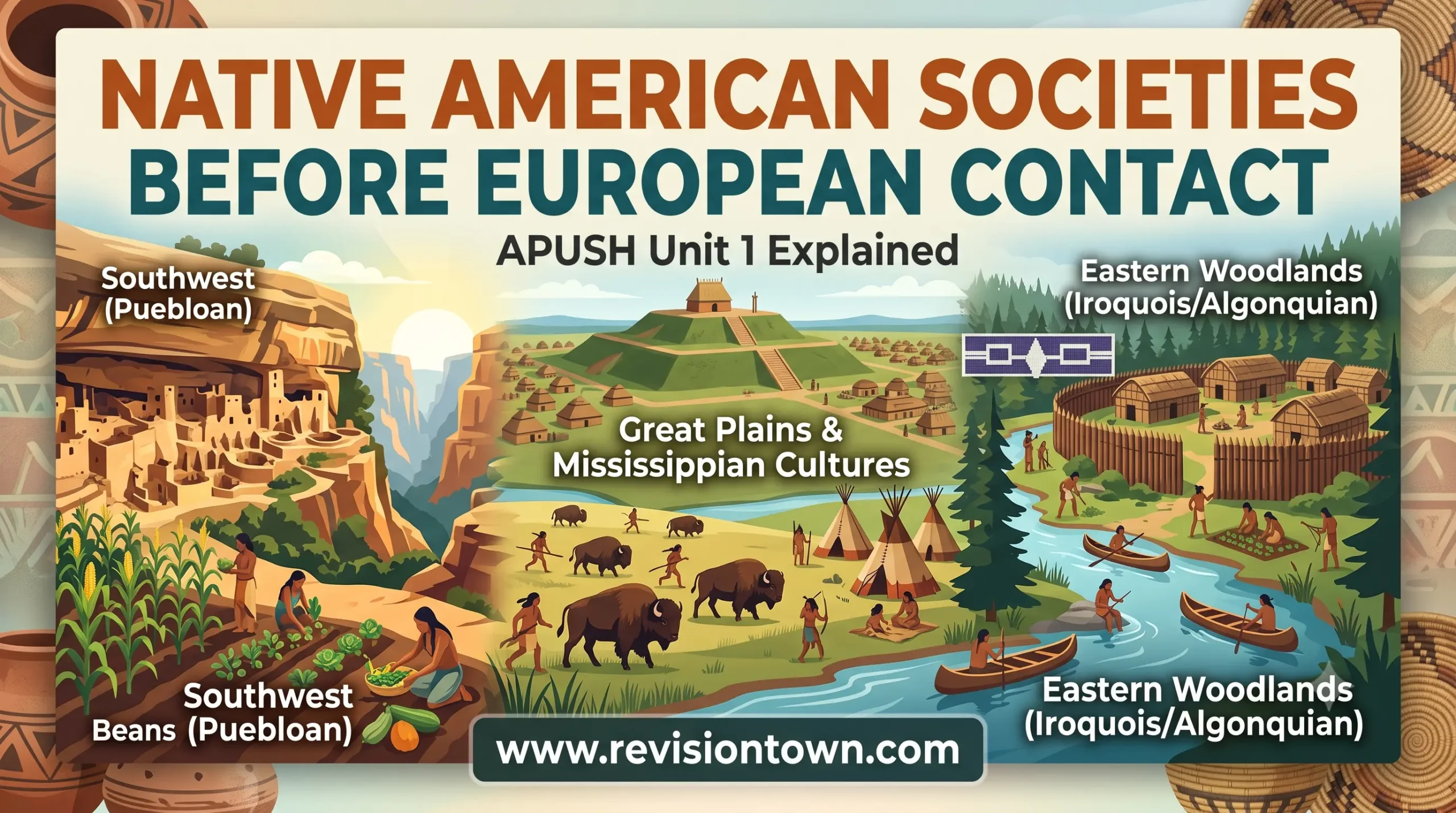
Native American societies varied dramatically based on geography and available resources, creating distinct cultural regions across North America. In the Southwest, groups like the Pueblo peoples (including the Ancestral Puebloans or Anasazi) adapted to arid conditions by developing sophisticated irrigation systems and constructing multi-story adobe dwellings in cliff faces and valleys. They cultivated maize, beans, and squash using the "Three Sisters" agricultural method, which allowed these crops to support each other symbiotically. The region's challenging environment encouraged sedentary agricultural communities with complex religious practices centered on rain and fertility.

The Great Plains were home to both sedentary agricultural villages along river valleys and nomadic hunting groups who followed buffalo herds. Before European contact introduced horses, Plains peoples hunted on foot using techniques like buffalo jumps (driving herds over cliffs). Groups like the Mandan and Hidatsa established permanent villages with earth lodge homes and practiced agriculture, while others maintained more mobile lifestyles. The Great Basin region, characterized by desert and mountains, supported smaller, mobile bands who relied on hunting small game and gathering seeds, nuts, and roots. The harsh environment meant populations remained relatively small and dispersed.

In the Northeast (Eastern Woodlands), the Iroquois Confederacy represented one of the most sophisticated political organizations in pre-Columbian North America. Formed sometime between 1450 and 1600, the Confederacy united five (later six) nations in a democratic league that influenced colonial and later American governmental concepts. Northeastern societies combined agriculture—particularly the Three Sisters—with hunting, fishing, and gathering. They lived in longhouses, large communal dwellings housing multiple families, and many societies were matrilineal, tracing descent through the mother's line. Women held significant political and economic power, owning property and playing key roles in leadership selection.

The Northwest Coast, stretching from present-day Alaska to Northern California, was home to societies that thrived without agriculture due to abundant marine resources. Groups like the Chinook, Haida, and Tlingit developed complex social hierarchies, elaborate art traditions including totem poles, and potlatch ceremonies where leaders distributed wealth to demonstrate status and create social obligations. They lived in permanent villages with plank houses and developed sophisticated fishing technologies. The Southeast was characterized by the Mississippian culture, which built impressive mound complexes like Cahokia near present-day St. Louis. By 1491, Cahokia had declined, but Mississippian influence persisted in hierarchical chiefdoms like those of the Creek, Cherokee, and Natchez peoples, who practiced intensive maize agriculture and lived in towns surrounding ceremonial mounds.

Why It Matters: Historical Significance

Understanding the diversity and sophistication of pre-contact Native American societies fundamentally challenges narratives of European "discovery" and notions of indigenous "primitiveness." These societies demonstrated remarkable innovation in agriculture, with the domestication of crops like maize, potatoes, and tomatoes that would eventually transform global food systems. Their political systems, particularly the Iroquois Confederacy's democratic principles, influenced Enlightenment thinkers and American founders. The regional variations in social organization, gender roles, and economic systems reveal that there was no single "Native American" experience but rather hundreds of distinct cultures shaped by their specific environments.

This topic is foundational for understanding European-Native American encounters after 1492. Native Americans' existing trade networks, political alliances, and territorial conflicts shaped how they responded to European arrival. Their agricultural knowledge proved essential to early colonial survival, while their population density and political organization influenced patterns of colonization. Recognizing Native American complexity and agency before contact is crucial for avoiding simplistic victim narratives while still acknowledging the devastating impacts of colonization. This understanding is essential for DBQ and LEQ essays that require sophisticated analysis of colonial encounters, comparative essays on different colonial regions, and continuity and change arguments about indigenous societies.

Continuity vs. Change (CCOT)

What Changed Over Time (Pre-Contact): Native American societies underwent significant transformations in the centuries before European contact. The adoption and refinement of maize agriculture led to population growth and more complex social hierarchies, particularly in the Southwest, Southeast, and Northeast. The Mississippian culture's mound-building reached its peak at Cahokia around 1100-1200 CE before declining, possibly due to environmental degradation, disease, or political instability. The formation of the Iroquois Confederacy represented a major political innovation, creating a multi-nation alliance that reduced warfare and promoted cooperation. Climate changes, including the Medieval Warm Period and subsequent cooling, affected agricultural productivity and settlement patterns.

What Persisted: Despite these changes, fundamental patterns remained constant. The primacy of geography in shaping cultural development persisted, with environmental adaptation remaining central to Native American life. Oral tradition continued as the primary method of transmitting cultural knowledge, history, and values across generations. Spiritual beliefs emphasizing the interconnectedness of humans and nature remained foundational. Kinship networks and clan structures continued to organize social relationships and political authority. Trade networks connecting distant regions persisted for centuries, moving goods like shells, obsidian, copper, and eventually European items along established routes.

Complexity: Tensions & Historical Debates

  • Population Size Estimates: Historians and demographers vigorously debate pre-contact Native American population sizes. Estimates for North America range from 2 million to 18 million, with implications for understanding the scale of post-contact demographic catastrophe. Higher estimates suggest more complex, populous societies and greater environmental modification, while lower estimates have historically been used to minimize indigenous presence and justify colonization.
  • Environmental Impact: Scholars debate whether Native Americans were "ecological Indians" living in harmony with nature or active environmental modifiers who used fire, agriculture, and hunting to reshape landscapes. Evidence suggests indigenous peoples significantly altered environments through controlled burning, deforestation for agriculture, and large-scale hunting, challenging both the "pristine wilderness" myth and stereotypes of passive indigenous peoples.
  • Complexity vs. "Civilization": Defining which societies qualify as "complex" or "civilizations" remains contested. While societies with cities, writing systems, and centralized states are traditionally labeled civilizations, this Eurocentric framework can obscure the sophistication of societies organized differently. The Iroquois Confederacy's democratic governance or Northwest Coast potlatch economies were highly complex despite lacking written language or large cities, raising questions about how we measure societal advancement.

Key Terms & Definitions

TermMeaningWhy It Matters for DBQ/LEQ
Three Sisters AgricultureNative American farming technique growing maize, beans, and squash together; beans fix nitrogen in soil, corn provides stalks for beans to climb, squash leaves shade roots and prevent weedsPerfect evidence of Native American agricultural innovation and environmental adaptation; shows sophistication that challenges "primitive" stereotypes
Iroquois Confederacy (Haudenosaunee)Political alliance of five (later six) Northeastern nations formed around 1450-1600; used democratic principles and consensus decision-makingDemonstrates complex Native American political organization; useful for arguments about indigenous influence on American democracy
Pueblo PeoplesSedentary agricultural societies in the Southwest who built multi-story adobe structures and developed irrigation systems to farm in arid conditionsEvidence of environmental adaptation and architectural sophistication; useful for regional comparison essays
Mississippian CultureWidespread Native American culture (800-1600 CE) known for building large earthen mounds for ceremonial and residential purposes; centered at CahokiaShows hierarchical social organization and urban development in pre-contact North America; evidence of continuity and change as culture declined before European contact
CahokiaLargest pre-Columbian settlement north of Mexico (near present-day St. Louis); peaked around 1200 CE with population estimated at 10,000-20,000Concrete example of indigenous urbanism and complexity; useful for challenging narratives of indigenous primitiveness
Matrilineal SocietySocial system tracing descent and inheritance through the mother's line; common in Iroquois and other Eastern Woodlands groupsEvidence of gender role diversity across Native American societies; useful for comparison with European patriarchal systems
LonghouseLarge communal dwelling used by Iroquois and other Northeastern peoples; housed multiple related families and symbolized political unityPhysical evidence of communal social organization and kinship structures; shows contrast with European nuclear family households
PotlatchCeremonial feast practiced by Northwest Coast peoples where hosts distributed wealth to guests to demonstrate status and create social obligationsShows complex economic systems and social hierarchies without agriculture; evidence of regional diversity in Native American cultures
Great Plains Buffalo CultureNomadic and semi-nomadic societies that relied on buffalo hunting for food, tools, and materials; used techniques like buffalo jumps before horsesDemonstrates environmental adaptation and resource specialization; useful for comparison before and after European contact introduced horses
ChinookNorthwest Coast people who controlled trade along the Columbia River; developed trade jargon that became lingua franca of the regionEvidence of pre-contact trade networks and linguistic diversity; shows Native American economic sophistication
Ancestral Puebloans (Anasazi)Ancient Southwest culture (100-1600 CE) known for cliff dwellings and elaborate pueblo complexes; Mesa Verde and Chaco Canyon represent major centersShows architectural achievement and social organization; useful for discussing environmental challenges and societal decline
Maize (Corn)Domesticated crop originating in Mesoamerica; spread throughout North America and became staple crop supporting population growth and sedentary societiesCentral to causation arguments about agricultural revolution enabling population growth and complex societies; later crucial in Columbian Exchange
Kinship NetworksSystems of social organization based on family relationships, clans, and lineages; governed social behavior, political authority, and economic exchangeExplains how many Native American societies organized without European-style centralized states; shows cultural difference in political organization
Totem PolesMonumental carvings created by Northwest Coast peoples depicting family lineages, stories, and spiritual beliefsPhysical evidence of artistic sophistication and complex social hierarchies; demonstrates cultural achievements without written language

Regional Overview: Major Native American Culture Areas

🏜️ Southwest (Pueblo, Ancestral Puebloans, Apache, Navajo)

Environment: Arid deserts, mesas, canyons with limited rainfall

Economy: Maize agriculture with irrigation; cotton cultivation; pottery and basket weaving

Social Structure: Sedentary villages; clan-based organization; religious leaders held significant authority

Key Features: Multi-story adobe dwellings; kivas (ceremonial chambers); sophisticated astronomy and calendar systems

🌲 Northeast/Eastern Woodlands (Iroquois, Algonquian peoples, Huron)

Environment: Deciduous forests, lakes, rivers with moderate climate

Economy: Mixed agriculture (Three Sisters), hunting, fishing, gathering

Social Structure: Matrilineal clans; women held economic and political power; longhouse-based villages

Key Features: Iroquois Confederacy's democratic governance; wampum used in diplomacy; extensive trade networks

🌾 Great Plains (Mandan, Hidatsa, Pawnee, Sioux, Cheyenne)

Environment: Grasslands with few trees; extreme temperature variations; dominated by buffalo herds

Economy: Nomadic buffalo hunting and sedentary agriculture along rivers; trade between mobile and settled groups

Social Structure: Band organization for nomadic groups; village councils for agricultural societies

Key Features: Earth lodge villages; buffalo jump hunting; ceremonial practices like Sun Dance

🏔️ Great Basin (Ute, Paiute, Shoshone)

Environment: Desert and mountains with scarce resources and water

Economy: Hunting small game and gathering seeds, nuts, roots, and insects

Social Structure: Small, mobile family bands; flexible group membership

Key Features: Adaptation to harsh environment; minimal material culture due to mobility; seasonal migration patterns

🌊 Northwest Coast (Chinook, Haida, Tlingit, Kwakiutl)

Environment: Coastal rainforests, abundant marine resources, mild climate

Economy: Salmon fishing, whale hunting, marine resource harvesting; no agriculture due to abundant food

Social Structure: Hierarchical with nobles, commoners, and slaves; wealth-based social status

Key Features: Plank house architecture; totem poles; potlatch ceremonies; sophisticated woodworking and weaving

🌿 Southeast (Creek, Cherokee, Choctaw, Natchez, Seminole)

Environment: Humid forests, rivers, coastal areas with long growing season

Economy: Intensive maize agriculture; hunting and gathering supplemented diet

Social Structure: Hierarchical chiefdoms with hereditary leadership; temple mound complexes as political and religious centers

Key Features: Mississippian cultural influence; elaborate mound complexes; complex religious ceremonies; matrilineal clans

Historical Thinking Skills (Topic-Specific)

Causation: Geography Shapes Culture

Causes of Regional Diversity:

  • Geographic differences: Varying climates, terrain, water availability, and natural resources created distinct environmental challenges and opportunities
  • Agricultural potential: Regions with suitable conditions for maize agriculture developed sedentary societies with larger populations and more complex hierarchies
  • Resource availability: Abundant marine resources on Northwest Coast eliminated need for agriculture; buffalo herds shaped Plains culture; scarce resources in Great Basin limited population density
  • Climate patterns: Growing season length, rainfall, temperature extremes determined viable economic strategies

Effects of Environmental Adaptation:

  • Population density variations: Agricultural societies supported larger, denser populations than hunting-gathering groups
  • Settlement patterns: Resource abundance or scarcity determined whether groups remained nomadic or sedentary
  • Social complexity: Agricultural surplus enabled specialized labor, hierarchical organization, and more complex political systems
  • Cultural practices: Spiritual beliefs, art, and ceremonies reflected environmental relationships—rain dances in Southwest, salmon ceremonies on Northwest Coast
  • Trade networks: Regional specializations created interdependence, with groups trading resources unavailable in their own territories

Causal Chain Example: Adoption of maize agriculture → reliable food surplus → population growth → sedentary settlements → social stratification → need for political organization → development of complex societies like Cahokia or the Iroquois Confederacy.

Continuity & Change Over Time

AspectContinuity (What Remained Constant)Change (What Transformed)
Subsistence StrategiesHunting, gathering, and fishing remained important even in agricultural societies; environmental adaptation stayed centralAgricultural revolution (maize domestication and spread) fundamentally altered food production; allowed population growth and sedentism
Social OrganizationKinship and clan structures continued to govern social relationships; oral tradition remained primary knowledge transmission methodAgricultural surplus enabled social stratification and hierarchies; specialized roles emerged (priests, craftspeople, warriors)
Political SystemsMany societies maintained consensus-based or council-led governance; local autonomy remained valuedSome societies developed more centralized authority (Mississippian chiefdoms); Iroquois Confederacy created multi-nation alliance
Spiritual BeliefsConnection between humans and nature remained foundational; animistic beliefs and respect for natural world persistedAgricultural societies developed more elaborate ceremonialism focused on planting cycles and rain; temple mounds became religious centers
Material CultureStone tools, pottery, and weaving techniques refined but remained technologically similar; no metalworking except copper for decorationArchitecture became more sophisticated (cliff dwellings, mounds, longhouses); artistic traditions like totem poles developed

Why Patterns Persisted or Changed: Continuity resulted from successful environmental adaptations that didn't require modification and from the persistence of oral traditions preserving cultural knowledge across generations. Changes occurred when new technologies (particularly agriculture) created opportunities for population growth and social complexity, or when environmental pressures (climate change, resource depletion) forced adaptation. The absence of large domesticated animals limited transportation and agricultural potential, while geographic isolation prevented the rapid spread of innovations that characterized Eurasia's connected civilizations.

Comparison: Agricultural vs. Non-Agricultural Societies

DimensionAgricultural Societies (Southwest, Southeast, Northeast)Non-Agricultural Societies (Northwest Coast, Great Basin)
Food SourcePrimarily cultivated crops (maize, beans, squash); supplemented by hunting and gatheringNorthwest Coast: abundant marine resources (salmon, whale); Great Basin: hunting and gathering scarce desert resources
Settlement PatternSedentary villages and towns; permanent dwellings (adobe, longhouses)Northwest Coast: permanent villages due to resource abundance; Great Basin: nomadic bands moving seasonally
Population DensityHigher population density due to agricultural surplus; Cahokia reached 10,000-20,000 peopleNorthwest Coast: relatively high density despite no agriculture; Great Basin: low density due to scarce resources
Social StructureHierarchical organization with leadership based on lineage, achievement, or religious authority; specialized rolesNorthwest Coast: highly hierarchical with nobles and slaves; Great Basin: egalitarian bands with minimal hierarchy
Political OrganizationComplex systems ranging from village councils to confederacies and chiefdoms; need for agricultural coordination and surplus managementNorthwest Coast: complex leadership managing resources and potlatch; Great Basin: informal family-based leadership
Material CultureExtensive material culture including pottery, elaborate dwellings, ceremonial structures; ability to accumulate possessionsNorthwest Coast: rich material culture (totem poles, plank houses) despite no agriculture; Great Basin: minimal possessions due to mobility

DBQ/LEQ Evidence Bank

Three Sisters Agriculture

How to use: Perfect for demonstrating Native American innovation and environmental knowledge. Argue that this technique shows sophisticated understanding of nitrogen fixation and companion planting predating European agricultural science. Use for comparison essays on agricultural methods or causation essays on how agriculture enabled complex societies.

Iroquois Confederacy (Haudenosaunee)

How to use: Strong evidence of indigenous political sophistication. In DBQs about democracy or governance, argue that Iroquois democratic principles influenced American founders. Use for complexity by noting that while sophisticated, the Confederacy also engaged in warfare and territorial expansion, avoiding simplistic narratives.

Cahokia Mound Complex

How to use: Concrete evidence of Native American urbanism and societal complexity. Use to challenge "empty wilderness" narratives. For CCOT essays, discuss Cahokia's decline before European contact as evidence of indigenous historical dynamism. Useful for contextualization in essays about early colonization.

Matrilineal Kinship Systems

How to use: Essential for comparison essays on gender roles between Native American and European societies. Argue that Iroquois women's political and economic power contrasted sharply with European patriarchy. Shows diversity within Native American societies—not all groups were matrilineal.

Pueblo Cliff Dwellings (Mesa Verde)

How to use: Physical evidence of architectural sophistication and environmental adaptation. Use in essays about how geography shaped culture—discuss how arid Southwest climate necessitated irrigation and influenced settlement patterns. Shows long-term occupation and cultural continuity before Spanish contact.

Northwest Coast Potlatch Ceremonies

How to use: Evidence of complex economic and social systems without agriculture. Useful for challenging assumptions that agriculture is necessary for social hierarchy. Demonstrates regional diversity—Northwest Coast societies differed dramatically from agricultural Northeast or nomadic Great Plains.

Great Plains Buffalo Hunting Techniques

How to use: Shows environmental adaptation and resource specialization. Use in comparison essays contrasting pre-contact hunting methods (buffalo jumps) with post-contact methods (horseback hunting after Spanish introduction of horses). Demonstrates continuity and change in indigenous cultures.

Longhouses

How to use: Physical evidence of communal living and kinship structures. Argue that architectural forms reflected social values—communal longhouses contrast with European nuclear family homes. Useful for discussing how material culture reflects social organization.

Maize Domestication and Diffusion

How to use: Central to causation arguments about agricultural revolution. Trace how maize spread from Mesoamerica throughout North America over centuries, enabling population growth and cultural complexity. Later crucial in Columbian Exchange essays as maize became global staple crop.

Mississippian Mound-Building Culture

How to use: Evidence of hierarchical political organization and religious authority. Use to argue that pre-contact Native Americans developed complex states comparable to European kingdoms. Shows continuity and change—Mississippian influence declined but persisted in Southeastern chiefdoms encountered by Spanish.

Ancestral Puebloan Irrigation Systems

How to use: Demonstrates technological innovation and communal labor organization. Argue that irrigation required coordination and planning, indicating sophisticated social organization. Use in causation essays about how technology enabled agriculture in challenging environments.

Oral Tradition and Historical Knowledge

How to use: Explains why we have limited written sources about pre-contact societies while acknowledging sophisticated knowledge transmission methods. Use for complexity by noting both strengths (preservation of cultural knowledge) and limitations (challenges for modern historical reconstruction) of oral tradition.

FAQ

Native American societies were extraordinarily diverse, with hundreds of distinct languages, cultures, and political systems adapted to vastly different environments. There was no single "Native American culture" but rather a spectrum ranging from nomadic hunter-gatherers in the Great Basin to the sophisticated urban center of Cahokia to the democratic Iroquois Confederacy to the hierarchical chiefdoms of the Northwest Coast. These societies differed in social structure (some matrilineal, some patrilineal), economy (agriculture, hunting, fishing, or combinations), political organization (from egalitarian bands to complex chiefdoms), and spiritual beliefs. This diversity was comparable to the variety found across Europe or Asia, though all shared some common features like oral tradition and spiritual connections to nature.

The Three Sisters technique is crucial because it demonstrates Native American agricultural sophistication and scientific understanding centuries before European contact. By planting maize, beans, and squash together, Native Americans created a symbiotic system where beans fixed nitrogen in the soil (fertilizing the corn and squash), corn stalks provided natural trellises for beans to climb, and squash leaves shaded the ground to retain moisture and suppress weeds. This innovation supported population growth and enabled sedentary societies throughout the Northeast, Southeast, and Southwest. For exam purposes, it's perfect evidence for arguments about indigenous innovation, environmental adaptation, and the agricultural foundations of complex societies. It also connects to later topics when Europeans adopt these crops through the Columbian Exchange.

When comparing Native American regions, focus on how geography shaped key dimensions: economy, social structure, and political organization. Start with the environmental context (climate, resources, terrain), then explain how each society adapted. For example, compare the agricultural Southwest Pueblos who developed irrigation to the non-agricultural Northwest Coast peoples who relied on salmon fishing—both developed complex, sedentary societies despite different subsistence strategies. Or contrast the hierarchical, mound-building Southeast chiefdoms with the more egalitarian Great Basin bands, explaining how agricultural surplus in one region enabled social stratification absent in the other. Always explain the reasons for differences (usually environmental) and note any surprising similarities. Use specific groups and details rather than vague generalizations.

Cahokia's decline before European arrival (around 1300-1400 CE) demonstrates that Native American history was dynamic and constantly changing, not static until Europeans arrived. The city's population peaked around 1200 CE and then dispersed, likely due to environmental degradation (deforestation, soil depletion), resource depletion (overhunting), climate change, disease, political instability, or some combination. This challenges the "frozen in time" stereotype and shows that indigenous societies experienced their own historical cycles of rise and fall. For essays, it's useful for demonstrating complexity and avoiding simplistic narratives. It also contextualizes Southeastern societies Europeans encountered—these were successors to, not identical to, Mississippian culture at its peak.

Gender roles varied significantly across Native American societies, reflecting environmental and economic factors. In many Eastern Woodlands societies like the Iroquois, matrilineal kinship systems gave women substantial political power—they controlled agricultural production, owned property, selected male leaders, and could remove chiefs from power. Women's importance in these societies stemmed from their role in agriculture. In contrast, Plains societies where hunting was central tended to be more male-dominated, though women still processed buffalo and manufactured goods. Northwest Coast societies had both male and female leaders depending on the group. This diversity is crucial for comparison essays with European societies, which were uniformly patriarchal. It also demonstrates that gender roles are culturally constructed rather than biologically determined.

This question contains Eurocentric assumptions about what constitutes "advanced" civilization. Some Native American societies did develop writing systems (Mesoamerican cultures used hieroglyphs), and North American groups used sophisticated pictographic communication and wampum belts for record-keeping. Copper metallurgy existed for decorative purposes, though iron smelting didn't develop, partly because stone tools remained effective and iron ore deposits were limited. The wheel wasn't developed not due to lack of intelligence but lack of necessity—North America lacked large domesticated animals for pulling wheeled vehicles, making wheels impractical. Without horses or oxen, humans pulling carts offered no advantage over carrying loads or using travois. This illustrates that technological development responds to environmental conditions and needs, not linear progress toward European-style technology.

Show complexity by avoiding both romanticization and denigration of indigenous societies. Acknowledge sophistication (democratic governance, agricultural innovation, architectural achievements) while recognizing that Native Americans also engaged in warfare, slavery (particularly Northwest Coast), human sacrifice (in some cultures), and environmental modification. Note that generalizations fail to capture diversity—discussing "Native Americans" as one group is like discussing "Europeans" without distinguishing English from Spanish. Explain tensions like the balance between individual autonomy and communal obligation, or between environmental sustainability and population pressure. Address historiographical debates like population size estimates or environmental impact. Connect specific evidence to larger patterns—for example, how the Iroquois Confederacy's formation represented both an innovation (multi-nation democracy) and continuity (building on existing clan structures and councils).

Practice & Additional Resources

External Resources for Deeper Study
Shares: